1. INTRODUCTION
Hi-Filter pilot plant was built for high efficiency collection of the particulate matter. It represents a combination of the two core systems, Electrostatic Precipitator (ESP) and Fabric Filter (FF), currently in wide use to collect the particulate matter from the discharge sources. This technology could be easily adapted for new installations as well as retrofits of existing ESP or FF collectors. By installing the ESP parts inside the casing the efficiency of the combine particulate control system is to be enhanced while being cost competitive with core particulate collectors.
ESP elements collect the bulk of the particulate load and remaining fine particles are then collected by means of FF. The system was initially built by install-
ing the thin blades arranged in rows inclined 45 de- grees towards discharge electrode as described in Choi et al. (2003) and Park et al. (2007). The scale up of the pilot system has been accomplished and the industrial scale system has been operated since then at three industrial sites. The manufacture of further two plants has raised the question since the manufacture cost has exceeded the predictions of the economic analysis in the development phase by expressing the worry, the system may not be sustainable in the collector market.
These concerns have led to the introduction of this stu- dy to promote a new concept of the collecting elements for the hybrid collector. In the first stage, the inclined plates from the initial layout have been replaced by installing a single corrugated. This modification is pro- jected to provide also large collection area as the array inclined collecting plates but offer more compact ar- rangement. In the final case the plain plates are install- ed instead of corrugated plates. Final objective of this
Evaluation of collection efficiency of the Hi-Filter by comparing the shape of collecting plates
Naim Hasolli*, Young Ok Park and Ho Kyung Choi
Korea Institute of Energy Research, 71-2 Jang-Dong, Yuseong-Gu, Daejeon 305-343, Korea
Abstract
Collection efficiency of electrostatic precipitator is largely dependent on the collection area of collecting plates and the shape of discharge electrode. The shape of collecting plates and discharge electrode indicate the difference in overall collection efficiency and manufacturing cost. Installing corrugated plates as collecting electrode can contribute to the reduction of particle reentrainment, large collection area and lower manufacturing cost compared with the thin blade collecting plates. Final layout predicts the replacement of the corrugated plates by installing plain plates. The economic review of the cost competitiveness due to the shape of the collecting plates finding the optimum solution is subject of this study.
Key words : Hi-Filter, Inclined plates, Corrugated plates, Plain plates, Economic review PAAR Vol. 3, No. 3-4 (2007) pp. 131~137
(사)한국입자에어로졸학회
*Corresponding author.
Tel : +82-(0)42-860-3458, E-mail : [email protected]
study stands for the new concept by incorporating the economic review and the efficiency performance tests results of the system based on which, the optimum layout for the collector will be recommended.
2. EXPERIMENT
2. 1 Experimental set up
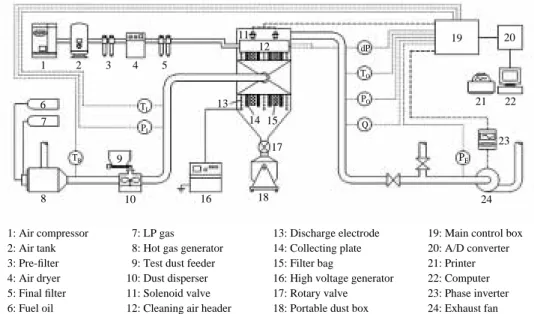
Figure 1 shows the schematic diagram of the experi- mental apparatus. It consists of several functional units as follows: a filter cleaning unit (1~5), hot-gas genera- tion and test particle feeding unit (6~10), pilot scale Hi-Filter with high voltage generator (11~18), system control and data acquisition unit (19~23), and exhaust fan (24). Hi-Filter compartment has a capacity of 1,800 m3/h with the initial layout of collecting parts.
For measuring particle size characteristics such as particle number distribution and mass concentration of the inlet and outlet of the Hi-Filter as well as the an- alysis of collection efficiency of the system, the Aero- dynamic Particle Sizer (TSI) and the additional hard- ware as well as the device software has been used.
Sample probe is chosen to match with the requirements
of isokinetic measurements at appropriate probe inlet flow velocity as described in Hinds (1982).
2. 2 Modification of collecting parts and test conditions
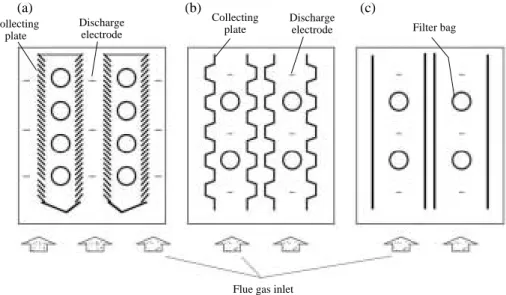
Arrangement of elements inside the Hi-Filter system is shown in Figure 2. Initially, the ESP parts are ar- ranged as horizontal wire-to-plate type in two pre- cipitating channels and the FF elements are installed inside the passage between collector plates in flow stream direction and between two discharge electrodes in cross stream direction. Discharge electrodes are of the barbed strip type. The modifications has been made by replacing the collecting electrodes which are in the initial phase as a set of thin blades (inclined plates) 1,500 mm of length and 45 degrees inclined towards discharge electrode (Figure 2(a)). The discharge elec- trode was installed first as barbed type with spikes which was later replaced by a barbed strip type. In the initial layout, the dust which is dislodged from the fabric surface will not be able to reach directly the discharge electrode, as it will have to pass through the narrow passage between two thin collecting plates first before entering the precipitation channel in the middle
Figure 1.Schematic diagram of experimental set up with the initial layout.
1 2 3 4 5
12 11
14 15
19
21 22
20
23
24 PF Q
PO
TO
TI
TB
PI
dP
13
17
16 18 10
9
8 7 6
1: Air compressor 7: LP gas 13: Discharge electrode 19: Main control box 2: Air tank 8: Hot gas generator 14: Collecting plate 20: A/D converter
3: Pre-filter 9: Test dust feeder 15: Filter bag 21: Printer
4: Air dryer 10: Dust disperser 16: High voltage generator 22: Computer 5: Final filter 11: Solenoid valve 17: Rotary valve 23: Phase inverter 6: Fuel oil 12: Cleaning air header 18: Portable dust box 24: Exhaust fan
part of which are discharge electrodes mounted. This may be helpful also for dislodging of the accumulated dust on the electrode surface, since the bulk of the dust will be collected on the front side of collecting plates which are inclined toward discharge electrode. In this case we have clear separation of collector stages: elec- trostatic precipitation stage and fabric filtration stage.
The FF bags are of the round type.
First modification introducing the layout with corru- gated plates (Figure 2(b)) is considered favorable for the large collecting area and stiffness due to the shape of the plates. At this stage, installing corrugated plates has emerged the modification of the fabric filter bags
consequently, since the arrangement of elements is different from the initial state and there is less space for 8 bags as initially designed. Another type of bags was introduced to enable the system operation at re- quired filtration velocity. Pleated type of bags provides round 2 times more filtration area than the round filter bags, so that only 4 bags are needed. In case of corru- gated plates, the arrangement is set so that collecting parts of ESP and FF installed inside the same channel.
The principle is here to engage the expansion-contrac- tion of the passage, where inside the expansion of the channel the particulate capture by means of electro- static precipitation and fabric filtration takes place in
Figure 2.Top view of the Hi-Filter with (a) initial layout, modification layout with (b) corrugated plates and (c) plain plates.
Table 1.Experimental conditions.
Conditions\Layout Initial Corrugated Plain
Discharge electrodes 3 rows (×4) 3 rows (×3) 3 rows (×3)
Collecting electrodes 4 rows (×32) 4 plates 4 plates
Fabric filter Round type Pleated type Pleated type
Fabric filter media Nomex Glass fiber++PTFE Glass fiber++PTFE
Dimensions mm (L, D) 1500, 156 1500, 156 1500, 156
Flow rate m3/min 24.5 17.5 24.5
Temperature �C 210 210 250
Test dust Fly ash++Absorb. Fly ash Fly ash
Mass median size µm 6.0 6.0 6.0
Inlet concentration g/m3 0.6 4.08 5.1
(a) (b) (c)
Collecting plate Collecting
plate
Discharge electrode Discharge
electrode Filter bag
Flue gas inlet
alternating manner. In contraction section of the pas- sage the gas flows with higher velocity and particles are adhered to collecting electrode surface before rea- ching the next expansion of the channel.
In the third stage corrugated plates are replaced by plain type collecting electrodes (Figure 2(c)). Plain plat- es have round 1.8 times less collection area than corru- gated plates. Except for the collecting electrodes, other parts of the interior arrangement remain unchanged.
This layout is almost the same as traditional wire to plate arrangement of ESP, with the difference that the FF bags are also installed inside the precipitation chan- nel.
In last two cases the discharge electrode is of the barbed strip type. It has spikes directed toward collec- ting electrode and stands perpendicular to the stream flow direction acting as a baffle plate for the entering dust laden gas stream. It can act as collecting electrode for particles charged positively and rebounded from the collecting (cold) electrode due to the back corona effect. The test with the initial layout of the HI-Filter has been made under the test conditions displayed in the Table 1. In the first case, as test dust fly ash from the heavy oil combustion with injected absorbent is used. In other two following modification cases fly ash
with mass median x50
= =6
µm was used.3. RESULTS AND DISCUSSIONS
3. 1 Pressure drop
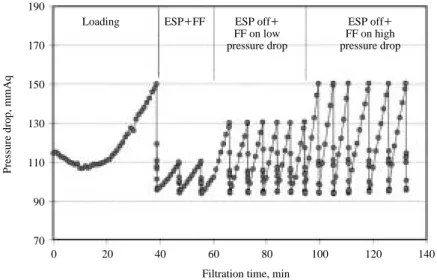
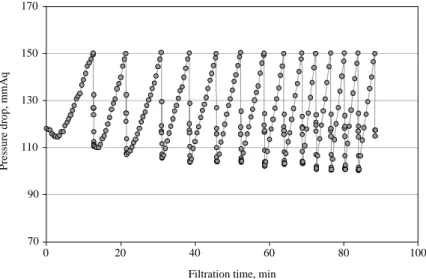
The pressure drop test of the system with two modi- fication layouts is presented in Figure 3 and 4 for the respective layout of the collecting plates.
The system has been operated first with both ESP and FF parts, as result is the extended filtration time without bag cleaning and the next stage represents the characteristics of the system running only with FF bags mounted and ESP parts without voltage induced. The pulse jet initiation pressure drop was increased from 110 to 130 and 150 mmAq to view the performance of the system at higher pressure drop values.
At the next stage the second modification of the collecting electrodes was performed and the system has been operated by engaging both ESP and FF ele- ments on particulate capture process. At this stage the pulse jet initiating pressure drop was kept constant at 150 mmAq level during the filtration time. The charac- teristics of the pressure drop for this stage are display- ed in the Figure 4. The filtration process without pulse
Figure 3.Pressure drop characteristics of the system with corrugated plates.
190
170
150
130
110
90
70
Loading ESP++FF ESP off++ ESP off++
FF on low FF on high
pressure drop pressure drop
0 20 40 60 80 100 120 140
Filtration time, min
Pressure drop, mmAq
jet cleaning of the bags is initially extended to approxi- mately 10 minutes and then later gradually decreased.
3. 2 Collection efficiency
The total collection efficiency as function of filtra- tion time is displayed in Figure 5. Different from the results for the collection efficiency, the performance of the modification with plain plates is far more reliable over the filtration time than the one with corrugated plates.
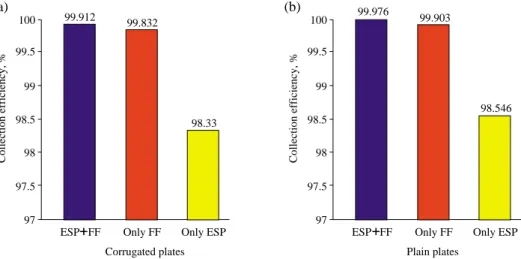
The overall collection efficiency was estimated to be 99.912% for the layout with corrugated plates (Figure
6(a)), for the given conditions without operating of ESP with only FF bags mounted round 99.832% while the efficiency of the system with ESP alone was 98.33%.
With plain plates (Figure 6(b)) installed the system has shown overall collection efficiency of 99.976%
with installed FF elements and 98.546% while ESP parts operating alone without FF bags.
3. 3 Fractional collection efficiency
The particulate capture performance of the system was evaluated by using data of the measurements with the Aerodynamic Particle Sizer (TSI) as described in section 2.1 of this paper. The fractional collection per- formance characteristics are shown in Figure 7 for the respective layout.
For these given conditions, the collection efficiency expressed in mass concentration of the outlet and the inlet of the system is above 99.99% in the particle range greater than 3µm when the system is operated with both ESP on and FF elements installed for cor- rugated plates the system shows good performance for fine particles but for particles greater than 10µm the collection efficiency deteriorates. This may be caused by the flow structure characteristics of the system with corrugated plates tending to result in turbulence inside 70
90 110 130 150 170
0 20 40 60 80 100
Filtration time, min
Pressure drop, mmAq
Figure 4.Pressure drop characteristics of the system with plain plates.
99 99.1 99.2 99.3 99.4 99.5 99.6 99.7 99.8 99.9 100
0 7 14 21 28 36 43 50
Time, min
Collection efficiency, %
Plain plates Corrugated plates
Figure 5. Collection efficiency as a function of time.
the casing due to the profile of the plates and presence of the FF bags inside the precipitation channel.
4. CONCLUSION
By elaborating the cost for the pilot plant we came to conclusion that there is possible a cost reduction by installing another type of collecting electrodes, since
the Hi-Filter, compared with a traditional baghouse, is in manufacturing cost round 37% more expensive.
Traditional baghouse is manufactured at cost of round 170,000
\/m
3. The main reason for higher manufactu- ring cost the installation of thin blades which make up the most of the increase in manufacturing cost could be identified. The replacement of these elements with cor- rugated plates has shown effective to some degree, so that after the estimation of cost, a reduction of round 9495 96 97 98 99 100
0.1 1 10 100
Particle aerodynamic diameter, µm
Fractional collection efficiency, %
Corrugated plates ESP on with FF bags
Corrugated plates ESP on without FF bags Plain plates ESP on with FF bags Plain plates ESP on without FF bags
Figure 7.Fractional collection efficiency of the system with modification layouts.
100
99.5
99
98.5
98
97.5
97
Collection efficiency, %
(a)
98.33 99.832
99.912
ESP FF Only FF Only ESP Corrugated plates
100
99.5
99
98.5
98
97.5
97
Collection efficiency, %
(b)
98.546 99.903
99.976
ESP FF Only FF Only ESP Plain plates
Figure 6.Comparison of collection efficiency between two modification layouts.
10% could be reached. The corrugated plates are pro- vided for manufacture of the system as ready made product. At the next stage, the manufacturing cost for plain plates is calculated with the cost reduction of round 30%, compared with the initial layout.
To find an optimum solution for the replacement of collecting electrodes of the HI-Filter there has been tests conducted to evaluate the collection efficiency as well as the economic review which was made to see the competitiveness of the system. From these results we can conclude as follows:
�First modification: Corrugated plates can achieve
high overall particulate collection efficiency perfor- mance, have large collection area, can capture fine particles with high collection efficiency. The system with this layout is not capable of modifying the shape since it is a ready made commercial product and the collector elements should be adjusted to cor- rugated profile and provides not such a great cost saving, since there is round 10% of the cost saved with the sacrifice of the interior space made rigid due to the shape of the plates. Viewing the fractional collection efficiency characteristics particle collec- tion efficiency deteriorates for particles greater than 10µm.�Second modification: Plain plates can provide higher
efficiency compared with the corrugated plates and are simple in manufacturing process and can be made at lower cost. The system collects fine parti- cles with poorer efficiency than with the corrugated plates and due to the plate profile provides less col-lection area.
As result of these analyses, the layout with plain plates is recommended to be adopted for the further development and installing of future plants, since it satisfies both economical and particulate collection performance criteria better than the layout with cor- rugated plates and it indicates a significant manufac- turing cost saving compared to initial layout.
ACKNOWLEDGEMENT
The research assistance received from the ECO-tec- hnopia 21 Project for this study is gratefully acknow- ledged.
REFERENCES
Choi, H.K., Kim, S.D., Son, J.E., and Park, Y.O. (2003).
Performance evaluation of a new type hybrid par- ticulate collector, proceedings of 7thinternational conference on energy for a clean environment, Lis- bon, Portugal, July.
Hinds, W.C. (1982). Aerosol technology, properties, behavior, and measurement of airborne particles, John Wiley
& Sons.
Park, Y.O., Choi, H.K., and Lim, J.H. (2007). Advanced electrostatic fabric filter system. International Con- ference & Exhibition for Filtration and Separation Technology Filtech 2007, Wiesbaden, Germany, Vol. II, pp. 96-106.