Antioxidant Activity of Rubus crataegifolius Bge. Fruit Extracts
Kyoung Mi Moon
2, Ji Eun Kim
1, Hae Young Kim
4, Jae Seol Lee
2, Gi Ae Son
1, Soo-Wan Nam
1,2,3, Byung-Woo Kim
3and Jong-Hwan Lee
1,2,3*
1
Department of Biotechnology and Bioengineering, Dong-Eui University, Busan 614-714, Korea
2
Department of Biomaterial Control, Dong-Eui University, Busan 614-714, Korea
3
Blue-Bio Regional Innovation Center, Dong-Eui University, Busan 614-714, Korea
4
Department of Nano Medical Science, Dankook University, Chungnam, 330-714, Korea
Received July 5, 2011 /Revised July 29, 2011 /Accepted August 4, 2011We investigated the fruits of Rubus crataegifolius Bge, a plant which has been traditionally used in Korea in phytotherapy, to describe antioxidant materials from plant sources. R. crataegifolius fruits were extracted with methanol and further fractionated into n-hexane, diethyl ether, and ethyl acetate.
The antioxidant activity of each fraction and the residue was assessed using a 1,1-diphenyl-2-picrylhy- drazyl (DPPH), H
2O
2radical scavenging method, and their cytotoxicity on human primary kera- tioncyte (HK) was determined by an MTS assay. The R. crataegifolius fruit methanol extract showed strong antioxidant activity (75.04%, 50%) compared with vitamin C (79.9%, 54.1%) by the DPPH, and H
2O
2method, respectively. The measured activity from the subsequent extracts of the methanol ex- tract were 20.3% for n-hexane fraction (HF), 68.8% for diethyl ether fraction (DF), 67.1% for ethyl ace- tate fraction (EF), and 67.1% for the residue fraction (RE) by DPPH and 2.2% for HF, 1.6% for DF, 10% for EF, and 50% for the RE by H
2O
2assay. An oxidative stress model of HK was established under a suitable concentration (1 mM). The cell viability of the RE treated group increased and the percentage of apoptotic cells decreased at concentrations of 0.005-0.02% RE compared with the H
2O
2treated group. Fruit extracts of the medicinal plant R. crataegifolius showed potent antioxidant activity and the ability to relieve cell damage from H
2O
2induced injury to HK.
Key words : Antioxidant activity, R. crataegifolius, fractionation, keratinocyte, skin disease
*Corresponding author
*Tel:+82-51-890-2280, Fax:+82-51-890-2632
*E-mail : [email protected]
Introduction
Many naturally substances in plants have antioxidant activities. Antioxidants from natural sources have been used to increase the stability of foods by preventing lipid oxida- tion and to protect against oxidative stress living systems by scavenging reactive oxygen species (ROS) [10]. In fact, antioxidants have been used for the food, pharmaceutical and cosmetic industries because of similar functionality re- quirements for the products.
Rubus crataegifolius Bge. belongs to family Rosaceae and distributes widely in Southeast Asian countries, especially Korea, north-eastern China, Japan, and the Ussuri region of the Russian Far East [5]. For many years, R. crataegifolius has been used to alleviate rheumatic arthritis, hepatitis and lung cancer in China [12] and its fruit is used in edible food, juice and ice cream in Korea. Some small molecules in roots or leafs of R. crataegifolius have been identified to be bioactive
phytochemicals [4,7,8,14].
However, little is known about the cytoprotective effects of R. crataegifolius fruit against oxidative stress. Oxidative stress has attracted great attention in the field of dermatology. It is believed that H
2O
2-induced oxidative con- dition of human keratinocytes (HK) can lead to many skin problems, such as vitiligo [3] and skin aging [9]. This study was undertaken in order to evaluate the antioxidant activity of R. crataegifolius fruit methanol extracts, as assessed by its ability to scavenge free radicals (DPPH, H
2O
2) and to protect HK from oxidative stress.
Materials and Methods Chemicals and reagents
The R. crataegifolius fruits used here were collected in
Kimhae, Busan, Korea on May 2009. Methanol, n-hexane, di-
ethyl ether, and ethyl acetate (Merck, Germany) were used
in fruit extraction and fractionation. DPPH (Tokyo Kasei
Kogyo, Japan) was used in the DPPH assay.
Cell culture and treatment
Normal HKs were purchased from ATCC cell bank (ATCC# PCS-200-011). HK was cultured in serum-free kera- tinocyte medium with epidermal growth factor at concen- trations of 0.2% (v/v) of bovine pituitary extract, 5 g/ml bovine insulin, 0.18 g/ml hydrocortisone, 5 g/ml bovine transferring, 0.2 ng/ml human epidermal growth factor (EGF) at 37°C in a 5% CO
2humidified atmosphere. The cul- tured HKs were randomly assigned to six groups; the con- trol group and treated groups with different concentrations, 50, 100, 250, 500, and 1,000 μM of H
2O
2(Sigma, USA) for 4 h. The proper concentration of H
2O
2was identified to es- tablish the oxidative stress model. In another set of experi- ments, HKs were randomly assigned to five groups: control, fractioned RCB extracts pretreated with final concentrations of 0.005%, 0.01%, 0.02%, 0.04%, and 0.08% + 1 mM H
2O
2, and H
2O
2without pretreatment groups. After incubated with frac- tioned RCB extracts for 4 hr, the cells were washed with cul- ture medium to remove the fractioned RCB extracts, and ex- posed to H
2O
2before being introduced into different assays.
MTS assay as a measure of cell viability
Cell viability was determined using CellTiter 96 Aqueous One Solution Reagent from Promega (Genesearch. madison, US). Briefly, cells (2×10
5) were placed in 96-well plastic cul- ture plates and incubated at 37°C in 5% CO
2for 24 hr, at which point 100 μl of 0.5 mg/ml MTS solution was added to each well and incubated for 4 hr at 37°C. Formazan ab- sorbance was read at 490 nm using a plate reader. To de- termine cell viability, the MTS assay was used with hydro- gen peroxide (H
2O
2) used as a positive control.
Extraction and solvent fractionation
One kilogram of fresh fruits of R. crataegifolius was ex- tracted with 10 l of methanol at room temperature for 24 hr, filtered using filter paper (Whatman 2; Sigma-aldrich, Germany) and the filtrate dried under vacuum by rotary evaporation, producing 177.2 g of extract. A 177.2 g portion of the extract was suspended in a ratio of 1:2 methanol:water (v/v) and partitioned into n-hexane, diethyl ether, and ethyl acetate. The rotary evaporated n-hexane, diethyl ether, ethyl acetate soluble fractions, and the water soluble residue massed 10.5 g, 3.5 g, 4.70 g, and 63.77 g, respectively.
Antioxidant assay
One mg of sample was first dissolved in 1 ml of DMSO
and used for experimentation in a concentration of 0.025%.
An assay using a DPPH radical scavenging method was per- formed as previously described by Arung et al [1]. For hy- drogen peroxide scavenging activity, RCB was added to 10 mM H
2O
2and 0.1 M phosphate buffer. The reaction mixture was pre- incubated for 5 min at 37°C. Then 1.25 mM ABTS with 30 μl peroxidase in 0.1 M phosphate buffer was added.
After those were incubated for 10 min at 37°C and then ab- sorbance was measured at 405 nm immediately. The content of hydrogen peroxide was calculated with absorbance and expressed as a percentage.
Statistical analysis
All statistical analyses were performed by SPSS13.0 soft- ware (SPSS Inc., USA). Measurement data were expressed as mean±standard deviation (SD). Differences between mul- tiple groups were analyzed by analysis of variance (ANOVA), while that between two groups were analyzed by t test. p<0.05 was considered statistically significant.
Results
Effect of RCB fruit extracts on DPPH scavenging activity To best of our knowledge, this is the first time that R.
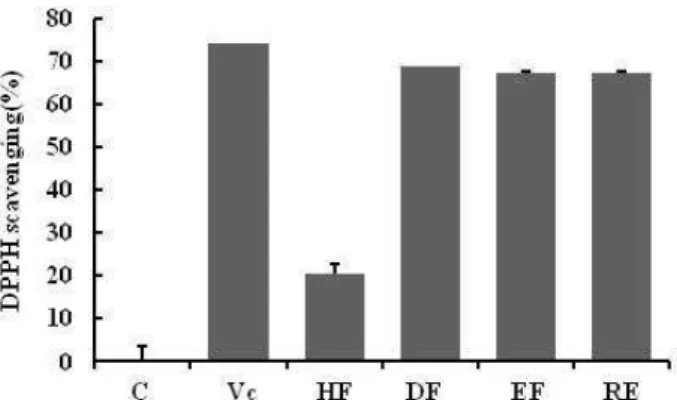
crataegifolius fruit extract has been demonstrated for DPPH antioxidant activity. The DPPH antioxidant activity of the methanol extract (75.04%) was similar than that of vitamin C (79.9% at 0.1%) as a positive control. The n-hexane layer, diethyl ether layer, ethyl acetate layer, and residue layers all represented scavenging activity (Fig. 1), with the diethyl ether layer showing scavenging activity (68.8% at 0.025%)
Fig. 1. Effect of RCB fruit extracts on DPPH scavenging activity.
C=control; Vc=vitamin C; HF=
n
-hexane fraction; DF=di- ethyl ether fraction; EF=ethyl acetate fraction; RE=resi- due fraction.Fig. 2. Effect of RCB fruit extracts on H2O2scavenging activity.
C=control; Vc=vitamin C; HF=
n
-hexane fraction; DF=di- ethyl ether fraction; EF=ethyl acetate fraction; RE=resi- due fraction.Fig. 3. Cytotoxicity of RCB methanol extract on human primary keratinocyte. DMSO=vehicle
Fig. 4. Cell viability of human primary keratinocytes (assayed by MTS). A: H2O2significantly decreased cell viability in the primary kerationocytes in a concentration-dependent manner compared with the control group (
p
<0.05). B: The cell viability increased significantly in the RE group compared with that in H2O2 group (1 mM) (p
<0.05).higher than the n-hexane (20.3%), ethyl acetate (67.1%), and residue (67.1%) layers.
Effect of RCB fruit extracts on H
2O
2scavenging activity Assessment of the H
2O
2antioxidant effect of the fractio- nated methanol extracts showed that induced scavenging ac- tivity produced effects of the n-hexane (2.2%), diethyl ether (1.6%), ethyl acetate (10%) and residue (50%) at 0.025% con- centration (Fig. 2), respectively, using for a positive control vitamin C (54.1%). This means that the water soluble fraction of RCB fruit methanol extract contained anti-oxidantor against DPPH and H
2O
2species.
Cytotoxicity of RCB methanol extract on human pri- mary keratinocyte
Assessment of the cytotoxic effect on HK showed that the RE was little cytotoxicity compared with the various concen-
tration of RE fractions (0.5%, 1%, 1.5% and 2%, respectively, Fig. 3).
Cell viability of human primary keratinocytes (assayed by MTS)
H
2O
2(50-1,000 μM) decreased the cell viability of the HK in a concentration-dependent manner (p<0.05). The cell via- bility in the 250 μM and 1,000 μM H
2O
2groups were sig- nificantly lower than in the other groups (p<0.05) (Fig. 4A).
The cell viability was increased in the RE groups compared
with the H
2O
2group (p<0.05, Fig. 4B). The cell viability in
0.005-0.02% RE groups showed a concentration-dependent
increase, but a little difference was found in the 0.04% and
0.08% groups without a statistical difference compared with
the 0.02% group (p>0.05). These results indicate that RE
could increase the cell viability compared with that in the
control group.
Discussion
Previous studies have claimed that R. crataegifolius ex- tracts have diverse pharmacological activities such as an- ti-inflammatory [4], and anti-cancer activities [8], and hep- atitis [12]. In the present study, attempts were made first to assess and compare the anti-oxidant actions of the RCB fruit extracts. The results obtained are expected to serve as information for understanding their pharmacological effects, developing new drugs from RCB fruit extracts, searching natural anti-oxidants or expanding its uses as various forms of beverages. The anti-oxidant activity of RCB extract was assessed by oxidation reactions, DPPH, H
2O
2,OH radical, TBARS oxidation and reducing power in this research. Of the 5 reactions, RCB extracts inhibited the DPPH, H
2O
2oxi- dant species. At present, we do not know the real com- pounds of RCB fruit extracts related to anti-oxidant activity.
One of raspberries, Rubus coreanus Miquel contains an abun- dance of sugars, vitamins, minerals, and polyphenols [2,13]
and was reported to have anti-inflammatory, anti- nociceptive, anti-gastropathic and anti-rheumatic effects [6,11]. The pharmacological properties of phenolic com- pounds such as caffeic acid conjugates, ellagic acid glyco- sides, and flavonol glycosides may be the major bioactive constituents responsible for antioxidant effects of RCB. As shown in Fig. 1, the result indicated that DPPH scavenging activity decreased after fractionation of the methanol extract and that compounds of the extract appeared to work synerg- istically to produce the overall methanol extract scavenging activity. In Fig. 2, these results indicate that the extract could be described as an industrial applicator such as cosmetics, drug development and tonic material. Further experiments are in progress to clarify the active phytochemical in these extracts. In conclusion, it is shown in this study that H
2O
2can damage HK and cause cell apoptosis. RE fraction is an efficient reagent able to prevent HK oxidative damage in- duced by H
2O
2exposure when used at certain concentrations. We do not know whether this action can oc- cur in the clinical use of these extracts. Although we do not know its meaning or significance now, however, the anti-ox- idant activity of these plants may be new information we should pay attention to. Considering the present results, RCB fruit methanol extract was found to be a good, potential candidate for future use as an antioxidant and industrial cos-
metic materials in the treatment of oxidative damage related skin disease.
Acknowledgments
This work was supported by a grant from Blue-Bio Industry RIC at Dong Eui University as a RIC program of KIAT under Ministry of Knowledge Economy, Korea.
Coauthors of K. M Moon and J. S Lee were the recipients of graduate fellowships from the Ministry of Education through the Brain Korea 21 Project.
References
1. Arung, E. T., K. Shimizu, and R. Kondo. 2006. Inhibitory effect of Artocarpanone from
Artocarpus heterophyllus
on melanin biosynthesis.Biol. Pharm. Bull.
29, 1966-1969.2. Bushman, B. S., B. Phillips, T. Isbell, B, Ou., J. M. Crane, and S. J. Knapp. 2004. Chemical composition of craneberry (Rubus spp.) seeds and oils and their antioxidant potential.
J. Agric. Food Chem.
52, 7982-7987.3. Bondanza, S., R. Maurelli, P. Paterna, E. Migliore, F. D.
Giacomo, G. Primavera, E. Paionni, E. Dellambra, and L.
Guerra. 2007. Keratinocyte cultures from involved skin in vitiligo patients show an impaired in vitro behaviour.
Pigment Cell Res.
20, 288-300.4. Cao, Y., Y. Wang, H. Jin, A. Wang, M. Liu, and X. Li. 1996.
Anti-inflammatory effects of alcoholic extract of roots of Rubus crataegifolius Bge
. Zhongguo Zhong Yao Za Zhi
21, 687-6885. Chinese Academy of Science China flora Editorial board, Traditional Chinese. Medicine Flora, Science Press: Beijing, 1985, pp. 117.
6. Erdemoglu, N., E. Kupeli, and E. Yesilada. 2003. Anti-in- flammatory and antinociceptive activity assessment of plants used as remedy in Turkish folk medicine.
J.
Ethnopharmacol.
89, 123-129.7. Jung, S. W., M. H. Shin, J. H. Jung, N. D. Kim, and K. S.
Im. 2001. A triterpene glucosyl ester from the roots of Rubus crataegifolius.
Arch. Pharm. Res.
24, 412-415.8. Lee, J. H., Y. A. Ham, S. H. Choi, E. O. Im, J. H. Jung, K.
S. Im, D. K. Kim, Y. Xu, M. W. Wang, and N. D. Kim. 2000.
Activity of crude extract of Rubus crataegifolius roots as a potent apoptosis inducer and DNA topoisomerase I inhibitor.
Arch. Pharm. Res
. 23, 338-343.9. Lu, C.Y., H. C. Lee, H. J. Fahn, and Y. H. Wei. 1999.
Oxidative damage elicited by imbalance of free radical scav- enging enzymes is associated with large-scale mtDNA dele- tions in aging human skin.
Mutat. Res
. 423, 11-21.10. Moure, A., J. M. Cruz, D. Franco, J. M. Domínguez, J. Sineiro, H. Domínguez, and M. J. Núñez, and J. Carlos Parajó. 2001.
Natural antioxidants from residual sources.
Food Chem.
72, 145-171.초록: Rubus crataegifolius Bge. 열매 추출물의 항산화 활성
문경미
2․김지은
1․김해영
4․이재설
2․손기애
1․남수완
1,2,3․김병우
3․이종환
1,2,3*
(
1동의대학교 공과대학 생명공학과,
2동의대학교 바이오물질제어학과,
3동의대학교 블루바이오센터,
4단국대
학교 나노의과학과)
식물자원으로부터 항산화 물질을 확보 하기위해 한국 등에서 전통적으로 phytotherapy로 이용되어 온 Rubus
crataegifolius Bge. 열매를 조사하였다. R. crataegifolius의 열매를 메탄올로 추출하였고 순차적으로 n-hexane, di- ethyl ether, and ethyl acetate로 분획화하였다. 각 분획물의 항산화 활성은 DPPH와 H
2O
2에 대항 인간 primary 세포인 keratinocyte (HK)를 이용하여 세포 독성 및 효능을 검증하였다. R. crataegifolius 열매 추출물은 비타민 C와 비슷한 강력한 DPPH (75.04%, 50%)와 H
2O
2(79.9%, 54.1%) 소거능을 보였다. 분획물의 DPPP에 대한 소거능 을 측정하였는데 n-hexane fraction (HF)은 20.3% , diethyl ether fraction (DF)은 68.8%, ethyl acetate fraction (EF)는 67.1% 그리고 residue fraction (RE)은 67.1%의 소거능을 보였으며 H
2O
2에 대해서는 2.2%, 1.6%, 10%, 그
리고 50%로 각각 나타내었다. H
2O
2에 대한 HK의 세포 보호능을 확인하기 위해 산화적 스트레스 모델을 확립하
였고(1 mM) 0.005-0.02%의 RE 분획물에서 H
2O
2에 대한 보호능을 발휘하였다. 따라서, R. crataegifolius의 열매 추
출물은 H
2O
2유발 상처에 대하여 HK세포의 보호능을 가지며 강력한 항산화 활성을 가지고 있다.
11. Nam, J. H., H. J. Jung, J. Choi, K. T. Lee, and H. J. Park.
2006. The anti-gastropathic anti-rheumatic effect of ni- ga-ichigoside F(1) and 23-hydroxytormentic acid isolated from the unripe fruits of Rubus coreanus in a rat model.
Biol. Pharm. Bull.
29, 967-970.12. Ni, W., X. Zhang, H. Bi, J. Iteku, L. Ji, C. Sun, J. Fang, G.
Tai, Y. Zhou, and J. Zhao. 2009. Preparation of a glucan from the roots of Rubus crataegifolius Bge. and its immuno- logical activity.
Carbohydr. Res.
344, 2512-2518.13. Siriwoharn, T,, R. E. Wrolstad, C. E. Finn, and C. B. Pereira.
2004. Influence of cultivar, maturity, and sampling on black- berry (Rubus L. Hybrids) anthocyanins, polyphenolics, and antioxidant properties.
J. Agric. Food Chem.
52, 8021-8030.14. Weihua, N. I., Z. Xu, B. Hongtao, I. Jeff, J. Li, S. Chengxin, F. Jinbo, T. Guihua, Z. Yifa, and Z. Jimin. 2009. Preparation of a glucan from the roots of