1523
ⓒ The Korean Society of Food Science and Technology
Antioxidant and Cytoprotective Activity of Castor-aralia
(Kalopanax
pictus) Leaves
Weicheng Hu, Seong-Il Heo, and Myeong-Hyeon Wang*
School of Biotechnology, Kangwon National University, Chuncheon, Gangwon 200-701, Korea
Abstract The present study was to investigate the in vitro antioxidant potential of hot water extract and its fractions from dichloromethane (CH2Cl2), ethyl acetate (EtOAc), n-butanol (n-BuOH), and water (H2O) of castor-aralia (Kalopanax pictus)
leaves using different antioxidant tests. Among these crude extract and fractions, EtOAc fraction exhibited higher antioxidant potency than others in1,1-diphenyl-2-pricylhydrazyl (DPPH) free radical scavenging, reducing power assay, and reactive oxygen species (ROS) scavenging activity. However, CH2Cl2 fraction showed higher hydroxyl radical scavenging and DNA damage
protective activity. This work demonstrates the potential of castor-aralialeaves as antioxidant functional food ingredients. Keywords: antioxidant, castor-aralia(Kalopanax pictus)leaf, DNA damage, reactive oxygen species, total phenolics
Introduction
Free radicals and active oxygen in the form of hydroxyl radicals (·OH), superoxide anions (O2−), hydrogen peroxide
(H2O2), and singlet oxygen (O2) are produced continuously
in the cells of the human body (1,2). Oxidation is essential in living organisms to obtain the energy needed for biological processes. However, excessively high levels of free radicals or reactive oxygen species (ROS) create oxidative stress, which leads to a variety of biochemical and physiological lesions and results in metabolic impairment and cell death (3,4). Although most organisms possess antioxidant defense and repair systems, their functions are limited, especially under conditions of severe oxidative stress (5). Epidemiological evidence indicates that the consumption of foodstuffs containing antioxidant phytochemicals is advantageous for health, since they can inhibit the polymerization chain initiated by free radicals and other subsequent oxidizing reactions (6). Several synthetic antioxidants, such as butylated hydroxyanisole (BHA), butylated hydroxytoluene (BHT), and tert-butylhydroquinone
(TBHQ), are commercially available, but their applications are restricted due to potential risks related to health (7). Plants contain a variety of free radical scavenging molecules such as phenolic compounds, nitrogen compounds, vitamins, terpenoids, and other endogenous metabolites that are rich in antioxidant activity (8). Therefore, the development of natural antioxidant from plant species, especially edible plant, is in progress.
Korean food has diverse plant products of its agriculture; in addition there are many wild food plants that are gathered from its fields and forests (9). In Korea, wild edible plants are either eaten raw, boiled, fried in oil, or baked to be served as dishes.
Castor-aralia(Kalopanax pictus), a deciduous tree in the
family Araliaceae is distributed mainly in Asian countries (10). Its bark and stem possesses a variety of biological activities, including anti-diabetic, cytotoxic, anti-fungal, and anti-inflammatory activities (11-13). And, the leaves of castor-aralia are being used as vegetable or a functional food in Korean society (14).
The previous research on castor-aralia has been conducted mainly using stem and bark samples (15,16); thus, little information is available regarding the leaves of castor-aralia. To date, antioxidant activity of its organic soluble fractions, such as, dichloromethane (CH2Cl2), ethylacetate
(EtOAc), n-butanol (n-BuOH), and the water layer of
castor-aralia have not been reported. Therefore, to investigate the potential antioxidant properties of different fractions from castor-aralialeaves, we employed the food values of castor-aralia leaf with a number of in vitro
measures, including the protective effect of the samples on free radical induced damage on plasmid DNA and RAW 264.7 cells in addition to DPPH free radical scavenging, hydroxyl radical scavenging, reducing power assay, and total phenolic measurement. It is interesting to observe the correlation between the phenolic content and antioxidant activity between the plant extracts, since phenolic compounds may contribute directly to antioxidant activity (17). Hence, correlation coefficients between phenolic content and antioxidant activity were analyzed.
Material and Methods
Chemicals and reagents 1,1-Diphenyl-2-pricylhydrazyl (DPPH), 2-deoxy-D-ribose, 7-dichlorofluorescein-diacetate
(DCFH-DA), sodium nitroprusside (SNP), α-tocopherol,
trichloroacetic acid (TCA), and BHA were purchased from Sigma-Aldrich (St. Louis, MO, USA). Thiobarbituric acid (TBA) was purchased from Alfa Aesar (Karlsruhe, Germany). RPMI medium 1640 and fetal bovine serum (FBS) were acquired from Gibco BRL (Grand Island, NY, USA). The culture supplies were obtained from SPL Brand Products (Seoul, Korea). All other chemicals were of analytical grade.
*Corresponding author: Tel: +82-33-250-6486; Fax: +82-33-241-6480 E-mail: [email protected]
Received June 10, 2009; Revised September 27, 2009; Accepted September 28, 2009
Preparation of the crude extract and fractionations
Leaves of castor-aralia collected from Chuncheon, South Korea, were dried in the shade at room temperature and then powdered. One-hundred g of the leaf powder were extracted with hot water for 3 hr. The extract was filtered through filter paper (100-mm; Whatman, Maidstone, UK) and evaporated using a vacuum rotary evaporator (CCA-1110; Eyela, Tokyo, Japan) to produce a crude extract of 15.32 g. Ten g of the crude extract was dissolved in distilled water and partitioned with CH2Cl2, EtOAc, and n
-BuOH successively to give CH2Cl2 (0.56 g), EtOAc (1.07
g), n-BuOH (2.97 g), and H2O (5.03 g) fractions after
removal of the solvents in vacuum, respectively.
Determination of the total phenolic contents The total phenolic content was determined using the Folin-Ciocalteu reagent described previously (18) with a slight modification. One mL of each sample (200µg/mL) was mixed with 1.8
mL of Folin-Ciocalteu reagent, and the solution was allowed to stand at 25oC for 5 min before the addition of
1.2 mL of a 15% sodium carbonate solution. Tannic acid (Tan) was used as the standard to create a calibration curve. The total phenolic content is expressed as mg Tan/g.
DPPH radical scavenging activity The free radical scavenging activity of the crude extract and its fractions from castor-aralia leaves was evaluated by the DPPH test as previously described (19). Briefly, 0.5 mL of 0.1 mM DPPH (in methanol) was added to a test tube containing 0.5 mL of the sample at various concentrations. The mixture was then shaken vigorously for 1 min and kept at room temperature for 30 min in the dark. The absorbance of each sample solution was measured at 515 nm using a multiplate spectrophotometer (ELx800TM; BioTek, Winooski, VT, USA).
Hydroxyl radical scavenging activity Hydroxyl radical scavenging activity was examined using the deoxyribose assay (20). The reaction mixture [0.2 mL of 10 mM FeSO4,
0.2 mL of 10 mM ethylenediamide tetraacetic acid (EDTA), 0.2 mL of 10 mM H2O2, and 0.2 mL of 10 mM
2-deoxy-D-ribose] was mixed with or without crude extract/
fractions to produce a final volume of 1 mL, then mixed with 1 mL of 0.1 M phosphate buffer (PB; pH 7.4). The mixture was incubated at 37oC for 4 hr. After incubation,
1 mL each of 2.8% TCA and 1.0% TBA were added and the mixture was heated using boiling water for 10 min. Finally, the reaction mixture was cooled on ice and centrifuged at 800×g for 10 min. The absorbance of the
supernatant was then measured at 532 nm.
DNA nicking assay The DNA nicking assay was evaluated according to the method described by Qian et al.
(21) with slight modification. Briefly, 3µL of 400µg/mL
castor-aralia leaf crude extract/fractions and 0.5µg of pBR
322 were mixed and incubated for 10 min at room temperature followed by the addition of 7µL of Fenton’s
reagent (3µL of 30% H2O2, 2µL of 5 mM FeSO4, and 2
µL of 50 mM PB). The resulting mixture (final volume 20 µL) was incubated for 30 min at 37oC. The DNA was
electrophoresed on 1% agarose gels and visualized using ethidium bromide and a Mini BIS image analysis system
(DNR Bio-Imaging Systems Ltd., Jerusalem, Israel).
Reducing power assay The reducing power was determined as described by Gupta with some modification (22). Various concentrations (1 mL of 100, 200, 300, 400, and 500µg/mL sample) were mixed with 2.5 mL of sodium
PB (0.2 M, pH 6.6) and 2.5 mL of 0.1% potassium ferricyanide, and the mixture was incubated at 50oC for 20
min. After the addition of 2.5 mL of 10% TCA, the mixture was centrifuged at 3,000×g for 10 min. The upper layer (5
mL) was mixed with 2.5 mL of distilled water and 0.5 mL of 0.1% of ferric chloride, and the absorbance was measured at 700 nm.
Cell line and cell culture RAW 264.7 cell line was purchased from the Korean Cell Line Bank (Seoul, Korea). RAW 264.7 cells were grown in RPMI 1640 medium supplemented with 10% FBS, 100 U/mL penicillin, and 100µg/mL streptomycin. Cells were incubated at 37°C in
a humidified atmosphere of 95% air and 5% CO2.
Determination of intracellular ROS Intracellular ROS induced by SNP was measured using fluorescent DCFH-DA probe. In brief, RAW 264.7 cells (100,000/well) were pre-treated with the 400 mg/mL crude/fractions for 1 hr prior to DCFH-DA (50µM) for 30 min. SNP (250µM)
was added and incubated at 37oC for 25 min. The ROS
generation was measured by flow cytometry (Becton-Dickinson, Franklin Lakes, NJ, USA) at an excitation wavelength of 485 nm and an emission of 530 nm. For each sample, 10,000 cells were analyzed using 3 replicates.
Data analysis All tests were carried out independently in triplicate (n=3). The data are expressed as the mean±
standard derivation (SD). All analyses were performed using SPSS 7.5 (SPSS Institute, Cary, NC, USA); individual comparisons were made using Tukey’s multiple range test, which was used to determine the differences between the means. p<0.01 was considered significant.
Result and Discussion
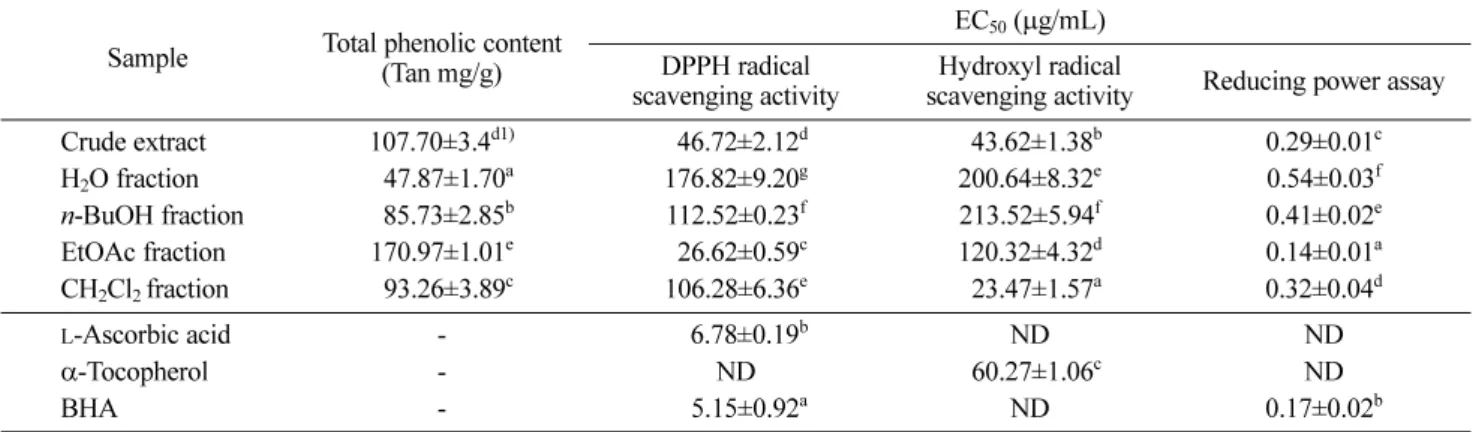
Total phenolic contents The total phenolic content in crude extract/fractions of castor-aralia leaves were determined and presented in Table 1. The total phenolic content of crude extract, H2O fraction, n-BuOH fraction,
EtOAc fraction, and CH2Cl2 fraction were 107.70, 47.87,
85.73, 170.97, and 93.26 mg Tan equivalent/g, respectively. It was noted that the EtOAc fraction had higher total phenolic content than other samples. Except H2O fraction,
which had a low phenolics content, all the other fractions showed a significantly higher phenolics content, indicating that the phenolic compounds in castor-aralia leaves were mainly soluble in organic solvents, especially ethyl acetate. This is in accordance with finding of Lo and Cheung (23). Jeong (24) had previously reported that the stem bark of castor-aralia had a 98.34 mg% dry matter of phenolics.
DPPH free radical scavenging activity Free radicals are known as the major cause of oxidative damage of biological molecules in human body, including coronary heart disease, aging, cancer, and dementia (25). DPPH has
been widely used to evaluate the free radical scavenging capacity of antioxidants. The DPPH radical scavenging activity of the bioactive compounds has been attributed to its ability to pair with the odd electron in the DPPH radical (26). The radical scavenging activity of crude extract/ fractions was shown in Table 1 and calculated as half-inhibition concentrations (EC50DPPH) values. The order of
activity was as follows: BHA (5.15µg/mL)>L-ascorbic
acid (6.78µg/mL)>EtOAc fraction (26.62µg/mL)>crude
extract (46.72µg/mL)>CH2Cl2 fraction (106.28µg/mL)
>n-BuOH fraction (112.52µg/mL)>H2O fraction (176.82
µg/mL). In this study, BHA and L-ascorbic acid were used
as the positive controls, showing the EC50 values of 5.15
and 6.78µg/mL, respectively. The results suggested that
the compounds within the EtOAc fraction were significantly strong radical scavengers. In previous studies, the bark of castor-aralia showed 57.0µg/mL of EC50 in ethanol extract
(27). However, comparing to bark of castor-aralia, the leaves of castor-aralia showed higher free radical scavenging activity.
Hydroxyl radical scavenging activity ·OH, the most reactive of all free radicals, is formed from O2− and H2O2
in the presence of metal ions(28). ·OH has the capacity to bond with the nucleotides in DNA, causing strand breakage that ultimately results in carcinogenesis, mutagenesis, and cytotoxicity (29). In addition, this species is believed to initiate the lipid peroxidation process, whereby hydrogen atoms are extracted from unsaturated fatty acids (30). The effect of each sample on the ·OH generated from Fe3+ ions
was measured based on the extent of deoxyribose oxidation, which is an indicator of TBA-malonaldehyde (MDA) adduct formation(31).
Result in Table 1 showed that CH2Cl2 fraction exhibited
stronger antioxidant activity (EC50OH=23.47µg/mL) against
·OH using the Fenton system than crude extract (EC50OH=
43.62µg/mL), H2O fraction (EC50OH=200.64µg/mL), n
-BuOH fraction (EC50OH=213.52µg/mL), and EtOAc fraction
(EC50OH=120.32µg/mL). Whereas, α-tocopherol used as a
positive control at 60.27µg/mL showed 50% hydroxyl
radical scavenging activity. This implies that CH2Cl2
fraction was more effective as a hydroxyl radical scavenger at low concentrations than the other samples or the standard antioxidant.
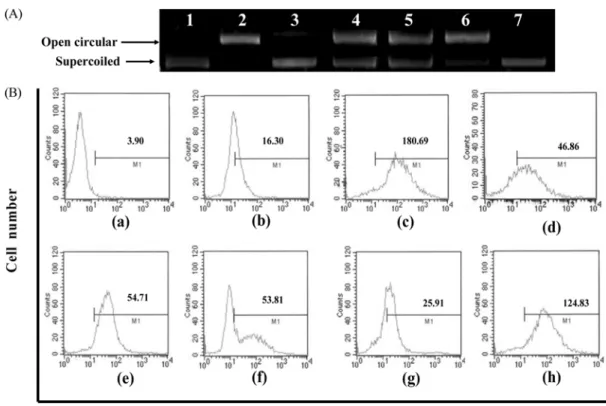
DNA nicking assay DNA is another sensitive biotarget for ROS-mediated oxidative damage. Oxidative DNA damage has been implicated in various degenerative diseases such as Parkinson’s and Alzheimer’s disease (32). Among the ROS, hydroxyl radical is considered as a DNA damaging agent of physiological significance (33). The antioxidant effect of the extracts was evaluated based on their ability to protect against hydroxyl radical-induced DNA damage in the plasmid pBR 322. The pBR 322 exists in 3 forms: supercoiled, open circular, and linear. When the plasmid was subjected to the Fenton reaction for 30 min, the intact supercoiled DNA was broken into an open circular form compared to the untreated plasmid (Fig. 1A). In the result, addition of the samples to the Fenton system resulted in a decreased conversion of supercoiled DNA to open circular. Whereas, the CH2Cl2 fraction showed higher DNA damage
protective activity compared to other samples used in the experiment. These results are consistent with our hydroxyl radical scavenging results.
Reducing power assay It has been reported that reducing activity is generally associated with the presence of reductones, which have been shown to exert an antioxidant effect by donating a hydrogen atom and thereby breaking the free radical chain (34). The reducing power of sample was revealed in Table 1. The EC50RPA (the effective
concentration at which the absorbance was 0.5) value of EtOAc fraction (0.14 mg/mL) is lower than for hot water extract (0.29 mg/mL), H2O fraction (0.54 mg/mL), n
-BuOH fraction (0.41 mg/mL), and CH2Cl2 fraction (0.32
mg/mL). However, the EC50RPA value obtained for positive
control (BHA) was 0.17 mg/mL. This result showed that EtOAc fraction has better reducing power than other samples including the positive control used in the experiment. The higher reducing ability of EtOAc fraction may be due to the high phenolic content which may act as reductones by donating electrons to free radicals.
Determination of intracellular ROS Accumulation of intracellular ROS was detected with DCFH-DA, which is freely permeable to cell membranes and deacetylated by intracellular esterases to dichlorofluroscin. Upon exposure to the ROS, dichlorofluroscin is oxidized to highly fluorescent dichlorofluroscin (35). Therefore, we applied DCFH-DA
Table 1. Total phenolic contents and free radical scavenging activity of samples from castor-aralia leaf
Sample Total phenolic content(Tan mg/g) DPPH radical EC50 (µg/mL)
scavenging activity scavenging activityHydroxyl radical Reducing power assay
Crude extract 107.70±3.4d1) 046.72±2.12d 043.62±1.38b 0.29±0.01c H2O fraction 047.87±1.70a 176.82±9.20g 200.64±8.32e 0.54±0.03f n-BuOH fraction 085.73±2.85b 112.52±0.23f 213.52±5.94f 0.41±0.02e EtOAc fraction 170.97±1.01e 026.62±0.59c 120.32±4.32d 0.14±0.01a CH2Cl2 fraction 093.26±3.89c 106.28±6.36e 023.47±1.57a 0.32±0.04d L-Ascorbic acid - 006.78±0.19b ND ND α-Tocopherol - ND 060.27±1.06c ND BHA - 005.15±0.92a ND 0.17±0.02b
as fluorescent probe to measure the intracellular oxidative activity in living cells. SNP was used to produce the oxidative stress in RAW 264.7 cells. As shown in Fig. 1B, the intracellular ROS accumulation resulting from SNP exposure was significantly increased compared with untreated cells. ROS level was decreased to the normal level in the presence of 400µg/mL EtOAc fraction. This implied that
EtOAc fraction can rapidly inhibit intracellular oxidative stress and protect RAW 264.7 cells from oxidative damage compared with other samples.
Assessment of correlation between total phenolic contents and antioxidant activity A strong positive correlation has been reported between total polyphenolic content and antioxidant capacity in some plants and fruits, since phenolic compounds contribute directly to antioxidant activity (36). A direct correlation between phenolic content and antioxidant paramenters (1/EC50DPPH , 1/EC50RPA, and1/
EC50OH) was assessed by linear regression analysis. As
shown in Table 2, the correlation coefficient (r) between
total phenolic content and antioxidant activity (1/EC50DPPH,
1/EC50RPA) are 0.953 and 0.970, respectively. It is indicated
that there is a significant positive relationship between the phenolic content and antioxidant activity of DPPH free radical scavenging and reducing power assay. On the other hand, phenolic compounds in castor-aralia leaf seemed to influence the hydroxyl radical scavenging activity weakly.
There are several reasons to explain the undefined relationship between the antioxidant activity and total phenolics: (i) total phenolic content did not incoporate all the antioxidants, such as ascorbic acid, carotenoid, and tocopherol; (ii) The synergism among the antioxidant in the sample exhibited the antioxidant activity, not only rely on the concentration of antioxidant, but also on the structure and interaction among the antioxidants; and (iii) phenolic compounds may act as antioxidants in various mechanisms: via free radical scavenging, hydrogen donation, singlet or triple oxygen quenching, metal chelating, or substrate for attack by superoxide. Therefore, different method to measure antioxidant activity with various mechanisms may lead to different observations (37).
From the above experiment, it can be concluded that the castor-aralia leaves possess strong antioxidant activity and
Fig. 1. (A) Visualization of the damage induced by hydroxyl radicals on plasmid DNA in the presence of samples from castor-aralia leaf by agarose gel electrophoresis. Line 1, DNA incubated without Fenton’s reagent; line 2, DNA incubated with Fenton’s reagent; line 3-7, DNA incubated with Fenton’s reagent in the presence of 400 µg/mLof crude extract, H2O fraction, n-BuOH fraction, EtOAc fraction, and CH2Cl2 fraction from castor-aralia leaf, respectively. (B) Flow cytometric analysis of SNP-induced ROS
production in RAW 264.7 cells. (a) Cells treated without SNP and DCFH-DA; (b) cells treated without SNP; (c) cells treated with SNP; (d) cells treated with SNP and crude extract; (e) cells treated with SNP and H2O fraction; (f) cells treated with SNP and n-BuOH fraction; (g) cells treated with SNP and EtOAc fraction; and (h) cells treated with SNP and CH2Cl2 fraction.
Table 2. Correlations established between total polyphenol contents and antioxidant activity
Antioxidant assays Equation r
DPPH free radical scavenging
activity y=3248.35x+47.223 0.953
Hydroxyl radical scavenging
activity y=56.982x+100.15 0.02
are rich in phenolic compounds. Furthermore, this research suggests that castor-aralia leaves are a good source of natural antioxidants and have positive effect on health and can be used against disease caused by oxidative stress. However, the components responsible for the antioxidant activities are unclear, further additional studies are currently underway to identify the active antioxidant compounds present in this plant.
Acknowledgments
This study was partially supported by the Research Institute of Bioscience & Biotechnology, Kangwon National University.
References
1. Chyau CC, Tsai SY, Ko PT, Mau JL. Antioxidant properties of solvent extracts from Terminalia catappa leaves. Food. Chem. 78: 483-488 (2002)
2. Karihtala P, Soini Y. Reactive oxygen species and antioxidant mechanisms in human tissues and their relation to malignancies. Apmis 115: 81-103 (2007)
3. Agarwal A, Saleh RA, Bedaiwy MA. Role of reactive oxygen species in the pathophysiology of human reproduction. Fertil. Steril. 79: 829-843 (2003)
4. Lefebvre PP, Malgrange B, Lallemend F, Staecker H, Moonen G, Van De Water TR. Mechanisms of cell death in the injured auditory system: Otoprotective strategies. Audiol. Neuro-otol. 7: 165-170 (2002)
5. Blokhina O, Virolainen E, Fagerstedt KV. Antioxidants, oxidative damage, and oxygen deprivation stress: A review. Ann. Bot. -London 91: 179-194 (2003)
6. Reiter R, Tang L, Garcia JJ, Muñoz-Hoyos A. Pharmacological actions of melatonin in oxygen radical pathophysiology. Life Sci. 60: 2255-2271 (1997)
7. Valentao P, Fernandes E, Carvalho F, Andrade PB, Seabra RM, Bastos ML. Antioxidative properties of cardoon (Cynara cardunculus L.) infusion against superoxide radical, hydroxyl radical, and hypochlorous acid. J. Agr. Food. Chem. 50: 4989-4993 (2002)
8. Cai Y, Luo Q, Sun M, Corke H. Antioxidant activity and phenolic compounds of 112 traditional Chinese medicinal plants associated with anticancer. Life Sci. 74: 2157-2184 (2004)
9. Pemeberton RW, Lee NS. Wild food plants in South Korea; market presence, new crops, and exports to the United States. Econ. Bot. 50: 57-70 (1996)
10. Choi J, Huh K, Kim SH, Lee KT, Park HJ, Han YN. Antinociceptive and anti-rheumatoidal effects of Kalopanax pictus
extract and its saponin components in experimental animals. J. Ethnopharmacol. 79: 199-204 (2002)
11. Park HJ, Kim KH, Choi JW, Park JH, Han YN. A potent anti-diabetic agent from Kalopanax pictus saponin. Arch. Pharm. Res. 21: 24-29 (1998)
12. Park HJ, Kwon SH, Lee JH, Lee KH, Miyamoto K, Lee KT. Kalopanaxsaponin A is a basic saponin structure for the anti-tumor activity of hederagenin monodesmosides. Planta Med. 67: 118-121 (2001)
13. Li DW, Lee EB, Kang SS, Hyun JE, Whang WK. Activity-guided isolation of saponins from Kalopanax pictus with anti-inflammatory activity. Chem. Pharm. Bull. 50: 900-903 (2002)
14. Park H, Nam J, Jung H, Kim W, Park K, Chung WY, Choi J. In vivo
antinociceptive antiinflamatory and antioxidative effects of the leaf and stem bark of Kalopanax pictus in rats. Korean J. Pharmacogn.
36: 318-323 (2005)
15. Park HJ, Lee KT, Jung WT, Choi JW, Kadota S. Protective effects of syringin isolated from Kalopanax pictus on galactosamine induced hepatotoxicity. Nat. Med. 53: 113-117 (1999)
16. Zhu W, Jia X, Zhang A, Zhang T, Wu Y. Advances in the research of Kalopana. Xi Bei Nong Lin Ke Ji Da Xue Xue Bao Zi Ran Ke Xue Ban 19: 119-124 (2004)
17. Javanmardi J, Stushnoff C, Locke E, Vivanco JM. Antioxdiant activity and total phenolic content of Iranian Ocimum accessions. Food Chem. 83: 547-550 (2003)
18. Kwon YI, Vattem DA, Shetty K. Evaluation of clonal herbs of Lamiaceae species for management of diabetes and hypertension. Asia Pac. J. Clin. Nutr. 15: 107-118 (2006)
19. Lu MJ, Chen C. Enzymatic modification by tannase increase the antioxidant activity of green tea. Food. Res. Int. 41: 130-137 (2008) 20. Chung SK, Osawa T. Hydroxy radical scavengers from white
mustard (Sinapis alba). Food. Sci. Biotechnol. 7: 209-213 (1998) 21. Qian Z, Jung WK, Byun HG, Kim SK. Protective effect of an
antioxidative peptide purified from gastrointestinal digests of oyster,
Crassostrea gigas against free radical induced DNA damage. Bioresource Technol. 99: 3365-3371 (2008)
22. Gupta S, Prakash J. Studies on Indian green leafy vegetables for their antioxidant activity. Plant Food. Hum. Nutr. 64: 39-45 (2009) 23. Lo KM, Cheung PCK. Antioxidant activity of extracts from the
fruiting bodies of Agrocybe aegerita var. alba. Food Chem. 89: 533-539 (2005)
24. Jeong YJ. Optimization of extraction conditions on physicochemical properties of extracts from stem barks of Kalopanax pictus. Food Sci. Biotechnol. 13: 733-738 (2004)
25. Siriwardhana N, Lee KW, Jeon YJ, Kim SH, Haw JW. Antioxidant activity of Hizikia fusiformis on reactive oxygen species scavenging and lipid peroxidation inhibition. Food. Sci. Technol. Int. 9: 339-346 (2003)
26. Heo SJ, Park EJ, Lee KW, Jeon YJ. Antioxidant activities of enzymatic extracts from brown seaweeds. Bioresource Technol. 96: 1613-1623 (2005)
27. Ahn BY. Free radical scavening effect of ethanol extract from Areca catechu. J. Korean Soc. Appl. Biol. Chem. 52: 92-95 (2009) 28. Breborowicz A. Free radicals in peritoneal dialysis: Agents of
damage? Periton. Dialysis Int. 12: 194-198 (1992)
29. Povirk LF. DNA damage and mutagenesis by radiomimetic DNA-cleaving agents: Bleomycin, neocarzinostatin, and other enediynes. Mutat. Res. 355: 71-89 (1996)
30. Girotti AW. Lipid hydroperoxide generation, turnover, and effector action in biological systems. J. Lipid Res. 39: 1529-1542 (1998) 31. Lee JC, Lim KT, Jang YS. Identification of Rhus verniciflua Stokes
compounds that exhibit free radical scavenging and anti-apoptotic properties. Biochim. Biophys. Acta 1570: 181-191 (2002) 32. Loft S, Fischer-Nielsen A, Jeding IB, Vistisen K, Poulsen HE.
8-Hydroxydeoxyguanosine as a urinary biomarker of oxidative DNA damage.J Toxicol. Env. Health 40: 391-404 (1993)
33. Je JY, Ahn CB, Oh MJ, Kang SY. Antioxidant activity of a red seaweed Polysiphonia morrowii extract. Food. Sci. Biotechnol. 18: 124-129 (2009)
34. Kumaran A, Joel Karunakaran R. Antioxidant and free radical scavenging activity of an aqueous extract of Coleus aromaticus. Food. Chem. 97: 109-114 (2006)
35. Hu C, Kwok BHL, Kitts DD. Saskatoon berries (Amelanchier alnifolia Nutt.) scavenge free radicals and inhibit intracellular oxidation. Food Res. Int. 38: 1079-1085 (2005)
36. Maisuthisakul P, Suttajit M, Pongsawatmanit R. Assessment of phenolic content and free radical-scavenging capacity of some Thai indigenous plants. Food Chem. 100: 1409-1418 (2007)
37. Lafka TI, Sinanoglou VS, Lazos ES. On the extraction and antioxidant activity activity of phenolic compounds from winery wasters. Food Chem. 104: 1206-1214 (2007)