• 검색 결과가 없습니다.

A Study on Microbiological Hazard Analysis according to the Steaming Process of Various Rice Cakes

N/A
N/A
Protected

Academic year: 2021

Share "A Study on Microbiological Hazard Analysis according to the Steaming Process of Various Rice Cakes"

Copied!
7
0
0

로드 중.... (전체 텍스트 보기)

전체 글

(1)

1. INTRODUCTION

Rice is a staple food in Korea and it can be processed in a variety of ways, such as ordinary cooked rice, porridge, and rice cake. Rice cakes called "tteok" are one of the most popu- lar of the Korean traditional food. Many types of rice cake can be prepared, via the use of different ingredients and different

manufacturing process (Kim, & Lee, 2007; Yoon, & Oh, 2014).

Rice cakes are made of raw materials such as rice, glutinous rice, potato, starch, or other cereals, which are added or cooked with salt, sugars, beans, vegetables, fruits, etc. Rice cakes are categorized as steamed and kneaded rice cakes according to the recipe method (KFDA, 2012; Lee, Doo, Kim, & Shim, 2010).

Since water activity of rice cake is 0.96 or higher, the rice cake Information available at the Culinary Society of Korea (http://www.culinary.re.kr/)

Culinary Science & Hospitality Research

Journal & Article Management System: https://cshr.jams.or.kr/

http://dx.doi.org/10.20878/cshr.2017.23.6.003

A Study on Microbiological Hazard Analysis according to the Steaming Process of Various Rice Cakes

Jung-Yun Kim

1

, Da-Hyun Park

2

and Young-Ah Rha

3

1

D ept. of Food & Nutrition, Seojeong College

2

Green Food Safety Research Institute

3
Dept. of Food Technology and Services, Eulji University

KEYWORDS ABSTRACT

Hazard Analysis(HA), Critical Control Point(CCP), Critical limit(CL), Rice cakes, Microbiological.

To guarantee the safety of rice cake production, the Hazard Analysis Critical Control Points system was applied to the production process. The purpose of this study was to analyze the microbiological hazards of the manufacture of rice cakes, and establish critical limits in the process of the manufacturing rice cakes. To control the microbiological hazards, the sterilization process was set to a critical limit. The process of manufacturing rice cakes can reduce these microbiological hazards during the steaming process. A microorganism test for each specimen was conducted three times and compared with before and after steaming processes. The finished product was conducted by microbiology experiment and the validity of the steaming process was verified. The results were determined to be capable of reducing the biological element of Critical Control Point via the steaming process. Microbiology such as aerobic plate count, coliform, Escherichia coli(E. coli), Listeria monocytogenes, Enterohemorrhagic E. coli, Salmonella spp., Bacillus cereus, Staphylococcus aureus and Clostridium perfringens was evaluated by the experimental method of Korean Food Standards Codex.

Aerobic plate count was reduced by steaming process, and no microorganism were detected. All rice cakes in the finished product were judged to be safe for both the Escherichia coli and general bacteria. In conclusion, it suggested that a HACCP plan was necessary for management standard and systematic approach in the establishment of critical limit, problem resolution, verification method, education, and records management. Based on this study, it is intended to provide a baseline for improving quality control standards and improving hygiene levels for small manu- facturers.

Corresponding author: Young-Ah Rha, Dept. of Food Technology and Services, Eulji University, Sanseong-Daero 553, Seongnam 13135, Korea, Tel.

+82-31-740-7181, E-mail: [email protected]

(2)

has a suitable condition for the rapid propagation of micro- organisms (Koh, 1999; Oh et al., 2010). Korean traditional rice cakes are generally packaged by linear low-density poly- ethylene after steaming and cooling at room temperature, and then distributed throughout markets. Recently, many con- sumers have become interested in the convenience of use and safety characteristics of food and their concerns regarding the safety of the newer ready-to-eat or microwavable food products have been increased. As the consumption of rice cakes increases, buying and eating the commercial products is increasing instead of making rice cakes at home. However, consumers eat rice cakes without a separate cooking pro- cess (No, Han, & Yoon, 2007). According to the survey of Yim and Kim (1988), the most important thing to improve the rice cake product was in hygienic care, it accounted for 37% (Yim, &

Kim, 1988). If improperly managed in manufacturing and dis- tribution processes, risk factors will increase to the risk level and then the finished product will not be able to secure safety and hygiene (Lee, & Bae, 2011). In 2010, the Korea Consumer Agency conducted a survey of 30 products that were sold in large supermarkets and traditional markets, general bacteria were detected at 2.36~6.89, Escherichia coli 1.32~4.69 and Bacillius cereus 1.38~2.48 log CFU/g (KCA, 2010). As a result, the overall sanitary condition turned out to be poor.

Hazard Analysis Critical Control Point (HACCP) is a world- recognized, effective, and preventive food hygiene manage- ment system. At present, the HACCP system has been widely adopted by many countries such as the United States, Japan, the United Kingdom, and member states of the European Union, as well as international organizations such as the World Health Organization, Food and Agriculture Organization, and Codex Alimentarius Commission (CAC). HACCP is defined as a “Food Safety Control System” in Korea (KFDA, 2009). HACCP is a further feature of the presented quality guarantee method based on standard operating procedures. It has two major components: hazard analysis and critical control. Hazard analy- sis is primarily about systematically identifying and assessing the food production process, and selecting any “biological”,

“chemical”, and “physical” characters or factors that may ren- der the food unsafe (Zhu, Yuan, & Zhang, 2003). Critical con- trol is mainly about basing on the results of hazard analysis, and formulating and managing the controllable points or pro- cedures during the process to minimize the safety hazard of final products.

Traditional quality ensuring methods, which simply require

inspecting the final products, can no longer satisfy the con- sumers' needs. Implementing HACCP is helpful in gaining con- sumers' trust and establishing a good corporate image (De- partment of Statistics, Ministry of Economic Affairs, 2012).

Moreover, many countries such as the United States, member nations of the European Union, and Japan have strict require- ments regarding food imports. The application of HACCP en- ables corporations in Korea to break down trade barriers and participate in international business, thereby effectively ex- panding their markets and increasing profits (Euromonitor International. Packaged food, 2013). Additionally, a logical and applicable HACCP plan can help food factories improve their management level and enhance their staff's safety consci- ousness.

HACCP is evaluated in the proper way to ensure the safety of food but rice cake's application for HACCP is being applied only to large company. However, the 96% of the manufac- turers of rice cakes are thought to be a small company with fewer than 10 employees and are thought seriously to be a problem with hygiene management (Jeong et al., 2012).

The purpose of this study is to analyze the microbiological hazards of the manufacture of rice cakes, and establish critical limit in the process of the manufacturing rice cakes. Based on this study, it is intended to provide a baseline for improving quality control standards and improving hygiene levels for small manufacturers.

2. MATERIALS AND METHODS

2.1. Preparation of Sample

The materials used in this study were collected by K Corpo- ration in May 2015. Each material was collected in a sterilized plastic pack to prevent secondary contamination and was transported to the sample box quickly and used for testing.

Samples for microbiological analysis have been treated asepti- cally at the clean bench, and all samples are used with sterile reagents and scissors.

2.2. Microorganisms Analyses by Manufacturing Process

It was categorized as “Tteokbokki tteok”, “Injeolmi”, “Injeol-

mi for ice flake”, “glutinous rice cake” depending on how the

rice cakes were manufactured. The overall manufacturing pro-

cess is summarized in Table 1. Different kinds of rice cakes

(3)

Order Process Microorganisms analyses

1 Raw materials

Aerobic plate count Coliform

Escherichia coli Listeria monocytogenes Enterohemorrhagic E. coli Salmonella spp.

Bacillus cereus Staphylococcus aureus Clostridium perfringens

2 Washing

3 Soaking

4 Milling & sieving

5 Mixing

6

CCP: Steaming at 100 steaming time:

‘Tteokbokki tteok’ 11 min, ‘Injeolmi’ 20 min,

‘Injeolmi’ for ice flake’ 25 min, ‘glutinous rice cake’ 30 min

7 Cooling and cutting

8 Packaging

9 Storage

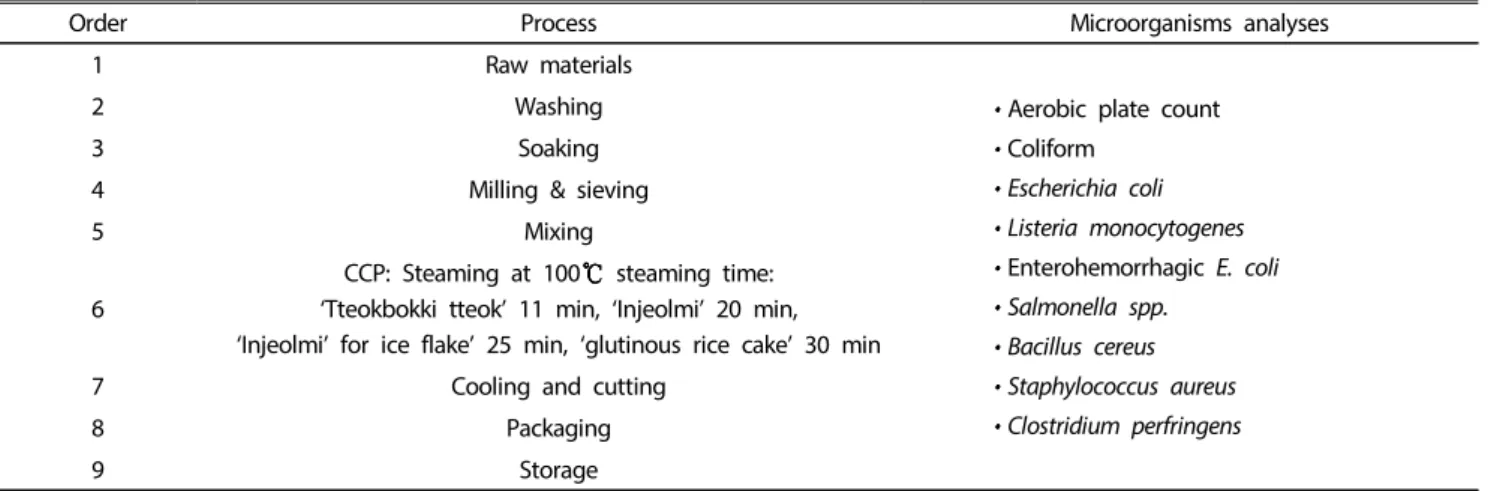
Table 1. Microorganisms analyses by manufacturing process had different steaming times (Table 1). To apply the HACCP system, all manufacturing stages should be identified from the preparation of the materials from preparation of the materials.

Microbiological hazard factors should be identified by each step of the sequence and recorded the major processing con- ditions (Food and Drug Administration, 2009; Choi et al., 2012;

Lee, 2006).

2.3. Microbiological Evaluation

Microbiology such as aerobic plate count, coliform, Escheri- chia coli (E. coli), Listeria monocytogenes, Enterohemorrhagic E.

coli, Salmonella spp., Bacillus cereus, Staphylococcus aureus and Clostridium perfringens was evaluated by the experimental method of Korean Food Standards Codex (Korea Food and Drug Administration, 2014).

2.4. Establishment of Critical Limits

To control the microbiological hazards, the sterilization process was set to a critical limits. The process of manufactu- ring rice cakes can reduce these microbiological hazards du- ring the steaming process. A microorganism test for each specimen was conducted three times and compared to before and after steaming processes. The finished product was con- ducted by microbiology experiment and the validity of the steaming process was verified.

3. RESULTS AND DISCUSSION

3.1. Changes in Number of General Bacteria and Coliform for Process of Steaming

HACCP is a systematic approach used in the food industry

for the identification, assessment, and control of biological, chemical, and physical hazards, providing an effective way to advance food quality/safety, focusing on preventing hazards and improving processes (KFDA, 2009). Critical limit is the processing requirement that needs to be fulfilled at every cor- responding control points. The HACCP system is applied in the present study as a preventive food safety approach to control the potential hazards appearing in the rice cakes (Lee,

& Kwon, 2013; Kang, Lee & Kim, 2015).

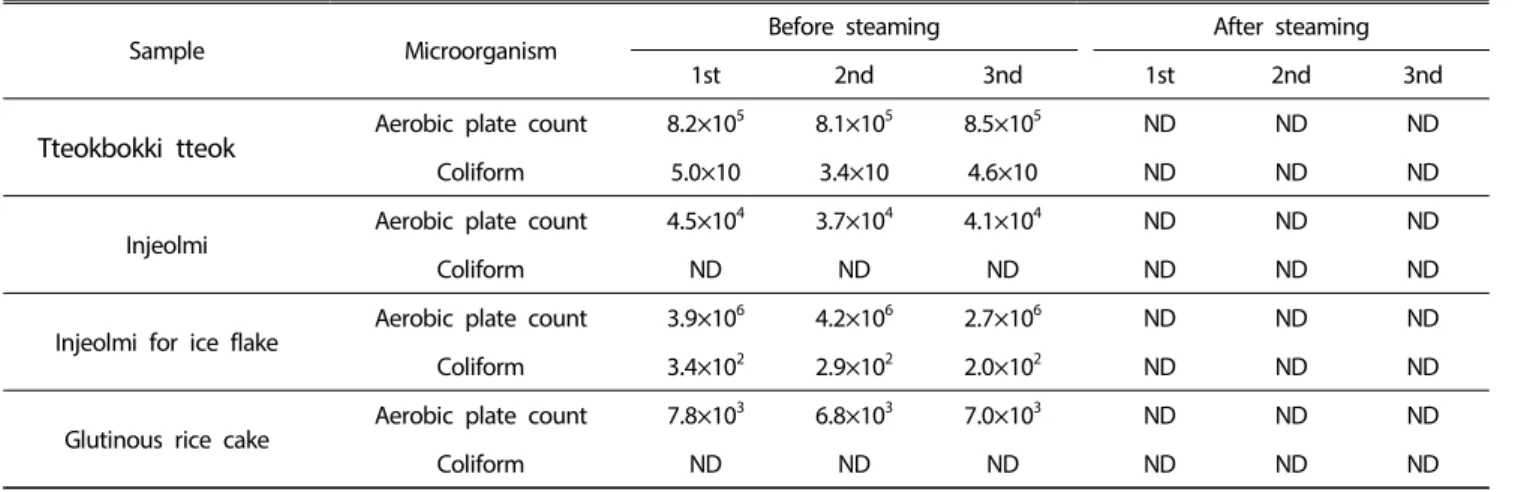
A microorganism test for each specimen was conducted tree times and compared to before and after steaming pro- cesses. The results of the changes in aerobic plate count and the E. coli. by steaming are shown in Table 2. The ‘Tteokbokki tteok’ showed that aerobic plate count ranged from 8.1×10

5

to 8.5×10

5

, ‘Injeolmi’ ranged from 3.7×10

4

to 4.5×10

4

, ‘Injeolmi for ice flake’ ranged from 2.7×10

6

to 4.2×10

6

, and ‘glutinous rice cake’ ranged from 6.8×10

3

to 7.8×10

3

. The ‘Tteokbokki tteok’ showed that coliform ranged from 3.4×10 to 5.0×10,

‘Injeolmi for ice flake’ ranged from 2.0×10

2

to 3.4×10

2

, and it was not detected in ‘Injeolmi’ and ‘glutinous rice cake’. After steaming, aerobic plate count and coliform were not detected in all kinds of rice cakes.

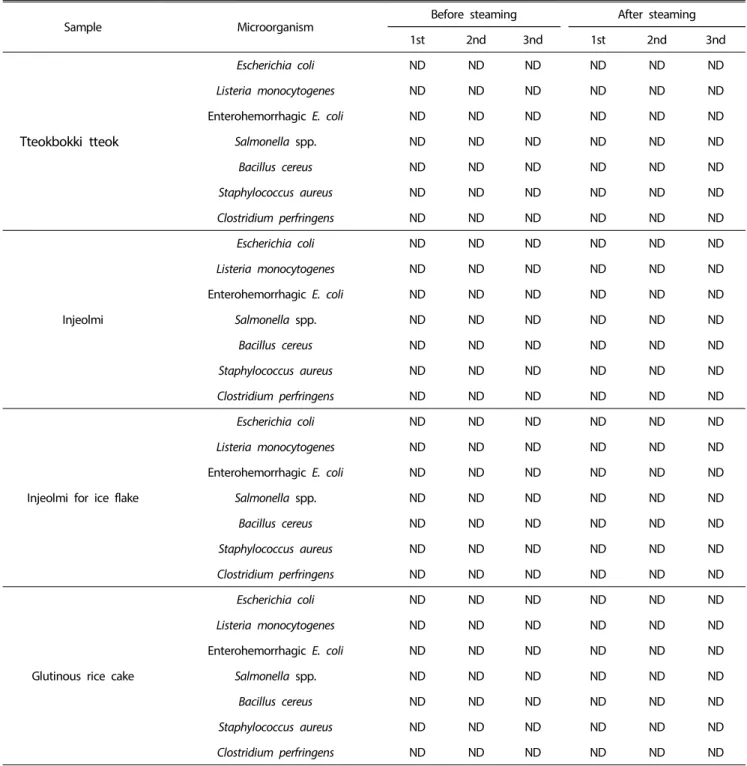
The results of the changes in pathogenic microorganisms such as E. coli, Listeria monocytogenes, Enterohemorrhagic E.

coli, Salmonella spp., Bacillus cereus, Staphylococcus aureus and Clostridium perfringens by steaming are shown in Table 3. The pathogenic microorganisms were not detected before and af- ter the steaming process in all types of rice cake. As shown in these results, all microorganisms are reduced to decrease the risk of microbiological hazards after the steaming process, so that the steaming process is judged to be a CCP.

The results of the microbiological evaluation of finished

(4)

Sample Microorganism Before steaming After steaming

1st 2nd 3nd 1st 2nd 3nd

Tteokbokki tteok Aerobic plate count 8.2×10

5

8.1×10

5

8.5×10

5

ND ND ND

Coliform 5.0×10 3.4×10 4.6×10 ND ND ND

Injeolmi Aerobic plate count 4.5×10

4

3.7×10

4

4.1×10

4

ND ND ND

Coliform ND ND ND ND ND ND

Injeolmi for ice flake Aerobic plate count 3.9×10

6

4.2×10

6

2.7×10

6

ND ND ND

Coliform 3.4×10

2

2.9×10

2

2.0×10

2

ND ND ND

Glutinous rice cake

Aerobic plate count 7.8×10

3

6.8×10

3

7.0×10

3

ND ND ND

Coliform ND ND ND ND ND ND

* Unit: CFU/g, ND : Not detected.

Table 2. Changes in number of aerobic plate count and coliform for process of steaming

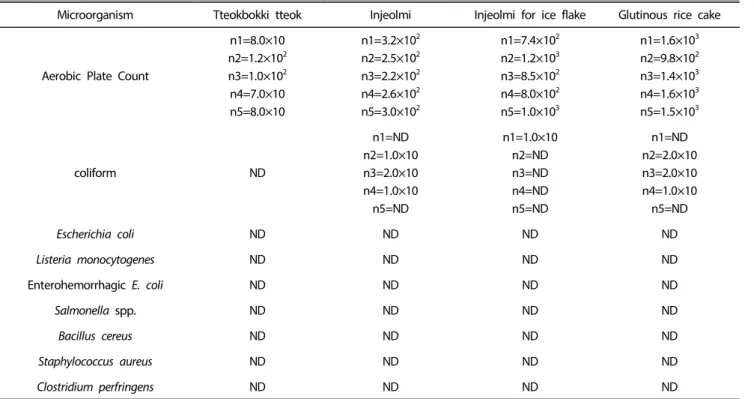
products are shown in Table 4. The rice cakes correspond to the "frozen food and rice cakes without heating in 2014- no.117 of Korean Food Standards Codex (Korea Food and Drug Administration, 2014). Based on the specifications of Korean Food Standards Codex, the rice cakes shall satisfy the following microbiological test results ; Number of bacteria : n=5, c=2, m=100,000, M=500,000, M=500,000, coliform: n=5, c=2, m=10, M=100, E. coli : n=5, c=1, m=0, M=10.

Result of analyzing microorganisms for finished products, it appeared as follows. The ‘Tteokbokki tteok’ showed that aerobic plate count ranged from 7.0×10 to 1.2×10

2

, ‘Injeolmi’

ranged from 2.2×10

2

to 3.2×10

2

, ‘Injeolmi for ice flake’ ranged from 7.4×10

2

to 1.2×10

3

, and ‘glutinous rice cake’ ranged from 9.8×10

2

to 1.6×10

3

. The ‘Injeolmi’ showed that coliform ranged from 0 to 2.0×10, ‘Injeolmi for ice flake’ ranged from 0 to 1.0×10, ‘glutinous rice cake’ ranged from 0 to 2.0×10, and it was not detected in ‘Tteokbokki tteok’. The pathogenic micro- organisms such as E. coli, Listeria monocytogenes, Enterohem- orrhagic E. coli, Salmonella spp., Bacillus cereus, Staphylococcus aureus and Clostridium perfringens were not detected in all types of rice cakes.

To control the microbiological hazards, the sterilization process was set to a critical limits. The process of manufactur- ing rice cakes can reduce these microbiological hazards du- ring the steaming process. Steaming time was set differently depending on the type of rice cake. The Steaming time was decided by 11 minutes of ‘Tteokbokki tteok’, 20 minutes of

‘Injeolmi’, 25 minutes of ‘Injeolmi for ice flake’, and 30 minutes of ‘glutinous rice cake’. The reason why steaming time varies depending on the type of rice cake is because there is a differ- ence in time between the sterilization results and the time

it does not affect the product. The steaming time specified in each product can be determined by showing the decrease in the number of microorganisms. If exceeding the specified heating time, quality of the product may deteriorate.

In order to prevent unsafe products from reaching consu- mers, a corrective action is carried out when there is a devia- tion from any established CCP. During this procedure, prob- lems will be corrected and production will be put back in control. Any unqualified product will be further tested to de- termine its safety. A complete HACCP plan also requires a ver- ification procedure, such as random sampling and testing, to examine whether HACCP can effectively control food safety.

Additionally, the implementation of the HACCP system should be well documented. Documentation usually includes the content of hazard analysis and CCP determination, and record keeping includes CCP monitoring activities, deviation and as- sociated corrective actions, and verifications. These proce- dures help to verify that HACCP controls are in place and are being appropriately maintained.

4. CONCLUSIONS

The purpose of this study is to analyze the microbiological hazards of the manufacture of rice cakes, and establish critical limit in the process of the manufacturing rice cakes. The rice cake manufacturing process was developed prior to this study.

During the manufacturing process, One of the CCPs is the

process of removing metallic debris, and the other is the pro-

cess of reducing the risk of hazardous microorganisms. This

could be determined by the CCPs such as in several studies,

which can reduce biological hazards and physical hazards

(5)

Sample Microorganism

Before steaming After steaming

1st 2nd 3nd 1st 2nd 3nd

Tteokbokki tteok

Escherichia coli ND ND ND ND ND ND

Listeria monocytogenes ND ND ND ND ND ND

Enterohemorrhagic E. coli ND ND ND ND ND ND

Salmonella spp. ND ND ND ND ND ND

Bacillus cereus ND ND ND ND ND ND

Staphylococcus aureus ND ND ND ND ND ND

Clostridium perfringens ND ND ND ND ND ND

Injeolmi

Escherichia coli ND ND ND ND ND ND

Listeria monocytogenes ND ND ND ND ND ND

Enterohemorrhagic E. coli ND ND ND ND ND ND

Salmonella spp. ND ND ND ND ND ND

Bacillus cereus ND ND ND ND ND ND

Staphylococcus aureus ND ND ND ND ND ND

Clostridium perfringens ND ND ND ND ND ND

Injeolmi for ice flake

Escherichia coli ND ND ND ND ND ND

Listeria monocytogenes ND ND ND ND ND ND

Enterohemorrhagic E. coli ND ND ND ND ND ND

Salmonella spp. ND ND ND ND ND ND

Bacillus cereus ND ND ND ND ND ND

Staphylococcus aureus ND ND ND ND ND ND

Clostridium perfringens ND ND ND ND ND ND

Glutinous rice cake

Escherichia coli ND ND ND ND ND ND

Listeria monocytogenes ND ND ND ND ND ND

Enterohemorrhagic E. coli ND ND ND ND ND ND

Salmonella spp. ND ND ND ND ND ND

Bacillus cereus ND ND ND ND ND ND

Staphylococcus aureus ND ND ND ND ND ND

Clostridium perfringens ND ND ND ND ND ND

* Unit: CFU/g, ND : Not detected.

Table 3. Changes in number of pathogenic microorganisms for process of steaming

(Kwon, 2011; Kwon, 2013). To control the microbiological ha- zards, the sterilization process was set to a critical limits. The process of manufacturing rice cakes can reduce these micro- biological hazards during the steaming process. Microbiology such as aerobic plate count, coliform, Escherichia coli (E. Coli), Listeria monocytogenes, Enterohemorrhagic E. coli, Salmonella spp., Bacillus cereus, Staphylococcus aureus and Clostridium per-

fringens was evaluated. A microorganism test for each speci-

men was conducted tree times and compared to before and

after steaming processes. The finished product was conducted

by microbiology experiment and the validity of the steaming

process was verified. To control the microbiological hazards,

the sterilization process was set to a critical limits. The process

of manufacturing rice cakes can reduce these microbiological

(6)

Microorganism Tteokbokki tteok Injeolmi Injeolmi for ice flake Glutinous rice cake

Aerobic Plate Count

n1=8.0×10 n2=1.2×10

2

n3=1.0×10

2

n4=7.0×10 n5=8.0×10

n1=3.2×10

2

n2=2.5×10

2

n3=2.2×10

2

n4=2.6×10

2

n5=3.0×10

2

n1=7.4×10

2

n2=1.2×10

3

n3=8.5×10

2

n4=8.0×10

2

n5=1.0×10

3

n1=1.6×10

3

n2=9.8×10

2

n3=1.4×10

3

n4=1.6×10

3

n5=1.5×10

3

coliform ND

n1=ND n2=1.0×10 n3=2.0×10 n4=1.0×10 n5=ND

n1=1.0×10 n2=ND n3=ND n4=ND n5=ND

n1=ND n2=2.0×10 n3=2.0×10 n4=1.0×10 n5=ND

Escherichia coli ND ND ND ND

Listeria monocytogenes ND ND ND ND

Enterohemorrhagic E. coli ND ND ND ND

Salmonella spp. ND ND ND ND

Bacillus cereus ND ND ND ND

Staphylococcus aureus ND ND ND ND

Clostridium perfringens ND ND ND ND

* Unit: CFU/g, ND : Not detected.

Table 4. Microbiological evaluation of the finished product

hazards during the steaming process. Steaming time was set differently depending on the type of rice cake. The steaming time was decided by 11 minutes of ‘Tteokbokki tteok’, 20 mi- nutes of ‘Injeolmi’, 25 minutes of ‘Injeolmi for ice flake’, and 30 minutes of ‘glutinous rice cake’. The reason why steaming time varies depending on the type of rice cake is because there is a difference in time between the sterilization results and the time it does not affect the product. The steaming time specified in each product can be determined by showing the decrease in the number of microorganisms. If exceeding the specified heating time, quality of the product may de- teriorate. It is judged that the temperature and time of the steaming process are suitable to removing pathogenic mi- croorganisms. In conclusion, it suggested that a HACCP plan was necessary for management standard and systematic ap- proach in the establishment of critical limit, problem reso- lution, verification method, education, and records manage- ment. Based on this study, it is intended to provide a baseline for improving quality control standards and improving hy- giene levels for small manufacturers. In addition to the results shown in this study, there are several important things in hy- giene management. Manufacturing facilities and equipment shall be cleaned and disinfected at regular intervals and shall be inspected for surface contamination. Analyzing the perso-

nal hygiene condition of employees is important to producing sanitary products. It is necessary to continuously manage per- sonal hygiene because it is judged that E. coli has been con- taminated indirectly by fecal matter. Food manufacturers are constantly required to undergo microbial tests, personal hy- giene education and training.

REFERENCES

Choi, S. Y., Jeong, S. H., Jeong, M. S., Park, K. H., Jeong, Y.

G., Cho, J. I., … & Chun, H. S. (2012). A monitoring for the management of microbiological hazard in rice-cake by climate change. Journal of Food Hygiene and Safety, 27(3), 301-305.

Department of Statistics, Ministry of Economic Affairs (2012).

Yearbook of industrial production statistics. Taiwan area, the Republic of China.

Euromonitor International Packaged Food. (2013). Euromonitor from trade sources/national statistics. Retrieved from Eu- romonitor Passport GMID database.

Food and Drug Administration (2009). Guidance for industry, guide to minimize microbial food safety hazard for fresh fruits and vegetables, Available from: http: csan.fda.gov.

Jeong, S. H., Choi, S. Y., Cho, J. I., Lee, S. H., Hwang, I. G., Na,

(7)

H. J., … & Ha, S. D. (2012). Microbiological contamination levels in the processing of Korea rice cakes. Journal of Food Hygiene and Safety, 27(2), 161-168.

Kang M. J., Lee H. T., & Kim J. Y. (2015). Hazard analysis, deter- mination of critical control points, and establishment of critical limits for seasoned Laver. Culinary Science & Hos- pitality Research, 21(2), 1-10.

KCA (2010). Report of result on the circulation in market of rice cake safety.

KFDA (2009). Development of general model for hazards analy- sis at a manufacturing process.

KFDA (2012). Rice-cake or Bread. Korea Food Standards Codex (Ⅰ).

Kim, C. H., & Lee, J. H. (2007). The study on the consumers' perception and purchasing behavior of rice cake as a meal. Culinary Science & Hospitality Research, 13(2), 59-68.

Koh, B. K. (1999). Development of the method to extend shelf life of Backsulgie with enzyme treatment. Korean Journal of Society of Food Science, 15, 533-538.

Korea Food and Drug Administration (2014). Korean Food Standards Codex.

Kwon, S. C. (2011). Microbiological evaluation for HACCP sys- tem application of green vegetable juice containing lac- tic acid bacteria. Journal of the Korea Academia-Industrial Cooperation Society, 12(11), 4924-4931.

Kwon, S. C. (2013). Microbiological hazard analysis for HACCP system application to vinegared pickle radishes. Journal of Food Hygiene and Safety, 28(1), 69-74.

Lee, H. S. (2006). The development of the HACCP plan in Korean rice cake manufacturing facilities (Doctoral dissertation).

Dankook University.

Lee, E. S., Doo, H. J., Kim, Y. R., & Shim, J. Y. (2010). Quality

characteristics of sulgidduk with whole wheat flour. Food Engineering Progress, 14, 146-152.

Lee, J. H., & Bae, H. J. (2011). Determining Kimbab shelf-life with a HACCP system. Korean Journal of Society of Food Cookery Science, 27, 61-71.

Lee, U. S., & Kwon, S. C. (2013). The application of the HACCP system to Korea rice-cake. Journal of the Korea Academ- ia-Industrial Cooperation Society, 14(11), 5792-5799.

Noh, K. S., Han, K. Y., & Yoon, S. J. (2007). A study on the housewives' consumption pattern and preference of the Korean rice cake as a substitute for meal. Journal of the Korean Society of Food Culture, 22(1), 10-21.

Oh, M. H., Shin, H. C., Park, J. D., Lee, H. Y., Kim, K. S., & Kum, J. S. (2010). Effect of added trehalose and enzymes on the qualities of Backsulgie. Journal of the Korean Society of Food Science and Nutrition, 39(7), 992-998.

Yoon, S. J., & Oh, I. S. (2014). Usage status of traditional rice cake as a meal substitute and analysis on the selection attributes affecting purchase. Culinary Science & Hospi- tality Research, 20(2), 38-53.

Yim, K. Y., & Kim, S. H. (1988). A survey on the utilization of Korean rice-cakes and evaluation about their commercial products by housewives. Journal of the Korean Society of Food Culture, 3, 163-175.

Zhu, J., Yuan, K., & Zhang, Y. (2003). Present status of food safety and application foreground of HACCP. Food Sci- ence, 14, 260-264.

Received:

Revised:

Accepted:

01 August, 2017

06 September, 2017

15 September, 2017

수치

Table 1. Microorganisms analyses by manufacturing processhad different steaming times (Table 1)
Table 2. Changes in number of aerobic plate count and coliform for process of steaming
Table  3. Changes in number of pathogenic microorganisms for process of steaming
Table 4.  Microbiological evaluation of the finished product

참조

관련 문서

The study derived the problems according to results of field-centered synthetic analysis on yellow croakers of fishery system currently used in Chujado, Korea

According to process analysis ‘the process of establishing peer-relationships between disabled children and non-disabled children in inclusive classeses of

S., An Experimental Study on the Cooling and Heating Performance of a Residential Ground Source Heat Pump System, Korean Journal of Air-Conditioning

The purpose of this study was to investigate the impact of social capital and positive psychology capital on the will of start-up according to experience

양성 환자에서 CNS (Coagulase-Negative Staphylococcus)균을 제외하고, Type1 환자 5명에서 Staphylococcus aureus, Escherichia coli, Acinetobacter Baumannii,

식품의 색과 갈변 (The Color of

Hagen, “The Efficacy Requirements of the Food, Drug and Cosmetic Act”, Food Drug Cosm.. Bodenheimer, “The drug Amendments of 1962 : The anatomy of a Regulatory

1 John Owen, Justification by Faith Alone, in The Works of John Owen, ed. John Bolt, trans. Scott Clark, "Do This and Live: Christ's Active Obedience as the