• 검색 결과가 없습니다.

Social Comparison Information, Ethnocentrism, National Identity Associated with Purchase Intention in China

N/A
N/A
Protected

Academic year: 2021

Share "Social Comparison Information, Ethnocentrism, National Identity Associated with Purchase Intention in China"

Copied!
12
0
0

로드 중.... (전체 텍스트 보기)

전체 글

(1)

1. Introduction

International marketers are confronted by many environmental changes. One of them is changes in the global economic environment. In the next two decades,

* First Author, Doctoral candidate, Department of International Trade, Chonbuk National University, Korea,

E-mail: [email protected].

** Corresponding Author, Associate professor, Department of International Trade, Chonbuk National University, Korea.

Tel: +82-63-270-3038, E-mail: [email protected].

*** Co Author, Assistant professor, Department of Business Administration, Kunsan National University, Korea, E-mail: [email protected]

**** Co Author, Doctoral candidate, Department of Business Administration, Chonbuk National University, Korea, E-mail: [email protected].

© Copyright: Korean Distribution Science Association (KODISA)

This is an Open Access article distributed under the terms of the Creative Commons Attribution Non-Commercial License (https://creativecommons.org/licenses/by-nc/4.0/) which permits unrestricted non-commercial use, distribution, and reproduction in any medium, provided the original work is properly cited.
another three billion people would be added to the middle class consumers exclusively from emerging markets (Ernst &

Young, 2013). Responding to this profound trend in the 21 century, international marketers are preparing for this peerless market opportunity (Cavusgil et al., 2018).

In emerging markets, the middle-class is developing and becoming the fastest-growing consumer market, which contrasts with the situation of developed countries where the middle-class is maturing or shrinking. Kharas (2016) and the Pew Research Center (2016) reported that the total middle-class’ consumption accounted for two-thirds of global spending, with only one-quarter of consumers from advanced economies. Meanwhile, international marketers are critically interested in these rapidly rising groups (Bang, Joshi, &

Singh, 2016). Thomas (2018) agreed that economic reforms, worldwide liberalization of trade, aging advanced economies, and the emergence of the middle class were the main attributors to the growth of emerging markets (Sheth, 2011).

KPMG (2014) reported that many Western firms are highly attracted to the middle class. Likewise, China has been Print ISSN: 1738-3110 / Online ISSN 2093-7717

http://dx.doi.org/10.15722/jds.17.05.201905.39

Social Comparison Information, Ethnocentrism, National Identity Associated with Purchase Intention in China

Yuantao FANG * , Han-Mo OH ** , Ki-Chang YOON *** , Zhuoqi TENG ****

Received: March 26, 2019. Revised: April 15, 2019. Accepted: May 05, 2019.

Abstract

Purpose – The purpose of our study is to provide an understanding of the relationships among consumer attention to social comparison information (ATSCI), consumer ethnocentrism (CET), national identity (NI), and consumer purchase intention to domestic brands (PIDB). Drawing on the social comparison theory (SCT) and social identity theory (SIT), we developed a model that is empirically testable and explains consumer behavior of domestic brands and products.

Research design, data, and methodology – The conceptual framework was tested with primary data collected through a survey in China. Structural equation modeling was employed to test hypotheses.

Results – The results from empirical analyses indicated that the ATSCI positively influenced CET and NI, and CET and NI affect consumer PIDB. In addition, the mediating effects of CET and NI on the relationship between ATSCI and PIDB were identified. Nonetheless, little direct impact of ATSCI on PIDB was reported.

Conclusions – We suggested that international marketers use given information to attract consumer attention and develop appropriate promotions, especially for Chinese young generations that would pay much attention to social comparison information in their purchase decisions. Our study originally connected one socio-psychological antecedent, ATSCI, with CET and NI and estimated the relationships among the three antecedents and their effects on PIDB in order to predict consumer behavior in China.

Keywords: Attention to Social Comparison Information, China, Consumer Ethnocentrism, National Identity, Purchase Intention.

JEL Classifications: F23, M16, M31.

(2)

evolving in this experience. Since 2000, the middle class of 54% of Chinese urban households had expanded two times more than the United States.

Some researchers concluded the characteristics of middle-class consumers are that they are equipped with disposable income, young, better educated, and have demands for wider products and services (Cavusgil et al., 2018; Guo, 2013; Swoboda, Pennemann, & Taube, 2012).

Boisvert and Ashill (2018) suggested that the study of Millennials, especially those young generations in their 20s, worth to be investigated in the future.

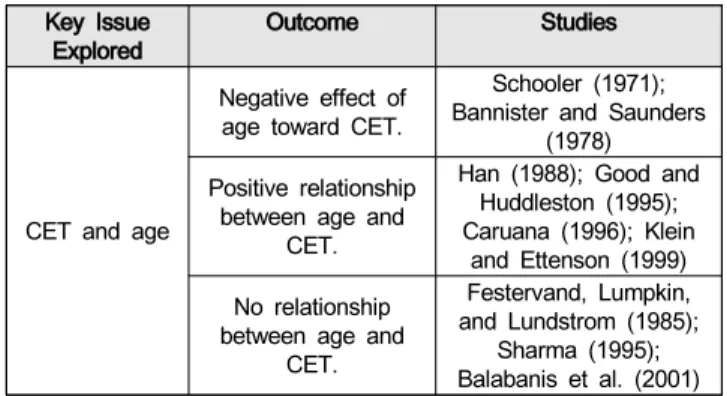
Age, as one of the demographic antecedents, disparate researchers presented different relationships between age and consumer ethnocentrism (CET). On the one hand, Schooler (1971) and Bannister and Saunders (1978) reported a negative effect of age toward CET. On the other hand, some researchers presented a positive relationship between age and CET (Han, 1988; Good & Huddleston, 1995; Caruana, 1996; Klein & Ettenson, 1999). However, Festervand, Lumpkin, and Lundstrom (1985), Sharma (1995), and Balabanis et al. (2001) found no relationship between age and CET. <Table 1> summarizes these opinions.

Table 1: Previous different opinions of the relationship between CET and age

Key Issue

Explored Outcome Studies

CET and age

Negative effect of age toward CET.

Schooler (1971);

Bannister and Saunders (1978)

Positive relationship between age and

CET.

Han (1988); Good and Huddleston (1995);

Caruana (1996); Klein and Ettenson (1999) No relationship

between age and CET.

Festervand, Lumpkin, and Lundstrom (1985);

Sharma (1995);

Balabanis et al. (2001) Based on the social identity theory (SIT), Zeugner-Roth, Žabkar, and Diamantopoulos (2015) advanced extant research by examining the predictive power of CET as anti-out-group construct, different from national identity (NI) as one pro-in-group construct on the impact of socio-psychological traits of consumer behavior. Meanwhile, Festinger (1954) pointed out that, social comparison is an automatic psychological mechanism rooted in consumer’s mind (Haferkamp & Krämer, 2011), and consumer’s attention to social comparison information (ATSCI) influences his/her attitudes, opinions, and even the behaviors towards certain objects (Mussweiler & Rüter, 2003).

Even though there some existing studies focus on the CET, NI and purchase intention, but no previous study has evaluated the joint predictive validity of consumer ATSCI, CET, and NI as drivers of consumer behavior, and thereby explicitly tested for their relative importance regarding the

direct and indirect effects on consumer’s purchase intentions for domestic brands (PIDB).

Our study draws on the social comparison theory (SCT) originally proposed by Festinger (1954) and the social identity theory (SIT) proposed by Tajfel (1974), sample with less than 30 years-old Chinese generations who are the representative middle class, focus on ATSCI, CET, and NI to explain and predict consumer behavior for domestic brand products.

Against the background, the threefold objectives of our study are as follows. First, we conceptualized ATSCI, CET, and NI drawing on SCT and SIT, proposed several hypotheses regarding these domains’ effects on PIDB while controlling for potential stimulus’ bias, and subsequently tested the hypotheses. Our study focused on young generations of Chinese avoiding the age bias of CET to developed research. Second, our study jointly investigated CET with NI as previous research (Zeugner-Roth, Žabkar, &

Diamantopoulos, 2015) presented NI as a one pro-in-group construct different from CET as an anti-out-group construct.

Third, our study presented an empirical structural equation modeling using ATSCI, CET, and NI as clustering variables, and then identified the direct and indirect effects on the relationship to the PIDB.

2. Conceptual Framework and Hypotheses

We conceptualized ATSCI, CET, NI, and PIDB. <Figure 1> shows a proposed model.

Figure 1: Proposed Model

2.1. SCT and ATSCI

The SCT was originally proposed by Festinger (1954) to understand how an individual’s self-evaluation affects social activities. Festinger (1954) argued that an individual is motivated to evaluate himself/herself to reduce uncertainty.

When objective criteria were absent, people tended to compare himself/herself with another person (comparison target) to judge his/her own ability and performance.

According to Festinger (1954), if the comparison target

(3)

(others) performs better than the individual (comparer) does, he or she will feel worse; on the contrary, if others are worse-off than him/her, individuals will feel better. Thus, two different dimensions of social comparison emerged: “upward- social comparison” and “downward social comparison”.

These two directions of social comparison were demonstrated in previous literature. Lyubomirsky and Ross (1997) found that the upward-social comparison can negatively affect self-evaluation (Morse & Gergen, 1970).

Other researchers pointed out that upward-social comparison will elicit negative emotions such as frustration (Aspinwall &

Taylor, 1993), jealousy (Salovey & Rodin, 1984), dissatisfaction with life (Emmons & Diener, 1985), depression, and discouragement (Wheeler & Miyake, 1992).

On the other hand, Wills (1981) reported that the downward-social comparison positively and significantly generates positive feelings and enhances self-evaluation (Collins, 1996; Wood, Taylor, & Lichtman, 1985).

Social comparison is an automatic psychological mechanism, and as Mettee and Riskind (1974, p.348) said, it is “effectively forced upon the individual by his social environment” (Mussweiler & Rüter, 2003), and it influences individuals’ attitudes, opinions, and even their behaviors towards certain objects. Festinger (1954) asserted that the social comparison as a psychological tendency is rooted in the mind (Haferkamp & Krämer, 2011).

Attention to Social Comparison Information (ATSCI) means the degree of person’s celerity towards collective assessment clues. Calder and Burnkrant (1977) pointed out that, based on others’ behaviors, ATSCI helps an individual in presenting oneself in a social setting. The requirement and need of social comparison differs person to person (Lennox

& Wolfe, 1984). The ATSCI scale proposed by Lennox and Wolfe (1984) attempted to measure a person’s behavior in a society and the level he/she might pay attention to social cues. A high ATSCI person is more likely to display himself/herself based on purchases compared to a low ATSCI consumer. Consumers with high ATSCI pay more attention to others’ opinions in purchasing branded products compared to low ATSCI consumers (Das & Saha, 2017).

Deval et al. (2013) pointed out that high ATSCI consumers are more open to the impact of social tolerability.

Consumers engaging in high ATSCI behavior comparatively show more concentration and interest (Berlyne, 1960; Bilkey

& Nes, 1982). Therefore, it is hypothesized that:

H1: ATSCI influences consumer purchase intention for domestic brands (PIDB) for young generations.

2.2. CET

Shimp and Sharma (1987, p. 280) constructed the CET as “beliefs held by ... consumers about the appropriateness, indeed morality, of purchasing foreign-made products”

(Zeugner-Roth, Žabkar, & Diamantopoulos, 2015), and

research on CET has been growing substantially over the past few years since the construct started (Cleveland, Laroche, & Papadopoulos, 2009; Zeugner-Roth, Žabkar, &

Diamantopoulos, 2015; Shoham & Gavish, 2016). According to Shimp and Sharma (1987), ethnocentric consumer domestic country bias was primarily based on an economic motive and normative belief that supporting domestic companies by purchasing domestic products is necessary (Verlegh, 2007; Shan Ding, 2017). Shankarmahesh (2006) employed CET construction to explain why consumers are apt to purchase their home country’s products but not foreign alternatives. In effect, ethnocentric consumers want to protect the domestic by through consuming domestic products (Sharma, 2011; Supphellen & Rittenburg, 2001).

Highly-ethnocentric consumers prefer favorite attitudes toward purchasing domestic brands and products because of economic and cultural threats from foreign brands and products (Cleveland, Laroche, & Papadopoulos, 2009;

Barbarossa, Pelsmacker, & Moons, 2018). Josiassen (2011) asserted that a particular center on CET is a preferred base of local bias to attitudes and behaviors toward products. For explaining consumer preferences for local and foreign products comprehensively, it is necessary to consider CET an extended range of consumer characteristics (Zeugner- Roth, Žabkar, & Diamantopoulos, 2015) which divides ethnocentrism into a pro-in-group construct (Balabanis &

Diamantopoulos, 2004; Sharma, Shimp, & Shin, 1994).

Even through previous studies observed the effect of CET on behaviors and attitudes towards local and alien products (Sharma, Ship, & Shin, 1994; Balabanis & Siamagka, 2017), a majority of studies focus on purchasing intentions and predicting attitudes, which cannot address actual behavior.

Furthermore, plenty of researchers pay attention to different forms of integrative measures instead of specific outcomes, like buying special brand-related products. Empirical research has concentrated on the impact of consumer ethnocentrism on the brand (Lee & Mazodier, 2015), willingness to buy local or foreign products (Zarkada-Fraser & Fraser, 2002;

Wang & Chen, 2004; Kwak, Jaju, & Larsen, 2006; Verlegh, 2007; Ranjbarian, Rojuee, & Mirzaei, 2010), evaluations of local and foreign products (Shimp & Sharma, 1987; Sharma, Shimp, & Shin, 1994; Durvasula, Andrews, & Netemeyer, 1997; Huddleston, Good, & Stoel, 2001; Wang & Chen, 2004; Verlegh, 2007; Poon, Evangelista, & Albaum, 2010;

Zeugner-Roth, Žabkar, & Diamantopoulos, 2015), and preferences (Balabanis & Diamantopoulos, 2004; Kesić, Rajh,

& Ozretić Došen, 2004; Ranjbarian, Rojuee, & Mirzaei, 2010).

However, one of the demographic antecedents, age, presented different relationships with CET. Through interviews, Schooler (1971) and Bannister and Saunders (1978) reported a negative effect of age toward CET.

However, Festervand, Lumpkin, and Lundstrom (1985)

sampled US consumers for various products (mechanical,

food, fashion, electronics, and leisure products) and reported

no relationship between age and CET. As well as, Sharma

(4)

(1995) targeted Korea, and Balabanis et al. (2001) sampled the Czech Republic and found the same results. Through a survey method, other researchers presented a positive relationship between age and CET (Han, 1988; Good &

Huddleston, 1995; Caruana, 1996; Klein & Ettenson, 1999;

Balabanis et al., 2001). Thus, it is hypothesized that:

H2: CET has a positive effect on DBPI in the young generation.

The concepts of CET and ATSCI are different with less potential for any possible relationship; still, a careful assessment of the two concepts indicates that there might be a connection. Smith (1992) viewed CET sentiments rooted in human values, and consumer decision-making also includes social considerations. CET as a major determinant affects consumer behavior (Zolfagharian, Saldivar, & Braun, 2017); the impact of CET has been always constructed using social identity theory (Tajfel, 1982; Tajfel & Turner, 1986). Siamagka and Balabanis (2015) found that CET positively and significantly influenced susceptibility to interpersonal interactions. Meanwhile, Deval et al. (2013) found that high-level ATSCI consumers were more likely to be prejudiced during purchases by social acceptability appeal. Therefore, it is hypothesized that:

H3: CET is positively affected by ATSCI in the young generation.

2.3. NI

Drawing on the SIT, Brewer (1999) found that, for consumers, in-group bias due to NI results from feelings of association with the in-group (e.g., home country), but without any explicit stimulus from out-groups (e.g., foreign country). Zeugner-Roth, Žabkar, and Diamantopoulos (2015) advanced extant research by examining the predictive power of NI as one pro-in-group construct, and CET as anti-out-group construct on the impact of socio-psychological traits of consumer behavior. Therefore, NI is fundamentally different from CET.

According to Coombes et al. (2001), NI was defined as consumers’ cultural expression of national traditions. In a given cultural context, NI represents the common cultural expression of national traditions by consumers in the same nation (Stöttinger & Penz, 2018). Müller-Peters (1998) proposed this special expression of social identity with the reference group of identity as the citizens of a nation. Blank and Schmidt (2003, p.296) said that NI refers to an inner bond with the nation as well as the importance of national affiliation and the subjective significance. Tajfel (1978) found NI indicates the extent to which consumers identify and presents a positive feeling of affiliation with the nation and the importance the consumer attaches to the feeling (Feather, 1981).

Rooted in consumer’s attachment to a nation, NI can be both positive and negative, which stretches from a sense of the explicit contra-identity as the negative identity to a positive identity (Blank, 2003). However, in most cases, NI is likely to be positive. In our study, the positive form of NI was adopted, but not the negative national identity as national disidentification presented by Josiassen (2011).

Dinnie (2002) presented that consumers may possess NI that influences purchase behavior. Moreover, Suarez and Belk (2017) suggested merging the local culture based on NI to develop a localization strategy for global firms. Thus, it is hypothesized that:

H4: NI has a positive effect on DBPI in the young generation.

H5: ATSCI has a positive effect on NI in the young generation.

3. Method

3.1. Data Collection and Sample

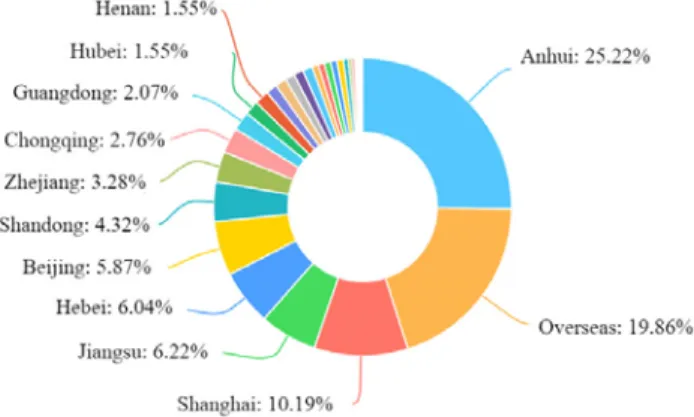
Chinese consumers are the sample of our study because China is the world’s largest emerging market (Wu & Zhou, 2018). The hypotheses were tested on Chinese generations under 30with an online survey through Wechat, an application with more than one billion monthly Chinese users. Based on prior research, the questionnaire was first developed in English; for ensuring translation equivalence, it was double-back-translated from English to Chinese to resolve inconsistencies through discussion between translators and researchers in ensuring the meaning of each item. In total, 579 completed questionnaires were collected with different locations (back-tracking the participants’ IP), ensuring the geographic diversity of the sample. <Figure 2>

displays that almost 80% of participants responding to the survey were located in China and that nearly 20% of were overseas at the time.

Figure 2: The Geographic Diversity of Total Participants

(5)

Our study primarily focused on the young generation, so those more than 30 and who failed to finish in 100 seconds were excluded. 415 usable responses were left in the final analysis. <Table 2> summarizes the demographic characteristics of the final sample with respect to age, gender, education, and location. All participants are under 30, consistent with the study requirement, and 92.3% of them were between 20 and 30 years old. Female (67.2%) respondents were more than two times greater than male (32.8%). Over 90% of respondents were slightly more educated (61.4% graduated from university, 31.6% of them with more than a master’s degree), and income was broad from less than 3000 RMB to more than 15000 RMB per month.

Table 2: Demographic Characteristics of the Sample Demographic

Variables Description Values

Age <=20 32(7.7%)

<21, <=30 383(92.3%)

Gender Male 136(32.8%)

Female 279(67.2%)

Highest Education

Middle School and Below 14(3.4%)

High School 15(3.6%)

University Bachelor(Collage Include) 255(61.4%) University Master and Higher 131(31.6%)

Income

<=3000 RMB 166(40%)

3000-6000 RMB 119(28.7%)

6000-9000 RMB 73(17.6)

9000-12000 RMB 30(7.2%)

12000-15000 RMB 11(2.7%)

>15000 RMB 16(3.9%)

3.2. Measurements

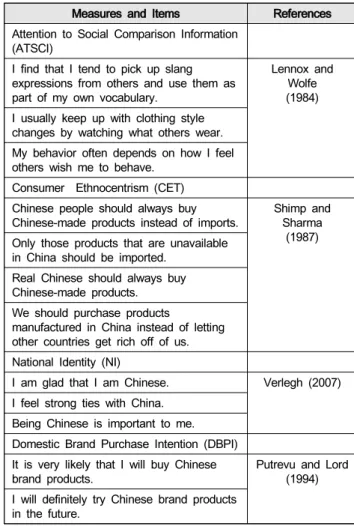
For the constructs, measures adapted from previous research and a seven-point Likert scale anchored by one (“strongly disagree”) and seven (“strongly agree”) was used in all items. According to Lennox and Wolfe (1984), we measured ‘Attention to Social Comparison Information’ with a three-item version of the ATSCI scale, which was validated by Deval et al. (2013). Similar to Zeugner-Roth, Žabkar, and Diamantopoulos (2015), we operationalized consumer ethnocentrism using the four-dimensional CETSCALE measure initially proposed by Shimp and Sharma (1987), which was widely validated (Balabanis & Diamantopoulos, 2004; Shankarmahesh, 2006; Verlegh, 2007) and adopted in a recently study on the Chinese consumer (Ding, 2017). As Blank and Schmidt (2003) said, there is “little disagreement on the measurement of national identity.” Thus, the version of three items was used in our study based on the previous research (e.g., Mlicki & Ellemers, 1996; Verlegh, 2007).

Consumer domestic products purchase intention from the stimulus countries was measured with two items from Putrevu and Lord (1994). <Table 3> summarizes the measures and items.

Table 3: Measures, Items and Scale Sources

Measures and Items References

Attention to Social Comparison Information

(ATSCI)

I find that I tend to pick up slang expressions from others and use them as part of my own vocabulary.

Lennox and Wolfe (1984) I usually keep up with clothing style

changes by watching what others wear.

My behavior often depends on how I feel others wish me to behave.

Consumer Ethnocentrism (CET) Chinese people should always buy

Chinese-made products instead of imports. Shimp and Sharma

(1987) Only those products that are unavailable

in China should be imported.

Real Chinese should always buy Chinese-made products.

We should purchase products

manufactured in China instead of letting other countries get rich off of us.

National Identity (NI)

I am glad that I am Chinese. Verlegh (2007) I feel strong ties with China.

Being Chinese is important to me.

Domestic Brand Purchase Intention (DBPI) It is very likely that I will buy Chinese

brand products. Putrevu and Lord

(1994) I will definitely try Chinese brand products

in the future.

4. Results

4.1. Reliability and Validity

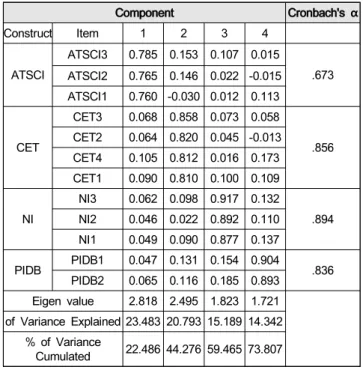
Before testing the hypotheses, we assessed the reliability and validity of the items for four constructs. Cronbach's α was used in checking internal consistency. <Table 4> shows that the total construct was 0.786, higher than 0.7, that the coefficients of each construct were higher than 0.6, and that ATSCI (α=.0.673), CET (α=0.856), NI (α=0.894), and PIDB (α=0.836) are shown as expected. Hair et al. (2014) suggested 0.6 as the minimum acceptable value for Cronbach's α; thus, the reliabilities of study measures were acceptable. A Varimax, confirmatory principal component analysis was conducted to explore principal components.

<Table 4> reports detailed estimation results.

(6)

Table 4: Analyzing Components Results of Constructs and Items

Component Cronbach's α

Construct Item 1 23 4

ATSCI

ATSCI3 0.785 0.153 0.107 0.015 ATSCI20.765 0.146 0.02 2 -0.015 .673 ATSCI1 0.760 -0.030 0.0120.113 CET

CET3 0.068 0.858 0.073 0.058 CET20.064 0.82 0 0.045 -0.013 .856 CET4 0.105 0.8120.016 0.173 CET1 0.090 0.810 0.100 0.109 NI

NI3 0.0620.098 0.917 0.132 .894 NI2 0.046 0.02 20.8920.110

NI1 0.049 0.090 0.877 0.137 PIDB PIDB1 0.047 0.131 0.154 0.904 PIDB20.065 0.116 0.185 0.893 .836 Eigen value 2.818 2.495 1.823 1.721 of Variance Explained 23.483 20.793 15.189 14.342

% of Variance

Cumulated 22.486 44.276 59.465 73.807

In addition, Fornell and Larcker (1981) pointed out average variance extracted (AVE) values of all constructs higher than 0.5 can be used to confirm convergence validity.

The AVE values (Table.4) and CR of each construct follow:

AVE(ATSCI)=0.415, CR(ATSCI)=0.677; AVE(CET)=0.600, CR(CET)=0.857; AVE(NI)=0.745, CR(NI)=0.897, AVE(PIDB)=

0.719, and CR(PIDB)=0.837.

According to Fornell and Larcker (1981) stating that if AVE is less than 0.5, but the composite reliability (CR) is higher than 0.6 with AVE more than 0.4, we determined that the convergent validity of the construct seems adequate.

Moreover, <Table 4> shows that the Ф coefficients among the constructs without 1.0 signify correlations. <Table 5>

presents that the discriminant validity of the constructs was confirmed (Anderson & Gerbing, 1988).

Table 5: Results of Analyzing AVE and Correlations

AVE ATSCI CET NI PIDB

ATSCI 0.415

CET 0.300

(0.090) 0.6

NI 0.183

(0.033) 0.196

(0.038) 0.745

PIDB 0.176

(0.031) 0.285

(0.081) 0.373

(0.139) 0.719 Notes: AVE is on the diagonal line in bold text, and the

squares of correlation coefficients are in ( ).

4.2. Tests of Hypotheses

For assessing the causal relationships among ATSCI,

CET, NI, and PIDB, we estimated the path coefficients in our study. <Table 6> reports the standardized path coefficients of the structural equation model analyzing results from the model estimation.

<Table 6> presents that χ

2

, CMIN/DF, GFI, AGFI, CFI, TLI, IFI, RFI, NFI, and RMSEA indices were used to evaluate model fitness. The results revealed that χ

2

was 93.000 (DF=49, P=0.000); CMIN/DF was 1.898, and thus less than 3; RMSEA was 0.047, less than 0.05; CFI was 0.979, and the others were GFI, AGFI, TLI, IFI, RFI, and NFI also were more than 0.9. As suggested by Hu and Bentler (1999), these indices indicate satisfactory levels for confirming the criteria for model fitness.

Table 6: Results of Testing Hypotheses

Hypotheses Path Estimate S.E. t-Value Sig. Results H1 ATSCIà PIDB 0.047 0.059 0.804 0.421 Rejected H2CETà PIDB 0.153 0.044 3.491 *** Supported H3 ATSCIàCET 0.383 0.083 4.635 *** Supported H4 NIà PIDB 0.259 0.046 5.657 *** Supported H5 ATSCIàNI 0.225 0.070 3.206 0.001 Supported

χ

2

=93.000(DF=49, P=0.000), CMIN/DF=1.898, GFI=0.964, AGFI=0.943, CFI=0.979, TLI=0.972, IFI=0.979, RFI=0.942,

NFI=0.957, RMSEA=0.047.

Note: *** denotes P<0.01

Both <Table 6> and <Figure 3> display that the direct path coefficient from ATSCI to PIDB was not significant (γ

=0.047, t-Value=0.804<1.96, p=0.421>0.1), rejecting H1. The CET of young generations of Chinese had a positive effect on PIDB (γ=0.153, t-Value=3.491>1.96, p<0.01), supporting H2. The positive influence of consumer ATSCI on CET (γ

=0.383, t-Value=4.635>1.96, p<0.01), supporting H3. In addition, the positive and significant impacts of consumer NI toward PIDB (γ=0.259, t-Value=5.657>1.96, p<0.01), supporting H4. ATSCI was positively and significantly related to consumer NI (γ=0.225, t-Value=3.206>1.96, p<0.01), supporting H5.

Note: *** denotes p<0.01

Figure 3: Structural Model Estimates

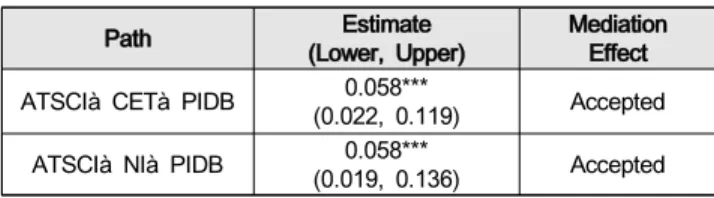
<Table 7> presents that the indirect path coefficient from

ATSCI to CET to PIDB was significant (CI= [0.022, 0.119],

p<0.01). The indirect path coefficient from ATSCI to NI to

PIDB was positive and significant (CI= [0.019, 0.136], p<0.01).

(7)

Table 7: Effects of CET and NI between ATSCI and PIDB

Path Estimate

(Lower, Upper) Mediation Effect ATSCIà CETà PIDB 0.058***

(0.022, 0.119) Accepted ATSCIà NIà PIDB 0.058***

(0.019, 0.136) Accepted Note: *** denotes p<0.01

5. Discussion and Implications

The results of our study show that for the young Chinese generation, there was no direct impact between ATSCI and PIDB. The CET presented a positive and significant relation toward PIDB, this result was consistent with previous research findings (Josiassen, 2011; Strizhakova & Coulter, 2015). The original definition of CET reported by Shimp and Sharma (1987) does not include consumers’ intentions to domestic products, but rather highlighted a clear bias of foreign products against Zarkada-Fraser and Fraser (2002).

Plenty of subsequent research, however, shows that CET positively biases consumers’ PIDB in different countries (Herche, 1992; Olsen, Biswas, & Granzin, 1993; Klein, Ettenson, & Morris, 1998; Suh & Kwon, 2002). The positive influence of young Chinese generation’s ATSCI on CET was consistent with Siamagka and Balabanis’ (2015) findings of positive association existing between CET and the susceptibility to interpersonal influence. The indirect mediation effect from ATSCI to CET to PIDB was significant.

However, these findings were little explored in the previous relevant research. National Identity (NI) positively and significantly influences young Chinese generation’s PIDB.

This finding agreed with previous literature (Verlegh, 2007;

Zeugner-Roth, Žabkar, & Diamantopoulos, 2015). ATSCI was positively and related significantly to NI. In addition, an indirect mediation effect from ATSCI to CET to PIDB was significant. These mediation effect findings are new.

Furthermore, ensuring the mediation effects of ATSCI to CET to PIDB and ATSCI to NI to PIDB, we found that the direct path from ATSCI to PIDB is little significant.

5.1. Theoretical Implications and Contributions

The current study has theoretical implications for the international marketing research in several ways. First, our study originally joined one socio-psychological antecedent in ATSCI and CET. In the previous literature relevant to CET, worldmindedness(Rawwas, Rajendran, & Wuehrer, 1996;

Balabanis et al., 2001), patriotism (Bannister & Saunder, 1978; Han, 1988; Sharma, Shimp, & Shin, 1994; Klein &

Ettenson, 1999; Balabanis et al., 2001), collectivism (Ettenson, wagner, & Gaeth, 1988; Nishina, 1990; Strutton, Pelton, & Lumpkin, 1994; Sharma, Shimp, & Shin, 1994), animosity (Klein, Ettenson, & Morris, 1998; Alden et al.,

2013), materialism (Clarke, Shankarmahesh, & Ford, 2000), and cosmopolitanism (Zeugner-Roth, Žabkar, &

Diamantopoulos, 2015) were explored only for CET but not for ATSCI. Our study documented a positive and significant relationship with ATSCI and CET, against the results of precious study (Das & Saha, 2017). Second, drawing on the SCT and the SIT, our study connected ATSCI with NI and estimated a positive relationship. These two socio- psychological antecedents were openness in the international marketing literature. Third, our study identified the mediating effects of CET and NI on the relationship between ATSCI and PIDB. The findings insisted that CET is different from NI (Zeugner-Roth, Žabkar, & Diamantopoulos, 2015), and against the previous research methods, it treats CET as one of dimensions of NI (Keillor & Hult, 1999; Cui & Adams, 2002).

5.2. Managerial Implications and Contributions

There are some managerial implications for international marketers wishing to stimulate young generations of Chinese to purchase domestic brand products. First, the results show that CET and NI influence young Chinese generations’

PIDB. Therefore, an international marketer should consider Chinese market entry-modes (foreign direct investment, international joint ventures and cobranding with a local brand) and branding decisions to mitigate young consumers’

domestic bias. Second, as the positive effects of ATSCI to CET and NI were explored, international marketers could use the given information to catch consumer attention in target product promotions. Furthermore, due to the ATSCI existing in young Chinese generations, it indirectly affects consumer PIDB. Meanwhile, consumers pay attention to the electronic word of mouth in decision-making (Lin & Kalwani, 2018). Thus, to build positive attitudes towards domestic brands, international marketers could focus on consumers’

information channels to promote products.

5.3. Limitations and Further Research

There are some limitations in the current research. First, our study was conducted in China and collected data only from young generations under 30. It is possible for further replication in other settings with different countries to mitigate the age bias. According to Hofstede’s (2001) cultural dimensions, China is a collective country; thus, the individual countries could be the sample in a future relevant study.

Also, examining the results of our study in other collective

countries may be worthwhile. Meanwhile, exploring the

findings through comparison with other countries in the

future is necessary for generalization. Second, our study did

not present specific domestic brands products as

investigative categories. From the aspect of product

attributes, functional and symbolic attributes were the

(8)

classical classifications of product (Park & Jeon, 2018).

Thus, specific brands categories or products are necessary with respect to further research. Third, though the convergent validity of the construct is adequate in our study, but according to Fornell and Larcker (1981), an AVE more than 0.5 will be better. Thus, in further research, related solutions for higher validity are worth exploring. Finally, our study excluded country of origin (COO) effects and focused on purchase intention toward domestic brand products without mentioning foreign brands. Moon and Oh (2017) suggested that the research of COO effects with CET and NI is necessary in the future; thus, further studies combining ATSCI, COO effects, CET, and NI would be significant.

References

Alden, D. L., Kelley, J. B., Riefler, P., Lee, J. A., &

Soutar, G. N. (2013). The Effect of Global Company Animosity on Global Brand Attitudes in Emerging and Developed Markets: Does Perceived Value Matter?.

Journal of International Marketing, 21(2), 17-38.

https://doi.org/10.1509/jim.12.0086

Anderson, J. C., & Gerbing, D. W. (1988). Structural Equation Modeling in Practice: A Review and Recommended Two-step Approach. Psychological bulletin, 103(3), 411-423. https://doi.org/10.1037/0033-2909.103.3.411 Anning-Dorson, T. (2018). Innovation and Competitive

Advantage Creation: The Role of Organizational Leadership in Service Firms from Emerging Markets.

International Marketing Review, 35(4), 580-600.

https://doi.org/10.1108/IMR-11-2015-0262

Aspinwall, L. G., & Taylor, S. E. (1993). Effects of Social Comparison Direction, Threat, and Self-esteem on Affect, Self-evaluation, and Expected Success. Journal of Personality and Social Psychology, 64(5), 708.

http://dx.doi.org/10.1037/0022-3514.64.5.708

Balabanis, G., & Diamantopoulos, A. (2004). Domestic Country Bias, Country-of-origin Effects, and Consumer Ethnocentrism: A Multidimensional Unfolding Approach.

Journal of the Academy of Marketing Science, 32(1), 80-95. https://doi.org/10.1177/0092070303257644 Balabanis, G., Diamantopoulos, A., Mueller, R. D., &

Melewar, T. C. (2001). The Impact of Nationalism, Patriotism and Internationalism on Consumer Ethnocentric Tendencies. Journal of International

Business Studies, 32(1), 157-175.

http://doi.org/10.1057/palgrave.jibs.8490943

Balabanis, G., & Siamagka, N. T. (2017). Inconsistencies in the Behavioural Effects of Consumer Ethnocentrism:

The Role of Brand, Product Category and Country of Origin. International Marketing Review, 34(2), 166-182.

http://doi.org/10.1108/IMR-03-2015-0057

Bang, V. V., Joshi, S. L., & Singh, M. C. (2016).

Marketing Strategy in Emerging Markets: A Conceptual Framework. Journal of Strategic Marketing, 24(2), 104-117. https://doi.org/10.1080/0965254X.2015.1011200 Bannister, J. P., & Saunders, J. A. (1978). UK Consumers’

Attitudes Towards Imports: The Measurement of National Stereotype Image. European Journal of marketing, 12(8), 562-570. https://doi.org/10.1108/EUM0000000004982 Barbarossa, C., De Pelsmacker, P., & Moons, I. (2018).

Effects of Country-of-origin Stereotypes on Consumer Responses to Product-harm Crises. International

Marketing Review, 35(3), 362-389.

http://doi.org/10.1108/IMR-06-2016-0122

Bilkey, W. J., & Nes, E. (1982). Country-of-origin Effects on Product Evaluations. Journal of international

business studies, 13(1), 89-100.

http://doi/10.1057/palgrave.jibs.8490539

Blank, T. (2003). Determinants of National Identity in East and West Germany: An Empirical Comparison of Theories on the Significance of Authoritarianism, Anomie, and General Self‐esteem. Political Psychology, 24(2), 259-288. http://doi.org/10.1111/0162-895X.00328 Blank, T., & Schmidt, P. (2003). National Identity in a

United Germany: Nationalism or Patriotism? An Empirical Test with Representative Data. Political Psychology, 24(2), 289-312. http://doi.org/10.1111/0162-895X.00329 Boisvert, J., & Ashill, N. J. (2018). The Impact of

Branding Strategies on Horizontal and Downward Line Extension of Luxury Brands: A Cross-national Study.

International Marketing Review, 35(6), 1033-1052.

http://doi.org/10.1108/IMR-10-2017-0208

Brewer, M. B. (1999). The Psychology of Prejudice: Ingroup Love and Outgroup Hate?. Journal of social issues, 55(3), 429-444. http://doi.org/10.1111/0022-4537.00126 Calder, B. J., & Burnkrant, R. E. (1977). Interpersonal

Influence on Consumer Behavior: An Attribution Theory Approach. Journal of Consumer Research, 4(1), 29-38.

http://doi.org/10.1086/208676

Caruana, A. (1996). The Effects of Dogmatism and Social Class Variables on Consumer Ethnocentrism in Malta.

Marketing Intelligence & Planning, 14(4), 39-44.

http://doi.org/10.1108/02634509610121569

Cavusgil, S. T., Deligonul, S., Kardes, I., & Cavusgil, E.

(2018). Middle-class Consumers in Emerging Markets:

Conceptualization, Propositions, and Implications for International Marketers. Journal of International Marketing, 26(3), 94-108. https://doi.org/10.1509/jim.16.0021 Clarke, I., Shankarmahesh, M. N., & Ford, J. B. (2000).

Consumer Ethnocentrism, Materialism and Values: a Four Country Study. In American Marketing Association.

Conference Proceedings, 11, 102. American Marketing Association.

Cleveland, M., Laroche, M., & Papadopoulos, N. (2009).

Cosmopolitanism, Consumer Ethnocentrism, and

Materialism: An Eight-country Study of Antecedents and

(9)

Outcomes. Journal of International Marketing, 17(1), 116-146. https://doi.org/10.1509/jimk.17.1.116

Collins, R. L. (1996). For better or worse: The Impact of Upward Social Comparison on Self-Evaluations.

Psychological bulletin, 119(1), 51.

http://doi.org/10.1037/0033-2909.119.1.51

Coombes, E., Hibbert, S., Hogg, G., & Varey, R. (2001).

Consuming Identity: the Case of Scotland. Advances in Consumer Research, 28(1), 328-333.

Chi C. C., & Adams, E. I. (2002). National Identity and NATID: An Assessment in Yemen. International

Marketing Review, 19(6), 637-662.

http://doi.org/10.1108/02651330210451953

Das, M., & Saha, V. (2017). A Study on Consumer Ethnocentrism and Social Comparison in Rural India:

Implications for Marketing Strategy. South Asian Journal of Management, 24(1). 141-164.

Deval, H., Mantel, S. P., Kardes, F. R., & Posavac, S. S.

(2012). How Naive Theories Drive Opposing Inferences From the Same Information. Journal of Consumer Research, 39(6), 1185-1201. http://doi.org/10.1086/668086 Dinnie, K. (2001). Impications of National Identity for

Marketing Strategy. The Marketing Review, 2(3), 285-300. https://doi.org/10.1362/1469347012569922 Durvasula, S., Andrews, J. C., & Netemeyer, R. G.

(1997). A Cross-cultural Comparison of Consumer Ethnocentrism in the United States and Russia. Journal of International Consumer Marketing, 9(4), 73-93.

https://doi.org/10.1300/J046v09n04_05

Emmons, R. A., & Diener, E. (1985). Factors Predicting Satisfaction Judgments: A Comparative Examination.

Social Indicators Research, 16(2), 157-167.

http://doi.org/10.1007/BF00574615

Ernst and Young (2013). Hitting the Sweet Spot: The Growth of the Middle Class in Emerging Markets.

report, http://www.ey.com/Publication/vwLUAssets/Hitting _the_sweet_spot/%24FILE/Hitting_the_sweet_spot.pdf.

Ettenson, R., Wagner, J., & Gaeth, G. (1988). Evaluating the Effect of Country of Originand The'Made In.

Journal of retailing, 64(1), 85-100.

Feather, N. T. (1981). National Sentiment in a Newly Independent Nation. Journal of Personality and Social

Psychology, 40(6), 1017.

http://doi.org/10.1037/0022-3514.40.6.1017

Festervand, T. A., Lumpkin, J. R., & Lundstrom, W. J.

(1985). Consumers Perceptions of Imports-an undate and Extension. Akron Business and Economic Review, 16(1), 31-36.

Festinger, L. (1954). A Theory of Social Comparison Processes. Human relations, 7(2), 117-140.

https://doi.org/10.1177/001872675400700202

Fornell, C., & Larcker, D. F. (1981). Evaluating Structural Equation Models with Unobservable Variables and Measurement Error. Journal of marketing research,

18(1), 39-50. https://doi.org/10.1177/002224378101800104 Good, L. K., & Huddleston, P. (1995). Ethnocentrism of

Polish and Russian Consumers: Are Feelings and Intentions Related. International Marketing Review, 12(5), 35-48. http://doi.org/10.1108/02651339510103047 Guo, X. (2013). Living in a global world: Influence of

Consumer Global Orientation on Attitudes Toward Global Brands from Developed versus Emerging Countries. Journal of International Marketing, 21(1), 1-22. https://doi.org/10.1509/jim.12.0065

Haferkamp, N., & Krämer, N. C. (2011). Social Comparison 2.0: Examining the Effects of Online Profiles on Social-networking Sites. Cyberpsychology, Behavior, and Social Networking, 14(5), 309-314.

https://doi.org/10.1089/cyber.2010.0120

Hair, J. F., Black, W. C., Babin, B. J., Anderson, R. E., and Tatham, R. L. (2014). Multivariate Data Analysis (7th ed.). Upper Saddle River, New Jersey: Pearson Education Limited.

Han, C. M (1988). The Role of Consumer Patriotism in the Choice of Domestic versus Foreign Products.

Journal of Advertising Research, 28(3), 25-32.

Herche, J. (1992). A Note on the Predictive Validity of the CETSCALE. Journal of the Academy of Marketing Science, 20(3), 261-264. https://doi.org/10.1007/BF02723413 Hofstede, G. (2001). Culture's Consequences: Comparing

Values, Behaviors, Institutions and Organizations Across Nations. Sage publications. Thousand Oaks, CA.

Hu, L. T., & Bentler, P. M. (1999). Cutoff Criteria for Fit Indexes in Covariance Structure Analysis: Conventional Criteria versus New Alternatives. Structural equation modeling: A multidisciplinary journal, 6(1), 1-55.

https://doi.org/10.1080/10705519909540118

Huddleston, P., Good, L. K., & Stoel, L. (2001).

Consumer Ethnocentrism, Product Necessity and Polish Consumers’ Perceptions of Quality. International Journal of Retail & Distribution Management, 29(5), 236-246.

https://doi.org/10.1108/09590550110390896

Josiassen, A. (2011). Consumer Disidentification and Its Effects on Domestic Product Purchases: An Empirical Investigation in the Netherlands. Journal of Marketing, 75(2), 124-140. https://doi.org/10.1509/jm.75.2.125 Keillor, B. D., Hult, G. T. M., Erffmeyer, R. C., &

Babakus, E. (1996). NATID: The Development and Application of a National Identity Measure for Use in International Marketing. Journal of International Marketing, 4(2), 57-73. https://doi.org/10.1177/1069031X9600400205 Kesić, T., Rajh, E., and Ozretić Došen, Đ. (2004). Effects

of Attitudes and Consumer Ethnocentrism on Intentions

to buy domestic vs. foreign products in Croatia and

Bosnia and Herzegovina, in Cantu, V., Hsu, M.K. and

Leach, M. (Eds). Proceedings of the Academy of

Marketing Science Cultural Perspectives on Marketing

Conference, Academy of Marketing Science, Puebla,

(10)

September.

Kharas, H. (2016). How a Growing Global Middle Class Could Save the World’s Economy. Trend Magazine (Summer), http://trend.pewtrusts.org/en/archive/trend- summer-2016/how-a-growing-middle-class-could-save-the- worlds-economy.

Klein, J. G., & Ettensoe, R. (1999). Consumer Animosity and Consumer Ethnocentrism: An Analysis of Unique Antecedents. Journal of International Consumer Marketing, 11(4), 5-24. https://doi.org/10.1300/J046v11n04_02 Klein, J. G., Ettenson, R., & Morris, M. D. (1998). The

Animosity Model of Foreign Product Purchase: An Empirical Test in the People's Republic of China.

Journal of marketing, 62(1), 89-100.

https://doi.org/10.1177/002224299806200108

KPMG. International. (2013). Future State 2030: The Global Megatrends Shaping Governments. Mowat Centre for Policy Innovation, University of Toronto.

Kwak, H., Jaju, A., & Larsen, T. (2006). Consumer Ethnocentrism Offline and Online: The Mediating Role of Marketing Efforts and Personality Traits in the United States, South Korea, and India. Journal of the academy of marketing science, 34(3), 367-385.

https://doi.org/10.1177/0092070304270140

Lee, R., & Mazodier, M. (2015). The Roles of Consumer Ethnocentrism, Animosity, and Cosmopolitanism in Sponsorship Effects. European Journal of Marketing, 49(5/6), 919-942. https://doi.org/10.1108/EJM-10-2013-0594 Lennox, R. D., & Wolfe, R. N. (1984). Revision of the Self-Monitoring Scale. Journal of Personality and Social

Psychology, 46(6), 1349-1364.

http://dx.doi.org/10.1037/0022-3514.46.6.1349

Lin, H., & Kalwani, M. U. (2018). Culturally Contingent Electronic Word-of-Mouth Signaling and Screening: A Comparative Study of Product Reviews in the United States and Japan. Journal of International Marketing, 26(2), 80-102. https://doi.org/10.1509/jim.17.0016 Lu Wang, C., & Xiong Chen, Z. (2004). Consumer

Ethnocentrism and Willingness to Buy Domestic Products in a Developing Country Setting: Testing Moderating Effects. Journal of Consumer Marketing, 21(6), 391-400. https://doi.org/10.1108/07363760410558663 Lyubomirsky, S., & Ross, L. (1997). Hedonic

Consequences of Social Comparison: A Contrast of Happy and Unhappy People. Journal of Personality and Social Psychology, 73(6), 1141-1157.

http://dx.doi.org/10.1037/0022-3514.73.6.1141

Mettee, D. R., & Riskind, J. (1974). Size of Defeat and Liking For Superior and Similar Ability Competitors.

Journal of Experimental Social Psychology, 10(4), 333-351. https://doi.org/10.1016/0022-1031(74)90030-4 Mlicki, P. P., & Ellemers, N. (1996). Being Different or

Being Better? National Stereotypes and Identifications of Polish and Dutch students. European Journal of

Social Psychology, 26(1), 97-114.

https://doi.org/10.1002/(SICI)1099-0992(199601)26:1<97::

AID-EJSP739>3.0.CO;2-F

Moon, B. J., & Oh, H. M. (2017). Country of Origin Effects in International Marketing Channels: How Overseas Distributors Account for the Origins of Products and Brands. International Marketing Review, 34(2), 224-238. https://doi.org/10.1108/IMR-03-2015-0073 Morse, S., & Gergen, K. J. (1970). Social Comparison, Self-consistency, and the Concept of Self. Journal of Personality and Social Psychology, 16(1), 148-156.

http://dx.doi.org/10.1037/h0029862

Mussweiler, T., & Rüter, K. (2003). What Friends are for!

The Use of Routine Standards in Social Comparison.

Journal of Personality and Social Psychology, 85(3), 467-481. https://doi.org/10.1037/0022-3514.85.3.467 Müller-Peters, A. (1998). The Significance of National

Pride and National Identity to the Attitude Toward the Single European Currency: A Europe-wide Comparison.

Journal of Economic Psychology, 19(6), 701-719.

https://doi.org/10.1016/S0167-4870(98)00033-6

Nishina, S. (1990). Japanese Consumers: Introducing Foreign Products/brands. Journal of Advertising Research, 30(2), 35-45.

Olsen, J. E., Biswas, A., & Granzin, K. L. (1993).

Influencing Consumers’ Selection of Domestic versus Imported Products: Implications for Marketing Based on A Model of Helping Behavior. Journal of the Academy

of Marketing Science, 21(4), 307.

https://doi.org/10.1007/BF02894523

Park, H. H., & Jeon, J. O. (2018). The Impact of Mixed eWOM Sequence on Brand Attitude Change: Cross- cultural Differences. International Marketing Review, 35(3), 390-411. https://doi.org/10.1108/IMR-06-2016-0118 65.

Pew Research Center (2016). America’s Shrinking Middle Class: A Close Look at Changes Within Metropolitan Areas. (May 11).

Poon, P., Evangelista, F., & Albaum, G. (2010). Attitudes of Migrants Towards Foreign-made Products: An Exploratory Study of Migrants in Australia. Journal of

Consumer Marketing, 27(1), 35-42.

https://doi.org/10.1108/07363761011012930

Putrevu, S., & Lord, K. R. (1994). Comparative and Noncomparative Advertising: Attitudinal Effects Under Cognitive and Affective Involvement conditions. Journal

of Advertising, 23(2), 77-91.

https://doi.org/10.1080/00913367.1994.10673443

Ranjbarian, B., Rojuee, M., & Mirzaei, A. (2010).

Consumer Ethnocentrism and Buying Intentions: An Empirical Analysis of Iranian Consumers. European Journal of Social Sciences, 13(3), 371-386.

Rawwas, M. Y., Rajendran, K. N., & Wuehrer, G. A.

(1996). The Influence of Worldmindedness and

(11)

Nationalism on Consumer Evaluation of Domestic and Foreign Products. International Marketing Review, 13(2), 20-38. https://doi.org/10.1108/02651339610115746 Salovey, P., & Rodin, J. (1984). Some Antecedents and

Consequences of Social-comparison Jealousy. Journal of Personality and Social psychology, 47(4), 780-792.

http://dx.doi.org/10.1037/0022-3514.47.4.780

Schooler, R. (1971). Bias Phenomena Attendant to the Marketing of Foreign Goods in the US. Journal of international business studies, 2(1), 71-80.

https://www.jstor.org/stable/154727

Shan Ding, Q. (2017). Chinese Products for Chinese People? Consumer Ethnocentrism in China. International Journal of Retail & Distribution Management, 45(5), 550-564. https://doi.org/10.1108/IJRDM-11-2016-0212 Shankarmahesh, M. N. (2006). Consumer Ethnocentrism:

An Integrative Review of Its Antecedents and Consequences. International Marketing Review, 23(2), 146-172. https://doi.org/10.1108/02651330610660065 Sharma, P. (2011). Country of Origin Effects in

Developed and Emerging Markets: Exploring the Contrasting Roles of Materialism and Value Consciousness. Journal of International Business Studies, 42(2), 285-306. https://doi.org/10.1057/jibs.2010.16 Sharma, S., Shimp, T. A., & Shin, J. (1994). Consumer

Ethnocentrism: A Test of Antecedents and Moderators.

Journal of the Academy of Marketing Science, 23(1), 26-37. https://doi.org/10.1177/0092070395231004 Sheth, J. N. (2011). Impact of Emerging Markets on

Marketing: Rethinking Existing Perspectives and Practices. Journal of Marketing, 75(4), 166-182.

https://doi.org/10.1509/jmkg.75.4.166

Shimp, T. A., & Sharma, S. (1987). Consumer Ethnocentrism: Construction and Validation of the CETSCALE. Journal of Marketing Research, 24(3), 280-289. https://doi.org/10.1177/002224378702400304 Shoham, A., & Gavish, Y. (2016). Antecedents and

Buying Behavior Consequences of Consumer Racism, National Identification, Consumer Animosity, and Consumer Ethnocentrism. Journal of International

Consumer Marketing, 28(5), 296-308.

https://doi.org/10.1080/08961530.2016.1214661

Siamagka, N. T., & Balabanis, G. (2015). Revisiting Consumer Ethnocentrism: Review, Reconceptualization, and Empirical Testing. Journal of International Marketing, 23(3), 66-86. https://doi.org/10.1509/jim.14.0085 Smith, M. B. (1992). Nationalism, Ethnocentrism, and the New World Order. Journal of Humanistic Psychology, 32(4), 76-91. https://doi.org/10.1177/0022167892324005 Stöttinger, B., & Penz, E. (2018). Balancing Territorial

Identities: How Consumers Manage Their Ethnic, Regional, and National Identities in Daily Life and Consumption Situations. International Marketing Review.

https://doi.org/10.1108/IMR-03-2018-0115

Strizhakova, Y., & Coulter, R. A. (2015). Drivers of Local Relative to Global Brand Purchases: A Contingency Approach. Journal of International Marketing, 23(1), 1-22. https://doi.org/10.1509/jim.14.0037

Strutton, D., Pelton, L. E., & Lumpkin, J. R. (1994).

Internal and External Country of Origin Stereotypes in the Global Marketplace: Effects and Implications for the Domestic Promotion of US Automobiles. Journal of

Global Marketing, 7(3), 61-78.

https://doi.org/10.1300/J042v07n03_04

Suarez, M., & Belk, R. (2017). Cultural Resonance of Global Brands in Brazilian Social Movements.

International Marketing Review, 34(4), 480-497.

https://doi.org/10.1108/IMR-07-2014-0252

Suh, T., & Kwon, I. W. G. (2002). Globalization and Reluctant Buyers. International Marketing Review, 19(6), 663-680. https://doi.org/10.1108/02651330210451962 Supphellen, M., & Rittenburg, T. L. (2001). Consumer

Ethnocentrism When Foreign Products are Better.

Psychology & Marketing, 18(9), 907-927.

https://doi.org/10.1002/mar.1035

Swoboda, B., Pennemann, K., & Taube, M. (2012). The Effects of Perceived Brand Globalness and Perceived Brand Localness in China: Empirical Evidence on Western, Asian, and Domestic Retailers. Journal of International Marketing, 20(4), 72-95.

https://doi.org/10.1509/jim.12.0105

Tajfel, H. (1974). Social Identity and Intergroup Behavior.

Information (International Social Science Council), 13(2), 65-93. https://doi.org/10.1177/053901847401300204 Tajfel, H. (1982). Social Psychology of Intergroup

Relations. Annual Review of Psychology, 33(1), 1-39.

https://doi.org/10.1146/annurev.ps.33.020182.000245 Tajfel, Henri (1978). Social Categorization, Social Identity

and Social Comparison. in Differentiation Between Social Groups: Studies in the Social Psychology of Intergroup Relations. Henri Tajfel, ed. London: Academic Press, 61–76.

Tajfel, H., & Turner, J. C. (1986). An Integrative Theory of Intergroup Relations. Psychology of Intergroup Relations. Nelson-Hall, Chicago, IL, 7-24.

Testa, M., & Major, B. (1990). The Impact of Social Comparisons After Failure: The Moderating Effects of Perceived Control. Basic and Applied Social

Psychology, 11(2), 205-218.

https://doi.org/10.1207/s15324834basp1102_7

Verlegh, P. W. (2007). Home Country Bias in Product Evaluation: the Complementary Roles of Economic and Socio-psychological Motives. Journal of International

Business Studies, 38(3), 361-373.

https://doi.org/10.1057/palgrave.jibs.8400269

Wheeler, L., & Miyake, K. (1992). Social Comparison in Everyday Life. Journal of Personality and Social

Psychology, 62(5), 760-773.

(12)

http://dx.doi.org/10.1037/0022-3514.62.5.760

Wills, T. A. (1981). Downward Comparison Principles in Social Psychology. Psychological Bulletin, 90(2), 245-271. http://dx.doi.org/10.1037/0033-2909.90.2.245 Wood, J. V., Taylor, S. E., & Lichtman, R. R. (1985).

Social Comparison in Adjustment to Breast Cancer.

Journal of Personality and Social Psychology, 49(5), 1169-1183. http://dx.doi.org/10.1037/0022-3514.49.5.1169 Wu, A., & Zhou, L. (2018). Understanding Earliness of Internationalization and Its Impact on Postentry Geographic Diversity of International Young Ventures.

Journal of International Marketing, 26(2), 62-79.

https://doi.org/10.1509/jim.16.0123

Zarkada-Fraser, A., & Fraser, C. (2002). Store Patronage Prediction for Foreign-owned Supermarkets.

International Journal of Retail & Distribution

Management, 30(6), 282-299.

https://doi.org/10.1108/09590550210429504

Zeugner-Roth, K. P., Žabkar, V., & Diamantopoulos, A.

(2015). Consumer Ethnocentrism, National Identity, and Consumer Cosmopolitanism As Drivers of Consumer Behavior: A Social Identity Theory Perspective. Journal of International Marketing, 23(2), 25-54.

https://doi.org/10.1509/jim.14.0038

Zolfagharian, M., Saldivar, R., & Braun, J. (2017).

Country of Origin and Ethnocentrism in the Context of Lateral, Upward and Downward Migration. International

Marketing Review, 34(2), 330-352.

https://doi.org/10.1108/IMR-06-2015-0158

수치

Table  1:  Previous  different  opinions  of  the  relationship  between  CET  and  age
Figure  2:  The  Geographic  Diversity  of  Total  Participants
Table  3:  Measures,  Items  and  Scale  Sources
Table  4:  Analyzing  Components  Results  of  Constructs  and  Items Component Cronbach's  α Construct Item 1 23 4 ATSCI ATSCI3 0.785 0.153 0.107 0.015 ATSCI20.765 0.146 0.02 2 -0.015 .673 ATSCI1 0.760 -0.030 0.0120.113 CET CET3 0.068 0.858 0.073 0.058CET
+2

참조

관련 문서

The purpose of this study is to investigate the effect of the “problem solving and programming” area of ​​information subject on perception and

The purpose of this study is to verify whether The mediating effects of planned happenstance skills on the relationship between perceived social support

The purpose of this study is to analyze the situations of violating the right to learn and violence in student-athletes from an ethnographic view and

The purpose of this study is to analyze the relationship between dance performances, which is a part of social contribution activities of local governments,

The purpose of this study was to investigate the impact of social capital and positive psychology capital on the will of start-up according to experience

The purpose is to analyze the content elements of character education presented in middle school social studies textbooks of the 2015 Revised Special

The purpose of this study is to cultivate the middle school student's appropriate Information Communication Ethics Consciousness by studying the advisable

In addition, it is the purpose of this study to analyze social and historical background and the characteristics on the establishment of the varied