서 론
DNA 다형 분석은 수산생물의 종내∙종간 및 집단 내∙집단간의 유전적 유연관계를 밝히는 중요한 지표로 이용되고 있으며, 이러한 연구는 핵 DNA 뿐만 아니라 미토콘드리아 DNA내의 다양한 유전자들에 대해서도 광범위하게 진행되고 있다(Beckenbach, 1991; Carr and
Marshall, 1991). 최근에는 수산생물의 진화유전학적 연 구를 위하여 coding region 뿐만 아니라 noncoding region에 대해서도 활발하게 조사되고 있으며, 특히, 미 토콘드리아 DNA control region (control region)은 그 genome의 복제 및 전사 과정을 조절하며, 이와 관련한 몇가지 구조적 특징이 알려져 있다(Doda et al., 1981;
Saccone et al., 1991).
미토콘드리아 DNA control region은 매우 보존적인
─
─ 163 ──
미토콘드리아
DNA control region
의 염기분석에 의한 연어아과 어류의 유전학적 연구이희정∙박중연∙김우진∙민광식∙김 윤*∙유미애**∙이원호***
국립수산진흥원 생물공학과, *국립수산진흥원 양식개발과
**부산대학교 분자생물학과, ***부산대학교 생물학과
Genetic Study of the Subfamily Salmoninae Based upon Mitochondrial DNA Control Region Sequences
Heui-Jung Lee, Jung-Youn Park, Woo-Jin Kim, Kwang-Sik Min, Yoon Kim*, Mi-Ae Yoo** and Won-Ho Lee***
Biotechnology Division, National Fisheries Research &
Development Institute, Pusan 619-900, Korea, *Aquaculture Division, National Fisheries Research & Development Institute, Pusan 619-900, Korea
**Department of Molecular Biology, Pusan National University, Pusan 609-735, Korea, ***Department of Biology, Pusan National University,
Pusan 609-735, Korea
The complete sequences of mtDNA control regions of six salmonines were determined: 1089 bp in lenok (Brachymystax lenok); 999 bp in cherry salmon (Oncorhynchus masou masou) and Ishikawa’s cherry salmon (O. masou ishikawae); 1002 bp in chum salmon (O. keta), and 1003 bp in rainbow trout (O. mykiss) and an albino mutant of rainbow trout. The estimated interspecific sequence divergences from PCR/direct sequencing data ranged from 5.42% to 16.49%. The organization of this region is similar to that of other vertebrates. A 81 bp tandemly repeated sequence, associated with length variation was observed in the 3’ end of the salmonids control region in this study. In addition, The phylogenetic tree based on the control region sequences supported that cherry salmon was closer to chum salmon than to rainbow trout, while lenok was most distantly related species among six salmonines.
Key words : mtDNA control region, length variation, tandem repeat
중심부(central domain)와 양쪽의 말단 변이영역으로 나뉘어지며 여기에는 CSBs (conserved sequence blocks) 와 TASs (termination associated sequences)와 같은 구 조적 요소가 포함된다고 보고되어져 있다(Zardoya et al., 1995b; Sbisa et al., 1997; Nesb et al., 1998). 또한, 미 토콘드리아내의 다른 유전자 영역에 비해 염기치환이 심하며, 수많은 반복서열의 변이는 일정한 진화의 양상 을 나타낸다고 알려져 있어(Zhu et al., 1994), 근연 집단 간의 유전적 유연관계 분석 및 종의 진화 등을 파악하 는데 중요한 척도로 이용되고 있다(Kitano et al., 1997;
Turner, 1997).
미토콘드리아 DNA control region에서의 길이변이와 관련한 계통유전학적∙분류학적 연구는 이미 대구 (Gadus morhua) (Árnason and Rand, 1992), 철갑상어 (genus Acipenser) (Brown et al, 1996), 농어목(Perca fluviatilis, Acerina cernua, Stizostedion lucioperca) (Nesbø et al., 1998)에서 연구되어졌으나, 국내의 수산 생물에 관한 자료는 전무하다.
연어류는 미국, 일본, 캐나다 등에서는 이미 오래전부 터 주요한 산업자원으로 취급되어 많은 연구가 진행되 어 오고 있으며, 우리나라에서는 최근에 자원조성을 위 해 대대적인 치어방류사업을 실시하는 등, 국가적으로 관심을 기울이고 있는 어종이다. 현재 우리나라 연안에 는 연어속(Oncorhynchus) 어류인 O. masou (산천어, 시 마연어), O. keta (연어), O. mykiss (무지개송어)와 열목어 속(Brachymystax)의 열목어(B. lenok)가 대부분을 점하 고 있으며, 이들에 관한 연구 자료는 미래의 고부가 양 식 산업 및 어종 관리에 크게 기여할 수 있을 것으로 기대된다.
이에, 본 연구에서는 우리나라 연안에 서식하는 연어 아과 어류의 미토콘드리아 DNA control region의 염기 서열 조성 및 구조적 변이를 비교∙분석하여, 이에 따라 연어아과 어류들의 유전적 유연관계를 밝히고 이 영역에 서의 유전적 표지인자 개발가능성을 조사하고자 하였다.
재료 및 방법
1. 실험어
본 연구에서는 국립수산진흥원 양양내수면 연구소에 서 종보존용 친어로서 사육중인, 연어(Oncorhynchus keta), 시마연어(O. masou masou), 산천어(O. masou ish- ikawae), 무지개송어(O. mykiss), 무지개송어의 체색변이 체(albino) 및 열목어(Brachymystax lenok)를 사용하였 으며(Table 1), 조직(간, 뇌 및 근육)을 채취한 뒤 -80�C
에서 동결∙보존하면서 분석에 이용하였다. 2. 미토콘드리아 DNA 분리 및 control region의
증폭
미토콘드리아 DNA 분리는 Chapman and Powers (1984)의 Non-idet 방법을 개량하여 사용하였으며, 미토 콘드리아 DNA control region의 증폭을 위해 PCR (poly- merase chain reaction)을 실시하였다. 분리된 DNA 0.2
~0.5µg과 해당primer 0.5µM; 각각의 dNTP 0.2 mM; 1
×Ex TaqTMbuffer (TaKaRa Co. JAPAN); 1.25 units의 Taq DNA polymerase (Ex TaqTM, TaKaRa Co. JAPAN) 가 든 반응액을 총 50µl되게 조성하였으며, denaturing (94�C, 1분), annealing (50~55�C, 1분) 및 extension (72
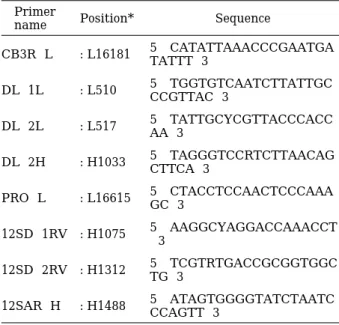
�C, 2분) cycle을 35회 반복하였다. PCR 반응 및 direct sequencing을 위해 8개의primers를 제작하여 사용하였 으며, 그들의 염기서열은Table 2에 나타내었다.
3. Direct sequencing
증폭된 PCR단편은 QIAquick PCR Purification Kits (QIAGEN Co. USA)나 QIAEX II Gel Extraction Kits을 사용하여 정제한 후, Table 2의 적절한 primer와 함께 cycle sequencing을 행하였다. ABI PRISM Dye Termina- tor Cycle Sequencing Ready Reaction Kits (Perkin- Elmer Co., Norwalk, USA)을 사용하여96�C, 10초; 50�C, 5초; 55~60�C, 4분간의 반응을 25회 반복하였으며, 얻 어진 extension products는 에탄올 침전후 automated DNA sequencer (ABI PRISM 377)로 전기영동하였다.
4. 염기서열분석
Direct sequencing에 의해 얻어진 미토콘드리아 DNA control region의 염기서열은 DNASIS ver. 2.5 program Table 1. Species of the subfamily Salmoninae used in
this study
Species Common name No. of Standard fish length (mm)
B. lenok Yolmogi
30 120 to 268 Manchurian trout
O. keta Chum salmon
50 obtained Keta salmon tissue itself O. masou Ishikawa’s cherry
30 239 to 340 ishikawae salmon
O. masou masou Cherry salmon 30 179 to 264 O. mykiss Rainbow trout 30 330 to 390 Albino rainbow
30 92 to 147 trout
(Hitachi Software Engineering Co., Ltd.)으로 정렬하여, maximum parsimony (MP), neighbor joining (NJ), maxi- mum likelihood (ML) 방법으로 계통유전학적 분석을 실 시하였다. PHYLIP version 3.5c package (Felsenstein, 1993)의 DNAPARS, NEIGHBOR 및 DNAML program 을 이용하여 각각의 phylogenetic tree를 결정하였으며, NJ 계통수와 MP 계통수 작성에는 bootstrapping을 1000회 반복하였다. 미토콘드리아DNA control region에 서의 반복서열 및 구조 분석은 Zardoya et al. (1995b), Sbisa et al. (1997) 및 Nesbø et al. (1998)의 자료를 참조 하여 DNASIS ver. 2.5 program을 이용하여 수행하였다. 본 연구에서 얻어진 연어류의 미토콘드리아 DNA con- trol region의 염기서열은 모두 GenBank database에 등 록되어져 있다(Accession number: AF125514~AF 125519).
결 과
조사한 모든 연어류에서 tRNAPro와 tRNAPhe사이에 존 재하는 noncoding control region을 분석한 결과, coding
region에 비해 전환으로 인한 염기치환수가 월등히 높
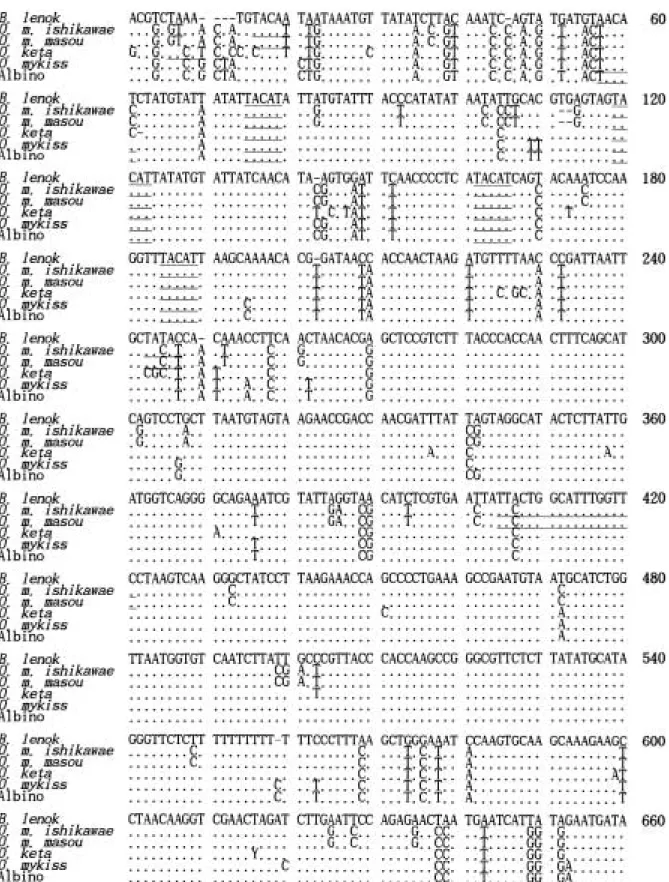
게 나타남을 알 수 있었으며(미토콘드리아 DNA ND6, cytochrome b, rRNA 유전자 영역에 대한 분석, 미발표), 증폭된 control region의 complete sequence는 Fig. 1에
나타내었다. 미토콘드리아 DNA control region은 종간에 서 염기의 삽입이나 결실과 같은 수적증감에 의한 뚜렷 한 길이 변이를 나타내었으며, 본 연구에서는 열목어속 (Brachymystax)의 열목어가 가장 긴 1089 bases, 연어 속(Oncorhynchus)의 산천어와 시마연어는 999 bases, 연어에서는 1002 bases, 무지개송어와 알비노에서는 1003 bases로 조사되었다(Fig. 1).
본 연구에서 얻어진 미토콘드리아 DNA control re- gion은 다른 생물종에서 보고된 것과 같이 뚜렷한A+T rich region으로써, 열목어에서는 그 비율이 최대인 67.22%였으며, 연어속의 산천어와 시마연어는 63.96%, 연어는 64.57%, 무지개송어는 65.11%, 알비노는 65.20%
로 나타났다.
한편 종간의 염기변이에 있어서는, 아종간인 산천어와 시마연어의 염기서열은 100% 일치하였으며, 무지개송어 와 알비노 변이체사이에는 단지3개의 전이(342, 620 및 1050번째 염기)만이 관찰되었다. 반면 열목어속의 열목 어는 연어속의 종과는 뚜렷하게 구별되는, 101개의 염기 치환과 104개의 삽입 및 결실이 조사되어 명백한 속간 의 차이를 확인할 수 있었다. 연어속 어류의 종내특이성 을 나타내는 specific site는 O. masou에서 43개, O. keta 에서 24개, O. mykiss에서 34개의 specific sites가 조사 되었으며, 특히 10번 염기위치에서는 연어속 3종모두에 서 특이적인 염기서열을 나타내었다. 이상의 결과로부터 계산된 종간 염기치환율(%)은 5.42~16.49%이었다 (Table 3).
Table 3. Pairwise sequene divergence estimates (above diagonal) and numbers of substitution (below diagonal) based on control region sequences
species L I M K R A
L - 16.49 16.49 15.14 13.53 13.28
I 146
(94/52) - 0 5.42 7.08 7.08
M 146 0
(94/52) (0/0) - 5.42 7.08 7.08
K 136 52 52
(84/52) (33/19) (33/19) - 5.84 5.84
R 123 67 67 56
(77/46) (46/21) (46/21) (37/19) - 0.03
A 121 67 67 56 3
(75/46) (46/21) (46/21) (37/19) (3/0) - Above diagonal includes pairwise sequence divergence estimates in percentage distances corrected by Kimura’s two-parameter model (1980). Below diagonal includes numbers of total substitu- tions and transition/transversion in parentheses. Species compar- ed: L, Brachymystax lenok; K, Oncorhynchus keta; M, O. masou masou; I, O. masou ishikawae; R, O. mykiss; A, Albino rainbow trout.
Table 2. Primers used for PCR amplification and sequ- encing of mitochondrial control region
Primer
name Position* Sequence
CB3R-L : L16181 5�-CATATTAAACCCGAATGA TATTT-3�
DL-1L : L510 5�-TGGTGTCAATCTTATTGC CCGTTAC-3�
DL-2L : L517 5�-TATTGCYCGTTACCCACC AA-3�
DL-2H : H1033 5�-TAGGGTCCRTCTTAACAG CTTCA-3�
PRO-L : L16615 5�-CTACCTCCAACTCCCAAA GC-3�
12SD-1RV : H1075 5�-AAGGCYAGGACCAAACCT -3�
12SD-2RV : H1312 5�-TCGTRTGACCGCGGTGGC TG-3�
12SAR-H : H1488 5�-ATAGTGGGGTATCTAATC CCAGTT-3�
* The letters L and H refer to the light and heavy strands, res- pectively, and the numbers refer to the positions of the 3�end of the primers in the complete rainbow trout mitochondrial DNA sequence (Zardoya et al., 1995a).
Fig. 1. Control region sequences of mitochondrial DNA from six salmonid species. All sequences were confirmed by at least two sequencing reactions in each direction. Nucleotide polymorphisms are indicated by IUPAC symbols. In each case, the sequence of Brachymystax lenok is shown in full. Dots (∙) denote identical bases; dashes (-), gaps inserted for alignment purposes. Particular features including TASs, CSBs, Tandem repeats are also shown.
Conserved sequences motifs are underlined. Albino represents albino rainbow trout.
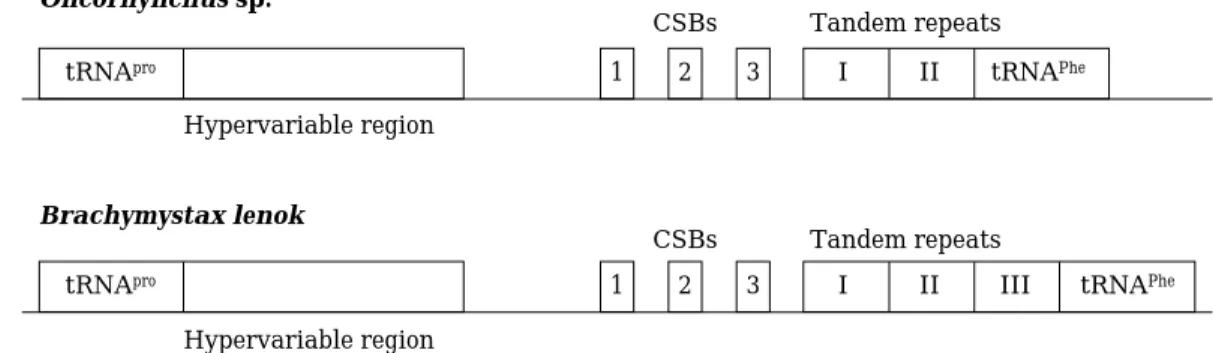
분석된 control region의 염기서열을 구조적 관점에서 살펴보면, 5�말단쪽에 위치한 변이영역에서는 염기치환 에 따른 polymorphic sites를 다수 포함하고 있었으며, 종에 따라 4~6개의 “TACAT ” 배열이 존재하였다. 중앙 의 conserved region을 지나 3�말단쪽에 세 개의 CSBs (conserved sequence blocks)가 관찰되었는데, CSB1은 677~699, CSB2는 752~770, CSB3은 795~812의 위 치에 놓여 있었다. 한편, 3�말단쪽에는 두 가지 종류의 반복서열이 종렬로 배열되어 있었으며, 염기의 조성 및
배열 양상에 있어서 종간 특이성을 나타내었다(Figs. 1, 2). 특히 열목어의 경우, 앞쪽의 반복서열(Type I)이 2 copy로 배열되어 있었으며, 이로인해 연어속 종들과는 현저한 길이차이를 보이게 되는데, 이것은 primers DL- 1L과 DL-2H에 의해 증폭된 PCR 단편의 전기영동 결 과에서도 확연한 차이를 나타낸다(Fig. 3). 두 가지 반복 배열내에서도 염기치환 및 삽입/결실에 의한 종간특이 성이 나타났으며, 각각의 변이위치에 나타나는 염기치환 양상으로부터 열목어-연어속의 연어류(salmons)-연어 Fig. 1. Continued.
속의 송어류(trout)의 grouping이 명확하게 이루어지고 있다. Type I의 경우, 77~81개의nucleotide로 구성되어 있었으며, 943과 955위치에서는 모든 종에서 특이적인 염기를 나타내었으며, 947에서는 연어속의 연어류 종들 에서만 특이적이었고, 무지개송어와 알비노는 3개 위 치(954, 983 및 999)에서 특이적인 염기조성을 나타내었 다. 열목어는 946을 비롯한 15개 위치에서 다른 연어속 종들과 뚜렷하게 구분되었다. 반복서열 중 뒤쪽에 위치
하는 Type II의 경우에서도 종간에 하나 또는 그 이상
의 염기 삽입 및 결실이 나타나는데, 열목어에서는 특징 적으로 보다 긴 “ATTAAGTGTGTTC”의 삽입을 포함하 고 있었다.
Type II내에서, 열목어와 연어속 종간에는 31.25%
(30/96)의 변이를 보이며, 연어속의 연어류 종들은 7개
(1031, 1034, 1036, 1044, 1059, 1064 및 1077)의 위치에 서, 연어속의 송어류 종들은 4개(1035, 1061, 1097 및 1103)의 위치에서 각각 염기특이성을 나타내었다.
고 찰
미토콘드리아 DNA 염기서열 다형성에 관한 연구는 유전학적 및 진화학적 견지에서 그 중요성이 크나, 지금 까지 조사된 것은 전체 genome의 약 3~5%에 지나지 않아, 집단간 비교∙분석 및 계통적 연구 등에 사용할 수 있는 자료는 극히 미비한 실정이다(Hillis et al., 1996). 이에 본 연구에서 조사된 control region의 com- plete sequences는 우리나라 연안에 서식하고 있는 연어 류에 대한 최초의 자료로서, 연안어업자원의 “genetic information bank”의 구축에 도움을 줄 수 있을 것으로 생각된다.
본 연구에서 조사된 종간 변이율은 이전의 미토콘드 리아DNA 다형 및 종간 변이 조사의 결과와 매우 유사 하였다. Grewe et al. (1990)는 미토콘드리아 DNA의 제 한효소분석을 통해 연어아목의 곤들매기속(Salvelinus) 과 자치속(Hucho)간에는 6.53~9.01%의 변이가 존재하 며, 곤들매기속내 아종간에는 2.70~4.25%의 변이가 존 재한다 하였다. Beckenbach (1991)는 연어아목 어류에 관한 review를 통해서 종간의 sequence divergence가 6.8% (O. tschawytscha와 O. kisutch간)에서 16.3% (O.
mykiss와 O. gorbuscha간)사이의 범위를 나타낸다고 하 였으며, McVeigh and Davison (1991)은 8종의 연어아목 의 cytochrome b유전자 영역의 종간변이율이 4.07~ 17.29%라고 보고하였다. 최근 연어속(Oncorhynchus) 종 들간의 D-loop 염기서열에서의 계통유전학적 연구에서, 종간 sequence divergences가 연어와 시마연어간에는 0.0640, 무지개송어와 연어 및 시마연어간에는0.0430으 로 보고된 바 있다(Kitano et al., 1997). 그러나Martin Oncorhynchus sp.
CSBs Tandem repeats
Hypervariable region
Brachymystax lenok
CSBs Tandem repeats
Hypervariable region
Fig. 2. Schematic diagram of the salmonid mtDNA control region. Conserved sequence elements and tRNAs are indicated by boxes.
tRNApro
tRNApro I II III tRNAPhe
I II tRNAPhe
3 3
2 2
1 1
Fig. 3. Amplif ied fragments produced by primers DL-1L and DL-2H. Lane M, 1 Kb molecular size marker (BRL / Gibco); Lane 1, B. lenok; Lane 2, O. masou ishikawae; Lane 3, O. masou masou; Lane 4, O.
keta; Lane 5, O. mykiss; Lane 6, Albino rainbow trout.
et al. (1992)은 Armorhead, Pseudopentaceros wheeleri에 서의 restriction analysis에서 D-loop 영역에서의 평균 염기치환율이 CO I에서의 변이에 비해 10배나 높게 나 타났다고 보고하였으며, 미토콘드리아 모든 영역 중에서 control region은 종내에서 변이율이 가장 높으며 가장 빠른 진화속도를 보인다는 일반적인 특징을 고려할 때 이러한 종간변이율은 전체 genome의 평균치에 지나지 않는다. 한편, 미토콘드리아 DNA control region의 구조 적인 특징을 고려해 볼 때, 많은 척추동물에서 기능적으 로 중요한 conserved element들이 보고되었으며, 본 연 구에서도 몇가지의 conserved sequences가 구조적으로 고정되어 있는 것으로 조사되었다(Desjardins and Morais, 1990). 따라서 미토콘드리아 DNA control region 의 염기치환율이 다른 coding region의 염기치환율과 크 게 차이나지 않는 것은 control region내에 존재하는 보 존적 영역으로 인해 변이가 심한 영역에서 나타나는 상 대적으로 높은 염기치환율이 상쇄되었기 때문인 것으로 사료되어진다.
Tandem repeat에 의한 mtDNA 길이변이에 관해서는, American shad에서 비교적 긴 1.5 Kbp의 반복에 의한 길이변이(Bentzen et al., 1988), 담수어인 Cyprinella spiloptera에서 260 bp의 반복(Broughton and Dowling, 1994) 및 철갑상어에서 78~82 bp 염기서열의 반복으로 인한 길이변이(Brown et al., 1996) 등이 보고된 바 있다. 또한, Árnason and Rand (1992)는 Atlantic cod (Gadus morhua)에서 40 bp 종렬 반복을 조사하였으며, Nesbø et al. (1998)은 percid mtDNA에서 비교적 짧은 10 bp의 반 복서열에 의한 종간∙속간 길이변이를 보고한 바 있다. 한편, Turner (1997)는 Percidae의 control region의 염기
서열분석을 통해 tandem repeats의 반복수와 염기 조성 에 따른 계통분류와darter의 속 및 아속집단들의 형태 적 분류가 일치함을 보고하였다. 본 연구에서도 종간에 뚜렷한 길이 변이가 나타났는데, 연어속에 속하는 종들 간의 길이변이는 몇몇 염기치환과 삽입∙결실에 의한 것이었으나, 열목어와 그외 연어속의 종간에 나타나는 길이차의 주요 원인은 3�말단의81 bp 영역의 반복수에 의한 것으로 조사되었다. 이러한 반복서열의 염기조성은 뚜렷한 종간특이성을 보이고 있어 연어아과 어류의 표 지인자로써 사용되어질 수 있으리라 사료되어진다.
연어과는 수산분야에서의 가장 많은 연구가 이루어진 분류군중의 하나이나, 이들의 계통적 유연관계에 관한 기존의 연구들은 자료에 따라 상충되는 결과를 보고하 고 있다. 이에 따라, 지금까지도 진화학적∙분류학적으 로 해결되지 않은 몇가지 문제를 안고 있으며, 그 중 가 장 대표적인 것이 시마연어의 계통적 유연관계에 관한 것이다. 시마연어의 계통학적 분류에 관해서는, 형태학적 인 연구(Stearley and Smith, 1993) 및 미토콘드리아 DNA의 염기서열분석(Thomas and Beckenbach, 1989;
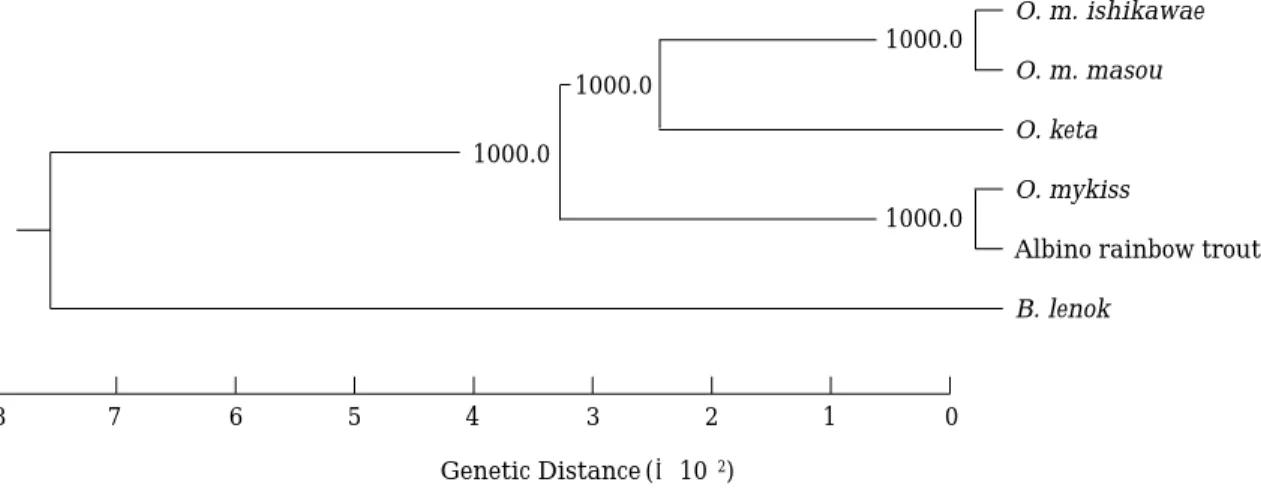
Kitano et al., 1997), 미토콘드리아 DNA의 RFLPs (res- triction fragment length polymorphisms) 분석(Thomas et al., 1986) 및 핵 DNA 염기서열분석(Murata et al., 1996; Domanico et al., 1997)에서는 태평양 연어류 (Pacif ic salmon; 연어, 왕연어 및 은연어)에 더 근연이라 고 밝히고 있다. 본 연구에서도, 3�말단 반복서열의 염 기조성 및 배열에 관한 분석을 통해 시마연어와 산천어 가 연어와 묶이게 되는 것을 알 수 있었으며, 각각의 염 기서열자료로부터 계통수를 작성해서 이들 종간의 진화 적인 유연관계를 살펴본 결과에서도, PHYLIP program
O. m. ishikawae
1000.0
1000.0
O. m. masou
1000.0 O. keta
O. mykiss 1000.0
Albino rainbow trout B. lenok
8 7 6 5 4 3 2 1 0
Genetic Distance (×10-2)
Fig. 4. Phylogenetic tree for six salmonines based on mitochondrial control region sequences. The numbers at the forks indicate the number of times the group consisting of the species which are to the right of that fork occurred among the trees, out of 1000 trees.
에서 얻어진 세 계통수에서 약간의 차이는 있었으나, 시 마연어가 무지개송어보다는 연어와 더 근연임을 나타내 었다(Fig. 4). 그러나, 동위효소분석(Utter et al., 1973), ribosomal DNA (rDNA) RFLPs 분석(Phillips et al., 1992) 및 growth hormone 2의 D intron (GH2D) 염기서 열분석(McKay et al., 1997)에서는 태평양 송어류(Paci- fic trout; 무지개송어와 Oncorhynchus clarki)에 더 가깝 다는 상반된 결과들을 보고하고있다. 시마연어는 한국, 일본을 비롯한 아시아에만 국소적으로 분포하는데 (Kitano et al., 1997; McKay et al., 1997), 이러한 분포상 의 특징으로 인해 그 계통적 연구에서 아시아쪽 자료가 절실히 요구되고 있으나, 그 실적은 미흡한 실정이다. 앞 으로 연어과 어류의 유연관계를 밝히는데 본 연구 결과 가 크게 도움이 될 수 있을 것으로 생각되어지며, 시마 연어의 계통분류학적인 위치를 명확히 규명하기 위해서 는 더 많은 자료가 보충되어져야 할 것이다.
적 요
열목어를 비롯한 산천어, 시마연어, 연어, 무지개송어 등 우리나라 연어아과 어류의 미토콘드리아 DNA con- trol region의 염기서열 조성 및 구조적 변이를 비교∙
분석하였다.
열목어속의 열목어는 연어속의 종들과 다수의 염기치 환 및 삽입/결실에 의해 뚜렷하게 구별되었으며, 연어속 어종간에는 5.42~16.49%의 염기치환율을 나타내었다. 한편, 산천어와 시마연어의 염기서열은 100% 일치하였 으며, 무지개송어와 알비노사이에는 단지 3개의 전이만 이 관찰되었다.
3�말단쪽에 77~96 bp의 반복서열이 종렬배열되어 종간에 뚜렷한 길이변이를 나타내었는데, 특히 열목어에 서는 특징적으로 81 bp 영역이 2 copy로 배열되어 있었 다. 각각의 반복서열상의 염기조성에 있어서도 종간 특 이성을 나타내었으며, 이러한 control region에서의 염기 변이는 연어아과 어류의 표지인자로써 유용하게 사용되 어질 수 있으리라 사료되어진다.
사 사
본 연구는 해양수산부 수산특정연구과제 연구비에 의 해 수행되었음.
참 고 문 헌
Árnason, E. and D.M. Rand. 1992. Heteroplasmy of short
tandem repeats in mitochondrial DNA of Atlantic cod, Gadus morhua. Genetics, 132 : 211~220.
Beckenbach, A.T. 1991. Rapid mtDNA sequence analysis of fish populations using polymerase chain reaction (PCR). Can. J. Fish. Aquat. Sci., 48 (Suppl. 1) : 95~98.
Bentzen, P., W.C. Leggett and G.C. Brown. 1988. Length and restriction site heteroplasmy in the mitochondrial DNA of American shad (Alosa sapidissima). Genetics, 118 : 509~518.
Broughton, R.E. and T.E. Dowling. 1994. Length variation in mitochondrial DNA of the minnow Cyprinella spilop- tera. Genetics, 138 : 179~190.
Brown, J.R., K. Beckenbach, A.T. Beckenbach and M.J.
Smith. 1996. Length variation, heteroplasmy and se- quence divergence in the mitochondrial DNA of four species sturgeon (Acipenser). Genetics, 142 : 525~535.
Carr, S.M. and H.D. Marshall. 1991. A direct approach to the measurement of genetic variation in fish popula- tions : Applications of the polymerase chain reaction to studies of Atlantic cod, Gadus morhus L. J. Fish Biol., 39 (Suppl. A) : 101~107.
Chapman, R.W. and D.A. Powers. 1984. A method for the rapid isolation of mitochondrial DNA from fishes.
Maryland Sea Grant College University of Maryland 1222, H.J. Partterson Hall College Park, MD 20742 UM-SG-TS-84, pp. 1~11.
Desjardins P. and R. Morais. 1990. Sequence and gene organization of the chicken mitochondrial genome : A novel gene order in higher vertebrates. J. Mol. Biol., 212 : 599~634.
Doda, J.N., C.T. Wright and D.A. Clayton. 1981. Elonga- tion displacement-loop strands in human and mouse mitochondrial DNA is arrested near specific template sequences. Proc. Natl. Acad. Sci. USA, 78(10) : 6116~
6120.
Domanico, M.J., R.B. Phillips and T.H. Oakley. 1997.
Phylogenetic analysis of Pacific salmon (genus Oncorh- ynchus) using nuclear and mitochondrial DNA sequen- ces. Can. J. Fish. Aquat. Sci., 54 : 1865~1872.
Felsenstein, J. 1993. PHYLIP (Phylogeny Inference Pack- age), version 3.5c. Department of Genetics, University of Washington, Seattle.
Grewe, P.M., N. Billington and P.D.N. Hebert. 1990. Phy- logenetic relationship among members of Salvelinus inferred from mitochondrial DNA divergence, Can. J.
Fish. Aquat. Sci., 47 : 984~991.
Hillis, D.M., C. Moritz, B.K. Mable (Eds.). 1996. Molecular Systematics. Sinauer Associates, Inc. Sunderland, Ma- ssachussetts.
Kimura, M. 1980. A simple method for estimating evolu-
tionary rate of base substitutions through comparative studies of nucleotide sequences. J. Mol. Evol., 16 : 111~
120.
Kitano, T., N. Matsuoka and N. Saitou. 1997. Phylogenetic relationship of the genus Oncorhynchus species inferr- ed from nuclear and mitochondrial markers. Genes Genet. Syst., 72 : 25~34.
Martin, A.P., R. Humphreys and S.R. Palumbi. 1992. Popu- lation genetic structure of the Armorhead, Pseudopen- taceros wheeleri, in the North Pacif ic Ocean: Applica- tion of the Polymerase Chain Reaction to f isheries pro- blems. Can. J. Fish. Aquat. Sci., 49 : 2386~2391.
McKay, S.J., M.J. Smith and R.H. Devlin. 1997. Polyme- rase chain reaction-based species identification of sal- mon and coastal trout in British Columbia. Mol. Mar.
Biol. & Biotech, 6(2) : 131~140.
McVeigh, H.P. and W.S. Davidson. 1991. A salmonid phy- logeny inferred from mitochondrial cytochrome b gene sequences, J. Fish Biol., 39(Suppl. A) : 277~282.
Murata, S., N. Takasaki, M. Saitoh, H. Tachida and N.
Okada. 1996. Details of retropositional genome dyna- mics that provide a rationale for a generic division : The distinct branching of all the Pacific salmon and trout (Oncorhynchus) from the Atlantic salmon and trout (Salmo). Genetics, 142 : 915~926.
Nesbø, C.L., M.O. Arab and K.S. Jakobsen. 1998. Hetero- plasmy, length and sequence variation in the mtDNA control regions of three percid fish species (Perca fluvi- atilis, Acerina cernua, Stizostedion lucioperca). Gene- tics, 148 : 1907~1919.
Phillips, R.B., K.A. Pleyte and M.R. Brown. 1992. Salmonid phylogeny inferred from ribosomal DNA restriction maps. Can. J. Fish. Aquet. Sci., 49 : 2345~2353.
Saccone, C., G. Pesole and E. Sbisa. 1991. The main regul- atory region of mammalian mitochondrial DNA: struc- ture-function model and evolutionary pattern. J. Mol.
Evol., 33(1) : 83~91.
Sbisa, E., F. Tanzariello, A. Reyes, G. Pesole and C. Sac- cone. 1997. Mammalian mitochondrial D-loop region structural analysis: Identification of new conserved se- quences and their functional and evolutionary impli- cations. Gene, 205 : 125~140.
Stearley, R.F. and G.R. Smith. 1993. Phylogeny of the Pacific trouts and salmons (Oncorhynchus) and genera of the family Salmonidae. Transactions of the American Fisheries Society, 122 : 1~33.
Thomas, W.K. and A.T. Beckenbach. 1989. Variation in salmonid mitochondrial DNA : Evolutionary constraints and mechanisms of substitution. J. Mol. Evol., 29 : 233
~245.
Thomas, W.K., R.F. Withler and A.T. Beckenbach. 1986.
Mitochondrial DNA analysis of Pacific salmonid evolu- tion. Can. J. Zool., 64 : 1058~1064.
Turner, T.F. 1997. Mitochondrial control region sequences and phylogenetic systematics of Darters (Teleostei : Percidae). Copeia (1997), 2 : 319~338.
Utter, F.M., F.W. Allendorf and H.O. Hodgins. 1973.
Genetic variability and relationships in Pacific salmon and related trout based on protein variations. Syst.
Zool., 22 : 257~270.
Zardoya, R., A. Garrido-Pertierra and J.M. Bautista.
1995a. The complete nucleotide sequence of the mito- chondrial DNA genome of the rainbow trout, Oncorhyn- chus mykiss. J. Mol. Evol., 41(6) : 942~951.
Zardoya, R., M. Villalta, M.J. López-Pérez, A. Garrido- Pertierra, J. Montoya and J.M. Bautista. 1995b. Nuc- leotide sequence of the sheep mitochondrial DNA D- loop and its f lanking tRNA genes. Curr. Genet., 28 : 94
~96.
Zhu, D., B.G.M. Jamieson, A. Hugall and C. Moritz. 1994.
Sequence evolution and phylogenetic signal in control region and cytochrome b sequences of rainbowf ishes (Melanotaeniidae). Mol. Biol. Evol., 11 : 672~683.
Received September 15, 1999 Accepted November 2, 1999