Vol. 28, No. 5 (2018)
268
Interfacial Properties of Atomic Layer Deposited Al
2O
3/AlN Bilayer on GaN
Hogyoung Kim
1†, Dong Ha Kim
2and Byung Joon Choi
21Department of Visual Optics, Seoul National University of Science and Technology(Seoultech), Seoul 01811, Republic of Korea
2Department of Materials Science and Engineering, Seoul National University of Science and Technology(Seoultech), Seoul 01811, Republic of Korea
(Received March 21, 2018 : Revised April 13, 2018 : Accepted April 17, 2018)
Abstract
An Al2O3/AlN bilayer deposited on GaN by atomic layer deposition (ALD) is employed to prepare Al2O3/AlN/GaN metal-insulator-semiconductor (MIS) diodes, and their interfacial properties are investigated using X-ray photoelectron spectroscopy (XPS) with sputter etch treatment and current-voltage (I-V) measurements. XPS analyses reveal that the native oxides on the GaN surface are reduced significantly during the early ALD stage, indicating that AlN deposition effectively clelans up the GaN surface. In addition, the suppression of Al-OH bonds is observed through the ALD process. This result may be related to the improved device performance because Al-OH bonds act as interface defects. Finally, temperature dependent I-V analyses show that the barrier height increases and the ideality factor decreases with an increase in temperature, which is associated with the barrier inhomogeneity. A Modified Richardson plot produces the Richardson constant of A** as 30.45 Acm−2K−2, which is similar to the theoretical value of 26.4 Acm−2K−2 for n-GaN. This indicates that the barrier inhomogeneity appropriately explains the forward current transport across the Au/Al2O3/AlN/GaN interface.Key words
Al2O3/AlN bilayer, native oxides, Al-OH bonds, barrier inhomogeneity.1. Introduction
GaN is a promising material for the applications to electronic devices such as high-power, high-temperature and high-frequency devices because of its large band gap, high electron saturation velocity, and high breakdown field.
1,2)Successful realization of these devices strongly requires Schottky contacts with low reverse current and ohmic contact with low contact resistance. There have been various researches on the metal-insulator-semicon- ductor(MIS) Schottky diodes in order to obtain lower leakage current and higher rectification ratio.
3-8)High per- formance metal-oxide-semiconductor field effect transistors (MOSFETs) can also be realized by combining GaN with high-k dielectric materials such as Al
2O
3.
9)However, high interface trap density in Al
2O
3/GaN interface is known to be a big problem in device performance,
10)which requires to minimize the interface trap density.
As a new passivation method in AlGaN/GaN device,
atomic layer deposition(ALD) grown AlN layer has been studied due to its good isolation stability and high inter- face quality in AlGaN/GaN.
11-13)Huang et al. suggested in GaN on Si with Al
2O
3/AlN dielectric stack that high- density positive fixed charges induced by AlN thin film can compensate the acceptor-like interface traps, resulting in effective suppression of current collapse.
11)The AlN passivation effect was found to be more significant in the interface properties in Al
2O
3/GaN for m-plane GaN as compared to c-plane GaN.
12)In our previous work, we applied ultrathin AlN layer to Al
2O
3/GaN using ALD and investigated the interfacial and electrical properties of Al
2O
3/AlN/GaN MIS diodes with different Al
2O
3thick- nesses and found that Al
2O
3thickness is a key factor in device performance.
13)However, we did not analyze the X-ray photoelectron spectroscopy(XPS) characteristics at different etch depths and current-voltage(I-V) characteristics were obtained at room temperature only. In this respect, we investigated the interfacial properties using XPS at
†Corresponding author
E-Mail : [email protected] (H. Kim, Seoultech)
©Materials Research Society of Korea, All rights reserved.
This is an Open-Access article distributed under the terms of the Creative Commons Attribution Non-Commercial License (http://creative- commons.org/licenses/by-nc/3.0) which permits unrestricted non-commercial use, distribution, and reproduction in any medium, provided the original work is properly cited.
different etch depths and the temperature dependent current transport to get the detailed interfacial formation mechanism in Au/Al
2O
3/AlN/GaN MIS diodes.
2. Experimental
Hydride vapor phase epitaxy(HVPE)-grown, c-plane (0001) bulk GaN wafer(thickness: 300 μm, carrier con- centration: 5 × 10
14cm
−3) purchased from Lumilog. was used in this work. The wafer was cut into small pieces and some of them were loaded into an ALD chamber after cleaning process. Then, the temperature was ramped up to 350
oC to deposit 1 nm thick AlN layer using Trimethylaluminum(TMA) and NH
3as precursors. After that, the temperature was reduced to 250
oC to grow 5 nm thick Al
2O
3layer using TMA and H
2O as precursors.
The thicknesses of AlN and Al
2O
3films on the Si witness samples were measured using a FS-1 multi-wavelength ellipsometers, acquiring ellipsometric ψ(amplitude ratio) and Δ(phase angle) data at 4 wavelengths across the visible spectrum: 465, 525, 580, and 635 nm. Measured data were fitted using a least-squares algorithm. In other words, the agreement between the experimentally mea- sured and the calculated ellipsometric data was quantified by the Fit Difference, summed over all 4 measurement wavelengths. To observe the formation mechanism near the Al
2O
3/AlN/GaN interface, XPS measurements with sputter etch treatment were performed using a mono- chromatic Al Kα x-ray source(1486.6 eV). The collected data at three different etch depths(interval: 1 nm) were analyzed with the multiple Gaussian functions. For Schottky contacts, 50 nm thick Au metal films were deposited by using electron beam evaporation through a shadow mask.
For substrate back contacts, 100 nm thick Al metal was deposited using electron beam evaporation and In metal was rubbed over the entire back surface to attach the samples on the Cu plate. Temperature dependent current- voltage(I-V-T) measurements were carried out with a Keithley 238 current source after placing samples on a hot chuck connected with a temperature controller.
3. Results and Discussion
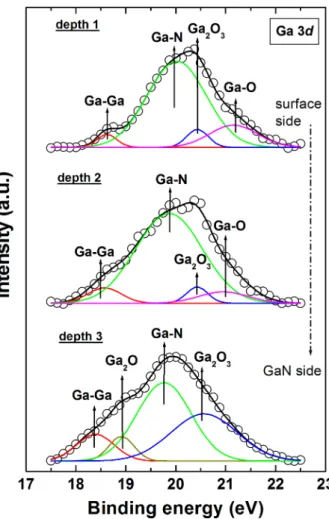
Fig. 1 shows the Ga 3d core level spectra near the Al
2O
3/AlN/GaN interface. The peaks were decomposed into four components. The main peak at ~19.8 eV is associated with Ga-N.
14)The peaks at ~18.5 eV, ~19.0 eV and ~20.5 eV can be attributed to metallic Ga(Ga-Ga), Ga
2O and Ga
2O
3, respectively.
15)The additional peak at higher energy(~21.0 eV) was assigned to the oxide in Ga-O bonds.
16)This peak also will be related with Ga in Ga
2O
3.
17)The integrated intensity ratios of Ga-O/Ga-N were calculated to be 0.29, 0.28, and 0.88, respectively,
for the depths 1, 2, and 3 (i.e., deeper from the surface).
This indicates that Ga
2O and Ga
2O
3are present signifi- cantly near the AlN/GaN interface, resulted from the Ga native oxide on GaN surface. During the ALD deposition process, these Ga-O bonds might be removed due to the self-cleaning effect through ALD process. Brennan et al.
investigated the initial stage of Al
2O
3growth on AlGaN surface by XPS and suggested that Al
2O
3, Ga
2O
3, and N- O states present initially were reduced during the course of the deposition process.
18)In addition, similar values for depths 1 and 2 imply that such reduction of Ga-O bonds occurred during the earlier ALD growth stage.
This clearly indicates the removal of native oxide on GaN surface by AlN layer.
Fig. 2 shows the Al 2p core level spectra, which are deconvoluted into four components. The main peak at
~75.0 eV are associated with Al
2O
3.
10)The peak at higher
binding energy(~76.0 eV) corresponds to the Al(OH)
3state
10,19)and the peak at ~73.5 eV is related with AlN.
20)By increasing rapid thermal annealing(RTA) temperature,
the Al(OH)
xconcentration was found to decrease in Al
2O
3/
AlGaN/GaN high electron mobility transistor(HEMT),
Fig. 1. Ga 3d core level spectra at different etch depths.which suppressed the threshold voltage(V
th) shift.
21)Hence, the removal of Al-OH bonds is beneficial in device performance. The presence of Al-OH is possible during the Al
2O
3growth using TMA and H
2O as precursors because some of hydroxyl groups are incompletely re- moved during the reaction cycle. The integrated intensity ratios of Al-OH/Al
2O
3were calculated to be 0.50, 0.72, and 1.92, respectively, for the depths 1, 2, and 3. This implies that the removal of hydroxyl groups were accel- erated as the Al
2O
3growth proceeded. Additionally, the peak at ~74.5 eV may be due to the formation of unstable defective oxide such as Al
2O and AlO acting as interface states.
10)The peak may also be associated with the Al-O-N bonds,
22)which can occur due to the presence of diffused N atoms.
Fig. 3 shows the O 1s core level spectra, which are deconvoluted into three or four components. The peak at 531.7-532.0 eV is associated with Al
2O
3.
23)The peaks at
~530.7 eV and ~531.0 eV are associated with Ga-O bonding in Ga
2O
3,
24,25)which might be due to the diffusion of Ga atoms into Al
2O
3layer. The peaks observed at
higher energy(532.7-533.6 eV) can be associated with Al-OH.
26)The integrated intensity ratios of Al-OH/Al
2O
3were calculated to be 0.26, 1.95, and 2.56, respectively, for the depths 1, 2, and 3, showing the same trend as obtained from the Al 2p core level spectra. This again
Fig. 2. O 1s core level spectra at different etch depths.Fig. 3. Al 2p core level spectra at different etch depths.
Fig. 4. (a) Semilogarithmic forward I-V characteristics at different temperatures and (b) obtained barrier height and ideality factor as a function of temperature.
indicates that the generation of Al-OH related defects were suppressed during the Al
2O
3growth process.
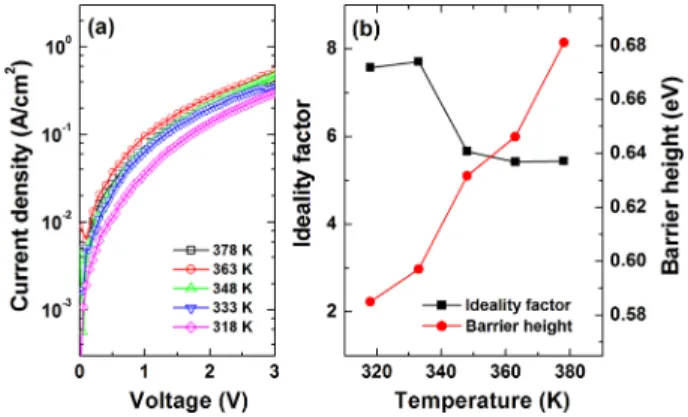
Fig. 4(a) shows the forward I-V curves measured at different temperatures. Based on the thermionic emission (TE) model,
27)the temperature dependences of the barrier height and the ideality factor has been obtained, which is shown in Fig. 4(b). The ideality factor is much larger than unity, indicating that the tunneling current across the Al
2O
3/AlN bilayer is significant. The barrier height in- creased and the ideality factor decreased with increasing the temperature. Such temperature dependence is associated with lateral Schottky barrier inhomogeneity.
26)According to inhomogeneous barrier model,
27)the temperature de- pendent effective barrier height( φ
B) is related with a zero- bias mean barrier height( φ
B) and a standard deviation( σ
0) as φ
B= φ
B− qσ
02/2kT. The linear fits to the plots of φ
Bvs.
1/2kT shown in Fig. 5(a) yielded the values of φ
B= 1.182 eV and σ
0= 0.182 V. Fig. 5(b) shows the modified Richardson plots of ln(I
0/T
2) − q
2σ
02/2k
2T
2vs. 1/kT. The intercepts at the ordinate produced the Richardson constant of A
**as 30.45 Acm
−2K
−2, which is similar to the theor- etical value of 26.4 Acm
−2K
−2for n-GaN, indicating that the barrier inhomogeneity is appropriate to explain the current transport.
Growth of AlN interfacial layer between Al
2O
3/GaN layers are reported to block effectively oxygen from the GaN surface and prevent the formation of detrimental Ga-O bonds, enhancing the device performance.
28)In-situ N
2plasma cleaning, consisting of alternating cycles of N
2plasma and TMA prior to Al
2O
3deposition was found to passivate Al
2O
3/GaN interface states effectively, which was correlated with the suppression of Ga-O bonds and the formation of an aluminum oxynitride interfacial layer.
29)N
2plasma pretreatment was also found to remove the native oxide on the III-N surface by forming an ultrathin monocrystal-like nitridation interlayer between Al
2O
3and III-N surface.
30)Gao et al. investigated the effect of TMA,
H
2O and Ar/N
2plasma pretreatment on the interfacial properties of Al
2O
3/GaN and found that TMA and H
2O pretreatment had trivial effects on interface engineering whereas Ar/N
2plasma pretreatment slightly reduced in- terfacial trap density and significantly reduced the border trap density.
31)Gu et al. reported that a two-step pretreatment, combining wet sulfide passivation with in- situ cyclic TMA/H
2plasma exposure, was beneficial in reducing both interface and border traps for Al
2O
3/ GaN.
32)From the XPS analyses, we also observed the removal of native oxide and the suppression of Al-OH bonds by AlN deposition. However, still the amount Ga- O and Al-OH bonds in Al
2O
3cannot be negligible as seen from XPS data. These defects might increase the tunneling current significantly. Therefore, we expect that TMA/N
2plasma pretreatment prior to AlN deposition will improve the Al
2O
3/GaN interfacial quality further.
4. Conclusion
We investigated the interfacial properties of Al
2O
3/ AlN/GaN MIS diodes prepared by ALD. Based on the XPS analyses, it was found that the reduction of native oxides on GaN surface and the suppression of Al-OH bonds occurred, especially during the ALD early stage which corresponds to AlN deposition. The results indicate that AlN layer effectively blocked the formation of Ga-O and Al-OH bonds in Al
2O
3layer. Temperature dependent I-V analyses revealed the barrier height increase with the temperature, which were associated with the lateral barrier inhomogeneity.
Acknowledgments
This study was supported by the Research Program funded by the Seoul National University of Science and Technology(Seoultech).
References
1. S. Strite and H. Morkoc, J. Vac. Sci. Technol., B, 10, 1237 (1992).
2. S. Pearton, J. Zolper, R. Shul, and F. Ren, J. Appl. Phys., 86, 1 (1999).
3. K. Chang, C. Cheng, and C. Lang, Solid State Electron., 46, 1399 (2002).
4. Q. Wang, X. Cheng, L. Zheng, L. Shen, J. Li, D. Zhang, R. Qian, and Y. Yu, RSC Adv., 7, 11745 (2017).
5. X. Liu, S. Zhao, L. Zhang, H. Huang, J. Shi, C. Zhang, H. Lu, P. Wang, and D. Zhang, Nanoscale Res. Lett., 10, 109 (2015).
6. X. Lu, J. Ma, Z. Liu, H. Jiang, T. Huang, and K. Lau, Phys. Status Solidi A, 211, 775 (2014).
7. B. Lakshmi, M. Reddy, A. Kumar, and V. Reddy, Curr.
Fig. 5. (a) Plot of barrier height vs. 1/kT and (b) modified Richardson plot of ln(I0/T2)− q2σ02
/2k2T2 vs. 1/kT.
Appl. Phys., 12, 765 (2012).
8. Y. Chang, H. Chiu,Y. Lee, M. Huang, K. Lee, Y. Chiu, Y. Wang, J. Kwo, and M. Hong, Appl. Phys. Lett., 90, 232904 (2007).
9. D. Ye, B. Yang, K. Ng, J. Bude, G. Wilk, S. Halder, and J. Hwang, Appl. Phys. Lett., 86, 063501 (2005).
10. H. Kang, M. Reddy, D. Kim, K. Kim, J. Ha, H. Choi, and J. Lee, J. Phys. D: Appl. Phys., 46, 155101 (2013).
11. S. Huang, Q. Jiang, S. Yang, Z. Tang, and K. Chen, IEEE Electron Dev. Lett., 34, 193 (2013).
12. X. Wu, R. Liang, L. Guo, L. Lei, L. Xiao, S. Shen, J.
Xu, and J. Wang, Appl. Phys. Lett., 109, 232101 (2016).
13. H. Kim, D. Kim, and B. Choi, Appl. Phys. A, 123, 800 (2017).
14. J. Ma, B. Garni, N. Perkins, W. O’Brien, T. Kuech, and M. Lagally, Appl. Phys. Lett., 69, 3351 (1996).
15. R. Carli and C. Bianchi, Appl. Surf. Sci., 74, 99 (1994).
16. A. Chanda, S. Verma, and C. Jacob, Bull. Mater. Sci., 30, 561 (2007).
17. R. Suri, D. Lichtenwalner, and V. Misra, Appl. Phys.
Lett., 96, 112905 (2010).
18. B. Brennan, X. Qin, H. Dong, J. Kim, and R. Wallace, Appl. Phys. Lett., 101, 211604 (2012).
19. R. Li, Y. Zhao, R. Hou, X. Ren, S. Yuan, Y. Lou, Z.
Wang, D. Li, and L. Shi, J. Photochem. Photobiol., A, 319, 62 (2016).
20. M. Alevli, C. Ozgit, I. Donmez, and N. Biyikli, Phys.
Status Solidi A, 209, 266 (2012).
21. S. Ozaki, T. Ohki, M. Kanamura, T. Imada, N. Nakamura, N. Okamoto, T. Miyajima, and T. Kikkawa, CS
MANTECH Conf. Apr. 23rd - 26th, 2012, Boston, USA 22. L. Rebouta, A. Sousa, M. Andritschky, F. Cerqueira, C.
Tavares, P. Santilli, and K. Pischow, Appl. Surf. Sci., 356, 203 (2015).
23. C. Hinkle, A. Sonnet, F. Vogel, S. McDonnell, G.
Hughes, M. Milojevic, B. Lee, F. Aguirre-Tostado, K.
Choi, H. Kim, J. Kim, and R. Wallace, Appl. Phys. Lett., 92, 071901 (2008).
24. W. Wei, Z. Qin, S. Fan, Z. Li, K. Shi, Q. Zhu, and G.
Zhang, Nanoscale Res. Lett., 7, 562 (2012).
25. C. Negrila, M. Lazarescu, C. Logofatu, C. Cotirlan, R.
Ghita, F. Frumosu, and L. Trupina, J. Nanomater., 2016, 7574526 (2016).
26. M. Alexander, G. Thompson, and G. Benmson, Surf.
Interface Anal., 29, 468 (2000).
27. R. Tung, Mater. Sci. Eng. R, 35, 1 (2001).
28. S. Liu, S. Yang, Z. Tang, Q. Jiang, C. Liu, M. Wang, B.
Shen, and K. Chen, Appl. Phys. Lett., 106, 051605 (2015).
29. J. Son, V. Chobpattana, B. McSkimming, and S. Stemmer, J. Vac. Sci. Technol. A, 33, 020602 (2015).
30. S. Yang, Z. Tang, K. Wong, Y. Lin, C. Liu, Y. Lu, S.
Huang, and K. Chen, IEEE Electron Dev. Lett., 34, 1497 (2013).
31. J. Gao, W. Li, S. Mandal, and S. Chowdhury, Proc. SPIE 10381, Wide Bandgap Power Devices and Applications II, 1038103 (2017).
32. S. Gu, E. Chagarov, J. Min, S. Madisetti, S. Novak, S.
Oktyabrsky, A. Kerr, T. Kaufman-Osborn, A. Kummel, and P. Asbeck, Appl. Surf. Sci. 317, 1022 (2014).