서 론
크고 작은 산맥들이 많은 우리나라의 지형적 특성은 담수어 류의 종 내 또는 종 간에 다양한 형태적, 유전적 변이를 초래하 며, 종분화에 중요한 역할을 하는 것으로 알려져 있다(Kim et
al., 2003; Kim et al., 2006; Kim and Song, 2011; Song et al.,
2017; Yoon et al., 2018). 일차담수어의 경우 생리학적 특성상 바다를 통해 인접 하천 간 능동적 이동 분산은 거의 불가능하 며, 이로 인한 유전적 교류의 단절은 수계별 고유한 유전적 특성을 유지하는 데 매우 중요한 역할을 한다(Kim, 1997; Song and Park, 2006; Song et al., 2017). 특히, 동해 독립하천에 분포하는 담수어는 생물지리학적으로 독특한 특성을 보유하고 있어 이들 의 종다양성 및 유전적 다양성 연구는 우리나라 어류 자원의 보 존 연구에 중요한 기초자료를 제공한다(Kim et al., 2003).
잉어목 Cypriniformes 종개과 Nemacheilidae에 속하는 저서 성 일차담수어인 종개속(genus Barbatula) 어류는 유럽과 북부 아시아에 20여 종 이상이 알려져 있으며(Kottelat and Freyhof, 2007), 우리나라에는 종개 B. toni(Dybowski, 1869)와 대륙종 개
B. nuda
(Bleeker, 1864)의 2종이 분포한다(Kim and Park, 2002; Kim et al., 2005; NIBR, 2019). 이들은 동해 독립하천을 포함하여 한반도 중부 이북의 여러 하천에 서식하고 있으며, 특—107 — http://www.fishkorea.or.kr 저자 직위: 안정현(전문위원), 유정남(선임연구원), 김병직(환경연구관),
배양섭(교수)
* Corresponding author: Yang-Seop Bae Tel: 82-32-835-8246, Fax: 82-32-835-0763, E-mail: [email protected]
ISSN: 1225-8598(Print), 2288-3371(Online). DOI: https://doi.org/10.35399/ISK.33.2.7
Accepted June 10 2021
한국산 종개속 (Barbatula) 어류의 유전적 다양성 특성 연구
안정현1,2·유정남3·김병직2·배양섭1,4,
*
1인천대학교 생물학과, 2국립생물자원관 생물자원연구부, 3국립낙동강생물자원관 다양성연구팀,
4인천대학교 생물자원환경연구소
Genetic Diversity and Relationship of the Genus Barbatula (Cypriniformes; Nemacheilidae) by Mitochondrial DNA Cytochrome b Partial Gene in Korea
by Jung-Hyun An1,2, Jeong-Nam Yu3, Byung-Jik Kim2 and Yang-Seop Bae1,4,* (1Division of Life Sciences, College of Life Sciences, Incheon National University, Incheon 22012, Republic of Korea; 2Biological Resources Research Department, National Institute of Biological Resources, Incheon 22689, Republic of Korea; 3Biodiversity Research Team, Nakdonggang National Institute of Biological Resources, Sangju 37242, Republic of Korea; 4Bio-Resource and Environmental Center, Incheon National University, Incheon 22012, Republic of Korea)ABSTRACT Two stone loaches (Nemacheilidae, Cypriniformes), Barbatula toni (Dybowski, 1869) and B. nuda (Bleeker, 1864), have been recognized in the Korean waters to date. Recently, due to indiscriminate artificial introduction as well as the change of their habitats induced by natural disasters, it seems to be concerned about the damage of species-specific geographic boundaries. We examined the genetic difference of two Korean Barbatula species by the haplotype network based on the Cytochrome b sequences of mitochondrial DNA and the phylogenetic relationships among them including Barbatula fishes occurring around the Korean peninsula. As a result, three and 29 haplotypes were obtained from B. toni and B. nuda, respectively, and totally three clades comprising “toni group”,
“nuda hangang group”, and “nuda donghae group” were identified. The sequence variable sites among them was 10~24%, showing a difference of interspecific level. Phylogenetic relationships of the latter group, especially, forms an independent cluster discriminating with other two groups as well as the Chinese, Japanese, Russian, and European Barbatula species, suggesting the possibility of the specific level divergence.
Key words: Barbatula, toni, nuda, Cytochrome b, haplotype, Korea
히 삼척 마읍천에 분포하는 대륙종개 집단은 다른 지역의 대륙 종개 집단과 구별되는 형태적 특징을 갖는 것으로 보고된 바 있 다(Kim et al., 1988).
최근 중국산 종개와 대륙종개의 미토콘드리아 DNA 염기서 열을 분석한 Yang et al.(2019)는 충북 단양의 연곡천(=어곡 천)에서 채집된 종개(Yu et al., 2016)와의 유전적 차이를 근거 로 분류학적 실체에 대한 의문을 제시하였다. 즉, Cytochrome
b
(Cyt b) 염기서열 기반의 Barbatula속 어류 계통유연관계 분 석 결과에서 중국의B. toni는 B. altayensis와, 한국의 B. toni는 B. liaoyangensis와 단계통을 형성한다고 보고하였다. 그러나 우
리나라에서는 종개속 어류에 대한 유전자 수준의 연구는 단일 종 종개로 취급되었던 시기에 일부 지역 집단을 대상으로 핵형 분석, 제한효소나 전기영동법에 의한 DNA 단편의 유전적 분석 이 수행되었을 뿐(Lee et al., 1990; Park and Lee, 1991; Yang etal., 1991), Kim and Park
(2002)에 의해 종개와 대륙종개의 2종 으로 구분된 이후 이들의 다양한 지역 집단을 대상으로 한 포괄 적인 연구는 아직 없다.본 연구에서는 국내·외에서 종판별 및 종다양성 연구에 많 이 활용되고 있는 미토콘드리아 DNA 유전자 영역 분석(Kim et
al., 2003; Galtier et al., 2009; April et al., 2011; Lee and Kim,
2016; Choi and Lee, 2018; Kim et al., 2020)을 통해 한국산 종 개속 어류의 유전적 다양성을 파악하여 생물다양성 보전 및 효 율적 관리를 위한 기초자료를 제공하고자 하였다. 또한 중국, 몽 고, 일본 등 인접국에 분포하는 종개속 어류와의 계통유연관계 분석을 통해 한국산 종개속 어류의 분류학적 실체 파악을 위한 분자유전학적 특징을 확보하고자 하였다.재료 및 방법
1. 실험 대상어 채집
2019년 5월부터 2020년 3월까지 종개와 대륙종개가 서식하 는 것으로 알려진 우리나라 주요 하천 즉, 임진강, 북한강, 남 한강, 낙동강 및 동해 독립하천의 총 17개 지점에서 족대(망목 6×6mm)를 사용하여 실험 대상어 총 333개체를 채집하였다 (Fig. 1, Table 1). 본 조사에서 확보한 개체수는 집단의 유전적 다양성 연구에 유의미한 데이터를 획득하기 위해 필요한 최소 한의 범위 내에서 집단별 약 20개체씩을 확보하였다. 실험어의 머리를 오른쪽으로 한 상태에서 한쪽 가슴지느러미와 배지느러 미를 전체 절취하여 100% 에탄올에 보존하여 유전자 분석용 시 료로 이용하였으며, 나머지 어체는 확증표본으로서 10% 포르말 린 용액에 고정하였고, 일부는 어체 전체를 100% 에탄올에 고 정하기도 하였다. 확증표본은 개체 식별을 위해 고유번호를 부 여하였으며, 충분히 고정된 이후 포르말린을 수세한 후 75% 에 탄올로 치환하여 국립생물자원관 척추동물액침표본수장고에
등록(NIBR-P), 보존하였다.
한국산 종개속 어류의 분류학적 실체에 대한 의문의 여지는 있지만(Chen et al., 2019), 본 연구에서 종개와 대륙종개의 구 분은 Cao et al.(2012)과 Chen et al.(2019)을 따라서 전비공 (anterior nostril)과 후비공(posterior nostril)이 서로 분리되어 있는 경우에는 ‘종개 Barbatula toni’, 서로 연접되어 있는 경우 에는 ‘대륙종개 B. nuda’로 간주하였고, 속명은 Kottelat(2012) 의 견해에 따라
Barbatula를 사용하였다. 비공
(nostrils)은 해부 현미경(Olympus SMZ-U, Japan) 아래에서 관찰하였다.2. Genomic DNA 추출 및 PCR
유전자 분석용 시료에서 Genomic DNA를 추출하기 위해 DNeasy Blood & Tissue Kit(QIAGEN Co., USA)를 이용하였 으며, 공급자의 매뉴얼에 따라 수행하였다. 추출된 DNA는 나노 분광광도계(Nanodrop)로 농도 및 순도를 측정하였다. 유전자 분석 마커로는 미토콘드리아 유전체의 Cyt b 유전자 영역을 이용하였고, 프라이머는 L14724(5′-GACTTGAAAAACCA CCGTTG-3′)와 H15915(5′-CTCCGATCTCCGGATTA CAAGAC-3′)를 사용하였다(He and Chen, 2006). PCR 반응 혼 합물은 Dr.MAX DNA Polymerase(Doctor Protein INC, Korea) 를 이용하였으며, 전체 용량 30μL에 맞추어 PCR PreMix 12.3 μL, genomic DNA 1μL, 프라이머 각각 1μL씩, 3차 증류수 Fig. 1. Sampling sites and haplotype(H) distribution of the Korean Barbatula populations. Population ID as Table 1.
14.7μL을 첨가하여 혼합하였다. 혼합된 PCR 반응 용액은 95℃
에서 5분간 초기 변성 단계(initial denaturation) 후, 95℃ 변성 단계(denaturation) 30초, 54℃ 프라이머 결합 단계(annealing) 30초, 72℃ 신장 단계(extension) 1분을 35회 반복한 뒤, 72℃
에서 추가 신장(final extension)을 7분간 진행하고 반응 종 료 후 4℃가 유지되도록 하였다. 증폭된 PCR 반응 산물은 2%
agarose gel로 전기영동하여 밴드의 유무 및 증폭된 fragment size를 확인하였으며 필요한 경우 자동전기영동장치(QIAxcel) 를 이용하여 최종 PCR 반응 산물을 확인하였다.
3. 염기서열 분석
전기영동을 통해 확인한 최종 PCR 산물은 정제(purification) 과정을 거쳐 ABI PRISM 3730XL Analyzer(96 capillary type, Applied Biosystems, Foster City, CA) 및 BigDye(R) Termina- tor v3.1 Cycle Sequencing Kit(Applied Biosystems, Foster City, CA)를 이용하여 염기서열을 획득하였다. Sequencher 5.0(Gene Codes Corporation Inc., Ann Arbor, Michigan, USA)을 이용 하여 염기서열을 확인였으며, 필요한 경우 직접 수정 및 보완 하였다. MtDNA 염기서열은 MEGA X(Kumar et al., 2018) 의 ClustalW를 이용하여 alignment를 수행하여 최종적으로 유 전적 다양성 분석에 필요한 데이터 파일을 획득하였다. 유전 자형 간의 유연관계를 파악하기 위해 TCS 프로그램을 이용하 여 유전자형 네트워크(haplotype network) 분석을 실시하였고
(Clement et al., 2000), Arlequin 3.1(Excoffier et al., 2005) 프 로그램을 이용하여 유전자형 다양도(haplotype diversity, h)와 염기 다양도(nucleotide diversity, π)를 구하였다. 종 및 집단 간 유연관계를 분석하기 위해 MEGA X 프로그램을 이용하여 Neighbour Joining(NJ) tree를 작성하였고 분지 신뢰도를 높이 기 위해 bootstrap 1,000회 반복하였으며, 분지의 지지도가 50%
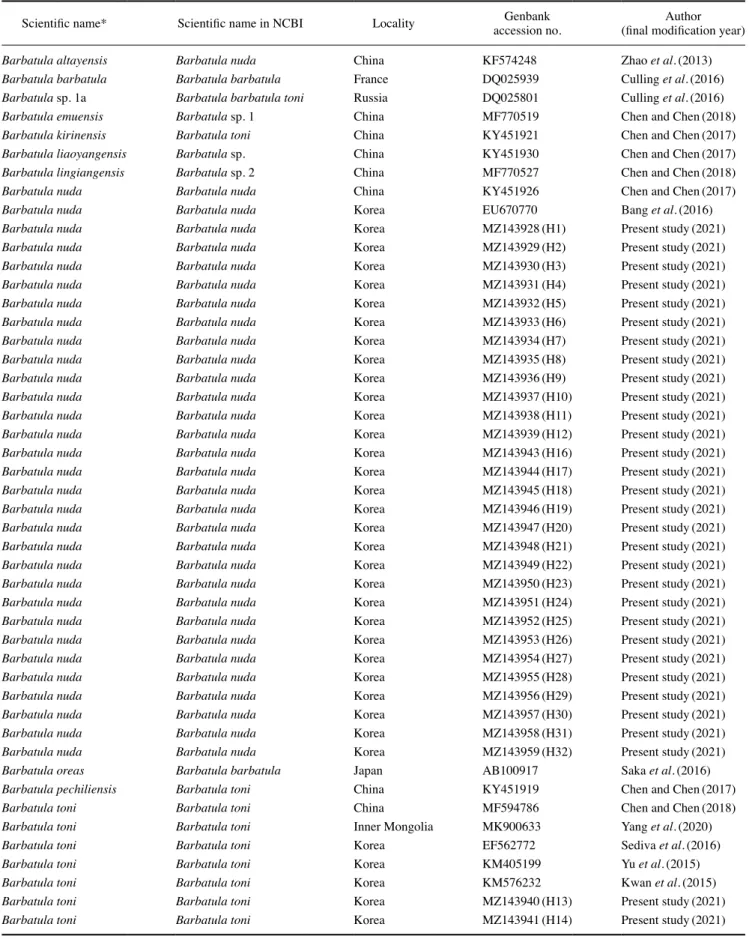
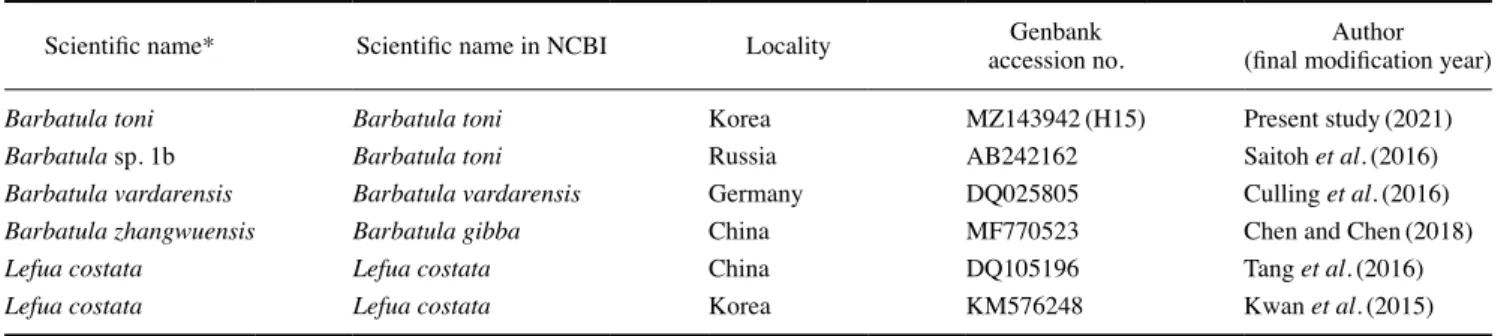
미만일 경우에는 표시하지 않았다(Kumar et al., 2018). 외군(out group)으로는 한국산 쌀미꾸리(Lefua castata(Kessler, 1876), KM576248)를 이용하였다. 또한 우리나라 종개속 어류와 중 국, 일본, 유럽 등에 분포하는 종개속 어류 사이의 분자계통학 적 관계를 확인하기 위하여 NCBI의 GenBank에 등록된 종개 속 어류 및 외군으로 종개과의 중국산 쌀미꾸리(DQ105196) 및 한국산 쌀미꾸리(KM576248)의 염기서열을 사용하였다 (Table 2). 본 연구에서 종개와 대륙종개에서 획득한 Cyt b 염기 서열 정보는 NCBI의 GenBank에 등록하여 Accession Number (MZ143928~MZ143959)를 부여받았다(Table 2).
결과 및 고찰
1. 종개속 어류의 유전적 다양성
한국산 종개속 어류 2종 총 333개체(종개 30개체, 대륙종개 303개체)를 대상으로 mtDNA Cyt b 유전자의 769bp 염기서열 Table 1. Totally 333 samples of the Korean Barbatula species examined in the present study
No. Locality Population
ID River or Stream Water system No. of
individuals Barbatula toni
1 Songgang-ri, Geojin-eup, Goseong-gun, Gangwon-do JAC Jasancheon Stream ESIS 20 2 Simgok-ri, Eosangcheon-myeon, Danyang-gun, Chungbuk-do EGCt Eogokcheon Stream Namhangang River 10 Barbatula nuda
3 Su-ri, Seo-myeon, Yangyang-gun, Gangwon-do YNC Yangyangnamdaecheon Stream ESIS 20 4 Haegnjeong-ri, Yeongok-myeon, Gangneung-si, Gangwon-do YGC Yeongokcheon Stream ESIS 20
5 Naegok-dong, Gangneung-si, Gangwon-do GNC Gangreungnamdaecheon Stream ESIS 20
6 Sangye-ri, Okgye-myeon, Gangneung-si, Gangwon-do JUC Jusucheon Stream ESIS 23
7 Sangjeong-ri, Miro-myeon, Samcheok-si, Gangwon-do OSC Samcheokoshipcheon Stream ESIS 19 8 Bunam-ri, Geundeok-myeon, Samcheok-si, Gangwon-do MEC Maeupcheon Stream ESIS 20 9 Wolcheon-ri, Wondeok-eup, Samcheok-si, Gangwon-do GGC Gagokcheon Stream ESIS 21 10 Samsan-ri, Giseong-myeon, Uljin-gun, Gyeongbuk-do BYC Bangyulcheon Stream ESIS 24 11 Hwanji-dong, Taebaek-si, Gangwon-do HJC Hwangjicheon Stream Nakdonggang River 20
12 Won-dong, Taebaek-si, Gangwon-do GJC Goljicheon Stream Namhangang River 20
13 Oncheon-ri, Suanbo-myeon, Chungju-si, Chungbuk-do DAC Dalcheon Stream Namhangang River 20 14 Simgok-ri, Eosangcheon-myeon, Danyang-gun, Chungbuk-do EGCn Eogokcheon Stream Namhangang Rirver 16 15 Gangcheon-ri, Angseong-myeon, Chungju-si, Chungbuk-do NHG Namhangang River Namhangang River 20 16 Jangnma-ri, Duchon-myeon, Hongcheon-gun, Gangwon-do JNC Jangnamcheon Stream Bukhangang River 20 17 Suib-ri, Ildong-myeon, Pocheon-si, Gyeonggi-do YPC Yeongpyeongcheon Stream Imjingang River 20 ESIS, East Sea Independent Stream
Table 2. List of Cytochrome b sequences of the Barbartula species downloaded from NCBI’s GenBank with locality information including 32 haplotypes(H) obtained in the present study
Scientific name* Scientific name in NCBI Locality Genbank
accession no. Author
(final modification year)
Barbatula altayensis Barbatula nuda China KF574248 Zhao et al.(2013)
Barbatula barbatula Barbatula barbatula France DQ025939 Culling et al.(2016)
Barbatula sp. 1a Barbatula barbatula toni Russia DQ025801 Culling et al.(2016)
Barbatula emuensis Barbatula sp. 1 China MF770519 Chen and Chen(2018)
Barbatula kirinensis Barbatula toni China KY451921 Chen and Chen(2017)
Barbatula liaoyangensis Barbatula sp. China KY451930 Chen and Chen(2017)
Barbatula lingiangensis Barbatula sp. 2 China MF770527 Chen and Chen(2018)
Barbatula nuda Barbatula nuda China KY451926 Chen and Chen(2017)
Barbatula nuda Barbatula nuda Korea EU670770 Bang et al.(2016)
Barbatula nuda Barbatula nuda Korea MZ143928(H1) Present study(2021)
Barbatula nuda Barbatula nuda Korea MZ143929(H2) Present study(2021)
Barbatula nuda Barbatula nuda Korea MZ143930(H3) Present study(2021)
Barbatula nuda Barbatula nuda Korea MZ143931(H4) Present study(2021)
Barbatula nuda Barbatula nuda Korea MZ143932(H5) Present study(2021)
Barbatula nuda Barbatula nuda Korea MZ143933(H6) Present study(2021)
Barbatula nuda Barbatula nuda Korea MZ143934(H7) Present study(2021)
Barbatula nuda Barbatula nuda Korea MZ143935(H8) Present study(2021)
Barbatula nuda Barbatula nuda Korea MZ143936(H9) Present study(2021)
Barbatula nuda Barbatula nuda Korea MZ143937(H10) Present study(2021)
Barbatula nuda Barbatula nuda Korea MZ143938(H11) Present study(2021)
Barbatula nuda Barbatula nuda Korea MZ143939(H12) Present study(2021)
Barbatula nuda Barbatula nuda Korea MZ143943(H16) Present study(2021)
Barbatula nuda Barbatula nuda Korea MZ143944(H17) Present study(2021)
Barbatula nuda Barbatula nuda Korea MZ143945(H18) Present study(2021)
Barbatula nuda Barbatula nuda Korea MZ143946(H19) Present study(2021)
Barbatula nuda Barbatula nuda Korea MZ143947(H20) Present study(2021)
Barbatula nuda Barbatula nuda Korea MZ143948(H21) Present study(2021)
Barbatula nuda Barbatula nuda Korea MZ143949(H22) Present study(2021)
Barbatula nuda Barbatula nuda Korea MZ143950(H23) Present study(2021)
Barbatula nuda Barbatula nuda Korea MZ143951(H24) Present study(2021)
Barbatula nuda Barbatula nuda Korea MZ143952(H25) Present study(2021)
Barbatula nuda Barbatula nuda Korea MZ143953(H26) Present study(2021)
Barbatula nuda Barbatula nuda Korea MZ143954(H27) Present study(2021)
Barbatula nuda Barbatula nuda Korea MZ143955(H28) Present study(2021)
Barbatula nuda Barbatula nuda Korea MZ143956(H29) Present study(2021)
Barbatula nuda Barbatula nuda Korea MZ143957(H30) Present study(2021)
Barbatula nuda Barbatula nuda Korea MZ143958(H31) Present study(2021)
Barbatula nuda Barbatula nuda Korea MZ143959(H32) Present study(2021)
Barbatula oreas Barbatula barbatula Japan AB100917 Saka et al.(2016)
Barbatula pechiliensis Barbatula toni China KY451919 Chen and Chen(2017)
Barbatula toni Barbatula toni China MF594786 Chen and Chen(2018)
Barbatula toni Barbatula toni Inner Mongolia MK900633 Yang et al.(2020)
Barbatula toni Barbatula toni Korea EF562772 Sediva et al.(2016)
Barbatula toni Barbatula toni Korea KM405199 Yu et al.(2015)
Barbatula toni Barbatula toni Korea KM576232 Kwan et al.(2015)
Barbatula toni Barbatula toni Korea MZ143940(H13) Present study(2021)
Barbatula toni Barbatula toni Korea MZ143941(H14) Present study(2021)
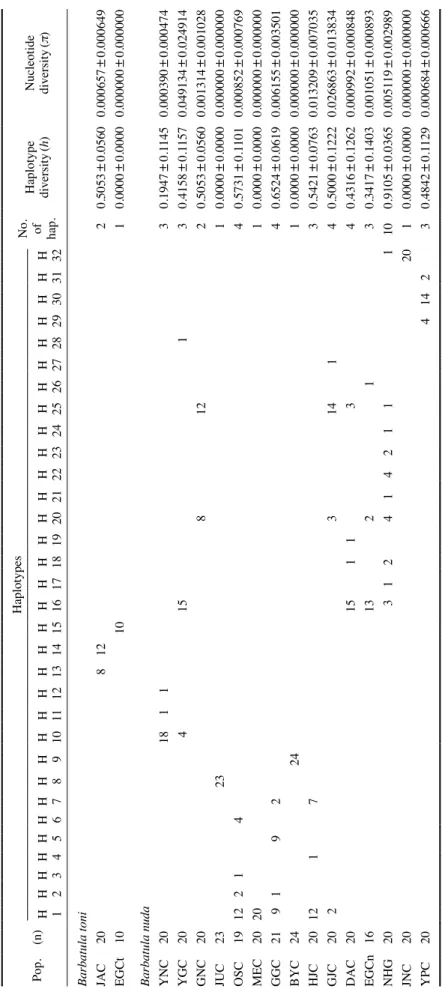
을 분석한 결과 200개 구간에서 염기 변이 사이트가 관찰되었 으며, 총 32개의 유전자형(haplotype, H)을 확보하였다(Fig. 1, Table 3). 그중 종개에서는 자산천(JAC) 집단에서 2개(H13, H14)와 어곡천(EGCt) 집단에서 1개(H15) 등 3개의 유전자형 이 관찰되었다. 그러나 대륙종개에서는 집단에 따라 유전자형 의 수는 1~10개로 다양하였으며, 총 29개의 유전자형이 관찰 되었다. 특히 남한강(NHG) 집단에서 가장 많은 유전자형을 확 인하였다. H1의 경우 삼척 오십천(OSC), 마읍천(MEC), 가곡천 (GGC), 황지천(HJC), 골지천(GJC)에 분포하는 5개 집단의 대 륙종개에서 공통으로 확인되는 등 유전자형의 집단별 공유 양 상은 2~5개 집단으로 다양하였다. 특히, 연곡천(YGC) 대륙종 개 집단에서 확인된 3개의 유전자형 중 H10과 H16은 각각 양 양 남대천(YNC)과 달천(DAC)-어곡천(EGCn)-남한강 집단과 공유하고 있었으며, 골지천 집단에서 확인된 4개 유전자형 중 H1, H20, H25는 각각 삼척 오십천-마읍천(MEC)-가곡천-황지 천, 어곡천-남한강, 달천-남한강 집단과 공유하였다.
유전자형 다양도(haplotype diversity, h)와 염기 다양도(nucl- eotide diversity, π) 결과는 Table 3에 나타내었다. 종개에서 자
산천 집단의 유전자형 다양도는 0.5053±0.0560로 높았으며 어 곡천 집단은 0.0000±0.0000이었다. 대륙종개에서는 남한강 집 단에서 0.9105±0.0365로 가장 높았으며, 그 다음으로 동해 독 립하천인 가곡천 집단에서 0.6524±0.0619로 높았다. 유전자형 다양도가 가장 낮게 나타난 집단은 단일 유전자형이 관찰된 동 해 독립하천인 주수천(JUC) 집단(H8), 마읍천 집단(H1), 방율 천(BYC) 집단(H9) 및 북한강 수계의 장남천(JNC) 집단(H32) 에서 모두 0.0000±0.0000이었다. 염기 다양도는 동해 독립 하천인 연곡천 집단과 남한강 수계인 골지천 집단에서 각각 0.049134±0.024914, 0.026863±0.013834로 관찰되었다. Yoon and Kim(2002)에 따르면, 강원도 강릉시 북부에 위치한 연곡천 의 경우 2003~04년 태풍 ‘루사’와 ‘매미’에 의한 홍수는 하천 수리적 특성의 급격한 변화와 더불어 수생동물 종다양성의 감 소를 초래하였다고 보고하였으며 이러한 수해 복구 과정에서 영서 지역에 분포하는 일차담수어(새코미꾸리 등)의 인위적 도 입이 이루어졌을 가능성이 제시되었다(Kim et al., 2006a). Kim and Park(2002)은 강릉 남대천 이북의 동해 독립하천에는 종개 가 분포하는 것으로 기록하고 있으나, 연곡천에는 종개와 대륙 Table 2. List of Cytochrome b sequences of the Barbartula species downloaded from NCBI’s GenBank with locality information including 32 haplotypes(H) obtained in the present study
Scientific name* Scientific name in NCBI Locality Genbank
accession no. Author
(final modification year)
Barbatula toni Barbatula toni Korea MZ143942(H15) Present study(2021)
Barbatula sp. 1b Barbatula toni Russia AB242162 Saitoh et al.(2016)
Barbatula vardarensis Barbatula vardarensis Germany DQ025805 Culling et al.(2016)
Barbatula zhangwuensis Barbatula gibba China MF770523 Chen and Chen(2018)
Lefua costata Lefua costata China DQ105196 Tang et al.(2016)
Lefua costata Lefua costata Korea KM576248 Kwan et al.(2015)
*Based on those of Chen et al.(2019) and the present study Table 2. Continued
Fig. 2. Haplotype network based on Cytochrome b gene of 32 haplotypes(H1~H32). Circle size indicates the number of individuals examined.
Table 3. Distribution of Cytochrome b haplotypes(H), haplotype diversity(h) and nucleotide diversity(π) obtained at 17 populations of two Korean Barbatula species Pop.(n)Haplotypes No. of hap.
Haplotype diversity
(h)
Nucleotide diversity
(π)
H 1 H 2 H 3 H 4 H 5 H 6 H 7 H 8 H 9 H 10 H 11 H 12 H 13 H 14 H 15 H 16 H 17 H 18 H 19 H 20 H 21 H 22 H 23 H 24 H 25 H 26 H 27 H 28 H 29 H 30 H 31 H 32
Barbatula toni JAC2081220.5053±0.05600.000657±0.000649 EGCt101010.0000±0.00000.000000±0.000000 Barbatula nuda YNC20181130.1947±0.11450.000390±0.000474 YGC20415130.4158±0.11570.049134±0.024914 GNC2081220.5053±0.05600.001314±0.001028 JUC232310.0000±0.00000.000000±0.000000 OSC191221440.5731±0.11010.000852±0.000769 MEC202010.0000±0.00000.000000±0.000000 GGC21919240.6524±0.06190.006155±0.003501 BYC242410.0000±0.00000.000000±0.000000 HJC20121730.5421±0.07630.013209±0.007035 GJC202314140.5000±0.12220.026863±0.013834 DAC201511340.4316±0.12620.000992±0.000848 EGCn16132130.3417±0.14030.001051±0.000893 NHG203124142111100.9105±0.03650.005119±0.002989 JNC202010.0000±0.00000.000000±0.000000 YPC20414230.4842±0.11290.000684±0.000666
종개가 함께 출현하고 있으며(An et al., 2021), 본 연구결과 남 한강 수계의 대륙종개 집단과 공유하는 유전자형이 존재하는 것으로 나타나 태백산맥을 넘나드는 일차담수어의 인위적 도 입 과정에서 대륙종개도 포함되었을 가능성을 시사하였다. 한 편, 남한강 상류에 위치한 골지천의 대륙종개 집단 역시 지리적 으로 인접한 낙동강 상류 황지천, 삼척 오십천, 마읍천, 가곡천 지역의 대륙종개 집단과 공유하는 유전자가 확인된 점은 Kim
et al.
(2017)이 언급한 바와 같이 태백산맥을 경계로 유수성 (rheophilic) 일차담수어의 하천쟁탈에 의한 자연적 이동에 따른 유전자 교류 등 지사학적 사건을 밝힐 수 있는 분자유전학적 추 가 증거의 확보가 필요하다.한국산 종개속 어류에서 관찰된 32개의 유전자형을 토대로 작성된 유전자형 네트워크를 보면 한국산 종개류는 총 3개 그 룹으로 구성되었으며(Fig. 2), 종개 그룹을 중앙에 두고 양쪽으 로 주로 동해 독립하천에 분포하는 ‘동해 대륙종개 그룹’과 주 로 한강 수계에 분포하는 ‘한강 대륙종개 그룹’이 위치하였다.
각 그룹 간 유전자 변이 사이트의 차이를 살펴보면, 동해 대륙 종개 그룹(H1~12)과 종개 그룹(H13~15)과는 100~149개 (13~19%)의 차이를 보였고, 종개 그룹(H13~15)과 한강 대륙 종개 그룹(H16~32) 사이에는 75~104개(10~14%)의 차이를 나타냈다. 특히 대륙종개의 동해 그룹과 한강 그룹 사이의 유전 자 변이 사이트의 차이는 122~184개(16~24%)로 오히려 종개 와 대륙종개 사이의 차이보다 크게 나타나, 두 그룹이 별종일 가 능성을 염두에 두고 핵 DNA의 추가분석 등 관련 연구가 필요 한 것으로 판단된다.
2. 종개속 어류의 계통유연관계
MtDNA Cyt b 염기서열을 이용한 분자 계통수에서도 한국산 종개속 어류는 비교적 높은 bootstrap value로 지지되는 3개의 계통군(clade)을 형성하였다(Fig. 3). 즉, Clade 1은 양양 남대천, 주수천, 삼척 오십천, 마읍천, 가곡천, 방율천, 황지천의 모든 개 체들과 연곡천의 4개체, 골지천의 2개체가 포함되었으며, 황지 Fig. 3. Phylogenetic tree of relationship in the haplotypes of the genus Barbatula by the neighbour-joining analysis and the evolutionary distanc- es were computed using the Kimura 2-parameter method. See Table 3.
천과 골지천을 제외하고 모두 동해 독립하천에 분포하는 대륙 종개 집단이었다(H1~12). Clade 2는 자산천의 모든 개체와 어 곡천의 10개체로 구성된 종개 집단이었다(H13~15). 그리고 Clade 3은 남한강, 달천, 어곡천, 장남천, 영평천(YPC), 강릉 남 대천의 모든 개체들과 골지천의 18개체, 연곡천의 16개체를 포 함하였으며, 강릉 남대천과 연곡천을 제외하고 모두 영서 지역 의 한강과 임진강 수계에 분포하는 대륙종개 집단이었다(H16~
32). 대륙종개는 태백산맥을 중심으로 영동과 영서 지역의 단계 통(Clade 1, 3)으로 나뉘며 서로 다른 계통을 이루고 있어 두 지 역 집단의 종분화 가능성을 시사하고 있다. Kim et al.(1988)이 당시 ‘종개(Orthrias toni, 본 연구의 Barbatula nuda)’의 지리적
변이에 관한 연구에서 동해 대륙종개 집단에 포함되는 삼척 마 읍천 집단의 형태 및 핵형의 특이성을 보고한 것처럼 우리나라 대륙종개(B. nuda)는 최소 두 개 그룹으로 구분되며, 그 실체 규 명을 위한 분류학적 심층 연구가 필요하다.
유라시아 대륙에 분포하는 종개속 어류의 분자계통학적 유연 관계 분석 결과에서도 크게 3개의 클러스터(cluster)를 보여주 었다(Fig. 4). 그중 계통수의 가장 기저에 위치한 Cluster A는 한국산 종개속 어류 중 동해 대륙종개 집단만으로 구성되어 있 었으며, Cluster B는 유럽산 종개속 어류만이 포함되어 있었다.
Cluster C는 우리나라를 비롯하여 중국, 몽고, 일본, 러시아의 다 양한 종개속 어류가 포함되어 있었으며, 여기에 포함된 한국산 Fig. 4. A neighbour-joining tree based on 51 mtDNA Cytochrome b gene sequences of the genus Barbatula. The percentage of replicate trees in which the associated taxa clustered together in the bootstrap test(1000 replicates) are shown next to the branches and the evolutionary distances were computed using the Kimura 2-parameter method. See Table 3.
종개속 어류 집단은 자산천과 어곡천의 종개 집단과 나머지 한 강 대륙종개 집단이었다. 동해 대륙종개 집단(H1~12)은 우리 나라 한강 대륙종개 집단을 포함한 유라시아에 분포하는 모든 종개속 어류와는 별개의 독립적인 계통군을 형성하고 있었다. 강원도 고성군의 자산천 종개 집단(H13~14)은 중국 북부에 분포하는
B. kirinensis, B. emuensis와 함께 단계통군을 이루었으
며, 일본의 B. oreas와 자매군 관계에 있는 것으로 나타났다. 그 러나 남한강 지류인 어곡천 종개 집단(H15)은 중국의 B. liao-yangensis와 근연관계를 보이면서 우리나라 종개 두 집단 사이
에서 보여주는 계통 관계는 별종의 가능성을 시사하였다. 또한 한강 대륙종개 집단(H16~32)은 중국 북부에 출현하는 B.lingiangensis와 근연관계를 나타냈다. 본 연구 결과는 중국 북
동부 지역에 분포하는 종개속 어류의 재검토 연구를 실시한 Chen et al.(2019)의 B. toni는 B. altayensis와, B. nuda는 B.kirinensis와 단계통군을 형성한 결과와 다소 차이가 있었으며,
중국산 종개와 대륙종개의 미토콘드리아 유전체 특성 연구에서 Yang et al.(2019)의 언급한 바와 같이 우리나라 어곡천의 종개 는 중국산 종개보다는B. liaoyangensis와 더 가까운 계통 관계
에 있었다.이와 같이 지금까지 우리나라에 분포하는 것으로 알려져 온 종개속 어류 2종은 mtDNA Cyt b의 염기서열에서도 중국 대륙 에 분포하는
B. toni 및 B. nuda와는 명확한 차이가 확인되었으
며, 특히 ‘동해 대륙종개 그룹’은 B. toni나 B. nuda가 아닌 별개 의 종 수준으로 분화했을 가능성도 있다. 하지만 아직 한반도에 공식적으로 보고되지 않은B. linjiangensis, B. zhangwuensis, B.
emuensis의 3종이 북한 지역에 출현할 수 있다는 의견이 제시되
어(Chen et al., 2019), 우리나라 종개속 어류의 분류학적 실체 규명을 위해서는 북한 집단을 포함한 국외의 다양한 종개속 표 본과의 형태학적 또는 분자계통학적 비교 연구가 필요한 것으 로 사료된다.요 약
우리나라에는 잉어목 Cypriniformes 종개과 Nemacheilidae 에 속하는 종개속(genus Barbatula) 어류로 종개 B. toni와 대 륙종개
B. nuda의 2종이 서식하는 것으로 알려져 있다. 이들
은 최근 서식환경의 변화와 자연재해에 의한 인위적 도입 등으 로 고유 분포역이 훼손되면서 종의 계통지리학적 경계의 붕괴 가 우려되고 있다. 본 연구에서는 미토콘드리아 DNA 유전자의 Cytochrome b 염기서열에 근거한 유전자형 네트워크를 통해 유 전적 다양성과, 한반도 주변의 종개속 어류를 포함한 계통 유연 관계 분석을 통해 우리나라 종개속 어류의 분자계통학적 위치 를 검토하였다. 그 결과 우리나라 종개와 대륙종개에서 각각 3 개와 29개의 유전자형을 획득하였으며, 종개 그룹, 한강 대륙종개 그룹, 동해 대륙종개 그룹의 3개 단계통을 확인하였다. 각 그 룹 간 변이사이트는 10~24%로 높은 유전자 변이율을 보였으 며, 특히 동해 대륙종개 그룹은 한강 대륙종개 그룹이나 종개 그 룹뿐만 아니라 중국, 일본, 러시아, 유럽의 종들과 독립적인 클 러스터를 형성하고 있어 종 수준으로 분화했을 가능성을 시사 하고 있다.
사 사
본 연구 결과를 도출하는 데 종개류의 표본 일부를 제공해 주 신 성무성 님(순천향대학교), 장지왕 님(인천대학교)께 깊은 감 사를 드리며, 종개속 어류에 관한 다수의 참고문헌을 제공해 주 신 Dr. A.M. Prokofiev(Russia Academy of Sciences, Russia)와 원고작성에 유용한 조언을 해 주신 윤희남 박사님(국립생태원) 께도 감사드립니다. 본 논문은 정부(환경부)의 재원으로 국립생 물자원관의 지원을 받아 수행하였습니다(NIBR202102113).
REFERENCES
An, J.H., B.J. Kim and Y.S. Bae. 2021. Distribution of the Korean
Barbatula
(Cypriniformes; Nemacheilidae) species reviewed by the morphological traits of nostrils. Korean J. Ichthyol.33: 117-125. https://doi.org/10.35399/ISK.33.2.8.
April, J., R.L. Mayden, R.H. Hanner and L. Bernatchez. 2011. Gene- tic calibration of species diversity among North America’s freshwater fishes. Proc. Natl. Acad. Sci., 108: 10602-10607.
https://doi.org/10.1073/pnas.1016437108.
Bleeker, P. 1864. Description de deux espèces inédites de Cobitioïdes.
Ned. Tijdschr. Dierk., 2: 11-14.
Cao, L., R. Causse and E. Zhang. 2012. Revision of the loach species
Barbatula nuda
(Bleeker 1865)(Pisces: Balitoridae) from North China, with a description of a new species from Inner Mongolia. Zootaxa, 3586: 236-248. https://doi.org/10.11646/zootaxa.3586.1.22.
Chen, H., H. Zhang, Y. Chen and J. Freyhof. 2019. A review of the
Barbatula loaches
(Teleostei: Nemacheilidae) from north- eastern China, with the description of four new species. Zoo- taxa, 4565: 1-36. https://doi.org/10.11646/zootaxa.4565.1.1.Choi, H.K. and H.J. Lee. 2018. Development of a species identifi- cation method for the egg and fry of the three Korean bitter- ling fishes(Pisces: Acheilognathinae) using RFLP(Restriction Fragment Length Polymorphism) markers. Korean J. Envi - ron. Biol., 36: 352-358. https://doi.org/10.11626/KJEB.
2018.36.3.352.
Clement, M., D. Posada and K.A. Crandall. 2000. TCS: a computer program to estimate gene genealogies. Mol. Ecol., 9: 1657- 1659. https://doi.org/10.1046/j.1365-294x.2000.01020.x.
Dybowski, B.N. 1869. VorläuFige Mittheilungen über die Fischfauna
des Ononflusses und des Ingoda in Transbaikalien. Verh.
Zool.-Bot. Ges. Wien., 19: 945-958.
Excoffier, L., G. Laval and S. Schneider. 2005. Arlequin(version 3.0):
an integrated software package for population genetics data analysis. Evol. Bioinform. Online, 1: 47-50.
Galtier, N., B. Nabholz, S. Glémin and G. Hurst. 2009. Mitochondrial DNA as a marker of molecular diversity: a reappraisal. Mol.
Ecol., 18: 4541-4550. https://doi.org/10.1111/j.1365-294X.
2009.04380.x.
He, D. and Y. Chen. 2006. Biogeography and molecular phylogeny of the genus Schizothorax(Teleostei: Cyprinidae) in China infer- red from cytochrome b sequences. J. Biogeogr., 33: 1448- 1460. https://doi.org/10.1111/j.1365-2699.2006.01510.x.
Kessler, K.T. 1876. Ryby. In: Prejevalsky, N.M.(ed.), Mongolia i Strana Tangutov. Vol. 2. St. Petersburg, Russia, pp. 1-36.
Kim, C.H., K.E. Hong, J.H. Kim and K.H. Kim. 2006. Ichthyofauna in Yeongok Stream, Gangneung, Korea. Korean J. Ichthyol., 18: 244-250.
Kim, D.M., M.V. Hirt, A.M. Simons and Y.J. Won. 2017. Small fishes crossed a large mountain range: Quaternary stream capture events and freshwater fishes on both sides of the Tae- baek Mountains. Integr. Zool., 12: 292-302. https://doi.org/
10.1111/1749-4877.12228.
Kim, I.S. 1997. Illustrated encyclopedia of fauna & flora of Korea.
Vol. 37. Freshwater fishes. Ministry of Education, Yeongi, Korea, 629pp.
Kim, I.S. and J.Y. Park. 2002. Freshwater fishes of Korea. Kyohak Publishing Co. Ltd., Seoul, Korea, 467pp.
Kim, I.S., E.H. Lee and Y.M. Son. 1988. Morphological variation and geographic distribution of two species on Nemacheiline loaches(Pisces, Cobitidae) from Korea. Korean J. Zool., 31:
283-294.
Kim, I.S., Y. Choi, C.L. Lee, Y.J. Lee, B.J. Kim and J.H. Kim. 2005.
Illustrated Book of Korean Fishes. Kyohak Publishing Co.
Ltd., Seoul, Korea, 615pp.
Kim, M.J. and C.B. Song. 2011. Origin of the Korean mandarin fish,
Siniperca scherzeri and its molecular phylogenetic relation-
ships to other Siniperca fishes. Korean J. Ichthyol., 23: 95- 105.Kim, Y.J., I.C. Kim, S.Y. Lee, W.O. Lee, Y.C. Cho and J.S. Lee.
2003. The use and conservation in molecular phylogeny of fish mitochondrial DNAs in Korean waters. Korean J. Ecol.
Environ., 36: 221-234.
Kim, Y.R., J.E. Jang, H. Choi and H.J. Lee. 2020. Phylogeographic and population genetic study of a Korean endemic freshwater fish species, Zacco koreanus. Korean J. Environ. Biol., 38:
650-657. https://doi.org/10.11626/KJEB.2020.38.4.650.
Kottelat, M. 2012. Conspectus cobitidium, an inventory of the loaches of the world(Teleostei: Cypriniformes: Cobitoidei). Raffles
Bull. Zool, Suppl., 26: 1-199.
Kottelat, M. and J. Freyhof. 2007. Handbook of European freshwater fishes. Kottelat, Cornol, Switzerland and Freyhof, Berlin, Germany, 647pp.
Kumar, S., G. Stecher, M. Li, C. Knyaz and K. Tamura. 2018. MEGA X: molecular evolutionary genetics analysis across computing platforms. Mol. Biol. Evol., 35: 1547-1549. https://doi.org/
10.1093/molbev/msy096.
Lee, H.Y., K.J. Jee and E.K. Jung. 1990. Characteristics and Variations of the Chromosomal Constituents of Korean Nemacheilus
toni
(Pisces, Cobitidae). Genes Genom., 12: 256-262.Lee, S.R. and J.J. Kim. 2016. Molecular Phylogeny Study of Rhyncho-
cypris kumgangensis in Korea Based on the Mitochondrial
DNA Cytochrom b Gene. J. Natl. Park Res., 7: 147-153.NIBR(National Institute of Biological Resources). 2019. National Species list of Korea. II. Vertebrates, Invertebrates. Design- zip, Seoul, Korea, 908pp.
Park, C.S. and H.Y. Lee. 1991. Systematic study on the fishes of family Cobitidae(Pisces: Cypriniformes): extensive varia- tion in mitochondrial DNA among geographicpopulations of
Nemacheilus toni. Korean J. Ichthyol., 3: 140-147.
Song, H.B. and G.M. Park. 2006. A molecular Genetic Variation among Intra-poplations of Korean shiner, Coreoleuciscus
splendidus Mori
(Cyprinidae). Korean J. Ichthyol., 18: 78-86.Song, H.Y., J.H. Kim, I.Y. Seo and I.C. Bang. 2017. Species and hybrid identification of Genus Coreoleuciscus species in Hwang-ji Stream, Nakdong River basin in Korea. Korean J.
Ichthyol., 29: 1-12.
Yang, S.Y., H.Y. Lee, H.J. Yang and J.H. Kim. 1991. Systematic study on the fishes of the family Cobitidae(Pisces, Cypriniformes) I. Geographic variation of Nemacheilus toni, Lefua costata, and Niwaella multifasciata. Korean J. Zool., 34: 110-122.
Yang, Y., H. Chen and Y. Chen. 2019. The complete mitochondrial genome of Barbatula nuda and B. toni(Teleostei: Nemachei- lidae). Mitochondrial DNA B, 4: 2585-2587. https://doi.org/1 0.1080/23802359.2019.1641435.
Yoon, J.D., J.H. Kim, S.H. Park and M.H. Jang. 2018. The distribution and diversity of freshwater fishes in Korean Peninsula. Korean J. Ecol. Environ., 51: 71-85. https://doi.org/10.11614/KSL.
2018.51.1.071.
Yoon, Y.Y. and H.S. Kim. 2004. Effect of Typhoon ‘Rusa’ on the Natu- ral Yeon-gok Stream and Coastal Ecosystem in the Yeong- Dong Province. J. Korean Soc. Mar. Environ., 7: 35-41.
Yu, J.N., J. Jun, C.E. Lim and S. Kim. 2016. Sequence and organization of the complete mitogenome of a Siberian stone loach, Bar-
batula toni
(Dybowsky, 1869)(Cypriniformes: Balitoridae).Mitochondrial DNA A, 27: 1798-1799. https://doi.org/10.310 9/19401736.2014.963818.