Effects of Combined Application of Rice Bran and Chemical Fertilizer on the Phytochemical Contents of Rice
Mi Young Kang*, Joo Hee Kim*, Kyu Hong Heo**, Sun Shik Cho**, Manuel Q. Esguerra**, Cyren M. Rico***, Tae Kwon Son**, and Sang Chul Lee**
†*Department of Food Science and Nutrition, Kyungpook National University, Daegu 702-701, Korea
**Division of Biosciences, College of Agriculture and Life Sciences, Kyungpook National University, Daegu 702-701, Korea
***ISTECH, Inc., Catholic University of Daegu, Gyeongbuk, 712-702, Korea
65
†
Corresponding author: (Phone) +82-53-950-5713
(E-mail) [email protected] <Received November 28, 2008>
ABSTRACT The effect of rice bran (RB) applied alone or in combination with chemical fertilizer at different appli- cation rate on the phytochemical and antioxidant properties of rice was investigated. The treatments were 3 levels of RB namely: 200% RB (500 kg 10a
-1), 100% RB (250 kg 10a
-1), 50% RB (125 kg 10a
-1), Recommended fertilizer dose (RF: N-P
2O
5-K
2O, 11-5.5-4.8 kg 10a
-1) combined with each RB, Half-recommended fertilizer dose (HRF: N-P
2O
5-K
2O, 5.5-2.75-2.4 kg 10a
-1) combined with each RB, RF and HRF applied at 1, 5, 10 days before rice transplanting (DBT). The parameters investigated were antioxidant, phytosterol and fatty acid contents. Results showed that the antioxidant pro- perty and phytosterol contents were high at 10 DBT HRF plus RB, 5 DBT RF plus RB, and 1 DBT 100 and 200%
RB. However, total polyphenols increased from 10 to 1 DBT.
In the case of fatty acids, no general trend was observed between treatments at different application times. Linoleic acid was high at 10 DBT HRF plus RB while linolenic acid was not affected at different application times. Palmitoeic and oleic acids were not also affected at 5 and 10 DBT.
Saturated fatty acids were not also affected by any treat- ment at different application times except for palmitic acid.
Most parameters obtained higher values at 100 and 200%
RB treatments in 1 DBT.
Keywords : antioxidant, fatty acid, organic fertilizer, phenolic compounds, phytosterol, rice, rice bran
Organic farming has shown to significantly improve the nutritional quality of crops compared to conventional farming system. It increased the phytochemical and antioxidant contents of fruit crops (Kazimierczak et al., 2008, Wang et
al., 2008), vegetable (Larson et al., 2000; Ren et al., 2001;
Xu et al., 2003, Khan et al., 2007a) and cereals like oats and rice (Dimberg et al., 2005; Na et al., 2007; Rico et al., 2007; Saha et al., 2007). While these observations are not yet absolutely acceptable, there are increasing numbers of reports that organic farming system can increase nutritional quality of crops (Brandt & Molgaard, 2001; Benbrook, 2005).
Many studies have been conducted on the efficacy of organic farming on agronomic characters and yield of cereals, but studies on its effects on the nutritional quality of grains are lacking (Dimberg et al., 2005). Cereals contain unique phytochemicals that have been linked to decreased risk of cancer, and prevention of cardiovascular and age-related diseases (Dimberg et al., 2005; Fardet et al., 2008). Con- sidering that rice is the staple food of over half of world’s population, effect of organic fertilizer on the nutritional quality of rice can be investigated.
Long-term use of organic fertilizer has been shown to be more beneficial on soil microorganism and nutrition (Wor- thington, 1998; Mader et al., 2002; Kubat & Lipavsky, 2006;
Khan et al., 2007b; Kazimierczak et al., 2008). While organic
farming system may improve antioxidant property in agri-
cultural produce and be more beneficial on sustainable soil
management, whole dependence on it may not produce enough
yield (Mader et al., 2002; Rembialkowska, 2007) for the
increasing demand of an ever growing population. To meet
the increasing demand for agricultural produce, chemical
fertilizer is still indispensable. However, continuous applica-
tion of chemical fertilizers poses problems and may also
result in failed agricultural production in the long run (Nelson
et al., 2004). Combined application of organic and reduced dose of chemical fertilizer can be beneficial for yield and soil productivity (Mamaril, 2004; Xu et al., 2008). In terms of nutritional quality, few studies have shown so far that mixed application of organic and reduced dose of chemical fertilizer performed better compared with application of recom- mended dose of chemical fertilizer alone (Mintah et al., 2007; Rico et al., 2007; Saha et al., 2007).
Therefore, the objective of this study is to investigate the effect of mixed application of rice bran and reduced dose of chemical fertilizer on the antioxidant property, and fatty acid and phytosterol contents of rice grain.
MATERIALS AND METHODS
The experiment was conducted at the Agricultural Research
& Extension Services, Chilgok, Kyungpook Province. The Rural Development Administration (RDA), Gyeongbuk Pro- vince provided the rice variety Ilpumbyeo and rice bran (RB). The experiment was laid out in randomized complete block design using 3 replicates. The treatments were: 200%
RB (500 kg 10
-1), 100% RB (250 kg 10
-1), 50% RB (125 kg 10
-1), RF+200% RB [Recommended fertilizer dose (RF):
N-P
2O
5-K
2O, 11-5.5-4.8 kg 10a
-1], RF+100% RB, RF+50%
RB, HRF+200% RB [Half-recommended fertilizer dose (HRF):
N-P
2O
5-K
2O, 5.5-2.75-2.4 kg 10a
-1], HRF+100% RB, HRF+
50% RB, RF and HRF. The application times were 1, 5 and 10 days before transplanting (DBT).
Antioxidant analysis
Brown rice was used for total phenol and electron donating capacity analysis. Rice sample (4 g) was dissolved in 40 mL 70% ethanol by continuous shaking for 24 hours at 40℃
ambient temperature. The supernatant was used for the analysis.
The electron donating capacity was analyzed using a method modified from the procedure described by Yen & Chen (1995).
The reaction mixture contained 0.5 mL 0.05 mM DPPH and 0.01 mL brown rice supernatant. The solution was allowed to react for 30 min in room temperature and then absorbance reading at 517 nm was recorded.
Total phenolic compounds were determined using the pro- cedure described by Zielinski & Kozlowska (2000). Rice sample (0.250 mL) was mixed with 0.250 mL of 50% Folin-
Ciocalteu (Sigma Co.), 0.5 mL 10% Na
2CO
3, and 2 mL distilled water. The solution was allowed to stand for 25 min at room temperature and then centrifuged at 5,000 rpm for 10 min. The supernatant liquid was collected and absor- bance reading at 725 nm was recorded. Gallic acid (100~500 μg mL
-1) was used for the standard curve.
Fatty acid analysis
Fatty acid analysis was done following the procedure of Ruibal-Mendieta et al. (2004). Brown rice sample was methylated by reacting with methanolic potassium hydroxide and analyzed for fatty acid using GC-MS (GC-MS: HP 6890 series, Hewlett Packard, Japan) equipped with DB-225 column (30 m × 0.25 mm × 0.25 μm). The injector temperature was 250℃ while the column temperature was 140℃ for 2 min and gradually increased to 200℃ at 5℃ min
-1and finally increased to 220℃ at 10℃ min
-1. The injection volume was 1 μL injected at a flow rate of 1 mL min
-1.
Squalene and phytosterols content
Brown rice extract was prepared by dissolving brown rice in 1 mL 50% KOH and boiled for 10 min in water bath (80℃). After rapid cooling, the precipitate was mixed tho- roughly in ethyl ether solution, added with Na
2SO
4to dry, and then the concentrate was recovered. The concentrate was added with 1 mL chloroform and filtered using 0.2 μm syringe filter. The filtrate was analyzed for squalene and phytosterols content using GC-MS (HP 6890, Hewlett-Packard Co., Japan) equipped with HP-5 column (30 m × 0.25 mm
× 0.25 μm). The injector temperature had an initial tempera- ture of 250℃ for 1 min and gradually increased at 2℃ min
-1until a temperature of 300℃ was reached. The carrier gas used was Helium and the injection volume was 1 μL at a flow rate of 1 mL min
-1.
RESULTS
Effect on antioxidant contents
The effect of rice bran on the antioxidant property of rice
grain was analyzed by determining its electron donating
ability, total phenolic compounds and squalene contents. In
the electron donating capacity, results showed that fertili-
zation at 1 DBT obtained high values (~65%) in the RF+RB
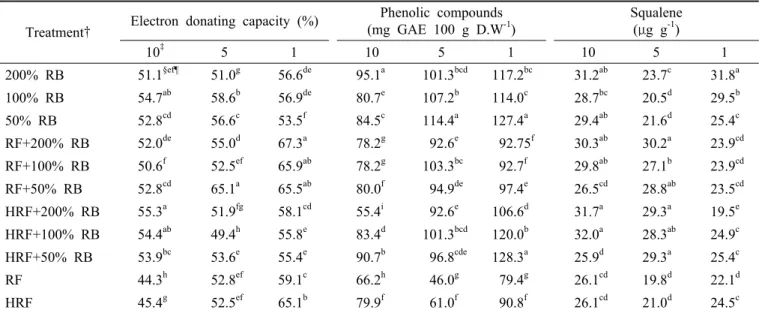
Table 1. Effect of rice bran and chemical fertilizer on the antioxidant properties of rice grains.
Treatment† Electron donating capacity (%) Phenolic compounds (mg GAE 100 g D.W
-1)
Squalene (μg g
-1)
10
‡5 1 10 5 1 10 5 1
200% RB 51.1
§ef¶51.0
g56.6
de95.1
a101.3
bcd117.2
bc31.2
ab23.7
c31.8
a100% RB 54.7
ab58.6
b56.9
de80.7
e107.2
b114.0
c28.7
bc20.5
d29.5
b50% RB 52.8
cd56.6
c53.5
f84.5
c114.4
a127.4
a29.4
ab21.6
d25.4
cRF+200% RB 52.0
de55.0
d67.3
a78.2
g92.6
e92.75
f30.3
ab30.2
a23.9
cdRF+100% RB 50.6
f52.5
ef65.9
ab78.2
g103.3
bc92.7
f29.8
ab27.1
b23.9
cdRF+50% RB 52.8
cd65.1
a65.5
ab80.0
f94.9
de97.4
e26.5
cd28.8
ab23.5
cdHRF+200% RB 55.3
a51.9
fg58.1
cd55.4
i92.6
e106.6
d31.7
a29.3
a19.5
eHRF+100% RB 54.4
ab49.4
h55.8
e83.4
d101.3
bcd120.0
b32.0
a28.3
ab24.9
cHRF+50% RB 53.9
bc53.6
e55.4
e90.7
b96.8
cde128.3
a25.9
d29.3
a25.4
cRF 44.3
h52.8
ef59.1
c66.2
h46.0
g79.4
g26.1
cd19.8
d22.1
dHRF 45.4
g52.5
ef65.1
b79.9
f61.0
f90.8
f26.1
cd21.0
d24.5
c†
Treatments: 200% RB (500 kg 10a
-1), 100% RB (250 kg 10a
-1), 50% RB (150 kg 10a
-1), RF (Recommended fertilizer dose:
N-P
2O
5-K
2O, 11-5.5-4.8 kg 10a
-1), HRF (Half-recommended fertilizer dose: N-P
2O
5-K
2O, 5.5-2.75-2.4 kg 10a
-1).
‡
Application day of fertilizer days before rice transplanting (DBT): 1, 5, and 10 DBT.
§
All values are mean of 15 samples and 3 replications.
¶
Within DBT, same letters are not significantly different P < 0.05 level by DMRT.
and HRF treatments but low values (55.4~55.8%) in the HRF+RB treatments. The trend was reversed at 10 DBT wherein the values in HRF+RB and 100% RB treatments obtained higher electron donating capacity (53.9~55.3%) than those of RF+RB treatments (50.6~52.8%). At 5 DBT, only RF+50% RB and 100% RB obtained high electron donating capacity (59~65%). In case of the total phenolic compounds, values decreased from 1 to 10 DBT which were 92.7~128.3, 92.6~114.4 and 55.4~95.1%, respectively. In 1 and 10 DBT treatment days, RF+RB treatments generally obtained lower values than those of HRF+RB. For squalene content, results at 10 DBT showed higher values in 100 and 200% RB treatments but lower in 50% RB while the highest value was at HRF+50% RB (~32 μg g
-1). At 5 DBT, RF and HRF combined with RB treatments obtained high values (27.1~
30.2 μg g
-1) while only 200% RB obtained high value (31.8%) at 1 DBT.
Effects on fatty acid contents
Effect of rice bran treatment on major fatty acid contents of rice grain was determined. The fatty acids analyzed were myristic (14:0), palmitic (16:0), stearic (18:0), arachidic (20:0),
palmitoeic (16:1), oleic (18:1), linoleic (18:2) and linolenic (18:3) acids. The results showed that the treatments had no apparent significant effects on the saturated fatty acids (data not shown) except for palmitic acid. At 1 and 5 DBT, palmitic acid content was lower at rice bran and HRF treat- ments. However, higher palmitic acid content was obtained in rice bran treatments at 10 DBT. Results also showed that the treatments affected unsaturated fatty acids contents (Table 2). Palmitoeic acid content was not affected at 5 and 10 DBT. At 1 DBT, highest value was obtained at HRF+
200% RB (0.08%) while RF plus RB treatments had signi- ficantly higher (0.06~0.08%) palmitoeic acid content than RB treatments (0.03~0.05%) alone. Oleic acid was signifi- cantly higher at HRF, RF and RF+50% RB (43.4~43.6%) than the other treatments at 10 DBT. At 5 DBT, results showed higher oleic acid content at 50 and 100% RB (42.7~
43.7%) and HRF plus 50 and 100% RB (42.5~43.1%) treat- ments. At 1 DBT, high values were obtained at 50 and 100%
RB (45.2~45.7%). Linoleic acid content at 10 DBT was high at 200% RB (37.0%), RF plus 100 and 200% RB (36.8~
37.3%), and HRF plus 100 and 200% RB (36.7~37.1%). It
was also high at 5 DBT treatments of HRF plus 100 and
Table 2. Percent (%) fatty acid content in rice grains at different rice bran and chemical fertilizer treatments.†
Treatment
‡Palmitic (16:0) Palmitoeic (16:1) Oleic (18:1) Linoleic (18:2) Linolenic (18:3)
10
§5 1 10 5 1 10 5 1 10 5 1 10 5 1
200% RB 18.6
¶ab#17.6
c16.5
bc0.10
a0.08
a0.05
de41.2
b42.0
c44.2
bcd37.0
ab37.2
b36.2
cd1.23
a1.23
ab1.20
a100% RB 18.7
ab17.7
bc16.1
c0.09
a0.08
a0.04
ef41.9
b42.7
bc45.7
a36.3
cd36.5
c35.1
f1.18
a1.20
ab1.15
ab50% RB 19.0
a18.2
abc16.6
bc0.08
a0.08
a0.03
f42.1
b43.7
a45.2
ab35.8
d34.7
e35.5
ef1.17
a1.16
b1.13
abRF+200% RB 18.5
ab18.7
a17.8
ab0.10
a0.08
a0.07
abc41.0
b40.9
d42.0
fg37.3
a37.3
b37.2
b1.25
a1.23
ab1.16
abRF+100% RB 18.0
abc18.0
abc17.6
ab0.09
a0.09
a0.07
abc41.9
b42.5
bc42.2
ef36.8
abc36.1
c37.4
ab1.21
a1.23
ab1.20
aRF+50% RB 18.0
abc18.2
abc17.5
ab0.09
a0.09
a0.07
ab43.4
a43.1
ab42.7
def35.9
d35.4
d36.4
c0.88
b1.21
ab1.15
abHRF+200% RB 18.1
abc17.9
abc18.2
a0.09
a0.09
a0.08
a41.7
b40.9
d40.8
g37.1
ab38.1
a37.9
a1.18
a1.24
a1.20
aHRF+100% RB 18.0
abc18.1
abc17.1
abc0.08
a0.09
a0.06
bcd42.2
b41.0
d43.4
cdef36.7
abc37.8
ab36.5
c1.22
a1.24
a1.14
abHRF+50% RB 18.3
ab17.5
c16.5
bc0.08
a0.08
a0.06
cd42.1
b42.1
c44.9
abc36.4
bcd37.3
b35.5
ef1.20
a1.26
a1.14
abRF 17.1
c18.3
abc17.5
ab0.09
a0.09
a0.07
bcd43.6
a41.1
d43.7
cde36.1
cd37.4
b35.8
ef1.23
a1.27
a1.09
bHRF 17.7
bc18.5
ab17.7
ab0.08
a0.08
a0.07
ab43.4
a42.4
bc43.0
def35.8
d35.9
cd36.3
cd1.16
a1.20
ab1.13
ab†
Total fatty acid contents equals 100% including those not reported in the table.
‡
Treatments: 200% RB (500 kg 10a
-1), 100% RB (250 kg 10a
-1), 50% RB (150 kg 10a
-1), RF (Recommended fertilizer dose: N-P
2O
5-K
2O, 11-5.5-4.8 kg 10a
-1), HRF (Half-recommended fertilizer dose: N-P
2O
5-K
2O, 5.5-2.75-2.4 kg 10a
-1).
§
Application day of fertilizer days before rice transplanting (DBT): 1, 5, and 10 DBT.
¶
All values are mean of 15 samples and 3 replications.
#
Within DBT, same letters are not significantly different P < 0.05 level by DMRT.
200% RB (37.8~38.1%) and 1 DBT HRF+200% RB (37.9%) treatments. In case of linolenic acid, there was no significant difference in the percent content between treatments at dif- ferent DBT treatments.
Effect on phytosterol contents
The effect of rice bran treatment on the phytosterol con- tents of rice grain was determined. The major phytosterols in rice were campesterol, stigmasterol, sitosterol and cyclo- artenol. Campesterol content was high at 1 DBT treatments of 100% RB (39.3 μg g
-1) and HRF (40.6 μg g
-1). The opposite was observed at 5 DBT wherein only HRF+50%
RB obtained low value (28.2 μg g
-1). At 10 DBT, low cam- pesterol content was obtained in the low fertilized treatment:
50% RB (30.9 μg g
-1), HRF+50% RB (27.6 μg g
-1), HRF (29.9 μg g
-1) and RF (30.1 μg g
-1), but was high at 100 and 200% RB (33.0 μg g
-1), RF plus RB treatments (32.7~
33.0 μg g
-1) and HRF plus 100 and 200% RB (33.1~33.6 μg g
-1). In the case of stigmasterol, high value was obtained at 1 DBT treatments of 100% RB (29.0 μg g
-1) and 50%
RB (29.6 μg g
-1). At 5 DBT, the RB treatments generally obtained high stigmasterol contents with the highest obtained in only 50% RB (24.4 μg g
-1). At 10 DBT, 100 and 200%
RB obtained values (22.1 and 22.3 μg g
-1, respectively)
comparable with those obtained in RF plus 100 and 200%
RB (23.2 and 22.3 μg g
-1, respectively), HRF plus 100 and 200% RB (21.6 and 22.4 μg g
-1, respectively), HRF (22.0 μg g
-1), and RF (22.9 μg g
-1). In sitosterol, high values were obtained 1 DBT treatments of 100 and 200% RB and HRF (90.0~92.4 μg g
-1). At 5 DBT, HRF+50% RB obtained the highest value (87.6 μg g
-1), but RF plus 100 and 200% RB, and HRF+200% RB also obtained high values (84.0, 84.0 and 80.4 μg g
-1, respectively). At 10 DBT, RF+200% RB obtained the highest value (90.9 μg g
-1), but HRF+200% RB, HRF+50% RB, RF and HRF obtained high values (88.8, 88.4, 89.7 and 89.8 μg g
-1, respectively) as well. In the case of cycloartenol, 1 DBT 100 and 200% RB treatments obtained high values (34.9 and 34.7 μg g
-1, respectively). At 5 DBT, RF+50% RB (32.1 μg g
-1) and HRF+50% RB (32.5 μg g
-1) obtained high values. At 10 DBT, RF+50% RB (37.9 μg g
-1) obtained high value compared to other treatments.
DISCUSSION
Results in the analysis of antioxidant property showed that
HRF plus 100 or 200% RB treatments obtained comparable
if not better antioxidant property than RF and RF plus RB
treatments. Values obtained were also higher at HRF plus
Table 3. Phytosterols content (μg g
-1) in rice grains at different rice bran and chemical fertilizer treatments.
Treatment
†Campesterol Stigmasterol Sitosterol Cycloartenol
10
‡5 1 10 5 1 10 5 1 10 5 1
200% RB 33.0
§ab¶31.9
a28.8
d22.3
ab23.6
ab20.1
e85.5
cd75.9
de92.4
a29.9
cd23.7
e34.7
a100% RB 33.0
ab31.7
a39.3
a22.1
abc23.3
bc29.0
a85.5
cd75.8
de90.0
a29.8
cd24.8
de34.9
a50% RB 30.9
bc31.3
a31.6
cd21.2
bc24.4
a23.6
bcd87.2
bcd73.6
e78.9
cde31.3
bc25.0
de29.9
cRF+200% RB 32.7
ab32.8
a36.0
b22.3
ab22.0
def25.4
b90.9
a84.0
ab80.7
cd27.8
d28.8
bc24.4
fRF+100% RB 33.0
ab30.7
ab32.9
c23.2
a21.2
fg23.6
bcd87.2
bcd84.0
ab78.0
de28.9
d28.9
b26.8
eRF+50% RB 32.8
ab31.2
a31.7
cd20.4
c21.4
efg22.8
cd82.2
e78.5
cd80.7
cd37.9
a32.1
a27.8
deHRF+200% RB 33.6
a31.9
a25.7
e22.4
ab22.2
de21.6
de88.8
ab80.4
bc66.8
f31.4
bc28.5
bc23.3
fHRF+100% RB 33.1
ab30.4
ab28.7
d21.6
abc21.1
fg24.2
bc84.9
de75.8
de77.3
e33.0
b27.3
c28.8
cdeHRF+50% RB 27.6
d28.2
b29.5
d18.4
d20.6
g23.9
bcd88.4
abc87.6
a81.4
c31.6
bc32.5
a32.9
bRF 30.1
c31.1
a38.3
ab22.9
ab22.5
cd25.6
b89.7
ab77.2
cde85.3
b33.5
b25.7
d28.6
cdeHRF 29.9
c30.3
ab40.6
a22.0
abc22.6
cd29.6
a89.8
ab74.1
e90.0
a32.2
bc25.8
d29.4
cd†
Treatments: 200% RB (500 kg 10a
-1), 100% RB (250 kg 10a
-1), 50% RB (150 kg 10a
-1), RF (Recommended fertilizer dose:
N-P
2O
5-K
2O, 11-5.5-4.8 kg 10a
-1), HRF (Half-recommended fertilizer dose: N-P
2O
5-K
2O, 5.5-2.75-2.4 kg 10a
-1).
‡
Application day of fertilizer days before rice transplanting (DBT): 1, 5, and 10 DBT.
§
All values are mean of 15 samples and 3 replications.
¶