http://dx.doi.org/10.11625/KJOA.2018.26.2.203 ISSN 2287-819X (Online)
The Relationship between Organic Products Familiarity, Perceived Value, and
Purchase Intention : An Empirical Study *
6)
V. G. Girish
**유기농 제품 친숙성, 인식된 가치 및 구매 의도 사이의 관계 : 경험적 연구
기 리 쉬
Product familiarity is vital to assess the purchase intention of consumers. In this study, a conceptual model was proposed to investigate the relationship among organic products familiarity, perceived value (measured by quality, emotional, price and social dimensions), and the purchase intention of students. The model was empirically tested using questionnaire survey data collected from 235 university students. The results reveal that organic products familiarity is positively associated with quality, emotional value, price value and social value. On the other hand, emotional value, price value and social value is also positively associated with purchase intention whereas quality shows insignificant relationship with purchase intention. Overall, the result shows students have positive outlook about their intention to purchase organic products.
Key words : perceived value, organic products, purchase intention, students
**
This study was supported by the Catholic University of Korea, Research Fund 2017.
**
Corresponding author, Assistant Professor, Department of Business Administration, Catholic University of
Korea ([email protected])
Ⅰ. Introduction
These days, consumers are of the belief and motto “You are what you eat” and this percep- tion has made great contributions to the increase in demand for organic food (Norman et al., 2000). The enhanced consciousness creates thoughtful effect on consumers using organic pro- ducts are expanding at a decent rate (Bhaskaran et al., 2006). The increase in organic produc- tion is due to consumers’ preference associated with health, ethics and trust as well as on ethical concerns such as environmental sustainability and animal rights (O’Mahony and Lobo, 2017).
Past studies also reported the direct correlation of individual’s concern towards the environment and positive attitude with respect to organic food (McEachern and Willock, 2004). However, not all consumers totally understand the differences between non-organic and organic foods, where labeling of food has a significant influence on consumers’ decision-making (Tsakiridou et al., 2006). The trend is consumers’ increased use of organic consumption is not just for satisfying the functional needs but also to enact their identities and reflect their core values (Du et al., 2017). The insightful comment of Schifferestein and Ophuis (1998) about organic consumption is “part of a way of life. It results from an ideology, connected to a particular value system that affects personality measures, attitude and consumption behavior” (p. 119). The emerging market trend indicates the growth of organic products. But consumers are curious to know what an organic product can deliver before making purchase decisions (Singh and Verma, 2017).
There has been a growing research in young people’s pro-environmental action and agency as
consumers and citizens (Larsson et al., 2010). Still, the process by which a young person
develops the intention to engage in purchasing organic products is relatively unexplored. Little is
known about how perceived value might interact on the basis of young people’s organic
products familiarity that leads to their purchase intention. It is very important especially to
understand the purchase intention of organic products because they are the strong force to
preserve the nature. Most likely, their education, acquaintance with internet, and learning through
educators and peers make them more knowledgeable about the issues (Yazdanpanah and
Forouzani, 2015). Research suggests, young people are the torch bearers of radical change and
not many adults become environmental activists (Lenzen and Murray, 2001). Moreover, young
people are future consumers and they have the capability of making a difference in forthcoming
decades (Vermeir and Verbeke, 2008). Specifically, this study focuses on four aspects of perceived
value, i.e. quality, emotional value, price value and social value (Sweeney and Soutar, 2001). In
exploring these relationships, this study contributes in three ways (i) to understand about young
people’s familiarity with organic products (ii) whether organic products familiarity is the
antecedent of perceived value (iii) examines the mediating relationship perceived value with organic products familiarity and purchase intention.
Ⅱ. Conceptual Framework and Hypothesis Development
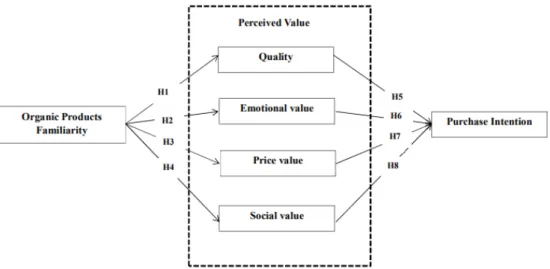
Previous studies focused on consumption behavior (Du et al., 2017) and product labeling (Jannsen and Hamm, 2012) of organic products. However this study focuses on understanding the purchase intention of consumers, associated with organic products. Organic products familiarity is very important to assess the perceived value and purchase intention of consumers. In this section, a conceptual model (Fig. 1) was developed delineating the antecedents and outcomes of perceived value. The significant determinants of organic consumptions are associated with consumers’ knowledge about quality and environment benefits of organic products (Bauer et al., 2013). Organic product familiarity is defined as “the number of product-related experiences that has been accumulated by the consumer” (Alba and Hutchinson, 1987, p. 411). Organic products familiarity occurs due to product related experiences that happens through purchasing and consuming organic products and collecting information about organic products either through research or reading about organic products or passively by seeing product display of organic products or advertisements (Du et al., 2017).
Values are simply, a person’s judgment about what is important in life (Ramayah et al.,
2010). Perceived values that are employed by a person are important criteria in making prefer-
ential judgment and direct the consumers’ choice (Varshneya and Das, 2017). Interplay of many
dimensions of values simultaneously influences consumers’ consumption experiences (Ghazali et
al., 2017). Zeithaml (1988) suggested perceived value as the overall assessment of the utility of
a product on the basis of what is received and what is given by consumers. Sweeney and Soutar
(2001) suggested the assessment of products by consumers not only on the basis of quality and
performance, but also by assessing emotional value and social value. They also claimed that
these values are often independent to each other, but they relatively add and make incremental
contribution in the choice of customers. Quality is the utility derived from the perceived quality
and expected performance of the organic products . Emotional value is, the utility derived from
the feelings or affective states that an organic product generates . Price means the utility derived
from the organic product as a function of cost. Social value is the degree to which organic
product is perceived as enhancement of people’s self-concept provided by the organic product
(Sweeney and Soutar, 2001). Indeed in business perspective, when people-based needs are
satisfied, simultaneously they are delivering value that will place the business in a commanding position in the long run (Burden, 1998).
Intention is a subjective probability to perform a specific behavior (Fishbein and Ajzen, 1975).
The significant predictors of actual buying behavior are influenced by intention and willingness (Ajzen, 1991). Several researchers highlighted the impact of price, quality and value in the shopping behavior and product choice (e.g. Sawyer and Dickson, 1984). Large numbers of studies related to consumer decision have a positive influence on attitude towards organic products which in turn has positive impact on purchase intention (e.g. Michaelidou and Hassan, 2008). In spite of attitudes, factors that can induce a consumer to make effort based on per- ceived values and interest about organic products have to be considered as a potential force in the buying decision of organic products.
“Human behaviors are value driven” (Chen, 2017, p. 3). Organic product-related cognitions determines organic consumptions (Hughner et al., 2007) and product familiarity shapes the use evaluations appropriateness (Jaeger et al., 2005). Consumers go through direct or indirect experi- ences about organic products and on the basis of that, consumers may have positive perception about perceived value in different spheres. Their increased organic products familiarity may enhance their opinion about perceived value of organic products. Radman (2005) reported consumer groups even have more positive attitude towards organic food and are willing to pay higher price. Sweeney and Soutar (2001) supported that, if consumers’ perception of a product is valuable they would most likely willing to buy the product at a premium price. Grubb and Grathwohl (1967) reported that to obtain positive opinion from social peers, they may engage in behavior including making purchases. Hollebeek and Chen (2014) supported perceived values as antecedents of consumers’ engagement of behaviors. Asshidin, Abidin and Bohran (2016) also support perceived value as the direct antecedent of a purchase decision. Thus the following hypotheses are formulated:
H1: Organic products familiarity is positively associated with quality.
H2: Organic products familiarity is positively associated with emotional value.
H3: Organic products familiarity is positively associated with price value.
H4: Organic products familiarity is positively associated with social value.
H5: Quality is positively associated with purchase intention.
H6: Emotional value is positively with purchase intension.
H7: Price value is positively with purchase intension.
H8: Social value is positively with purchase intension.
Based on the foregoing review of literature, we propose the research model illustrated in Fig. 1.
Fig. 1. Proposed research model.
Ⅲ. Research Methodology
To measure organic products familiarity (three items), the scale used by Du et al. (2017) was adapted. Perceived value about organic products was measured on the basis of quality, emo- tional, price and social dimensions. For measuring quality (four items), emotional value (five items), price value (four items) and social value (four items), we used the scale developed by Sweeney and Soutar (2001). Purchase intention (three items) was measured, using the scale developed by Michaelidou and Hassan (2008) and Lin (2007). Organic products familiarity, perceived value, and purchase intention were measured using a 5-point Likert scale measuring from strongly disagree (1) to strongly agree (5). To determine the content validity, two acade- micians were consulted and as per their suggestions, minor modification in the wordings of the questionnaire items was done. After that, a pilot study was conducted among twenty five students. The pilot study results confirmed the scale reliability and internal consistency of the items by a high Cronbach’s alpha value.
The survey was conducted among university students. Researcher’s students and his colleagues’
students participated in the survey. Prior permission was taken from his colleagues to conduct
the survey among their students. The questionnaire was prepared only in English language and
distributed among students who are proficient in English language, thereby eliminating the
necessity to translate the questionnaire to Korean. The purpose of research was explained by the
researcher before the beginning of the survey and the students were assured that the information
collected from them will not be used other than this research purpose. A total of 280 questionnaires were distributed and 235 questionnaires were used for analysis excluding the incomplete questionnaire.
Structural equation modeling, with the maximum likelihood procedure was used to examine the latent variables within the casual structures. Following Anderson and Gerbing’s (1988) two step approach, the measurement model was first estimated by confirmatory factor analysis (CFA) to assess its adequacy and to examine the model fitness and test the casual relationships, structural equation modeling was employed. The model fitness of the conceptual model to the empirical data was assessed by chi-square ( χ2) statistics, the goodness-of-fit index (GFI), the adjusted goodness-of-fit-index (AGFI), the normed fit index (NFI), the comparative fit index (CFI), and the root mean square of approximation (RMSEA). For each of those statistics except the RMSEA, values of 0.9 or higher indicate an acceptable fit, and RMSEA values of up to 0.08 indicate an acceptable fit to the data (Hair et al., 2006).
Ⅳ. Results and Discussion
1. Demographic profiles
The majority of the respondents (Table 1) were female (60%) compared to that of male (40%). Among the respondents, 51.9% of the respondents were from the age group of 21-25 followed by 16-20 years of age (39.1%). Most of the respondents were from Korea (86.8%) and the rest were from other countries. Of the respondents, 86% of them were pursuing under graduate degree and the rest of the respondents were enrolled for graduate and above degree.
57.9% of the respondents were from social science major, 27.2% of the respondents were from science major and the rest of them were from arts major. 62.1% of the respondents were using organic products less than a year.
Table 1. Descriptive statistics
Variable n = 235 %
Gender
Male 94 40
Female 141 60
2. Measurement model
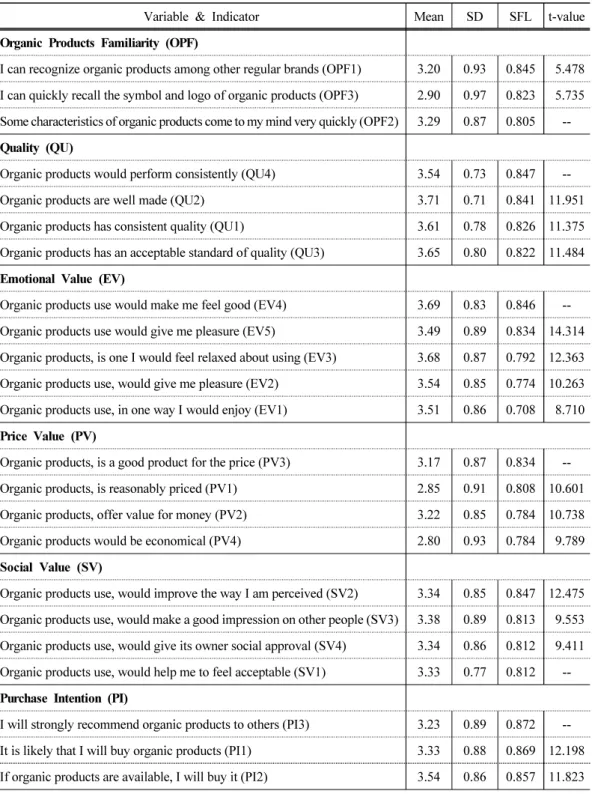
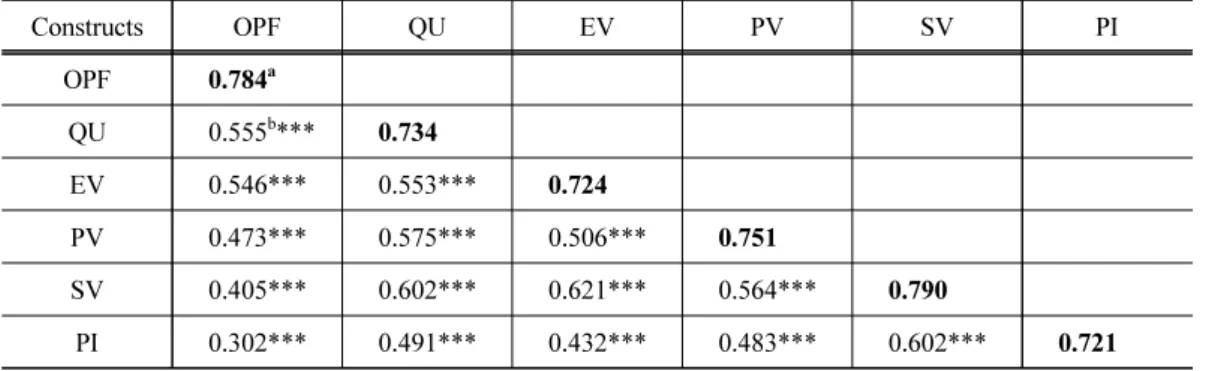
SPSS 24 and AMOS 23 module softwares were used to analyze the empirical data. The measurement model was evaluated by using CFA (Table 2). The Cronbach’s α value of all the factors were above 0.76, which is higher than the minimum cutoff (0.7). As shown in Table 3, the composite reliability (ranging from 0.864 to 0.901) was much higher than the suggested value of 0.7 (Hair et al., 1998). The average variance extracted (AVE) of constructs (ranging from 0.627 to 0.749) were higher than the minimum accepted value of 0.5 (Bagozzi and Yi, 1988). All the variables’ factor loadings were well above the minimum accepted value of 0.5 with the high AVE of the latent constructs thus confirming convergent validity (Fornell and Larcker, 1981). The discriminant validity (Table 4) is also confirmed, as the AVE is also greater than the squared correlation of each construct.
Variable n = 235 %
Age (in years)
16-20 92 39.1
21-25 122 51.9
26-30 20 8.5
Above 30 1 0.4
Nationality
Korean 204 86.8
Foreigner 31 13.2
Educational Qualification
Pursuing Undergraduate 202 86
Pursuing Graduate/above 33 14
Major
Arts 35 14.9
Science 64 27.2
Social Science 136 57.9
Using Organic Products
Less than one year 146 62.1
1-5 years 63 26.8
More than 5 years 26 11.1
Table 2. Results of confirmatory factor analysis
Variable & Indicator Mean SD SFL t-value
Organic Products Familiarity (OPF)
I can recognize organic products among other regular brands (OPF1) 3.20 0.93 0.845 5.478 I can quickly recall the symbol and logo of organic products (OPF3) 2.90 0.97 0.823 5.735 Some characteristics of organic products come to my mind very quickly (OPF2) 3.29 0.87 0.805 -- Quality (QU)
Organic products would perform consistently (QU4) 3.54 0.73 0.847 --
Organic products are well made (QU2) 3.71 0.71 0.841 11.951
Organic products has consistent quality (QU1) 3.61 0.78 0.826 11.375 Organic products has an acceptable standard of quality (QU3) 3.65 0.80 0.822 11.484 Emotional Value (EV)
Organic products use would make me feel good (EV4) 3.69 0.83 0.846 -- Organic products use would give me pleasure (EV5) 3.49 0.89 0.834 14.314 Organic products, is one I would feel relaxed about using (EV3) 3.68 0.87 0.792 12.363 Organic products use, would give me pleasure (EV2) 3.54 0.85 0.774 10.263 Organic products use, in one way I would enjoy (EV1) 3.51 0.86 0.708 8.710 Price Value (PV)
Organic products, is a good product for the price (PV3) 3.17 0.87 0.834 -- Organic products, is reasonably priced (PV1) 2.85 0.91 0.808 10.601 Organic products, offer value for money (PV2) 3.22 0.85 0.784 10.738
Organic products would be economical (PV4) 2.80 0.93 0.784 9.789
Social Value (SV)
Organic products use, would improve the way I am perceived (SV2) 3.34 0.85 0.847 12.475 Organic products use, would make a good impression on other people (SV3) 3.38 0.89 0.813 9.553 Organic products use, would give its owner social approval (SV4) 3.34 0.86 0.812 9.411 Organic products use, would help me to feel acceptable (SV1) 3.33 0.77 0.812 -- Purchase Intention (PI)
I will strongly recommend organic products to others (PI3) 3.23 0.89 0.872 --
It is likely that I will buy organic products (PI1) 3.33 0.88 0.869 12.198
If organic products are available, I will buy it (PI2) 3.54 0.86 0.857 11.823
Note : SD, Standard Deviation; SFL, Standard Factor Loadings
Table 3. CR, AVE and Cronbach’s α coefficients
Variable & Indicator I-T-C α CR AVE
Organic Products Familiarity (OPF)
I can recognize organic products among other regular brands (OPF1) 0.628 0.764 0.864 0.679 I can quickly recall the symbol and logo of organic products (OPF3) 0.595
Some characteristics of organic products come to my mind very quickly (OPF2) 0.567 Quality (QU)
Organic products would perform consistently (QU4) 0.713 0.854 0.901 0.695
Organic products are well made (QU2) 0.711
Organic products has consistent quality (QU1) 0.678 Organic products has an acceptable standard of quality (QU3) 0.678 Emotional Value (EV)
Organic products use would make me feel good (EV4) 0.729 0.851 0.893 0.627 Organic products use would give me pleasure (EV5) 0.710
Organic products, is one I would feel relaxed about using (EV3) 0.656 Organic products use, would give me pleasure (EV2) 0.646 Organic products use, in one way I would enjoy (EV1) 0.567 Price (PV)
Organic products, is a good product for the price (PV3) 0.677 0.816 0.878 0.644
Organic products, is reasonably priced (PV1) 0.644
Organic products, offer value for money (PV2) 0.608
Organic products would be economical (PV4) 0.606
Social (SV)
Organic products use, would improve the way I am perceived (SV2) 0.703 0.839 0.892 0.674 Organic products use, would make a good impression on other people (SV3) 0.664
Organic products use, would give its owner social approval (SV4) 0.663 Organic products use, would help me to feel acceptable (SV1) 0.655 Purchase Intention (PI)
I will strongly recommend organic products to others (PI3) 0.703 0.833 0.899 0.749 It is likely that I will buy organic products (PI1) 0.698
If organic products are available, I will buy it (PI2) 0.679
Note : ITC, item-to-total correlation; CR, Composite Reliability; AVE, Average Variance Extracted; α,
Cronbach’s α.
Table 4. Discriminant validity of the constructs
Constructs OPF QU EV PV SV PI
OPF 0.784
aQU 0.555
b*** 0.734
EV 0.546*** 0.553*** 0.724
PV 0.473*** 0.575*** 0.506*** 0.751
SV 0.405*** 0.602*** 0.621*** 0.564*** 0.790
PI 0.302*** 0.491*** 0.432*** 0.483*** 0.602*** 0.721
Note :
aAverage Variance Extracted;
bSquared Correlation
3. Structural equation modeling and hypothesis testing
The result of structural equation model (Fig. 2) shows good model fit. The fit indices were χ2 = 422.12, p < 0.001 and the d.f. = 286 which is less than the criteria of 3 (Hair et al., 2010).
The GFI =0.911, AGFI= 0.907, CFI =0.923, NFI =0.912, and RMSEA 0.031 value indicates that there is no discrepancy between the hypothesized model and empirical data. As shown in Fig.
2, all the hypothesized relationships were positive and showing significant relationship except for the path quality towards purchase intention. The relationship of organic product familiarity towards quality (0.672, t = 6.722, p = 0.001), emotional value (0.791, t = 7.653, p = 0.001), price value (0.705, t = 6.972, p = 0.001) and social value (0.729, t = 7.079, p = 0.001) shows positive relationship and high significance. On the other hand, the relationship of emotional value (0.266, t = 2.965, p = 0.01), price value (0.378, t = 4.297, p = 0.001) and social value (0.262, t = 3.016, p
Fig. 2. Results of the proposed model.
= 0.01) towards purchase intention also shows positive and significant relationship. Therefore H1, H2, H3, H4, H6, H7 and H8 were supported and only H5 was rejected.
Ⅴ. Conclusion
Exploring the relationship between organic products familiarity, perceived value and purchase intention rarely received attention. The current study assesses the relationship between organic products familiarity, perceived value and purchase intention of organic products. The findings of this study confirm organic products familiarity is very important and plays an important role in assessing its perceived value that leads to the purchase intention of consumers. Specifically, this study focused on assessing the familiarity of organic products among young people. The results reveal that young people are aware about organic products and they are willing to purchase organic products in the future. The outcome of this study suggests promoting organic farming and the young generation is having favorable outlook towards organic products. Following are the main results of the study.
First, the result of this empirical study shows that organic products familiarity positively
affects perceived value that was measured under four different dimensions such as quality,
emotional value, price value and social value. The perceived values of the respondents were
dominated primarily by emotional value followed by social value, price value and quality with
respect to organic products familiarity. As the emotional value and social value shows strong
influence, apparently we may notice that young people have the moral and ethical obligations in
their consumption behavior. Secondly, on the relationship between perceived value and purchase
intention, only quality dimension showed insignificant relationship with purchase intention. This
might be because of the difficulty by the consumers in differentiating and assessing the quality
between organic and inorganic products. Price value followed by emotional value and social
value were having strong influence in the purchase intention of organic products. Overall the
study confirms the strong relationship of organic products familiarity, perceived value and
purchase intention. Prior research supports the link between positive effect of organic product
identification and purchase behavior (Bartels and Reinders, 2016). However this study addresses
exploring the mediating influence of perceived value related to purchase intension. This study
also helps to understand the purchase behavior of organic products especially among young
generation, as the sample of our study were students.
[Submitted, November. 9, 2017 ; Revised, March. 2, 2018 ; Accepted, May. 4, 2018]
References