Print ISSN: 2093-9582 Online ISSN 2508-4593
http://dx.doi.org/10.21871/KJFM.2021.3.12.1.21
The Effects of Perceived Quality and Relationship Quality on Store Performance(Revisit Intention) in the Context of Coffee Specialty Shops*
Sang Suk LEE
1, Jee Eun LEE
2Received: October 21, 2020. Revised: February 08, 2021. Accepted: March 03, 2021.
Abstract
Purpose: This study examines the structural relationship between perceived quality, relationship quality, and revisit intention in the context of coffee shop. In this model, perceived quality consists of product, service, and experience quality, and relationship quality consists of satisfaction, trust, and commitment, and performance consists of revisit intention. More specially, this study identifies whether perceived quality plays a mediating role in the relationship between perceived quality and relationship quality and the direct/indirect effects of perceive quality on intention to revisit. Research design, data and methodology: The survey was conducted from September 1 to 30, 2019. The data were collected from 320 respondents and analyzed using structural equation modeling (SEM) with AMOS program.
Results: The findings are as follows. First, quality perception of coffee specialty stores had a statistically positive effect on relationship quality, indicating supports H1. Therefore, customers can know that they are aware of the quality of coffee specialty stores, including quality of service and experience as well as products, and that they form relationship quality with coffee specialty stores. Second, relationship quality between coffee shops and customers had a significant positive effect on performance. Thus, H2 was supported. The results show that if the coffee shop does not consider relationship quality as important, customer loyalty decreases, the number of customers decreases, and the number of customers who switch to another coffee shop increases, which can lead to a threat to the coffee shop. Third, in the case of hypothesis H3, it was found that there was a partial mediating effect of satisfaction and trust between quality perception and reuse intention of coffee specialty stores, so hypothesis H3 was partially supported. As commitment appears to have no mediating effect, it can be said that customers who use coffee shops are not only difficult to maintain as regular customers of a particular coffee shop, but also have ample room to move to other coffee shops. Conclusions: Although many scholars point out the importance of service quality, few studies were conducted in the context of the Korean food service industry (including coffee shops). From this perspective, this study tested several hypotheses that the quality (product, service, experience) perceived by customers can have a positive effect on relationship quality and performance (re-visit intention), either directly or indirectly. The findings of this study demonstrate that if the manager of a coffee shop understands the characteristics of quality perceived by customers and the role of relationship quality, the effect of quality perceptions on customers can be maximized in order to maintain the relationship with customers.
Keywords : Perceived Quality, Relationship Quality, Revisit Intention JEL Classification Code : M10, M31, M38
1
21. 서론
* This paper was supported by Kangnam University Research Grant in 2020.
1 First Author’s Affiliation: Full Professor, Kangnam University, Division of Global Business Administration, Korea.
Email: [email protected]
2 Corresponding Author’s Affiliation: Doctoral Candidate, School of Business, Korea University, Seoul, Korea.
Email: [email protected]
© Copyright: Korean Distribution Science Association (KODISA)
This is an Open Access article distributed under the terms of the Creative Commons Attribution Non- Commercial License (https://creativecommons.org/licenses/by-nc/4.0/) which permits unrestricted non- commercial use, distribution, and reproduction in any medium, provided the original work is properly cited.
2018년 기준 한국 커피전문점 시장의 규모는 약 43억 달러로 미국과 중국에 이어서 세계에서 세 번째로 큰 규모이다. 국내 커피 시장은 2016년 5조 9000억 원에서 2023년 860조 원으로 성장할 것으로 예상된다. 커피 전문점 수는 빠르게 증가하고 있으며 진입 장벽이 낮아 경쟁이 심화되고 있다 (KB경영연구원, https://www.kbfg.com/kbresearch/index.do). 특히 가격 경쟁력이 있는 저가 커피전문점이 증가하는 가운데 브랜드와 맛에 중점을 둔 프랜차이즈 전문점이 증가되고 있다. 경기 침체로 값싼 커피를 선호하는 소비자가 늘어나고 있는 가운데 가격보다 맛과 프리미엄 브랜드 이미지를 중시하는 마니아에 대한 수요도 견고하다. 또한
브랜드 론칭 이후 커피와 같은 기초 음료 뿐 아니라 프리미엄 디저트 카페 콘셉트도 매출 증대에 큰 역할을 했다고 볼 수 있다.
이러한 상황은 소비자 매장 내 구매 및 소비를 늘리기 위한 더 나은 전략을 찾는 데 도움이 될 수 있다.
고급 커피는 한때 지나치게 비싸다고 여겨졌지만 오늘날 소비자는 저렴한 사치품이라고 생각한다. 그 결과 가치를 포함한 커피전문점에 대해서 인식된 품질은 커피 사업의 성공을 정의하는 데 없어서는 안 될 요소가 되었다 (Giacalone et al., 2016). 따라서 고품질을 제공하는 커피전문점의 능력은 소비자의 호의적인 행동에 필수적이다 (Ting & Ramayah, 2016). 제품이 고품질로 인식되면 무형의 반응을 재구매 및 재방문과 같은 유형의 행동으로 전환할 가능성이 높다 (Wakefield & Blodgett, 1999).
인식된 품질은 가치 인식과 관련이 있으며, 시장에서 소비자의 행동에 중요한 요소가 되고 있다. 인식된 품질은 기업 (Zeithaml, 1988)의 전반적인 우월성이며, 이전 연구에서 제품 및 서비스 품질이 성능 (만족도, 충성도, 재사용 의도 등)에 영향을 미친다는 사실이 밝혀졌다 (Asmayadi & Hartini, 2015; Chathoth et al., 2016).
또한 최근 연구에 따르면 정서적 만족과 같은 경험의 품질이 성과에 영향을 미친다고 보고되고 있다 (Ali & Raza, 2015; Yu &
Tung, 2013).
온라인 소셜 네트워킹의 빠른 발전은 다양한 구매자가 서로 다른 브랜드와 조직을 연결하는 방식을 변화시켰다. 이러한 변화는 소비자가 구매 결정을 내리는 방식에 변화를 가져왔다 (Leung et al., 2015). 이전에는 마케터가 홍보 메시지에 의존하고 매스컴 미디어를 사용하여 구매자에게 정보를 제공하고 브랜드에 대한 호의적인 성향을 구축했다 (Hafeez et al., 2017). 그러나 최근 마케터들은 온라인 소셜 네트워킹 마케팅에 특히 중점을 두고 온라인 마케팅 예산을 늘리고 있는 실정이다. 소셜 네트워킹 사이트는 기업에 새로운 마케팅 홍보 도구 세트와 고객의 현대 사회에 참여할 수 있는 새로운 방법을 제공하고 있다. 그 만큼 서비스 제공자와 고객 간의 관계품질의 수단에도 변화되었다고 볼 수 있다.
이 연구의 목적은 세 가지로 요약될 수 있다. 첫째, 본 연구는 제품 및 서비스 품질, 커피전문점 경험품질 수준이 관계품질과 재방문의도에 미치는 영향을 확인한다. 둘째, 관계품질이 재방문의도에 미치는 영향을 확인한다. 셋째, 인식된 품질과 재방문의도 사이의 관계품질의 매개역할을 확인한다. 따라서 본 연구는 인식된 품질, 관계품질, 재방문의도의 구조적 관계를 실증분석을 통해서 규명하는 것이다. 특히 인식된 품질이 매개변수인 관계품질에 대한 영향, 그리고 인식된 품질과 재방문의도 상황에서 관계품질의 매개효과 및 인식된 품질의 직/간접 효과에 대해서 분석한다.
2. 이론적 배경 및 연구모형
2.1. 이론적 배경2.1.1. 인식된 품질
2.1.1.1. 제품품질
품질은 0 불량률 (zero error rate)로써 표현되어왔다 (Parasuraman et al., 1985). 제품의 우수성은 품질 평가의 주요한 항목으로 여겨왔다 (Madu et al., 1995; Eduardo et al., 2008). 일반적으로 품질은 주어진 조건 또는 그 이상으로 충족하기 위한 제품의 능력에 공헌하는 제품특성의 집합체로서 표현될 수 있다 (Ngoc &
Uyen, 2015). 다시 말해서, 제품품질은 소비자의 기대에 부응하기 위한 제품 사양 (specification)을 어떻게 잘 부합되도록 제공할 것 인가의 문제인 것이다. 금전적 가치를 제공하는 제품은 사전 구매행위 (pre-purchase behavior) 뿐만 아니라 사후 구매행위에도 영향을 미친다 (Alex & Thomas, 2011). 이는 소비자들이 좋은 품질로 인식할 때 제품에 대해서 기꺼이 금전을 지불하게 되며, 그것에 대해서 다른 소비자에게 전하게 되고 특정한 구매 장소를 반복하여 방문하게 된다는 것을 의미한다. 본 연구에서 제품의 품질은 커피전문점에서 제공된 제품의 속성에 대해서 고객의 기대에 대한 평가를 나타낸다 (Jakpar et al., 2012). 고객을 확보한다는 측면에서 재방문 의도에 대한 제품품질의 효과를 파악한다는 것은 매우 중요한 일이다. 최근 여가시간에 대한 중요성이 점차 증가되고 있으며 욕구 충족을 위한 제품에 대해서는 기꺼이 소비를 하는 경향이 있기 때문에 소비자들이 커피전문점에서 취급하는 제품의 품질에 대한 인식은 매우 중요한 요인이라고 볼 수 있다.
2.1.1.2. 서비스품질
서비스품질은 그 동안 널리 알려져 있는 SERVQUAL모형을 포함해서 다양한 방법으로 설명되었다 (Parasuraman et al.,1994; Ali
& Raza, 2015). 서비스품질은 소비자의 기대와 실제 서비스 사이에 차이의 기능으로서 설명되어져 왔다 (Parasuraman et al., 1985).
소비자는 궁극적으로 받은 것과 받기를 원하는 것을 비교함으로써 품질을 판단한다는 것이다 (Lau et al., 2013). 받기를 원하는 것과 받은 것 간에 차이 (gap)로 인하여, 또한 서비스품질은 서비스경험에 대한 인식으로써 받아들인다 (Ryu et al., 2012).
이것은 소비자가 편의시설, 서비스 종업원의 평가를 포함해서 전환 과정 (transaction process)으로 인식하거나 서비스 성과의 수준 (level of service performance)으로 인식하기 때문이다(Abebe, 2014).
서비스품질은 종종 서비스 수준을 측정하는 사업의 지표로써 사용된다 (Bharadwaj et al., 2015). 고객만족을 위해서 정교하게 설계된 서비스 과정은 사업성과 및 조직을 운영하는데 매우 중요하다. 이것은 커피전문점 운영을 위한 고객 확보에 중요한 사항일 수 있다. 서비스는 상황에 따라 다양하게 동시에 주고받기 때문에 서비스 제공자는 세심하게 주의해야 한다 (Kotler, 2016).
서비스가 품질로써 간주될 때, 호의적인 구전과 재방문 행위와 같은 긍정적인 행위의 결과가 나타난다 (Ryu et al., 2012).
2.1.1.3. 경험품질
소비자의 전반적인 만족과 특정 제품과 서비스의 상호작용에 의한 감정은 맥락적 경험으로써 알려졌다 (Alex & Thomas, 2011).
그러므로 소비자의 경험은 제공자와 소비자 사이에 상호작용 가치의 행위가 관여됨에 따라 나타날 수 있다 (Schmitt, 2010).
이것은 직/간접적 상호작용의 과정에서 내적 평가로써 표현될 수 있으며 궁극적으로는 인식과 행위로 나타난다 (Meyer & Schwager, 2007; Page & Conell, 2006).
그럼에도 불구하고 경험은 제품과 서비스에 따라 다르다. 제품은 대상을 만질 수 있으나 서비스 행위는 만질 수 없고, 경험은 접점의 진행과정으로 전환과정에 대한 애착 (attachment)이다 (Johnston & Kong, 2010; Poulsson & Kale, 2004). 그러므로 경험품질의 생성은 고객을 위한 특정 요구사항을 수행하기 위한 조직의 능력에 따라 결정된다 (Mascarenhas et al., 2006).
기존연구들은 소비자의 우호적 경험의 효율적 생성은 소비자의 충성도, 의도, 성과를 구성하는 핵심이라고 주장하고 있다 (Lemke et al, 2006). 소비자는 어떤 즐거움을 특별하게 경험했을 때 그것을 오랫동안 기억하고 싶고, 다른 사람에게 전하고 싶고, 행위를 반복하게 된다. 이런 측면에서 커피전문점은 제품과 서비스뿐 아니라 여가를 활성화하고 즐기는 것과 같은 다양한 행위를 위한 즐거운 장소로 제공될 수 있다.
2.1.2. 관계품질
관계품질 (relationship quality)은 커피전문점과 고객 간의 중요한 매개변수라고 볼 수 있으며 다차원적 개념으로 설명될 수 있다.
관계품질은 고객이 서비스제공자에 대해 지각하는 상호관계의 정도에 대한 판단 (Crosby et al., 1990) 또는 구매자와 판매자 간의 교환과 관련이 있는 무형적인 가치 (Gwinner et al., 1998)라고 볼 수 있다.
관계품질을 위한 측정은 다양한 변수로 측정되었는데 Wulf et al.
(2001) 등은 서비스를 제공하는 자의 행동과 관련된 만족, 신뢰, 상호관계에 대한 몰입을 관계품질의 구성요소로 제시하였으며, Leonidou et al. (2006) 등은 몰입, 적응, 정보, 혜택, 만족, 신뢰, 이해
등의 변수에 의해서 관계품질을 측정하였다. 관계품질의 구성요소에 대해서 기존연구들은 일치하지는 않지만 대부분의 연구들은 신뢰, 만족, 몰입 등 3개 변수 또는 일부를 포함하고 있다.
일반적으로 전반적인 만족은 모든 업무관계에 대한 평가로부터 긍정적인 감정 상태라고 볼 수 있다 (Anderson & Narus, 1990).
특히, 신뢰 (trust)는 기업 간 혹은 기업과 개인 간 거래의 관계형성에 필수적으로 요구되는 감정이기 때문에 관계마케팅의 가장 중요한 핵심개념들 중의 하나로 간주된다 (Morgan & Hunt, 1994). 특히, Wilson (1995)은 신뢰는 기본적 관계를 구축하는데 중요한 요소로 인식하였으며, 몰입은 미래관계를 예측하기 위한 필수적인 요인으로 보았다. 그리고 고객관계를 형성하는데 원활한 소통은 마케팅관계의 신뢰를 구축하게 되고, 이는 몰입을 촉진시키는 역할을 한다고 주장하였다.
몰입 (commitment)은 교환에 참여하고 있는 한 당사자가 상대방과의 가치 있는 관계를 유지하고자 하는 바램을 의미한다 (Morgan & Hunt, 1994). 이때 감정적 몰입 (affective commitment)이 높은 경우, 교환 당사자는 상대방에게 매우 강한 유대감을 갖게 되고 우호적인 관계의 유지를 원한다. Anderson and Weitz (1989)는 몰입은 지속적이면서 안정적인 관계를 유지하기 위해 단기적인 희생을 감수하고자 하는 의지라고 하였고, Garbarino and Johnson (1999)은 조직의 장기적인 측면까지 고려하는 심리적 애착 상태라고 주장하였다. 이와 관련하여 Moorman et al. (1992)은 몰입을 가치 있는 관계를 유지하고자 하는 지속적 욕구라고 하였다. 따라서 몰입은 거래 구성원 간의 관계를 지속시키려는 의도 또는 바람이며, 이는 거래 당사자 간의 관계에서 긍정적인 측면이 있다면 그들의 관계는 지속될 수 있음을 내포하는 것이라고 볼 수 있다.
2.1.3. 재방문의도
어떤 기업에 의해서 제공된 제품 (서비스)은 현재 시장에서의 경쟁자의 제품 (서비스)과 유사할 가능성이 높다. 그리고 보통 소비자들이 선택할 수 있는 대안 (제품/서비스)은 많다고 볼 수 있다. 그러므로 기업은 새로운 고객에 관심을 가지는 것 이외에 현존하는 고객의 가치를 향상시키고, 재 구매 행위에 필요한 효율적인 방안을 위한 노력이 중요하다 (Hanai et al., 2008). 고객 재구매의도는 여행서비스 (Alegre & Cladera, 2006), 식자재서비스 (Kim & Moon, 2009), 병원서비스 (Lee, 2005), 도소매업 (Zboja &
Voorhees, 2006), 은행서비스 (Shao et al., 2008), 텔레콤비즈니스 (Wang et al., 2004) 등 많은 분야에서 연구되어 로지스틱 회귀모형 또는 구조방정식모형을 이용하여 영향 변수에 대한 연구가 진행되었다. 일반적으로 영향 요인들은 만족, 신뢰, 방문 횟수, 기회비용, 고객가치 등이 고려되었다. 많은 연구들은 이러한
변수들 중 만족이 고객 재방문에 영향을 주는 변수로 제시하고 있다 (Alegre & Cladera, 2006; Um et al., 2006; Hui et al., 2007; Alegre
& Cladera, 2009; Han et al., 2009; Campo-Martínez et al., 2010).
2.2. 연구모형 및 연구가설
2.2.1. 연구모형
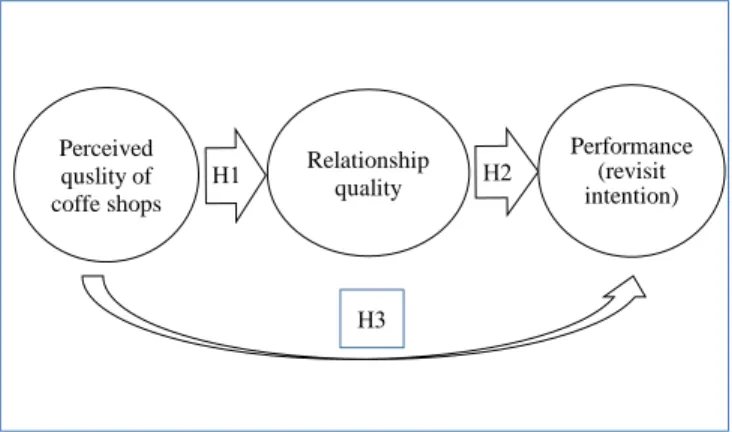
연구모형(Figure 1)은 한국의 커피전문점을 대상으로 테스트 되었다. 커피전문점을 선택한 이유는 2가지가 있다. 첫째, 커피전문점의 매출액을 유지, 성장하기 위해서는 고객의 재방문이 매우 중요하며 재방문율은 고객의 커피전문점 방문 경험과 밀접한 관계를 가지고 있기 때문이다. 둘째, 커피전문점이 급속히 성장하고 있는 상황에서 고객확보를 위한 새로운 접근이 필요하기 때문이다.
Figure 1: Research Model
2.2.2. 연구가설
음식은 음식서비스업에서 핵심 제품이며 근본적으로 이용고객의 식사경험에 영향을 준다(Hansen, 2014). 음식에 대한 고객의 평가는 고객의 식사경험과 반응에 영향을 주기 때문에 음식의 맛, 신선도, 시식, 분량 등을 포함하는 음식품질에 대해서 많은 연구가 진행되어왔다(Ha & Jang, 2009; Namkung & Jang, 2007). 음식품질이 고객 식사경험의 핵심요소로 알려져 있기 때문에 많은 커피전문점들은 경쟁력을 유지하기 위해서 메뉴를 추가하는 경향이 있다 (Euromonitor International, 2016; Jin et al., 2015).
고객은 종업원이 제공한 서비스가 무례하고 느리고 이해할 수 없을 정도라고 인식했을 때 서비스품질에 부정적인 영향을 미친다 (Wall & Berry, 2007; Tsai & Huang, 2002). 이러한 환경 하에서 서비스가 전달되는 동안에는 고객과 종업원은 분리될 수 없다 (Bowen, 2016; Ha & Jang, 2009). 그러므로 종업원은 고객이
전반적인 서비스 수준을 평가하는 것으로부터 핵심으로 간주된다 (Ha & Jang, 2009). 이런 측면에서 서비스품질은 커피전문점 경험에 대한 평가와 고객의 마음속에서 서비스제공자에 대한 마지막 인상이라고 볼 수 있다 (Jin et al., 2015; Liang & Zhang, 2012).
레스토랑 환경에 존재하는 물리적인 요인들 때문에 식사 경험은 다양한 차원과 요인들이 고려된다 (Bufquin et al., 2017; Ali et al., 2016; Antun et al., 2010; Line et al., 2012). 기존연구들은 식사경험에 관한 차원에 분위기, 음식, 서비스, 사회적 유대감 등을 포함하는 것에는 동의하고 있다. 더욱이 커피전문점은 고객에게 즐거운 경험을 제공하기 위해서 분위기에 많이 의존한다 (Ting &
Thurasamy, 2016; Sage, 2013). 많은 고객들은 그들의 감각적이고 기호적인 욕망을 충족시키기 위해서 제품이나 서비스를 구매한다 (Maklan & Klaus, 2011). 그러므로 어떤 연구들은 서비스 전달 동안 고객의 마음속에 기억할 만한 경험을 심어 주기 위한 서비스전달 환경의 디자인을 강조하고 있다 (Lemon & Verhoef, 2016; Zorfas &
Leemon, 2016). 이러한 선행연구들에 근거하여 다음과 같은 가설들이 설정되었다.
H1: 커피전문점에 대한 품질인식은 관계품질에 정(+)의 유의한 영향을 미칠 것이다.
H1-1: 커피전문점의 제품품질은 고객과의 관계품질에 정(+)의 유의한 영향을 미칠 것이다.
H1-2: 커피전문점의 서비스품질은 고객과의 관계품질에 정(+)의 유의한 영향을 미칠 것이다.
H1-3: 커피전문점의 경험품질은 고객과의 관계품질에 정(+)의 유의한 영향을 미칠 것이다.
관계품질의 구성요소에 대한 기존연구들의 의견은 일치하지는 않지만 대부분의 연구에서 만족, 신뢰, 몰입 등 3개 변수 혹은 일부를 포함하고 있다고 볼 수 있다. 일반적으로 전반적인 만족(satisfaction)은 모든 업무 관계에 대한 평가로부터 긍정적인 감정 상태라고 볼 수 있다 (Anderson & Narus, 1990).
관계만족은 파트너십을 형성하고, 장기지향성의 강화를 통해 여러 가지 분쟁을 감소시킴으로써 긍정적인 관계 유지에 영향을 미친다(Anderson & Nurus, 1990; Ganesan, 1994).
신뢰(trust)는 기업 간 혹은 기업과 개인 간 거래의 관계형성에 필수적으로 요구되는 감정이기 때문에 관계마케팅의 가장 중요한 핵심개념들 중의 하나로 간주된다(Morgan & Hunt, 1994). 따라서 고객관계를 형성하는데 효과적인 소통은 마케팅관계의 신뢰를 구축하게 되고, 이는 관계몰입을 촉진시키는 역할을 한다고 주장하였다.
Relationship quality Perceived
quslity of coffe shops
Performance (revisit intention)
H3
몰입(commitment)은 교환에 참여하고 있는 한 당사자가 상대방과의 가치 있는 관계를 유지하고자 하는 바램을 의미한다(Morgan & Hunt, 1994). 이때 감정적 몰입(affective commitment)이 높은 경우 교환 당사자는 상대 파트너에게 매우 강한 유대감을 갖게 되어 우호적인 경로관계의 유지를 원한다.
이러한 연구들을 근거로 다음과 같은 가설들이 설정되었다.
H2: 커피전문점과 고객 간의 관계품질은 재방문 의도에 유의한 영향을 미칠 것이다.
H2-1: 커피전문점과 고객 간의 만족은 재방문 의도에 유의한 영향을 미칠 것이다.
H2-2: 커피전문점과 고객 간의 신뢰는 재방문 의도에 유의한 영향을 미칠 것이다.
H2-3: 커피전문점과 고객 간의 몰입은 재방문 의도에 유의한 영향을 미칠 것이다.
또한 레스토랑 서비스에 관한 기존연구들은 만족이 고객 재방문의도에 긍정적인 영향을 미치며 매개역할을 한다는 것을 확인하였다 (Song & Qu, 2017; Ali et al, 2016; Lai, 2015; Prayag et al., 2015). 이러한 기존연구들을 바탕으로 다음과 같은 가설을 설정하였다.
H3: 커피전문점에 대한 품질인식과 재방문 의도 관계에서 관계품질은 매개효과를 나타낼 것이다.
H3-1: 커피전문점에 대한 제품품질과 재방문 의도 관계에서 관계품질은 매개효과를 나타낼 것이다.
H3-2: 커피전문점에 대한 서비스품질과 재방문 의도 관계에서 관계품질은 매개효과를 나타낼 것이다.
H3-3: 커피전문점에 대한 경험품질과 재방문 의도 관계에서 관계품질은 매개효과를 나타낼 것이다.
3. 연구설계
3.1. 변수의 측정본 연구에서 사용한 측정변수는 커피전문점을 대상으로 리커트 척도 (1: 매우 그렇지 않다; 5: 매우 그렇다)로 측정되었다.
독립변수인 품질인식은 고객이 인식하고 있는 제품품질, 서비스품질, 경험품질 등으로 구분되었다. 제품품질의 측정은 고객에게 제공된 제품속성에 대한 기대가치 (Jakpar et al., 2012),
서비스품질은 서비스품질에 대한 인식의 결과 (Ryu et al., 2012), 경험품질은 서비스 제공자와 고객 간의 상호작용 행위의 결과 (Schmitt, 2010)로 측정되었다. 또한 관계품질은 Cuccinelli et al.
(2009), Wakefield & Blodgett (1999)연구를 바탕으로 Athanasopoulou (2009), Vesel & Zabkar (2010a, b), Yu & Tung (2013) 등의 연구를 참고하여 만족(3개 문항), 신뢰(4개 문항), 몰입(4개 문항)으로 측정되었다. 종속변수는 재방문의도를 사용하여 커피전문점에 적용한 Pöyry et al. (2013), Kühn & Bothma (2018)연구를 참조하여 재방문의도, 추천, 그리고 우호적 평가의 3개 항목으로 측정되었다.
3.2. 자료수집
데이터는 본교 경영학과에 재학중인 3, 4학년 학생 (주/야간)을 대상으로 수집되었으며, 학생들에게 추가적으로 주변 지인에게 각 1부의 설문을 의뢰하도록 하였다. 그리고 설문서는 설문에 동의한 학생들에게 학년별, 반별, 연령대를 고려하여 배포되었다. 조사 시기는 2019년 9월 1일~9월 30일까지 실시되었으며, 320부가 회수되어 분석에 이용되었다.
4. 실증분석
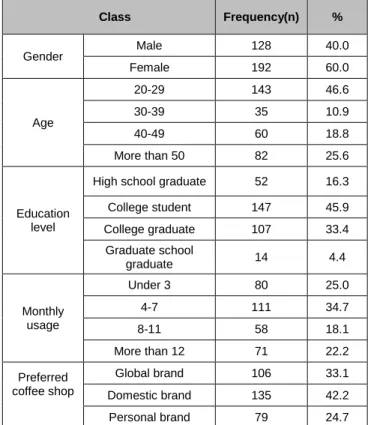
4.1. 표본의 특성표본의 인구 통계적 특성은 Table 1과 같다. 성별 비율을 보면 여성 (60%)이 남성 (40%)에 비하여 많으며, 연령별 분포는 30~40대 (57.5%)가 40~50대 (42.5%)보다 약간 많은 비중을 차지하고 있어 커피전문점을 이용하는 고객의 특성을 고려해 볼 때 모집단을 잘 대표하는 것으로 볼 수 있다. 교육 수준은 대학생 (45.9%), 대졸 (33.4%)의 표본 특성을 가지고 있으며, 커피전문점의 월 이용횟수는 4~7회가 가장 많은 비중을 차지하고 있다. 자주 이용하는 커피전문점은 국내브랜드 (프랜차이즈) 비율이 42.2%, 해외브랜드 (프랜차이즈)가 33.1%, 개인커피전문점이 24.7%의 비중을 차지하고 있어 표본의 대표성은 무리가 없는 것으로 판단된다.
4.2. 신뢰도 및 타당도 분석
본 연구에 사용된 측정변수들의 신뢰성과 타당성은 다음과 같이 검증되었다. 먼저, Cronbach‘s Alpha값을 이용하여 내적 일관성이 평가되었다. Cronbach's Alpha는 .7 이상이 될 경우 신뢰성 있는 변수로 인정되는데 (Kerlinger, 1973), Appendix 2와 Appendix 3에서
보는 바와 같이, 대부분 척도들의 Cronbach𝛼 값이 .7 이상으로서 만족할 만한 수준으로 나타났다.
Table 1: Respondent’s Characteristics (n = 320)
Class Frequency(n) %
Gender Male 128 40.0
Female 192 60.0
Age
20-29 143 46.6
30-39 35 10.9
40-49 60 18.8
More than 50 82 25.6
Education level
High school graduate 52 16.3 College student 147 45.9 College graduate 107 33.4
Graduate school
graduate 14 4.4
Monthly usage
Under 3 80 25.0
4-7 111 34.7
8-11 58 18.1
More than 12 71 22.2 Preferred
coffee shop
Global brand 106 33.1 Domestic brand 135 42.2 Personal brand 79 24.7
둘째, 단일차원성을 검증하기 위해 AMOS 20.0을 이용한 확인요인분석이 실시되었다. 분석 결과, Appendix 4에서와 같이, 측정변수의 항목들은 구성신뢰도 (Composite Reliability: CR)와 평균추출분산 (Average Variance Extracted: AVE) 측정치가 각각 .7과 .5 이상으로 나타나 (Fornell, 1992) 단일차원성을 저해하지 않는 것으로 나타났다. 또한, Appendix 3에서와 같이, 모든 상관계수들의 제곱한 값이 AVE 값보다 작게 산출되어 자료의 판별타당성이 있는 것으로 나타났다 (Fornell, 1992).
본 연구모형은 최대우도법을 사용하여 분석한 결과, 적합도에서 𝑥2/DF = 2.891, RMR = .086, GFI = .906, AGFI = .892, CFI = .920, TLI
= .907, RMSEA = .077로 나타나 분석에 무리가 없다고 판단된다.
또한 관계품질의 매개효과는 부트스트래핑 (bootstrapping)을 이용하여 검증되었다 (Hoyle et al., 1994).
4.3.2. 가설 검정
커피전문점의 품질인식이 관계품질과 재방문의도에 미치는 구조모형 검증 결과는 Appendix 5와 같다.
먼저, H1은 커피전문점에 대한 품질인식과 관계품질을 설명하기 위한 것이다. 분석 결과, 제품품질의 경우, 만족 (β = .445, t = 5.253, p > .001), 신뢰 (β = .358, t = 4.617, p < .001), 몰입 (β = .270, t = 3.302, p < .001)이 관계품질에 정 (+)의 유의한 영향을 미치는 것으로 분석되어 H1-1은 모두 지지되었다. 서비스품질의 경우, 만족 (β = .160, t = 3.41, p < .001), 신뢰 (β = .451, t = 9.106, p <.001), 몰입 (β = .167, t = 3.405, p < .001) 모두 관계품질에 정 (+)의 유의한 영향을 미치는 것으로 분석되어 H1-2는 지지되었다.
경험품질은 만족 (β = .346, t = 4.41, p < .001), 신뢰 (β = .348, t = 4.626, p < .001), 몰입 (β = .153, t = 2.154, p < .001)에 모두 정 (+)의 유의한 영향을 미치는 것으로 분석되어 H1-3은 지지되었다.
그러므로 커피전문점에 대한 품질인식 (제품품질, 서비스품질, 경험품질)이 높을수록 관계품질 (만족, 신뢰, 몰입)이 높아지는 것을 알 수 있다. 특히 커피전문점의 제품품질은 서비스품질에 비해서 상대적으로 영향이 큰 것으로 나타났다. 따라서 동종 커피전문점의 수요에 대응하고 경쟁우위를 확보하기 위해서 커피전문점은 커피의 품질 개선 및 지속적인 메뉴 개발과 이를 위한 효율적인 운영시스템을 유지할 필요가 있다.
H2는 커피전문점과 고객 간의 관계품질을 설명하기 위한 것이다.
분석 결과, 만족 (β = .675, t = 13.193, p < .001)과 신뢰 (β = .123, t = 2.463, p < .001), 몰입 (β = .196, t = 3.029, p < .001) 모두 성과 (재계약 의도)에 정 (+) 의 유의한 영향을 미치는 것으로 나타났다.
따라서 커피전문점과 고객 간의 관계품질을 확대시키고 성과 (재방문의도)를 제고시키기 위한 적극적인 방안을 모색하여야 할 것이다.
H3은 커피전문점에 대한 품질인식과 성과 (재방문의도) 간에 관계품질의 매개효과를 설명하기 위한 것이다 (Appendix 6 참고).
부트스트랩 (bootstrap)을 통한 매개효과 분석 결과, 제품품질, 서비스품질, 경험서비스와 성과 (재방문의도) 간의 관계에서 관계품질 중 몰입을 제외한 만족과 신뢰의 매개효과가 있는 것으로 나타났다. 이러한 결과는 커피전문점의 특성 상 고객의 만족과 신뢰를 높이는 것을 가능하나, 치열한 경쟁환경으로 인하여 단골고객을 유지하기가 어렵다는 것으로 해석된다. 따라서 커피전문점에 대한 품질인식은 고객과의 관계품질을 통하여 재방문의도에 정 (+)의 간접적인 영향을 미치지만 단골고객을 유지하기가 어렵고 새로운 고객확보를 위한 노력이 중요하다고 해석된다. 향후 커피전문점의 성장 가능성을 감안할 때 커피전문점과 고객 간의 관계품질을 강화하고 커피전문점의 경쟁우위를 확보하기 위한 지속적인 서비스시스템의 개선과 고객만족을 위한 커피품질 유지 및 커피전문점에서 취급되고 있는 관련 메뉴개발이 핵심경쟁력이라고 볼 수 있다.
5. 결론
본 연구는 커피전문점을 이용하는 고객이 커피전문점에 대해 인식한 제품품질 뿐만 아니라 서비스, 경험품질 수준이 관계품질과 재방문의도에 영향을 미친다는 연구모형의 설계에서 시작되었다.
특히, 연구모형은 제품 품질 (Ngoc & Uyen, 2015), 서비스 품질(Parasuraman et al., 1985) 및 경험 품질 (Alex & Thomas, 2011) 간의 수준에서 품질의 중요성을 강조하고자 한다. 이 연구는 인식된 품질 간의 관계 뿐 아니라 관계품질의 매개 역할 또는 서비스 제공자-고객 관계에서 성과 (재방문의도)에 대한 인식된 품질의 간접적인 영향을 설명하는 연구모형을 확립하고 실증적으로 검증하고자 하였다.
본 연구의 분석 결과와 토의는 다음과 같다.
첫째, 커피전문점에 대한 품질인식(제품, 서비스, 경험품질)이 관계품질(만족, 신뢰, 몰입)에 통계적으로 정(+)의 유의한 영향을 미치는 것으로 나타나 H1은 채택되었다. 이러한 연구결과는 일부 학자들이 지각된 제품품질에 초점을 맞추고 있는 것과는 달리 제품, 서비스, 경험과 같이 독립적으로 지각된 품질이 고객의 태도나 의도에 영향을 미치고 있음을 뒷받침하고 있다 (Avlonitis et al., 2001). 따라서 고객은 제품뿐 아니라 서비스와 경험 품질을 포함하여 커피전문점에 대한 품질을 인지하고, 커피전문점에 대한 관계품질을 형성한다는 것을 알 수 있다. 둘째, 커피전문점과 고객 간의 관계품질이 성과 (재방문의도)에 유의한 정 (+)의 영향을 미치는 것으로 나타나 H2는 채택되었다. 현재 커피전문점 사업은 그들 사이에서 강한 생존경쟁을 경험하고 있다. 이러한 결과는 커피전문점이 관계품질을 중요하게 고려하지 않는다면, 고객 충성도가 낮아지고, 고객 수가 감소되며, 다른 커피전문점으로의 전환고객이 증가되어, 그 결과 커피전문점의 위협으로 이어질 수 있다는 것을 보여준다. 셋째, 커피전문점에 대한 품질인식과 재이용의도 간의 관계에 있어서 만족과 신뢰가 부분매개 역할을 하는 것으로 나타나 가설 H3은 부분 채택되었다. 즉, 커피전문점에 대한 품질인식은 만족과 신뢰를 통하여 성과 (재이용의도)에 정 (+)의 간접적인 영향을 미치는 것으로 해석된다. 그러나 몰입은 매개효과가 없는 것으로 나타나 커피전문점을 이용하는 고객은 특정 커피전문점의 단골 고객으로서 유지하기가 어려울 뿐만 아니라 다른 커피전문점으로 이동할 수 있는 여지가 충분히 있음을 의미한다고 볼 수 있다. 따라서 향후 커피전문점의 급속한 성장 가능성을 감안할 때, 소비자의 라이프 사이클과 의식 구조의 추세에 따른 제품, 서비스, 경험품질을 위한 적극적인 대응책을 모색해야 할 것으로 판단된다.
본 연구의 목적은 커피전문점에 대해서 고객이 인식한 품질과 관계품질이 재방문의도에 미치는 영향을 검증하는 것이다. 이 연구는 또한 관계품질의 만족, 신뢰, 몰입이 고객이 인식한 품질을 이해하고 재방문의도에 중요한 매개역할을 한다는 연구모형에 근거하고 있다. 많은 학자들이 서비스 품질의 중요성을 지적하고 있지만 본 연구와 같이 한국외식산업(커피전문점 포함)을 맥락으로 한 실증연구는 많지 않았다. 본 연구는 이러한 점을 감안하여 고객이 인식한 품질 (제품, 서비스, 경험)이 관계품질 및 성과 (재방문의도)에 직/간접적으로 긍정적인 영향을 미칠 수 있다는 가설을 검증하였다. 본 연구의 결과는 커피전문점의 관리자가 고객이 인식하는 품질의 특성과 관계품질의 역할을 잘 이해하고 있다면, 고객과의 관계를 유지하기 위해 고객에 대한 품질인식의 효과를 극대화할 수 있다는 것을 보여준다.
이러한 연구결과에도 불구하고 본 연구는 다음과 같은 몇 가지 한계점을 가지고 있다. 첫째, 본 연구는 표본의 대상 및 범위에 관해서 문제를 제기할 수 있다. 설문조사 과정에서 커피전문점의 규모 및 사업경력, 그리고 특정기간 내에 설문조사를 실시하였기 때문에 표본이 다양하지 않다는 한계점이 있어 향후 연구에서는 표본의 다양한 특성을 고려한 연구가 진행될 필요가 있다. 둘째, 본 연구는 커피전문점 전체를 대상으로 하였기 때문에 연구 결과를 커피전문점의 유형에 따른 특성을 반영하지 못하여 향후 연구에서는 규모 및 유형에 따른 추가 연구가 필요하다. 셋째, 본 연구에 사용된 설문문항은 기존연구를 바탕으로 전문가들의 의견을 반영하여 분석되었다. 따라서 본 연구모형에 코로나19와 같이 커피전문점 이용 행동에 영향을 미칠 수 있는 중요사건 또는 이벤트 변수를 반영한 변수를 고려하여 연구될 필요가 있다.
References
Alegre, J., & Cladera, M. (2006). Repeat visitation in mature sun and sand holiday destinations. Journal of Travel Research, 44(3), 288-297.
Alex, D., & Thomas, S. (2011). Impact of product quality, service quality and contextual experience on customer perceived value and future buying intentions. European Journal of Management and Business Economics, 3(3), 307-315.
Ali, M., & Raza, S. A. (2015). Service quality perception and customer satisfaction in Islamic banks of Pakistan: The modified SERVQUAL model. Total Quality Management &
Business Excellence, 28(5-6), 559-577.
Ali, F., Amin, M., & Cobanoglu, C. (2016). An integrated model of service experience, emotions, satisfaction, and price acceptance: An empirical analysis in the Chinese hospitality industry. Journal of Hospitality Marketing and Management, 25(4), 449-475.
Anderson, J. C., & Narus, J. A. (1990). A model of manufacturer firm and distributor firm working partnerships. Journal of Marketing, 54(1), 42−58.
Anderson, E., & Weitz, B. (1989). Determinants of continuity in conventional industrial channel dyads. Marketing Science, 8(4), 310-323.
Antun, J. M., Frash, R. E., Costen, W., & Runyan, R. C. (2010).
Accurately assessing expectations most important to restaurant patrons: The creation of the DinEX scale. Journal of Foodservice Business Research, 13(4), 360-379.
Asmayadi, E., & Hartini, S. (2015). The impact of service quality and product quality towards customer loyalty through emotional and functional values in traditional markets in Pontiak, Indonesia. European Journal of Business and Management, 7(5), 128-135.
Avlonitis G, Papastathopoulou P., & Gounaris, S. (2001). An empirically-based typology of product innovativeness for new financial services: Success and failure scenarios. Journal of Production Innovation Management, 18(5), 324–342.
Athanasopoulou, P. (2009). Relationship quality: A critical literature review and research agenda. European Journal of Marketing, 43(5/6), 583-610.
Bharadwaj, S. G., Varadarajan, P. R., & Fahy, J. (1993).
Sustainable competitive advantage in service industries: A conceptual model and research propositions. Journal of Marketing, 57(4), 83-99.
Bowen, D. E. (2016). The changing role of employees in service theory and practice: An interdisciplinary view. Human Resource Management Review, 26(1), 4-13.
Bufquin, D., DiPietro, R. B., & Partlow, C. G. (2017). The influence of the DinEX service quality dimensions on casual dining restaurant customers’ satisfaction and behavioral intentions. Journal of Food service Business Research, 20(5), 542-556.
Campo-Martínez, S., Garau-Vadell, J. B., & Martínez-Ruiz, M. P.
(2010). Factors influencing repeat visits to a destination: The influence of group composition. Tourism Management, 31(6), 862 Chathoth, P. K., Ungson, G. R., Harrington, R. J., & Chan, E. S.
(2016). Co-creation and higher order customer engagement in hospitality and tourism services. International Journal of Contemporary Hospitality Management, 28(2), 222-245.
Chiou, J. S., Hsieh, C. H., & Yang, C. H. (2004). The effect of franchisors’ communication, service assistance, and competitive advantage on franchisees’ intentions to remain in the franchise system. Journal of Small Business Management, 24(1), 19-36.
Cronin, J. J., & Taylor, S. A. (1992). Measuring service quality: A re-examination and extension, Journal of Marketing, 56(3), 55-68.
Crosby, L. A., Evans, K. R., & Cowles, D. (1990). Relationship quality in services selling: An interpersonal influence perspective. Journal of Marketing, 54(2), 68-81.
Eduardo, T. M., Arturo, Z. V. P., & Forge, Z. G. (2008). Customer satisfaction and loyalty: Start with the product, culminate with the brand. Journal of Consumer Marketing, 25(5), 302-313.
Euromonitor International (2016). Imperial brands in tobacco (world), global company profile 29(Feb.). Research, 51(2), 11-27.
Fornell, C. A. (1992). National customer satisfaction barometer:
The Swedish experience. Journal of Marketing, 56(1), 6-21.
Frazier, G. L., James, D. G., & Kale, S. H. (1989). Dealer dependence levels and reciprocal actions in a channel of
distribution in developing country. Journal of Marketing, 53(1), 50-69.
Ganesan, S. (1994). Determinants of long-term orientation in buyer-seller relationships. Journal of Marketing, 58(2), 1-19.
Garbrino, E., & Johonson, M. S. (1999). The different role of satisfaction, trust, and customer relationship. Journal of Marketing, 63(2), 70-87.
Gaski, J. F., & Nevin, J. R. (1985). The differential effects of exercised and unexercised power sources in a marketing channel. Journal of Marketing Research, 22(2), 130-142.
Giacalone, D., Fosgaard, T.R., Steen, I., & Münchow, M. (2016).
Quality does not sell itself: Divergence between ‘objective’
product quality and preference for coffee in naïve consumers.
British Food Journal, 118(10), 2462-2474.
Gwinner, K. P., Gremler, D. D., & Bitner, M. J. (1998). Relational benefits in service industries: the customer’s perspective.
Journal of the Academy of Marketing Science, 26(2), 101-114.
Ha, J., & Jang, S. (2009). Perceived justice in service recovery and behavioral intentions: The role of relationship quality.
International Journal of Hospitality Management, 28(3), 319-327.
Hafeez, H. A., Manzoor, A., & Salman, F. (2017). Impact of social networking sites on consumer purchase intention: An analysis of restaurants in Karachi. Journal of Business Strategies, 11(1), 1–20.
Han, H., & Jeong, C. (2013). Multi-dimensions of patrons’
emotional experiences in upscale restaurants and their role in loyalty formation: Emotion scale improvement. International Journal of Hospitality Management, 32(1), 59-70.
Han, H., & Ryu, K. (2009). The roles of the physical environment, price perception and customer satisfaction in determining customer loyalty in the restaurant industry. Journal of Hospitality and Tourism Research, 33(4), 487-510.
Han, X., Kwortnik, R. J., & Wang, C. (2008). Service loyalty: An integrative model and examination across service contexts.
Journal of Service Research, 11(1), 22-42.
Hanai, T., Oguchi, T., Ando, K., & Yamaguchi, K. (2008).
Important attributes of lodgings to gain repeat business: a comparison between individual travels and group travels.
International Journal of Hospitality Management, 27(2), 268-275.
Hansen, K. V. (2014). Development of SERVQUAL and DINESERV for measuring meal experiences in eating establishments. Scandinavian Journal of Hospitality and Tourism, 14(2), 116–134.
Hoyle, R. H., & Gregory, T. S. (1994). Formulating clinical research hypotheses as structural equation models: A conceptual overview. Journal of Consulting and Clinical Psychology, 62(3), 429-440
Hui, T. K., Wan, D., & Ho, A. (2007). Tourists’ satisfaction, recommendation and revisiting Singapore. Tourism Management, 28(4), 965–975.
Jakpar, S., Sze Na, A. G., Johari, A., & Myint, K. T. (2012).
Examining the product quality attributes that influences customer satisfaction most when the price was discounted: A case study in Kuching Sarawak. International Journal of Business and Social Science, 3(23), 221-236.
Jin, N., Line, N. D., & Ann, S. (2015). The full-service dining experience: An assessment of generation specific determinants of customer loyalty. Journal of Food service Business Research, 18(4), 307-327.
Johnston, R., & Kong, X. (2010). The customer experience: A road-map for improvement. Management Service Quality, 21(1), 5-24.
Keating, B. W., Kriz, A., Alpert, F., & Quazi, A. (2011).
Mediating role of relationship quality in online services.
Journal of Computer Information Systems, 52(2), 33-41.
Kerlinger, F. (1973). Foundation of behavioral research, Wadsworth Publishing; 4th edition.
Kim, W. G., & Moon, Y. J. (2009). Customers’ cognitive, emotional, and actionable response to the service scape: a test of the moderating effect of the restaurant type. International Journal of Hospitality Management, 28, 144 –156.
Kotler, P. (2016). A framework for marketing management, Pearson Education Limited.
Kühn, S., & Bothma, M. (2018). The coffee shop dining experience and customer loyalty intentions: Brewing the perfect blend. Management Dynamics, 27(4), 12-28.
Ladhari, R., Souiden, N., & Dufour, B. (2017). The role of emotion in utilitarian service settings: The effects of emotional satisfaction on product perception and behavioral intentions.
Journal of Retailing and Consumer Services, 34, 10-18.
Lai, I. K. W. (2015). The roles of value, satisfaction, and commitment in the effect of service quality on customer loyalty in Hong Kong-style restaurants. Restaurant Management, 56(1), 118-138.
Lau, W. M., Hosea, L. C. V., & Paul, D. A. (2013). Impacts of customer orientation, service orientation, service quality, service encounter quality and perceived value towards customers satisfaction and behavioral intention in retail context. Asian Journal of Business Research, 3(1), 54-65.
Lee, K. J. (2005). A practical method of predicting client revisit intention in a hospital setting. Health Care Management Review, 30(2), 157-170.
Lemke, F., Clark, M., & Wilson, H. (2011). Customer experience quality: An exploration in business and customer contexts using repertory grid technique. Journal of the Academy of Marketing Science, 39(6), 846-869.
Lemon, K. N., & Verhoef, P. C. (2016). Understanding customer experience throughout the customer journey. Journal of Marketing, 80(6), 69-96.
Leonidou, L.C., Barnes, B. R., & Talias, M. A. (2006). Exporter- importer relationship quality: The inhibiting role of uncertainty, distance and conflict. Industrial Marketing Management, 35(5), 576–588.
Leung, X. Y., Bai, B., & Stahura, K. A. (2015). The marketing effectiveness of social media in the hotel industry a comparison of Facebook and twitter. Journal of Hospitality &
Tourism Research, 39(2), 147-169.
Lerner, J. S., Li, Y., Valdesolo, P., & Kassam, K. S. (2015).
Emotion and decision-making. Annual Review of Psychology, 66, 799-823.
Liang, R., & Zhang, J. (2012). The effect of service interaction orientation on customer satisfaction and behavioral intention:
The moderating effect of dining frequency. Asia Pacific Journal of Marketing and Logistics, 24(1), 153-170.
Line, N. D., Runyan, R. C., Costen, W., Frash, R., & Antun, J.M.
(2012). Where everybody knows your name: Homophily in restaurant atmospherics. Journal of Hospitality Marketing and Management, 21(1), 1-19.
Madu, C., Kuei, C., & Lin, C. (1995). A comparative analysis of quality practice in manufacturing firms in the US and Taiwan.
Decision Science, 26(5), 621-635.
Maklan, S., & Klaus, P. (2011). Customer experience: Are we measuring the right things. International Journal of Marketing Research, 53(6), 771-792.
Mascarenhas, O., Kesavan, R., & Bernacchi, M. (2006). Lasting customer loyalty: A total customer approach. Journal of Customer Marketing, 23(7), 397-405.
Meyer, C., & Schwager, A. (2007). Understanding customer experience. Harvard Business Review, 85(2), 117-126.
Moorman, C., Zaltman, G., & Deshpande, R. (1992). Relationship between providers and users of market research: The dynamics of trust, Journal of Marketing Research, 29(3), 314-318.
Morgan, R., & Hunt, S. (1994). The commitment-trust theory of relationship marketing. Journal of Marketing, 58(3), 20-38.
Namkung, Y., & Jang, S. C. (2018). Effects of perceived service fairness on emotions, and behavioral intentions in restaurants.
European Journal of Marketing, 44(9/10), 1233-1259.
Ngoc, K. M., & Uyen, T. T. (2015). Factors affecting guest perceived service quality, product quality, and satisfaction–A study of luxury restaurants in Ho Chi Minh city, Vietnam.
Journal of Advanced Management Science, 3(4), 284-291.
Oliver, R. L. (1997). Satisfaction: A behavioral perspective on the consumer, Irwin/McGraw-Hill.
Page, S. J., & Conell, J. (2006). Tourism a modern synthesis. 2nd ed., Thomson Learning.
Parasuraman, A., Zeithaml, V. A., & Berry, L. L. (1985). A conceptual model of service quality and its implications for future research. Journal of Marketing, 49(4), 41-50.
Parasuraman, A., Berry, L. L., & Zeithaml, V. A. (1994).
Reassessment of expectations as a comparison standard in measuring service quality: Implications for further research.
Journal of Marketing, 58(1), 111-124.
Pizam, A., Shapoval, V., & Ellis, T. (2016). Customer satisfaction and its measurement in hospitality enterprises: A revisit and update, International Journal of Contemporary Hospitality Management, 28(1), 2-35.
Poulsson, H. G. S., & Kale, H. S. (2004). The experience economy and commercial experiences. Marketing Review, 4(3), 267-277.
Pöyry, E., Parbinen, P., & Malmivaara, T. (2013). Can we get from liking to buying? behavioral differences in hedonic and utilitarian Facebook usage. Electronic Commerce Research and Applications, 12(4), 224-235.
Prayag, G., Khoo-Lattimore, C., & Sitruk, J. (2015). Casual dining on the french riviera: Examining the relationship between visitors’ perceived quality, positive emotions, and behavioral intentions. Journal of Hospitality Marketing and Management, 24(1), 24-46.
Puccinelli, N. M., Goodstein, R. C., Grewal, D., Price., R., Raghubir, P. & Stewart, D. (2009). Customer experience management in retailing: Understanding the buying process.
Journal of Retailing, 85(1), 15-30.
Ruekert, R. W., & Churchill Jr, G. A. (1984). Reliability and validity of alternative measures of channel member satisfaction. Journal of Marketing Research, 21(2), 226-233.
Rychalski, A., & Hudson, S. (2017). A symmetric effects of customer emotions on satisfaction and loyalty in utilitarian service context. Journal of Business Research, 71, 84-91.
Ryu, K., Lee, H. R., & Kim, W. G. (2012). The influence of the quality of the physical environment, food, and service on restaurant image, customer perceived value, customer satisfaction, and behavioral intentions. Internal Journal of Contemporary Hospitality Management, 24(2), 200-223.
Sage, E. (2013). Atmospherics: Delivering more than a cup. SCA news (Online).
http://www.scanews.coffee/2013/11/13/atmospherics-delivering more -than-a-cup/.
Schmitt, B. (2010). Experience marketing: Concepts, frameworks and customer insights. Foundation and Trends® in Marketing, 5(2), 55-112.
Shao, J., Wang, Z., & Long, X. (2008). The driving factor of customer retention: empirical study on bank card. In 2008 International Conference on Management Science &
Engineering, 558-564.
Song, J., & Qu, H. (2017). The mediating role of consumption emotions. International Journal of Hospitality Management, 66, 66-76.
Tantanatewin, W., & Inkarojrit, V. (2018). The influence of emotional response to interior color on restaurant entry decision. International Journal of Hospitality Management, 69(21), 124-131.
Tsai, W., & Huang, Y. (2002). Mechanisms linking employee affective delivery and customer behavioral intentions. Journal of Applied Psychology, 87(5), 1001-1008.
Um, S., Chon, K., & Ro, Y. H. (2006). Antecedents of revisit intention. Annals of Tourism Research, 33, 1141–1158.
Ting, H., & Thurasamy, R. (2016). What matters to infrequent customers: A pragmatic approach to understanding perceived value and intention to revisit trendy coffee café. Springer Plus, 5(1), 651-662).
Vesel, P., & Zabkarand, V. (2010a). Comprehension of relationship quality in the retail environment. Managing Service Quality, 20(3), 213-235.
Vesel, P., & Zabkar, V. (2010b). Relationship quality evaluation in retailers’ relationships with consumers. European Journal of Marketing, 44(9/10), 1334-1365.
Wall, E. A., & Berry, L. L. (2007). The combined effects of the physical environment and employee behavior on customer perception of restaurant service quality. Cornell Hotel and Restaurant Administration Quarterly, 48(1), 59-69.
Walsh, G., Shiu, E., Hassan, L. M., Michaelidou, N., & Beatty, S.
H. (2011). Emotions, store-environmental cues, store-choice criteria, and marketing outcomes. Journal of Business Research, 64(7), 737-744.
Wakefield, K. L., & Blodgett, J. G. (1999). Customer response to intangible and tangible service factors. Psychology and Marketing, 16(1), 51-68.
Yu, T. W., & Tung, F. C. (2013). Investigating effects of relationship marketing types in life insurers in Taiwan.
Managing Service Quality, 23(2), 111-130.
Appendixes
Appendix 1: Measure of Variables
Variables and Items References
Perceived quality
Product
(X11) Customer's taste of coffee
Jakpar et al. (2012), Ryu et al. (2012), Schmitt (2010)
(X12) Various drinks and menus other than coffee (X13) Hygiene for products
(X14) Product price is resonable
Service
(X21) Kindness of employees (X22) Responding to customer needs
(X23) Employee training (X24) Mistakes on the order
Experience
(X31) Used for coffee and relaxation (X32) Regular customers (X33) Suitable meeting place
(X34) Space atmosphere
Relationship quality
Satisfaction
(Q11) Overall satisfaction
Athanasopoulou (2009), Vesel & Zabkar (2010a, b), Yu & Tung (2013) (Q12) Experience satisfaction
(Q13) Trust satisfaction
Trust
(Q21) Customer interest (Q22) Honest hospitality (Q23) Customer service
(Q24) Overall trust
Commitment
(Q31) Customer benefits (Q32) affordable price (Q33) Coffee shop convenience
(Q34) Frequent use
Performance Revisit intention
(Z1) Intention to recommend
Pöyry et al. (2013), Kühn & Bothma (2018) (Z2) Keep visiting
(Z3) Favorable evaluation
Appendix 2: Results of Factor Analysis and Reliability Test
Factors and Items Factor loading Cronbach𝜶
Perceived quality
Product
Customer's taste of coffee .727
.763 Various drinks and menus other than
coffee .559 Hygiene for products .578
Service
Kindness of employees .848
.928 Responding to customer needs .824
Employee training .802
Experience
Regular customers .737
.757 Suitable meeting place .763
Space atmosphere .628
Relationship quality
Satisfaction
Overall satisfaction .804
.893 Experience satisfaction .787
Trust satisfaction .722
Trust
Customer interest .851
.900
Honest hospitality .803
Customer service .760
Overall trust .617
Commitment
Customer benefits .661
,711
affordable price .745
Coffee shop convenience .673
Frequent use .729
Performance Revisit intention
Intention to recommend .875
.981
Keep visiting .888
Favorable evaluation .885
Eigen value Variance (%)
8.16 35.51
2.41 10.48
1.88 8.21
1.56 6.79
1.35 5.87
1.10 4.79
1.03 3.89
Appendix 3: Correlation Coefficient and Square Root of AVE
Item 1 2 3 4 5 6 7 Mean SD
1 Product Quality .732 3.61 .62
2 Service Quality .405 .900 3.92 .71
3 Experience Quality .196 .206 .732 3.72 .68
4 Satisfaction .325 .373 .317 .867 3.54 .62
5 Trust .357 .508 .314 .494 .834 3.76 .74
6 Commitment .375 .232 .141 .206 .277 .724 3.38 .72 7 Revisit intention .301 .395 .311 .412 .478 .290 .972 4.41 .67
Appendix 4: Measurement Model Analysis
Constructs and Items Estimate S.E. C.R. Structural
Construct CR AVE
Perceived Quality
Customer's taste of coffee(X11) .747 .035 9.186***
Product Quality (X1)
.777 .537 Various drinks and menus other than coffee(X12) .733 .050 9.443***
Hygiene for products(X13) .718 .038 9.697***
Kindness of employees(X21) .887 .016 8.953***
Service Quality
(X2) .928 .810 Responding to customer needs(X22) .902 .016 8.257***
Employee training(X23) .911 .016 7.768***
Regular customers(X32) .776 .077 9.757***
Experience Quality
(X3) .776 .536 Suitable meeting place(X33) .724 .065 6.407***
Space atmosphere(X34) .694 .052 9.442***
Relationship Quality
Overall satisfaction(Q11) .949 .011 4.546***
Satisfaction
(Q1) .900 .752 Experience satisfaction(Q12) .881 .011 8.818***
Trust satisfaction(Q13) .762 .018 11.350***
Customer interest(Q21) .790 .027 10.708***
Trust
(Q2) .901 .696 Honest hospitality(Q22) .879 .020 8.584***
Customer service(Q23) .882 .017 8.582***
Overall trust(Q24) .780 .024 10.837***
Customer benefits(Q31) .752 .062 11.062***
Commitment
(Q3) .814 .525 affordable price(Q32) .618 .093 11.888***
Coffee shop convenience(Q33) .776 .046 6.908***
Frequent use(Q34) .742 .048 7.837***
Performance
Intention to recommend(Z1) .984 .003 5.544***
Revisit Intention
(Z)
.981 .946 Keep visiting(Z2) .965 .004 9.396***
Favorable evaluation(Z3) .968 .003 8.923***
Goodness of Fit Index 𝑥2= 506.433, df = 209, p = .000, RMR = .041, GFI = .907, AGFI = .877, TLI = .930, CFI
= .943, RMSEA = .067
* p < .1, ** p < .05, *** p < .01
Appendix 5: Results of Hypothesis
Hypotheses Paths Unstandardized
Regression Weight S.E C.R. Standardized
Regression Weight Result
H1 H1-1
Product Quality(X1)
→ Satisfaction(Q1) .445 .085 5.253 .377*** Accepted Product Quality(X1) → Trust(Q2) .358 .078 4.617 .300*** Accepted
Product Quality(X1)
→ Commitment(Q3) .270 .082 3.302 .269*** Accepted
H1-2
Service Quality(X2)
→ Satisfaction(Q1) .160 .047 3.414 .187*** Accepted Service Quality(X2) → Trust(Q2) .451 .050 9.106 .522*** Accepted
Service Quality(X2)
→ Commitment(Q3) .167 .049 3.405 .230*** Accepted
H1-3
Experience Quality(X3)
→ Satisfaction(Q1) .346 .078 4.442 .317*** Accepted Experience Quality(X3)
→ Trust(Q2) .348 .075 4.626 .315*** Accepted
Experience Quality(X3)
→ Commitment(Q3) .153 .071 2.154 .165** Accepted
H2
H2-1 Satisfaction(Q1) → Revisit
intention(Z) .675 .051 13.193 .632*** Accepted H2-2 Trust(Q2) → Revisit intention(Z) .123 .050 2.463 .117** Accepted H2-3 Commitment(Q3) → Revisit
intention(Z) .196 .065 3.029 .156*** Accepted Goodness of Fit Index 𝑥2=630.332, DF = 218, p = .000, 𝑥2/DF = 2.891, RMR = .086, GFI = .906,
AGFI = .892, TLI = .907, CFI = .920 RMSEA = .077
* p < .05, ** p < .01, *** p < .001 Appendix 6: The Mediation Effect
Hypotheses Paths
Unstandardized Regression
Weight
95% bootstrap
CIs p -value Mediation Effect LL Cls UL Cls
H3 H3-1
Product Quality(X1) → Satisfaction(Q1)
→ Revisit intention(Z) .300*** .480 .870 .005 Accepted Product Quality(X1) → Trust(Q2)
→ Revisit intention(Z) .044*** .047 .382 .005 Accepted Product Quality(X1) → Commitment(Q3)
→ Revisit intention(Z) .052 -.090 .221 .378 Rejected
H3-2
Service Quality(X2) → Satisfaction(Q1)
→ Revisit intention(Z) .108*** .480 .870 .005 Accepted Service Quality(X2) → Trust(Q2)
→ Revisit intention(Z) .055*** .047 .382 .005 Accepted Service Quality(X2) → Commitment(Q3)
→ Revisit intention(Z) .032 -.090 .221 .378 Accepted
H3-3
Experience Quality(X3) → Satisfaction(Q1)
→ Revisit intention(Z) .233 .480 .870 .005 Accepted Experience Quality(X3) → Trust(Q2)
→ Revisit intention(Z) .042 .047 .382 .005 Accepted Experience Quality(X3) → Commitment(Q3)
→ Revisit intention(Z) .029*** -.090 .221 .378 Rejected
* p < .05, ** p < .01, *** p < .001