• 검색 결과가 없습니다.

The Moderating Effect of Visual Cues in eWOM on the Relationship between Perceived Risk and Purchase Intention

N/A
N/A
Protected

Academic year: 2021

Share "The Moderating Effect of Visual Cues in eWOM on the Relationship between Perceived Risk and Purchase Intention"

Copied!
8
0
0

로드 중.... (전체 텍스트 보기)

전체 글

(1)

The Moderating Effect of Visual Cues in eWOM on the Relationship between Perceived Risk and Purchase Intention

Sun Young Ahn

1*

, JungHwa Hong

2

1

Visiting Assistant Professor, Business Management, Washington College

2

Assistant Professor, Management and Marketing, University of Texas at Tyler

위험지각과 소비자의 구매의도의 관계에 대한 온라인 구전정보의 시각적 단서의 조절효과

안선영1*, 홍정화2

1미국 워싱턴 컬리지 경영학과 객원조교수

2미국 텍사스 주립대학교 타일러캠퍼스 경영마케팅학과 조교수

Abstract The current study examined the moderating effect of visual cues in eWOM on the relationship between perceived risk and purchase intention. Specifically, the study tested the different directions of the moderating effect in positive and negative eWOM. Two studies from a 2 (perceived risk: high vs. low) by 2 (visual cue: presence vs.

absence) experimental design were used with online subjects. Findings from study 1 (n=123) supported that visual cues in positive eWOM help to reduce the negative effect of perceived risk on purchase intention. However, study 2 (n=122) showed that visual cues in negative eWOM intensify the negative effect of perceived risk on purchase intention. The findings demonstrated that visual cues in eWOM influence consumers’ decision under high risk conditions. We discussed findings of this study how visual cues in positive and negative eWOM can be strategically managed for new online sellers.

Key Words : eWOM, Perceived Risk, Visual cues of eWOM, Purchase Intention, Online Seller

요 약 본 연구는 온라인 판매자에 대한 위험지각이 소비자의 구매의도에 미치는 관계에 구전정보의 시각적 단서가 어떠 한 조절효과를 미치는가를 검증하기 위한 목적으로 시행되었다. 본 연구는 긍정 혹은 부정적으로 나뉜 구전정보에 따라 시각단서의 조절효과 방향이 다를 것이라는 가설하에 2(위험지각: 고 vs. 저) X 2(시각적 단서: 유 vs. 무)의 두 실험연구가 진행되었다. 첫 번째 연구결과(n=123), 긍정적 구전정보에서의 시각적 단서는 위험지각이 소비자 구매의도에 미치는 부정 적 영향을 줄여주는 것으로 밝혀졌다. 하지만 두 번째 연구결과(n=122), 부정적 구전정보에서의 시각적 단서는 위험지각이 소비자 구매의도에 미치는 영향을 더욱 강화해주는 것으로 검증되었다. 본 연구결과는 온라인 구전정보의 시각적 단서가 소비자 의사결정에 설득력을 높여줌을 시사하였다. 또한, 본 연구결과를 바탕으로 온라인 판매자에 대한 소비자의 위험지 각이 높은 경우, 긍정적 부정적 구전정보의 시각단서를 어떻게 전략적으로 활용할 수 있을지에 대한 실무적 함의를 논의하 였다.

주제어 : 온라인 구전정보, 위험지각, 시각적 단서, 구매의도, 온라인 판매자

*Corresponding Author: Sun Young Ahn ([email protected]) Received October 2, 2018

Accepted November 20, 2018

Revised November 5, 2018 Published November 28, 2018
(2)

1. Introduction

Unlike traditional store shoppers, online consumers express higher perceived risks associated with online retail stores (e.g., security concerns, privacy concerns, inability to interact personally with the merchandise or sales personnel), and such concerns are perceived as barriers to consumers’ adoption of online shopping and mobile shopping[1,2]. Previous literature reports that consumers will not purchase from an online store if consumers perceive that there is high risk associated with transacting via the website[1]. Thus, studies concerning how online retailers might better manage consumers’ perceived overall risks represent an important research issue facing both academicians and practitioners.

Just as traditional Word-of-Mouth (WOM) has been recognized as being an influential resource affecting consumers’ decision making[3], Electronic Word-of-Mouth (eWOM) also has a powerful marketing force to influence consumers’ shopping behaviors[4,5]. eWOM refers to any positive or negative statements made by potential, actual, and former consumers about a product or a company via the internet[6]. Thus, online retailers should not overlook consumers’ reviews and should provide better services based on consumers’ reviews of their shopping experiences. To enhance vividness and authenticity of consumers’ reviews, many online retailers also allow consumers to add product photos or videos along with text-based reviews. In particular, since visual information in a message influences consumers’ perceptions[7], visual cues in eWOM seem to be critical to understand online consumers’

behaviors. While prior studies have investigated the effect of eWOM on consumer behaviors[8,9], there have been relatively few studies concerning the effect of eWOM with visual cues under the highly perceived risk context. Thus, the current study focuses on moderating effects of eWOM in the relationship between perceived risks toward online sellers and purchase intention. Particularly, we attempt to test the impact of visual cues (presence vs. absence) in both

positive and negative eWOM and show how visual cues have beneficial as well as detrimental effects for online sellers under highly perceived risk situations.

Our findings enable us to discuss further how strategically managed visual cues in positive and negative eWOM can help potential consumers (i.e., first time users) trust the online seller and make more transactions.

2. Literature Review

2.1 Social Influence Theory

Consumers seek other consumers’ opinions primarily to reduce their decision risks[10]. In the present context, consumers are more likely to seek consumer reviews on sellers when they perceive risks toward an online store. Thus, adapting other consumers’ opinions toward the online store will be useful to reduce perceived risks in the situation. This can be explained by social influence theory[11] which purports that people not only behave in accordance with their own beliefs and attitudes but also rely on external information from others in their social networks to reinforce their beliefs and attitudes. Therefore, consumers should be able to deal with the perceived risks associated with the online store via the use of external information from eWOM that may reinforce their behaviors.

2.2 Perceived Risk and eWOM

Perceived risk in the context of the internet is

defined as the subjectively determined expectation of

loss by an internet shopper in contemplating a

particular online purchase[1]. Perceived risk is thought

to include different types of risks when consumers

purchase products or services through online

transactions. Previous literature examined perceived

risk in online settings from a multidimensional

perspective including financial risk (a perceived net

loss of money to a customer), product performance (the

(3)

perceived loss incurred when a brand or a product does not perform as expected), psychological risk (the perceived disappointment, frustration and shame experienced when personal information is disclosed), and time/convenience risk (perceived loss of time and inconvenience experienced due to the difficulty in website navigation, processing of an order, finding an appropriate website, and delayed receipt of ordered products)[1]. In addition to these categories, social risk and security and privacy concerns are also considered as salient forms of perceived risk in online settings[12].

In online transactions, perceived risk serves as a significant deterrent affecting consumers’ decisions to make an online purchase[13,14]. Previous studies found that a high level of perceived web risk negatively affects purchase from the online seller[15,16]. Since consumers consider reviewers to be a valuable reference group, eWOM can be very persuasive in shaping consumers’ attitudes, beliefs, and behaviors[17,18].

Especially, for first-time visitors to a website, online reviews are helpful to evaluate and trust the online vendor more easily[18]. Thus, we propose that the relationship between perceived risk and purchase intention is moderated by online reviews. The current study focuses primarily on eWOM about online sellers.

Compared to eWOM about products or services, eWOM about online sellers tends to include transaction-related information such as information on product delivery performance and/or service quality[19].

2.3 Visual Cues of eWOM

Online reviews can be the combination of texts and visual information such as pictures, emoticons or videos. Visual cues are defined as “any image (a form of communication) posted by a reviewer and directed at other consumers when evaluating the characteristics of a particular good or service” (p. 133)[17]. Visual cues may provide rich information about a product and/or service that helps consumers to evaluate the offerings of an online retailer better. Overall, prior research findings support the superiority of visual information in

judgment[20]. In a consumer research context, researchers found superior effects for visual information on online contexts as well. For example, it was more effective when visual information was combined with verbal information; specifically, consumers who read an online review that included visual cues (vs. without visual cues) tended to exhibit greater favorable attitudes[21]

and purchase intention[17,22].

Kisielius and Sternthal’s theoretical framework[23]

helps to explain the process by which visual information impacts consumer behaviors. It suggests that visual information can enhance the extent to which consumers engage in cognitive elaboration[24]. Thus, the messages containing visual cues are more likely to be persuasive since individuals elaborate on the message, resulting in more opinion change[23].

Supporting the framework, it is found that visual cues in a positive message formed more favorable brand attitudes, whereas visual cues in a negative message formed more unfavorable attitudes[24]. Therefore, the moderating role of visual cues in eWOM on the relationship between perceived risk and purchase intention should have different directions by the valence of eWOM (i.e., positive and negative eWOM).

2.4 Valence of eWOM and Visual Cues Similar to WOM in offline settings, e-WOM includes both positive and negative messages regarding the products or services provided by an online store.

Positive and negative valences found in e-WOM have different impacts on consumers. Previous research demonstrated that negative information was considered more useful, correct, and diagnostic in consumer decisions[25,26]. However, in other research, positive information reduced dissonant thoughts related to a specific purchase decision[27].

3. Conceptual Framework and Hypotheses Development

Our conceptual model investigates online reviews as

(4)

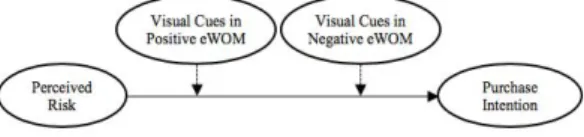
influential social information that impacts on consumer decision when consumers perceive high risk associated with online shopping. Given that consumers rely on external information sources as a way to deal with high risk condition[10,28], our research framework posits that the presence of relevant visual cues (e.g., pictures) in eWOM will interact with the perceived risk to influence purchase intention (see Fig. 1).

Fig. 1. Conceptual model

The effect of eWOM valence is expected to be highlighted with visual cues in eWOM because the visual cues help to elaborate cognitively and increase persuasiveness[24]. Visual cues in positive eWOM should assuage the negative impact of perceived risk on purchase intention, while visual cues in negative eWOM should strengthen the negative impact of perceived risk on purchase intention. Thus, we hypothesize:

H1: With the absence of pictures in positive eWOM, consumers have much lower purchase intention in the online store when they have high perceived risk (vs.

low perceived risk). However, with the presence of pictures in positive eWOM, consumers have a similar level of purchase intention in the online store regardless of high vs. low perceived risk.

H2: With the presence of pictures in the negative online review, consumers have much lower purchase intention in the online store when they have high perceived risk (vs. low perceived risk). However, with the absence of pictures in the online review, consumers have similar level of purchase intention in the online store regardless of high vs. low perceived risk.

4. Method

4.1 Study 1: Visual Cues in Positive eWOM

4.1.1 Study Design and Variables

We conducted Study 1 with positive eWOM to test the moderating effect of visual cues on the relationship between perceived risk and purchase intention (H1).

We recruited 123 participants (61.0% of males and 39.0% of females; average age=33.4) from Amazon Mechanical Turk in exchange for monetary compensation. Participants were randomly assigned to one of four experimental conditions in a 2 (perceived risk: high vs. low)ⅹ2 (visual cue: presence vs.

absence) between-subjects design. We manipulated high (vs. low) perceived risk using a scenario that they were thinking to buy a tablet PC. Participants were told that Consumer Reports reported that there was a 40%

greater chance (vs. same chance) in having delivery problems and/or poor service quality when using/shopping online stores compared to brick and mortar stores[29]. Next, participants were asked to read an online review written by a consumer who bought the tablet PC from the online store. For all conditions, participants were provided with a text-based positive review regarding the online seller’s delivery condition, delivery time, and service quality. Participants in the visual cue presence condition found a picture of a tablet PC in a package box with a positive eWOM message (see Fig. 2), while participants in the absence of visual cue condition were given only a text-based positive review without the picture. For the manipulation check, participants indicated on a 7-point scale how much risk would be involved with the purchase of a tablet PC from the online store[29]. Two items were used to measure a dependent variable, purchase intention (e.g., I intend to buy a tablet PC in this online store), on a 7-point scale[30]. Product involvement and risk-taking propensity were also measured as covariate variables.

To control the product involvement, one item was used

(“For me, tablet PC does not matter (r)”) on a 5-point

scale[31]. The risk-taking propensity was measured

with one item (“I am willing to accept some risk of

losing money if online shopping is likely to involve an

insignificant amount of risk”) using a 7-point scale[32].

(5)

Fig. 2. Positive eWOM with visual cues

4.1.2 Results

Our manipulation of perceived risk was successful (t=4.43, p<.001; M

high

=5.17, M

low

=3.97, p<.001). To test H1, we performed a two-way ANCOVA test by using product involvement and risk-taking propensity as covariates. The results showed that the covariate effect of product involvement was marginally significant (F=3.47, p=.065) and the effect of risk-taking propensity was significant (F=16.66, p<.001). The results revealed a significant main effect of perceived risk (F=10.31, p<.01; M

high

=5.01, M

low

=5.68). A main effect of visual cue was not significant (F<1, n.s.).

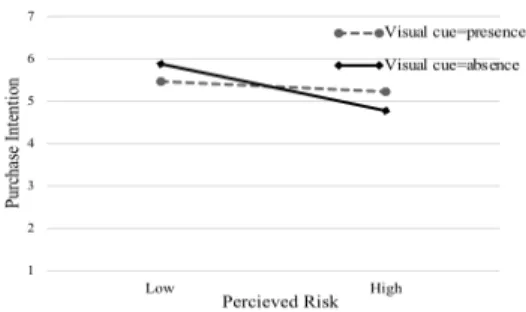
However, more interestingly, the two-way interaction between perceived risk and visual cue was significant (F=4.05, p<.05). In particular, the interaction result revealed that in the absence of visual cue condition, purchase intention was significantly higher under low (vs. high) risk (F=13.70, p<.001; M

high/absence

=4.79, M

low/absence

=5.88). However, in the presence of visual cue condition, this purchase intention became similar regardless of high or low perceived risk (F <1, p=.367;

M

high/presence

= 5.23, M

low/presence

=5.48). Thus, H1 was supported (see Fig. 3). This interaction result showed that the negative effect of high level of perceived risk toward an online store could be mitigated via presence of visual cues in positive eWOM.

Fig. 3. Interaction effect in positive eWOM

4.2 Study 2: Visual Cues in Negative eWOM 4.2.1 Study Design and Variables

We conducted Study 2 with negative eWOM to test the moderating effect of visual cues on the relationship between perceived risk and purchase intention (H2).

Study 2 is identical to Study 1 except for two aspects.

First, a digital camera product was used as another technology-related product. Second, subjects were given negative eWOM about the online seller’s delivery condition, delivery time, and service quality. We recruited 122 participants (64.8% of males and 35.2% of females; average age=32.0) from Amazon Mechanical Turk. They were randomly assigned in a 2 (perceived risk: high vs. low)ⅹ2 (visual cue: presence vs.

absence) between-subjects design. To manipulate visual cues, participants in the visual cue presence condition were given a picture of a damaged package with the negative eWOM, while participants in absence of visual cue condition were given only a text-based negative eWOM without the picture.

4.2.2 Results

Our manipulation of perceived risk was successful in Study 2 (t=5.39, p<.001; M

high

= 4.46, M

low

=3.17, p<.001).

A two-way ANCOVA test showed that the covariate effect of product involvement was marginally significant (F=3.15, p=.079) and the effect of risk-taking propensity was significant (F=5.98, p<.05).

The results revealed a main effect of perceived risk was marginally significant (F=4.773, p=.074; M

high

=2.20, M

low

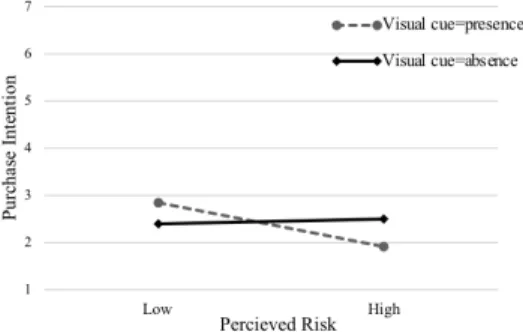
=2.63). A main effect of visual cue was not significant (F <1, n.s.). However, the two-way interaction between perceived risk and visual cue was significant (F=4.89, p<.05). The interaction result revealed that in the presence of visual cue condition, purchase intention was significantly lower under high (vs. low) risk (F=7.90, p<.01; M

high/presence

=1.93, M

low/presence

=2.84). However, in the absence of visual cue condition, there was no significant difference in purchase intention as a function of perceived risk (F

<1, p=.783; M

high/absence

= 2.51, M

low/absence

=2.41). Thus, H2

(6)

was supported (see Fig. 4). This interaction result showed that visual cues in negative eWOM intensified the effect of high levels of perceived risk toward online store on purchase intention.

Fig. 4. Interaction Effect in Negative eWOM

5. General Discussion

Based upon social influence theory and literature on visual information, this research extends eWOM studies by focusing on the effect of a visual cue in eWOM under high perceived risk situation of online stores. The current research suggests a visual cue as one of distinct attributes of eWOM that will serve as a moderator of the negative relationship between perceived risk and purchase intention toward an online seller. Specifically, this research examined the different directions of the effects of eWOM visual cues in positive eWOM and negative eWOM. Findings from study 1 supported that visual cues in positive eWOM helped to attenuate the effect of high perceived risk on purchase intention. However, study 2 demonstrated that visual cues in negative eWOM intensified the negative effect of high perceived risk on purchase intention. It is important to note that the main effect of visual cues on purchase intention was not significant, but the effect is conditional on purchase intention by interacting with perceived risk toward online sellers.

Thus, this study especially provides meaningful information for new online sellers those have a high level of perceived risks.

The results suggest that the combination of verbal and visual information is more effective to deliver message to consumers. Consumers consider visual information as useful, and it helps consumers’ decision making to evaluate the offerings of an online retailer better. Thus, it is important for online retailers to develop user-friendly visual information posting system facilitating ease of editing and posting visual cues with text in the website.

However, the disparity between the effect of visual cues in positive and negative eWOM should be interpreted carefully by managers. New online sellers or new online stores might strengthen the effect of positive eWOM by encouraging consumers to attach or upload the visual cues such as pictures or videos as a way to deal with a high-risk position in online markets.

For example, marketers can strategically identify consumers who share positive online reviews based on star rating information or their comments, and then encourage them to post pictures under their reviews.

Since visual information in positive reviews can help other consumers alleviate the uncertainty and risk of using that websites, more visual cues (e.g., photos or videos) to support positive reviews will be effective. As the findings of Study 2 suggested, however, new online sellers or new online stores need to be on guard from negative reviews with visual cues, which can deter consumers’ purchase intentions. To protect themselves from negative reviews, managers might attempt to provide a response to resolve the issues, which helps online reputation management[33]. For example, if consumers post their negative reviews with pictures, managers should leave a follow-up comment on the consumers’ negative reviews to make them feel better and solve the problem. By providing the interaction and conversation with consumers who have negative feedbacks on the websites, other consumers will see how the sellers react to those consumers. Managers’

immediate feedback and effort of caring consumers will reduce consumers’ fear of using online stores.

Moreover, previous studies suggest that consumers

(7)

may not consider negative messages when the message has low quality or low volume[9,24]. Thus, managers can offset the effect of visual cues in negative online reviews by encouraging consumers post more high-quality positive reviews with pictures.

Though this study casts meaningful results, several limitations remain. This study examined the interaction effects of perceived risks and visual cues of eWOM in a positive and negative review separately, but future study needs to further consider both positive and negative eWOM simultaneously in a 2 (perceived risk:

high vs. low) by 2 (visual cue: presence vs. absence) by 2 (valence: positive vs. negative) experimental design to clarify the visual cue effects. In addition, the current study only tested a single negative message which may be more harmful for purchase intention;

however, one negative message in a large volume of positive ones may not be harmful and may even be beneficial in the eWOM context[34]. Thus, findings from this study should be further investigated in future research with other eWOM attributes such as volume or review quality. Moreover, future research can expand the study with a different product category (e.g., experience goods) or with different contexts (e.g., social media contents or mobile shopping).

REFERENCES

[1] S. M. Forsythe & B. Shi. (2003). Consumer Patronage and Risk Perceptions in Internet Shopping. Journal of Business Research, 56(11), 867-875.

[2] M. Hubert, M. Blut, C. Brock, C. Backhaus & T.

Eberhardt. (2017). Acceptance of Smartphone‐Based Mobile Shopping: Mobile Benefits, Customer Characteristics, Perceived Risks, and the Impact of Application Context.

Psychology & Marketing, 34(2), 175-194.

[3] D. S. Sundaram & C. Webster. (1999). The Role of Brand Familiarity on The Impact of Word-Of-Mouth Communication on Brand Evaluations. Advances in Consumer Research, 26, 664-670.

[4] C. M. Cheung & D. R. Thadani. (2012). The Impact of Electronic Word-Of-Mouth Communication: A Literature Analysis and Integrative Model. Decision

Support Systems, 54(1), 461-470.

[5] D. H. Park & J. Lee. (2008). eWOM Overload and Its Effect on Consumer Behavioral Intention Depending on Consumer Involvement. Electronic Commerce Research and Applications, 7(4), 386-398.

[6] T. Hennig-Thurau, K. P. Gwinner, G. Walsh & D. D.

Gremler. (2004). Electronic Word-of-Mouth Via Consumer-Opinion Platforms: What Motivates Consumers to Articulate Themselves on the Internet?.

Journal of Interactive Marketing, 18(1), 38-52.

[7] D. D. Childers & M. J. Houston. (1984). Conditions for a Picture-Superiority Effect on Consumer Memory.

Journal of Consumer Research, 11(2), 643-654.

[8] J. Lee, D. H. Park & I. Han. (2008). The Effect of Negative Online Consumer Reviews on Product Attitude:

An Information Processing View. Electronic Commerce Research and Applications, 7(3), 341-352.

[9] A. Khare, L. I. Labrecque & A. K. Asare. (2011). The Assimilative and Contrastive Effects of Word-Of-Mouth Volume: An Experimental Examination of Online Consumer Ratings. Journal of Retailing, 87(1), 111-126.

[10] F. A. Buttle. (1998). Word of Mouth: Understanding and Managing Referral Marketing. Journal of Strategic Marketing, 6(3), 241-254.

[11] S. Tanford & S. Penrod. (1984). Social Influence Model:

A Formal Integration of Research on Majority and Minority Influence Processes. Psychological Bulletin, 95(2), 189-225.

[12] D. Litter & D. Melanthiou. (2006). Consumer Perceptions of Risk and Uncertainty and the Implications for Behavior Towards Innovative Retail Services: The Case of Internet Banking. Journal of Retailing and Consumer Services, 13(6), 431-443.

[13] J. Park, S. J. Lennon & L. Stoel. (2005). On-Line Product Presentation: Effects on Mood, Perceived Risk, and Purchase Intention. Psychology and Marketing, 22(9), 695-719.

[14] L. R. Vijayasarathy & J. M. Jones. (2000). Print and Internet Catalog Shopping. Internet Research, 10(3), 191-202.

[15] H. H. Chang & S. W. Chen. (2008). The Impact of Online Store Environment Cues on Purchase Intention. Online Information Review, 32(6), 818-841.

[16] B. Dai, S. Forsythe & W. S. Kwon. (2014). The Impact of Online Shopping Experience on Risk Perceptions and Online Purchase Intentions: Does Product Category Matter?. Journal of Electronic Commerce Research, 15(1), 13-24.

[17] A. Davis & D. Khazanchi. (2008). An Empirical Study of

(8)

Online Word of Mouth as a Predictor for Multi‐Product Category E‐Commerce Sales. Electronic markets, 18(2), 130-141.

[18] C. Cheng & M. K. Lee. (2008). Online Consumer Reviews: Does Negative Electronic Word-of-Mouth Hurt More? Americas Conference on Information Systems Proceedings, 143. Toronto, Canada.

[19] M. I. Melnik & J. Alm. (2002). Does a Seller’s Ecommerce Reputation Matter? Evidence from ebay Auctions. The Journal of Industrial Economics, 50(3), 337-349.

[20] R. M. Reyes, W. C. Thompson & G. H. Bower. (1980).

Judgmental Biases Resulting from Differing Availabilities of Arguments. Journal of Personality and Social Psychology, 39(1), 2-12.

[21] M. Kim & S. Lennon. (2008). The Effects of Visual and Verbal Information on Attitudes and Purchase Intentions in Internet Shopping. Psychology & Marketing, 25(2), 146-178.

[22] T. M. Lin, K. Y. Lu & J. J. Wu. (2012). The Effects of Visual Information in eWOM Communication. Journal of Research in Interactive Marketing, 6(1), 7-26.

[23] J. Kisielius & B. Sternthal. (1986). Examining the Vividness Controversy: An Availability-Valence Interpretation.

Journal of Consumer Research, 12(4), 418-431.

[24] J. Kim, F. R. Kardes & P. M. Herr. (1991). Consumer Expertise and The Vividness Effect: Implication for Judgment and Inference. Advances in Consumer Research, 18, 90-93.

[25] D. Maheswaran & J. Meyers-Levy. (1990). The Influence of Message Framing and Issue Involvement.

Journal of Marketing Research, 27(3), 361-367.

[26] P. F. Wu. (2013). In Search of Negativity Bias: An Empirical Study of Perceived Helpfulness of Online Reviews. Psychology & Marketing, 30(11), 971-984.

[27] W. H. Cummings & M. Venkatesan. (1976). Cognitive Dissonance and Consumer Behavior: A Review of The Evidence. Journal of Marketing Research, 13(3), 303-308.

[28] M. P. Conchar, G. M. Zinkhan, C. Peters & S.

Olavarrieta. (2004). An Integrated Framework for the Conceptualization of Consumers’ Perceived-Risk Processing. Journal of the Academy of Marketing Science, 32(4), 418-436.

[29] Z. Gürhan-Canli & R. Batra. (2004). When Corporate Image Affects Product Evaluations: The Moderating Role of Perceived Risk. Journal of Marketing Research, 41(2), 197-205.

[30] P. A. Pavlou. (2003). Consumer Acceptance of Electronic Commerce: Integrating Trust and Risk With the Technology Acceptance Model. International Journal of

Electronic Commerce, 7(3), 101-134.

[31] B. Mittal & M. S. Lee. (1989). A Causal Model of Consumer Involvement. Journal of Economic Psychology, 10(3), 363-389.

[32] J. Cho & J. Lee. (2006). An Integrated Model of Risk and Risk-Reducing Strategies. Journal of Business Research, 59(1), 112-120.

[33] B. A. Sparks, K. K. F. So & G. L. Bradley. (2016).

Responding to Negative Online Reviews: The Effects of Hotel Responses on Customer Inferences of Trust and Concern. Tourism Management, 53, 74-85.

[34] S. J. Doh & J. S. Hwang. (2009). How Consumers Evaluate eWOM (Electronic Word-Of-Mouth) Messages.

CyberPsychology & Behavior, 12(2), 193-197.

안 선 영(Ahn, Sun Young) [정회원]

․2005년 8월: 서울대학교 소비자 학과 (생활과학 학사)

․2007년 8월 : 서울대학교 소비자 학과 (생활과학 석사)

․2016년 8월 : University of Arizona Retailing and Consumer Sciences (Ph. D.)

․2006년 8월 ~ 현재 : Washington College, Business Management, Visiting Assistant Professor in Marketing

․관심분야 : 소비자행동, 소비의사결정, 소비자유통

․E-Mail : [email protected]

홍 정 화(Hong, Jung Hwa) [정회원]

․2007년 8월 : 숙명여자대학교 정치 외교학과 (정치외교학 학사)

․2011년 5월 : University of Arizona Retailing and Consumer Sciences (M.S.)

․2015년 12월 : University of New York at Binghamton (Ph. D. in Marketing)

․2015년 9월 ~ 2016년 8월 : University of Texas at Tyler, Senior Lecturer

․2016년 9월 ~ 현재 : University of Texas at Tyler, Assistant Professor of Marketing

․관심분야 : 소비심리, 소비자행동, 소비자웰빙

․E-Mail : [email protected]

수치

Fig.  1.  Conceptual  model
Fig.  2.  Positive  eWOM  with  visual  cues
Fig.  4.  Interaction  Effect  in  Negative  eWOM

참조

관련 문서

A Mediating Effect of Job Stress Between Physical Environmental Risk and Safety Behavior, and Moderating Effect of Perceived Control.. Byung-Jik Kim⋅Won-Koo Ji * ⋅Sang-Gil

Furthermore, perceived risk negatively affected the intention to adopt nanotechnology products, that is, when customers’per- ceived risk increased, the adoption intention of

Overall, we expect that trust, benefit, shopping enjoyment, and website quality are likely to positively influence purchase intention, and perceived risk negatively

Product replacement cycle was adopted to investigate the moderating effects on consumer attitude stemming from ecological motivation and on purchase intention

This paper reviewed the relationship between perceived organizational justice(distributive justice, procedural justice, interactional justice) and job stress, and the moderating

Analysis shows that the perceived usefulness and purchase intention is positively affected by social influence and recognized risk.. It is found that

This study examined the influence of perceived value, perceived quality, reasonable price of subtropical vegetables on trust, purchase intention and word of

Abstract I have empirically investigated the relationship between work-family facilitation and perceived team performance and the moderating effect of wellness