닭 농장 HACCP 심사항목의 적부판정 향상을 위한 차등 점수 설정에 관한 연구
*
1)
남 인 식
**A Study on The Setting of Differentiate the Score to Improve the Proper and Non-proper Judgement of HACCP
Evaluation Items of Poultry Farm
Nam, In Sik
This study was conducted to improve correct judgement of HACCP evaluation items in poultry farm. The importance levels and score of each HACCP evaluation item was derived through the non-compliance rate and severity levels of hazard.
The total score of HACCP evaluation items of the pre-requisite management section was 200 points and the HACCP management section was developed to have a total of 100 points. Implementation of the result of this study to poultry farm may help to produce safer and hygienic chicken and egg production. For a more objective assessment, detailed criteria should be developed according to the score of each HACCP evaluation item.
Key words : HACCP, evaluation items, differential score, poultry farm
Ⅰ. 서 론
HACCP (Hazard Analysis and Critical Control Point) 은 식품에서 발생 가능한 생물학적, 화 학적, 물리적 위해를 사전에 예방하여 위해를 허용수준 이하로 낮추거나 제거하는 제도로 국내뿐만 아니라 거의 대부분의 국가에서 식품을 제조하는 작업장에 도입 및 운용하고 있는 식품의 안전성을 향상시키기 위한 관리 프로그램이다(Adams, 1994; Unnevehr and Jensen,
**
본 연구는 2015년 식품의약품안전처 연구비 지원으로 수행되었으며, 이에 감사드립니다.
**
한경대학교 고품질친환경축산물생산기술연구센터([email protected])
1996; Codex Alimentarius Commission, 2001). 국내 축산분야의 HACCP 제도는 축산물위생관 리법 및 사료관리법의 개정으로 축산물가공업을 시작으로 도축장, 사료공장, 가축사육농장 등 모든 축산산업에 연차적으로 적용하여 사료의 생산에서 축산물의 판매에 이르는 모든 과 정에 HACCP 제도를 도입하여 안전한 축산물을 소비자에게 공급하고 있다(MAFRA, 1997;
2009).
닭(육계, 산란계) 농장 HACCP은 2008년 25개 농장에 HACCP 인증을 시작으로 현재에는 약 1,700여 농장에서 HACCP을 인증 받아 운영 중에 있다. 이는 전업농 기준 소 또는 돼지 농가보다 HACCP 인증 비율이 월등히 높으며, 육계 및 산란계를 사육하고 있는 거의 대부 분의 전업농가에서 HACCP 제도를 도입한 것으로 판단된다(KOLPHAS, 2016).
한편, 닭 농장에 HACCP 제도 도입에 따른 영향으로는 피크 산란율, 성계 생존율, 월평균 소독약품 사용비 등이 증가하는 경향을 나타내었으며, 월평균 동물용 의약품 사용비 등은 감소하는 경향이 있는 것으로 보고되고 있다(Nam et al., 2014). 또한 HACCP 제도를 적용하 고 있는 농장 시설 및 환경에 대한 세균관리 수준은 HACCP을 적용하지 않는 일반 농장에 비하여 월등히 높은 것으로 보고되고 있다(Lee et al., 2011).
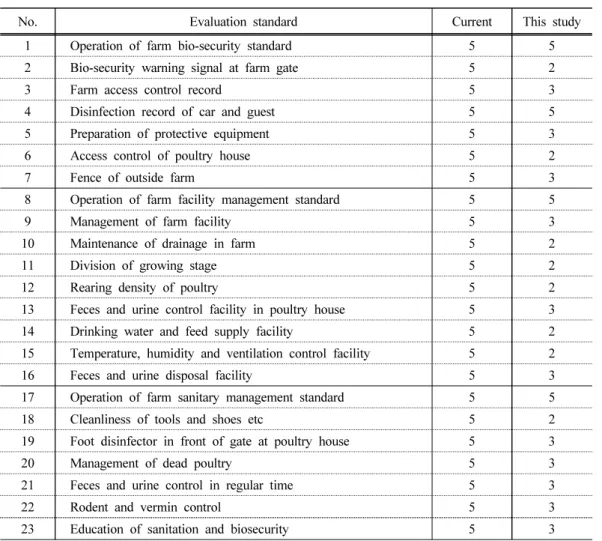
현행 닭 농장 HACCP 심사방법은 각 심사항목별로 5점 만점을 부여하고 이를 토대로 5 점(농장 및 기록유지 양호), 3점(비반복적인 실수 및 경미한 수준의 기록 미흡), 1점(농장 및 기록유지 미흡), 0점(HACCP 미이행 또는 법 위반) 등으로 구분하여 심사 점수를 부여는 체 계를 구축하여 운영하고 있다. 심사결과 판단기준은 전체 심사항목 대비 만점의 85% 이상 취득하면 ‘적합’, 70% 이상 80% 미만일 경우 ‘보완’, 70% 미만일 경우에는 ‘부적합’으로 판 정한다(KFDA, 2015). 그러나 각각의 심사항목은 계육 또는 계란의 안전성에 미치는 영향이 다름에도 불구하고 최고 5점씩 동일한 점수를 부여하는 방법은 HACCP 제도의 목적에 부 정적인 영향을 가져다 줄 수 있다(Nam et al., 2015). 본 연구는 현행 동일한 심사점수 체계 를 활용하여 HACCP을 심사하고 있는 닭 농장 HACCP 심사기준에 대한 중요도를 도출하 고 이를 기초로 각 심사항목에 대한 차등적인 심사점수를 부여하여 닭 농장 HACCP 심사 기준의 합리성을 높이는 방안을 제시하기 위한 목적으로 실시하였다.
Ⅱ. 재료 및 방법
1. 닭 농장 HACCP 심사항목 중요도 설정과 차등 점수 부여 방법
본 연구는 닭농장 HACCP 인증에 사용되는 75개 심사항목에 중요도를 수립하고 이에 따
른 차등 점수를 부여하여 HACCP 심사의 객관성과 공정성을 높이기 위한 목적으로 실시하
였다. 이를 위하여 최근 3년간 닭(육계, 산란계)농장 HACCP 심사결과에 따른 지적사항 발
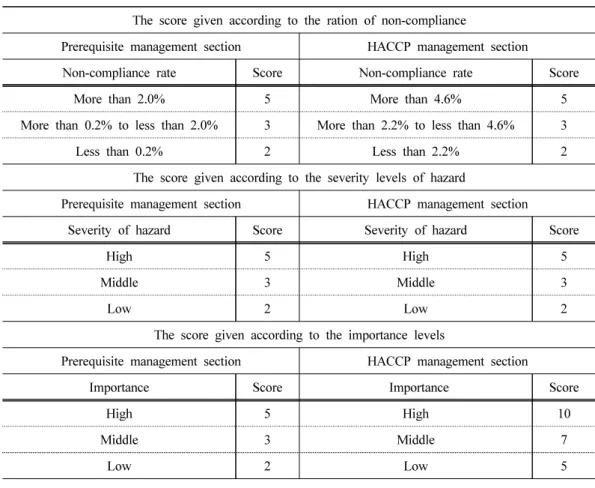
생비율 분석, 각 심사항목별 위해의 심각도 수준 분석, 그리고 각 심사항목의 중요도 수준 의 수립을 통하여 각 심사항목의 점수를 차등 부여하는 방법을 이용하였다(Table 1).
Table 1. The method for giving scores according to the ration of non-compliance, severity levels of hazard and importance levels of each HACCP evaluation items on poultry farm
The score given according to the ration of non-compliance
Prerequisite management section HACCP management section
Non-compliance rate Score Non-compliance rate Score
More than 2.0% 5 More than 4.6% 5
More than 0.2% to less than 2.0% 3 More than 2.2% to less than 4.6% 3
Less than 0.2% 2 Less than 2.2% 2
The score given according to the severity levels of hazard
Prerequisite management section HACCP management section
Severity of hazard Score Severity of hazard Score
High 5 High 5
Middle 3 Middle 3
Low 2 Low 2
The score given according to the importance levels
Prerequisite management section HACCP management section
Importance Score Importance Score
High 5 High 10
Middle 3 Middle 7
Low 2 Low 5
2. 닭 농장 HACCP 심사결과 지적비율 분석
최근 3년간(2012년~2014년) 축산물안전관리인증원에서 743개의 닭농장을 심사한 결과 선행요건관리 심사항목 분야 지적건수(2,072건)와 HACCP 관리 심사항목 분야 지적건수 (1,098 건)를 토대로 심사항목별 지적비율을 분석하였다. 지적비율별로 분석한 결과에 따라, 선행요건 분야 심사항목은 지적비율 0.2% 미만은 2점, 지적비율 0.2% 이상~2.0% 미만은 3 점, 지적비율 2.0% 이상은 5점을 부여하였다. HACCP 관리 분야 심사항목은 지적비율 2.2%
미만은 2점, 지적비율 2.2% 이상~4.6% 미만은 3점, 지적비율 4.6% 이상은 5점을 부여하였
다(Table 2).
3. 닭 농장 HACCP 심사항목 위해의 심각도 수준 분석
닭 농장 HACCP 심사항목별 위해의 심각도 수준을 3단계(상, 중, 하)로 구분하여 분석하 였다. 이때 위해의 심각도 ‘상(5점)’은 해당 심사항목이 축산물(계육, 계란) 또는 인체에 미 치는 영향이 안전성에 직접 관련된 경우와 시정조치에 많은 시간이 걸리는 경우, ‘중(3점)’
은 해당 심사항목이 축산물(계육, 계란) 및 인체에 미치는 영향이 안전성에 간접적으로 관 련된 경우(위해정도가 상대적으로 낮은 경우)와 시정조치에 많이 시간이 걸리는 경우, ‘하 (2 점)’는 해당 심사항목이 축산물(계육, 계란) 및 인체에 미치는 영향이 안전성에 간접 관련 된 경우와 즉시 시정이 가능한 경우로 각 심사항목별 위해의 심각도를 구분하여 나열하였 다(Table 2).
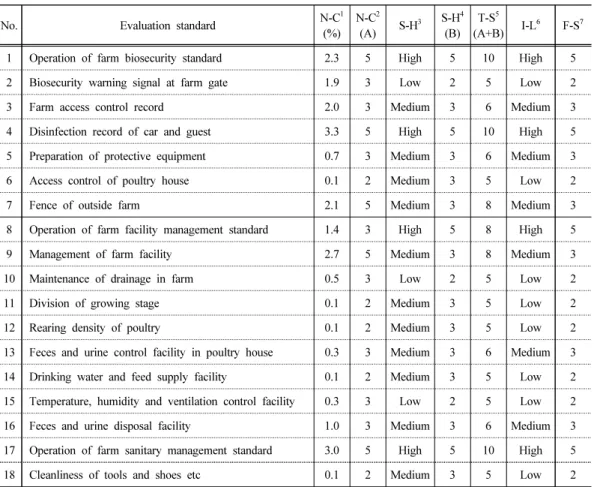
Table 2. The result of importance levels and final score of each evaluation standard on poultry farm (Prerequisite management section)
No. Evaluation standard N-C1
(%) N-C2
(A) S-H3 S-H4 (B)
T-S5
(A+B) I-L6 F-S7
1 Operation of farm biosecurity standard 2.3 5 High 5 10 High 5
2 Biosecurity warning signal at farm gate 1.9 3 Low 2 5 Low 2
3 Farm access control record 2.0 3 Medium 3 6 Medium 3
4 Disinfection record of car and guest 3.3 5 High 5 10 High 5
5 Preparation of protective equipment 0.7 3 Medium 3 6 Medium 3
6 Access control of poultry house 0.1 2 Medium 3 5 Low 2
7 Fence of outside farm 2.1 5 Medium 3 8 Medium 3
8 Operation of farm facility management standard 1.4 3 High 5 8 High 5
9 Management of farm facility 2.7 5 Medium 3 8 Medium 3
10 Maintenance of drainage in farm 0.5 3 Low 2 5 Low 2
11 Division of growing stage 0.1 2 Medium 3 5 Low 2
12 Rearing density of poultry 0.1 2 Medium 3 5 Low 2
13 Feces and urine control facility in poultry house 0.3 3 Medium 3 6 Medium 3 14 Drinking water and feed supply facility 0.1 2 Medium 3 5 Low 2 15 Temperature, humidity and ventilation control facility 0.3 3 Low 2 5 Low 2
16 Feces and urine disposal facility 1.0 3 Medium 3 6 Medium 3
17 Operation of farm sanitary management standard 3.0 5 High 5 10 High 5
18 Cleanliness of tools and shoes etc 0.1 2 Medium 3 5 Low 2
No. Evaluation standard N-C1 (%)
N-C2
(A) S-H3 S-H4 (B)
T-S5
(A+B) I-L6 F-S7 19 Foot disinfector in front of gate at poultry house 1.8 3 Medium 3 6 Medium 3
20 Management of dead poultry 0.9 3 Medium 3 6 Medium 3
21 Feces and urine control in regular time 0.5 3 Medium 3 6 Medium 3
22 Rodent and vermin control 1.4 3 Medium 3 6 Medium 3
23 Education of sanitation and biosecurity 4.0 5 Medium 3 8 Medium 3 24 Control standard of each growing stage 0.5 3 High 5 8 Medium 3
25 Salmonella enteritidis test in farm environment and
poultry 18.9 5 High 5 10 High 5
26 Operation of feed, medicine and water management
standard 2.3 5 High 5 10 High 5
27 Feeding HACCP certified feed 0.2 2 Medium 3 5 Low 2
28 Management of feed 1.0 3 Medium 3 6 Medium 3
29 Cleanliness of feed storage place 0.3 3 Medium 3 6 Medium 3
30 Cleanliness of feeder and feed supply facility 0.2 2 Medium 3 5 Low 2 31 Standard of self produced feed at farm 0.5 3 Medium 3 6 Medium 3 32 Residue prevention plan of antibiotics in chicken 2.4 5 High 5 10 High 5
33 In and out control of animal medicine 3.0 5 High 5 10 High 5
34 Test of drinking water in regular time 13.6 5 High 5 10 High 5
35 Cleanliness of water supply facility 0.1 2 Low 2 4 Low 2
36 Operation of disease management standard 1.2 3 High 5 8 High 5 37 Disease control and prevention program 0.8 3 Medium 3 6 Medium 3 38 Consultation by veterinarian in regular time 0.1 2 Medium 3 5 Low 2
39 Helminth control 0.2 2 Medium 3 5 Low 2
40 Periodic inspection of breeding and hatchery farm 0.1 2 High 5 7 Medium 3
41 Control plan of M. gallisepticum, M. synoviae in
breeding farm 0.2 2 High 5 7 Medium 3
42 DVH preventive vaccine program 1.6 3 Medium 3 6 Medium 3
43 AI test in regular time 0.4 3 High 5 8 Medium 3
44 Operation of carry in and shipping management
standard 1.0 3 High 5 8 High 5
45 Broiler trading record book 0.1 2 Medium 3 5 Low 2
46 Record keeping of disease check, vaccination 1.2 3 Medium 3 6 Medium 3 47 Clinical observation of introduced flock 1.4 3 Medium 3 6 Medium 3
48 Broiler shipment recording book 5.8 5 High 5 10 High 5
49 Operation of egg management standard 0.7 3 High 5 8 High 5
1Non-compliance (%); 2Non-compliance (score), (A); 3Severity levels of hazard; 4Severity levels of hazard(score), (B); 5Total score(A+B); 6Importance levels; 7Final score
4. 닭 농장 HACCP 심사항목의 중요도 및 점수 부여
지적비율 분석 및 위해의 심각도 수준 분석 결과를 기초로 하여 각 심사항목의 중요도 수준을 수립하였다. 선행요건 분야의 경우에는 지적비율 분석결과와 위해의 심각도 수준에 따른 결과를 합산한 합계점수가 10점일 경우 중요도 수준을 ‘상’으로 분류하고 5점을 부여 하였으며, 합계점수가 6~8점은 ‘중’으로 분류하고 3점을 부여하였다. 합계점수가 5점 이하는
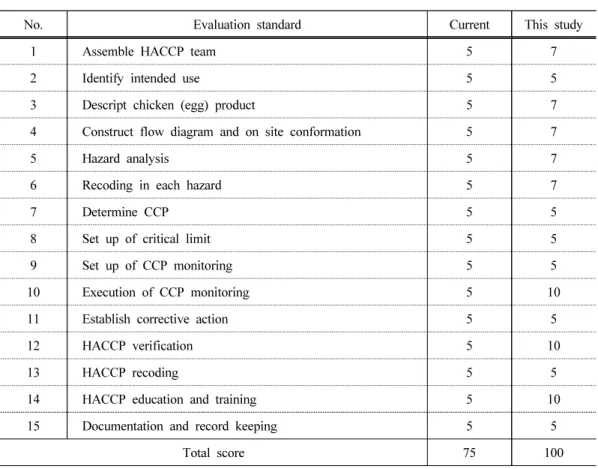
‘ 하’로 분류하고 점수를 2점을 부여하였다. HACCP 관리 분야는 선행요건 분야보다 심사항 목의 중요성이 강조되므로 지적비율 분석결과와 위해의 심각도 수준에 따른 결과를 합산한 합계점수가 10점일 경우 중요도 수준을 ‘상’으로 분류하고 10점을 부여하였으며, 합계점수 가 6~8점은 ‘중’으로 분류하고 7점을 부여하였다. 합계점수가 5점 이하는 ‘하’로 분류하고 점수를 5점을 부여 하였다(Table 2). 닭 농장 HACCP 심사항목에 대한 총 점수는 300점으로 설정하였는데, 선행요건 분야의 총 점수는 200점, HACCP 관리 분야는 100점으로 하였다.
Ⅲ. 결 과
1. 지적비율, 위해의 심각도 수준 및 중요도 설정
최근 3년간의 축산물안전관리인증원의 닭 농장 HACCP 심사결과(선행요건관리 분야)에
No. Evaluation standard N-C1
(%) N-C2
(A) S-H3 S-H4 (B)
T-S5
(A+B) I-L6 F-S7
50 Prevent animal medicine residues in egg 0.2 2 High 5 7 High 5
51 Control of insect, ventilation in egg collecting room 1.5 3 Medium 3 6 Medium 3 52 Disinfection and cleaning of egg collecting machine 0.4 3 Medium 3 6 Medium 3
53 First in and first out of egg 1.2 3 Medium 3 6 Medium 3
54 Residual test of animal medicine in eggs 1.4 3 High 5 8 High 5 55 Minimizing temperature changes in eggs 0.3 3 Medium 3 6 Medium 3 56 Temperature control of egg storage and collecting room 0.8 3 Medium 3 6 Medium 3
57 Egg shipment record 1.9 3 High 5 8 High 5
58 Contaminated egg management 0.2 2 High 5 7 Medium 3
59 Salmonella enteritidis test of egg in regular time 2.3 5 High 5 10 High 5 60 Hygienic packaging material management of egg 1.2 3 Medium 3 6 Medium 3
따른 지적비율과 위해의 심각도 수준 분석을 통하여 각 심사항목별 중요도 수준을 수립하 였으며 이에 따른 점수를 부여한 결과는 Table 3과 같다. 최근 3년간 심사한 선행요건관리 분야 2,072건의 지적건수를 심사항목별 지적비율로 분석한 결과 지적비율이 2% 이상에 해 당되는 심사항목은 1번(2.3%), 4번(3.3%), 7번(2.1%), 9번(2.7%), 17번(3.0%), 23번(4.0%), 25 번(18.9%), 26번(2.3%), 32번(2.4%), 33번(3.0%), 34번(13.6%), 48번(5.8%), 59번(2.3%)인 것으 로 나타나 해당 심사항목은 모두 5점을 부여하였다. 지적비율이 0.2% 미만인 심사항목은 6 번, 11번, 12번, 14번, 18번, 27번, 30번, 35번, 38번, 39번, 40번, 41번, 45번, 50번, 57번으로 조사되어 모두 2점을 부여하였다. 나머지 심사항목은 지적비율이 0.2% 이상~2.0% 미만에 해당되어 각각 3점씩 부여하였다. 위해의 심각도 수준을 분석한 결과 ‘높음’에 해당되는 심 사항목은 1번, 4번, 8번, 17번, 24번, 25번, 26번, 32번, 33번, 34번, 36번, 40번, 41번, 43번, 44 번, 48번, 49번, 50번, 54번, 57번, 58번, 59번 등 총 22개 심사항목으로 각각 5점씩 부여하 였다. 상대적으로 ‘낮음’에 해당되는 심사항목은 2번, 10번, 15번, 35번으로 나타나 해당 심 사항목은 모두 2점을 부여하였으며 나머지 심사항목은 위해의 심각도 수준이 ‘보통’에 해 당되므로 모두 3점씩 부여하였다. 심사항목별 지적비율과 위해의 심각도 수준을 통하여 중 요도 수준을 도출한 결과 중요도 수준이 ‘높음’에 해당되는 심사항목은 1번, 4번, 8번, 17번, 25 번, 26번, 32번, 33번, 34번, 36번, 44번, 48번, 49번, 50번, 54번, 57번, 59번 등 총 17개 심 사항목으로 나타나 최종 점수를 각각 5점씩 부여하였다. 중요도 수준이 ‘중간’에 해당되는 심사항목은 모두 29개 항목으로 3점을 부여하였다. 아울러 중요도 수준이 ‘낮음’에 해당되 는 심사항목 수는 모두 14개 항목이었으며 해당 심사항목에는 2점씩 부여하였다. 선행요건 관리 분여 심사항목 중 중요도 수준 비율을 보면 ‘높음’에 해당되는 심사항목 비율은 28.33
% 이며, ‘보통’은 48.33% 그리고 ‘낮음’은 23.33%로 나타났다.
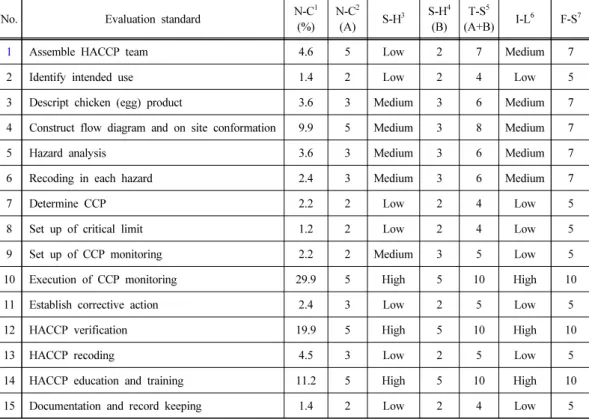
Table 3 은 닭 농장 HACCP 관리 분야 심사항목에 대한 최근 3년간 지적비율, 위해의 심 각도 수준을 통하여 중요도 수준 및 최종 심사점수를 도출한 결과를 나타내었다. 총 15개 심사항목 중 지적비율이 2.2% 이하인 항목은 2번(1.4%), 7번(2.2%), 8번(1.2%), 9번(2.2%), 15 번(1.4%)으로 나타나 각각 2점씩 부여하였으며, 2.2% 이상~4.6% 미만은 1번(4.6%), 3번 (3.6%), 5 번(3.6%), 6번(2.4%), 11번(2.4%), 13번(4.5%)이 해당되어 모두 3점씩 부여하였다.
아울러 지적 비율이 4.6% 이상에 해당되는 심사항목은 4번(9.9%), 10번(29.9%), 12번
(19.9%), 14 번(11.2%)로 조사되어 각각 5점을 부여하였다. 위해의 심각도 수준 분석결과 ‘높
음’에 해당되는 심사항목은 모두 3개(10번, 12번, 14번)로 나타났으며, ‘중간’은 5개(3번, 4
번, 5번, 6번, 9번) 그리고 ‘낮음’은 7개(1번, 2번, 7번, 8번, 11번, 13번, 15번)로 나타나 ‘높
음’은 5점, ‘중간’은 3점, 그리고 ‘낮음’에 해당되는 심사항목은 각각 2점씩 부여하였다. 지
적비율 및 위해의 심각도 수준 분석을 통하여 도출된 기초 결과에 따라 심사항목별 중요도
수준을 수립하였는데 중요도가 ‘높음(10점)’에 해당되는 심사항목은 10번, 12번, 14번이었
으며, ‘중간(7점)’은 1번, 3번, 4번, 5번 6번으로 나타났고 ‘낮음(5점)’은 2번, 7번, 8번, 9번,
11 번, 13번, 15번으로 나타났다. HACCP 관리 분야 심사항목 중 중요도 수준 비율을 보면
‘ 높음’에 해당되는 심사항목 비율은 20.00%이며, ‘보통’은 33.33% 그리고 ‘낮음’은 46.67%
로 나타났다.
Table 3. The result of importance levels and final score of each evaluation standard on poultry farm (HACCP management section)
No. Evaluation standard N-C1
(%) N-C2
(A) S-H3 S-H4 (B)
T-S5
(A+B) I-L6 F-S7
1 Assemble HACCP team 4.6 5 Low 2 7 Medium 7
2 Identify intended use 1.4 2 Low 2 4 Low 5
3 Descript chicken (egg) product 3.6 3 Medium 3 6 Medium 7
4 Construct flow diagram and on site conformation 9.9 5 Medium 3 8 Medium 7
5 Hazard analysis 3.6 3 Medium 3 6 Medium 7
6 Recoding in each hazard 2.4 3 Medium 3 6 Medium 7
7 Determine CCP 2.2 2 Low 2 4 Low 5
8 Set up of critical limit 1.2 2 Low 2 4 Low 5
9 Set up of CCP monitoring 2.2 2 Medium 3 5 Low 5
10 Execution of CCP monitoring 29.9 5 High 5 10 High 10
11 Establish corrective action 2.4 3 Low 2 5 Low 5
12 HACCP verification 19.9 5 High 5 10 High 10
13 HACCP recoding 4.5 3 Low 2 5 Low 5
14 HACCP education and training 11.2 5 High 5 10 High 10
15 Documentation and record keeping 1.4 2 Low 2 4 Low 5
1Non-compliance (%); 2Non-compliance (score), (A); 3Severity levels of hazard; 4Severity levels of hazard (score), (B); 5Total score, (A+B); 6Importance levels; 7Final score
2. 기존 닭 농장 심사항목과 비교