Effect of Chemical Fertilizer and Compost on Soil Physicochemical Properties, Leaf Mineral Content, Yield and Fruit Quality of Red Pepper
(Capsicum annuum L.) in Open Field
Seong Eun Lee*, Jin Myeon Park, Young Eun Park, and Tae Jun Lim
Horticultural & Herbal Crop Environment Division, National Institute of Horticultural & Herbal Science, Wanju 55365, Korea (Received: October 8 2015, Revised: December 10 2015, Accepted: December 10 2015)
Nowadays, sustainable and environment-friendly agriculture has become an important issue all around the world, and repeated applications of mineral and/or organic fertilizer will probably affect mineral nutrient dynamics in soil in the long term but only a limited number of observations are available. This study was carried out to investigate whether there is any influence of different fertilizer management for red pepper (Capsicum annuum L.) cultivation on soil physicochemical properties, leaf mineral content, yield and fruit quality in the aspect of long-term practice in open field condition. NPK, NPK+compost, compost only, and unfertilized control plot were included in the treatments. The application of chemical fertilizer and/or compost repeated annually for 17 years from 1994 to 2011. Soil organic matter content was higher in compost treatments than in no-manure treatments. Available phosphate and the yield of red pepper were highest in NPK+compost treatment followed by NPK (chemical fertilizer), compost, and control. The results indicate that in the long term, nitrogen supply is still needed for increasing red pepper yield, but reduction in the use of chemical fertilizer could be also possible with the proper application of compost.
Key words: Organic matter, Exchangeable cation, Available phosphate, Bulk density
Effect of chemical fertilizer and compost on fruit quality and yield of red pepper.
Treatment Yield Capsaicin Dihydro-capsaicin Carotenoid
kg 10a
-1--- mg g
-1D.W. --- ASTA
†value
Control 256.2 d
‡2.36 a 1.95 a 94.67 a
NPK 1183.1 b 0.58 b 0.31 b 73.00 a
NPK + compost 1481.2 a 0.13 b 0.00 b 74.33 a
Compost 827.0 c 1.67 a 1.45 a 77.67 a
†
ASTA: American Spice Trade Association.
‡
Mean separation within columns by LSD at P=0.05.
1)
*Corresponding author: Phone: +82632386342, Fax: +82632386305, E-mail: [email protected]
§
Acknowledgement: This work was carried out with the support of ‘Cooperative Research Program for Agriculture Science & Technology
Development (Project No. PJ006487)’, Rural Development Administration, Republic of Korea.
Table 1. Fertilizer treatments used in this experiment.
Treatment N P
2O
5K
2O CaO Compost
--- kg ha
-1--- Mg ha
-1Control - - - - -
NPK 190 112 149 LR -
NPK + compost 190 112 149 LR 20
Compost - - - LR 20
†
LR: Lime requirement to bring the soil to pH 6.5.
Introduction
Sustainable and organic farming is largely based on INM (Integrated Nutrient Management). For this reason, appropriate soil management is required to improve soil fertility and crop production while minimizing nutrient losses. It becomes more apparent in long-term experiments because permanent agricultural use of soil decreases nutrient and soil organic matter contents (Chan et al. 2002), and long-term intensive cultivation can cause considerable changes in soil pH, cation exchange capacity and ex- changeable cation contents, mainly by fertilizer additions (Schjønning et al., 1994; Hera, 1996; Blake et al., 1999;
Ellmer et al., 2000; Noble et al., 2000; Pernes-Debuyser and Tessier, 2004).
Organic farming systems mainly rely on organic fertilizers such as compost, slurry, and animal and green manure to maintain nitrogen (N) nutrition of the crops. Soil organic carbon is closely associated with a wide range of physical, chemical and biological properties of soil, and its content has been recognized as a key component of soil quality (Reeves, 1997). Several studies have demonstrated that repeated manure applications over many years significantly increase gross N mineralization (Müller et al., 2011). Gibbs and Barraclough (1998) reported that the addition of labile organic matter to soil did not affect gross N minerali- zation, but markedly increased N immobilization in short- term. It is one of the key challenges of organic farming to match N release from organic fertilizers and crop demand for N.
Soil organic carbon (SOC) is fundamental to the main- tenance of soil fertility and function, and has been identified as a key indicator of soil quality, which influences a wide range of soil physical, chemical and biological properties.
Besides this, conversion of organic residues such as sewage sludge, green cut, organic wastes or animal manure into useable composts reduces the amount of waste deposed into landfill sites, thereby improving the cycling of matter.
However, to maintain plant nutrient contents, in most cases, mineral fertilizers are used, whilst the role of soil organic matter as an essential determinant of soil fertility and stability is often underestimated (Ros et al., 2006).
Red pepper is a popular spice and one of the major vegetable crops in Korea. Continuous cropping of red pepper is widespread because many farmers prefer monoculture for several reasons such as technical convenience. For these reasons, NIHHS (National Institute of Horticultural and Herbal Science)’ long-term application experiment for nutrient management in red pepper started in 1994. The aim of this work was to evaluate the long-term effects of chemical fertilizer and compost on the soil physical and chemical properties, leaf mineral content, yield and fruit quality of red pepper, to ascertain the advantage of organic matter on the crop and soil, and to look for the possibility of reducing the use of chemical fertilizer by gaining precious information through long-term experiment of various soil management practices on red pepper.
Materials and Methods
Red pepper cultivation and fertilizer management Red pepper ( Capsicum annuum cv. Geumtap) plants were grown in long-term application plots filled with sandy loam from 1994 to 2011 in Suwon. The area of each experimental plot was 10.8 m
2(3.0 × 3.6 m), and the seedlings were planted at a spacing of 0.75 × 0.45 m in early-May and grown until early-October every year. They were grown in open field condition in a randomized block design with three replicates. The treatments were NPK, NPK+compost, compost only, and control (no-fertilizer treatment). In this experiment, 20 Mg ha
-1of compost made from rice straw and cattle manure was given in compost treatments every year, and the annual application rate of N (urea), P
2O
5(superphosphate) and K
2O (potassium sulfate) were 190, 112, and 149 kg ha
-1, respectively. Split application rate of nitrogen and potash was 55 (basal):
15:15:15 (three times additional)%. Lime was applied by
ORD method to maintain appropriate soil pH for red
pepper cultivation except control. Soil samples for
chemical analysis were collected by soil auger, and soil
samples for physical analysis were collected by 100 cm
3cylindrical core in the depth of 5 ~ 15 cm at pre-planting
stage. Fertilizer treatment designed for this long-term
experiment is presented on Table 1.
Table 2. HPLC condition for capsaicin and dihydrocapsaicin analysis used in this experiment.
Parameter Condition
Column µBondapak C18, 3.9 × 300 mm, 10 μm
Mobile phase Methanol : 1% Acetic acid = 7 : 3
Flow rate 1.0 mL min
-1Temperature Ambient
Injection volume 10 μL
Table 3. Effect of chemical fertilizer and compost on soil physical properties at pre-planting stage (Mar. 27, 2011).
Treatment Bulk density Solid phase Liquid phase Gaseous phase
g cm
-3--- %, v/v ---
Control 1.30 a
†49 a 28 a 23 a
NPK 1.31 a 49 a 28 a 23 a
NPK + compost 1.20 b 45 b 30 a 25 a
Compost 1.19 b 45 b 29 a 26 a
†
Mean separation within columns by LSD at P=0.05.
Soil and plant analysis Chemical analysis for determination of the mineral content of each sample was conducted according to 뺷Methods of soil chemical analysis뺸 (NIAST, 2000). For the determination of soil pH, air-dried soil samples were mixed with deionized water with a ratio of 1 : 5 (soil : water), and the pH of the clear supernatant was measured by pH electrode (Orion VERSA STAR, Thermo fisher scientific, US). And then, soil electrical conductivity (EC) was measured by electrical conductivity meter (CM-30R, DKK-TOA, Japan). Soil available pho- sphate was determined according to the method of Lancaster.
For determination of soil exchangeable cation (K, Ca, and Mg), air-dried soil samples were extracted with 1 N ammonium acetate (soil : solution ratio was 1 : 10) for 30 minutes, and concentration of the extract was determined by ICP-OES (SDS-720, GBC, Australia). Soil moisture content of each treatment, as an indicator linked to soil- water and pore space relation, was measured by obtaining samples with a 2.54 cm cylindrical coring tube.
Quantitative analysis of plant N followed Kjeldahl method. About 3 g catalyst mixture (K
2SO
4: CuSO
4= 9 : 1) and 10 mL concentrated sulfuric acid were added to 0.5 g of dry plant samples for digestion, and then the distillate obtained by Kjeldahl apparatus (Kjeltec 8400, Foss, Sweden) was titrated with standardized 0.1 N HCl. Plant P was measured by ammonium vanadate method, and K, Ca, and Mg were determined by ICP-OES (SDS-720, GBC, Australia) after wet digestion with a mixture of HNO
3and HClO
4(85/15, v/v).
Capsaicin and dihydrocapsaicin content of red pepper fruit were analyzed by UPLC (Acquity, Waters, America) method (Table 2). 1 g of red pepper powder, dried at 60
oC, was extracted with 10 mL acetone for 5 hours.
After that, 1 mL of supernatant was mixed with 4 mL methanol, and filtered by 0.2 µm membrane filter. A 20 μL aliquot was used for each UPLC injection, and the analysis of carotenoid was followed ASTA (American Spice Trade Association) method (AOAC, 1990).
Statistical analysis Multiple comparison tests using LSD range test were conducted in this experiment. Statistical analysis was carried out by SAS statistical package (version 9.2, SAS Institute, Cary, NC).
Results and Discussion
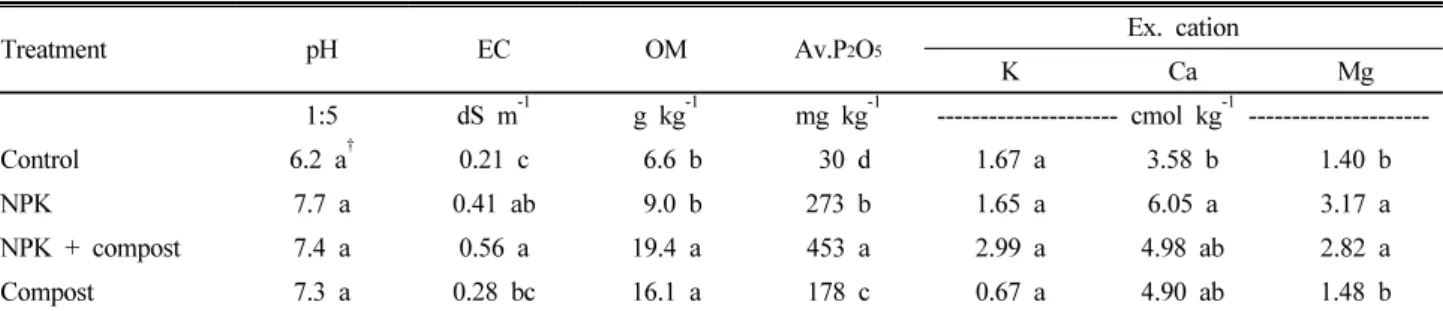
Soil physical and chemical properties The long-term application of compost increased the liquid and gaseous phase of soil. As a result, the bulk density of soil near root zone showed significant decrease in this experiment (Table 3). Regular addition of organic residues, particularly the composted ones, increased soil physical fertility, mainly by improving aggregate stability and decreasing soil bulk density (Diacono et al., 2010).
Soil chemical properties sampled at 5~15 cm and 15~25 cm from the surface are presented in Table 4 and 5, respectively. Soil organic matter was higher in compost treatments than in other treatments. Numerous studies in both temperate and tropical regions have shown that large increases in soil organic matter content can be achieved by adding organic manures and wastes to soils (Haynes et al., 1998; Khaleel et al., 1981). Electrical conductivity and exchangeable magnesium were higher in chemical fertilizer treatments than in control or compost treatment.
Exchangeable Ca was higher in NPK than in NPK+
compost treatment. Available phosphate in soil at 5~15
Table 4. Effect of chemical fertilizer and compost on soil chemical properties at 5~15 cm depth (Mar. 28, 2011).
Treatment pH EC OM Av.P
2O
5Ex. cation
K Ca Mg
1:5 dS m
-1g kg
-1mg kg
-1--- cmol kg
-1---
Control 6.2 a
†0.21 c 6.6 b 30 d 1.67 a 3.58 b 1.40 b
NPK 7.7 a 0.41 ab 9.0 b 273 b 1.65 a 6.05 a 3.17 a
NPK + compost 7.4 a 0.56 a 19.4 a 453 a 2.99 a 4.98 ab 2.82 a
Compost 7.3 a 0.28 bc 16.1 a 178 c 0.67 a 4.90 ab 1.48 b
†
Mean separation within columns by LSD at P=0.05.
Table 5. Effect of chemical fertilizer and compost on soil chemical properties at 15~25 cm depth (Mar. 28, 2011).
Treatment pH EC OM Av.P
2O
5Ex.cation
K Ca Mg
1:5 dS m
-1g kg
-1mg kg
-1--- cmol kg
-1---
Control 6.3 a
†0.19 b 4.1 a 23 c 1.30 a 3.22 c 1.32 b
NPK 7.6 a 0.34 a 4.8 a 104 b 3.32 a 4.40 ab 2.50 a
NPK + compost 7.5 a 0.39 a 7.5 a 222 a 1.27 a 5.13 a 2.44 a
Compost 7.4 a 0.22 b 7.9 a 110 b 0.83 a 3.87 bc 1.27 b
†
Mean separation within columns by LSD at P=0.05.
Table 6. Effect of chemical fertilizer and compost on leaf mineral content of red pepper at growing stage (Jun. 20, 2011).
Treatment T-N P K Ca Mg
--- g kg
-1---
Control 36.6 b
†2.31 c 46.4 a 24.6 a 9.86 a
NPK 43.2 a 4.41 b 50.2 a 19.4 a 11.39 a
NPK + compost 46.1 a 5.24 a 54.0 a 16.5 a 8.42 a
Compost 43.1 a 4.05 b 51.0 a 20.2 a 7.07 a
†
Mean separation within columns by LSD at P=0.05.
Table 7. Effect of chemical fertilizer and compost on leaf mineral content of red pepper at harvesting stage (Oct. 26, 2011).
Treatment T-N P K Ca Mg
--- g kg
-1---
Control 12.7 a
†2.07 b 23.0 a 11.5 a 2.87 b
NPK 14.0 a 2.51 b 19.7 a 12.9 a 4.99 a
NPK + compost 15.3 a 2.09 b 20.9 a 14.2 a 4.38 a
Compost 12.4 a 3.36 a 22.4 a 14.4 a 3.19 b
†
Mean separation within columns by LSD at P=0.05.
cm was highest in NPK+compost treatment followed by NPK (chemical fertilizer), compost, and control. Available P concentrations were greater with manure application than without manure (Eghball et al., 1996). Long-term applications of large amounts of P fertilizer and animal manures caused an accumulation of inorganic P, resulting in an increase of the potential risk related to mobilization of inorganic P in the top 5 cm of soil (Koopmans et al., 2003).
Leaf mineral content, yield and fruit quality of red
pepper Leaf N and P content of NPK and those of
compost were not significantly different at growing stage
(Table 6) because of substantial supply of mineral nutrients
from compost (Bartiono and Mokwunye, 1991; Padwick,
1983). Leaf N content of red pepper was lowest in control
at growing stage, though it catched up with other treatments
at harvesting stage (Table 6 and 7). The gross yield was
greatly affected by this low nitrogen content by affecting
the initial yield of red pepper (Table 8). Leaf K content
Table 8. Effect of chemical fertilizer and compost on fruit quality and yield of red pepper (2011).
Treatment Yield Capsaicin Dihydro-capsaicin Carotenoid
kg 10a
-1--- mg g
-1D.W. --- ASTA
†value
Control 256.2 d
‡2.36 a 1.95 a 94.67 a
NPK 1183.1 b 0.58 b 0.31 b 73.00 a
NPK + compost 1481.2 a 0.13 b 0.00 b 74.33 a
Compost 827.0 c 1.67 a 1.45 a 77.67 a
†
ASTA: American Spice Trade Association.
‡