• 검색 결과가 없습니다.

Influence of Organic and Inorganic Fertilizer Application on Red Pepper Yield, Soil Chemical Properties, and Soil Enzyme Activities

N/A
N/A
Protected

Academic year: 2021

Share "Influence of Organic and Inorganic Fertilizer Application on Red Pepper Yield, Soil Chemical Properties, and Soil Enzyme Activities"

Copied!
10
0
0

로드 중.... (전체 텍스트 보기)

전체 글

(1)

Received: May 30, 2018 Revised: August 7, 2018 Accepted:August 8, 2018

OPEN ACCESS

HORTICULTURAL SCIENCE and TECHNOLOGY 36(6):789-798, 2018

URL: http://www.kjhst.org pISSN : 1226-8763 eISSN : 2465-8588

This is an Open Access article distributed under the terms of the Creative Commons Attribution Non-Commercial License which permits unrestricted non-commercial use, distribution, and reproduction in any medium, provided the original work is properly cited.

Copyrightⓒ2018 Korean Society for Horticultural Science.

This research was supported by the “Cooperative Research Program for Agriculture Science &

Technology Development (Project No. PJ011 38101)” of the Rural Development Administration, Republic of Korea.

Influence of Organic and Inorganic Fertilizer Application on Red Pepper Yield, Soil Chemical Properties, and Soil Enzyme Activities

Gopal Selvakumar, Pyoung Ho Yi, Seong Eun Lee, and Seung Gab Han

*

Horticultural and Herbal Crop Environment Division, National Institute of Horticultural and Herbal Science, Rural Development Administration, Wanju 55365, Korea

*Corresponding author: [email protected]

Abstract

Green manures and compost have been widely used as alternatives to chemical fertilizers. The present study aimed to assess the changes in red pepper ( Capsicum annuum) yield, soil properties, and soil enzyme activities under organic and inorganic nitrogen fertilizer management. The treatments used here were chemical fertilizer (CF), hairy vetch ( Vicia villosa L.) residue with CF (HV+N), and livestock compost (LC). The same amount of nitrogen was applied in all treatments.

In general, all fertilization treatments significantly increased red pepper growth, yield, and macronutrient content compared to the control (CON); however, no differences were observed among the fertilization treatments. The phosphorous uptake rate was significantly higher in the HV+N treatment than the LC treatment. Post-experiment soil analysis showed that the LC application significantly increased soil organic matter, electrical conductivity, and available phosphorus content compared to the CF or HV+N treatments. The CF treatment significantly increased the nitrate content in the soil. The HV+N and LC treatments significantly increased soil dehydrogenase activity. The CF treatment resulted in significantly higher urease activity in the soil; whereas there were no differences in β- glucosidase and phosphatase enzyme activities among the treatments. These results suggest that the addition of hairy vetch residue to inorganic fertilizer, or a compost application, can increase enzyme activities while providing similar crop yield to those obtained with a chemical fertilizer application.

Additional key words: Beta-glucosidase activity, Capsicum annuum, crop yield, dehydrogenase activity, hairy vetch, livestock compost

Introduction

Utilization of chemical fertilizers has increased worldwide due to its availability and accessibility (Graham and Vance, 2000). Intensive agricultural systems using chemical fertilizers have degraded soils by decreasing soil organic matter and reducing soil fertility (Montemurro et al., 2015).

Increasing crop productivity has been the main objective in most agricultural production systems;

however, other production goals, such as product quality, cost effectiveness, and environmentally

friendly approaches, also need to be considered in crop production (del Amor, 2007). The application

(2)

of organic fertilizers could improve soil quality and crop yield, and is an environmentally friendly approach to reduce the use of chemical fertilizers.

Green manure is an environmental friendly organic fertilizer that has the potential to reduce the dependence on mineral fertilizers and to maintain soil organic matter content (Elfstrand et al., 2007). Leguminous green manures, such as crimson clover ( Trifolium incarnatum) and residue from a hairy vetch (Vicia villosa L.) cover crop, are important nitrogen (N) sources in organic crop production (Drinkwater et al., 1998; Muchanga et al., 2017) as legumes form root nodules with symbiotic N-fixing bacteria. Hence, legume-based green manures supply N to soil. Applications of compost have long been recognized for improving soil physical properties, structure, and water holding capacity (Lavelle, 1988), and reducing the dependency on inorganic fertilizers (Maynard and Hill, 1994; Moon et al., 2018).

Soil microbes influence soil organic matter decomposition and soil enzyme activities (Nannipieri et al., 1990). Soil enzyme activities are the primary mediators of soil biological processes, including organic matter degradation, mineralization, and nutrient recycling. Decomposed organic matter serves as a nutrient source for both plants and soil microbes. Soil enzyme activities are indicators of soil quality because they are strongly connected with important soil properties, such as organic matter, physical properties, and microbial activity or biomass (Bowles et al., 2014).

Global consumption of nutrients for crop production in 2014 accounted for roughly 108 million tons of N, 47 million tons of phosphorous (P), and 38 million tons of potassium (K) (Food and Agriculture Organization Corporate Statistical Database). However, the recovery efficiency of applied fertilizers is low. For instance, Haefele et al. (2003) reported that the recovery efficiency of nutrients after rice ( Oryza sativa) cultivation were 31 to 50% (the average for all sites was 36%) for N, 26 to 43% for P, and 53 to 65% for K. Large amounts of N are deposited in agricultural lands every year. The over application of N in agricultural lands leads to increased nitrate levels in ground water (Li and Yost, 2000). Optimal N fertilization management is crucial not only for improving crop production but also to protect the environment (Mosier, 2002). The objectives of this study were to assess the effect of organic and inorganic N management on red pepper ( Capsicum annuum) growth, yield, soil chemical properties, and soil enzyme activities.

Materials and Methods

Experimental Site and Treatment Details

The experimental plots (4 m × 3 m) were constructed at the National Institute of Horticulture and Herbal Science research fields, located in Wanju, Korea. The plots were separated by a concrete wall about one meter deep to avoid mobilization of nutrients between the plots. The entire experimental site was covered with a polyvinyl house to exclude precipitation from the plots. The initial chemical properties of the soil used in the experimental plots, prior to the start of the experiments, are given in Table 1 .

Four treatments were applied in the experimental plots in a randomized complete block design with three replications

per treatment. The treatments were as follows: no fertilizer (CON), chemical fertilizer (CF), hairy vetch ( Vicia villosa L.)

residue and chemical fertilizer (HV+N), and livestock compost (LC). The CF treatment plots received synthetic fertilizer

based on the nutrient requirements recommended by the Rural Development Administration of Korea for greenhouse red

pepper production. The amount of nitrogen (N), phosphorous (P), and potassium (K) applied for the CF treatment was 28,

(3)

9, and 13 kg/10a, respectively. For the HV treatment, seeds of hairy vetch legumes were sown and allowed to grow from November until April. Hairy vetch plants were harvested and ploughed in the same plots after the nutrient contents were analyzed. In addition to HV, synthetic N and P were applied to meet the required amount for red pepper growth. Livestock compost consisted of cow manure (40%), swine manure (10%), chicken manure (5%), sawdust (40%), bark (3%), and rice ( O. sativa) hull (2%). The amount of organic fertilizer applied corresponded to the N content of the chemical fertilizer.

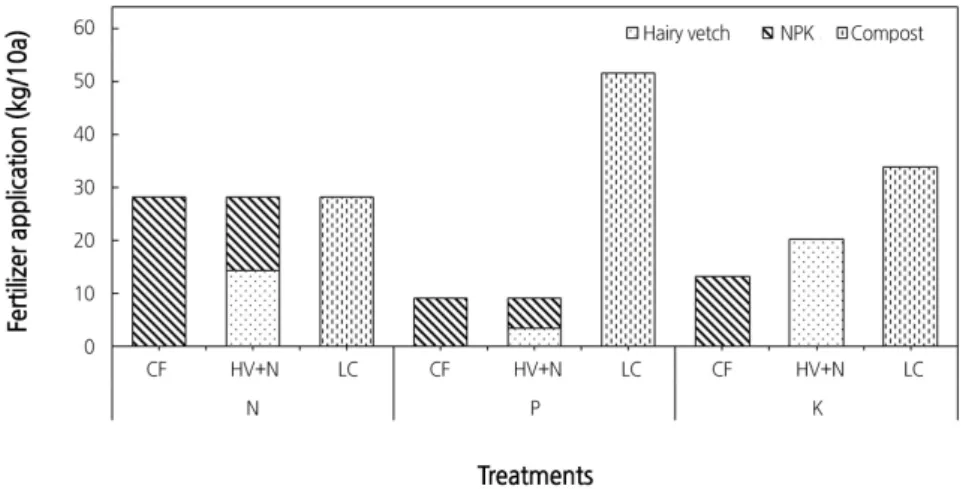
The amount of N, P, and K for each fertilizer treatment applied for 10a is given in Fig. 1 .

Plant Materials and Growth Conditions

Approximately 70-day-old red pepper seedlings ( Capsicum annuum L.) were purchased from Gyeonggi seedling company, South Korea. In each plot, the red pepper seedlings were transplanted in three rows with 10 plants per row. The distance between the rows was 100 cm and the distance between two plants was 40 cm. The plots were equipped with a drip irrigation system and the soil moisture content of the plots was maintained at field capacity. The plants were maintained for another 170 days in the experimental plots.

Table 1. Chemical properties of the soil used in this experiment before and after the experiment

Time Treatments

z

pH (1:5)

EC (dS ・m

-1

)

SOM (g ・kg

-1

)

Av.P

2

O

5

(mg ・kg

-1

)

K (cmol ・kg

-1

)

Ca (cmol ・kg

-1

)

Mg (cmol ・kg

-1

)

NH

4

-N (mg ・kg

-1

)

NO

3

-N (mg ・kg

-1

) Before 5.97 ± 0.06

y

0.27 ± 0.03 5.98 ± 0.38 6.85 ± 0.79 0.28 ± 0.03 4.15 ± 0.18 4.43 ± 0.10 22.27 ± 6.63 7.22 ± 0.30 After CON 5.53 ± 0.10a

x

0.30 ± 0.03c 0.70 ± 0.04b 6.85 ± 0.79b 0.26 ± 0.01b 3.83 ± 0.10b 1.74 ± 0.75a 52.46 ± 4.38a 4.92 ± 2.19b

CF 5.12 ± 0.11a 0.52 ± 0.02b 0.66 ± 0.03b 41.24 ± 15.55b 0.30 ± 0.02b 3.83 ± 0.16b 2.50 ± 0.19a 46.03 ± 2.59a 16.33 ± 4.70a HV+N 4.92 ± 0.95a 0.52 ± 0.03b 1.07 ± 0.06a 52.99 ± 6.95b 0.36 ± 0.03ab 5.22 ± 0.16a 2.40 ± 0.08a 43.72 ± 4.34a 12.99 ± 3.22ab LC 6.38 ± 0.23a 0.78 ± 0.06a 1.10 ± 0.06a 109.39 ± 36.89a 0.43 ± 0.05a 5.93 ± 0.35a 2.67 ± 0.17a 56.93 ± 8.60a 8.86 ± 3.56ab

z

CON: control, CF: chemical fertilizer, HV+N: hairy vetch + chemical fertilizer, LC: livestock compost.

y

Each value represents the mean of 3 replications ± standard error.

x
Each value in a column followed by the same letter are not significantly different by Duncan's multiple range test at p ≤ 0.05.

Fig. 1. Rate of fertilizer application in each treatment used in this study. CON: control, CF: chemical fertilizer, HV+N: hairy

vetch + CF, LC: livestock compost.

(4)

Plant Sampling and Nutrient Analysis

After 170 days, one red pepper plant from each plot was randomly selected and harvested. Leaf, fruit, stem, and root samples were collected separately. The collected samples were dried in an oven at 70°C for three days and dry weights were measured. Plant tissue macro and micro nutrient contents were measured using standard laboratory protocols. The total N content in the plant tissues was measured using a Kjeldahl analyzer (Kjeltec 8400, Foss, Sweden). Plant P content was measured by the ammonium metavanadate method. Plant K content was measured using inductively coupled plasma optical emission spectrometry (ICP-OES) (SDS-720, GBC, Australia). The plant nutrient uptake rate was determined using the equation:

Fertilized plant nutrient uptake – control plant nutrient uptake

× 100 Fertilizer applied in the soil

Soil Enzymatic Activity

Three rhizosphere soil samples were collected from each plot 100 days after transplanting and pooled together as one replication. The collected soil samples were transported immediately to the laboratory and soil enzymatic activity assays were performed within a week. Soil dehydrogenase activity was determined following the method developed by Casida et al. (1964) using triphenyltetrazolium chloride dye. Soil β-glucosidase and phosphatase activities were determined colorimetrically as the concentration of p-nitrophenol produced after the incubation of 1 g of soil (37°C for 1 h) in 0.25 mL toluene, 4 mL of modified universal buffer (MUB; pH 6.5), and 0.025 M p-nitrophenyl-β-D-glucopyranoside or 0.115 M disodium p-nitrophenyl phosphate, respectively (Tabatabai and Bremner, 1969; Eivazi and Tabatabai, 1988).

Soil urease activity was quantified colorimetrically as the NH

4+

produced after incubating 5 g of soil in 2.5 mL of 0.08 M urea solution and 50 mL of 1 M potassium chloride solution at 37°C for 2 h (Kandeler and Gerber, 1988).

Rhizosphere Soil Sample Collection and Analysis of Soil Chemical Properties

Five rhizosphere soils samples (within a 10 cm radius of the roots and a 15 cm depth; approximately 100 g) were collected from each plot, pooled together, mixed, and dried after the red peppers were harvested. The dried soil samples were used for the analysis of soil chemical properties. Soil pH, electrical conductivity (EC), soil organic matter content, and available P (Av. P

2

O

5

) content were analyzed using standard laboratory protocols. Soil nitrate and ammonia contents were analyzed using a Kjeldahl analyzer. The concentrations of other nutrients, such as K, Ca, and Mg, were measured through ICP-OES.

Statistical Analysis

Data were subjected to analysis of variance (ANOVA) and significant differences of the means were compared by

Duncan’s multiple range test (DMRT) at p ≤ 0.05. All data were analyzed using SAS package (verson 9.2, SAS Institute,

Cary, NC, USA).

(5)

Results

All fertilizer treatments increased plant dry matter content compared to the control. Significantly higher red pepper leaf, stem, root, and fruit dry weights were observed in all fertilizer treatments (Fig. 2) compared to the control; however, no differences were observed between the organic and chemical fertilizer treatments. Significantly higher nutrient contents

A B

C D

Fig. 2. Plant growth and yield response to organic and inorganic fertilizer application. (A) leaf dry weight, (B) stem dry weight, (C) root dry weight, and (D) fruit dry weight. Bars with same letters are not statistically different according to DMRT test (p ≤ 0.05). CON: control, CF: chemical fertilizer, HV+N: hairy vetch + CF, LC: livestock compost.

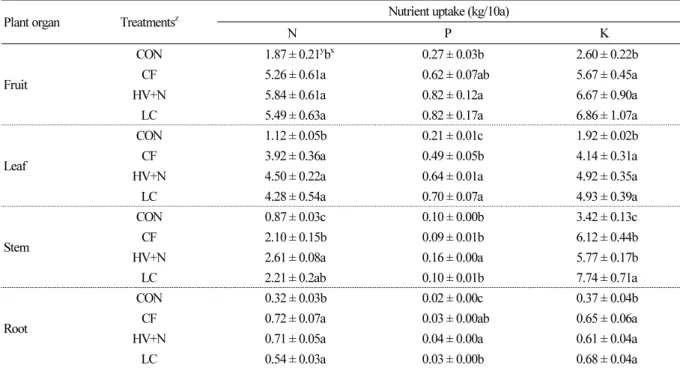
Table 2. Effect of organic and inorganic fertilizer on red pepper nutrient uptake

Plant organ Treatments

z

Nutrient uptake (kg/10a)

N P K

Fruit

CON 1.87 ± 0.21

y

b

x

0.27 ± 0.03b 2.60 ± 0.22b

CF 5.26 ± 0.61a 0.62 ± 0.07ab 5.67 ± 0.45a

HV+N 5.84 ± 0.61a 0.82 ± 0.12a 6.67 ± 0.90a

LC 5.49 ± 0.63a 0.82 ± 0.17a 6.86 ± 1.07a

Leaf

CON 1.12 ± 0.05b 0.21 ± 0.01c 1.92 ± 0.02b

CF 3.92 ± 0.36a 0.49 ± 0.05b 4.14 ± 0.31a

HV+N 4.50 ± 0.22a 0.64 ± 0.01a 4.92 ± 0.35a

LC 4.28 ± 0.54a 0.70 ± 0.07a 4.93 ± 0.39a

Stem

CON 0.87 ± 0.03c 0.10 ± 0.00b 3.42 ± 0.13c

CF 2.10 ± 0.15b 0.09 ± 0.01b 6.12 ± 0.44b

HV+N 2.61 ± 0.08a 0.16 ± 0.00a 5.77 ± 0.17b

LC 2.21 ± 0.2ab 0.10 ± 0.01b 7.74 ± 0.71a

Root

CON 0.32 ± 0.03b 0.02 ± 0.00c 0.37 ± 0.04b

CF 0.72 ± 0.07a 0.03 ± 0.00ab 0.65 ± 0.06a

HV+N 0.71 ± 0.05a 0.04 ± 0.00a 0.61 ± 0.04a

LC 0.54 ± 0.03a 0.03 ± 0.00b 0.68 ± 0.04a

z

CON: control, CF: chemical fertilizer, HV+N: hairy vetch + chemical fertilizer, LC: livestock compost.

y

Each value represents the mean of 3 replications ± standard error.

x
Each value in a column followed by the same letter are not significantly different by Duncan's multiple range test at p ≤ 0.05.

(6)

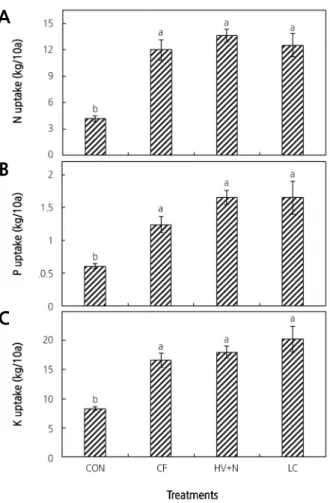
of the fruit, leaf, stem, and root tissues were observed for both organic and inorganic fertilizer treatments compared to control plants (Table 2) . In whole plant analyses, all fertilizer treatments showed almost two-fold higher N, P, and K uptake than in the control (Fig. 3) ; however, no differences were observed between the organic and chemical fertilizer treatments. Even though different sources of N were applied, it did not influence the N uptake rate by the plants (Fig. 4) .

A

B

C

Fig. 3. Macronutrient uptake of red pepper plants under organic and inorganic fertilizer application. (A) nitrogen uptake, (B) phosphorous uptake, and (C) potassium uptake. Bars with the same letters are not statistically different according to DMRT test (p ≤ 0.05). CON: control, CF: chemical fertilizer, HV+N: hairy vetch + CF, LC: livestock compost.

Fig. 4. Nitrogen uptake rate of red pepper plants grown under organic and inorganic fertilizer application. Bars with same

letters are not statistically different according to DMRT test (p ≤ 0.05). CON: control, CF: chemical fertilizer, HV+N: hairy

vetch + CF, LC: livestock compost.

(7)

Analysis of post experiment soil properties showed that the fertilizer treatments significantly influenced soil chemical properties (Table 1) . Compost-applied plots had significantly higher soil EC than the CF- and HV+N-treated plots. Plots treated with organic fertilizer had significantly higher soil organic matter content than plots treated with chemical fertilizer alone. LC-treated soils had significantly higher available P than the HC+N- and CF-treated soils. Soil K and Ca contents were also significantly higher in the LC treatment, followed by the HV+N treatment. No significant differences were observed in ammonium content between the treatments. Significantly higher nitrate content was observed in the CF treatment than in the LC treatment.

Fertilizer applications significantly influenced soil enzyme activities. Significantly higher dehydrogenase activity was observed in LC-treated soils followed by HV+N-treated soils. CF-treated plots and control plots had similar dehydrogenase activities (Fig. 5A) . Significantly higher urease activity was observed in the CF and HV+N treatments compared to the control (Fig. 5B) . Only the HV+N treatment showed significantly higher β-glucosidase activity than the control (Fig. 5C) . No significant differences were observed in phosphatase activity between the treatments (Fig. 5D) .

Discussion

Adequate nutrient availability is important for crop growth and yield. Normally, crop yield is closely associated with N supply when no other nutrients are deficient in the soil (Keeling et al., 2003). Conventional CF, HV+N, and LC applications resulted in a significant increase in red pepper plant biomass and fruit yield. Combining hairy vetch and CF (the HV+N treatment) resulted in red pepper growth and yield similar to the CF or LC treatments. A previous study by del Amor (2007) also reported that conventional fertilizer, organic fertilizer, and the integration of both had a similar effect on sweet pepper yield and fruit quality. Although all fertilizer treatments improved red pepper growth and yield, the

A B

C D

Fig. 5. Soil enzyme activities during the growth of red pepper plants under different fertilizer treatments. (A) dehydrogenase activity, (B) urease activity, (C) β-glucosidase activity, and (D) phosphatase activity. Bars with same letters are not statistically different according to DMRT test (p ≤ 0.05). CON: control, CF: chemical fertilizer, HV+N: hairy vetch + CF, LC:

livestock compost.

(8)

quality of the fruits is the most important measure to determine the effect of the fertilizer applications.

Previous reports found that in pepper and tomato ( Solanum lycopersicum), the N concentration of fruits were significantly higher with chemical fertilization than with organic fertilization (Clark et al., 1999; Colla et al., 2002;

Herencia et al., 2007). This is due to the fact that conventional chemical fertilizers supply N in a form that is immediately available to plants; whereas in organic fertilizers, the N supply is dependent on the decomposition rate of the organic matter (Lopez et al., 2013). Some researchers have confirmed that nitrate levels in vegetable crops are higher when N is supplied in an inorganic form than in an organic form (Bourn and Prescott, 2002; Williams, 2002). However, our results showed that the CF, LC, and HV+LC treatments resulted in a similar N content in all parts of the plant, including fruit, regardless of the N source. The N uptake rate by red pepper plants also showed no differences despite the differences in the N source. Our results confirm the findings by Ortega et al. (2016) that organic and conventional chemical fertilizers have similar effects on pepper growth.

Although compost-applied soils received over a two-fold higher P application than the CF or HV+N treatments, no differences in plant P uptake were observed between the fertilizer treatments. This result suggests that over application of nutrients doesn’t necessarily increase plant nutrient uptake. Chang et al. (2007) reported that applying compost in amounts greater than the required rate did not increase vegetable yield. A similar study by Hernandez et al. (2016) reported that compost application did not affect lettuce ( Lactuca sativa) growth during the first crop. Our results also showed no considerable differences in red pepper yield between chemical fertilizer and compost applications after the first cropping. Similarly, despite the different amount of K applied in each treatment, no differences were observed in K uptake between the fertilizer treatments.

The fertilizer applications influenced soil chemical properties. Although all the treatments received the same amount of N, the nitrate content was higher in the chemical fertilizer-applied soil than in the organic fertilizer-applied soils. This result confirms the findings that chemical fertilizer increased the nitrate content in the soil (Hepperly et al., 2007;

Bar-Yosef, 2017). The HV+N application increased the soil organic matter content more than the CF application alone.

Previous studies (Ouedraogo et al., 2001; Birkhofer et al., 2008; Selvakumar et al., 2018) and our results confirmed that compost application increases the soil organic matter content. Although P and K contents were higher in the compost than in the CF, the P and K contents of the plants were similar in both treatments, and the compost application resulted in increased soil-available P and K after red pepper harvest.

Dehydrogenases play an important role in the biological oxidation of soil organic matter. The dehydrogenase activity results of this study suggest that the compost application significantly increased the microbial activity in the soil compared to the CF application (Hernandez et al., 2016). The activities of other hydrolases involved in the cycles of important plant nutrients, such as urease (N cycle), β-glucosidase (C cycle), and phosphatase (P cycle) (Tabatabai, 1994), are used as indicators for microbial-mediated soil functions (Sinsabaugh, 1994). Higher urease activities measured in the CF- and HV+N-applied soils suggest that increased soil urease activity is related to the application of mineral N as urea.

Green manure increases soil enzyme activities by stimulating the soil microbial biomass (Piotrowska and Wilczewski,

2012). The hairy vetch residue application increased β-glucosidase activity in the soil, which suggests that hairy vetch

provides specific substrates for this enzyme or stimulates its synthesis. A previous study by Stott et al. (2010) found a

positive correlation between β-glucosidase activity and degradation of plant material. Degrading plant material releases

simple sugars for use by microbial populations, thus increasing microbial activity. Despite the higher P content in

(9)

compost, no differences in phosphatase activity were observed in this study. In a similar study by Hernandez et al. (2016), they reported that compost application did not influence phosphatase activity during the first crop; however, higher activity was observed during the second crop. Our results and the findings of Hernandez et al. (2016) suggest that the decomposition of compost increases over time, thereby increasing the release of nutrients over time.

Conclusion

Our results demonstrate that hairy vetch residue with addition of a chemical fertilizer, and the compost application, improved plant growth and yield similar to that observed from a chemical fertilizer application. Unlike chemical fertilizer, the hairy vetch residue and compost application improved soil chemical properties by increasing the soil organic matter and available P. In addition, organic fertilizers, such as hairy vetch residue and compost, increased soil biological activities, especially dehydrogenase and beta-glucosidase. These results suggest that organic fertilizers can be as effective at improving pepper plant growth, and yield as chemical fertilizers. These findings also suggest that hairy vetch residue and compost can be used as an alternative to chemical fertilizers to reduce the use of chemical fertilizer without losses to crop yield.

Literature Cited

Bar-Yosef B (2017) Conclusions from the permanent plot experiment at Gilat, Isreal: long-term (35 Y) effects of manure and fertilizer on crop yield, soil fertility, N uptake, and solutes leaching in soil. Isr J Plant Sci 64:124-135. doi:10.1080/07929978.2016.1275360 Birkhofer K, Bezemer TM, Bloem J, Bonkowski M, Christensen S, Dubois D, Ekelund F, Fließbach A, Gunst A, et al (2008) Long-term

organic farming fosters below and aboveground biota: Implications for soil quality, biological and productivity. Soil Biol Biochem 40:2297-2308. doi:10.1016/j.soilbio.2008.05.007

Bourn D, Prescott J (2002) Some qualitative aspects of tomatoes grown on NFT. Soilless Culture 3:3-7

Bowles TM, Acosta-Martínez V, Calderón V, Jackson LE (2014) Soil enzyme activities, microbial communities, and carbon and nitrogen availability in organic agroecosystems across an intensively-managed agricultural landscape. Soil Biol Biochem 68:252-262.

doi:10.1016/j.soilbio.2013.10.004

Casida L, Klein D, Santoro T (1964) Soil dehydrogenase activity. Soil Sci 98:371-376

Chang EH, Chung RS, Tsai YH (2007) Effect of different application rates of organic fertilizer on soil enzyme activity and microbial population. Soil Sci Plant Nutr 53:132-140. doi:10.1111/j.1747-0765.2007.00122.x

Clark MS, Horwath WR, Shennan, C, Scow KM, Lantni WT, Ferris H (1999) Nitrogen, weeds and water as yield-limiting factors in conventional low-input, and organic tomato systems. Agric Ecosyst Environ 73:257-270. doi:10.1016/S0167-8809(99)00057-2 Colla G, Mitchell JP, Poudel DD, Temple SR (2002) Changes of tomato yield and fruit elemental composition in conventional, low input,

and organic systems. J Sustain Agric 20:53-67. doi:10.1300/J064v20n02_07

del Amor FM (2007) Yield and fruit quality response of sweet pepper to organic and mineral fertilization. Renew Agr Food Syst 22:233-238. doi:10.1017/S1742170507001792

Drinkwater LE, Wagoner P, Sarrantonio M (1998) Legume-based cropping systems have reduced carbon and nitrogen losses. Nature 396:262-265. doi:10.1038/24376

Eivazi F, Tabatabai MA (1988) Glucosidases and galactosidases in soils. Soil Biol Biochem 20:601-606. doi:10.1016/0038-0717(88) 90141-1

Elfstrand S, Bath B, Martensson A (2007) Influence of various forms of green manure amendment on soil microbial community composition, enzyme activity and nutrient levels in leek. Appl Soil Ecol 36:70-82. doi:10.1016/j.apsoil.2006.11.001

Graham PH, Vance CP (2000) Nitrogen fixation in perspective: an overview of research and extension needs. Field Crop Res 65:93-106.

doi:10.1016/S0378-4290(99)00080-5

Haefele SM, Wopereis MCS, Ndiaye MK, Barro SE, Ould Isselmou M (2003) Internal nutrient efficiencies, fertilizer recovery rates and

indigenous nutrient supply of irrigated lowland rice in Sahelian West Africa. Field Crop Res 80:19-32. doi:10.1016/S0378-4290(02)00152-1

Hepperly P, Lotter D, Ulsh CZ, Seidel R, Reider C (2007) Compost, manure and synthetic fertilizer influences crop yields, soil properties,

(10)

nitrate leaching and crop nutrient content. Compost Sci Util 17:117-126. doi:10.1080/1065657X.2009.10702410

Herencia JF, Ruiz-Porras JC, Melero S, Garcia-Galavis PA, Morillo E, Maqueda, C (2007) Comparison between organic mineral fertilization for soil fertility level crop macronutrient concentrations, and yield. Agron J 99:973-983. doi:10.2134/agronj2006.0168

Hernandez T, Chocano C, Moreno JL, Garcia C (2016) Use of compost as an alternative to conventional inorganic fertilizers in intensive lettuce (Lactuca sativa L.) crops-effects on soil and plant. Soil Tillage Res 160:14-22. doi:10.1016/j.still.2016.02.005

Kandeler E, Gerber H (1988) Short-term assay of soil urease activity using colorimetric determination of ammonium. Biol Fertil Soils 6:68-72. doi:10.1007/BF00257924

Keeling A, McCallum R, Beckwitn C (2003) Mature green waste compost enhances growth and nitrogen uptake in wheat (Triticum aestivum L.) and oilseed rape (Brassica napus L.) through the action of water-extractable factors. Bioresour Technol 90:127-132.

doi:10.1016/S0960-8524(03)00125-1

Lavelle P (1988) Earthworm activities and soil system. Biol Fertil Soils 6:237-251. doi:10.1007/BF00260820

Li M, Yost RS (2000) Management-oriented modelling: optimizing nitrogen management with artificial intelligence. Agric Syst 65:1-27.

doi:10.1016/S0308-521X(00)00023-8

Lopez A, Fenoll J, Hellin P, Flores P (2013) Physical characteristics and mineral composition of two pepper cultivars under organic, conventional and soilless cultivation. Sci Hortic 150:259-266. doi:10.1016/j.scienta.2012.11.020

Maynard AA (1994) Sustained vegetable production for three years using composted animal manures. Compost Sci Util 2:88-96.

doi:10.1080/1065657X.1994.10757922

Montemurro F, Ciaccia C, Leogrande R, Ceglie F, Diacono M (2015) Suitability of different organic amendments from agro-industrial wastes in organic lettuce crops. Nutr Cycl Agroecosyst 102:243-252. doi:10.1007/s10705-015-9694-5

Moon KG, Um IS, Jeon SH, Cho YS, Kim YG, Rho IR (2018) Effect of organic fertilizer application on growth characteristics and saponin content in Codonopsis lanceolate. Hortic Environ Biotechnol 59:125-130. doi:10.1007/s13580-018-0013-3

Mosier AR (2002) Environmental changes associated with needed increases in global nitrogen fixation. Nutr Cycl Agroecosyst 63:101-116. doi:10.1023/A:1021101423341

Muchanga RA, Hirata T, Araki H (2017) Hairy vetch becomes an alternative basal N fertilizer in low-input fresh-market production in a plastic high tunnel. Hortic J 86:493-500. doi:10.17660/ActaHortic.2017.1164.16

Nannipieri P, Grego S, Ceccanti B (1990) Ecological significance of biological activity. In JM Bollag, G Stotzky, eds, Soil Biochemistry, vol.

6. Marcel Dekker, New York, USA, pp 293-355

Ortega R, Miralles I, Meca DE, Gazquez JC, Domene MA (2016) Effect of organic and synthetic fertilizers on the crop yield and macronutrients contents in soil and red pepper. Commun Soil Sci Plant Anal 47:1216-1226. doi:10.1080/00103624.2016.1166246 Ouedraogo E, Mando A, Zombre NP (2001) Use of compost to improve soil properties and crop productivity under low input agricultural

system in West Africa. Agric Ecosyst Environ 84:259-266. doi:10.1016/S0167-8809(00)00246-2

Piotrowska A, Wilczewski E (2012) Effects of catch crops cultivated for green manure and mineral nitrogen fertilization on soil enzyme activities and chemical properties. Geoderma 189-190:72-80. doi:10.1016/j.geoderma.2012.04.018

Selvakumar G, Yi PH, Lee SE, Han SG, Chung BN (2018) Hairy vetch, compost and chemical fertilizer management effect on red pepper yield, quality, and soil microbial population. Hortic Environ Biotechnol 59:607-614. doi:10.1007/s13580-018-0078-z

Sinsabaugh RL (1994) Enzymatic analysis of microbial pattern and process. Biol Fertil Soils 17:69-74. doi:10.1007/BF00418675 Stott DE, Andrews SS, Liebig MA, Wienhold BJ, Karlen DL (2010) Evaluation of ß-glucosidase activity as a soil quality indicator for the soil

management assessment framework. Soil Sci Soc Am J 74:107-119. doi:10.2136/sssaj2009.0029

Tabatabai MA (1994) Soil enzymes. In RW Weaver, ed, Methods of soil analysis, part 2. Microbiological and biochemical properties. Soil Science Society of America, Madison, WI, USA, pp 775-833

Tabatabai MA, Bremner JM (1969) Use of p-nitrophenyl phosphate for assay of soil phosphatase activity. Soil Biol Biochem 1:301-307.

doi:10.1016/0038-0717(69)90012-1

Williams CM (2002) Nutritional quality of organic fruit: shades of grey of shades of green? Proc Nutr Soc 61:19-24. doi:10.1079/

PNS2001126

수치

Fig. 1. Rate of fertilizer application in each treatment used in this study. CON: control, CF: chemical fertilizer, HV+N: hairy  vetch + CF, LC: livestock compost.
Table 2. Effect of organic and inorganic fertilizer on red pepper nutrient uptake
Fig. 3. Macronutrient uptake of red pepper plants under organic and inorganic fertilizer application
Fig. 5. Soil enzyme activities during the growth of red pepper plants under different fertilizer treatments

참조

관련 문서

모든 데이터는 XLSTAT 프로그램 (ver. 시설 다채 재배 결과에서도 유박 시용량이 증가하 여도 생육에 유의적 차이가 없는 결과와 유사하였다 7). Yield of lettuce according to

Effect of expeller cake fertilizer application on soil properties and red mustards ( Brassica Juncea L.) yield in soil of organic farm of plastic film greenhouse.

Effects of Winter Cultivation of Green Manure Crop and Application of Organic Resources on Watermelon Yield and Soil Physico-chemical Properties in Greenhouse.. Young-Sang

To evaluate the application level of expeller cake fertilizer (ECF), we have investigated soil chemical properties, leaf mineral contents and yield of red mustard in

Influence of city finished compost and nitrogen, phosphorus and potassium (NPK) fertilizer on yield, nutrient uptake and nutrient use efficiency of radish (Raphanus sativus L.)