*Corresponding author: Pyoung Ho Yi Phone: +82-63-238-6341; Fax: +82-63-238-6305;
E-mail: [email protected]
Korean J Environ Agric. 2018;37(1):9-14. English Online ISSN: 2233-4173
Published online 2018 April 4. https://doi.org/10.5338/KJEA.2018.37.1.10 Print ISSN: 1225-3537
Short-Term Fertilization with Hairy Vetch, Compost and Chemical Fertilizer Affect Red Pepper Yield and Quality and
Soil Properties
Gopal Selvakumar, Pyoung Ho Yi*, Seong Eun Lee and Seung Gab Han
Horticultural and Herbal Crop Environment Division, National Institute of Horticultural and Herbal Science, Rural Development Administration, Wanju 55365, Korea
Received: 1 March 2018 / Revised: 25 March 2018 / Accepted: 28 March 2018 Copyright ⓒ 2018 The Korean Society of Environmental Agriculture
This is an Open-Access article distributed under the terms of the Creative Commons Attribution Non-Commercial License (http://creativecommons.org/licenses/by-nc/3.0) which permits unrestricted non-commercial use, distribution, and reproduction in any medium, provided the original work is properly cited.
ORCID
Gopal Selvakumar
http://orcid.org/0000-0001-7575-7022
9
Abstract
BACKGROUND: The use of green manure and compost as organic fertilizer may increase crop yield and soil fertility due to improved soil nutrient availability and soil organic matter content (SOM). This study aimed to investigate the effects of hairy vetch (Vicia villosa L.) and compost application on red pepper growth, yield, fruit quality and soil health.
METHODS AND RESULTS: The treatments were no fertilizer (CON), chemical fertilizer (CF), hairy vetch (HV), and livestock compost+HV (LC+HV). Red pepper seedlings (70 days old) were transplanted and maintained in experimental plots for 140 days. Plant dry weight, micro- and macronutrient contents of plants and soil chemical properties were determined. All fertilizer treatments significantly increased plant dry weight. Fruit yield was significantly highest with HV treatment. As for nutrient content, plants in HV and LC+HV treatments have significantly higher K and Ca contents than the other treatments. Regarding soil properties, HV and LC+HV application significantly altered the soil chemical properties. Significantly higher SOM was observed in HV and LC+HV treated soils.
CONCLUSION: The results of this study suggest that short-term application of hairy vetch and compost is an effective alternative to the conventional chemical fertilizer
to increase fruit yield red pepper and improve soil health.
Keywords: Hairy vetch, Organic fertilizer, Pepper yield, Soil fertility, Synthetic fertilizer
Introduction
Nutrients are necessary for proper plant growth and good yields to meet the food requirements by the growing population. Nutrients released from inorganic fertilizers are immediately available to plant, thus enhancing plant growth rapidly and increasing the crop yield. However, the continuous use of inorganic fertilizer does not improve soil health and does not meet the requirement of soil organic matter (SOM) content which is necessary in crop cultivation (Hernandez et al., 2016). In addition, prolonged use of inorganic fertilizer causes problems such as salt accumulation. For example, the excessive application of nitrogen leads to nitrate accumulation which is prone to leach under the roots and contaminate the groundwater (Montemurro et al., 2015).
The loss of soil organic matter due to overuse of inorganic fertilizers has led to an increase in the use of organic fertilizers such as organic wastes and compost to restore soil fertility (Clapp et al., 2007).
Application of organic wastes as fertilizer increases the SOM content, encourage soil microbial growth and activity, improve soil physical characteristics and water holding capacity (Plaza et al., 2004; Tejada et al., 2009). In addition, organic fertilizers such as compost Open Access Research Article
Treatments pH EC OM Av.P2O5 K Ca Mg NH4-N NO3-N (1:5) (dS/m) (%) (mg/kg) (cmol/kg) (cmol/kg) (cmol/kg) (mg/kg) (mg/kg)
CON 5.67 0.22 0.51 9.41 0.30 4.02 3.13 9.83 46.59
CF 5.47 0.22 0.64 16.39 0.31 3.54 2.99 18.39 49.23
HV 5.36 0.25 0.56 8.89 0.34 3.67 2.97 14.70 29.00
LC+HV 6.39 0.30 1.01 43.04 0.45 5.36 2.95 11.81 40.23
Each value represents the mean of three replicates.
also acts as an important nutrient source for plants and microorganisms (Tejada and Gonzalez, 2006; Hernandez et al., 2014). Unlike inorganic fertilizer, organic fertilizers continue to improve soil health long after the plants have taken enough nutrients they need. Repeated application of organic fertilizers increase the beneficial effects of soil properties (Garcia-Ruiz et al., 2012).
Several cover crops planted before or between the cash crops have been shown to improve soil properties which eventually lead to enhancement of soil health and crop yield (Araki and Ito, 1999; Kuo and Jellum, 2002; Campiglia et al., 2012). Legume- based cover crop green manures such as hairy vetch (Vicia villosa), are important nitrogen source for organic crop production (Drinkwater et al., 1998) as they form nodules with symbiotic nitrogen fixing bacteria.
Pepper (Capsicum annuum L.) is an important vegetable crop worldwide in terms of commercial value (Gonzalez- Diaz et al., 2009). In Korea, 30% of the vegetables produced are red pepper and the demand is not reduced as it is major ingredient in Korean food industry. The present study aimed to compare the effect of conventional chemical fertilizer, hairy vetch and compost application on red pepper plant growth, yield and soil chemical properties.
Materials and Methods
Experimental Plot Construction and Treatment Details The experimental area consisting of 12 blocks was constructed in 2015 in the research fields of the National Institute of Horticultural and Herbal Science, Korea. The dimension of each block was 4 m×3 m.
The blocks were separated by one meter concrete wall to prevent nutrient mobilization to adjacent blocks or leaching out. Subsoil from the non-cultivated demolished hummock was used to fill up the experimental plots.
The chemical properties of the soils in each treatment were given in Table 1.
Four different fertilizer treatments were applied in the experimental plots. Each treatment contained three replications in a randomized complete block design. The treatments were as follows: no fertilizer
(CON), chemical fertilizer (CF), hairy vetch (HV), and livestock compost+hairy vetch (LC+HV). For chemical fertilizers, conventional synthetic nitrogen (N), phosphorous (P) and potassium (K) fertilizers were applied based on the nutrient requirements recommended by the Rural Development Administration of Korea for red pepper plants. The amount of N, P and K applied for CF treatment were 19, 6.4 and 10.1 kg 10a-1, respectively. For HV treatment, hairy vetch legumes were allowed to growth in their respective plots from November to early April of the following year. Hairy vetch was sampled and analyzed for nutrient contents. Before planting the red pepper, the hairy vetch plants were plowed in the same plot. Hairy vetch plants nutrient content alone was not enough to meet the recommended fertilizer application for red pepper. So in addition to HV, a required amount of CF was added to meet the recommended amount.
However, the final nitrogen content was equal to that of CF treatment nitrogen content. For LC+HV application, livestock compost (cow manure 40%;
swine manure 10%; chicken manure 5%; sawdust 40%;
bark 3%; and rice hull 2%) and hairy vetch were used. In addition to hairy vetch, compost was applied to meet the recommended fertilizer application. The final nitrogen content of the hairy vetch and compost combined amount was equal to that of the nitrogen content in the CF treatment.
Planting and Maintenance
Approximately 70 day old red pepper seedlings were purchased from Gyeonggi Seedling Company, South Korea. Red pepper seedlings were transplanted in four rows per plot; each row contained eight seedlings. A total of 32 seedlings were planted per experimental plot.
The plots were equipped with drip irrigation system and were maintained at field capacity. The plants were maintained in the experimental plots for 140 days.
Plant Sampling and Nutrient Content Analysis After 140 days, two plants from each treatment were randomly selected and harvested. Plant leaf, fruit, stem and root samples were collected separately. The
Fig. 1. Dry weight of red pepper plant parts as affected by chemical and organic fertilizers. (A) leaf dry weight (B) Stem dry weight (C) root dry weight and (D) fruit dry weight. CON – control; CF – chemical fertilizer; HV – hairy vetch; and LC+HV – livestock compost + hairy vetch. Each value represents the mean of three replicates ± standard error (SE). Alphabets on top of columns indicate statistical grouping based on DMRT (P≤0.5).
collected samples were dried in an oven at 70℃ for three days and dry weight was measured. Plant tissue macro- and micronutrient contents were measured using standard laboratory protocols. The total nitrogen content in the plant tissues were measured using a Kjeldahl analyzer. The phosphorus content was measured by the ammonium metavanadate method. The other nutrients such as K, Ca, Mg, Fe, Cu, Mn and Zn concentrations were measured through inductively coupled plasma optical emission spectrometry (ICP-OES).
Rhizosphere Soil Sample Collection and Analysis of Soil Chemical Properties
For each treatment, five rhizosphere soils samples (within 10 cm radius and 15 cm depth; approximately 500 g) were randomly collected from each plot, pooled together and mixed. The soil samples were sieved through 2 mm sieve. Soil moisture content was determined. Briefly, 10 g of fresh soil was dried at 105℃
for 72 h and the dry weight was measured. After drying the sample, soil chemical properties were analyzed. Soil pH, electrical conductivity, organic matter content and available phosphorous content were analyzed using standard laboratory protocol. Soil nitrate and ammonia contents were analyzed using Kjeldahl analyzer. The other nutrients such as K, Ca, Mg, concentrations were measured using ICP-OES.
Statistical Analysis
The average value of two plants from a single plot was considered as one replication. Data were subjected to analysis of variance (ANOVA) and the mean significant differences were compared by Duncan's multiple range test (DMRT) at P≤0.05. All data were analyzed using SAS package, Version 9.2.
Results
Fertilization resulted in significantly higher red pepper leaf, stem and root dry weight than no fertilization (Fig.
1A,B,C). Application of HV and LC+HV did not differ from CF treatment in plant dry weight parameters.
Fertilizer application significantly increased fruit dry weight (Fig. 1D). The highest dry weight was observed for HV treatment followed by CF and LC+HV.
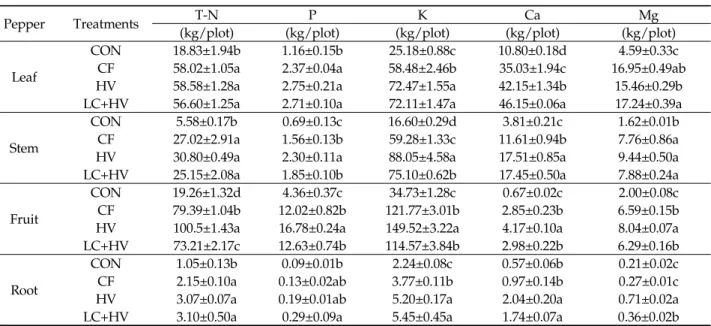
Fertilized plants had significantly higher macronutrient contents than control plants (Table 2). Although all fertilizer application showed significantly higher macronutrient content than control treatment, the difference between the treatments varied in each part of the plant. For instance, no differences between the fertilizer treatments for T-N in plant leaf, stem and root, however, in fruit, HV treatment showed significantly higher T-N than CF and LC+HV. In P content, HV treatment showed significantly higher P content in stem and fruit. Whereas in K content, the differences between the treatments are more evident where HV treatment showed significantly higher K content than CF treatment in all parts of the plant followed by LC+HV treatment (except fruit). The similar trend was observed for Ca content where HV treatment showed significantly higher Ca content than CF treatment in all parts of the plant followed by LC+HV treatment (except fruit). Likewise HV treatment showed significantly higher Mg accumulation in fruit and root than CF treatment.
Fertilization treatments influenced micronutrient content of the plants variably (Table 3). Fe content of plants were similar in all fertilization treatments. Whereas, Cu content uptake was varied in each part of the plant. For instance, In leaf, the Cu content was high for control treatment; in stem and fruit, CF showed
Pepper Treatments Fe Cu Mn Zn
(g/plot) (g/plot) (g/plot) (g/plot)
Leaf
CON 193.38±14.65b 23.68±1.96a 141.01±15.01c 344.19±24.34c
CF 456.55±38.71a 19.79±3.31ab 745.19±36.34a 641.98±23.19b
HV 489.93±58.90a 12.59±2.35b 633.31±56.55a 726.63±32.61a
LC+HV 439.58±13.38a 16.06±1.54ab 435.62±32.65b 747.66±53.82a
Stem
CON 57.41±5.76a 6.24±0.20b 192.98±11.00ab 73.87±5.91c
CF 185.14±73.63a 16.91±4.84a 383.35±111.78a 88.80±2.89bc
HV 120.05±13.37a 3.00±0.38b 231.31±18.22ab 126.70±8.00a
LC+HV 101.42±13.02a 1.86±0.65b 97.93±7.34b 104.74±7.16ab
Fruit
CON 61.19±3.75b 12.39±1.07b 51.37±0.85b 64.05±5.69d
CF 224.74±17.33a 41.99±1.59a 107.54±14.89a 220.01±13.11a
HV 238.89±16.23a 13.58±0.73b 73.31±7.08ab 183.62±11.50b
LC+HV 224.98±12.12a 12.15±1.23b 73.92±22.83ab 129.83±8.37c
Root
CON 53.91±16.06b 0.48±0.23a 5.87±0.76c 2.98±0.39a
CF 144.30±9.73ab 0.47±0.14a 12.99±1.69b 5.56±2.12a
HV 110.35±10.09ab 0.85±0.05a 19.90±1.23a 10.04±2.17a
LC+HV 203.25±54.26a 0.59±0.13a 18.64±1.06a 6.11±1.78a
CON–control; CF–chemical fertilizer; HV–hairy vetch; and LC+HV–livestock compost+hairy vetch. Each value represents the mean of three replicates ± standard error (SE). Alphabets in each columns indicate statistical grouping based on DMRT (P≤0.5).
Table 3. Micronutrient content in red pepper plants under different fertilizer treatments
Pepper Treatments T-N P K Ca Mg
(kg/plot) (kg/plot) (kg/plot) (kg/plot) (kg/plot)
Leaf
CON 18.83±1.94b 1.16±0.15b 25.18±0.88c 10.80±0.18d 4.59±0.33c
CF 58.02±1.05a 2.37±0.04a 58.48±2.46b 35.03±1.94c 16.95±0.49ab
HV 58.58±1.28a 2.75±0.21a 72.47±1.55a 42.15±1.34b 15.46±0.29b
LC+HV 56.60±1.25a 2.71±0.10a 72.11±1.47a 46.15±0.06a 17.24±0.39a Stem
CON 5.58±0.17b 0.69±0.13c 16.60±0.29d 3.81±0.21c 1.62±0.01b
CF 27.02±2.91a 1.56±0.13b 59.28±1.33c 11.61±0.94b 7.76±0.86a
HV 30.80±0.49a 2.30±0.11a 88.05±4.58a 17.51±0.85a 9.44±0.50a
LC+HV 25.15±2.08a 1.85±0.10b 75.10±0.62b 17.45±0.50a 7.88±0.24a Fruit
CON 19.26±1.32d 4.36±0.37c 34.73±1.28c 0.67±0.02c 2.00±0.08c
CF 79.39±1.04b 12.02±0.82b 121.77±3.01b 2.85±0.23b 6.59±0.15b HV 100.5±1.43a 16.78±0.24a 149.52±3.22a 4.17±0.10a 8.04±0.07a LC+HV 73.21±2.17c 12.63±0.74b 114.57±3.84b 2.98±0.22b 6.29±0.16b Root
CON 1.05±0.13b 0.09±0.01b 2.24±0.08c 0.57±0.06b 0.21±0.02c
CF 2.15±0.10a 0.13±0.02ab 3.77±0.11b 0.97±0.14b 0.27±0.01c
HV 3.07±0.07a 0.19±0.01ab 5.20±0.17a 2.04±0.20a 0.71±0.02a
LC+HV 3.10±0.50a 0.29±0.09a 5.45±0.45a 1.74±0.07a 0.36±0.02b
CON–control; CF–chemical fertilizer; HV–hairy vetch; and LC+HV–livestock compost+hairy vetch. Each value represents the mean of three replicates ± standard error (SE). Alphabets in each columns indicate statistical grouping based on DMRT (P≤0.5).
significantly high; and in root not difference between the treatments were observed. Likewise, for Mn and Zn contents, the differences between the treatments were varied in each part of the red pepper plant.
The post-production soil analysis showed that green manure application positively influenced soil properties (Table 4). LC+HV application positively influenced soil pH followed by HV application. HV and LC+HV fertilized soils had significantly higher soil organic matter content than CF and control plots.
Significantly higher P content was observed in soils treated with HV and LC+HV. Soil K and Ca contents also were higher in HV and LC+HV treated soils.
NH4-N and NO3-N of the soil were not statistically different among the treatments.
Discussion
Mineral nutrients especially nitrogen is the key nutrient for plant growth. When no other nutrient is
Treatments pH EC OM Av.P2O5 K Ca Mg NH4-N NO3-N (1:5) (dS/m) (%) (mg/kg) (cmol/kg) (cmol/kg) (cmol/kg) (mg/kg) (mg/kg) CON 5.9±0.2ab 0.2±0.0b 0.5±0.0c 5.2±0.4b 0.3±0.0d 4.4±0.2b 3.1±0.1a 24.2±3.2a 5.5±1.7a CF 5.6±0.1b 0.4±0.0b 0.6±0.0c 33.6±6.6b 0.4±0.0c 4.1±0.0b 3.0±0.1a 15.9±2.6a 6.3±0.8a HV 6.3±0.3ab 0.4±0.0b 1.3±0.2b 163.8±45.2ab 0.5±0.0b 6.1±0.4a 2.9±0.2a 27.3±7.2a 12.5±4.9a LC+HV 6.6±0.1a 0.7±0.2a 2.0±0.2a 251.9±90.3a 0.7±0.0a 6.4±0.2a 3.4±0.2a 30.3±8.7a 17.3±6.5a Each value represents the mean of three replicates ± standard error (SE). Alphabets in each columns indicate statistical grouping based on DMRT (P≤0.5).
Table 4. Soil properties of experimental plots after the harvest of red pepper plants
limiting growth, crop yield is closely related to the addition of N supply (Keeling et al., 2003). Application of hairy vetch as green manure provides the essential nutrients needed for plant growth and improves soil health and soil biological activity (Kataoka et al., 2017).
The potential of leguminous plants such as hairy vetch not only benefits the current standing crop as these fix large amounts of nitrogen that help meet the nitrogen needs of the succeeding crops (Seo and Lee, 2005). With the increasing perception that organic fruit is safer, more nutritious and environment-friendly than conventional foods, the demand for organic crop products among consumers have risen (Winter and Davis, 2006). In order to promote the use of hairy vetch as an alternative to inorganic fertilizer, comparisons between organic and inorganic fertilization on the basis of similar N availability should be established (Hernandez et al., 2016). The present study compares the application of similar amount of N supply from inorganic fertilizer and hairy vetch with or without compost on red pepper yield and soil chemical parameters.
In this study, all fertilizer treatments promoted red pepper plant growth regardless of source. However, the more pronounced increment in fruit dry weight with hairy vetch application and similar effect of compost and hairy vetch treatment with chemical fertilization suggest that these organic materials provide better or comparable nutrient supply for plant growth and development. A previous study by Jokela and Nair (2016) also reported that hairy vetch grown as a cover crop and later applied as green manure increased bell pepper production. In another study by Montemurro et al. (2013) also reported that organic fertilization and vetch mulch improved zucchini growth and yield. These results support our findings that hairy vetch application increased the yield of red pepper yield. However, the yield from combined application of hairy vetch and compost showed no differences with CF treatment. The reason for this could be the slow decomposition of short term compost application. Maynard (2000) reported that tomato yield did not significantly increase after one year of application of compost due to slow rate of compost
decomposition. However, the yield was significantly increased in the following years. This may explain the low yield of peppers in our study as the compost was applied one year before the experiment.
Green manure and compost release nutrients in slow rate than chemical fertilizers (Sacco et al., 2015).
In this study, the nitrogen content in plant tissues were higher in chemical fertilizer applied plants than LC+HV applied soils. Higher K and Ca contents in HV applied plant tissues suggest that hairy vetch application effectively improved plant nutrient uptake.
Similar micronutrient contents in plant tissue suggest that neither chemical fertilizer nor organic fertilizer has influenced the micronutrient uptake by plants.
It is expected that organic fertilization increase soil available N (Berry et al., 2002; Corre-Hellou and Crozat, 2005) as leguminous cover crops cause N fixation. Indeed, this was the case for HV and LC+
HV applied soils. The nitrate and ammonia contents were double the amount of CF applied soils. More evidently, soil fertilized with organic matter had higher SOM content than conventional chemical fertilizer applied soils. Our results coincides with Astier et al. (2006) that green manure application improved soil chemical properties.
Organic fertilization exhibited similar, in general, as did the chemical fertilizers: however, the difference was in relation with the fertilization years. Short term organic fertilization increased the red pepper yield.
Higher soil available nutrients in organic fertilizer applied soils were evident for improved soil health.
Although the plant nutrients were similar in all treatments, the decomposition of hairy vetch and compost may increase soil nutrient availability for consequent crops.
Acknowledgment
This research was supported by the “Cooperative Research Program for Agriculture Science & Technology Development (Project No. PJ01138101)” of the Rural Development Administration, Republic of Korea.
Araki, H., & Ito, M. (1999). Soil properties and vegetable production with organic mulch and no-tillage system.
Japanese Journal of Farm Work Research, 34(1), 29-37.
Astier, M., Maass, J. M., Etchevers-Barra, J. D., Pena, J. J.,
& de Leon Gonzalez, D. (2006). Short-term green manure and tillage management effects on maize yield and soil quality in an Andisol. Soil & Tillage Research, 88(1-2), 153-159.
Berry, P. M., Sylvester-Bradley, R., Philipps, L., Hatch, D.
H., Cuttle, S. P., Rayns, F. W., & Gosling, P. (2002). Is the productivity of organic farms restricted by the supply of available nitrogen. Soil Use Management, 18(s1), 248-255.
Campiglia, E., Radicetti, E., & Mancinelli, R. (2012). Weed control strategies and yield response in a pepper crop (Capsicum annum L.) mulched with hairy vetch (Viciavillosa Roth.) and oat (Avena sativa L.) residues.
Crop Protection, 33, 65-73.
Clapp, C. E., Hayes, M. H. B., & Ciavatta, C. (2007).
Organic wastes in soils: biogeological and environmental aspects. Soil Biology and Biochemistry, 39, 1239-1243.
Corre-Hellou, G., & Crozat, Y. (2005). N2 fixation and N supply in organic pea (Pisum sativa L.) cropping systems as affected by weeds and peaweevil (Sitonalineatus L.).
European Journal of Agronomy, 22(4), 449-458.
Drinkwater, L. E., Wagoner, P., & Sarrantonio, M. (1998).
Legume-based cropping systems have reduced carbon and nitrogen losses. Nature, 396, 262-265.
Garcia-Ruiz, R., Ochoa, M. V., Hinojosa, M. B., &
Gomez-Munoz, B. (2012). Improved soil quality after 16 years of olive mil pomace application in olive oil groves. Agronomy for Sustainable Development, 32(3), 803-810.
Gonzalez-Diaz, L., Martinez-Jimenez, P., Bastida, F., &
Gonzalez-Andujar, J.L. (2009). Expert systems for integrated plant protection in pepper (Capsicum annum L.). Expert Systems with Application, 36(5), 8975-8979.
Hernandez, T., Chocano, C., Moreno, J. L., & Garcia, C.
(2014). Towards a more sustainable fertilization:
combined use of compost and inorganic fertilization for tomato cultivation. Agriculture Ecosystem and Environment, 196, 178-184.
Hernandez, T., Chocano, C., Moreno, J. L., & Garcia, C.
(2016). Use of compost as an alternative to conventional inorganic fertilizers in intensive lettuce (Lactuca sativa L.) crops-Effects on soil and plant. Soil and Tillage Research, 160, 14-22.
Jokela, D., & Nair, A. (2016). Effects of reduced tillage and fertilizer application method on plant growth, yield,
Kataoka, R., Nagasaka, K., Tanaka, Y., Yamamura, H., Shinohara, S., Haramoto, E., Hayakawa, M., & Sakamoto, Y. (2017). Hairy vetch (Vicia villosa), as green manure, increases fungal biomass, fungal community composition, and phosphatase activity in soil. Applied Soil Ecology, 117-118, 16-20.
Keeling, A., McCallum, R., & Beckwitn, C. (2003). Mature green waste compost enhances growth and nitrogen uptake in wheat (Triticumaestivum L.) and oilseed rape (Brassica napus L.) through the action of water- extractable factors. Bioresource Technology, 90(2), 127- 132.
Kuo, S., & Jellum, E. J. (2002). Influence of winter cover crop and residue management on soil nitrogen availability and corn. Agronomy Journal, 94(3), 501-508.
Maynard, A. A. (2000). Applying Leaf compost to reduce fertilizer use in tomatoproduction. Compost Science &
Utilization, 8(3), 203-209.
Montemurro, F., Ciaccia, C., Leogrande, R., Ceglie, F., &
Diacono, M. (2015). Suitability of different organic amendments from agro-industrial wastes in organic lettuce crops. Nutrient Cycling in Agroecosystems, 102(2), 243-252.
Montemurro, F., Fiore, A., Campanelli, G., Tittarelli, F., Ledda, L., & Canali, S. (2013). Organic fertilization, green manure, and vetch mulch to improve organic zucchini yield and quality. HortScience, 48(8), 1027–
1033.
Plaza, C., Hernandez, D., Garcia-Gil, J. C., & Polo, A.
(2004). Microbial activity in pig slurry amended soils under semiarid conditions. Soil Biology and Biochemistry, 36(10), 1577-1585.
Sacco, D., Moretti, B., Monaco, S., & Grignani, C. (2015).
Six-year transition from conventional to organic farming: effects on crop production and soil quality.
European Journal of Agronomy, 69, 10-20.
Seo, J. H., & Lee, H. J. (2005). Effects of hairy vetch green manure on nitrogen enrichment in soil and corn plant.
Korean Journal of Soil Science and Fertilizer, 38(4), 211-217.
Tejada, M., & Gonzalez, J. L. (2006). Crushed cotton gin compost on soil biological properties and rice yield.
European journal of Agronomy, 25(1), 22-29.
Tejada, M., Hemandez, M. T., & Garcia, C. (2009). Soil restoration using composted plant residues: Effects on soil properties. Soil and Tillage Research, 102(1), 109-117.
Winter, C. K., & Davis, S. F. (2006). Organic foods. Journal of Food Science, 71(9), 117-124.