• 검색 결과가 없습니다.

S Phase Cell Cycle Arrest and Apoptosis is Induced by Eugenol in G361 Human Melanoma Cells

N/A
N/A
Protected

Academic year: 2021

Share "S Phase Cell Cycle Arrest and Apoptosis is Induced by Eugenol in G361 Human Melanoma Cells"

Copied!
6
0
0

로드 중.... (전체 텍스트 보기)

전체 글

(1)

Copyright ⓒ 2011, The Korean Academy of Oral Biology

129

Journal of Oral Biology

S Phase Cell Cycle Arrest and Apoptosis is Induced by Eugenol in G361 Human Melanoma Cells

Byul-Bo Ra Choi, Sang-Hun Shin

1

, Uk-Kyu Kim

1

, Jin-Woo Hong

2

*, and Gyoo-Cheon Kim*

Department of Oral Anatomy, School of Dentistry, Pusan National University, Yangsan 626-870, Korea

1

Department of Oral & Maxillofacial Surgery, School of Dentistry, Pusan National University, Yangsan 626-870, Korea

2
Department of Korean Internal Medicine, School of Korean Medicine, Pusan National University, Yangsan, 626-870, Korea (received May 23, 2011 ; revised June 27, 2011 ; accepted August 23, 2011)

Eugenol is an essential oil found in cloves and cinnamon that is used widely in perfumes. However, the significant anesthetic and sedative effects of this compound have led to its use also in dental procedures. Recently, it was reported that eugenol induces apoptosis in several cancer cell types but the mechanism underlying this effect has remained unknown. In our current study, we examined whether the cytotoxic effects of eugenol upon human melanoma G361 cells are associated with cell cycle arrest and apoptosis using a range of methods including an XTT assay, Hoechst staining, immunocyto- chemistry, western blotting and flow cytometry. Eugenol treatment was found to decrease the viability of the G361 cells in both a time- and dose-dependent manner. The induction of apoptosis in eugenol-treated G361 cells was confirmed by the appearance of nuclear condensation, the release of both cytochrome c and AIF into the cytosol, the cleavage of PARP and DFF45, and the downregulation of procaspase-3 and -9.

With regard to cell cycle arrest, a time-dependent decrease in cyclin A, cyclin D3, cyclin E, cdk2, cdk4, and cdc2 expression was observed in the cells after eugenol treatment. Flow cytometry using a FACScan further demonstrated that eugenol induces a cell cycle arrest at S phase. Our results thus suggest that the inhibition of G361 cell proliferation by eugenol is the result of an apoptotic response and an S phase arrest that is linked to the decreased expression of key cell

cycle-related molecules.

Key words: eugenol, human melanoma cell, cell cycle arrest, apoptosis.

Introduction

Human melanoma is a malignant tumor of melanocytes with an increasing incidence in the western population (Jiang et al., 2009; Xu et al., 2009). The number of cases worldwide has doubled over the last 20 years and has become one of the fastest growing cancers worldwide. Melanoma often arises in the oral mucosa (Hicks MJ and Flaitz., 2000). Melanoma is a major public health problem with a very poor prognosis (Weber et al., 2009). Melanoma cells are highly resistant to chemotherapy and radiotherapy (Eberle et al., 2007; La Porta, 2007). Despite the recent advances in therapeutic methods including surgery, the severe morbidity from human melanoma has not been improved (Atkins et al., 1997; Dreiling et al., 1996). Therefore, considerable effort has been focused on the development of new chemo-preventive measures.

Eugenol (4-Allyl-2-methoxyphenol) is found in reasonable quantities in the essential oils of many spices, such as Syzgium aromaticum (clove), Pimenta racemosa (bay leaves) and Cinnamomum verum (cinnamon leaf) (Ghosh et al., 2005). It is commonly used in sauces, perfumes, wine, cosmetics and food products. Eugenol is also used as an antiseptic, anti- bacterial, analgesic agent in traditional medical practices in Asia as well as in dentistry during cavity-filling procedures (Markowitz et al., 1992; Sakano et al., 2004). In long term experiments by various groups, eugenol was found to be non- carcinogenic and non-mutagenic. Furthermore, because of its safety, it was listed on the FDA (Food and Drug Adminis-

*Corresponding author: Gyoo-Cheon Kim, Address: Department of Oral Anatomy, School of Dentistry, Pusan National University, Yangsan 626-870, Korea. Tel: +82-51-510-8243, Fax: +82-51-510- 8241, E-mail: [email protected]

Jin-Woo Hong, Department of Korean Internal Medicine, School of Korean Medicine, Pusan National University, Yangsan, 626-870, Korea.

Tel: +82-51-510-8481, Fax: +82-51-510-8481,

E-mail: [email protected]

(2)

tration)’s GRAS (generally recognized as safe) food ingredient list. Many researchers argued that eugenol plays a role in the metabolism of cellular reactive oxygen species (ROS). Gen- erally, low concentrations of eugenol can act as an antioxidant and anti-inflammatory agent, whereas its high concentration acts as a pro-oxidant resulting from the enhanced generation of tissue-damaging free radicals (Asha et al., 2001; Chogo and Crank, 1981). In this aspect, several studies demonstrated that eugenol triggers DNA damage and induces cell death in some cancer cells through a range of oxidation mechanisms (Suzuki et al., 1985; Wright et al., 1995).

Many studies on the molecular analysis of cancers have found that cell cycle regulators are frequently mutated in most common malignances. Therefore, the control of cell cycle progression in tumor cells is a potentially effective strategy for the control of tumor growth. Many type of stresses, including DNA damage induced by anti-cancer drugs, UV and gamma- radiation, induce apoptosis accompanied by specific cell cycle arrest in various cancer cells. Although there are many reports dealing with the apoptotic properties of a eugenol treatment in cancer cells, the effect of eugenol on cell cycle regulation is not completely understood. This study examined whether eugenol can induce cell cycle arrest and apoptosis in human melanoma cells. Cell cycle arrest in the S phase coupled with apoptosis after a eugenol treatment was observed by FACS analysis. A significant decrease in the cell cycle regulators after the eugenol treatment was observed followed by the induction of the apoptotic signals. Overall, eugenol can induce S arrest of cell cycle leading to apoptosis in melanoma cells.

Materials and Methods

Materials

Eugenol, RNase A, proteinase K, leupeptin, aprotinin, pro- pidium iodide, phenyl-methylsulfonyl fluoride (PMSF), Hoechst 33342, Ponceau S were purchased from Sigma (St Louis, MO, USA). The ECL Western blotting detection reagents were ob- tained from Amersham international (Buckinghamshire, UK).

Antibodies

Rabbit polyclonal anti-human cyclin D3 antibody was pur- chased from Cell Signaling Technology, Inc. (Boston, MA).

Rabbit polyclonal anti-human cyclin A, cyclin E, cdc 2, cdk 4, apoptosis inducing factor (AIF), cytochrome c and DFF45 (ICAD) antibodies were supplied by Santa Cruz Biotechnology (CA, USA); Monoclonal mouse anti-human cdk 2, β-actin, GAPDH, caspase-3, caspase-9 and PARP antibodies were ob- tained from Santa Cruz Biotechnology (CA, USA); Biotinylated and HRP conjugated goat anti-mouse and anti-Rabbit IgG were acquired from Santa Cruz Biotechnology (CA, USA).

Cell culture

G361 cells were cultured in RPMI 1640 media containing 25 mM Hepes, 100 µg/ml penicillin/streptomycin, 4 mM L-

glutamine, 10% fetal bovine serum at 37

o

C in a 5% CO

2

hu- midified air incubator.

Cell viability assay

The viability of the cultured cells was estimated using a XTT assay. In the XTT assay, the cells were placed in a 96-well plate and incubated for 24 h. The cells were then treated with various concentrations of eugenol for 24 h. The XTT solution was accomplished by heating in a 60

o

C water bath. Menadione (MEN) was made up into a 100 mM solution in dimetyl sulfoxide (DMSO) and a MEN solution was added to 10 mM of a XTT solution. 25 µl of a XTT/MEN mixture was added to each well. After 4 h of further incubation, the cell viability was measured using an ELISA reader (Sunrise Remote Control, Tecan, Austria) at 650 nm. The assay was performed in trip- licate.

Nuclear staining with hoechst 33258

The cells were harvested after 24 h incubation, and cytocen- trifuged. The cells were washed twice in cold PBS and incubated with 4 µg/ml of Hoechst 33258, a DNA-binding fluorescent dye, for 10 min at 37

o

C. The morphology of the apoptotic cells were observed by fluorescent microscopy (Zeiss Axioscope, German). Cells with fragmented and/or condensed nuclei were classified as apoptotic body cells.

Immunocytochemisty

The cell suspensions were loaded into a cytospin chamber and centrifuged at 1000 rpm for 3 min. Subsequently, the cells were fixed in 4% paraformaldehyde for 10 min, the cells were washed with cold PBS, and incubated with the primary antibody and biotin-conjugated secondary antibody at a dilu- tion of 1:100 for 1 h. The cells were stained by dipping the slides for 10 sec in DAB and hematoxylin color reagent.

Western blot analysis

For protein analysis, the cells were lysed with a lysis buffer (10 mM Tris/HCl, pH 7.2, 1% Triton X-100, 150 nM NaCl, 5 mM EDTA, 2 mM PMSF, 2 µg/mL aprotinin and 2 µg/

mL leupeptin) on ice for 30 min. The lysate were clarified by centrifugation at 14,000 revolution per min for 20 min at 4

o

C, and the supernatant was obtained. The protein content of the lysate was determined using a Bio-Rad Protein Assay (Bio-Rad laboratories Hercules, CA). 30 µg of protein was mixed with the sample buffer. After heating to 95ºC for 5 min, the protein was resolved on polyacrylamide SDS gels and transferred to a PVDF membrane. After transfer, the mem- branes were blocked with a blocking reagent [5% non-fat milk in TBS-T (20 mM Tris, 150 mM NaCl, 0.1% Tween 20)] for 1 h. The membranes were incubated for 1 h with the corres- ponding antibody. The membranes were treated with ECL Western blotting reagents and detected.

Flow cytometry analysis

The G361 cells were seeded into a 6-well plate at a density of

(3)

1 × 10

4

/well and incubated for 24 h. The eugenol treated cells were incubated for the indicated times. The cells were har- vested and washed with cold PBS. The cells were centrifuged at 1500 rpm for 5 min. For fixation, the cells were added to cold 70% ethanol and incubated for 1 h. The fixed cells were washed with PBS and centrifuged at 1500 rpm for 5 min.

20 µg/ml of RNase A was added to each sample, and incubated at 37

o

C for 30 min. The samples were finally resuspended in a PI solution (10 µg/ml). The cells were incubated at 4

o

C for 5 min and analyzed by flow cytometry. The percentage of arrest cells were calculated using Cell Quest software (Becton Dickinson).

Statistical analysis

The results of eugenol treated groups and control group were determined using paired T-test statistical method by SPSS for Win 12.0 for summary data. p < 0.01 and p < 0.05 were considered statistically significant.

Results

Eugenol effectively inhibits cell proliferation in G361 melanoma cells

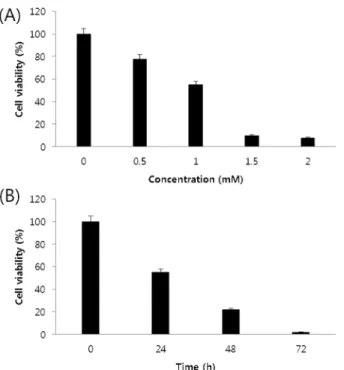
Initially, the effect of eugenol on G361 melanoma cells was elucidated. As shown in Fig. 1A, eugenol inhibited cell viability in a dose-dependent manner. Treatment with 1 mM

eugenol for 24 h inhibited cell viability by approximately 50%. In particular, eugenol in the range of 1.5-2 mM reduced the cell viability to below 15% of the untreated cells. G361 cells were further subjected to a 1 mM eugenol treatment to examine its activity at various time points. As a result, eugenol produced a significant time-dependent decrease in G361 cell viability (Fig. 1B).

Eugenol treatment induces release of cytochrome c and AIF leading to cellular apoptosis

The changes in morphology after the eugenol treatment were examined to determine if the eugenol treatment can induce apoptosis in G361 cells. As shown in Fig. 2A, the G361 cells were subjected to Hoechst 33258 staining to visualize the nuclear morphological changes in the presence of eugenol. As expected, the untreated cells showed homogeneous staining of their nuclei, whereas the cells treated with eugenol showed irregular staining of their nuclei due to chromatin condensation and nuclear fragmentation. To confirm cellular apoptosis on the molecular level, the subcellular location of mitochondrial apoptosis related factors after the eugenol treatment was examined further (Fig. 2B, C). Immunofluorescent microscopy showed that cytochrome c and AIF in the control cells are located in a punctuate pattern. On the other hand, a diffused distribution in eugenol-treated cells suggests that eugenol

Fig. 1. Effect of eugenol on the viability of G361 cells (A) The cells were treated with various concentrations of eugenol as indicated.

After 24 h incubation, the cell viability was measured using a XTT assay (1~2 mM, p < 0.01). (B) The cells were treated with 1 mM of eugenol for the indicated time periods and XTT assay were per- formed as indicated in Materials and Methods (24 h and 48 h, p < 0.05; 72 h, p < 0.01).

Fig. 2. Eugenol effectively induces the apoptotic phenotypes (A) 24 h after cell seeding, the cells were treated with 1 mM of eugenol (right panel) or not treated (left panel). After 24 h further incubation, the morphology of the nucleus was visualized by Hoechst staining.

(B) After 24 h incubation in the presence (right panel) or absence

(left panel) of 1 mM eugenol, subcellular location of cytochrome c

was visualized by immunocytochemistry using anti-cytochrome c-

antibody. (C) Translocation of AIF in response to a 1 mM eugenol

treatment for 24 h was visualized by immunocytochemistry using

the anti-AIF antibody. The inside panel shows the translocation of

AIF from the cytoplasm to the nucleus, as indicated by the arrows.

(4)

caused the release of those proteins from the mitochondria into the cytosol. In particular, the AIF protein which had been distributed mainly out of the nucleus in the control cells was translocated into the nucleus in eugenol-treated cells (Fig. 2C).

Eugenol induces cell cycle arrest at S phase.

FACS analysis was used to determine if eugenol-induced apoptosis is accompanied by a specific cell cycle alteration.

G361 cells were treated with 1 mM of eugenol for 3 to 48 h and the cell cycle progress was monitored by flow cytometry using PI staining. As shown in Fig. 3, the number of cells in the S phase increased at 3 h after the eugenol treatment with a con- comitant decrease in those in the G1 and G2/M phase. There was an increase in the number of cells undergoing apoptosis at 24 h after the treatment indicating that the eugenol treatment first induces cell cycle arrest at the S phase followed by apoptotic progression.

Eugenol can own-regulates cyclins, cdks, cdc2, procaspase- 3, procaspase-9 and cleavage of PARP, DFF45 (ICAD) in G361 cells.

Previous data showed that a eugenol treatment can inhibit

G361 cell growth by inducing S phase arrest of cell cycle progression. To determine the precise molecular changes during eugenol induced cell cycle arrest and apoptosis, the expression level of the proteins involved in cell cycle pro- gression, particularly in the G1/S phase transition, were moni- tored. As shown in Fig. 4A and 4B, treatment with eugenol resulted in a significant decrease in the expression of cyclin A, D3 and E in a time-dependent manner. Because cyclin D3 is the most potently inhibited cyclin by eugenol in G361 cells, a pronounced decrease in the expression of cdc2, cdk2 and cdk4 was observed after the eugenol treatment. Fig. 5 showed that eugenol induced activations of caspase-3, -9, and cleavages of PARP and DFF45. This suggests that the observation in Fig. 3 is well supported by molecular changes within the eugenol- treated cells.

Fig. 5. Eugenol treated G361 cells showed the degraded levels of procaspase-3, -9 and increased cleavage of PARP and DFF45. After incubating the G361 cells with 1 mM of eugenol for the indicated times, the cells were subjected to SDS-PAGE coupled with Western Blot using anti-caspase-3, caspase-9, PARP and DFF45 antibodies as indicated.

Fig. 4. Eugenol effectively decreased thee level of proteins for G1/S transition. The G361 cells were incubated in the presence of 1 mM eugenol for the indicated times. The total protein lysates were used for SDS-PAGE followed by Western blot using antibodies against cyclins (A), and cyclin partner Cdk2, Cdk4 and Cdc2 (B) Antibodies against β-actin was used as the loading control.

Fig. 3. Eugenol-treated G361 cells show the S-phase arrest pheno-

type prior to apoptosis. The G361 cells were treated with 1 mM

eugenol for 3 to 48 h. At each time point, the cells were subjected to

FACS analysis using PI solution as indicated.

(5)

Discussion

In many patients with metastatic melanoma, a systemic treatment can be ineffective due to the high resistance of melanoma cells to various anticancer treatments (Henmi et al., 2009). In several studies, the induction of cell cycle arrest and apoptosis have been highlighted as a means of controlling the unlimited growth of cells (Eberle and Hossini, 2008). In this article, the role of eugenol as an inducer of cell cycle arrest and apoptosis in human melanoma G361 cells was elucidated.

Eugenol had a significant inhibitory effect on the viability of G361 cells in a time- and dose-dependent manner (Fig. 1). In particular, a 1 mM eugenol treatment was sufficient to inhibit G361 cell growth by approximately half that of non-treated cells at 24 h after treatment. As shown in Fig. 2A, nuclear staining with Hoechst revealed morphological changes in the nucleus of the eugenol treated cells at 24 h. This shows that eugenol-induced cell death had already begun at 24 h. The mitochondrial protein markers for apoptosis were detected to determine if this nuclear phonotype induced by a eugenol treatment is a result of cellular apoptosis progression. It has been reported widely that during apoptosis, the outer mito- chondrial membrane becomes permeable to intermembrane space proteins, such as cytochome c and AIF (Golab et al., 2000). AIF induces chromatin condensation and large-scale DNA fragmentation in the caspase-independent features of apoptosis (Daugas et al., 2000). Cytochrome c release is a well known feature in apoptosis triggered by proteasome inhibition (Wagenknecht et al., 2000). As shown in Fig. 2B and 2C, the release of cytochrome c and AIF were observed 24 h after the eugenol treatment, indicating that eugenol-induced cell death follows the apoptotic pathway.

In the next step, the effect of eugenol on the cell cycle was studied. As shown in fig. 3, flow cytometry indicated that before inducing cellular apoptosis, eugenol also increases the number of cells in the S phase and decreases the portion of those in the G1 and G2/M phase cells. This suggests that eugenol affects the cell cycle regulatory machineries.

The expression level of the cell cycle regulatory proteins were examined after the eugenol treatment to better understand the precise regulatory mechanism of eugenol-induced cell cycle arrest and apoptosis. The cell cycle progression is regulated by cyclin dependent kinase (cdks) and cyclins.

According to cdk binding, the activating cyclins increase and decrease (Evans et al., 1983). Each cyclin plays a key role in the different phases of the cell cycle (Sherr, 1994). The three D type cyclins (cyclin D1, cyclin D2 and cyclin D3) bind to cdk4 and cdk6. Hence, cdk-cyclin D complexes are essential for the cell to enter the G1 phase. E type cyclin associates with cdk2 to regulate the progression from the G1 into the S phase, and cyclin A binds with cdk2, which is needed during the S phase (Girard et al., 1991; Ohtsubo et al., 1995; Srivastava et al., 2007). Cyclin E accumulates in the late G1 phase as a result of E2F-mediated transcriptional regulation (Nakanishi et al., 2006; Singer et al., 1999). As shown in Fig. 4, the expression

level of the cyclins, cdks and cdc2 were decreased after the eugenol treatment in a time-dependent manner. Chief of all, this suggests that a eugenol treatment causes cyclin A-cdk2 and cyclin E-cdk2 inhibition, triggering S arrest. A common final event of apoptosis is nuclear condensation and fragmen- tation, which are regulated by caspases, DFF and PARP. Once activated, the effector caspases are accountable for the prote- olytic cleavage of a broad spectrum of cellular targets, leading eventually to cell death and in this study, the caspase-3 substrates DFF45 and PARP were cleaved during eugenol treatment (Lee et al., 2009; Koo et al., 2011). In this study, we observed the activation of caspase-3, -9 and cleavage of DFF45 and PARP. Therefore, eugenol modulates cell cycle regulatory machinery leading to S cell cycle arrest, and it induces the caspases triggering apoptotic pathway in G361 human melanoma cells.

Acknowledgments

This work was supported by a 2-Year Research Grant of Pusan National University.

References

Asha MK, Prashanth D, Murali B, Padmaja R, Amit A.

Anthelmintic activity of essential oil of Ocimum sanctum and eugenol. Fitoterapia. 2001;72:669-70.

Atkins N, O'Brien E, Wesseling KH, Guelen II. Increasing observer objectivity with audio-visual technology: the Sphygmocorder. Blood Press Monit. 1999;72:269-272.

Chogo JB, Crank G. Chemical composition and biological activity of the Tanzanian plant Ocimum suave. J Nat Prod.

1981;44:308-11.

Daugas E, Susin SA, Zamzami N, Ferri KF, Irinopoulou T, Larochette N, Prevost MC, Leber B, Andrews D, Penninger J, Kroemer G. Mitochondrio-nuclear translocation of AIF in apoptosis and necrosis. Faseb J. 2000;14:729-39.

Dreiling L, Hoffman S, Robinson WA. Melanoma: epidemi- ology, pathogenesis, and new modes of treatment. Adv Intern Med. 1996;41:553-604.

Eberle J, Hossini AM. Expression and function of bcl-2 proteins in melanoma. Curr Genomics. 2008;9:409-19.

Eberle J, Kurbanov BM, Hossini AM, Trefzer U, Fecker LF.

Overcoming apoptosis deficiency of melanoma-hope for new therapeutic approaches. Drug Resist Updat. 2007;10:218-34.

Evans T, Rosenthal ET, Youngblom J, Distel D, Hunt T. Cyclin:

a protein specified by maternal mRNA in sea urchin eggs that is destroyed at each cleavage division. Cell. 1983;33:389-96.

Ghosh R, Nadiminty N, Fitzpatrick JE, Alworth WL, Slaga TJ, Kumar AP. Eugenol causes melanoma growth suppression through inhibition of E2F1 transcriptional activity. J Biol Chem. 2005;280:5812-9.

Girard F, Strausfeld U, Fernandez A, Lamb NJ. Cyclin A is

required for the onset of DNA replication in mammalian

(6)

fibroblasts. Cell. 1991;67:1169-79.

Golab J, Stoklosa T, Czajka A, Dabrowska A, Jakobisiak M, Zagozdzon R, Wojcik C, Marczak M, Wilk S. Synergistic antitumor effects of a selective proteasome inhibitor and TNF in mice. Anticancer Res. 2000;20:1717-21.

Henmi K, Hiwatashi Y, Hikita E, Toyama N, Hirano T. Methoxy- and fluoro-chalcone derivatives arrest cell cycle progression and induce apoptosis in human melanoma cell A375. Biol Pharm Bull. 2009;32:1109-13.

Hicks MJ, Flaitz CM. Oral mucosal melanoma: epidemiology and pathobiology. Oral Oncol. 2000; 36: 152-69.

Jiang CC, Yang F, Thorne RF, Zhu BK, Hersey P, Zhang XD.

Human melanoma cells under endoplasmic reticulum stress acquire resistance to microtubule-targeting drugs through XBP- 1-mediated activation of Akt. Neoplasia. 2009;11:436-47.

Koo BC, Kim DH, Kim IR, Kim GC, Kwak HH, Park BS. A Natural Product, Chios Gum Mastic, Induces the Death of HL-60 Cells via Apoptosis and Cell Cycle Arrest. Int J Oral Biol. 2011;36:13-21.

La Porta CA. Drug resistance in melanoma: new perspectives.

Curr Med Chem. 2007;14:387-91.

Lee SE, Hur YJ, Kim IR, Kwak HH, Kim GC, Shin SH, Kim CH, Park BS. Mechanism underlying Chios gum masticinduced apoptosis on SCC25 human tongue squamous cell carcinoma cell line. Int J Oral Biol. 2009;34:61-77.

Markowitz K, Moynihan M, Liu M, Kim S. Biologic properties of eugenol and zinc oxide-eugenol. A clinically oriented review.

Oral Surg Oral Med Oral Pathol. 1992;73:729-37.

Nakanishi M, Shimada M, Niida H. Genetic instability in cancer cells by impaired cell cycle checkpoints. Cancer Sci. 2006;97:

984-9.

Ohtsubo M, Theodoras AM, Schumacher J, Roberts JM, Pagano M. Human cyclin E, a nuclear protein essential for the

G1-to-S phase transition. Mol Cell Biol. 1995;15:2612-24.

Sakano K, Inagaki Y, Oikawa S, Hiraku Y, Kawanishi S. Copper- mediated oxidative DNA damage induced by eugenol: possible involvement of O-demethylation. Mutat Res. 2004;565:35-44.

Sherr CJ. G1 phase progression: cycling on cue. Cell. 1994;79:

551-5.

Singer JD, Gurian-West M, Clurman B, Roberts JM. Cullin-3 targets cyclin E for ubiquitination and controls S phase in mammalian cells. Genes Dev. 1999;13:2375-87.

Srivastava RK, Chen Q, Siddiqui I, Sarva K, Shankar S. Linkage of curcumin-induced cell cycle arrest and apoptosis by cyclin- dependent kinase inhibitor p21(/WAF1/CIP1). Cell Cycle. 2007;

6:2953-61.

Suzuki Y, Sugiyama K, Furuta H. Eugenol-mediated superoxide generation and cytotoxicity in guinea pig neutrophils. Jpn J Pharmacol. 1985;39:381-6.

Wagenknecht B, Hermisson M, Groscurth P, Liston P, Krammer PH, Weller M. Proteasome inhibitor-induced apoptosis of glioma cells involves the processing of multiple caspases and cytochrome c release. J Neurochem. 2000;75:2288-97.

Weber A, Kirejczyk Z, Potthoff S, Ploner C, Hacker G. En- dogenous Noxa Determines the Strong Proapoptotic Synergism of the BH3-Mimetic ABT-737 with Chemotherapeutic Agents in Human Melanoma Cells. Transl Oncol. 2009;2:73-83.

Wright SE, Baron DA, Heffner JE. Intravenous eugenol causes hemorrhagic lung edema in rats: proposed oxidant mechanisms.

J Lab Clin Med. 1995;125:257-64.

Xu X, Liu Y, Wang L, He J, Zhang H, Chen X, Li Y, Yang J, Tao J. Gambogic acid induces apoptosis by regulating the expres- sion of Bax and Bcl-2 and enhancing caspase-3 activity in human malignant melanoma A375 cells. Int J Dermatol.

2009;48:186-92.

수치

Fig. 2. Eugenol effectively induces the apoptotic phenotypes (A) 24 h after cell seeding, the cells were treated with 1 mM of eugenol (right panel) or not treated (left panel)
Fig. 5. Eugenol treated G361 cells showed the degraded levels of procaspase-3, -9 and increased cleavage of PARP and DFF45

참조

관련 문서

Taken together, we suggest that apop- tosis of prostate cancer cell line PC-3 induced by silibinin is associated with cell cycle arrest through decrease of cell cycle check

The aim of this work was to determine the effects of Bacoside A on cell cycle arrest and apoptosis with associated impact on expression of Notch pathway genes in human GBM cell

Effects of ochnaflavone on the expression of cell cycle regulatory proteins and apoptosis related proteins Based on the cell cycle distribution data evoked by och-

Triptolide Inhibits Proliferation and Induces Apoptosis in Human Melanoma A375 Cells induce cell apoptosis by inhibiting NF-κB activation in.. some tumor cell lines (Geng et

Induction apoptosis and G2/M phase cell cycle arrest by non-ther- mal plasma in human osteosarcoma MG-63 cell line.. Byul Bo Ra Choi and Gyoo

It was found that METO treatment showed cytotoxic activity in a dose-dependent manner, and induced G2/M cell cycle arrest and apoptosis in HT29 cells.. The induction of G2/M arrest

Differential effects on growth, cell cycle arrest, and induction of apoptosis by resveratrol in human prostate cancer cell lines.. Resveratrol causes arrest in

The data revealed that silencing of the endogenous Foxo3a expression rescued breast cancer cells from apoptosis and cell cycle arrest and abolished the increment of p53, p21