Introduction
In this century, soil salinization is getting rapidly increase and it is one of global environmental problems (Schofield et al., 2001; FAO 2005). Exceed of salts in the salt-affected soils cause of soil deterioration (Naidu and Rengasamy, 1993; Curtin and Naidu, 1998): soil physiochemical properties getting worse (Gupta et al., 1984; Chiang et al., 1987), osmotic stress and specific ion effects induce bad influence to plant growth (Aslam et al., 1996; Qadir and Schubert, 2002). The growth and distribution of plant, and ecological characteristics were influenced by soil characteristics (Amiaud et al., 1998;
Bouzillé, 2001). Assessment for relationship between salt-affected soil and distribution of plant might be an important tool to explain for soil characteristics as environmental factors (Adams, 1963) and response of plant (Ungar, 1966). Plant distribution of salt marsh and salt-affected soils has deep relationship with some
characteristics (soil salinity, inundation, soil texture, drainage, competition with other species) (Phleger, 1971).
But field investigation for relationship between soil salinity and plant distribution was little carried out on the reclaimed tidal flats in Korea.
Reclaimed tidal flat as an artificial salt-affected soil where plants occurrence were limited, because soil salinity takes charge of an important limiting factor for plant growth (Gupta and Abrol, 1990; Page et al., 1990).
It was known that some species of halophytes that had salt tolerance (Flowers et al., 1977; Shekhawat et al., 2006) predominated on the reclaimed tidal flats (Joenje, 1974; Bonis et al., 2005). Thongh Korea has a lot of reclaimed tidal flats, domestic study conducted for halophytes focused on distribution and ecological characteristics were rare.
Understanding for spatial variation of plant species on the reclaimed tidal flats, we have two hypotheses: one is plant species has each different ecological niche and the other is each niche has different soil salinity as an environmental factor. Assessment for relationship between soil salinity and plant distribution require
Received : July 6. 2009 Accepted : August 10. 2009*Corresponding author: Phone : +82337602250, E-mail : [email protected]
Soil Salinity Influencing Plant Stands on the Reclaimed Tidal Flats of Kyonggi-Bay in the Midwestern Coast of Korea
Eun-Kyu Kim
1, Soul Chun
2, Young-K. Joo
2,
*Yeong-Sang Jung
31
Jukjeon High School, Yongin, 449-548, Korea
2
Department of Bioresources and Technology, Yonsei University, Wonju, 220-710,Korea
3
College of Agriculture and Life Science, Kangwon National University, Chuncheon, 200-701, Korea
To identify controlling factors for spatial variation of vegetation in reclaimed tidal flats, plant stands were investigated in a newly reclaimed as well as three matured tidal flats, and a natural tidal flat in the mid- west coast of Korea. Electrical conductivity of saturated soil extract (ECe) was measured to assess soil salinity. Soil salinity differed significantly among plant stands. Depending on soil salinity, plant species showed different niches: glycophyte predominated low saline spots, halophyte predominated high saline spots. Soil salinity for each plant habitats was in order of as follow: bare soil or plant wilted > mixed pioneer halophyte > pioneer halophyte > mixed with pioneer halophyte and facultative halophyte > mixed facultative halophyte > facultative halophyte > mixed with facultative halophyte and glycophyte >
glycophyte > mixed glycophyte stands. These results suggested that plant distribution might have been influenced by spatial edaphic gradient (soil salinity), and thus it could be utilized as an indicator for field soil salinity gradient. Relationship between soil salinity and plant distribution was not different among the aged reclaimed tidal flats, suggesting that the vegetative population might have changed into a similar direction since the reclamation.
Key words: Spatial variation, Plant distribution, Reclaimed tidal flat, Electrical conductivity of saturated soil
extract (ECe), Halophyte
environmental factors (as soil salinity) and response of plant. Therefore, the aim of this work was to describe the soil salinity of each plant stands and to establish the relationship between soil salinity gradient and plant species, and finally to provide scientific criteria of soil salinity for management of plant and salt-affected soil.
In this study, soil salinity status of each plant stand was investigated, in accordance with analysis for environmental factors. Field investigation was conducted to four reclaimed tidal flats (newly reclaimed tidal flat:
Namyang, aged reclaimed tidal flats: Seukmun, Sihwa and Daeho) and one natural tidal flat (Hangdam) of Kyonggi-bay in the mid-west coast of Korea.
Materials and Methods
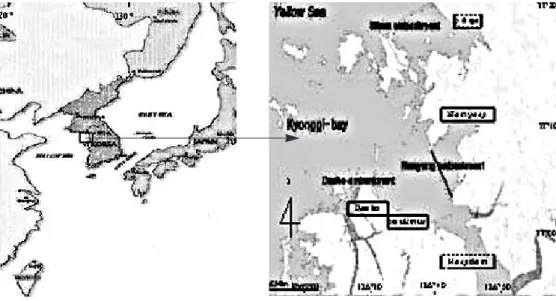
Site description Geographically all of the study sites located in the west coast of Korea (Fig. 1):
Hangdamlocated E126.40'~126.50', N 36.90'~37.00', Namyang located E 126.40'~126.50', N 37.00'~37.10', Seukmun located E 126.30'~126.40', N 36.90'~37.00', Sihwa located E 126.40'~126.50', N 37.10'~37.20', Daeho located E 126.20'~ 126.30', N 36.90'~37.00'. Five sites used for investigation: one tidal flat (Hangdam) used for control, four reclaimed tidal flats (newly: Namyang, aged: Seukmun, Sihwa, Daeho) that differ from reclaimed age used for experiments. Based on the embankment period in 2002, Daeho has passed 18years, Namyang as a newly reclaimed tidal flat has passed 1 month, Seukmun and Sihwa has passed 7 and 9 years, respectively.
The climate of region is temperate is Korea, with a mean temperature from Apr. to Nov. of 6.7~16.8
℃, with total precipitation from Apr. to Nov. of 1,144~1,314 mm.
The soil texture of Hangdam (tidal flat), Sihwa and Daeho (aged reclaimed tidal flat) was similar with silt loam, on the other hand Namyang (newly reclaimed tidal flat) and Seukmun (aged) was similar with silt loam or silty clay loam.
On the tidal flat (Hangdam), plant species was simple and habitat was distinguished two area: one was inundation zone, the other was over the inundation zone, bare soil predominated in the inundation zone. Only Suaeda japonica occurred in the inundation area, while various halophytes (Aster tripolium, Zoycia sinica, and Limonium tetragonum) occurred over the inundation zone. On the newly reclaimed tidal flat (Namyang) only pioneer halophyte group (Suaeda japonica, Salicornia europaea, Suaeda maritima, and Suaeda glauca) occurred most of the site and bare soil existed lots of portion. On the aged reclaimed tidal flats (Seukmun, Sihwa, Daeho), plant was occurred all of the site, and plants were various as pioneer halophyte,pioneer halophyte, mixed with pioneer halophyte and facultative halophyte, facultative halophyte, mixed facultative halophyte, mixed with facultative halophyte and glycophyte, mixed glycophyte, and glycophyte. Bare soil distributed partially on districted zone.
Field survey and laboratory analyses All of the vascular plants in the study sites were investigated from Apr. to Nov. in 2002. The occurred plant was identified
Fig. 1. Location map of the study sites.
by salt tolerance (Flowers et al., 1977; Kim, 1983;
USDA, 1999; Ihm, 2001; Zhao et al., 2002) and classified to 8 stands by the occurrence shape: pioneer halophyte, mixed pioneer halophyte, mixed with pioneer halophyte and facultative halophyte, facultative halophyte, mixed facultative halophyte, mixed with facultative halophyte and glycophyte, mixed of glycophyte, and glycophyte. Species nomenclature followed Flora of Korea (Lee, 2002) and Illustrated Flora of Korea (Lee, 1999), and referred Naturalized plant of Korea (Park, 2001a), Colored illustrations of naturalized plants of Korea (Park, 2001b).
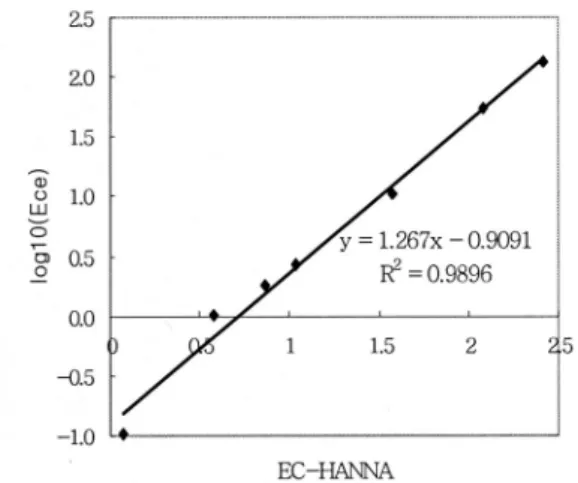
Electrical conductivity of saturated soil extract (ECe) (USSL, 1954; Jurinak and Suarez, 1990) was used for parameter of soil salinity, and soil salinity was measured by salinity probe (HANNA: HI 7031) into 10 cm depth of soil at the rhizosphere on fields. The value of soil salinity that measured by probe converted into ECe meter (YSI, 3200) value in the unit of dS/m (Fig. 2).
Measurement repeated 3 times at one spot on the surface (10cm depth). To compare with relationship between plant habitats and soil salinity for edaphic variables the measurement of soil salinity was performed in each plant species stands and bare soils. To find the range of available habitat for the most significant species,
graphically compared for soil salinity from the lowest to the highest value.
General Liner Model (GLM) of ANOVA for SAS (Windows, v. 8.1 SAS institute 2000) used to analysis for difference of soil salinity among plant stands.
Results and Discussion
Soil properties The Physiochemical properties of the soils taken at the vegetation occurred spots on the 5 study sites are listed in Table 1. The soil texture of the studied sites was similar with silt loam. The high and low range of pH on the study sites was similar: it was lower on Seukmun and was higher on Sihwa a as one of aged reclaimed tidal flat. The concentrations of Na
+, Ca
2+, and Mg
2+were higher in the tidal flats than reclaimed tidal flats, but they decreased after reclamation.
Soil salinity range of each plant stands in comparison with bare soils Adaptable soil salinity range for plant species was various and wide. Generally halophyte stands were recorded at high range but facultative halophyte and glycophyte stands were recorded lower than halophyte.
In the tidal flat (Hangdam), soil salinity of Suaeda japonica stands and bare soils where on the periodical inundation zone were recorded 13.1~56.4 dS/m, 15.6~50.2 dS/m, respectively(Fig. 2), so these salinity were similar with each other. Otherwise salinity of mixed facultative halophyte groups and Limonium tetragonum where over the inundation zone were recorded 1.6~22.2 dS/m, 1.2~8.7 dS/m respectively so these spots were lower than inundation zone.
In the newly reclaimed tidal flat (Namyang), soil salinity of Suaeda japonica and Suaeda maritima stands ranged as 1.6~31.5 dS/m, 3.2~58.1 dS/m, respectively (Fig. 2). The lowest soil salinity of Salicornia europaea as one of pioneer halophyte stand was recorded 24.2 dS/m, this value was higher than other pioneer
Fig. 2. Relationship between ECe and EC-HANNA values.Mg2+
K+ Ca2+
Na+ pH
clay silt
Sand
--- % --- --- cmol kg-1---
Hangdam 1.5~4.6 80.8~84.8 10.7~16.5 7.5~8.0 14.3~20.8 4.5~5.0 0.4~0.6 18.0~18.3
Namyang 1.2~46.9 37.6~78.3 9.7~31.0 7.8~8.1 6.0~14.0 1.0~1.5 0.9~1.2 11.8~33.0
Seuklmun 17.8~68.4 28.0~74.1 3.6~11.0 7.1~7.8 5.0~13.6 2.5~5.0 0. 3~0.4 2.4~7.1
Sihwa 21.3~48.2 36.7~64.3 5.2~11.9 6.9~8.6 2.1~13.0 3.5~10.6 0.4~0.7 0.8~2.1
Daeho 36.0~37.0 49.7~52.7 9.9~12.7 7.3~8.1 2.8~20.9 3.1~4.8 0.3~0.5 8.0~14.0
Table 1. Physiochemical properties of the soils taken at the vegetation occurred spots on the 5 study sites.
halophyte(Suaeda glauca: 8.7 dS/m, Suaeda maritima:
1.6 dS/m, Suaeda japonica: 3.2 dS/m) this indicated that Salicornia europaea cauld occur more at higher salinity spots than others (Hoy et al., 1994). The highest soil salinity of Suaeda japonica and bare soil were recorded 58.1 dS/m, 51.7 dS/m, respectively, it was similar with on the tidal flat (Hangdam), this result indicated that the environmental factors of newly reclaimed tidal flat was almost the same with tidal flat.
Bare soils were recorded higher soil salinity than plant habitats on the aged reclaimed tidal flats (Seukmun, Sihwa, and Daeho), this implied that salt might be concentrated on bare soils and salt influenced the occurrence of plant as toxicity (Aslam et al., 2003).
In Seukmun (one of aged reclaimed tidal flats), soil salinity of bare soils and plant wilted stands was the highest. Especially plant wilted stands was higher than bare soils as 42.2~107.2 dS/m, this result implied that another environmental factors might restrict the growth of plant that except soil salinity. The range of soil salinity for bare soils was much wide. This result implied that desalinization was differed from each spots. The soil salinity of Suaeda glauca as one of pioneer halophyte was recorded very lower soil salinity than other sites of it.
Low range of soil salinity for Salicornia europaea, mixed with Salicornia europaea and Suaeda maritima was recorded 0.9~9.8 dS/m, it was lower than the same species stands (24.2 dS/m) on the newly reclaimed tidal flat. According to the field investigation, Suaeda glauca and Salicornia europaea with low soil salinity were not good shape of growth(i.e. in Seukmun) than where higher of it (i.e. in newly reclaimed tidal flat). This result implied that Suaeda glauca and Salicornia europaea well grew at high soil salinity. In Seukmun, soil salinity of Phragmites communis was recorded 0.2~51.7 dS/m and it formed large community. This indicated that Phragmites communis adapted wide range of salinity.
However, the soil salinity of pioneer halophyte (Salicornia europaea, Suaeda maritima, and mixed with Salicornia europaea and Suaeda maritima) stands was recorded higher than facultative halophytes and glycophytes.
In Sihwa (one of aged reclaimed tidal flats) upper area, soil salinity of bare soils was recorded very high as 15.2~161.3 dS/m, it might be the high soil salinity caused by the salt pan which formed on the surface of soil. The soil salinity of facultative halophytes (Phragmites communis, Kochia scoparia var. littorea, and Limonium
tetragonum) and pioneer halophytes (Suaeda maritima and Suaeda glauca) was recorded more higher than other facultative halophyte (Aster tripolium) and glycophyte.
Soil salinity of Suaeda maritima and Suaeda glauca as pioneer halophyte was recorded 35.4 dS/m, 47.4 dS/m, respectively at high range. These were lower than facultative halophytes (i.e. Kochia scoparia var. littorea:
82.5 dS/m, Phragmites communis: 75.9 dS/m, Limonium tetragonum: 56.4 dS/m). The growth shape of Suaeda glauca was not good in Seukmun and Daeho, but in the drier zone of Sihwa upper area, it had grown like a shrub.
This result suggested that Suaeda glauca prefer higher soil salinity and drier zone.
General soil salinity of Sihwa middle-lower area where side of the Sihwa sea water reservoir was recorded higher than Sihwa upper area. Soil salinity of bare soils of Sihwa middle-lower area was recorded 2.8~192.2 dS/m (Fig. 2) which was the highest value of soil salinity among the four reclaimed tidal flats. The soil salinity of pioneer halophyte stands (Suaeda glauca), plant wilted stands, and facultative halophyte (Aster tripolium and Phragmites communis) stands was recorded high otherwise glycophyte stand was recorded low.
Phragmites communis, Aster tripolium and Suaeda glauca stand had wide range of soil salinity as 0.2~75.6 dS/m, 8.5~67.2 dS/m, and 21.6~101.2 dS/m, respectively. But the soil salinity of mixed with glycophyte and facultative halophyte stands was recorded 3.0~16.6 dS/m. This result implied that low soil salinity would provide for more profit conditions to various plant species. Aster subulatus as a naturalized plant occurred at 22.2~32.4 dS/m of soil salinity. Suaeda maritima occurred randomly with small patch where soil salinity was low and its growth shape was not as good as in the newly reclaimed tidal flat.
In Daeho (one of aged reclaimed tidal flats), soil salinity of bare soils was high as 19.8~147.8 dS/m(Fig. 2).
Generally the soil salinity of pioneer halophyte (Suaeda
maritima and Salicornia europaea) stands was the highest
among plant stands. Facultative halophyte (Limonium
tetragonum and Phragmites communis) stands was higher
than other glycophyte stands except Festuca arundinacea
(glycophyte). Soil salinity of Suaeda maritima and
Salicornia europaea stands was higher as 1.6~77.8 dS/m,
7.1~61.6 dS/m, respectively than facultative halophyte
stands (Aster tripolium 0.9~23.5 dS/m, Puccinellia
nipponica 0.8~36.4 dS/m) and glycophyte stands
(Trifolium pratense 0.1~8.0 dS/m, and Bromus tectorum
0.5~24.9 dS/m). This result indicated that pioneer halophyte of Chenopodiaceae family predominated at high soil salinity (Kang and Shim 1998).
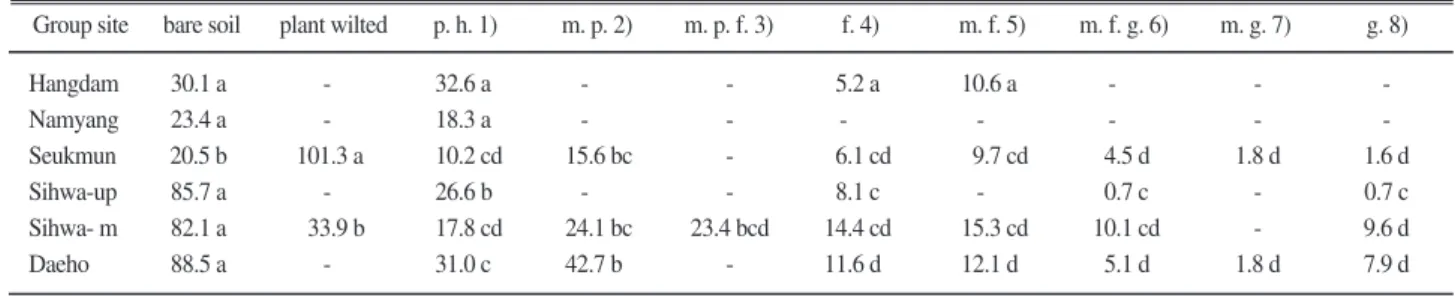
Soil salinity gradient and plant distribution As a result of ANOVA, the soil salinity was significantly
different among plant stands (Table 2). In the all of the
studied sites, soil salinity of plant stands distinguished as
followed: bare soil and plant wilted (23.4~88.5 dS/m,
33.9~101.3 dS/m, respectively ) > mixed pioneer
halophyte (15.6~42.7 dS/m) > pioneer halophyte
(10.2~31.0 dS/m) > mixed with pioneer halophyte and
Fig. 2. Soil salinity range of each plant stands and bare soils in studied sites: it described high and low soil salinity of each plant species stands. Bare soil, plant wilted spot, and pioneer halophyte stands were higher than facultative halophyte and glycophytefacultative halophyte (23.4 dS/m) > mixed facultative halophyte (9.7~15.3 dS/m) > facultative halophyte (6.1~14.4 dS/m) > mixed with facultative halophyte and glycophyte (0.7~10.1 dS/m) > glycophyte(0.7~9.6 dS/m)
> mixed glycophyte (1.8 dS/m) (Table 2). The order of soil salinity gradient for plant stands was almost equilibrated in each sites as pioneer halophyte>
facultative halophyte> glycophyte. This result suggested that plant distribution might influenced by the gradient of soil salinity (Bouzillé, 2001; Bonis, 2005) on the reclaimed tidal flats.
The soil salinity of bare soil was 88.5 dS/m in the aged reclaimed tidal flat(Daeho) and 23.4 dS/m in the newly reclaimed tidal flat (Namyang), at plant wilted stands were 101.3 dS/m, and 33.9 dS/m in the aged reclaimed tidal flats(Seukmun, Sihwa middle- lower area, respectively). This result indicated that the gradient of soil salinity for bare soils and plant wilted stands was very high, and high soil salinity might influence to the occurrence of plant as a limiting factor((Lesly and Nola, 1971; Kravchenko et al., 1999; Michael et al., 2001).
In the aged reclaimed tidal flats(Seukmun, Sihwa and Daeho) soil salinity for mixed pioneer halophyte stands was higher (15.6~42.7 dS/m) than pioneer halophyte stands (10.2~31.0 dS/m), this implied that along with the age mono patch of pioneer halophyte decreased while mixed patch with pioneer halophyte increased (as clumped type) where high soil salinity spots.
Seukmun as one of the studied sites had lower soil salinity than other sites (except plant wilted stands), this might be caused by the disruption that made for paddy and soil texture (soil texture of Seukmun was sandy loam and silt loam that sand contained 17.8~68.3%) (Min and Kim, 1997).
Soil salinity class for each plant stand To know the adaptable salinity range for plant species in the reclaimed tidal flats, average soil salinity was calculated for each plant stands in the all of the studied sites, and the result was compared with soil salinity criteria (USSL, 1954).
Soil salinity of pioneer halophyte stand classified extreme soil salinity (USSL 1954) for 21.8 dS/m (Tab. 3), this value included the range of pioneer halophyte (10.2~32.6 dS/m) stand in Table 2. Mixed pioneer halophyte stand classified extreme soil salinity for 25.7 dS/m, this value included the range of mixed pioneer halophyte stand (15.6~42.7 dS/m). Pioneer halophyte and mixed pioneer halophyte stand had high soil salinity which implied that pioneer halophytes need for salt to grow (Flowers, 1977; Watkinson and Davy, 1985).
Soil salinity of facultative halophyte stand was recorded 10.5 dS/m so it was lower than pioneer halophyte stand (21.8 dS/m),pioneer halophyte stand (25.7 dS/m),with pioneer halophyte and facultative halophyte stand(23.4 dS/m). This result implied that facultative halophyte preferred lower salinity than higher. But the soil salinity
Group site
Hangdam 30.1 a - 32.6 a - - 5.2 a 10.6 a - - -
Namyang 23.4 a - 18.3 a - - - -
Seukmun 20.5 b 101.3 a 10.2 cd 15.6 bc - 6.1 cd 9.7 cd 4.5 d 1.8 d 1.6 d
Sihwa-up 85.7 a - 26.6 b - - 8.1 c - 0.7 c - 0.7 c
Sihwa- m 82.1 a 33.9 b 17.8 cd 24.1 bc 23.4 bcd 14.4 cd 15.3 cd 10.1 cd - 9.6 d
Daeho 88.5 a - 31.0 c 42.7 b - 11.6 d 12.1 d 5.1 d 1.8 d 7.9 d
LSD < 0.05, Means with the same letters in row are not significantly different.
Sihwa- up: upper area of Sihwa
Sihwa- m: middle and lower area of Sihwa 1) p. h.: pioneer halophyte
2) m. p.: mixed pioneer halophyte
3) m. p. f.: mixed with pioneer halophyte and facultative halophyte 4) f.: facultative halophyte
5) m. f.: mixed facultative halophyte
6) m. f. g.: mixed with facultative halophyte and glycophyte 7) m. g.: mixed glycophyte
8) g.: glycophyte
g. 8) m. g. 7)
m. f. g. 6) m. f. 5)
f. 4) m. p. f. 3)
m. p. 2) p. h. 1)
plant wilted bare soil
Table 2. ANOVA result for soil salinity of study sites (in 2002) explains that the soil salinity significantly differed among plant stands and the gradient of soil salinity for plant stands can be ordered. The order of soil salinity was equilibrated all of the studied sites.
(unit: dS/m)
of mixed facultative halophyte stand(13.5 dS/m) was higher than facultative halophyte stand (10.5 dS/m). This result suggested that the facultative halophyte had wide range of soil salinity for inhabitation.
Soil salinity of glycophyte stand classified moderately saline soil for 5.3 dS/m, of which result indicated that glycophyte could occur in moderately saline soil, otherwise mixed glycophyte occurred in non-saline soil for 1.8 dS/m.
According to the soil salinity criteria, plant species showed each ecological niche on the reclaimed tidal flats.
For example pioneer halophyte as Suaeda japonica, Salicornia europaea, Suaeda maritima, and Suaeda glauca predominated in extreme saline soil, facultative halophyte as Aster tripolium, Kochia scoparia var. littorea, and Puccinellia nipponica predominated in the very saline soil,facultative halophyte and glycophyte predominated in the very saline or moderately soil, glycophyte and mixed glycophyte predominated in the slightly ~ non-saline soil.
This result explained that plant species had each different habitat along with the gradient of soil salinity, and spatial variation was formed on the reclaimed tidal flats.
Eventually soil salinity decided the occurrence of plant species, and plant species can be an indicator for soil salinity gradient on the reclaimed tidal flats.
Conclusions
In the reclaimed tidalflats, the gradient of soil salinity differed from the plant stand and studied sites. There was
no significant difference of soil salinity among plant species on the newly reclaimed tidal flat, but significant difference was found on the aged reclaimed tidal flats. This meant that spatial variation of plant species was formed after reclamation, and also the increasing of mixed stand with plant implied that environmental factors for habitat changed along with the age after reclamation.
High soil salinity was recorded at bare soils, plant wilted stands, and pioneer halophyte stand otherwise low soil salinity was recorded at facultative halophyte and glycophyte stands. This result implied that every plant species showed each preferable salinity range so that distribution of plant was decided by the gradient of soil salinity. The gradient of soil salinity was almost equilibrated among the plant species and studied sites: it was ordered bare soil or plant wilted stand > mixed pioneer halophyte > pioneer halophyte > mixedwith pioneer halophyte and facultative halophyte > mixed facultative halophyte > facultative halophyte > mixed with facultative halophyte and glycophyte > glycophyte
> mixed glycophyte. This meant plant species had each preferable soil salinity for inhabitation.
The occurrence of plant species was decided by soil salinity so soil salinity influenced to plant distribution as a limiting factor, this phenomenon was regular form in the all of the studied sites: mixed pioneer halophyte, pioneer halophyte, mixed with pioneer halophyte and facultative halophyte occurred in the extreme saline soil;
mixed facultative halophyte, facultative halophyte occurred in the very saline soil; mixed with facultative
Soil salinity range*(dS/m)
*Soil salinity range from USS£Ã(1954) and Agricultural salinity assessment and management(1990)
Extreme Pioneer halophyte 21.8 Extreme
>16.0 Mixed pioneer halophyte 25.7
Mixed with pioneer halophyte 23.4
and facultative halophyte
Very high Facultative halophyte 10.5 High
8.0~16.0 Mixed facultative halophyte 13.5
Moderately Mixed with facultative halophyte 5.3 Moderately
4.0~8.0 and glycophyte
2.0~4.0 Glycophyte 5.3 Non-saline
Slightly 2.0~4.0
Non-saline Mixed glycophyte 1.8 Non-saline
<2.0
Classification of soil salinity * Average ECe (dS/m)
of plant habitats (0~10 cm depth) Plant stand
Table 3. Based on the soil salinity criteria, salinity gradient of each plant habitats classified extreme, very, moderately, and non saline soil.
halophyte and glycophyte, and glycophyte occurred in the moderately saline soil; mixed glycophyte occurred in the non-saline soil. The shape of plant distribution was equilibrated among the aged reclaimed tidal flats so it was formed after reclamation and it was irrelevant to reclaimed age. On the reclaimed tidal flats spatial variation of plant formed along with the order of soil salinity, so the plant distribution could be an indicator to distinguish the gradient of soil salinity.
References
Amiaud, B., Bouzillé, J. B., Tournade, F., and Bonis, A. (1998) Spatial patterns of soil salinities in old embanked marshlands in western France. Wetland 18: 482-494.
Adams, D. A. (1963) Factors influencing vascular plant zonation in North Carolina salt marshes. Ecology, 44: 445-456.
Aslam, M., T. J. Flowers, R. H. Qureshi, and A. R. Yeo. (1996) Interaction of phosphate and salinity on the growth and yield of rice(Oryza sativa L.). Journal of Agronomy Crop Science, 176:
249-258
Aslam, M., N. Muhammad, R. H. Qureshi, Z. Ahmad, S. Nawaz, and J. Akhtar. (2003) Calcium and Salt-Tolerance of Rice.
Communication in Soil Science and Plant Analysis, 34(19 and 20):
3013-3031.
Bonis, A., J. B. Bouzillé, B. Amiaud, and G. Loucougaray. (2005) Plant community patterns in old embanked grasslands and the survival of halophytic flora. Flora, 200: 74-87.
Bouzillé, J. B., Kerneis, E., Bonis, A., and Touzard. B. (2001) Vegetation and ecological gradients in abandoned salt pans in western France. Journal of Vegetation Science, 12: 269-278.
Chiang, S. C., D. E. Radcliffe, W. P. Miller, and K. D. Newman.
(1987) Hydraulic conductivity of three southeastern soils as affected by sodium, electrolyte concentration, and pH. Soil Science Society of America Journal, 51: 1293-1299.
Curtin, D., and R. Naidu. (1998) Fertility constraints to plant production. In Sodic Soil: Distribution, Management and Environmental Consequences; Sumner M. E., and Naidu R. (eds.);
Oxford University Press: New York, 107-123.
FAO. (2005) Global Network on Integrated Soil Management for Sustainable Use of Salt-affected Soils. FAO Land and Plant Nutrition Management Service. Rome, Italy. http://www. fao.
org/ag/agl/agll/spush.
Flowers, T. J., P. F. Troke, and A. R. Yeo. (1977) The mechanism of salt tolerance in halophytes. Annual reviews. Plant Physiology, 28: 89-121.
Gupta, R. K., D. K. Bhumbla, and I. P. Abrol. (1984) Effect of sodicity, pH, organic matter, and calcium carbonate on the dispersion behaviour of soils. Soil Science, 137: 245-251.
Gupta R. K., and I. P. Abrol. (1990) Salt-affected soils: their reclamation and management for crop production. Advances in Soil Science, 11: 223-288.
Hoy, N. T., M. J. Gale, and K. B. Walsh. (1994) Revegetation of a
scaled saline discharge zone in central Queensland: 1. Selection of tree species and evaluation of an establishment technique.
Australian Journal of Experimental Agriculture, 34: 765-776.
Ihm B. S. (2001) Distribution of halophytes on the south coast of Korea. Nature Conservation, 116: 9-14.
Joenje, W. (1974) Production and structure in the early stages of vegetation development in the Lauwerszee-poder. Vegetatio, 29:
101-108.
Jurinak, J. J, and D. L. Suarez. (1990) The chemistry of salt-affected soils and waters. In ASCE Manuals and Reports on Engineering Practice No. 71. Agricultural Salinity Assessment and Management; Tanji K. K. (ed.); American Society of Civil Engineers: New York. 42-47.
Kang, B. H., and S. I. Shim. (1998) Screening of tolerant plants and development of biological monitoring technique for saline stress. I.
Survey of vegetation in saline region and determination of saline tolerance of the plant species of the region. Korean Journal of Environmental Agriculture, 17(1): 26-33.
Kravchenko, A. N., C. W. Boast, and D. G. Bullock. 1999.
Multifractal analysis of soil spatial variability. Agronomy Journal, 91: 1033-1041.
Kim, C. S. (1983) Distribution of halophyte community. Korean Journal of Nature Conservation, 41: 31-36.
Lee, T. B. (1999) Illustrated flora of Korea. Hayng-Moon Publishing Co.: Seoul, Korea.
Lee, Y. N. (2002) Flora of Korea. Kyo-Hak Publishing Co.: Seoul, Korea.
Lesly D.Clarke and N. J. Hannon. 1971.The mangrove swamp and salt marsh communities of the Sydeny district: Ⅲ. Plant growth in relation to salinity and waterlogging. Journal of Ecology, 58(2):
351-369.
Michael, B. D., P. Delaune, P. A. Moore, Jr., A. Mauromoustakos, and S. L. Chapman. 2001. Soil phosphorous variability in pastures : Implications for sampling and environmental management strategies. Journal of Environmental Quality, 30: 2157-2165.
Min, B. M. (1985) Changes of Soil and Vegetation in Costal Reclaimed Lands, West Coast of Korea.Ph.D. dissertation, Deptartment of Botany. Seoul National University.
Min, B. M, and J. H. Kim. (1997) Soil texture and desalination after land reclamation on the west coast of Korea. Korean Journal of Ecology, 20(2): 133-143.
Moore, G. (1998) Soilguide: A handbook for understanding and managing agricultural soils. Department Agriculture Western Australia Bulletin No. 4343.
Naidu, R., and P. Rengasamy. (1993) Ion interactions and constraints to plant nutrition in Australian sodic soils. Australian Journal of Soil Research, 31: 801-819.
Page, A. L., A. C. Chang, and D. C. Adriano. (1990) Deficiencies and toxicities of trace elements. In ASCE Manuals and Reports on Engineering Practice No. 71. Agricultural Salinity Assessment and Management; Tanji K. K. (ed.); American Society of Civil Engineers: New York. 138-160.
Park, S. H. (2001a) Foreign. Naturalized plant of Korea. Dae-Won Publishing Co.: Seoul, Korea.
Park, S. H. (2001b) Colored Illustrations of Naturalized Plants of Korea. Ilchokak Co.: Seoul, Korea.
Phleger, C. F. (1971) Effect of salinity on growth of a salt marsh grass. Ecology,52(5): 908-911.
Qadir, M., and Schubert S. (2002) Degradation process and nutrient constraints on sodic soils. Land Degradation and Development, 13: 275-294.
SAS. (2000) The SAS system for Windows. SAS Institute, USA.
Schofield, R., D. S. G. Thomas, and M. J. Kirkby. (2001) Causal processes of soil salinization in Tunisia, Spain and Hungary. Land Degradation and Development, 12: 163-181.
Shekhawat, V. P. S., A. Kumar, and K. H. Neumann. (2006) Effect of sodium chloride salinity on growth and ion accumulation in some halophytes. Communication in Soil Science and Plant Analysis, 37: 1933-1946.
Sudmeyer, R. A., C. Saunders, I. Maling, and T. Clark. (1994) Perennial pastures: For areas receiving less than 800 mm annual rainfall. Department of Agriculture Western Australia. Bulletin
4253.
Ungar, I. A. (1966) Salt tolerance of plants growing in saline areas of Kansas and Oklahoma. Ecology, 47: 154-155.
USDA-ARS George E. Brown, Jr. Salinity Lab. (1999) Halophyte database salt-tolerance plants and their uses. USDA ARS by N.P.
Yensenhttp://www.ussl.ars. usda. gov/pls/caliche/halophyte.preface US Salinity Laboratory Staff. (1954) Diagnosis and improvement of
Saline and alkali soils. USDA Handbook No. 60.
Watkinson, A. R., and A. J Davy. (1985) Population biology of salt marsh and sand dune annuals. Vegetatio, 62: 487-497.
Zhao, K., F. Hai, and I. A. Ungar. (2002) Survey of halophyte species in China. Plant Science, 163(3): 491-498.
Mass, E. V. (1990) Crop salt tolerance. ASCE Manuals and Reports on Engineering Practice No. 71. Agricultural Salinity Assessment and Management (ed, Tanji K. K.) p. 283. American Society of Civil Engineers, New York.
간척지에서 식생의 공간적 분포 변이에 영향을 주는 요인을 알아내기 위하여, 중서부 해안 경기만의 신간척지 와 간척연대가 다른 간척지 세 곳, 그리고 이들의 인근 비간척 간석지에서 식생 분포를 조사하였다. 토양 염도 의 지표로 포화침출액의 전기전도도를 조사하였다. 토양염도에 따라 식생 분포가 확연이 달랐다. 토양 염도에 따라 각 식생의 최적 서식지가 존재하며, 이는 저염도 지점에는 중성 식물이, 고염도 지점에는 염생식물이 분포 함을 의미하고 있다. 서식 식물 군집에 따른 토양 염도의 순서는 다음과 같다. 즉, 토양 염도는 식생 위조지>
선구 염생식물지> 혼합선구염생식물지> 선구염생식물지> 선구염생식물 및 통성 염생식물 혼합지> 혼합 통성염 색식물지> 통성염생식물 및 중성식물 혼합지>혼합 중성식물지의 순이었다. 이 결과는 토양 염도의 공간적 토양 구배에 따라 식물 종의 분포가 이루어짐을 보여 주고 있으며, 이에 따라 식물종의 분포에 따라 토양 염도의 차 이를 판단할 수 있음을 시사하고 있다. 토양 염도와 식물종의 분포양상 관계는 여러 간척지간에 큰 차이를 보 이지 않았고, 식물 군락 밀집도가 간척 이후 식생이 어떤 방향으로 천이되는지의 지표를 제시하여주고 있다.
우리나라 중서부 해안 경기만 간척지에서 식생 분포에 대한 토양 염도의 영향
김은규1·천소을2·주영규2·정영상3,*
1죽전고등학교, 2연세대학교 응용과학부 생물자원공학과, 3강원대학교 농업생명과학대학