Introduction
Increasing of soil salinization is getting rapidly and it was one of global environmental problems (FAO, 2005). High salinity of soil is not adequate for growth of glycophyte, but halophyte can grow on the salt-affected soils. The researches for halophyte have increased because halophyte has salt tolerance (Flowers, 1977). The investigations of halophyte were accumulated by saltmarsh plants (Ganong, 1903;
McCrea, 1926). In the early stage, the objects of investigation for halophyte were based on the ecology and physiology of halophyte (Chapman, 1941). But recently the views for halophyte focused on geneticall usage for salt
tolerance (Felger and Mota-Urbina, 1982; Yensen, 2000) and economical usage for physiological characteristics (Ungar, 1974). Nowdays the genotype of native plants has become biotechnological resources, the halophytes are also become important gene resources (Isaacs, 1964; Rains et al., 1980;
Liming and Zhu, 2002; Munns, 2005), so the distribution and ecological characteristics of halophyte were concerned for economical and biotechnical views (Mudie, 1972;
Mudie, 1974; Epstein, 1963; Mass and Hoffman, 1977;
Epstein et al., 1980; Menzel and Lieth, 1999).
Korea has a lot of tidal flats but these were decreased by reclamation and development (Korea Agricultural and Rural Infrastructure Corporation, 1996), so the habitat of halophytes diminished rapidly. Most of the investigations for halophytes in Korea were carried out on saltmarsh,
Received : June 12. 2009 Accepted : August 6. 2009*Corresponding author: Phone : +82337602812, E-mail : [email protected]
Changes in Flora Dynamics on the Reclaimed Tidal Flats of Kyonggi-Bay in the Mid-west Coast of Korea
Eun-Kyu Kim
1, Yeong-Sang Jung
2, Soul Chun
3, Young-K. Joo
3,
*and Hyeung-Geun Jeong
41
Jukjeon High School, Yongin, 449-548, Korea
2
College of Agriculture and Life Science, Kangwon National University, Chuncheon, 200-701, Korea
3
Department of Bioresources and Technology, Yonsei University, Wonju, 220-710, Korea
4
Department of Environmental Engineering, Yonsei University, Wonju, 220-710, Korea
Flora distribution was surveyed in the newly reclaimed tidal flats in the west coastal area in Korea to understand changes in flora dynamics after reclamation. The surveyed reclaimed tidal flats were the newly reclaimed tidal flat in Hangdam, the mid Kyonggi Bay in 2002, and three reclaimed lands in Seukmun and Daeho, Chungnam, and Hangdam in Kyonggi Bay, of which reclamation years based on embankment were 7, 9 and 18 years, respectively. In the newly reclaimed tidal flat, the dominant flora was Suaeda japonica and other florae were rare, while various halophytes and glycophytes were distributed in the reclaimed lands. On the newly reclaimed tidal flat, four species of halophytic pioneer florae, Salicornia europaea, Suaeda glauca, Suaeda japonica, and Suaeda maritime occurred, and along with age facultative halophyte and glycophyte occurred sequently. On the reclaimed lands, the florae were more complex with various facultative halophyte and glycophyte, so these were predominated rather than pioneer halophyte, while one of pioneer halophyte that Suaeda japonica was not occurred. Increasing of various facultative halophyte and glycophyte, and decreasing of pioneer halophyte indicated that flora changed toward to increase of facultative halophyte and glycophyte by aged after reclamation. On the newly reclaimed tidal flat the ratio of flora species changed rapidly with the invasion of plant. This implied that the flora had begun to change in the early stage of reclamation. Facultative halophyte and glycophyte started to increase on the early stage of reclamation but relative density and frequency of pioneer halophyte was higher than facultative halophyte and glycophyte. According to the investigation up to 3 years after reclamation, pioneer halophyte predominated on it. Although flora changed, there were common representative halophytes among the reclaimed tidal flats: Salicornia europaea, Suaeda maritima, and Suaeda glauca as pioneer halophyte, Aster tripolium, Sonchus brachyotus, and Phragmites communis as facultative halophytes.
Key words: Reclaimed tidal flat, Salt-affected soil, Halophyte, Flora change
sand dune, abandoned salt paddy, estuary of river, and island. Since halophyte communities were formed in the artificial salt-affected soils (reclaimed tidal flats) and it changed dynamically (Joenje, 1974; Joenje and During, 1977), therefore, reclaimed tidal flats were fit for the dual study that salt-affected soils and ecology of halophyte.
But ecological study between salt-affected soils and halophyte was little carried out (Kim, 1971; Min, 1985).
Reclaimed tidal flats were no longer on conservation for long time by development, and the flora of it had changed rapidly so the study for ecological statue of flora imight be important for not only conservation of halophyte but also the investigation of the relationship between salt-affected soils and flora. The aim of this work was to find the change direction of flora on the artificial salt-affected soils, reclaimed tidal flat.
Understanding for how flora changed on the reclaimed tidal flats, this study has two hypotheses: one was flora of the reclaimed tidal flats differ from tidal flat, the other was flora will be changed by ageing after reclamation, and these results to provide the change direction of flora on it.
In order to find the change direction of flora on the reclaimed tidal flats this study was to classify the flora species that occurred, to describe the change of flora species and to establish the relationship between salt- affected soils and ecology of flora on the reclaimed tidal flat.
In this study, to understand changes in flora dynamics after reclamation, field investigation was carried out on four reclaimed tidal flats (newly reclaimed tidal flat:
Namyang, aged reclaimed tidal flats: Seukmun, Sihwa,
and Daeho) and one tidal flat (Hangdam) of Kyonggi- Bay in the mid-west coast of Korea.
Materials and Methods
Study sites Five sites were used for investigation: one tidal flat (Hangdam) used for control, four reclaimed tidal flats (newly reclaimed tidal flat: Namyang, aged:
Seukmun, Sihwa, and Daeho) that differed from reclaimed age used for experiments. Based on the embankment period in 2002, Namyang as a newly reclaimed tidalflat had passed 1 month, Seukmun has passed 7 years, Sihwa had passed 9 years, and Daeho has passed 18 years. Each sites had different characteristics:
Daeho was not disturbed and was conserved for research of native plant, Seukmun was much disturbed by field arrangement, and Sihwa disturbed nearby the traffic road.
Geographically all of the studied sites located in the mid- west coast of Korea: Hangdam located E126.40
′~126.50
′, N36.90
′~37.00
′, Namyang located E126.40
′~126.50
′, N37.00′ ~37.10′ , Seukmun located E 126.30′
~126.40′ , N 36.90′ ~37.00′ , Sihwa located E 126.40′
~126.50′, N 37.10′~37.20′, and Daeho located E 126.20′ ~ 126.30′ , N 36.90′ ~37.00
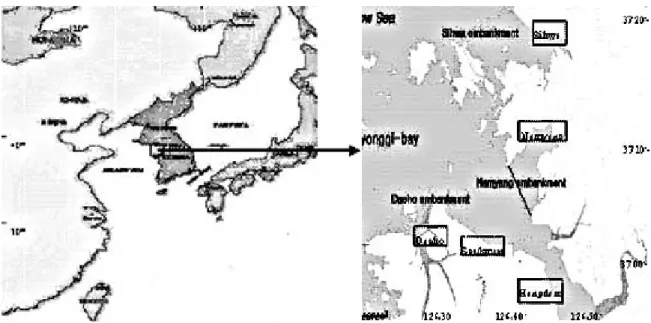
′. Figure 1 describes for study sites in the mid-west coast of Korea. The climate is temperate with a mean temperature from Apr.
to Nov. of 16.7~16.8
℃, with total precipitation from Apr.
to Nov. of 1,144~1,314 mm. The soil texture of Hangdam (tidal flat), Sihwa and Daeho (aged reclaimed tidal flat) was similar with silt loam, on the other hand Namyang (newly reclaimed tidal flat) and Seukmun
Fig. 1 Study sites of Kyonggi-Bay in the mid-west coast of Korea.
(aged) was similar with silt loam or silty clay loam. The average pH on the tidal flat (Hangdam) was 7.71, newly reclaimed tidal flat (Namyang) was 8.00, aged reclaimed tidal flats was (Seukmun, Sihwa upper area, Sihwa middle and lower are, and Daeho) 7.42, 7.76, 6.78, and 7.44, respectively.
Classification and identification of flora All of vascular plants for studied sites was recorded which occurred on the tidal flat (Hangdam) from Apr. 2002 to Nov. 2003, on the newly reclaimed tidal flat (Namyang) from Apr. 2002 to Nov. 2004, on the aged (Seukmun, Sihwa, and Daeho) from Apr. 2002 to Nov. 2002, Species nomenclature followed Flora of Korea (Lee, 2002), Illustrated Flora of Korea (Lee, 1999), and refered for Naturalized plant of Korea (Park, 2001) and Colored illustrations of naturalized plants of Korea (Park, 2001).
For this study all of vascular plants was recorded that occurred in the reclaimed tidal flat, but except the plants not occurred on the reclaimed tidal flat (e.g. occurred near by the reclaimed tidal flat or disturbed spots).
Identification for halophyte and glycophyte used for released papers (Kim, 1983; Ihm, 2001; Zhao et al., 2002; USDA, 1999) and halophyte list (Aronson, 1985).
Plant species occurred on the year of reclamation identified by pioneer halophyte, halophyte that occurred after the pioneer halophyte identified facultative halophyte (Uphof, 1941).
Relative density (RD) and relative frequency (RF) Relative density (RD) was calculated by equation 1,
which followed the equation (Curtis and Mclntosh 1951;
Brower and Zar 1977):
RDi = ni/ ∑n (1),
where ∑n=the number of total individuals of all species, ni=ratio of the individual number of the specific species.
Relative frequency (RF) was calculated by equation 2, which follows the equation:
RFi = Fi/Pt (2),
where Fi=frequency of the specific species, Pt=sum of total frequency of all species that occurred.
Percent of Naturalized Plant Species (%) Naturalized index was calculated by equation 3, which follows the equation (Yim and Jeon 1980):
PN = S/NV
×100 (3), where S=number of naturalized species that occurred, NV=number of vascular plants that occurred.
Results
FLORA OF TIDAL FLAT AND RECLAIMED TIDAL FLATS
On the tidal flat (Hangdam), only one species was occurred. On the newly reclaimed tidal flat (Namyang), four species of halophyte occurred at reclaimed zone as pioneer and one native plant (Triglochin maritimum) inhabited in the slough where was not reclaimed zone.
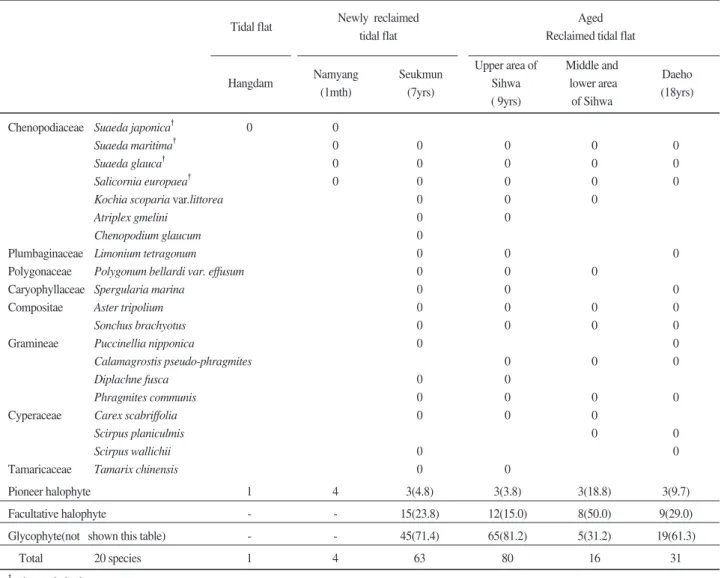
On the aged reclaimed tidal flats, lots of plants occurred (Table 1): 63 species in Seukmun, 80 species upper area
Sites Rank Order Family Geunus Species
Hangdam
"
Triglochin maritimum distributed in the slough but it was not occurred on the reclaimed zone as a native plant.
Angiospermae Angiospermae
Equisetineae Angiospermae
Angiospermae
Angiospermae
Angiospermae
Dicotyledoneae Monocotyledoneae"
Dicotyledoneae
Monocotyledoneae Dicotyledoneae Monocotyledoneae
Dicotyledoneae Monocotyledoneae
Dicotyledoneae Monocotyledoneae
Dicotyledoneae
1 1 1 1 2 11
3 13
1 3 2 8
1 1 1 1 3 14
4 18
2 3 3 9
1 1 4 1 16 35 16 47 7 6 15 12
1 1 4 1 21 41 21 59 8 8 16 15 Tidal flat
Table 1. List for the vascular plants of the studied sites in 2002: On the tidal flat (Hangdam) only one species was occurred, otherwise on the newly reclaimed tidal flat (Namyang) 4 species were occurred as pioneer halophyte, and on the aged reclaimed tidal flats, lots of plant species were occurred.
of Sihwa, 31 species in Daeho, this result indicated that flora species increased after reclamation. Glycophyte was not occurred in the tidal flat and the newly reclaimed tidal flat, this indicated that glycophyte is not a native plant in reclaimed tidal flat and tidal flat.
Tamarix chinensis that woody halophyte occurred on the upper area of Sihwa and Seukmun but not occurred other sites.
Tidal flat (Hangdam) On the inundation zone, the flora was simple(Adam, 1990; Ewanchuk & Bertness, 2004): since there occurred only Suaeda japonica (Hong, 1958), while over the inundation zone there was more complicated with mono patch of Zoysia sinica, Aster tripolium, and Limonium tetragonum mixed patch of Zoysia sinica, Aster tripolium, Limonium tetragonum, Salicornia europaea, and Suaeda maritime (Chapman, 1947) (Table 2).
Newly reclaimed tidal flat (Namyang) On Namyang reclaimed tidal flat, pioneer halophyte partially occurred through all of the site where dry spots in the year of reclamation. In the early stage of reclamation, the aspect of flora occurrence differed from plant species:
Salicornia europaea occurred near by tidal stream where contains more water contents (Davy et al., 2001), Suaeda glauca occurred near by the tidal flat shore where drier, Suaeda japonica and Suaeda maritima spread randomly all of the tidal flat.
On the year of reclamation, Suaeda japonica, Suaeda maritima, Salicornia europaea, and Suaeda glauca occurred as pioneer halophyte group (Kim, 1983) (Table 3). Just from the second year after reclamation, sequential change of flora started to begin with the occurrence of facultative halophyte group (Sonchus brachyotus, Aster tripolium, Limonium tetragonum, Phragmites communis, and Kochia scoparia var. littorea) and glycophyte group
(Aster subulatus, Lactuca scariola, Erigeron canadensis, and Erechitites hieracifolia). These plants started to increase, but distributed randomly and were not spread out the entire reclaimed tidal flat.
Herbaceous halophyte and woody halophyte on the studied sites The list of herbaceous and woody halophyte that occurred on the study sites showing that the occurrence of halophytes was various and changed (Table 4). The classification of halophyte in the reclaimed tidal flats and the tidal flat is ordered 8 family, 17 genus, and 20 species. In 2002, halophyte occurred on the tidal flat(Hangdam) was ordered 1 family, 1 genus, and 1 species, on the newly reclaimed tidal flat(Namyang) was ordered 1 family, 2 genus, 4 species, on Seukmun (aged reclaimed tidal flat) was ordered 8 family, 17 genus, 18 species, on the upper area of Sihwa (aged reclaimed tidal flat) was ordered 8 family, 14 genus, 15 species, on the middle and lower area of Sihwa was ordered 5 family, 10 genus, 11 species and on Daeho(aged reclaimed tidal flat) was ordered 6 family, 10 genus, 12 species(Table 4). This result indicated that the halophyte occurred on the reclaimed tidal flats tended to increase along with the age after reclamation. Most of the halophytes were classified Chenopodiaceae and Gramineae. Chenopodiaceae consisted of 7 species and Gramineae consisted of 4 species, these family comprised 20~35% of all the halophytes in the reclaimed tidal flats. The occurrence of pioneer halophyte was more in the newly reclaimed tidal flat, but facultative halophyte was more in the aged reclaimed tidal flats. On a newly reclaimed tidal flat (Namyang), 4 species of halophytic pioneer flora(Suaeda japonica, Salicornia europaea, Suaeda maritima, and Suaeda glauca) as Chenopodiaceae family were occurred. Suaeda japonica occurred only inundation zone on the tidal flat (Hangdam) and the newly reclaimed tidal flat (Namyang), this result indicated that Suaeda
Family Chenopodiaceae
Compositae Gramineae Plumbaginaceae Total
over the inundation zone inundation zone
Scientific Name Suaeda japonica Salicornia europaea
Suaeda maritima Aster tripolium
Zoysia sinica Limonium tetragonum
0
1
0 0 0 0 0 5
Table 2. Flora on the inundation zone of the tidal flat (in 2002 and 2003) was simple since there only Suaeda japonica occurred while over the inundation zone, 5 species of halophyte occurred. And there was no sequential change of plant species on the inundation zone from 2002 to 2003.
japonica is the represented plant of saltmarsh in the west coast of Korea (Lee, 1988). But Suaeda japonica not occurred in the aged reclaimed tidal flat. This result suggested that Suaeda japonica preferred the inundation zone (Hong, 1958; Reimold and Queen, 1974; Kim and Song, 1983) and disappearance of Suaeda japonica might cause interception of periodical inundation after reclamation. Disappearance of Suaeda japonica was similar with the result in the 8 years passed Mokpo site(Kim, 1971) after reclamation. This indicated that Suaeda japonica which one of 4 speciesof pioneer halophyte was extinguished at first by aged after
reclamation. By aged after reclamation, halophytes that not pioneer plants occurred after pioneer halophyte and increased (Table.4), these classified facultative halophytes (Uphof, 1941).
Disappearance and occurrence of halophyte in the reclaimed tidal flat indicated that soil environment changed after reclamation, and continually changed (Joenje 1974). Although flora changed dynamically but there were common occurred plants in the four reclaimed tidal flats: Salicornia europaea, Suaeda maritima, and Suaeda glauca were common occurred as pioneer halophytes, and also Aster tripolium, Sonchus
Family
"
pioneer halophyte
‡facultative halophyte naturalized plant as glycophyte
not marked is not naturalized plant as glycophyte
Numbers in parentheses represented percent of species composition.
Chenopodiaceae Suaeda japonica" 0 0 0
Suaeda maritima" 0 0 0
Suaeda glauca" 0 0 0
Salicornia europaea" 0 0 0
Kochia scoparia var.littorea‡ 0 0
Compositae Artemisia scoparia‡ 0
Lactuca scariola‡ 0 0
Aster tripolium‡ 0 0
Sonchus brachyotus‡ 0 0
Aster subulatus 0 0
Erigeron canadensis 0 0
Taraxacum mongolicum 0
Hemistepta lyrata 0
Erechitites hieracifolia 0 0
Eclipta prostrata 0
Cyperaceae Carex scabrifolia‡ 0
Gramineae Calamagrostis pseudo - phragmites‡ 0
Phragmites communis‡ 0 0
Echinochloa crusgalli var.oryzicola 0
Echinochloa crusgalli 0
Setaria glauca 0
Stearia viridis 0
Themeda triandra var.japonica 0
Digitaria sanguinalis 0
Plumbaginaceae Limonium tetragonum‡ 0 0
Polygonaceae Rumex crispus 0
pioneer halophyte 4 4(30.8) 4(15.4)
Facultative halophyte - 5(38.4) 8(30.8)
Glycophyte - 4(30.8) 14(53.8)
Total 4 13 26
2004 2003
2002 Scientific Name
Table 3. Newly reclaimed tidal flat (Namyang) was investigated for 3 years sequently. On the year of reclamation, Suaeda japonica, Suaeda maritima, Salicornia europaea, and Suaeda glauca occurred as pioneer halophyte group. Just from the second year of reclamation, facultative halophyte and glycophyte group started to increase and also the composition ratio of facultative halophyte and glycophyte increased sequently.
brachyotus, Calamagrostis pseudo-phragmites, and Phragmites communis were common occurred as facultative halophytes, these were the representative halophyte plants on the reclaimed tidal flats. The occurrence of Kochia scoparia var. littorea, Chenopodium glaucum, Atriplex gmelini, Limonium tetragonum, Polygonum bellardi var. effusum, Spergularia marina, Puccinellia nipponica,, Diplachne fusca, Carex scabriffolia, Scirpus planiculmis, and Scirpus wallichii are differ from reclaimed tidal flats(Table 4). Tamarix chinensis as a woody halophyte (Zhao et al., 2002) occurred among the herbaceous halophyte (Chung et al., 2000) on Seukmun and Sihwa upper area this result suggest that it could be one of woody species for landscape on reclaimed tidal flats.
CHANGE IN FLORA ON THE NEWLY RECLAIMED TIDAL FLAT
Relative density and relative frequency By the year passed, plant species increased. In the second year (2003) of reclamation, relative density of pioneer halophyte group was recorded 6.0~60.0, and relative frequency was recorded 8.7~26.1 (Fig. 2 and 3). Relative density of facultative halophyte group was recorded 0.1~0.6(Fig. 2), relative frequency was recorded 4.3~5.2(Fig. 3). Relative density of glycophyte was recorded 0.1~0.2(Fig. 4), and relative frequency was recorded 2.6~5.2(Fig. 3 and 5).
This result indicated that pioneer halophyte predominated but not facultative halophyte and glycophyte.
In the third year(2004), relative density and relative frequency were high on the pioneer halophyte group, so
"
pioneer halophyte
Numbers in parentheses represented percent of species composition.
Daeho (18yrs) Aged
Reclaimed tidal flat Newly reclaimed
tidal flat Tidal flat
Middle and lower area of Sihwa Upper area of
Sihwa ( 9yrs) Seukmun
(7yrs) Namyang
(1mth) Hangdam
Chenopodiaceae Suaeda japonica" 0 0
Suaeda maritima" 0 0 0 0 0
Suaeda glauca" 0 0 0 0 0
Salicornia europaea" 0 0 0 0 0
Kochia scoparia var.littorea 0 0 0
Atriplex gmelini 0 0
Chenopodium glaucum 0
Plumbaginaceae Limonium tetragonum 0 0 0
Polygonaceae Polygonum bellardi var. effusum 0 0 0
Caryophyllaceae Spergularia marina 0 0 0
Compositae Aster tripolium 0 0 0 0
Sonchus brachyotus 0 0 0 0
Gramineae Puccinellia nipponica 0 0
Calamagrostis pseudo-phragmites 0 0 0
Diplachne fusca 0 0
Phragmites communis 0 0 0 0
Cyperaceae Carex scabriffolia 0 0 0
Scirpus planiculmis 0 0
Scirpus wallichii 0 0
Tamaricaceae Tamarix chinensis 0 0
Pioneer halophyte 1 4 3(4.8) 3(3.8) 3(18.8) 3(9.7)
Facultative halophyte - - 15(23.8) 12(15.0) 8(50.0) 9(29.0)
Glycophyte(not shown this table) - - 45(71.4) 65(81.2) 5(31.2) 19(61.3)
Total 20 species 1 4 63 80 16 31
Table 4. The classification of halophyte in the reclaimed tidal flats and the tidal flat in 2002 was ordered 8 family, 17 genus, and 20 species. On the reclaimed tidal flats, occurrence of herbaceous halophyte intended to increase along with the age after reclamation.
On the aged reclaimed tidal flats (Seukmun, Sihwa, and Daeho), pioneer halophyte species has decreased from 4 to 3, facultative halophyte and glycophyte were more than the newly reclaimed tidal flat and tidal flat. Most of the halophytes are classified Chenopodiaceae and Gramineae. Tamarix chinensis as a woody halophyte occurred among the herbaceous halophytes.
dominant species in the third year was similar with the second year, relative density and relative frequency of facultative halophyte group intended to increase: relative
density of Sonchus brachyotus changed from 0.1(2003 was not shown the Fig. 2) to 0.6, Aster tripolium changed from 0.1 (2003 was not shown the Fig. 2) to 7.0(Fig. 2), and relative frequency of Sonchus brachyotus changed from 4.3 to 4.7, Aster tripoliumhas changed from 5.2 to 15.6(Fig. 3), it is suggest that facultative halophyte group increased rapidly.
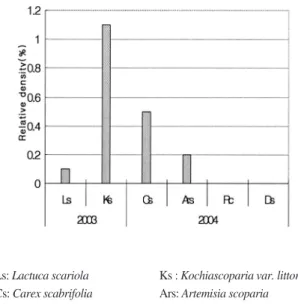
Fig. 4. Lactuca scariola and Kochia scoparia var. littorea newly occurred in 2003. Carex scabrifolia, Artemisia scoparia, Rumex crispus, and Digitaria sanguinalis newly occurred in 2004.
Relative density of them on the newly reclaimed tidal flat (Namyang) in 2003 and 2004 was very low. Graphically shape of Rumex crispus and Digitaria sanguinalis was not shown this figure since these values were very low.
Ls: Lactuca scariola Ks : Kochiascoparia var. littorea Cs: Carex scabrifolia Ars: Artemisia scoparia Rc: Rumex crispus Ds : Digitaria sanguinalis
Fig. 5. Lactuca scariola, and Kochia scoparia var. littorea newly occurred in 2003. Carex scabrifolia, Artemisia scoparia, Rumex crispus, and Digitaria sanguinalis newly occurred in 2004.
Relative frequency of them on the newly reclaimed tidal flat (Namyang) was lower than pioneer halophyte and facultative halophyte in 2003 and 2004 (Fig. 3).
Fig. 2. On the second year(2003) of reclamation, relative density of pioneer halophyte group(Se, Sj, Sg, and Sm) was higher than facultative halophyte (At, Lt, Sb, and Pc) and glycophyte group(As and Ec), on the third year(2004) relative density of facultative halophyte (At) and glycophyte(As) was started to increase, but relative density was still higher in most of pioneer halophyte group(Sj, Sg, and Sm) than facultative halophyte and glycophyte group.
Se: Salicornia europaea Sj : Suaeda japonica At: Aster tripolium Lt: Limonium tetragonum As: Aster subulatus Ec: Erigeron canadensis
Fig. 3. On the second year(2003) of reclamation, relative frequency for all of pioneer halophyte group(Se, Sj, Sg, and Sm) was higher than the facultative halophyte group(At, Lt, Sb, and Pc). On the third year(2004), relative frequency of facultative halophyte(At) and glycophyte(As) was started to increase, but relative frequency was still higher in most of pioneer halophyte group(Sj, Sg, and Sm) than facultative halophyte and glycophyte group.
Sg: Suaeda glauca Sm: Suaeda maritime Sb: Sonchus brachyotus Pc: Phragmites communis
Relative density of Aster subulatus as one of glycophyte occurred in 2003 has changed from 0.2 to 3.5(Fig. 2), relative frequency has changed from 5.2 to 7.6(Fig. 3), it suggested that Aster subulatus showed high salt tolerance and rapidly adapted in the barren soil as reclaimed tidal flat.
Up to the second and third year of reclamation, pioneer halophyte group was recorded high relative density and frequency, on the other hand facultative halophyte and glycophyte group were recorded low, this meant that facultative halophyte and glycophyte group could not develop a dominant group.
On the second and third year of reclamation, some facultative halophyte and glycophyte newly occurred:
Lactuca scariola and Kochia scoparia var. littorea occurred in 2003; Carex scabrifolia, Artemisia scoparia, Rumex crispus, and Digitaria sanguinalis occurred in 2004. But relative density and frequency of them were very low (Fig. 4, 5) in 2003 and 2004. Kochia scoparia var. littorea was recorded higher relative density and frequency than among others but relative density and frequency for all of newly occurred facultative halophyte include Kochia scoparia var. littorea and glycophyte was lower than pioneer halophyte.
Discussion
On the reclaimed tidal flats the change direction of flora tended to be sequently: the flora, in the early stage of reclamation, was similar with the tidal flat (Table 2 and 3) but time passed after reclamation, flora changed variously (Table 4). Interception of inundation after reclamation reflects the occurrence of flora successively.
And change of environmental factors (tide, water table, drainage, aeration, and salinity) might have influenced change of flora (Chapman 1941; Armstrong et al. 1985).
The floras on the reclaimed tidal flats were differed from not only tidal flat but also among the aged reclaimed tidal flats. The flora in the newly reclaimed tidal flat was similar with saltmarsh, but in the aged reclaimed tidal flat species changed variously. It meant that the age of reclamation and invasion of plant were main causes for change of flora.
CHANGE OF THE FLORA SPECIES
On the reclaimed tidal flats, the change of flora was observed: flora has changed from pioneer halophyte (occurred on the tidal flat and on the reclaimed tidal flats
in the first year of reclamation) to facultative halophyte and glycophyte.
On the tidal flat (Hangdam) only one halophyte (Suaeda japonica) occurred (Table 2) but on the reclaimed tidal flats, 20 species of herbaceous, one woody halophyte, and 5~65 species of glycophyte occurred (Table 4). These results indicated that the floras on the reclaimed tidal flats were getting various than tidal flat (Bonis et al., 2005), and the reclaimed tidal flats was differed and changed by aged after reclamation. On the newly reclaimed tidal flat, pioneer halophyte occurred 4 species(Namyang in 2002), facultative halophyte occurred 5 species, glycophyte occurred 4 species (Namyang in 2003)(Table 3) but in the aged reclaimed tidal flats(Seukmun, Sihwa, and Daeho in 2002) pioneer halophyte occurred 3 species, facultative halophyte occurred 8~15 species, glycophyte occurred 5~65 species(Table 4), this result indicated that flora species changed more various by the age of reclamation (Beeftink, 1979; Joenje, 1979).
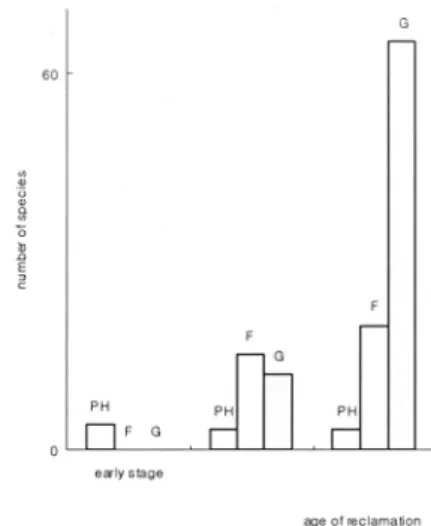
On the newly reclaimed tidal flat the flora completely consisted of pioneer halophyte, so the number of pioneer halophyte was more as 4 species, than on the aged reclaimed tidal flats (Seukmun, Sihwa, and Daeho) as 3 species (Table 4). This was the reason of disapperance of Suaeda japonica. At the result of facultative halophyte and glycophyte was increased in the old aged reclaimed tidal flat (Min 1985). This result indicated that the occurrence of flora in the reclaimed tidal flats started with pioneer halophyte, but changed to facultative halophyte
Fig. 6. This scheme shows that the flora changes along with the time after reclamation. In the early stage of reclamation, pioneer halophyte only occurred. Along with the time after reclamation pioneer halophyte decreased but facultative halophyte and glycophyte increased (PH: pioneer halophyte F:
facultative halophyte G: glycophyte).
andglycophyte along with the age (Joenje 1974; Joenje and During 1977). The change of flora after reclamation might be concern with environmental factors that tide, water table, drainage, aeration, and salinity (Chapman 1941).
INVASION OF PLANTS
In the early stage of reclamation pioneer halophyte only occurred on the reclaimed tidal flat. Along with the time passed after reclamation, the number of pioneer halophyte species was decreased, otherwise facultative halophyte and glycophyte were increased. The increase of plant species originated by the invasion of new plants such as facultative halophyte and glycophyte that occurred after pioneer halophyte therefore the main cause for the change of flora on the reclaimed tidal flat was the invasion of new plant (Kolb et al., 2002; Todde et al., 2006).
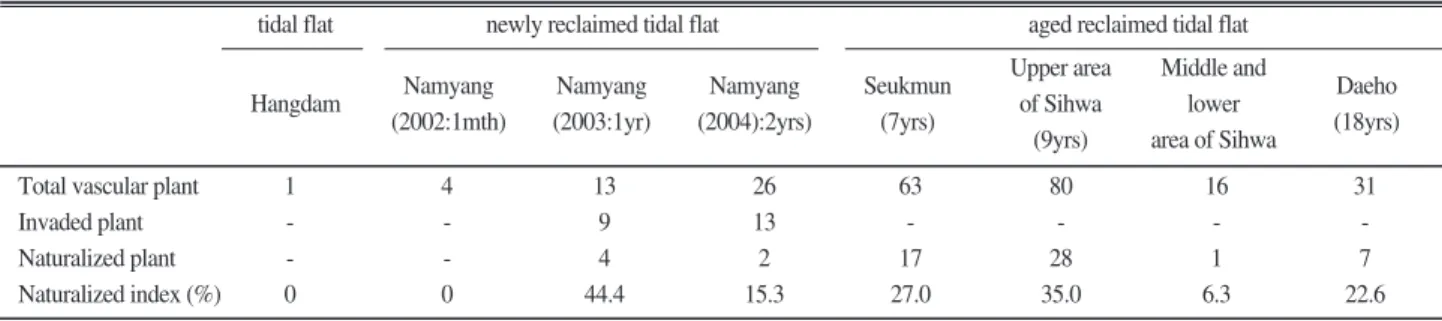
Most of invaded plants were glycophyte as a naturalized plant (Table 3). Naturalized plants well invaded into desolated spots where not occurred native plants and it reflects the ecological niche caused by thecompetition between native plants and naturalized plants (Kim et al., 2002). Through the invasion of newly occurred plant, the flora changed from pioneer halophyte to facultative halophyte and glycophyte (Table 3). This result implied that the environmental factors might continually change for the invasion of facultative halophyte and glycophyte, after reclamation. And also the change of environmental factors sequently influenced to the flora (Lesley, 1970) on the reclaimed tidal flats. On the newly reclaimed tidal flat (Namyang in 2003) the naturalized index was high as 44.4% (Table 5). This result indicated that a lot of portion of the invaded plants were naturalized, and these glycophyte species (Erigeron canadensis, Erechitites hieracifolia, Lactuca scariola, and Aster subulatus) might have salt tolerance since they
occurred on the early stage of reclaimed tidal flat. The naturalized index of Seukmun was higher than the second year of Namyang, because Seukmun was disturbed and surrounded by paddy field. The naturalized index for upper area of Sihwa was high as 35.0%, caused of some part covered terrestrial soils and located near the traffic road. But the naturalized index for middle and lower area of Sihwa where near by Sihwa seawater reservoir was low, because there was no disturbance by terrestrial soils and opportunity for invasion of glycophyte. The naturalized index of Daeho was lower than Namyang caused of there was no disturbance and far from urban.
Some naturalized plants which Chenopodium glaucum, Lactuca scariola, Aster subulatus, Diplachne fusca, and Erechitites hieracifolia were appeared in the reclaimed tidal flat, but little carried out for study of naturalized plants. Chenopodium glaucum and Diplachne fusca were the halophyte as naturalized plant. Aster subulatus and Diplachne fusca was reported by Kim (1971) as invaded plants on the reclaimed tidal flat. Aster subulatus was not classified halophyte but occurred all of the studied sites this suggest that it might have high salt tolerance. This result implied that Aster subulatus would be widespread all of the reclaimed tidal flats. Although Aster subulatus and Diplachne fuscahave high salt tolerance, they did not occurred as a pioneer, other wise they occurred after pioneer halophyte as like other glycophyte.
Conclusions
The flora of reclaimed tidal flats was differed from tidal flat and also differed from among the aged reclaimed tidal flats. Only one halophyte (Suaeda japonica) occurred on the tidal flat (Hangdam), four species of pioneer halophyte occurred on the newly reclaimed tidal flat. So the flora on the newly reclaimed tidal flat was similar with tidal flat, but facultative halophyte and
Total vascular plant 1 4 13 26 63 80 16 31
Invaded plant - - 9 13 - - - -
Naturalized plant - - 4 2 17 28 1 7
Naturalized index (%) 0 0 44.4 15.3 27.0 35.0 6.3 22.6
Daeho (18yrs) aged reclaimed tidal flat
tidal flat
Hangdam, Seukmun, Sihwa, and Daeho were investigated in 2002.
newly reclaimed tidal flat
Middle and lower area of Sihwa Upper area
of Sihwa (9yrs) Seukmun
(7yrs) Namyang
(2004):2yrs) Namyang
(2003:1yr) Namyang
(2002:1mth) Hangdam
Table 5. On the newly reclaimed tidal flat (Namyang), naturalized index was rapidly increased. On the aged reclaimed tidal flat (Seukmun and upper area of Sihwa), naturalized index was recorded higher than newly reclaimed tidal flat.
glycophyte were increased sequently.
On the aged reclaimed tidal flats, various facultative halophytes and glycophytes occurred while one of pioneer halophyte(Suaeda japonica) disappeared, so the flora changed toward to increasing of facultative halophytes and glycophytes, and toward to decreasing of pioneer halophyte along with the age after reclamation.
Although facultative halophyte and glycophyte was started to increase on the early stage of reclamation, pioneer halophyte had higher relative density and frequency than facultative halophyte and glycophyte. So pioneer halophyte predominated on the newly reclaimed tidal flat (investigation was up to 3 years after reclamation).
On the reclaimed tidal flat, one of main factors for change of flora was invasion of salt tolerance species (some of facultative halophyte and glycophyte) that invaded after pioneer halophyte. These meant the change of flora was begun in the early stage of reclamation. The other is, presumably, the change of environmental factors that might influence increase of invade plants and decrease of halophyte.
References
Adam, P(1990) Saltmarsh Ecology. Cambridge University Press, Cambridge.
Armstrong, W., Wright, E. J., Lythe, S., & Gaynard, T. J. (1985) Plant zonation and the effects of the spring-neap tidal cycle on soil aeration in a Humber salt marsh. Journal of Ecology, 73, 323-339.
Aronson, J. A. (1985) Economic halophytes-a global review. Plants for arid lands:of the Kew international conference on economic plants for arid lands(eds Wickens, G. E., J. R. Goodin, & D. V.
Field), pp. 177-188. George, Allen, andLondon.
Beefthink, W. G. (1979) The structure of salt marsh communities in relation to environmental disturbances. Ecological process in coastal environments (eds Jefferies, R. L. & A. J. Davy), pp. 77- 93. Blackwell, Oxford.
Bonis, A., Bouzille, J. B., Amiaud, B. & Loucougaray, G. (2005) Plant community patterns in old embanked grasslands and the survival of halophytic flora. Flora, 200, 74-87.
Brower, J. E., & Zar, J. H. (1977) Field and laboratory methods for general ecology, p. 194. Wm. C. Brown Company Publication, Iowa.
Chapman, V. J. (1941) Studies in salt-marsh ecology. Ⅷ. Journal of Ecology, 29, 69-82.
Chapman, V. J. (1947) Suaeda Maritima (L.) Dum. Journal of Ecology, 35, 293-302.
Curtis, J. T. & Mclntosh, R. P. (1951) An upland forest continuum in the prairie-forest border region of Wisconsin. Ecology 32, 476- 496.
Davy, A. J., Bishop, G. F., & Costa, C. S. B. (2001) Salicornia L.
(Salicornia pusilla J.S. ramosissima J. Woods, S. europaea L., S.
obscura P. W. Ball & Tutin, S.nitens P. W. Ball & Tutin, S. fragilis P. W. Ball & Tutin and S. dolichostachyaMoss). Journal of Ecology, 89, 681-707.
Epstein, E. (1963) Publication 942. Desalination research conference, p.284. National Academy of Sciences-National Research Council, Washington. D. C.
Epstein, E., Norlyn, J. D., Rush, D. W., Kingsbury, R. W., Kelly, D.
B., Cunningham, G. A. & Wrona, A. F. (1980) Saline culture of crops: A genetic approach. Science, 210, 399-404.
Ewanchuk, P. J & Bertness, M. D (2004) Structure and organization of a northern New England salt marsh plant community. Journal of Ecology, 92, 72-85.
FAO. (2005) Global network on integrated soil management for sustainable use of salt-affected soils. Rome, Italy: FAO Land and Plant Nutrition Management Service. http://www. fao.
org/ag/agl/agll/spush.
Felger, R. S., and Mota-Urbina, J. C. (1982) Halophytes: New sources of nutrition. Biosaline agriculture: A look to the future (ed Pietro, A. S.), Plenum Press, New
Flowers, T. J., Troke, P. F., & Yeo, A. R. (1977) The mechanism of salt tolerance in halophytes. Annual reviews. Plant Physiology, 28, 89-121.
Ganong, W. F. (1903) The vegetation of the Bay of Fundy salt and dikedmarshes. Botany Gazette, 36, 161-186, 280-302, 349-367, 429-455.
Hong, W. S. (1958) Investigation report on plant communities on Yongzong island. Korean Journal of Botany, 1(2), 7-15.
Isaacs, J. D. (1964) Proceedings of the First International Conference of Women Engineers Scientists. Society of Women Engineers,Ⅱ-1, New York.
Ihm B. S. (2001) Distribution of halophytes on the south coast of Korea. Korean Journal Nature Conservation, 116, 9-14.
Joenje, W. (1974) Production and structure in the early stages of vegetation developmentthe Lauwerszee-poder. Vegetatio, 29, 101- 108.
Joenje, W., & During, H. J. (1977) Colonisation of a desalination Waddenpolder byVegetatio, 35, 177-185.
Joenje, W. (1979) Plant succession and nature conservation of newly embanked tidal flats in the Lawerszeepolder. Ecological Process in Coastal Environments (eds Jefferies, R. L. and A. J.
Davy), pp. 617-634. Blackwell, Oxford.
Kim, C.S. (1971) An ecological study on the process of plant community formation inland. Korean Journal of Botany, 14(4), 27-33.
Kim, C. S. (1983) Distribution of halophyte community. Nature Conservation, 41,
Kim, C, S., & Song, T. G. (1983) Ecological studies on the halophyte communitiesat western and southern coasts in Korea(Ⅳ). Korean Journal of Ecology, 6(3),
Kim, C. N., Oh, Y. J., & Lee, Y. C. (2002) Flora and Forest vegetation of Mt. Hamback. Journal of Korean Boiota, 7, 86 Kolb, A., Albert, P., Enters, D., & Holzapfel, C. (2002) Patterns of
invasion within acommunity. Journal of Ecology, 90, 871-881.
Korea Agricultural and Rural Infrastructure Corporation (KARICO).
(1996) Tideland reclamation in Korea, p. 26. KARICO, Seoul.
Lee, J. S. (1988) Studies on the distribution of vegetation in the salt marsh of River Estuary. Korean Journal of Environmental Biology, 6(1), 1-10.
Lee, Y. N. (2002) Flora of Korea. Kyo-Hak Publishing Co., Ltd., Seoul.
Lee, T. B. (1999) Illustrated flora of Korea. Hayng-Moon Publishing Co., Seoul.
Lee, H. J., Chun, Y. M., Chung, H. L., Bang, J. Y., Chang, I. D., &
Seo, S. H. (2002) The flora of Yeonguong island. Journal of Korean Biota, 7, 157-184.
Lesley, D. C. & Hannon, N. J. (1970) The mangrove swamp and salt marsh communitiesthe Sydney district. Journal of Ecology, 58(2), 351-396.
Liming, X. & J. K. Zhu. (2002) Salt tolerance. American Society of Plant Biologists, 1-24.
McCrea, R. H. (1926) The salt marsh vegetation of Little Island, Co.
Cork. Journal of, 14(2), 342-346.
Mass, E. V. & G. J. Hoffman. (1977) Crop salt tolerance-current assessment. Journal of Irrigation and Drain, 103, 115-134.
Menzel, U. & H. Lieth. (1999) Annex 4: Halophyte database vers. 2.
Halophyte uses in different climates, 1. Ecological and ecophysiological(eds Lieth, H., M. Moschenko, M. Lohmann, H.
W. Koyro, and A.p.258. Progress in Biometeorology 13, Backhuys Publishers, Leiden.
Min, B. M. (1985) Changes of Soil and Vegetation in Costal Reclaimed Lands, west Coast of Korea. Seoul National University, Ph.D. dissertation, Department of
Min, B. M. (2001) The conservation strategy for uninhabited islands' vegetations inWestern sea of Korea. Korean Journal of Nature Conversation, 115, 22-29.
Mudie, P. J.(1972). Preliminary studies on seawater irrigation.
HalophyteProgress Publication 1. Scripps Institution of Oceanography.
Mudie, P. J. (1974). Ecology of Halophyte. (eds R. J. Reimold, and W. H. Queen), p.565. Academic press, London.
Munns, R. (2005). Genes and salt tolerance: bringing them together.
New, 167, 645-663
Park, S. H. (2001) Foreign Naturalized plant of Korea. Dae-Won Publishing Co., Seoul.
Park, S. H. (2001) Colored Illustrations of Naturalized Plants of Korea. Ilchokak Co., Seoul.
Rains, D. W., Valentine, R. C. & Hollaender, A. (1980) Geneticof Osmoregualtion: Impact on Plant Productivity for Food,and Energy, Plenum, New York.
Reimold, R. J. & Queen, W. H. (1974) Ecology of Halophyte, p.
605. AcademicPress, London.
Todde, M., Simpson, J. C., & Bertness, M. D. (2006) Mechanisms of exclusion of nativemarsh plants by an invasive grass. Journal of Ecology, 94, 342-354.
Ungar, I. A. (1974) Inland halophytes of the United States. Ecology of halophytes.(edsReimold, R. J., and W. H. Queen), pp. 235-305.
Academic Press, London.
Uphof, J. C. (1941) Halophytes. Botany Review, 1, 1-58.
USDA-ARS George E. Brown, Jr. Salinity Lab. (1999) Halophyte database salt-tolerance plants and their uses. USDA ARS by N.P.
Yensen
http://www.ussl.ars.usda.gov/pls/caliche/halophyte.preface Yensen, N. P.(2000) New horizons in the use of saline resources, pp.
4-8. Austriann of natural resource management.
Yim, Y. J. & Jeon, E. S. (1980) Distribution of naturalized plants in the Koreapeninsula. Korean Journal of Botany, 23, 69-83.
Zhao, K., Hai, F., & Ungar, I. A. (2002) Survey of halophyte species in China. Plant Science, 163(3), 491-498.
간척후 식생변화를 알기 위하여 우리나라 중서부 해안 간척지에서 식생분포를 조사하였다. 조사대상지는 2002 년 간척된 경기만 행담간석지, 체절후 각각 7년, 9년, 18년 된 충남 석문과 대호, 경기만 행담 간척지이다. 신간 척지에서 주 식생은 Suaeda japonica이었으며 다른 식생은 드물었다. 기존 간척지에서는 다양한 염생식물과 중 성식물이 분포하고 있었다. 신간척지에서는 Salicornia europaea, Suaeda glauca, Suaeda japonica, 그리고 Suaeda maritime 등 4종의 염생선구종식생이 분포하고 있었다. 간척연대가 진전되면서 통성염생식물과 중성식물이 차 례로 출현하고 있었다. 기존 간척지에서 다양한 통성염생식물과 중성식물이 복합하여 나타났고, 이들이 선구종 염생식물보다 우점하였으며, Suaeda japonica는 출현하지 않았다. 통성염생식물과 중성식물의 다양성이 높아질 수록 선구종염생식물이 감소되는 현상은 식생이 간척후 숙성에 따라 식생이 통성염생식물과 중성식물의 혼합 으로 천이되는 것을 시사하고 있다. 간척초기에 신간척지에서는 외부식물의 침입에 따라 식생종의 변화가 빠르 게 진행되었다. 통성염생식물과 중성식물은 간척초기에 증가하였으나 선구종염생식물의 상대적 밀도와 빈도는 통성염생식물과 중성식물보다 높았다. 간척후 3년 이후 연구에 의하면 외부식물이 선구종 염생식물이 우점하였 다. 이러한 식생의 변화에도 선구종염생식물로 Salicornia europaea, Suaeda maritima, 그리고 Suaeda glauca, 통 성염생식물로 Aster tripolium, Sonchus brachvotus, 그리고 Phragmites communis 간척지에서는 공통적인 주 염 생식물으로서의 위치를 점하고 있었다.
우리나라 중서부 해안 경기만 간척지에서 식생변화
김은규1·정영상2,*·천소을3·주영규3·정형근4
1죽전고등학교, 2강원대학교 농업생명과학대학, 3연세대학교 응용과학부 생물자원공학과, 4연세대학교 환경공학과