Introduction
Land-use of the reclaimed tidal land has been strongly recommended from paddy use for rice cultivation to upland use for vegetable, fruit trees and other cash crops by influence of the trade liberalization and rice over production. Multiple use of the Saemangeum reclaimed tidal land also has been strongly asked by lots of people.
Research on the multiple use of the Saemangeum reclaimed tidal land is now leaded by KARICO (RRI, 2006) and also widely discussed by agricultural researchers of many universities and research institutes (Yoo and Park, 2004; RRI, 2007). However, many problems such as technical limitation of desalinization suitable for cultivation of upland and also seed development of cash crops suitable for the reclaimed tidal land are still remained without any practical solutions.
Research papers on the reclaimed tidal land are dominant for paddy rice, but are only several for upland crops such as barley (Shim et al., 1998; Lee, et al., 1996), corn (Shim
et al., 1998), flowers (NICS, 2007), fodder crops (Song et al., 1981; Sohn et al., 2009a and 2009b). In addition, research results regarding on the cultivation of fruit trees in the reclaimed tidal land in Korea are lacking.
Therefore, the objective of this research was to investigate the effects of seasonal change of soil conditions, such as soil salinity and soil-wetness, on the growth of fruit trees over the range of time period from spring to winter. The result of this research will be helpful for successful development of orchard farm in the Saemangeum reclaimed tidal land.
Materials and method
Soil profile investigation of experiment site Morphological characteristics of the experimental site in the Saemangeum reclaimed tidal land was investigated by observation and description of soil profile in the pit (1 x 1 x 1.2 m) according to soil survey manual and guidelines (NAAS, 1973; USDA, 2000).
Investigation and analysis of physico-chemical properties Soil samples for particle size analysis were
Effect of Soil Salinity and Soil-wetting by Summer-Rising of
Water Table on the Growth of Fruit Trees Transplanted at the Saemangeum Reclaimed Tidal Land in Korea
Yong-Man Sohn*, Geon-Yeong Jeon, Jae-Do Song, Jae-Hwang Lee, Doo-Hwan Kim, and Moo-Eon Park Rural Research Institute. KARICO. Ansan 426-170, Korea
The effect of soil salinity and soil-wetting by rise of water table on the growth of fruit trees was studied to obtain information for orchard establishment in the Saemangeum reclaimed tidal land. Survival ratio of trees was 85%for grape, 31%for fig, 15%for apple and pear, and near zero for peach and blueberry. Wet injury induced by water-logged orflooded condition, ratherthan salt injury(soil EC was lowerthan 3.0dS m
-1during growing period) is thought to be more responsible for low survival ratio of fruit trees transplanted in Saemangeum area. During the summer raining season in the reclaimed areas, the soil salinity tends to be decreased by natural rainfall effect, and the rainfall acceptable capacity(RAC) of soils dramatically is reduced(10-24 mm) as rainfall is continued to occur. In spite of high hydraulic conductivity(121 cm day
-1) of soils across the area, low RAC of soils might be due to high soil saturation and elevated water table during summer raining season. Therefore, the installation of effective drainage system should be the primary factor determining successful establishment of orchard in the Saemangeum reclaimed tidal land.
Key words: Reclaimed tidal land, Soil salinity, Rainfall acceptable capacity, Fruit tree
Received : January 2. 2010 Accepted : February 18. 2010
*Corresponding author : Phone:+82314001836
E-mail: [email protected]
collected from the layers of soil profile and core samples for bulk density measurement were collected from soil depth 0-20, 20-40 and 40-60 cm in the experimental site.
Soil texture was decided by USDA texture triangle according to particle size distribution data analyzed by pipeting method. Bulk density was measured by core method and soil hydraulic conductivity was measured by the inversed auger-hole method (Park and Yoo, 1983;
Boast and Kirkham, 1971; Maasland, 1955).
Measurement of water table level was done by installing PVC pipe (4 m in length, 3 cm in diameter) into soil.
Composite soil samples for chemical analysis were collected and mixed together from surface soils of several places across the experimental site. Soil chemical properties was analysed by standard method of the Rural Development Administrate (NAAS, 2000). Soil pH was measured for mixture sample of soil 1 to distilled water 5 ratio by pH meter. Various analysing methods for other chemical properties were used, such as Tyurin method for soil organic content, Lancaster method for available phosphate, 1N-NH4OAc (pH7.0) method for exchange- able cations. Soil salinity was measured for mixture sample of soil 1 to distilled water 5 ratio by EC-meter (NAAS, 2000). Soil salinity (EC) was practically expressed to be multiplied by five times of the values obtained from the 1:5 dilution method in this paper.
Cultivation method of fruit trees and measurement of growth status Experiment was done in the plot of 2,500 m
2(50x50 m) area that was temporally established in the Saemangeum reclaimed tidal land. Six kinds of fruit trees such as apple, pear, peach, grape, fig and blueberry were tested in the experiment. Young fruit trees for the experiment were transplanted at intervals of 3 m on the top of high ridge (70 cm in width and 30 cm in height) on May 31, 2007 and intervals of row was 2 m. Drainage
pipes were installed for soil desalting and drainage of excess soil water by interval of 3m on the half area of experimental site.
Survival ratio of fruit trees was calculated by counting the lived trees to total trees transplanted. Shoot length was measured at three trees according to kinds of fruit trees and measurement for valuable data was done by using same branches and same trees labelled.
Results and Discussion
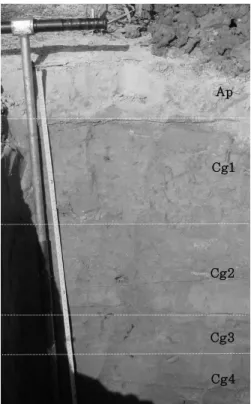
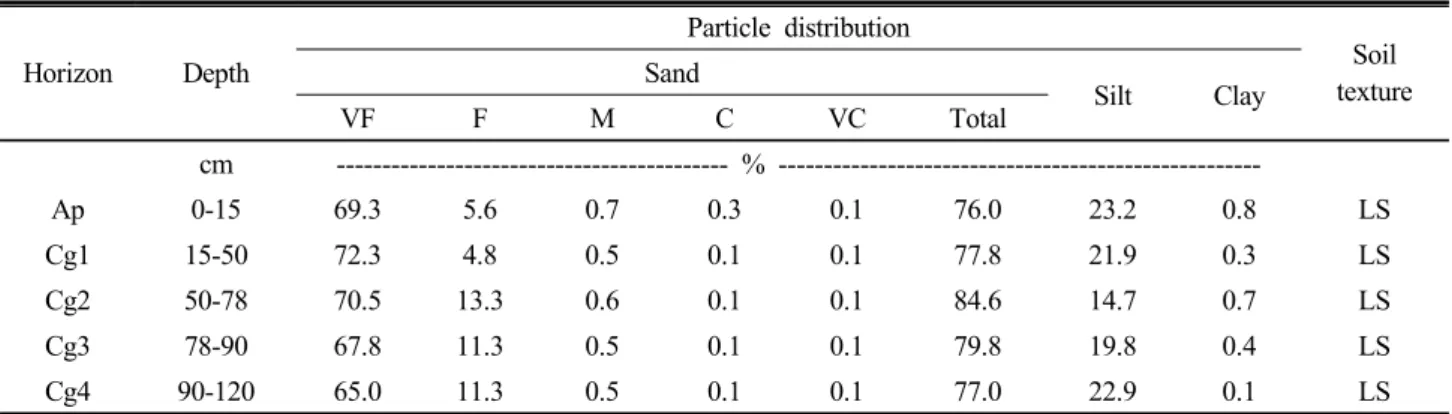
Morphological characteristics of soil profile in the experimental site Soil profile were differentiated by five layers such Ap, Cg1, Cg2, Cg3 and Cg4, as shown in Photo. 1 and Table 1.
Cg4 Ap
Cg1
Cg2
Cg3
Photo. 1. Soil profile at the experimental site.
Table 1. Soil profile description of the experimental site.
Field description : Geojeonri, Gwanghwalmyun, Gimjae, Jeonnam
Ap (0 to 15 cm) : Light brownish gray(10YR 6/2) silt loam, non-sticky and non-plastic, many fine mica flakes, single grains, few fine roots; abrupt smooth boundary.
Cg1 (15 to 50 cm) : Gray(2.5Y 5/1) loamy sand, many dark grayish brown to brown(10YR 4/2 to 4/3) mottles, structureless, abrupt smooth boundary.
Cg2 (50 to 78 cm) : Brownish gray(2.5Y 6/2), loamy sand, faint dark grayish brown to brown(10YR 4/2 to 4/3) mottles, structureless, abrupt smooth boundary.
Cg3 (78 to 90 cm) : Dark gray(5Y 4/1) Loamy sand, many dark brown(7.5Y 3/4) mottles, structureless, abrupt smooth boundary.
Cg4 (90 to 120 cm) : Dark gray(5Y 4/1) Loamy sand; few dark brown(7.5Y 3/4) mottles, structureless.
According to soil profile description, the layer below 70 cm in soil depth has some features to show reducing process, such as dark colour, less mottles and soil saturation. However, it is concluded that soil has generally good properties for cultivation of fruit trees on the basis of effective soil depth, soil texture and hydraulic conductivity.
Characteristics of Soil Profile and Physico- chemical properties The soil texture was loamy sand from top soil to lower layers of the soil profile. The soils contained more than 65% of very fine sand and less than 1% of clay content(Table 2).
Chemical properties were measured for composite soil samples, which were collected from surface soil of several places across the experimental site.
The site has weak alkaline soil having low content of available phosphate, but soil salinity is low enough for fruit trees to be cultivated.
Relationship between Soil Salinity and Growth of Fruit trees In order to find any problems caused by soil salinity, soil EC was measured at three depth such as 0-20, 20-40 and 40-60 cm. Fig. 1 shows the change of soil salinity during cultivation of fruit trees.
Fig. 1. Soil salinity changes during growing period of fruit crops at the experimented site of the Saemangeum reclaimed land.
According to measurement of soil salinity, soil EC was about 2.3 dS m
-1before cultivation, and ranged from 1.58 to 2.65 dS m
-1for soil depth 0-20 cm, from 1.55 to 2.12 dS m
-1for soil depth 20-40 cm and from 0.87 to 1.50 dS m
-1for depth 40-60 cm. Consequently, it is considered that soil salinity is more less low enough for cultivation of fruit trees, because limit of soil EC for non-saline soil was 4.0 dS m
-1(Yoo et al., 2000) and low limit of soil EC for the low salt tolerance crops, is 3.0 dS m
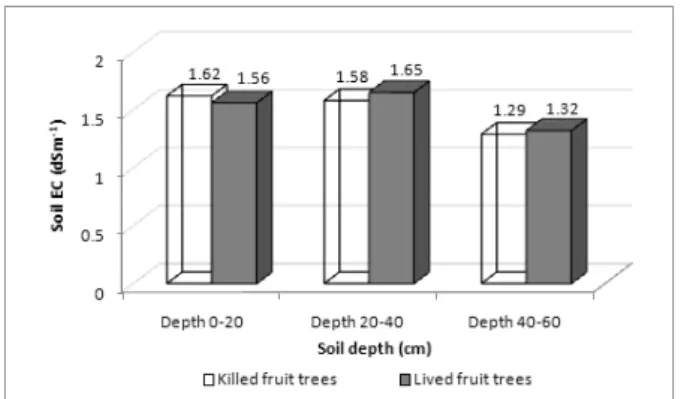
-1(Knott, 1962). In order for the effect of salinity on survival of fruit trees to be conclude, soil salinity was measured on the soils of the lived trees and the killed trees, as shown in Fig. 2.
Table 2. Soil particle distribution and texture of the soil profile at the experimented site of the Saemangeum reclaimed land.
Horizon Depth
Particle distribution
Soil texture
Sand Silt Clay
VF F M C VC Total
cm --- % ---
Ap 0-15 69.3 5.6 0.7 0.3 0.1 76.0 23.2 0.8 LS
Cg1 15-50 72.3 4.8 0.5 0.1 0.1 77.8 21.9 0.3 LS
Cg2 50-78 70.5 13.3 0.6 0.1 0.1 84.6 14.7 0.7 LS
Cg3 78-90 67.8 11.3 0.5 0.1 0.1 79.8 19.8 0.4 LS
Cg4 90-120 65.0 11.3 0.5 0.1 0.1 77.0 22.9 0.1 LS
Table 3. Soil chemical properties of the composite samples before and after experiment for the cultivation of fruit trees at the Saemangeum reclaimed land.
Soil sampled pH EC OM Av.P
2O
5Exchangeable cations
Ca Mg K Na
1:5 dS m
-1g kg
-1mg kg
-1--- cmol
ckg
-1---
Before experiment 8.4 1.9 20 33 0.7 1.8 0.68 3.22
After experiment 8.0 0.8 20 38 0.9 1.8 0.62 2.02
Fig.2. Comparison of the average soil salinity at the place of the survival tree with that at the place of the killed tree on Aug. 5, 2009.
Soil salinity was a little more high in the soil of lived trees than that of killed trees and then it was concluded that soil salinity did not give harmful influence to growth of trees. Nevertheless, it was observed that many trees were killed or suffered from severe physiological disorder such as necrosis of leaves, stopping of shoot growth, leaf dropping, etc.
Soil Water Content and Wet Injury Possibility of Fruit Trees Crops are very sensible to soil moisture condition. Excess soil water bring about wet injury of crops and deficient soil water bring about drought injury such as growth retardation and yield reduction. Soil water was monitored during cultivation of fruit trees, as shown in Fig. 3.
Fig. 3. Changes in soil moisture of orchard soil at the experimented site of the Saemangeum reclaimed land.
During cultivation of trees, soil water ranged from 20%
to 32% more than 18% of average soil moisture content for field capacity of sandy loam soils (Cha and Park, 1973).
Consequently, it was concluded that soil water was enough for fruit trees to be grown. Other factors should be taken account of good plant growth, such as air space ratio.
Air space can play an important role of not only root respiration but also rain acceptable volume. Root respiration is related positively to air-filled porosity, but negatively to degree of saturation. Data of bulk density and soil moisture content are needed for the calculation of air space ratio. Bulk density was measured as 1.36 Mg m
-3for soil depth 0-20 cm, 1.45 Mg m
-3for soil depth 20-40 cm and 1.48 Mg m
-3for soil depth 40-60 cm(Fig. 4).
Fig. 4. Bulk density with soil depth at the experimental site in the Saemangeum reclaimed tidal land.
Bulk densities measured in this study are very similar to those of previous study (Shon et al., 2007). Then porosity calculated from average 1.43 Mg m
-3in bulk density is 46%. Soil water content (weight base) ranged from 21.7 to 31.7% in this study, then water volume ranged from 31.0% to 45.3%. This means that air volume is only 0.7∼
15% and this is low enough for fruit trees to be poorly grown or killed by deficiency of oxygen for respiration.
Sohn et al. (2009) reported that possibility of flooding in field was estimated by comparison of soil hydraulic conductivity and rainfall. Table 4 shows data of hydraulic conductivity determined by the inversed auger hole method at the experimented site of the Saemangeum reclaimed land.
Table 4. Hydraulic conductivity determined by the inver- sed auger hole method at the experimented site of the Saemangeum reclaimed land.
No. of measurement Hydraulic conductivity (cm day
-1) Average Highest Lowest
13 120.7 192.2 66.2
Soil hydraulic conductivity ranged from 66.2 to 120.7
cm day
-1. In order to estimate possibility of flooding,
rainfall data also needed. Table 5 shows rainfall data
recorded at Buan station of the Korea Meterological
Administration near the Saemangeum reclaimed land.
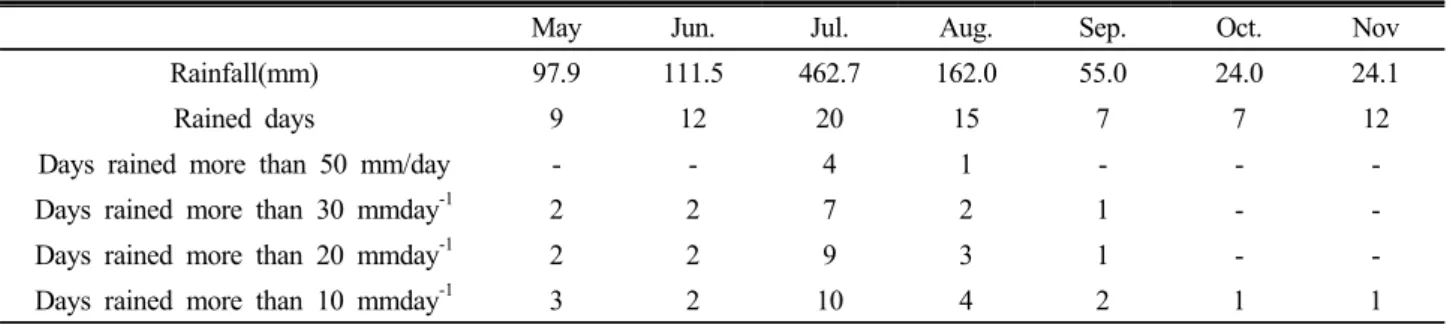
According to comparison of Table 4 and Table 5, there was no chance to be flooded by heavy rain over hydraulic conductivity. However, it was observed that flooding was happened several times in the Saemangeum reclaimed land. This means that other factor may be involved in flooding phenomenon.
Tidal land is located in the flat and low place where elevation is near sea level and water table is dependent upon controlling of the floodgate. Therefore, the infiltrated and or runoff rainfall may rise water table under close condition of floodgate during period of rainy summer season. The infiltrated rainfall may theoretically fill in all soil pores and then excess water contributes to rising of water table. Contributable amount of rainfall to rise water table is amount of rainfall over soil saturation fully filled in soil pores and is equivalent to rainfall acceptable capacity of the soil (RAC). Low RAC will easily bring about flooding by heavy rainfall of summer season and wet injury of fruit trees. Consequently, flooding damage of the fruit trees can be estimated by calculation of RAC. RAC is directly related with degree of saturation and soil air volume, and then possibly calculated from data of soil bulk density, water table level and soil water content (Hillel, 1980)
Soil bulk density of the Saemangeum reclaimed tidal land is average 1,43 Mg m
-3in this study (Fig. 4). Soil water content (weight base) during cultivation period raged from 22% to 32% (Fig, 3). Water table was fluctuated from -10 cm to -155 cm during fruit cultivation period in the Saemangeum reclaimed tidal land, as shown in Fig. 5.
This result is very similar to that of previous study, that water table is risen over -10 -30 cm in soil depth for ∼ rainy summer season and fallen down -90 150 cm in soil ∼ depth for dry winter to spring season (Shon et al., 2007).
Especially field was almost flooded up to shoulder of high ridge during summer rainy season from July to August. As
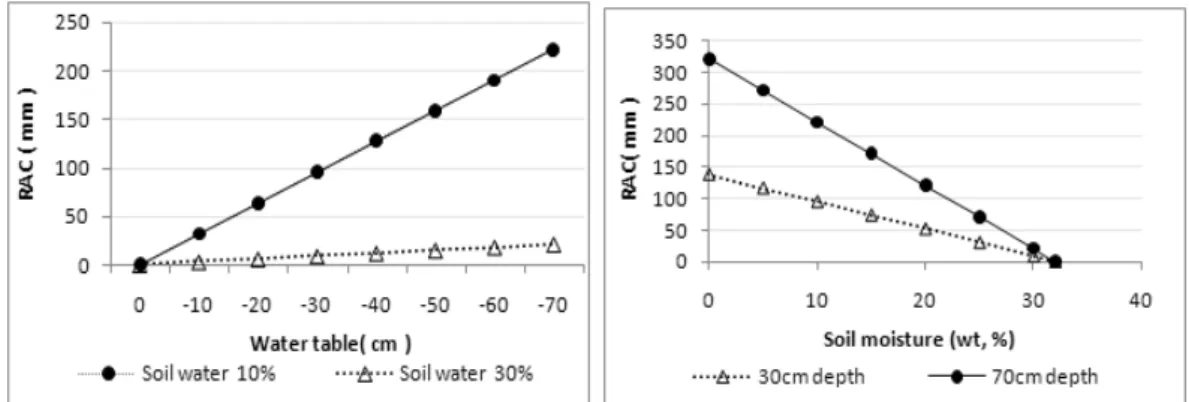
morphological evidence of the soil profile, the dark grey coloured layer by severely reducing process came from long stay of water table is observed at 70 cm in depth, as shown in Photo. 1. Consequently, maximum limit of rainfall acceptable soil depth during summer season could be 70 cm in the Saemangeum reclaimed tidal land. The rainfall acceptable capacities (RAC) with change of water tables are theoretically calculated for two cases of water content, such as 10 and 30% (left side of Fig. 6) and also RAC with the change of water content was done for two cases of soil depth, such as 30 and 70 cm in depth (right side of Fig. 6) under the conditions of average 1.43 Mgm
-3in soil bulk density, as shown in Fig. 6.
Although the rainfall acceptable capacities (RAC) is 138 mm for 30 cm in soil depth and 322 mm for 70 cm in soil depth under the ultimate dry soil condition with 1.43 Mg m
-3, RAC is only 95 mm for soil water 10% and 31 mm for soil water 20% and zero mm for soil water 32%.
Furthermore RAC sharply decrease with rise of water table. RAC of soil water 10% decrease sharply from 222 mm to 63 mm when water table rise from -70 cm upto -20 cm. RAC of soil water 30% is negligible because RAC decrease from 22 mm to 6 mm when water table rise from -70 cm upto -20 cm.
Table 5. Rainfall recorded at Buan station of the Korea Meterological Administration near the Saemangeum reclaimed land in 2009.
May Jun. Jul. Aug. Sep. Oct. Nov
Rainfall(mm) 97.9 111.5 462.7 162.0 55.0 24.0 24.1
Rained days 9 12 20 15 7 7 12
Days rained more than 50 mm/day - - 4 1 - - -
Days rained more than 30 mmday
-12 2 7 2 1 - -
Days rained more than 20 mmday
-12 2 9 3 1 - -
Days rained more than 10 mmday
-13 2 10 4 2 1 1
Jun.26 Jul.10 Aug.8 Aug.19 Sep.7 Oct.2 Nov.2
Fig. 5. Change of water table during fruit cultivation
period in the Saemangeum reclaimed tidal land.
During summer season, average soil moisture ranged from 23% to 32%, and average height of water table was -20 cm and bulk density was 1.43 Mg m
-3, and then RAC move up and down from 26 mm to zero mm. Practical value of RDA should be much more less than theoretical values because of the trapped air in pore (Hillel, 1980).
This means that flooding has been happened several times in the Saemangeum reclaimed land, because the days rained more over 30 mm day
-1are to be 14 times during cultivation of fruit trees (Table 5). It was considered that decisive reason of the trees killed or suffered from severe physiological disorder should be from wet injury by flooding and soil wet (Park and Ha, 1984). Finally, it is concluded that 30 cm of ridge height of high ridge cultivation is not enough to prevent from wet injury when rain water stand long in furrow, because height of capillary movement is 35-70 cm for fine sand and 70-150 cm for silt (Jung, 2009).
Survival of fruit trees and growth status Young trees transplanted at May 31, were successfully taken rooting and shown relatively vigorous growth at the
beginning season. Table 6 shows survival ratio and shoot length of the transplanted trees at June 22, 2009.
Survival ratio was 95% for grape trees and 87% for pear trees, but 66% for apple trees and 60% for fig trees and 60% for blueberry trees. Shoot length of apple, fig and blueberry was longer than those of pear, peach and grape.
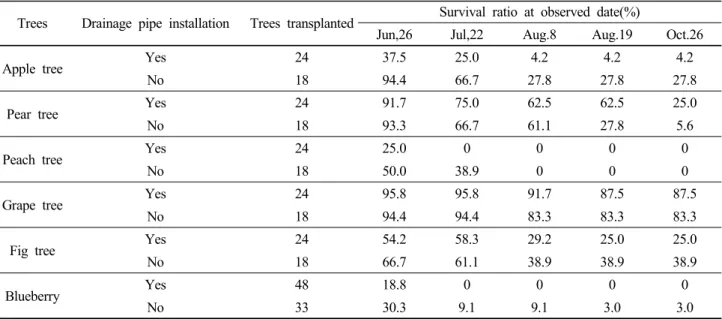
Effect of installation of drainage pipe was not clear, because survival ratio and shoot length were variable according to kind of trees. This result might be concluded that the effect of drainage pipe installation did not respond to growth of trees because high rising of water table during cultivation. Survival ratio of trees decreased greatly in the course of time, and finally arrived at 85% for grape, 31%
for fig, 15% for apple and pear, near zero for peach and blueberry, as shown in Table 7.
Especially, number of killed trees was severely increased during summer season. It was supposed that all of peach trees were killed because of physiological weakness to wet or flooded soil, but blueberry trees were almost killed because of physiological weakness to high pH. However, installation of drainage pipe line did not give any positive effect to the growth and survival of fruit Fig. 6. Theoretical rainfall acceptable capacity of the soil (RAC) with change of water table and soil water content in the Saemangeum reclaimed tidal land(RAC was calculated by reduction of soil water from saturated water filled theoretically in pores under the conditions of 1.43 Mgm
-3in soil bulk density.
Table 6. Survival ratio and shoot length of the transplanted fruit trees measured on June 26, 2009.
Crops
Survival ratio(%) Shoot length(cm)
Drain. pipe installation
Average Drain. pipe installation
Average
Yes No Yes No
Apple tree 37.5 94.4 65.95 12 16 14.00
Pear tree 91.7 83.3 87.50 5.7 2.7 4.20
Peach tree 25.0 50.0 37.50 3.3 3.4 3.35
Grape tree 95.8 94.4 95.10 2.7 3.6 3.15
Fig tree 54.2 66.7 60.45 2.4 17.7 10.05
Blueberry 18.8 30.3 24.55 18.7 20.3 19.50
trees because of water table rise during summer season.
Finally, it is concluded that poor growth and low survival ratio of fruit trees transplanted should be from severe wet injury by water-logged or flooded problem, but salt injury was not so much serious because of low salinity in the Saemangeum reclaimed tidal land. Therefore, good drainage system should be more considered for establishment of orchard in the Saemangeum reclaimed tidal land.
Conclusion
Fruit trees transplanted on the top of high ridge were not properly rooted and grown for establishment of orchard.
Based on the results of soil data (such as soil salinity, soil conductivity, soil texture and rainfall acceptable capacity) and geomorphological survey (such as rainfall pattern and rising of water table) collected as a function of time over the summer raining season, it was concluded that main reason of physiological damage for transplanted fruit trees, was not salt injury by desalting problem, but clearly wet injury by flooding or water-logging. Survival ratio of trees decreased greatly from 95% to 85% for grape, from 60% to 31% for fig, from 66% to 15% for apple, from 87%
to 15% for pear, from 60% to 3% for blueberry and from 38% to zero for peach during summer season. Soil moisture of summer season ranged from 23% to 32%, and average height of water table was -20cm and bulk density was 1.43 Mg m
-3, and then the rainfall acceptable capacity (RAC) move up and down from 26 mm to zero mm. This
means that flooding has been occurred several times in the Saemangeum reclaimed land, because the days rained more over 30 mm are to be 14 times during cultivation of fruit trees. In addition, installation of drainage pipe line did not give any positive effect to the growth and survival of fruit trees because of water table rise during summer season. Therefore, it is concluded that installation of effective drainage systems prior to desalting treatment of soils is more strongly recommended to bring a successful establishment of orchard farm in the Saemangeum reclaimed tidal land of Korea.
References
Boast C.W., and D. Kirkham. 1971. Auger hole seepage theory.
Soil Sci. Soc. Am. Proc. 35:365-373.
Cha, D.Y., and M.E. Park. 1973. Multiple regression equation estimating water holding capacities with textural composition and organic matter of upland soils in Korea. RDA J. Agri.
Sci. 15:29-36.
Hillel, D. 1980. Fundamentals of soil physics. Academic Press, Jung, P.G., and D.S. Oh. 2002. Soil conservation method for the
sloping land. Soil conservation and management for the sloping land. pp. 103-113.
Jung, Y.H. 2009. Proposal for active development of tree nursery farm in the Saemangeum reclaimed tidal land.
Symposium report pp 41-60, Rural Research Institute, KARICO in Korea.
Knott, J.E. 1962. Handbook for vegetable growers. p44 45. ∼ J.W. Wiley & sons, Inc.
Lee, S.H., B.D. Hong, Y. Ahn, and H.M. Ro. 2003. Relation between growth condition of six upland-crops and soil salinity in reclaimed land. Korean J. Soil Sci. Fert..
Table 7. Changes in survival ratio of the transplanted fruit trees with the measured date in 2009.
Trees Drainage pipe installation Trees transplanted Survival ratio at observed date(%)
Jun,26 Jul,22 Aug.8 Aug.19 Oct.26
Apple tree Yes 24 37.5 25.0 4.2 4.2 4.2
No 18 94.4 66.7 27.8 27.8 27.8
Pear tree Yes 24 91.7 75.0 62.5 62.5 25.0
No 18 93.3 66.7 61.1 27.8 5.6
Peach tree Yes 24 25.0 0 0 0 0
No 18 50.0 38.9 0 0 0
Grape tree Yes 24 95.8 95.8 91.7 87.5 87.5
No 18 94.4 94.4 83.3 83.3 83.3
Fig tree Yes 24 54.2 58.3 29.2 25.0 25.0
No 18 66.7 61.1 38.9 38.9 38.9
Blueberry Yes 48 18.8 0 0 0 0
No 33 30.3 9.1 9.1 3.0 3.0
36(2):66-71.
Lee, S.Y., C.S. Kim, J.W. Cho, and Y.K. Kang. 1996.
Physiological response of barley seedlings to salt stress.
Korean J. Crop Sci. 41:665-671.
Maasland, M. 1955. Measurement of hydraulic conductivity by the auger hole method in an isotropic soil. Soil Sci.
71:379-389.
NAAS. 1973. Guidelines for soil survey and soil classification.
National Institute of Crop Science, RDA, Suwon, Korea NAAS. 2000. Analysis of soil and plant. National Academy of
Agricultural Science, RDA, Suwon, Korea.
NICS. 2002. Agriculture of the reclaimed tidal land in Korea.
National Institute of Crop Science, RDA, Suwon, Korea.
NICS. 2007. Studies on friendly environmental development for foundation of multiple agriculture in reclaimed land:pp99-147. National Institute of Crop Science, RDA.
Park M.E., and S.H. Yoo. 1983. A comparison of soil hydraulic conductivities determined by three different methods in a sandy loam soil. Korean J. Soil Sci. Fert. 16(1):14-19.
Park M.E., and Y.W. Ha. 1984. Studies on grain filling in wheat and barley. III. Effect of flooding treatment in the maturing period of barley. RDA J. Agri. Sci. 26:112-117.
RRI. 2006. Agricultural complex development for upland &
Horticultural crops in the Seamangeum reclaimed farmland.
Res. Rpt. Rural Research Institute. pp 1-504, Rural Research Institute, KARICO in Korea.
RRI. 2007. Development method of the future agriculture complex in reclaimed land: pp 1-400. Rural Research Institute, KARICO in Korea.
Shim, S.I., S.G. Lee, and B.H. Kang. 1998. Screening of saline tolerant plants and development of biological monitoring technique for saline stress. 2. Responses of emergence and early growth of several crop species to saline stress. Kor. J.
Environ. Agric. 17(2):122-126.
Sohn, Y.M. G.Y. Jean, J.D. Song, J.H. Lee, and M.E. Park.
2009a. Effect of spatial soil salinity variation on the emergence of soiling and forage crops seeded at the newly reclaimed tidal lands in Korea. Korean J. Soil Sci. Fert.
42(3):172-178
Sohn, Y.M. G.Y. Jean, J.D. Song, J.H. Lee, and M.E. Park.
2009b. Effect of spatial soil salinity variation on the growth of soiling and forage crops seeded at the newly reclaimed tidal lands in Korea. Korean J. Soil Sci. Fert. 42(3):179-186.
Sohn, Y.M., J.S. Park, H.T. Kim, J.H. Lee, G.B. Lee, J.J. Lee, Y.G. Shin, M.E. Park, and Y.S. Hwang. 2007. Multiple utilization of tidal reclaimed farmland for advanced agriculture. Rural Research Institute, KARICO in Korea.
Song, J.D., K.J. Lee, and J.Y. Lee. 1981. Selection experiment of forage crops suitable for reclaimed land. Res. Report of National Institute of Animal Science:p782-789. RDA, Suwon, Korea.
USDA. 2000. Soil survey manual. Agri. Research Admini- stration, U.S.A.
Yoo, S.H., and M.E. Park. 2004. Proposal of land-use planing for agricultural use of the Saemangeum reclaimed land.
SARRL 2:68-91.
Yoo, S.H. et al. 2000. Dictionary of soil science. Seoul National University.
새만금간척지의 토양염농도와 지하수위의 하계 상승이 이식한 과수의 생육에 미치는 영향