서 론
뱀장어속(genus Anguilla) 어류는 전 세계적으로 3아종 (subspecies)을 포함하여 모두 19종이 분포하며(Watanabe et al., 2009), 담수에서 성장한 후 바다로 산란 회유하여 산란하 고 치어는 다시 강으로 소상하는 강하성 어류(catadromous fish)이다(Ege, 1939; Tesch, 1977). 우리나라에는 일본, 중국, 대만 등 주로 동북아시아에 분포하는 뱀장어 Anguilla japoni
ca와 열대 및 아열대성으로 서부 중앙 태평양과 인도양 등 적 도지역에 주로 서식하는 무태장어 Anguilla marmorata 2종이 분포한다(Watanabe et al., 2004, 2009; Kim and Park, 2007).
이 중 A. japonica는 강의 하구나 담수에서 5~8년 동안 성장 하는 동안에는 미성숙한 황뱀장어(yellow eel) 시기를 보낸 후,
눈이 커지고, 소화관은 퇴화되며, 체색이 검게 변하면서 생식 소가 성숙하는 은뱀장어(silver eel)로 변태하여 산란을 위해 바다로 회유한다(Tzeng et al., 2000; Han et al., 2003).
A. japonica는 고부가가치 양식어종으로 현재까지 산업적 으로 완전한 인공종묘생산기술이 정립되지 않아 자연에서 체 포한 실뱀장어(glass eel)에 의존하는 불완전한 양식어종이다.
1970년대 이후 전 세계적으로 남획, 서식지 감소 및 환경오 염 등의 원인으로(Tatsukawa, 2003) 개체군이 지속적으로 감 소되고 있어 자원 회복을 위하여 관리방안 마련이 시급하다 (Dekker, 2003). 국내의 경우 수산자원 활용을 위하여 주로 양 식 관련 연구가 이루어졌으며(Kim and Jo, 1974; Kim et al., 1977; Chun and Kim, 1985; Kim et al., 2006a, 2006b, 2007), 실뱀장어시기의 성장 및 소상생태(Kim, 1974; Lee and Lee, 1989; Moon, 2002; Hwang et al., 2014)가 수행되었다. 성장 기 및 회유기 뱀장어에 대해서는 금강과 만경강 하구 뱀장어 의 성비, 연령, 성장과 서식처 유형에 관한 연구가 수행되었다
—94 — http://www.fishkorea.or.kr
국내에서 채집된 뱀장어 Anguilla japonica (Anguillidae)의 Silvering index와 생식소 발달 단계가 서로 다른
Pseudosilver eels의 출현
홍양기·송미영·박희원·강정하1·이완옥
*
국립수산과학원 중앙내수면연구소, 1국립수산과학원 생명공학과
The Occurrence of Pseudo-silver eels with Different Silvering Index and Gonadal Development Stages in Anguilla japonica(Anguillidae) from Korean waters by Yang-Ki Hong, Mi-Young Song, Hee-Won Park, Jung-Ha Kang1 and Wan-Ok Lee* (Inland Fisheries Research Institute, National Institute of Fisheries Science, Gapyeong 12453, Republic of Korea; 1Biotechnology Research Division, National Institute of Fisheries Science, Busan 46083, Republic of Korea)
ABSTRACT Three pseudo-silver eels(PS1~PS3) were found by analysis of silvering index and biological characteristics of 454 eels, Anguilla japonica, collected from the 9 sites of Korean fresh and brackish waters from September 2014 to August 2015. Two specimens(PS1~PS2) from Lake Soyang and one(PS3) from Geum river estuary were identified as pseudo-silver eel showing a large difference between silvering index and GSI. The external morphology of the pseudo-silver eels were in S2(late silver eel) stage, but they were classified into Y1(yellow eel) and Y2(late yellow eel) stage in GSI, Gut index, Eye index and Y2 stage in gonadal development and mean egg diameter.
Key words: pseudo-silver eel, Anguilla japonica, silvering index, GSI
* Corresponding author: Wan-Ok Lee Tel: 82-31-589-5160, Fax: 82-31-589-5151, E-mail: [email protected]
(Hwang, 2010). Hong et al.(2015)은 국내에 서식하는 A.
japonica의 자원관리를 위해 전국의 주요 하천, 댐 호 및 하구 에서 뱀장어를 채집하여 성숙 단계에 따른 형태 및 생물학적 특성 연구 과정에서 외부 체색 및 형태는 성숙한 뱀장어인 S2 (late silver eel) 단계로 보이지만, 생식소의 발달단계는 미성숙 뱀장어인 Y1(yellow eel)과 Y2(late yellow eel) 단계에 해당 하는 개체를 pseudosilver eel로 보고하였다. Yellow eel에서 silver eel 시기로 변하는 2차 변태는 산란을 위해 거치는 중요 한 생활사 단계로 pseudosilver eel의 출현은 매우 특별한 경 우이다. 본 연구에서는 우리나라의 대형 댐 호, 하천 및 하구 와 같이 다양한 서식처에서 추가 조사를 수행하여 채집된 3개 체의 pseudosilver eel의 생식소와 형태적 특징을 분석하였다.
재료 및 방법
1. 시험어 확보 및 구분
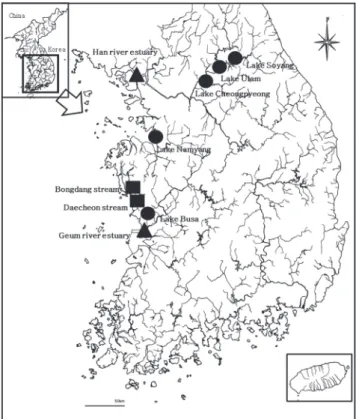
본 연구에 사용한 Anguilla japonica는 산란회유 시기를 포 함하는 2014년 9월부터 2015년 8월까지 댐 호(남양호, 부사 호, 소양호, 의암호, 청평호), 하천(대천천, 봉당천) 및 하구(금 강, 한강)에서 현지 어부가 어획한 시험어를 현장에서 수집하 였다(Fig. 1). A. japonica의 어획방법은 하천과 하구에서는 정 치망(길그물 길이 20m, 망목내경 12mm 및 자루그물 길이 5.3 m, 끝자루 망목내경 10mm)을 이용하였고, 댐 호에서는 주낙 (길이 16.3mm, 미늘 길이 9.2mm, 미늘폭 8.1mm, 바늘갯수 100개)을 함께 사용하였다. 조사에 사용한 시험어는 하천인 대천천 119개체, 봉당천 8개체, 댐 호인 남양호 6개체, 부사호 25개체, 소양호 122개체, 의암호 1개체, 청평호 11개체, 금강하 구 118개체, 한강하구 44개체로 총 454개체였다(Table 1). 시 험어는 채집 즉시 신선도를 유지하기 위해 아이스박스에 얼 음과 함께 담은 뒤 신속하게 실험실로 운반하여 각 부위의 체 색 및 외부 형태를 관찰하고, silvering index(SI)에 따라 Y1 (yellow eel), Y2(late yellow eel), S1(silver eel), S2(late silver eel)의 4가지 단계로 구분하였다(Okamura et al., 2007). 시험 어 중에 체색 및 외부형태 등의 기준으로는 S2였으나, GSI는 Y1 및 Y2에 속하는 개체는 pseudosilver eel(PS1~PS3)로 구 분하였다(Hong et al., 2015). 성별에 따른 체색의 차이는 직접 관찰되지 않았으며, 이전 연구에서도 알려지지 않아서 SI 단계 별 암·수를 별도로 구분하지 않았다. 분석에 사용한 시험 어는 A. japonica인지를 우선 확인하기 위하여, 미토콘드리 아 Cytb 유전자(forward primer, 5ʹ-CCGTTGTAATTCAAC TATAGAAACA-3ʹ; reverse primer, 5ʹ-AGCGCT AGGAAGAA TTTTAATC-3ʹ) 분석을 통하여 A. japonica임을 확인하였다.
2. 외부형태 형질 및 성숙 관련 지수 측정
A. japonica의 yellow eel 및 silver eel 시기별 계측형질 간 차이가 알려진 외부형태 형질을 측정 후 비교하였다(Okamura et al., 2007; Hong et al., 2015). 계측형질의 비교를 위하여 전 장(total length, TL)을 버니어캘리퍼스(Mitutoyo, Japan)로 0.1 mm 단위까지 측정하였다. 또한 체중(body weight, BW)은 디 지털 전자저울(CAS, Korea)을 이용하여 0.1g까지 측정하였 고, 생식소 무게(gonad weight) 및 소화관 무게(digestive tract weight)는 0.01g까지 측정한 후, GSI, 소화관지수(Gut index) 및 안경지수(Eye index) 등 성숙과 관련된 지수(Pankhurst, 1982)들을 아래의 식에 의해 계산하였다. A. japonica는 외부 형태만으로는 성별을 구분할 수 없어 복부를 절개한 후 생 식소 형태의 차이에 따라 암·수를 구분하였다(Kuhlmann, 1975).
GSI=gonad weight(g)÷BW(g)×100
Gut index=digestive tract weight(g)÷BW(g)×100 Eye index= {[(horizontal orbital diameter(mm)
+vertical orbital diameter(mm))÷4]2×π
÷TL(mm)}×100
Fig. 1. Map showing the location of sampling sites. The diagram in
dicates lake(circle), estuary(triangle) and stream(rectangle).
3. 조직학적 분석
Silvering index(SI) 기준과 GSI의 차이가 큰 개체는 조직학 적 분석을 실시하였다. 생식소 출현 부위를 파악하여 10% 포 르말린으로 고정한 후 파라핀에 포매하여 5μm 두께로 연속 절편을 만들었다. 이후 절편은 Harris’s haematoxylin과 eosin 으로 염색한 후 광학현미경(Olympus, Japan)에 부착된 디지털 카메라(TOUPCAM, China)로 촬영하였다. 암컷의 평균 난경 (oocyte diameter, ±1μm)은 핵이 관찰되는 난모세포 20개를 선정하여 각각의 장경을 측정한 뒤 평균값을 사용하였고, 생 식소 발달 단계는 Yamamoto et al.(1974)과 Miura et al.(1991) 를 따랐다.
결 과
1. Pseudo-silver eel의 출현
실험에 사용한 총 454개체는 미토콘드리아 Cytb 영역의 염 기서열 분석 결과 모두 Anguilla japonica로 확인되었다. 생식 소 차이에 따른 구분 결과, 암컷은 310개체, 수컷은 111개체 로 확인되어 0.36의 성비(♂/♀)로 암컷이 우세하였고, 생식소 가 발달하지 못하여 암·수 구분이 불가한 미성숙 개체는 33 개체였다(Table 1). 이 중 Y1(yellow eel)은 264개체(58.1%)였 으며, Y2(late yellow eel)은 107개체(23.6%), S1(silver eel)은
72개체(15.9%), S2(late silver eel)은 11개체(2.4%)였다(Table 1). Silvering index 단계별 구분과 GSI의 차이가 큰 Pseudo
silver eel은 총 3개체(0.7%)이었고, 지역별로 PS1~PS2 개체 는 소양호, PS3 개체는 금강하구에서 출현하였다(Table 1, Fig.
2). PS1 개체는 2014년 12월 소양호에서 어획된 수컷(TL 507 mm, BW 181.8g)으로 Silvering index의 기준으로는 S2로 분 류되었지만, GSI가 0.07로 매우 낮아 Y1의 생식소 성숙상태 를 유지하였다(Fig. 2). 본 개체는 GSI를 제외한 형태적인 변 태과정을 나타내는 지수 중 Gut index는 2.1, Eye index는 3.7 이었다. PS2 개체는 2015년 5월 소양호에서 어획된 암컷(TL 498mm, BW 200.4g)으로 Silvering index의 기준으로는 S2로 분류되었지만, GSI가 0.35로 매우 낮아 생식소 발달 단계로는 Y1과 비슷하였다(Fig. 2). 본 개체는 GSI를 제외한 형태적인 변태과정을 나타내는 지수 중 Gut index는 2.5, Eye index는 3.0이었다. PS3 개체는 2015년 9월 금강하구에서 어획된 암 컷(TL 702mm, BW 436.1g)으로 Silvering index의 기준으로 는 S2로 분류되었지만, GSI가 0.52로 낮아 Y2의 생식소 성숙 상태를 유지하였다(Fig. 2). 본 개체는 GSI를 제외한 형태적인 변태과정을 나타내는 지수인 Gut index는 2.3, Eye index는 3.1 이었다.
2. 생식소 조직분석
PS1 개체는 수컷으로 Fig. 3A에서 보는 바와 같이 정소 안 생식세포 내에는 Type A의 정원세포 일부만 확인되어 전형적 Table 1. The sex and silvering stage of Anguilla japonica in Korean waters
Sampling sites Stations Sex Total Stages
Y1 Y2 S1 S2
Stream Daecheon Juvenile
Female Male
30 6 83
30 2
81 2
1 2
1
Bongdang Female 8 5 1 2
Lake
Namyang Female 6 5 1
Busa Juvenile
Female Male
1 20 4
115
2 5
2
Soyang Juvenile
Female Male
1 109 12
156
3 46
6 6
2 (1)*
(1)*
Uiam Juvenile 1 1
Cheongpyeong Female 11 3 6 2
Estuary
Geum river Female
Male 109
9 55
1 32 19
7 2, (1)*
1
Han river Female
Male 41
3 2
1 6 31
1 2
1
*Number in the parentheses represent the pseudo-silver eel specimen.
인 수컷 Y1시기였다. PS2 개체와 PS3 개체는 암컷으로 둥근 핵과 함께 핵질 피질부 주변에 작은 인들이 빠르게 성장하는 주변인기 시기(perinucleolus stage)로 관찰되었고, 난모세포 주변에 일부 지방 소포체가 관찰되는 암컷 Y2 단계로 확인되 었다(Fig. 3B, C). 평균 난경은 PS2 개체는 86.9±7.48(73.2~
97.0)μm이었고, PS3 개체는 97.4±7.94(84.1~115.5)μm로 PS3 개체가 난경이 더 큰 것으로 확인되었다(Table 2).
고 찰
댐에 막혀 바다로 산란회유가 어려운 소양호에서 외부 체색 과 형태에서 성적으로 성숙한 형태의 Anguilla japonica를 채
집하였는데, GSI가 0.07로 매우 낮고 나머지 성숙관련지수에 서도 미성숙뱀장어인 Y1과 Y2에 해당하는 수컷 한 개체를 채 집하였으며, 이러한 특징을 가진 개체를 pseudosilver eel로 보고한 바 있다(Hong et al., 2015). 본 연구에서는 바다로 산 란회유가 어려운 댐 호와 같은 서식지외에서도 추가적으로 이 와 유사한 형태적 특성을 가진 개체가 확인되어, 하천 및 하 구를 포함한 다양한 자연수역에 서식하는 A. japonica를 대 상으로 이러한 특징을 보이는 개체가 출현하는지 조사하였 다. 조사 결과, 소양호 및 금강하구에 서식하는 암컷 2개체가 pseudosilver eel로 확인되었다(Table 1).
뱀장어속 어류는 주로 강의 하구, 기수 및 담수에서 약 5~8 년 서식하는 동안에는 성적으로 미성숙한 yellow eel 시기를 보낸 후, 크기가 충분히 성장한 후에 성적으로 성숙하면서 생 Fig. 3. Microscopic histology of the gonads stained with haematoxylin and eosin(magnification×100). A: PS1, Male(collected in Lake Soyang on December 17, 2014) 507mm TL, 181.8g BW. B: PS2, Female(collected in Lake Soyang on May 24, 2015) 498mm TL, 200.4g BW. C: PS3, Female(collected in Geum River Estuary on September 2, 2015) 702mm TL, 436.1g BW. The arrow indicate LV(lipid vesicles), N: nucleus, OG: oogonia, SG: spermatogonia, CT: connective tissue. Scale bars indicate 50μm.
A B C
Fig. 2. Pseudosilver eels of Anguilla japonica collected in Korean waters. A: lateral view, B: expanding lateral view, C: ventral view. Scale bars indicate 10mm.
A B C
식소가 커지고 복부는 은백색으로 바뀌는데(silvering), 이렇게 성숙하여 silver eel로 2차 변태를 한다(Tesch, 1977; Tzeng et al., 2000). 이러한 기본적인 변태과정의 일반적인 발달 단계를 가지는 개체와 외부형태의 변태와 생식소의 발달이 부조화한 일부 개체(pseudo eel)들이 출현한다. 본 연구는 이들 개체 사 이에 형태적 차이를 알아보기 위하여 Okamura et al.(2007)와 Hong et al.(2015)의 연구를 참고하여 yellow eel과 silver eel 단계에서 통계적으로 구분되는 외부 계측 형질 및 성숙 관련 지수를 이용하여 분석한 결과, 전장과 체중에서는 Y1 및 Y2 로 황뱀장어 단계였으나, 전장에서만 은뱀장어 단계에 해당하 여 차이를 보이는 개체가 금강하구에서 채집되었다(Table 2).
이러한 pseudosilver eel 개체들은 GSI에서는 yellow eel 단계 인 Y1 및 Y2였고, 형태적인 변태과정을 나타내는 지수 중 Gut index와 Eye index에서도 모두 yellow eel 단계인 Y1 및 Y2로 확인되었다(Table 2). 이러한 결과를 종합해 보면, pseudosil
ver eel 개체는 외부 체색을 기준으로 구분한 Silvering index에 서는 silver eel 단계에 해당되지만, 전장, 체중, GSI, Gut index 및 Eye index에서는 yellow eel 단계였다.
한편 Table 2에서 pseudosilver eel 개체들의 조직학적 조사 에서 암컷의 난경이 PS2는 86.9±7.48(73.2~97.0)mm이었 고, PS3 개체는 97.4±7.94(84.1~115.5)mm로 대만 Kaoping River 하구에서 조사한 결과 Y1 단계에서 64.0±1.19mm, Y2 단계에서는 102.7±1.71mm, S1 단계는 159.3±4.28mm와 비 교하여 볼 때, Silvering index뿐 아니라 난경에서도 Y2 단계였 다(Han et al., 2003).
Bezdzenyezhnykh(1973, 1974)은 10년 동안 산란회유를 하지 못한 성숙한 크기의 뱀장어 단계에 해당하는 Anguilla anguilla의 경우 식세포(phagocytic)에 의한 영향으로 난모세 포가 재흡수(resorption)되는 사례를 보고한 바 있다. Moriarty and Hackett(1976)는 아일랜드에 위치한 Cork 호수에 서식하 는 대형 A. anguilla(TL 1,220mm, BW 3,540g) 출현을 보고하 면서 이석 분석에 의한 연령 추정 결과, 20년생으로 첫 13년 동안은 빠른 성장을 보인 반면 이후 7년 동안은 느린 성장 패 턴을 확인하였다. 또한 호수 내 뱀장어 자원 조사 결과, 채집
된 개체들은 모두 전장 500mm 이상의 산란 회유가 가능한 성 숙뱀장어(Silver eel)들로 소형 뱀장어가 없는 비정상적인 성 장 패턴을 보인 개체군으로 확인되었는데, 이는 바다로 연결 되는 Lee River의 지류와 차단되면서 뱀장어 개체군의 이·출 입 중단에 따른 결과로 설명하였다. 따라서 소양호에서 채집 된 pseudosilver eel 개체도 직접적인 비교는 어려우나 충분히 성장하였지만 인위적 장애물인 댐 호에 고립되어, 산란회유를 하지 못하고 생식소가 재흡수되었을 것으로 추정된다. 금강하 구에서 확인된 암컷 PS3 개체는 금강하구둑 아래 바다와 연결 되는 지점에서 채집되었는데, 주기적으로 하구둑의 수문을 개 방하고 있어 앞서 소양호에서 확인된 pseudosilver eel처럼 산 란회유 경로 차단에 의한 생식소 재흡수 현상으로 볼 수 없어 왜 이런 개체가 출현하는지 출현 원인과 추가 출현 여부에 대 한 연구가 필요하였다.
Pseudosilver eel 2개체가 채집된 소양호는 북한강 상류에 위치한 대형 인공 댐으로 바다와 연결되는 한강 하구까지는 여러 개의 대규모 댐을 거쳐야 회유가 가능하여 자연산 뱀장 어 개체군의 이입이 어려울 것으로 사료된다. 현재 소양호 내 에 서식하는 뱀장어는 내수면 자원 조성을 위하여 인위적으로 방류된 개체들이며(Choi et al., 2003), 댐 호 내로 방류되는 개 체들이 방류 전에 양식장에서 사육되는 시기에 또는 방류 이 후 댐 호 내에서 서식하는 시기의 생리적, 행동적, 환경적 변 화 등의 원인으로 pseudosilver eel과 같은 비정상적인 변태과 정을 가지는 개체가 출현하는 것으로 추정되나, 더 자세한 출 현 원인을 이해하기 위하여 이들 개체의 생식호르몬 변화를 포함한 추가적 연구가 필요하였다.
요 약
2014년 9월부터 2015년 8월까지 국내 9개 지점에서 채집된 Anguilla japonica 454개체의 생물학적 특성을 조사한 결과, silvering index(SI) 구분과 GSI의 차이가 큰 pseudosilver eel 이 소양호에서 2개체(PS1~PS2)와 금강하구에서 1개체(PS3) Table 2. Morphometric and physiological indices of pseudo-silver eels collected in Korean waters
Pseudosilver eel 1 Pseudosilver eel 2 Pseudosilver eel 3
Total length(mm) 507 498 702
Body weight(g) 181.8 200.4 436.1
Silvering index(SI) S2 S2 S2
Sex Male Female Female
GSI 0.07 0.35 0.52
Gut index 2.1 2.5 2.3
Eye index 3.7 3.0 3.1
Oocyte diameter(μm)
mean±SD(range) - 86.9±7.48
(73.2~97.0) 97.4±7.94
(84.1~115.5)
가 확인되었다. Pseudo-silver eel은 외부형태 기준으로는 S2 단계였으나, GSI, 소화관지수(Gut index) 및 안경지수(Eye index)에서는 모두 yellow eel 단계인 Y1 및 Y2였고, 생식소 발달단계와 난경에서도 Y2 단계였다.
사 사
본 연구는 2017년도 국립수산과학원 수산과학연구사 업인 「내수면 수산자원보호구역 환경 및 수산자원 연구 (R2017034)」의 지원으로 수행되었습니다. 연구기간 동안 시 험어 확보에 도움을 주신 서병안, 주민규, 허춘 어업인 분들과 현장조사 및 시료 분석을 도와준 국립수산과학원 중앙내수면 연구소 권수정, 김승용, 송선화, 송하윤, 신아리, 이혜선, 최성국 연구원에게 감사드립니다.
REFERENCES
Bezdzenyezhnykh, V.A. 1973. Resorption of oocytes in the Euro
pean eel. Beloruss Vyesti Akad. Nauk, BSSR, Ser. Byal.
Nauk, 3: 96-101.
Bezdzenyezhnykh, V.A. 1974. State of oocytes of silver eels. Belo
russ Vyesti Akad. Nauk, BSSR, Ser. Byal. Nauk, 3: 99-102.
Choi, J.S., K.Y. Lee, Y.S. Jang, M.H. Ko, O.K. Kwon and B.C. Kim.
2003. Study on the dynamics of the fish community in lake Soyang. Korean J. Ichthyol., 15: 95-104.(in Korean) Chun, S.K. and J.W. Kim. 1985. Immune response of the Japanese
eel(Anguilla japonica) to Vibrio anguillarum. Korean J.
Fish. Aquat. Sci., 18: 464-470.(in Korean)
Dekker, W. 2003. Did lack of spawners cause the collapse of the European eel, Anguilla anguilla. Fish. Managemt. Ecol., 10: 365-376.
Ege, V. 1939. A revision of the genus Auguilla Shaw, a systematic, phylogenetic and geographical study. Dana Rep., 16: 1-256.
Han, Y.S., I.C. Liao, Y.S. Huang, J.T. He, C.W. Chang and W.N.
Tzeng. 2003. Synchronous changes of morphology and gonadal development of silvering Japanese eel Anguilla ja- ponica. Aquaculture, 219: 783-796.
Hong, Y.K., M.Y. Song, S.E. Yi and W.O. Lee. 2015. Change in morphological and biological characteristics by maturation of Japanese eel, Anguilla japonica, collected in Korea wa
ters. Korean J. Ichthyol., 27: 263-274.(in Korean)
Hwang, H.B. 2010. Sex ratio, age, growth and habitat use patterns of Anguilla japonica in the Geum River and the Mangyeo
ng River estuaries. Ph. D Thesis, Chungnam National Uni
versity, Korea, 95pp.(in Korean)
Hwang, S.D., T.W. Lee, I.S. Choi and S.W. Hwang. 2014. Environ
mental factors affecting the daily catch levels of Anguilla
japonica glass eels in the Geum River estuary, South Korea.
J. Coastal. Res., 30: 954-960.
Kim, D.J., E.J. Kang, J.Y. Bae, M.W. Park and E.O. Kim. 2007. De
velopment of the eggs and pre-leptocephalus larvae by nat
ural spawning of artificially-matured Japanese eel, Anguilla japonica. J. Aquacult., 20: 160-167.(in Korean)
Kim, D.J., E.O. Kim, M.W. Park, Y.C. Cho and S.G. Lim. 2006a.
Plasma sex steroid hormone profiles in artificially maturing wild eel, Anguilla japonica. J. Aquacult., 19: 267-274.(in Korean)
Kim, E.B. 1974. Studies on the upstream status and environmental factors of glass eel collected in the Cheju Island, Korea.
Korean J. Limnol., 7: 1-22.(in Korean)
Kim, E.O., J.Y. Bae, S.G. Lim, M.H. Son, M.W. Park, M.S. Park, Y.C. Cho and D.J. Kim. 2006b. Plasma sex steroid hormone profiles and testicular development in artificially maturing cultured male eel, Anguilla japonica. Korean J. Fish. Aquat.
Sci., 39: 466-471.(in Korean)
Kim, I.B. and J.Y. Jo. 1974. Rearing of the early stage of the eel Anguilla japonica. Korean J. Fish. Aquat. Sci., 7: 179-186.
(in Korean)
Kim, I.B., Y.U. Kim and J.Y. Jo. 1977. Rearing of the eel Anguilla japonica in recirculating aquariums. Korean J. Fish. Aquat.
Sci., 10: 115-124.(in Korean)
Kim, I.S. and J.Y. Park. 2007. Freshwater fishes of Korea. Kyohak
sa, Seoul, 467pp.(in Korean)
Kuhlmann, H. 1975. The influence of temperature, food, size, and origin on the sexual differentiation of elvers(Anguilla an- guilla). Helgolander Wissenschaftliche Meeresuntersuchun
gen, 27: 139-155.
Lee, T.W. and K.S. Lee. 1989. Daily growth increments and lunar pattern in otolith of the eel, Anguilla japonica, in the fresh
water. Korean J. Fish. Aquat. Sci., 22: 36-40.
Miura, T., K. Yamauchi, H. Takahashi and Y. Nagahama. 1991. Hor
monal induction of all stages of spermatogenesis in vitro in the male Japanese eel(Anguilla japonica). Proc. Natl. Acad.
Sci., 88: 5774-5778.
Moon, H.T. 2002. The early life history of eel Anguilla japonica determined by otolith microstructure and catch data of glass eels. Ph. D Thesis, Chungnam National University, Korea, 111pp.(in Korean)
Moriarty, C. and N. Hackett. 1976. An exceptionally large eel An- guilla anguilla(L.). The Irish Naturalists’ J., pp. 307-308.
Okamura, A., Y. Yamada, K. Yokouchi, N. Horie, N. Mikawa, T.
Utoh, S. Tanaka and K. Tsukamoto. 2007. A silvering index for the Japanese eel Anguilla japonica. Environ. Biol. Fish., 80: 77-89.
Pankhurst, N.W. 1982. Relation of visual changes to the onset of sexual maturation in the European eel Anguilla anguilla(L.).
J. Fish Biol., 21: 127-140.
Tatsukawa, K. 2003. Eel resources in East Asia. In: Aida K, Tsuka
moto K, Yamauchi K(eds) Eel biology. Springer, Tokyo, pp. 293-298.
Tesch, F.W. 1977. The eel. Biology and management of Anguillid eels. Chapman and Hall, London, 434pp.
Tzeng, W.N., H.R. Lin, C.H. Wang and S.N. Xu. 2000. Differenc
es in size and growth rates of male and female migrating Japanese eels in Pearl River, China. J. Fish Biol., 57: 1245- 1253.
Watanabe, S., J. Aoyama and K. Tsukamoto. 2004. Reexamination of Ege’s(1939) use of taxonomic characters of the genus
Anguilla. Mar. Sci., 74: 337-351.
Watanabe, S., J. Aoyama and K. Tsukamoto. 2009. A new species of freshwater eel Anguilla luzonensis(Teleostei: Anguillidae) from Luzon Island of the Philippines. Fish. Sci., 75: 387- 392.
Yamamoto, K., M. Omori and K. Yamauchi. 1974. Oogenesis of Japanese eel. Bull. Japan. Soc. Sci. Fish., 40: 9-15.