서 론
꼬치동자개 Pseudobagrus brevicorpus는 메기목(Siluriform
es) 동자개과(Bagridae)에 속하는 한국 고유종이며 낙동강수계 에만 분포하는 종으로 보고되어져 왔으나(Kim and Park, 2002;
Kim et al., 2005), 최근 동해로 유입하는 포항과 경주의 독립하 천 수계 저수지에서 출현이 보고된 바 있다(Yoo et al., 2008, 2009; Kim et al., 2011).
최근 각종 개발 및 환경오염 등으로 인해 자연서식지가 파괴 됨에 따라 개체수가 급격하게 감소하고 있어 우리나라 환경부 에서는 멸종위기 야생생물 I급(ME, 1998, 2005, 2012, 2017), 문 화재청에서는 천연기념물 455호(CHA, 2005)로 지정하여 보호 및 관리하고 있다. 본 종은 일본인 학자 Mori(1936)에 의해 신 종으로 등재된 이래 Uchida(1939)가 분류학적 형질 및 일부 생 태를 구명하였고, Lee and Kim(1990)에 의해 속명이 정리된 바 있으며 생식소 구조(Kim and Lee, 2003), 초기생활사(Kang et
al., 2007), 인공종묘의 성 분화 과정(Oh et al., 2008), 성장 및 성 숙(Yang et al., 2009), 집단의 유전적 구조분석(Kim, 2009) 등이 보고된 바 있다.
어류의 개체군 생태 연구는 어류의 성장, 성비, 먹이생물, 산 란시기 등 종에 대한 여러 가지 특징과 습성을 이해하는데 도움 을 준다(Song and Son, 2003). 그중 어류의 식성연구는 섭식주 기, 섭식활동, 성장효과 등을 알 수 있다(Jobling, 1982; Braaten, 1984; Ko et al., 2018). 또한 해당 종의 생태계의 기능적인 면을 이해하고 섭식생태를 알아보기 위한 유일한 방법이기에 매우 중요하다(Amundsen et al., 1996; Huh and Kwak, 1997).
국내에 서식하는 멸종위기야생생물(어류) 27종 중 식성에 관 한 연구는 14종에서 수행된 바 있으나(Choi et al., 2001, 2004;
Baek et al., 2002, 2008; Son and Byeon, 2004; Baek and Song, 2005; Lee, 2005; Hong et al., 2011; Kang, 2011; Ko et al., 2011;
Moon, 2012; Yoon et al., 2013; Hong, 2014; Kim et al., 2014;
Ko and Bang, 2018), 꼬치동자개는 생활사 및 식성에 관한 일부 단편적인 보고(ME, 2006, 2008; Kang et al., 2007)만 있을 뿐 정 밀연구는 수행된 바 없다.
—54 — http://www.fishkorea.or.kr
* Corresponding author: InChul Bang Tel: 82415301286, Fax: 82415301493, Email: [email protected] ISSN: 1225-8598(Print), 2288-3371(Online)
Accepted: March 26, 2019
낙동강 수계 대가천의 꼬치동자개 Pseudobagrus brevicorpus (Pisces: Bagridae)의 일주기 활동 및 식성
곽영호·김강래·방인철
*
순천향대학교 생명시스템학과
Diel Activity and Feeding Habitat of Pseudobagrus brevicorpus(Pisces: Bagridae) in the Daegacheon Stream of Nakdonggang River, Korea by Yeong-Ho Kwak, Kang-Rae Kim and In-Chul Bang* (Department of Life Sciences and Biotechnology, Soonchunhyang University, Asan 31538, Republic of Korea)
ABSTRACT A study on the diel activities and feeding habits of Pseudobagrus brevicorpus living in the Daegacheon Stream of Nakdonggang River was conducted in September 2017. Diel activity took place during the night, just after sunset and just before sunrise. Pseudobagrus brevicorpus swam in the middle depths, and when they found prey organisms, approached and consumed them immediately. Fish were divided by age into three groups. Prey organisms whose index of relative importance in the stomach contents exceeded 1% belonged to the orders Ephemeroptera(80.8%), Diptera(8.6%), and Trichoptera (8.5%). An index of relative importance by age showed that the Ephemeroptera are very important prey organisms, and the sizes of prey organisms increase with fish growth.
Key words: Pseudobagrus brevicorpus, diel activity, feeding habits, index of relative importance, Daegacheon Stream
따라서 본 연구는 멸종위기야생생물 I급 꼬치동자개의 기초생 태연구로 일주기활동과 식성의 상대중요성지수(IRI), 연령과 성장 에 따른 먹이생물의 구성 및 크기 변화를 분석하여 본 종의 생물 학적 특성을 밝혀서 종 보전에 기여하고자 본 연구를 수행하였다.
재료 및 방법
1. 조사시기
연구대상종인 꼬치동자개 Pseudobagrus brevicorpus의 포획 은 문화재청의 현상변경허가(2017년, 3197호)를 받은 후 경상 북도 성주군에 위치한 대가천에서 수환경이 비교적 안정되는 시기인 2017년 9월에 수행하였다(Fig. 1).
2. 일주기 활동
일 중 꼬치동자개가 활동하는 시간대를 알아보기 위해 24시 간 동안 약 3시간 간격으로 8회에 걸쳐 수중관찰(스킨다이빙) 과 일각망(망목 4×4mm, 날개길이 10m)을 이용하였으며, 활 동개체수를 조사하였다. 수중관찰은 약 45m2의 조사지역(수심:
0.4~1m, 유속: 0~0.1m/sec) 내에서 30분간 실시하였으며 일각
망은 조사지점 기준 상류에 1개, 하류에 1개를 설치하여 같은 시 간대별로 그물에 들어온 개체수 및 동소출현종 수를 계수하였 고 각각의 시간대별로 기온과 수온을 측정하였다. 또한 식성분 석에 이용된 일부 개체는 활동 시간대 조사 중 수중관찰지점 외 의 장소에서 포획하여 관찰지점 내 외부자극을 최소화하였다.
3. 식성분석
꼬치동자개의 연령은 전장빈도분포법(Ricker, 1971)을 통해 추정하였으며 전장 계급은 2mm 간격으로 측정하였다. 또한 항 문 뒤쪽 생식돌기를 육안으로 관찰하여 치어와 암컷, 수컷을 구 분하였고 전장을 측정한 후 대부분 방류하였다.
식성분석에 활용된 개체들은 조사일 기준 21시에 채집하였 고, 연령별 5개체씩 선별하여 소화물의 유출을 막기 위해 10%
포르말린 용액으로 즉시 고정하였다. 고정된 개체는 개복 후 위 를 적출하여 내부에 들어있는 내용물을 분류하여 해부현미경 (Olympus SZX9, Japan)과 광학현미경(Olympus BX50, Japan) 으로 관찰하였고 Yoon(1995)과 Won et al.(2008)에 따라 먹이 생물들을 동정하여 계수 및 습중량을 측정하였다. 위내용물 분 석결과는 각각의 먹이생물별 개체수비(%)와 습중량비(%), 출현 빈도(%)를 통해 상대중요성지수(index of relative importance, IRI)를 Pinkas et al.(1971)의 방법으로 계산하여 성장에 따른 먹 이생물의 변화를 조사하였고 섭식한 먹이생물의 크기는 전 연 령층에서 섭식한 파리목(Diptera)의 깔다구과(Chironomidae)와 하루살이목(Ephemeroptera)의 꼬마하루살이과(Baetidae)의 크 기를 측정하여 성장에 따른 변화양상을 비교 분석하였다.
Fi=Ai/N×100
(Fi: 출현빈도, Ai: 해당 먹이생물이 발견된 총 개체수, N: 위내용 물이 발견된 총 개체수)
IRI=(N+W)×Fi
(N: 먹이생물 총 개체수에 대한 백분율, W: 먹이생물 전체 습중 량에 대한 백분율, Fi: 각 먹이생물의 출현빈도)
4. 통계처리
연령에 따른 먹이생물 크기에 따른 통계처리는 SPSS 12.0을 이용하여 Oneway ANOVA의 Duncan’s test로 평균 간의 유의성 을 검정하였다(p<0.05).
결 과
1. 일주기 활동 및 동소종
꼬치동자개 Pseudobagrus brevicorpus는 일몰 직후인 18시 Fig. 1. A map of the study site in the Daegacheon Stream of Nakdong
gang River, Suryunmyeon, Seongjugun, Gyeongsangbukdo, Korea.
30분부터 은신처인 호박돌과 돌 틈에서 나와 활동을 시작하였 고 일몰 30분 후에는 모든 개체가 은신처 밖으로 나와 활동하였 다. 서식지 내 활동반경은 은신처 주변으로 매우 좁았으며 하상 위 약 50mm 떨어진 지점부터 중층까지 행동범위를 나타냈는 데 주로 중층에서 꼬리를 좌우로 흔들며 느리게 유영을 하였다. 또한 은신처 주변으로 다른 개체가 접근하면 “쳐다보기(looking up)”, “선회운동(mutual circling)”, “쫓아내기(chasing)” 등의 3 가지 행동반응을 보이며 자기 영역에 대한 강한 세력권을 형성 하였다. 섭식행동은 천천히 돌과 바위 틈을 바라보며 느리게 유 영하다가 먹이생물이 발견되면 다가가서 즉시 흡입하는 형태를 취했다. 시간에 따른 관찰은 일몰 직후부터 기온과 수온이 하강 하기 시작하는 18시 30분~19시 사이에 수중관찰(15개체), 일각 망(4개체)으로 가장 많은 개체수(19개체)가 관찰되었다(Fig. 2).
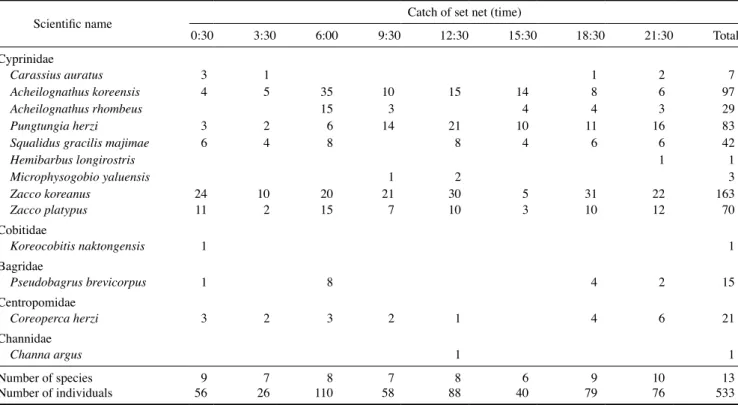
그러나 시간이 경과함에 따라 은신처 밖으로 나와 활동하는 개 체수가 지속적으로 감소하였고, 0시 30분~4시 사이에는 수중관 찰, 일각망에서 3개체만 확인되었다. 이때 대부분의 꼬치동자개 는 은신처에서 휴식을 취하고 있었다. 하지만 일출 직전인 6시 에 은신처 밖에서 활동하는 꼬치동자개 3마리를 관찰한 이후 일 각망에서도 8개체를 확인할 수 있었다. 이후 기온과 수온이 모두 상승하였지만, 일출 이후로는 은신처 밖으로 나와 활동하지 않았 다. 시간대별로 일각망으로 확인된 동소출현종은 총 5과 13종으 로 나타났다(Table 1). 일각망으로 포획된 총 개체수 중 우점종 은 참갈겨니 Zacco koreanus가 30.6%였고 아우점종은 칼납자 루 Acheilognathus koreensis 18.2%로 확인되었다. 포획된 종 중 낮 시간대에만 확인된 종은 돌마자 Microphysogobio yaluensis
와 가물치 Channa argus였으며 밤 시간대에만 확인된 종은 붕 어 Carassius auratus, 참마자 Hemibarbus longirostris, 얼룩새
Table 1. List of fish species and number of individuals caught by set net in the survey site in the Daegacheon Stream of Nakdonggang River, Korea
Scientific name Catch of set net (time)
0:30 3:30 6:00 9:30 12:30 15:30 18:30 21:30 Total
Cyprinidae
Carassius auratus 3 1 1 2 7
Acheilognathus koreensis 4 5 35 10 15 14 8 6 97
Acheilognathus rhombeus 15 3 4 4 3 29
Pungtungia herzi 3 2 6 14 21 10 11 16 83
Squalidus gracilis majimae 6 4 8 8 4 6 6 42
Hemibarbus longirostris 1 1
Microphysogobio yaluensis 1 2 3
Zacco koreanus 24 10 20 21 30 5 31 22 163
Zacco platypus 11 2 15 7 10 3 10 12 70
Cobitidae
Koreocobitis naktongensis 1 1
Bagridae
Pseudobagrus brevicorpus 1 8 4 2 15
Centropomidae
Coreoperca herzi 3 2 3 2 1 4 6 21
Channidae
Channa argus 1 1
Number of species 9 7 8 7 8 6 9 10 13
Number of individuals 56 26 110 58 88 40 79 76 533
Fig. 2. Changes in air and water temperature (A)and number of ac
tivities per Pseudobagrus brevicorpus individual (B)over time in the Daegacheon Stream of Nakdonggang River, Korea.
(A)
(B)
Temperature(°C)
Air tem. Water tem.
Sunrise 06:10
Sunset 18:30
Snorkeling Set net
Number of individuals
0:30 0:30 6:00 9:30 12:30 15:30 18:30 21:30 Time (hour)
30 28 26 24 22 20 18 16 14 12 10 20
15
10
5
0
코미꾸리 Koreocobitis naktongensis, 꼬치동자개로 나타났다.
2. 식성분석 1) 연령추정
9월에 포획한 50마리 개체군의 전장을 측정하여 전장빈도분 포로 연령을 추정하였으며, 개체군의 전장 범위는 35mm에서 111mm까지 나타났다. 전장빈도분포로 볼 때, 전장이 35~61 mm인 무리는 당년생(0+), 암컷은 70~85mm가 1년생(1+), 87~99mm의 무리는 2년생 이상(2+≤)으로 추정되었고 수컷 은 67mm의 개체가 1년생(1+), 89~101mm의 무리가 2년생 (2+), 111mm 개체는 3년생 이상(3+≤)된 개체로 추정되었다 (Fig. 3).
2) 위내용물 분석
분석한 전체 꼬치동자개(n =15)의 위에는 먹이생물로 가 득 차있었고 공복인 개체는 없었다. 위 내부에 있었던 먹이생 물은 모두 동물성먹이로 주로 수서곤충류를 섭식하였다(Table 2). 섭식한 먹이생물의 개체수는 하루살이목(Ephemeroptera) 이 68.2%로 가장 높은 값을 나타냈고 그 뒤로 파리목(Diptera, 13.6%), 날도래목(Trichoptera, 11.9%), 딱정벌레목(Coleoptera, 4.9%), 중복족목(Mesogastropoda, 0.7%), 등각류(Isopoda, 0.7%) 순으로 나타났다. 습중량은 하루살이목이 67.3%로 대부 분을 구성하고 있었고 중복족목(15.2%), 날도래목(13%), 파리 목(1.8%), 딱정벌레목(1.5%), 등각목(1.3%) 순으로 나타났다.
먹이생물의 출현빈도는 하루살이목(93.3%), 파리목(86.7%), 날 도래목(53.3%), 딱정벌레목(33.3%), 강도래목(6.7%), 중복족목 (6.7%), 등각류(6.7%)로 나타났다. 상대중요성지수(IRI)는 하루 살이목이 80.8%로 섭식한 먹이생물 중 가장 중요한 먹이생물
분류군으로 나타났고 파리목(8.6%), 날도래목(8.5%), 딱정벌레 목(1.4%), 중복족목(0.7%), 등각목(0.1%) 순으로 나타났다.
3) 연령별 먹이생물 및 크기 변화
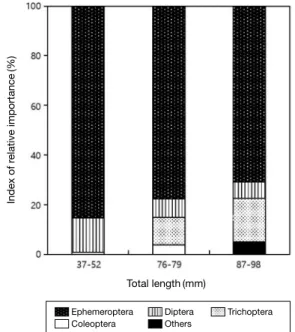
연령별로 성장에 따른 먹이생물 조성의 변화를 상대중요성지 수(IRI, %)로 조사한 결과는 Fig. 4와 같다. 전장 37~52mm의 당년생 치어는 하루살이목(85.5%), 파리목(13.8%), 딱정벌레목 (0.8%) 순으로 하루살이목을 주로 섭식하였고, 76~79mm의 1 년생은 하루살이목(77.7%), 날도래목(11.2%), 파리목(7.4%), 딱 정벌레목(3.7%) 순으로 섭식하였다. 87~98mm의 2년생은 하 루살이목(70.9%), 날도래목(17.5%), 파리목(6.6%) 등의 순으로
Index of relative importance(%)
Total length(mm)
Ephemeroptera Diptera Trichoptera Coleoptera Others
Fig. 4. The index of relative importance prey organisms ingested by age of Pseudobagrus brevicorpus in the Daegacheon Stream of Nak
donggang River, Korea.
Number of individuals
Total length (mm) Female
Male Juvenile
Fig. 3. Estimation of age of Pseudobagrus brevicorpus(n=50) using total length frequency distribution in the Daegacheon Stream of Nak
donggang River, Korea.
(n=50) 6 5 4 3 2 1 0 1 2 3 4 5
Total length(mm) Baetidae Chironomidae
Size of prey(mm)
Fig. 5. Changes in size of prey organisms by age according to growth of Pseudobagrus brevicorpus in the Daegacheon Stream of Nakdong
gang River, Korea.
37~52 76~79 87~98 6
5
4
3
2
1
0
나타났다. 당년생 치어는 하루살이목과 파리목의 비중(99.3%) 이 위내용물의 대부분을 차지하였으나 1년생과 2년생 개체에서 는 비중이 각각 85%, 77.5%로 점차적으로 감소하는 경향을 나 타내었다. 또한 1년생과 2년생 이상 개체에서 날도래목이 출현 하여 비중이 각각 11.2%, 17.5%로 증가하였다. 또한 연령별로 섭식하는 먹이생물 분류군도 증가하는 경향을 나타냈는데 당년 생은 3개목에 속한 수서곤충을 1년생은 4개목에 속한 먹이생물 을 2년생은 6개 목에 속하는 생물을 섭식하여 성장에 따라 다양 한 수서곤충류를 섭식하였다.
전 연령군에서 모두 섭식한 하루살이목의 꼬마하루살이 (Baetidae)과와 파리목 깔따구과(Chironomidae)를 대상으로
한 크기 측정값은 Fig. 5와 같다. 당년생이 섭식한 꼬마하루살 이과의 평균 크기는 2.5±0.5mm, 1년생은 3.6±0.5mm, 2년생 은 3.8±0.6mm로 나타났고, 당년생이 섭식한 깔따구과 수서곤 충의 평균 크기는 2.3±0.9mm, 1년생은 3.2±0.7mm, 2년생은 4.1±1.0mm로 나타났다. 통계처리 결과 꼬마하루살이과를 섭 식한 당년생과 1~2년생은 먹이생물의 크기에서 유의한 차이를 보였지만(p<0.05), 1년생과 2년생 이상은 통계적으로 유의하지 않았다(p>0.05). 깔따구과는 당년생부터 2년생 이상까지 모든 연령군에서 유의한 차이를 보여 성장함에 따라 먹이생물의 크 기 또한 커지는 양상을 나타냈다(p<0.05).
Table 2. Analysis of stomach contents of Pseudobagrus brevicorpus(n=15) in the Daegacheon Stream of Nakdonggang River, Korea
Prey organisms Number Number(%) Weight Weight(%) Occurrence(%) IRI IRI(%) Insecta
Ephemeroptera 195 68.2 0.4 67.3 93.3 12642.7 80.8
Baetidae
Baetis sp. 150 52.4 0.2 36.6 93.3 8307.7 59.3
Ephemerellidae
Serratella setigera 38 13.3 0.1 21.9 86.7 3052.8 21.8
Uracanthella rufa 1 0.3 + 0.5 6.7 6.0 +
Heptageniidae
Ecdyonurus levis 4 1.4 + 6.0 26.7 198.4 1.4
Epeorus pellucidus 2 0.7 + 2.2 13.3 38.6 0.3
Coleoptera 14 4.9 + 1.5 33.3 211.9 1.4
Elmidae
Elmidae sp. 1 0.3 + 0.2 6.7 3.5 +
Psephenidae
Mataeopsephus KUa 6 2.1 + 0.4 20.0 49.3 0.4
Unid.(Imago) 7 2.4 + 0.9 13.3 44.8 0.3
Diptera 39 13.6 + 1.8 86.7 1340.3 8.6
Ceratopogonidae
Ceratopogonidae sp. 1 0.3 + 0.2 6.7 3.5 +
Chironomidae
Chironomus sp. 38 13.3 + 1.6 86.7 1294.1 9.2
Trichoptera 34 11.9 0.1 13.0 53.3 1326.3 8.5
Hydropsychidae
Hydropsyche kozhantschikovi 7 2.4 + 7.5 40.0 397.7 2.8
Unid.(Imago) 15 5.2 + 3.5 40.0 348.7 2.5
Psychomyiidae
Psychomyia KUa 9 3.1 + 0.5 20.0 73.9 0.5
Leptoceridae
Ceraclea KUa 1 0.3 + 0.2 6.7 3.5 +
Unid.(Imago) 2 0.7 + 1.3 6.7 13.2 0.1
Mesogastropoda 2 0.7 0.1 15.2 6.7 105.8 0.7
Pleuroceridae
Semisulcospira sp. 2 0.7 0.1 15.2 6.7 105.8 0.8
Isopoda 2 0.7 + 1.3 6.7 13.2 0.1
Corixidae
Asellus sp. 2 0.7 + 1.3 6.7 13.2 0.1
+: <0.1%; Unid.: Unidentification
고 찰
대가천에 서식하는 꼬치동자개 Pseudobagrus brevicorpus는 국내에 서식하는 대부분의 메기목(Siluriformes) 어류의 공통적 인 특성(Kim, 1997; Kim and Park, 2002)인 야간에만 활동하는 야행성이었다. 환경부(ME, 2006)의 결과에 따르면 꼬치동자개 의 섭식 주요 활동시간은 일몰부터 자정무렵이고 21시부터 22 시까지 위충만도가 가장 높았으며 위내용물의 양은 일출 전에 는 위가 비어있는 것으로 보고된 바 있다. 그러나 이후 수행된 환경부(ME, 2008) 결과에서는 일몰 이후부터 섭식량이 증가하 여 일출시간인 06시에 최고 섭식량을 나타냈다고 보고한 바 있 다. 본 연구에서는 포획 및 훼손 개체수 제한으로 인해 시간대별 섭식한 먹이생물의 변화는 직접 확인 및 비교할 수 없었지만, 일 주기 활동시기가 크게 2회 나타났고 선행연구의 위충만도가 최 대인 시점과 활동시기가 유사하다는 점을 들어 활동시간과 섭 식시간이 서로 비례할 것이라 추정된다. 또한 선행연구에서 위 충만도 시기가 엇갈린 점은 서로 다른 곳에서 연구가 수행되었 던 지역적 차이와 서식지의 수환경적 차이, 식성분석에 이용된 개체수가 충분하지 않은 결과라 생각되며 꼬치동자개의 주된 활동시간이 일몰 직후와 일출 직전에 활발히 움직이는 2번의 일 주기패턴을 나타낸 점은 주목되었다.
꼬치동자개는 다른 개체가 자기 영역 및 은신처에 접근하 면 3가지 패턴의 공격적인 행동을 보였는데 같은 동자개과 어 류인 Pseudobagrus ichikawai의 경우(Watanabe, 2008)와 유사 하였다. 꼬치동자개의 위내용물에서 나온 섭식한 먹이의 개체 수 빈도는 하루살이목(Ephemeroptera, 68.2%), 파리목(Diptera, 13.6%), 날도래목(Trichoptera, 11.9%) 순서로 나타났는데 환경 부(ME, 2006)의 연구결과와 유사한 결과를 나타냈지만, 이후 에 수행된 환경부(ME, 2008)의 결과 파리목(48%), 날도래목 (31%), 하루살이목(18%)과는 매우 상이한 차이를 보였다. 조사 시기가 10월 초로 동일하다는 점을 보았을 때, 조사수역의 지역 적인 차이와 서식지 내 서식하는 먹이생물의 조성에 따른 차이 의 결과로 보인다. 또한 위내용물 중 수서곤충 유충뿐만 아니라 성충도 다수 발견되었는데 대다수 성충의 날개와 기관들이 가 지런하게 포개진 점으로 볼 때 번데기에서 성충으로 변태하는 중에 섭식된 것으로 사료된다.
연령별 상대중요성지수는 만 1년생 개체부터 섭식한 먹이자 원의 다양성이 두드러졌고 특히 날도래목이 증가하는 양상이 두드러졌는데, 이는 성장함에 따라 먹이원에 대한 포식 및 탐색 능력, 유영능력 등이 향상되었고(Gerking, 1994) 입 크기가 커짐 에 따라 비교적 큰 먹이원의 섭식이 가능해진 거라고 사료된다 (Byeon, 2017). 또한 하루살이목은 먹이생물을 섭식한 총 개체 의 50% 이상을 차지하여 전 연령 모두 먹이선택성이 매우 높은 먹이원으로 추정되며, 성장함에 따라 날도래목이 증가한 이유는 성장함에 따라 입의 크기가 커져 생체량이 비교적 큰 먹이를 선
택한 결과로 보인다. 대다수의 어류들이 성장함에 따라 먹이생 물의 크기를 다르게 섭식하여 먹이원에 대한 종 내에서의 먹이 경쟁을 최소화하는 현상을 보이는데(Clement and Choat, 1993;
Choi, 2003), 꼬치동자개도 성장함에 따라 연령별 주요 공통먹 이자원인 깔따구과(Chironomidae)의 크기가 점차 증가하였고 꼬마하루살이과(Baetidae) 또한 증가하는 경향을 보여 종 내에 서도 먹이생물의 크기를 서로 달리 섭취함으로써 상호간의 경 쟁을 최소화하는 것으로 보인다.
본 연구결과에서 꼬치동자개는 수서곤충류를 주요 먹이자원 으로 이용하였고 연령과 관계없이 모두 하루살이목을 주요 섭 식원으로 이용하는 것으로 나타났다. 결론적으로 꼬치동자개의 서식지 내 보전에 있어서 먹이자원인 수서곤충의 풍부도는 매 우 중요할 것이라 사료되며, 특히 전 연령에서 공통적으로 주로 섭식하는 먹이원인 하루살이목에 관해 각별한 관심이 필요해 보인다.
요 약
꼬치동자개 Pseudobagrus brevicorpus의 일주기활동과 식성 에 관한 연구를 낙동강 지류인 대가천에서 실시하였다. 일주기 활동은 일몰 직후와 일출 전에 2회에 걸쳐 일어났다. 주로 하천 의 중층대에서 활동을 하며 먹이생물이 발견하면 접근하여 흡 입하는 행동을 취했다. 연령은 3개 그룹으로 구분되었고 위내용 물 중 상대중요성지수(index of relative importance, IRI)가 1%
를 초과하는 먹이생물은 하루살이목(Ephemeroptera) 80.8%, 파 리목(Diptera) 8.6%, 날도래목(Trichoptera) 8.5% 순으로 나타났 다. 또한 모든 연령군에서 하루살이목이 매우 중요한 먹이생물 이었고, 성장함에 따라 먹이생물의 크기가 증가하였다.
사 사
본 연구는 환경부 멸종위기 담수어류(꼬치동자개) 보전 방안 연구와 순천향대학교의 연구비 지원으로 수행되었습니다.
REFERENCES
Amundsen, P.A., H.M. Gabler and F.J. Staldvik. 1996. A new ap
proach to graphical analysis of feeding strategy from stom
ach contents data-modification of Costello(1990) method. J.
Fish Biol., 48: 607614.
Baek, H.M. and H.B. Song. 2005. Digestive apparatus and food of the Korean bitterling, Acheilognathus signifer(Cyprinidae).
Korean J. Ichthyol., 17: 2763.(in Korean)
Baek, H.M., H.B. Song, H.S. Sim, Y.G. Kim and O.K. Kwon. 2002.
Habitat segregation and prey selectivity on cohabitation fishes, Phoxinus phoxinus and Rhynchocypris kumgangensis.
Korean J. Ichthyol., 14: 121131.(in Korean)
Baek, H.M., H.S. Sim, H.N. Youn and H.B. Song. 2008. Feeding ecology of endangered Cottus hangiongensis in the Hosan Stream, Korea. Korean J. Ichthyol., 20: 279284.(in Korean) Braaten, B. 1984. Growth of cod in relation to the fish size and ration
level. Floedevigen Rapportserie Adrenal, Norway, pp. 677
710.
Byeon, H.K. 2017. Studies on the feeding habits of Korean aucha perch, Coreoperca herzi in the Geum River, Korea. J. Ecol.
Environ., 31: 472478.(in Korean)
CHA(Cultural Heritage Administration). 2005. Report on state des
ignated cultural heritage natural monuments & scenic sites.
Cultural Heritage Administration, Daejeon, pp. 5657.(in Korean)
Choi, J.S., O.K. Kwon, J.H. Park and H.K. Byeon. 2001. Feeding habit of Gobiobotia brevibarba(Cyprinidae) from the Hong
cheon River, Korea. Korean J. Ichthyol., 13: 230236.(in Korean)
Choi, J.S., Y.S. Jang, K.Y. Lee and O.K. Kwon. 2004. Feeding habit of Gobiobotia macrocephala(Cyprinidae) from the Namhan River, Korea. Korean J. Ichthyol., 16: 165172.(in Korean) Choi, S.H. 2003. A study on foraging behavior of four species in the
genus Pterogobius(Pisces: Gobiidae), with note on specia
tion. Doctoral thesis, Hiroshima University, 162pp.
Clements, K.D. and J.H. Choat. 1993. Influence of season, ontogeny and tide on the diet of the temperate marine herbivorous fish Odox pullus(Odacidae). Mar. Biol., 117: 213362.
Gerking, S.D. 1994. Feeding ecology of fish. Academic Press, San Diego, 416pp.
Hong, Y.K. 2014. Studies of the conservation biology of an endan
gered freshwater fish, Microphysogobio rapidus(Cyprinidae).
Doctoral Thesis, Soonchunhyang University, Asan, 163pp.(in Korean)
Hong, Y.K., H. Yang and I.C. Bang. 2011. Habitat, reproduction and feeding habit of endangered fish Koreocobitis naktongensis (Cobitidae) in the Jaho Stream, Korea. Korean J. Ichthyol., 23: 234241.(in Korean)
Huh, S.H. and S.N. Kwak. 1997. Feeding habits of Pholis nebulisa.
Korean J. Ichthyol., 9: 2229.(in Korean)
Jobling, M. 1982. Food and growth relationships of the cod Gadus morhua L., with special reference to Balsfjorden, north Nor
way. J. Fish. Biol., 21: 357371.
Kang, D.W. 2011. Feeding ecology of the endangered species, slen
der shinner(Pseudopungtungia tenuicorpa) from Korea.
Chonnam National University, Gwangju, 44pp.(in Korean) Kang, E.J., H. Yang, H.H. Lee, Y.C. Cho, E.O. Kim, S.G. Lim and I.C.
Bang. 2007. Ecology and early life history of endangered freshwater fish, Pseudobagrus brevicorpus(Pisces: Bagri
dae). J. Ecol. Environ., 25: 378384.(in Korean)
Kim, H.S., H. Yang and Y.K. Hong. 2014. Population ecology of en
dangered fish Gobiobotia naktongensis inhabiting the Gam
cheon Stream, Nakdonggang River(Pisces: Gobioninae).
Korean J. Ichthyol., 26: 110.
Kim, I.S. 1997. Illustrated encyclopedia of fauna & flora of Korea, Vol. 37, freshwater fishes. Ministry of Education, Yeongi, 518pp.(in Korean)
Kim, I.S. and J.Y. Park. 2002. Freshwater fishes of Korea. Kyohak Publishing, Seoul, 465pp.(in Korean)
Kim, I.S., Y. Choi, C.L. Lee, Y.J. Lee, B.J. Kim and J.H. Kim. 2005.
Illustrated book of Korean fishes. Kyohak Publishing, Seoul, 615pp.(in Korean)
Kim, K.H. and J.I. Lee. 2003. Ultrastructure of spermatozoa of the slender catfish, Pseudobagrus brevicorpus(Teleostei, Bag
ridae) with phylogenetic considerations. Fish. Aquatic. Sci., 36: 480485.(in Korean)
Kim, K.S. 2009. Characterization of polymorphic microsatellite markers and population structure analysis in the endangered Korean stumpy bullhead, Pseudobagrus brevicorpus. Master Thesis, Soonchunhyang University, Asan, 56pp.(in Korean) Kim, S.K., Y.H. Kang, G.B. Hong, D.U. Yoo, H.Y. Suk, B.S. Chae,
H.S. Kim and U.W. Hwang. 2011. Ichthyofauna and commu
nity structure from 21 Lakes in the Yeongnam area including Gyeongsangbukdo and Gyeongsangnamdo provinces, Ko
rea. Korean J. Ichthyol., 23: 288299.(in Korean)
Ko, M.H., H.J. Kim, R.Y. Myung and Y.J. Won. 2018. The activity period and feeding ecology of the Korean eastern spined loach, Iksookimia yongdokensis(Pisces: Cobitidae). Korean J.
Ichthyol., 30: 2735.(in Korean)
Ko, M.H., H.Y. Song and I.C. Bang. 2011. Habitat environment, age and feeding ecology of the endangered species, Gobiobotia macrocephala(Pisces: Cyprinidae) in the Seom River, Korea.
Korean J. Ichthyol., 23: 278287.(in Korean)
Ko, M.H. and I.C. Bang. 2018. Feeding ecology of the endangered Korean endemic Miho spine loach, Cobitis choii(Pisces: Co
bitidae) in Geumgang River, Korea. Korean J. Ichthyol., 30:
9299.(in Korean)
Lee, C.L. and I.S. Kim, 1990. A taxonomic revision of the family Bagridae(Pisces, Siluriformes) from Korea. Korean J. Ich
thyol., 2: 117137.(in Korean)
Lee, H.H. 2005. Feeding and spawning ecology of the Pseu- dopungtungia nigra in the upper stream of the Keum River, Korea. Master Thesis, Chonbuk National University, Jeonju, 54pp.(in Korean)
ME(Ministry of Environment). 1998. Natural environment conserva
tion act(Law No. 5392).(in Korean)
ME(Ministry of Environment). 2005. Enforcement of wildlife laws (Law No. 7167).(in Korean)
ME(Ministry of environment). 2006. Species conservation, resto
ration and development of propagation technique for the en
dangered endemic species among the freshwater fishes from Korea. Kunsan University, Gunsan, 537pp.(in Korean) ME(Ministry of environment). 2008. Culture and restoration research
of Pseudobagrus brevicorpus. Inland Culture Research Cen
ter, National Institute of Fisheries Science, 72pp.(in Korean) ME(Ministry of Environment). 2012. Conservation and management
laws of wildlife(Law No. 10977).(in Korean)
ME(Ministry of Environment). 2017. Conservation and management laws of wildlife(Law No. 737).(in Korean)
Moon, S.J. 2012. Distribution and population ecology of the far east
ern brook lamprey Lethenteron reissneri in Korea. Master Thesis, Soonchunhyang University, Asan, 79pp.(in Korean) Mori, T. 1936. Studies on the geographical distribution of freshwater
fishes in Korea. Bull. Biogeogr. Soc. Jpn. 6: 35-61.(in Japa
nese)
Oh, M.K., J.Y. Park, E.J. Kang, S.G. Yang, E.O. Kim and Y.C. Jo.
2008. Sexual differentiation in Korean stumpy bullhead Pseudobagrus brevicorpus derived from artificial fertiliza
tion. Korean J. Ichthyol., 20: 255262.(in Korean)
Pinkas, L., M.S. Oliphant and I.K.K. Iverson. 1971. Food habits of albacore, bluefin tuna and bonito in California waters. Fish.
Bull., 152: 1105.
Ricker, W.E. 1971. Methods for assessment of fish production in freshwater. IBP hand book, 3: 112113
Son, Y.M. and H.K. Byeon. 2004. Feeding habits of bullhead torrent catfish, Liobagrus obesus from the Geum River, Korea. Ko
rean J. Ichthyol., 16: 336340.(in Korean)
Song, H.B. and Y.M. Son. 2003. Population ecology of Microphyso- gobio longidorsalis(Cyprinidae) from Korea. Korean J. Ich
thyol., 15: 303310.(in Korean)
Uchida, K. 1939. The fishes of Tyosen. Part 1. Nematognathi, Even
tognathi. Bull. Fish. Exp. Sta. Gov. Gener. Tyosen., 6, 458pp.
(in Japanese)
Watanabe, K. 2008. Diel activity and reproductive territory of the Japanese bagrid catfish, Pseudobagrus ichikawai. Environ.
Biol. Fishes, 81: 7786.(in Japanese)
Won, D.H., S.J. Kwon and Y.C. Jeon. 2008. Aquatic insects of Korea.
Korean Ecosystem Service, Seoul, 415pp.(in Korean) Yang, S.G., E.J. Kang, K.S. Kim and I.C. Bang. 2009. Characteris
tics on growth and sexual maturation of an endangered fish, stumpy bullhead(Pseudobagrus brevicorpus), from Korea by artificial rearing. J. Ecol. Environ., 27: 369-374.(in Korean) Yoo, D.J., K.H. Han, S.H. Lee, H.S. Yim, J.H. Hwang, J.H. Lee and
K.W. Kang. 2008. Ichthyofauna collected from reservoirs in Pohangsi, Gyeongsangbukdo. Korean J. Ichthyol., 41: 363
370.(in Korean)
Yoo, D.J., K.H. Han, H.S. Yim, W.I. Seo and S.H. Lee. 2009. Ichthy
ofauna from reservoirs in Gyeongjusi, Gyeongsangbukdo, Korea. Korean J. Ichthyol., 21: 3846.(in Korean)
Yoon, H.N., K.D. Kim, Y.L. Jeon, J.H. Lee and Y.J. Park. 2013.
Stomach contents of the Manchurian trout(Brachymystax lenok tsinlingensis) and river salmon(Oncorhynchus masou masou) in the Odae mountain. Korean J. Ichthyol., 25: 90
105.(in Korean)
Yoon, I.B. 1995. Aquatic insects of Korea. Jeonghaeng Publishing Company, Seoul, 262pp.(in Korean)