The Development of a New Soybean Strain Without Kunitz Trypsin Inhibitor, Lectin, and 7S α' Subunit Protein
Won Gi Chae, Sang Woo Choi, Gyung Young Kang and Jong Il Chung*
Department of Agronomy, Gyeongsang National University, Jinju 52828, Korea Received March 24, 2020 /Revised May 10, 2020 /Accepted June 15, 2020
Soybean [Glycine max (L.) Merr.] seeds contain an average of 40% protein on a dry weight basis, but they also contain antinutritional elements such as lectin, Kunitz trypsin inhibitor (KTI), and 7S α'- sub- unit protein. The objective of this research was to develop a new soybean genotype with triple re- cessive alleles for these elements. Three parents (Gaechuck#2, PI506876, and Le-16) were used to de- velop the genetic population, and the presence of lectin and KTI ㅔprotein was detected using Western blot while 7S α' subunit protein was detected using SDS-PAGE. One F
3plant strain with proper agronomical traits such as type, height, seed quality, and 100-seed weight was selected. The genotype of the developed strain is titilelecgy1cgy1, that is KTI, lectin, and 7S α' subunit protein free.
The new strain has a purple flower, determinate growth habit, and light yellow pods at maturity. The seed has a buffer hilum and is yellow in color. The new strain’s height was 58 cm compared to the Daewonkong cultivar at 46 cm, and its 100-seed weight was 27.1 g, smaller than the Daewonkong at 29.0 g. This is the first new soybean strain with the titilelecgy1cgy1 genotype, and it can be used to improve yellow soybean cultivars of high quality and function.
Key words : 7S α'-subunit, Kunitz trypsin inhibitor (KTI), lectin, soybean, three proteins-free
*Corresponding author
*Tel : +82-55-772-1872, Fax : +82-55-772-1879
*E-mail : [email protected]
This is an Open-Access article distributed under the terms of the Creative Commons Attribution Non-Commercial License (http://creativecommons.org/licenses/by-nc/3.0) which permits unrestricted non-commercial use, distribution, and reproduction in any medium, provided the original work is properly cited.
Introduction
Soybean seed is one of the major food sources for protein, oil, carbohydrates, isoflavones, and many other nutrients to humans and animals. Soybean seed is composed of 40%
protein. Demand of soybean and soybean products has in- creased in recent years because of high quantity and quality of soybean protein. Also, several antinutritional factors and allergenic proteins in the raw mature soybean are exist.
Kunitz Trypsin Inhibitor (KTI) protein, lectin protein and 7S α‘-subunit protein are main antinutrients responsible for re- ducing the nutritional value of unprocessed soybean.
Soybean Kunitz Trypsin Inhibitor (KTI) protein is a small and non-glycosylated protein containing 181 amino acid res- idues with 21.5 kDa. KTI protein was first isolated and crys- tallized from soybean seeds by Kunitz [11]. Kunitz trypsin inhibitor protein strongly inhibits trypsin, thus reducing food intake by diminishing digestion and absorption. Five
electrophoretic forms of KTI have been discovered. The ge- netic control of four forms, Ti
a, Ti
b, Ti
c, and Ti
d, has been reported as a codominant multiple allelic series at a single locus [5, 16, 20]. Orf and Hymowitz [16] found that the fifth form does not exhibit a soybean trypsin inhibitor-A2 band and is inherited as a recessive allele designated ti. Orf and Hymowitz [16] identified two soybean accessions (PI157440 and PI196168) which lacks KTI protein from USDA germ- plasm collection. The Ti locus has been located on linkage group 9 in the classical linkage map of soybean [4, 6], which was integrated in linkage group A2 (chromosome 8) of the USDA/Iowa State University soybean molecular linkage map [1].
Soybean lectin protein is a glycoprotein with a molecular weight of 120 kDa with four similar subunits [17]. The soy- bean lectin is able to link to carbohydrate chains found in glycoproteins and glycolipids and present a strong affinity for N-acetyl-D- galactosamine and to a lower extent for D- galactose. This lectin-carbohydrate interaction will con- sequently result into a changed morphology of the intestinal epithelium, as well as a decrease in the digestion and absorp- tion of nutrients [18]. The presence of seed lectin is con- trolled by a single dominant gene designated Le and the ho- mozygous recessive lele results in the lack of lectin [15]. Ti and Le loci were segregated independently [12, 13, 16].
Recently, a new soybean line with triple null recessive geno-
Table 1. Genotype for Ti (ti), Le (le), and Cgy1 (cgy1) alleles of parents used in this experiment
Parents Trait/genotype
KTI protein Ti (ti) Lectin protein Le (le) 7S
α
' subunit protein Cgy1 (cgy1) Gaechuck#2PI506876 Le-16
Absent Present Present
titi TiTi TiTi
Present Present Absent
LeLe LeLe lele
Present Absent Present
Cgy1Cgy1 cgy1cgy1 Cgy1Cgy1
types (ti/ti-le/le-p34/p34) was developed [19].
Soybean β-conglycinin (7S globulin) and glycinin (11S globulin) are the major components of storage protein in soybean. β-conglycinin consists of three subunits, α‘, α, β and exhibits poorer nutritional and food processing proper- ties than glycinin [22]. Also, β-conglycinin contains much less sulfur-containing amino acid, methionine and cysteine, than glycinin [9]. Several mutant lines affecting accumu- lation of β-conglycinin have been identified in soybean germplasms. Kitamura and Kaizuma [7] identified Keburi, which was characterized by the absence of the α’-subunit of β-conglycinin. Kitamura et al. [8] reported that the ab- sence of α‘-subunit were controlled by single recessive al- leles, cgy
1. Wild soybean line, QT2, which lacks α’-subunit was also identified. In the QT2 line, the deficiency of α‘-sub- unit is controlled by a single dominant gene, Scg [2]. Scg gene was inherited independently with cgy
1gene. Studies also showed that absence of the α’-subunit in QT2 was in- herited independently from the presence of lipoxygenase isozymes. Hayashi et al. [3] identified AFLP marker to be tightly linked to the gene for deficiency of the β-conglycinin.
Highly negative correlation between the contents of β-con- glycinin and glycinin was reported by Ogawa et al. [14].
Breeding of soybean containing large amount of glycinin compared with current varieties is possible by selecting strain of soybean that does not exhibit or lacks α‘,α, and β- subunits of β-conglycinin.
Development of new soybean cultivar with free of KTI, lectin, 7S α' subunit proteins is needed to improve the nu- trition values and to modify the food processing properties of soybeans. Also, this cultivar enhances the utilization of soybean in food as well as feed uses. The objective of this research was to develop new soybean genotype with triple recessive alleles (titilelecgy1cgy1) for KTI protein, lectin pro- tein and 7S α' subunit protein. This is the first report on soybean strain with titilelecgy1cgy1 genotype (KTI, lectin and 7S α' subunit protein free.
Materials and Methods
Genetic population
Three parents (Gaechuck#2, PI506876, and Le-16) were used to develop genetic population. Gaechuck#2 parent has titiLeLeCgy1Cgy1 genotype (KTI protein absent, lectin and 7S α' subunit protein present), yellow seed coat and black hilum. PI506876 parent has TiTiLeLecgy1cgy1 genotype (KTI and lectin protein present, 7S α' subunit protein absent), yel- low seed coat and brown hilum. Le-16 parent has TiTileleCgy1Cgy1 genotype (KTI protein present, lectin pro- tein absent, 7S α' subunit protein present), greenish yellow seed coat and yellow hilum. Genotype for Ti (ti), Le (le), and Cgy1 (cgy1) alleles of three parents is presented in Table 1.
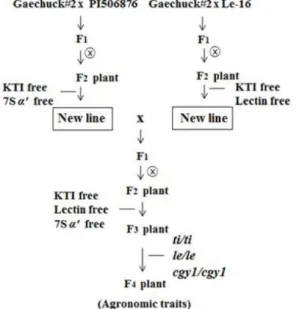
The seeds of Gaechuck#2, PI200508, and Le-16 parents were planted to cross in a greenhouse. The crosses of Gaechuck#2 (titiLeLeCgy1Cgy1) × PI506876 (TiTiLeLecgy1cgy1) and Gae- chuck#2 (titiLeLeCgy1Cgy1) × Le-16 (TiTileleCgy1Cgy1) were made and F
1seeds were obtained. F
1seeds obtained were planted in greenhouse. F
2seeds from F
1plant were har- vested. Two new genotypes (titiLeLecgy1cgy1 and titileleCgy1 Cgy1) were selected from the F
2plant population. The cross of titiLeLecgy1cgy1 x titileleCgy1Cgy1 was made and F
1seeds were obtained. F
1seeds obtained were planted in green- house. F
1hybridity was confirmed on morphological traits.
F
2seeds were harvested. The F
2seeds were analyzed to screen the seed with titilelecgy1cgy1 genotype (KTI, lectin and 7S α' subunit protein free).
Determination of lectin protein by Western blot analysis
Proteins of parent, each F
2seed, random F
3seed and F
4seed were separated by 10% or 12% SDS-PAGE, and trans- ferred on to Immobilon-P membrane (PVDF, Millipore).
After blocking for 2 hr in TBS buffer [20 mM Tris (pH7.5), 150 mM NaCl, and 0.1% Tween 20 ] with 5% nonfat dried milk (Carnation, Glendale, CA) at room temperature, the membrane were incubated with lectin antibody for 1 hr.
After washing in TBS buffer three times, the blot was in-
Fig. 1. Scheme for development of soybean strain with titile- lecgy1cgy1 genotype (KTI protein free, lectin protein free and 7S
α
' subunit protein free).cubated with a horseradish peroxidase conjugated secondary antibody, and the complex was visualized using an en- hanced chemiluminescence kit (Amersham, Bucking-ham- shire, UK). The thickness of band was then determined visually.
Determination of KTI protein by Western blot analysis
Proteins of parent, each F
2seed, random F
3seed and F
4seed were separated by 10% or 12% SDS-PAGE, and trans- ferred onto Immobilon-Pmembrane (PVDF, Millipore). After blocking for 2 hr in TBS buffer [20 mM Tris (pH7.5), 150 mM NaCl, and 0.1% Tween 20] with 5% nonfat dried milk (Carnation, Glendale, CA) at room temperature, the mem- brane were incubated with KTI antibody for 1 hr. After washing in TBS buffer three times, the blot was incubated with a horseradish peroxidase conjugated secondary anti- body, and the complex was visualized using an enhanced chemiluminescence kit (Amersham, Bucking-hamshire, UK).
The thickness of band was then determined visually.
Determination of 7S α'-subunit protein by SDS- PAGE
Crude proteins from parent, each F
2seed, random F
3seed and F
4seed were extracted to determine the presence or ab- sence of α‘-subunit protein of β-conglycinin electrophoreti- cally. A piece of cotyledon from parent and each F
2seed was removed and was incubated for 30 min (at room tem- perature) in 1 ml Tris-HCl, pH8.0, containing 1.56%v/v β- mercaptoethanol. After centrifugation, 50 ul of the super- natant was added to an equivalent amount of 5X sample buffer [10%w/v sodium dodecyl sulfate (SDS), 50%v/v glycerol, 1.96%v/v β-mercaptoethanol, 1M Tris-HCl, pH 6.8]. The samples were boiled at 97
oC for 5 min and then centrifuged.Two microliters of the supernatant were loaded on a 12% acrylamide SDS polyacrylamide gel electro- phoresis (SDS-PAGE) medium gels in Owl Separation Sys- tems Inc (Model:P9DS, Portsmouth, NH, USA). Electropho- resis was performed at 120 V for 7 hr. Gels were stained overnight in an aqueous solution of 0.25 g Coomassie blue R250, 10% acetic acid, and 45% methanol. The gels were then destained with destaining solution (5% acetic acid, 14%
methanol) for several hours. A Wide-Range SDS-PAGE mo- lecular mass standard (Sigma Marker
TM, Product Code:
M4038, St.Louis MO, USA) containing the 72 kDa (for α’-sub- unit) was used to aid recognition of samples lacking the α‘-
subunit of β-conglycinin protein.
Selection of titilelecgy1cgy1 (free of KTI, lectin, and 7S α' subunit proteins) genotype
The F
2seeds with titilelecgy1cgy1 genotype (KTI, lectin and 7S α' subunit protein free) were planted to advance F
2plant generation. F
2plants with a proper agronomic traits were individually harvested. F
3seeds with titilelecgy1cgy1 geno- type were planted to F
3plant generation. F
3plants with a proper agronomic traits were individually harvested. Ran- dom F
4seeds from F
3plants harvested were used to confirm KTI protein free, lectin protein free, and 7S α' subunit protein free. Flower color, plant height, growth habit, 100-seed weight, seed coat color, and hilum color were recorded on the F
4plant generation.
Mean values of plant height and 100-seed weight were compared by Duncan’s multiple range test at the 5% level.
Scheme for development of titilelecgy1cgy1 genotype (KTI, lectin and 7S α' subunit protein free) is presented in Fig. 1.
Results and Discussion
F
1seeds were obtained from the cross of titiLeLecgy1cgy1
× titileleCgy1Cgy1. Genotype of F
1seeds obtained was
titiLeleCgy1cgy1 and lectin and 7S α' subunit proteins were
observed. F
2seeds were harvested from F
1hybrid plant. Both
lectin protein of 120 kDa and 7S α' subunit protein of 72
A
B
C
Fig. 2. Confirmation of Kunitz Trypsin Inhibitor (KTI) protein free (A), lectin protein free (B), and 7S
α
' subunit protein free (C) in the current cultivar (“Daewonkong”) and new strain. C: “Daewonkomg” (TiTiLeLeCgy1Cgy1 geno- type), S: new strain (titilelecgy1cgy1 genotype). +, -: pres- ence and absence of KTI, lectin, and 7Sα
' subunit pro- teins, respectively.Table 2. Agronomic traits of cultivar and new strain developed in this experiment Cultivar/
strain
Flower color
Growth habit
Plant height (cm)
Seed weight (g/100 seed)
Seed coat color
Hilum color
“Daewonkong”
New strain
Purple Purple
Determinate Determinate
46a 58b
29.0a 27.1b
Yellow Yellow
Yellow Buffer a-b: Different letters in the column are significantly different by DMRT at 5%.
A B
Fig. 3. Plant (A) and seed (B) of new soybean strain (titilelec- gy1cgy1 genotype) with Kunitz Trypsin Inhibitor protein free, lectin protein free, and 7S
α
' subunit protein free.kDa were segregated in the F
2seed generation. The 3:1 segre- gation ratios for inheritance of lectin and 7S α' subunit pro- teins were observed in the F
2seed generation. Among F
2seeds obtained, 45 F
2seeds with cgy1cgy1 genotype (7S α' subunit protein free) were selected. Four F
2seeds with titile- lecgy1cgy1 genotype (KTI, lectin and 7S α' subunit protein free) were selected and were planted. This result supports that absence of KTI, lectin, and 7S α‘-subunit proteins was controlled by a single recessive gene [5, 8, 12, 15]. Four F
2plants were individually harvested and two F
2plants with a proper agronomic traits were selected. Two F
3seed strains were planted and one F
3plant strain with a proper agronom- ical traits such as plant type, plant height, seed quality, and 100-seed weight was finally selected. Random F
4seeds were used to confirm absence for KTI, lectin and 7S α' subunit proteins (Fig. 2).
KTI, lectin, and 7S α' subunit proteins were not observed in the mature F
4seed of new strain. However, in the seed of “Daewonkong” cultivar, KTI, lectin, and 7S α ' subunit
proteins were shown (Fig. 2). This result indicates that geno- type of new strain is titilelecgy1cgy1. Agronomic traits such as flower color, growth habit, plant height, 100-seed weight, seed coat color, and hilum color for “Daewonkomg”
(TiTiLeLeCgy1Cgy1 genotype) and new F
4plant strain (titile- lecgy1cgy1 genotype) are presented in Table 2.
New strain has purple flower, determinate growth habit, and light yellow pods at maturity. The seed of new strain has buffer hilum color and yellow seed coat color. Plant height of new strain was 58 cm compared to the “Daewon- kong” cultivar of 46 cm. The 100-seed weight of new strain was 27.1 g smaller than that of "Daewonkong" (29.0 g). Plant type harvested and seed of new strain with titilelecgy1cgy1 genotype (KTI, lectin, and 7S α' subunit proteins free) is shown in Fig. 3.
KTI, lectin, and 7S α' subunit proteins are major anti- nutrients responsible for reducing the nutritional value of unprocessed soybean. Presence of these proteins in mature raw soybean seeds requires heating step to denature the ac- tivity of these antinutritional components. However, ex- cessive heat treatment may lower amino acid availability.
The genetic elimination removal of these components could
be an alternative to the heat treatment. Breeding of soybean
cultivar with free of KTI, lectin, and 7S α' subunit proteins
is needed to improve the nutrition values and to modify
the food processing properties of soybeans. This is the first
new soybean strain with titilelecgy1cgy1 genotype (KTI pro-
tein free, lectin protein free, and 7S α' subunit protein free).
New strain developed in this research will be used to im- prove new yellow soybean cultivar with high quality and function.
Acknowledgement
This research was supported by Korea Institute of Planning and Evaluation for Technology in Food, Agricul- ture and Forestry (Research number:119011-3).
The Conflict of Interest Statement
The authors declare that they have no conflicts of interest with the contents of this article.
References
1. Cregan, P. B., Jarvik, T., Bush, A. L., Shoemaker, R. C., Lark, K. G., Kahler, A. L., Kaya, N., VanToai, T. T., Lohnes, D.
G., Chung, J. I. and Specht, J. E. 1999. An integrated genetic linkage map of the soybean. Crop Sci. 39, 1464-1490.
2. Hajika, M., Takahashi, M., Sakai, S. and Matsunaga, R. 1998.
Dominant inheritance of a trait lacking β-conglycinin de- tected in a wild soybean line. Breed. Sci. 48, 383-386.
3. Hayashi, M., Nishioka, M., Kitamura, K. and Harada, K.
2000. Identification of AFLP markers tightly linked to the gene for deficiency of the 7S globulin in soybean seed and characterization of abnormal phenotypes involved in the mutation. Breed. Sci. 50, 123-129.
4. Hildebrand, D. F., Orf, J. H. and Hymowitz, T. 1980. Inher- itance of anacid phosphatase and its linkage with the Kunitz trypsin inhibitor seed protein of soybeans. Crop Sci. 20, 83- 85.
5. Hymowitz, T. and Hadley, H. H. 1972. Inheritance of a tryp- sin variant in seed protein of soybeans. Crop Sci. 12, 197-198.
6. Kiang, Y. T. 1987. Mapping three protein loci on a soybean chromosome. Crop Sci. 27, 44-46.
7. Kitamura, K. and Kaizuma, N. 1981. Mutant strains with low level of subunits of 7S globulins in soybean seed. Japan J. Breed. 31, 353-359.
8. Kitamura, K., Davies, C. S. and Nielsen, N. C. 1984. Inher
itance of alleles for Cgy1 and Gy4 storage protein genes in soybean. Theor. Appl. Genet. 68, 253-257.
9. Koshiyama, I. 1968. Chemical and physical properties in soybean globulins. Cereal Chem. 45, 394-404.
10. Krober, O. A. and Cartter, J. L. 1962. Quantitative inter- relations of protein and nonprotein constituents of soybeans.
Crop Sci. 2, 171-172.
11. Kunitz, M. 1945. Crystallization of a trypsin inhibitor from soybean. Science 101, 668-669.
12. Lee, K. J., Park, M. S., Sung, M. K., Kim, M. S. and Chung, J. I. 2008. Inheritance between Le gene and Ti gene in soy- bean (Glycine maxL.). Kor. J. Breed Sci. 40, 97-100.
13. Moraes, R. M. A., Soares, T. C. B., Colombo, L. R., Salla, M. F. S., Barros, J. G. A. and Piovesan, N. D. 2006. Assisted selection by specific DNA markers for genetic elimination of the kunitz trypsin inhibitor and lectin in soybean seeds.
Euphytica 149, 221-226.
14. Ogawa, T. E., Tayama, E., Kitamura, K. and Kaizuma, N.
1989. Genetic improvement of seed storage proteins using three variant alleles of 7S globulin subunits in soybean.
Japan J. Breed. 39, 137-147.
15. Orf, J. H., Hymowitz, T., Pull, S. P. and Pueppke, S. G. 1978.
Inheritance of a soybean seed lectin. Crop Sci. 18, 899-900.
16. Orf, J. H. and Hymowitz, T. 1979. Soybean linkage test be- tween Ti and Le seed proteins. Soybean Genet. Newslett. 6, 32.
17. Pull, S. P., Pueppke, S. G., Hymowitz, H. and Orf, J. H. 1978.
Soybean lines lacking the 120,000 daltons seed lectin. Science 200, 1277-1279.
18. Schulze, H., Saini, H. S., Huisman, J., Hessing, M., Berg, W. and Verstegen, M. W. A. 1995. Increased nitrogen secre- tion by inclusion of soya lectin in the diets of pigs. J. Sci.
Food Agriculture 69, 501-510.
19. Schmidt, M. A., Hymowitz, T. and Herman, E. M. 2015.
Breeding and characterrization of soybean triple null; a stack of recessive alleles of kunitz trypsin inhibitor, soybean agglutinin, and p34 allergen nulls. Plant Breed. 134, 310-315.
20. Singh, L., Wilson, C. M. and Hadley, H. H. 1969. Genetic differences in soybean trypsin inhibitors separated by disc electrophoresis. Crop Sci. 9, 489-491.
21. Sung, M. K., Han, S. J., Seo, H. J., Choi, S. W., Nam, S.
H. and Chung, J. I. 2014. Genotype and environment influ- ence on raffinose and stachyose content of soybean seed.
Kor. J. Crop Sci. 59, 319-324.
22. Thanh, V. H. and Shibasaki, K. 1976. Heterogeneity of beta- conglycinin. Biochim. Biophys. Acta 469, 326-328.
초록:쿠니츠트립인히비터, 렉틴 및 7S α' 서버유닛 3가지 단백질이 없는 콩 계통의 개발
채원기․최상우․강경영․정종일*
(경상대학교 농학과)