Marker Assisted Selection-Applications and Evaluation for Commercial Poultry Breeding
Simrinder Singh Sodhi
1,a, Dong Kee Jeong
1,a, Neelesh Sharma
1, Jun Heon Lee
4, Jeong Hyun Kim
1, Sung Hoon Kim
2, Sung Woo Kim
3and Sung Jong Oh
1,*1
Department of Animal Biotechnology, Faculty of Biotechnology, Jeju National University, Jeju 690-756 South Korea.
2
Department of Animal Life and Environment Science, Hankyong National University, Ansung 456-749 South Korea
3
Animal Genetic Resources Station, National Institute of Animal Science, Suwon 441-706, South Korea
4
Department of Animal Science and Biotechnology, Chungnam National University, Daejeon 305-764, South Korea
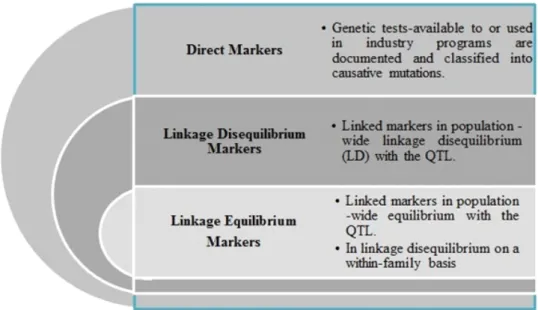
Abstract Poultry industry is abounding day by day as it engrosses less cost of investment per bird as compared to large animals. Poultry have the most copious genomic tool box amongst domestic animals for the detection of quantitative trait loci (QTL) and marker assisted selection (MAS). Use of multiple markers and least square techniques for mapping of QTL affec- ting quality and production traits in poultry is in vogue. Examples of genetic tests that are available to or used in industry programs are documented and classified into causative mutations (direct markers), linked markers in population-wide linkage disequilibrium (LD) with the QTL (LD markers), and linked markers in population wide equilibrium with the QTL (LE markers).
Development of genome-wide SNP assays, role of 42 K, 60 K (Illumina) and 600 K (Affymetrix
®Axim
®) SNP chip with next generation sequencing for identification of single nucleotide polymorphism (SNP) has been documented. Hybridization based, PCR based, DNA chip and sequencing based are the major segments of DNA markers which help in conducting of MAS in poultry. Economic index-marker assisted selection (EI-MAS) provides platform for simultaneous selection for production traits while giving due weightage to their marginal economic values by calculating predicted breeding value, using information on DNA markers which are normally associated with relevant QTL. Understanding of linkage equilibrium, linkage dis-equilibrium, relation between the markers and gene of interest are quite important for success of MAS. This kind of selection is the most useful tool in enhancing disease resistance by identifying candidate genes to improve the immune response. The application of marker assisted selection in selection procedures would help in improvement of economic traits in poultry.
(Key words : chicken genomics, chicken breeding, molecular markers, marker assisted selection, traits)
a
These authors contributed equally to this work.
†