Journal of Asian Finance, Economics and Business Vol 8 No 3 (2021) 1257–1266 1257
Print ISSN: 2288-4637 / Online ISSN 2288-4645 doi:10.13106/jafeb.2021.vol8.no3.1257
Factors Influencing Online Shopping Intention:
An Empirical Study in Vietnam*
Ngoc Thang HA1, Thi Lien Huong NGUYEN2, Thanh Van PHAM3, Thi Hong Tham NGUYEN4
Received: November 30, 2020 Revised: February 01, 2021 Accepted: February 16, 2021
Abstract
The study examines factors that influence shopping intention of online consumers in Vietnam. Studied factors include consumers’ attitude, subjective norms, perception of behavioral control, perception of usefulness, perceived risks and trust. The expansion of Theory of Planned Behavior (TPB) and Technology Acceptance Model (TAM) are used as basic theories. We have surveyed people who have experiences on online shopping. There are 836 selected questionnaires that are qualified for data processing. The collected data are analyzed through a process which starts from scale reliability test to exploratory factor analysis (EFA), correlation analysis and regression analysis. The results show that shopping intention of online consumers are positively affected by their attitude, subjective norms, perception of behavioral control, perception of usefulness and trust. In contrast, online shopping intention is negatively affected by the perceived risks that online shopping could bring. Among those factors, the perception of risk is shown to have the strongest influence to online shopping intention. The findings of this study suggest that managers and retailers can apply cash-on-delivery method and design their website with user-friendly interface to enhance online shopping intention of consumers. The Government is also recommended to fulfill the law system to reduce customers’ perception of financial risks.
Keywords: Attitude, Behavioral Control, Ease of Use, Online Shopping Intention, Subjective Norm JEL Classification Code: E21, F18, N45, N75
1. Introduction
With the development of technology and media, online shopping has become one of the most popular shopping methods in the recent years (Lim et al., 2016; Wu et al., 2011). The number of online shopping consumers and online shopping revenue has continuously increased over the years (Ozen & Engizek, 2014). Processed through the internet,
*Acknowledgments:
This research is funded by National Economics University, Hanoi, Vietnam.
1First Author and Corresponding Author. Senior Lecturer, National Economics University, Vietnam [Postal Address: No. 207 Giai Phong Street, Dong Tam Ward, Hai Ba Trung District, Hanoi, 10000, Vietnam] Email: [email protected]
2Lecturer, National Economics University, Hanoi, Vietnam.
Email: [email protected]
3Lecturer, National Economics University, Hanoi, Vietnam.
Email: [email protected]
4Lecturer, National Economics University, Hanoi, Vietnam.
Email: [email protected]
© Copyright: The Author(s)
This is an Open Access article distributed under the terms of the Creative Commons Attribution Non-Commercial License (https://creativecommons.org/licenses/by-nc/4.0/) which permits unrestricted non-commercial use, distribution, and reproduction in any medium, provided the original work is properly cited.
the online shopping has more advantages than traditional shopping ways available anywhere and anytime (Lester et al., 2005); saving time (Abbad et al., 2011; Morganosky &
Cude, 2000); having a wide range of products (Delafrooz et al., 2011; y Monsuwé et al., 2004) and saving cost by buying products at lower prices (Choi & Park, 2006; Elliot & Fowell, 2000; Lester et al., 2005; Walsh & Godfrey, 2000). Previous studies which were based on Technology Acceptance Model - TAM (Davis et al., 1989) prove that these benefits are one of the most important and positively influencing factors to intention (Aziz & Wahid, 2018; Gefen et al., 2003a; Ha et al., 2019; Lim et al., 2016). Beside the perception of usefulness, studies which uses TAM of Davis et al. (1989) also show that the ease of use also influences the shopping intention of online consumers (Gefen et al., 2003a; Gefen et al., 2003b;
Ha, 2020; Ha et al., 2019; Lin, 2007). Besides TAM, many studies also use the Theory of Planned Behavior – TPB (Ajzen, 1991) to investigate shopping intention of online consumers.
According to TPB, consumers’ shopping intention is affected by attitude, subjective norms and perceived behavioral control. However, most previous studies have been done in the developed countries (Slade et al., 2015), which have fully
developed technology infrastructure, more positive attitude, higher level of control behavior and lower perceived risks for online shopping (Hanafizadeh et al., 2014; Malaquias
& Hwang, 2016). There are many evidences that consumer influential factors that are different among developed and developing countries. (Hanafizadeh et al., 2014; Malaquias
& Hwang, 2016). Besides that, the results of previous studies still contain many inconsistencies, which need further examination in specific contexts.
In Vietnam, the rate of consumers who participated in online shopping are still lower than other countries in the same region and in the world (Ministry of Industry and Trade, 2015). The lack of trust is one of the main barriers that lower the online shopping portion of Vietnamese consumers (Cimigo, 2012; Ha & Nguyen, 2015). The lack of trust is also affirmed as one of the main reasons that prevent consumers from shopping online (Jarvenpaa et al., 2000; Lee & Turban, 2001; y Monsuwé et al., 2004). If consumer trust is not built, online transaction could not happen (Bart et al., 2005;
Winch & Joyce, 2006). Therefore, consumer trust to online sellers is the basis of online shopping activities (Chen &
Chou, 2012; George, 2004). The trust is considered to be the central element in all exchanging relationships (McKnight et al., 2002), and a major factor that influences consumer behavior in both online and traditional shopping (Winch &
Joyce, 2006). In online shopping, trust plays a particularly important role as consumers’ perception of transaction risks in online environment is higher when consumers don’t have direct interaction with sellers as well as products they intend to buy (Jarvenpaa et al., 2000; Pavlou, 2003; Verhagen et al., 2006). Possible risks consumers may encounter in online shopping include financial risks and product risks (Bhatnagar et al., 2000). However, in previous studies, there are still many conflicting conclusions about the impacts of perceived risks on consumers’ online shopping intention.
Shopping intention is one of two decisive factors that influence consumers’ shopping behaviors (Ajzen, 1991).
Therefore, to persuade online consumers to consume more, online retailers need to identify factors that hinder and promote consumers’ online shopping intention (Lohse et al., 2000). In order to have better understanding of factors that influence Vietnamese consumers’ shopping intention, this research would combine TAM with the TPB and add 2 factors, including perceived risk and trust. The study contributes to the literature review by providing greater explanatory power for investigating the question of why consumers decide to use online shopping in Vietnam. On the other hand, this research also examines inconsistent relationships in previous studies.
2. Literature Review and Hypothesis
Shopping intention is one of two factors that affect the shopping behavior of the consumers. (Blackwell et al., 2001).
It is a factor that is used to evaluate the likelihood of future behavior (Blackwell et al., 2001). According to Ajzen (1991), intention is one of the motivating factors that motivates one person to process an action. Meanwhile, Akbar et al. (2014) argues that intention is a specific purpose of consumers while processing one or a series of actions. Consumers may have many different intentions, including shopping intention. According to Blackwell et al. (2001), shopping intention is a plan to choose where to buy products of consumers. Based on that, Delafrooz et al. (2011) considers online shopping intention as the strength of a consumer’s intentions to perform a specific purchasing behavior via Internet (Delafrooz et al., 2011).
According to Ajzen (1991), intention to perform behaviors is directly affected by attitude toward the behavior, subjective norms and perceived behavior control. Attitude is defined as the degree to which a person has a favorable or unfavorable evaluation of the behavior (Ajzen, 1991). In the context of online shipping, attitude refers to the general consumer feelings of favorableness or unfavourableness towards the use of internet to buy products from retail websites. (Lin, 2007). Consumer attitude influences their intention (Fishbein & Ajzen, 1975). In the context of online shopping, the shopping attitude of consumers is proved to have positive relationship with their buying intention (Ha, 2020; Ha et al., 2019; Yoh et al., 2003). This relationship is also supported by many empirical studies (Ha, 2020; Ha et al., 2019; Lin, 2007; Pavlou & Fygenson, 2006). Therefore, the proposed hypothesis is:
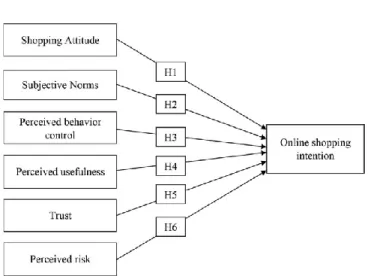
H1: The shopping attitude of online customers has positive impact on their shopping intention.
Subjective norms refer to individual perceived social pressure to perform or not perform a behavior (Ajzen, 1991).
Previous studies show that there is a positive correlation between subjective norms and intentions. (Bhattacherjee, 2000; Hansen et al., 2004; Yoh et al., 2003). In the context of online shopping, subjective norms reflect consumer perceptions about the use of online shopping by the influence of referent group, such as friends and colleagues.
(Lin, 2007). However, the relationship between subjective norms and shopping intention has not been consistent. There are still many certain contradictions among previous studies.
According to Bonera (2011), online shopping intention of online consumers is not affected by the opinions of the referent group. Meanwhile, some studies demonstrate that the opinions of referent group have a positive impact on shopping intention of online customers. (Ha, 2020; Ha et al., 2019; Lin, 2007). Other studies about consumer behavior suggest that the opinions of referent group have great impact on consumer behavior (Blackwell et al., 2001). Therefore, the second proposed hypothesis is:
Journal of Asian Finance, Economics and Business Vol 8 No 3 (2021) 1257–1266 1259
H2: Subjective norms of consumers have positive impact on their online shopping intention.
Perceived behavior control (PBC) is defined as personal perceived ease or difficulty of performing the behavior (Ajzen, 1991). Perceived ease of use is defined as the degree to which a person believes that using a particular system would be free of effort (Davis, 1989). Therefore, perceived behavior control in TPB is similar to the perceived ease of use in TAM (Ha & Nguyen, 2016). In the online shopping context, perceived behavior control describes consumers’ perception of the availability of necessary resources, knowledge and opportunities to go shopping online (Lin, 2007). In online shopping, perceived behavior control is approved to have positive impacts on online consumers’ intention (Lin, 2007).
Therefore, the third proposed hypothesis is:
H3: Perceived behavior control has positive impact on their online shopping intention.
According to Davis (1989), consumers’ intention is also affected by their perception of usefulness. Perceived usefulness is the degree to which a person believes that using a particular system would enhance his or her performance (Davis, 1989). In the online shopping context, perceived usefulness refers to a degree in which an individual consumer believes that online shopping would enhance the effectiveness of their shopping (Shih, 2004). There are evidences which prove that online shopping intention is significantly affected by perceived usefulness (Gefen et al., 2003a; Ha, 2020; Ha & Nguyen, 2013; Ha et al., 2019).
Therefore, the forth proposed hypothesis is:
H4: Perceived usefulness has positive impact on online shopping intention.
Trust is the expectation that other individuals or companies with whom one interacts will not take undue advantage of a dependence upon them. That is the belief that all related parties would behave in an ethical, dependable and social appropriate manner and would fulfill their expected commitments (Gefen et al., 2003b). In the online shopping context, McKnight et al. (2002) believes that the trust is the readiness to accept vulnerability (risks) from online retail websites after gathering information about them. Or trust can be the readiness to accept vulnerability (risks) to make purchase with online retailers (Lee & Turban, 2001). Trust is a central element in exchange relationships (McKnight et al., 2002) and a factor that has significant impact on consumers’
behavior in both online and traditional shopping (Ha et al., 2019; Winch & Joyce, 2006). In the online shopping context, trust plays a particularly important role as the consumer’s perception of transaction risk in online environment is
higher when the buyer doesn’t have direct interaction with seller as well as products they intent to buy (Jarvenpaa et al., 2000; Pavlou, 2003; Verhagen et al., 2006). Previous studies show that consumer trust to one retail website is an important factor that impacts on shopping intention (Gefen et al., 2003a; Gefen et al., 2003b; Ha et al., 2019; Pavlou, 2003). The lack of trust is acknowledged as one of the main reasons that prevent consumers from shopping online. (Ha
& Nguyen, 2014; Jarvenpaa et al., 2000; Y Monsuwé et al., 2004). Therefore, the proposed hypothesis is:
H5: Consumer trust on one retail website has positive impact on customer’s online shopping intention.
Perceived risk refers to consumer’s perception of uncertainty and the negative consequences of participating in some specific activities (Dowling & Staelin, 1994). More specifically, Mayer et al. (1995) argues that risk perception is customers’ perception of the possibility of gain or loss in transactions with stores/distributors. In online shopping, instead of direct contact, buyers use internet to contact with suppliers, so there are many potential risks. The risks that online customers may encounter include: economical risks (financial loss, loss of money), risk from sellers, risk of privacy (personal information can be illegally revealed) and risk of security (information of credit cards may be stolen) (Pavlou, 2003). In the context of online shopping, the relationship between risk perception and online shopping intention is not consistent in previous studies. Gefen et al. (2003b) does not find the effect of risk perception on shopping intention of online consumers. Meanwhile, some studies prove that risk perception has a negative relationship with online shopping intention (Ha, 2020; Tham et al., 2019;
Hsin Chang & Wen Chen, 2008). Therefore, the proposed hypothesis is:
H6: Perceived risk has negative relationship with customer’s online shopping intention.
Basing on these above hypothesis, the proposed research model is:
3. Research Method
3.1. QuestionnaireQuestionnaire is established based on the above literature review and adjusted to make it suitable in the context of Vietnam. The scales of research variables are based on previous studies. In this research, attitude to online shopping refers positive or negative reviews of consumers while using internet to purchase products and services from retail websites. Therefore, in this research, attitude is measured
Figure 1: Proposed Research Hypothesis
by the scale in the research of Pavlou and Fygenson (2006).
Meanwhile, subjective norms refer to consumers’ perspective of online shopping through the opinions of stakeholders.
Online shopping intention refers the likelihood of consumers in making future online shopping. Therefore, in this research, subjective norms and shopping intentions are measured by scales from Lin’s research (2007). This scale was adjusted from the original scale of Pavlou and Fygenson (2006) by Lin (2007) to be suitable with online shopping context.
Variable “perceived behavior control” is considered from the individual perspectives of how easy or difficult to perform online shopping behavior. It relates to the perception of the availability of resources and knowledge to perform behavior.
Variable “perceived usefulness” is considered from benefits that consumers gain while shopping online. Therefore,
“perceived behavior control” and “perceived usefulness” are measured by Lin’s scale (2007), which was adjusted from original scale of Davis (1989) to make it suitable with online shopping context. Variable “trust” in this research means the readiness to accept possible risks from retail online website.
Therefore, it is measured by scale from Jarvenpaa et al.
(2000) and McKnight et al. (2002). Variable “perceived risk”
is considered as consumers’ perception of possible gain and loss in online transaction with online retailers. Therefore, in this research, “perceived risk” is measured by scale of Forsythe et al. (2006) and Corbitt et al. (2003). All variables are measured by Likert scale from 1 to 7.
Before conducting the research on large scale, the questionnaires are sent to 30 customers for testing. After testing, some questions are adjusted to avoid misunderstanding the meaning of questions and to encourage the response.
3.2. Data Collection and Sample Characteristics Sample research has been done on people who have experiences on using internet for online shopping in Vietnam.
Table 1: Characteristics of Research Samples (n = 836)
Characteristics Quantity Ratio (%) Gender
Male 385 46.1
Female 451 53.9
Academic Level
High school 231 27.6
College 177 21.2
Undergraduate 240 28.7
Graduate 184 22.0
Others 4 0.5
Average income per month
≤ 10.000.000 VND 481 57.5
> 10.000.000 VND 355 42.5
Age
From 18 to 25 288 34.4
From 26 to 35 254 30.4
From 36 to above 294 35.2
Questionnaires are sent directly to respondents through mails and emails. There are 1,162 filled questionnaires, in which 326 questionnaires are invalid and removed before collecting data. Therefore, the valid questionnaire that are used to analyze are 836. The characteristics of research samples are as follows:
In these research samples, 70% samples have academic level that is equal and higher than collage, 64% samples are between the ages of 18 to 25. These samples are suitable with in the context of the research and is a representative sample in the context of thhe reaesrch. According to the previous studies of innovation, especially research about information and communication technology (ICT) and services that uses ICT as an intermediary, like computers, internet and online payment, users tend to be younger (Rogers, 1995).
Meanwhile, this research focuses on online shopping intention. In order to shop online, customers are usually young people with high education, who have opportunities to access and use internet regularly.
3.3. Data Analysis Method
After collecting response and removing invalid questionnaires, the data is encoded and analyzed by SPSS.
The process of analyzing data includes the following steps:
reliability testing, factor analysis, correlation analysis and regression analysis.
In each factor, the reliability of research scale is tested by Cronbach’s Alpha coefficient. The purpose of this testing is to
Journal of Asian Finance, Economics and Business Vol 8 No 3 (2021) 1257–1266 1261
find out if observed variables measure the same concept or not.
By doing this, the authors can remove inappropriate variables in the research model. According to Hoang and Chu (2008), Cronbach’s Alpha coefficients of 0.8 to nearly 1 is good, of 0.7 to 0.8 is usable. The scale needs to have a Corrected Item – Total Correlation coefficient of 0.3 and more (Hair et al., 2010).
EFA is used for all observed variables Varimax rotation, eigenvalue > 1.0 to find representative factors for variables.
According to Hair et al. (2010), standards of analyzing EFA include: (i) KMO with value from 0.5 to 1; (ii) Observed variables with factor loading coefficient greater than 0.3 are retained, factor loading coefficients smaller than 0.3 are removed; (iii) Total Varicance Explained > 50%; and (iv) Eigenvalue > 1.
After testing the reliability of scales and EFA analysis, satisfactory scales are determined for the mean value and controlled variables are coded for correlation analysis. The researcher uses Pearson’s correlation coefficient (r) to check the linear relationship among factors. If the correlation coefficient between the dependent and independent variables is large, it proves that they are related to each other and can be suitable for linear regression analysis. The absolute value of r tells us how strict a linear relationship is. The closer the absolute value of r is to 1, the more closely correlated the two variables are and vice versa.
After coefficient analysis, the researcher conducts multivariate regression analysis by Enter method with the significant level of 5% to test research hypotheses, the relevance of model as well as the influence of variables on dependent variables. Like previous studies, linear regression analysis is used instead of nonlinear regression analysis.
The regression method used in this study is ordinary least squares (OLS). Adjusted coefficient R2 is used to determine the suitability of model, the F-test is used to confirm the scalability of model, t-test is used to remove the hypothesis that the total regression coefficient is equal to 0.
4. Research Results
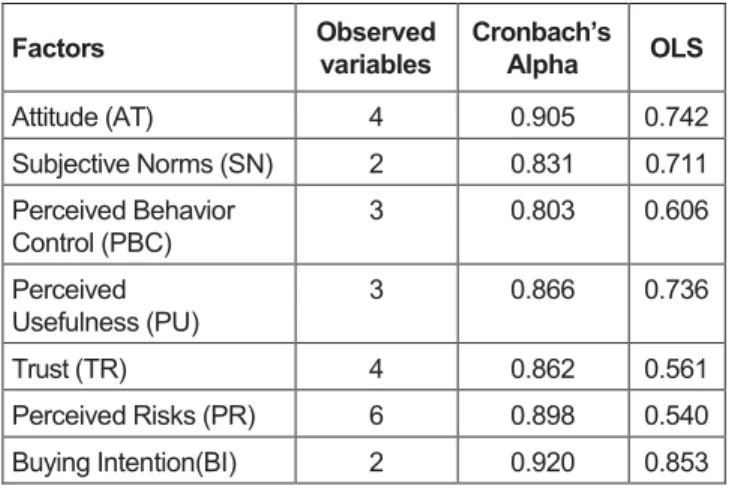
4.1. Reliability of ScalesThe reliability of scales is determined by Cronbach’s Alpha coefficients. The results of Cronbach’s Alpha are larger than 0.8 and the total variable correlation coefficients are greater than 0.5. It means scales of all definitions assure the requirements of reliability (Hoang & Chu, 2008).
4.2. Exploratory Factor Analysis
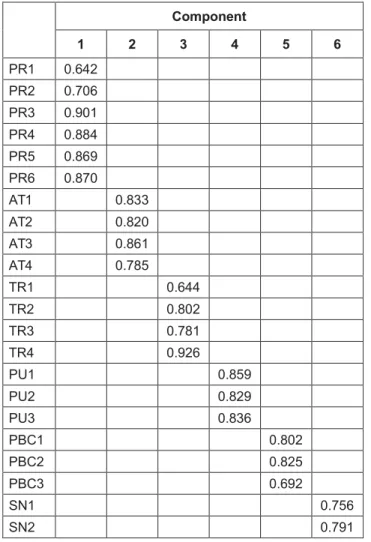
The compatibility of research sample is measured by factor analysis for independent variables, Varimax rotation, KMO (Kaiser-Meyer-Olkin) Test and Bartlett Test. The results of exploratory factor analysis are as follows: KMO
Table 2: Testing Results of Scale Reliability
Factors Observed
variables
Cronbach’s Alpha OLS
Attitude (AT) 4 0.905 0.742
Subjective Norms (SN) 2 0.831 0.711
Perceived Behavior Control (PBC)
3 0.803 0.606
Perceived Usefulness (PU)
3 0.866 0.736
Trust (TR) 4 0.862 0.561
Perceived Risks (PR) 6 0.898 0.540
Buying Intention(BI) 2 0.920 0.853
and Bartlett test has the value of 0.801, which is within allowable range from 0.5 to 1. Besides that, 22 observations coverage 6 factors with factor loads > 0.6. Based on collected data from EFA analysis, the data is appropriate for factor analysis. Therefore, all observations are kept in this model.
4.3. Correlation Analysis
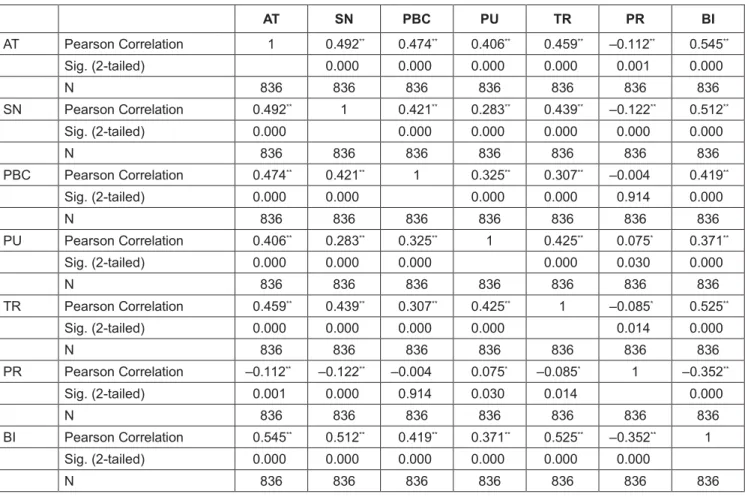
Pearson correlation coefficient is used to analyze the correlation between quantitative variables. The correlation variables show that all relationships between dependent variables and independent variables are statistically significant.
On the other hand, the value of correlation coefficients ensures that there is no multicollinearity phenomenon. Thus, it is possible to use other statistics to test the relationship between the variables.
4.4. Hypotheses Testing
When all independent variables are included in the research model, the model is statistically significant with adjusted R2
= 0.528; F = 156.873; p = 0.000 < 0.05. According to this result, factors “attitude”, “subjective norms”, “perceived behavior control”, “perceived usefulness” and “trust” have standardized Beta coefficient > 0 and p < 0.05. Therefore, shopping intention of online consumers is positively impacted by “attitude”, “subjective norms”, “perceived behavior control”, “perceived usefulness” and “trust”. As a result, hypothesis H1, H2, H3, H4 and H5 are accepted.
Meanwhile, factor “perceived risk” has standardized Beta coefficient < 0 and p < 0.05, so it can be concluded that shopping intention of online consumers has negative impact on “perceived risk”, which means the riskier customers feel, the less they make online shopping. Therefore, hypothesis H6 is accepted.
Table 3: Rotated Component Matrixa
Component
1 2 3 4 5 6
PR1 0.642 PR2 0.706 PR3 0.901 PR4 0.884 PR5 0.869 PR6 0.870
AT1 0.833
AT2 0.820
AT3 0.861
AT4 0.785
TR1 0.644
TR2 0.802
TR3 0.781
TR4 0.926
PU1 0.859
PU2 0.829
PU3 0.836
PBC1 0.802
PBC2 0.825
PBC3 0.692
SN1 0.756
SN2 0.791
5. Discussion and Implications
The research is based on the expansion of Theory of Planned Behavior (TPB) and Technology Acceptance Model (TAM). Variables “trust” and “perceived risk” are added to find out factors that influence the shopping intention of online customers in emerging markets like Vietnam. Results confirm the reliability and suitability of the research model.
Besides testing factors by original models of TPB and TAM, factor “trust” and “perceived risk” are found to have direct and significant impact on shopping intention of online consumers. On the other hand, this research also tests some correlations that are unclear in previous studies. Therefore, this study has some important theoretical and practical contributions.
This study shows the consistency with previous studies in using TPB and TAM to explain different behavior of consumers Furthermore, this research re-confirms the
relevance of TPB and TAM in researching consumers’
behavior in online shopping context of transforming markets like Vietnam.
The results of this research have proved that the attitude of consumers to online shopping has positive impact on their shopping intention. The better attitude consumers have towards a website/online store, the more they intend to shop in that website/store. This result is consistent with previous studies like Lin (2007), Bigne-Alcaniz et al. (2008) and so on.
Different from Bonera (2011), this study shows that shopping intention of online customers is also affected by subjective norms. Subjective norms are personal perception of one individual about social pressure to perform a behavior.
In e-commerce, subjective norms reflect consumers’
perception about the influence of reference group on online shopping ability (Lin, 2007). Research results show that the opinion of reference group has a positive relationship with shopping intention of online customers. It also means the more reference group encourage online shopping, the higher online customers tend to shop online and vice versa. This result is similar to the research of Lin (2007).
On the other hand, research results prove that shopping intention of online customers is also positively affected by perceived behavior control. When customers perceive that they have all the necessary conditions for online shopping, their shopping intention would improve and vice versa. This result is similar to the research of Lin (2007).
Along with these above factors, shopping intention of online consumers is also positively affected by perceived usefulness that online shopping can provide to consumers.
The benefits of online shopping include time-saving, cheaper prices, easier product comparison and the removal of geographical barriers. Shopping intention of online customers is also higher if they can perceive the benefits that shopping online can bring to them. This result is similar to the results of some of the previous studies (Gefen et al., 2003a).
While Gefen et al. (2003b) could not find any relationship between perceived risk and online shopping intention, the results of this study show that perceived risk has the strongest negative impact on online shopping intention of customers. This result is similar to the results of Hsin & Wen (2008) and Tran (2020). Moreover, the results also show that the perception of risk is the most influential factor to online shopping intention. Perceived risk refers consumers’
perception of the uncertainty and negative consequences while shopping online in a website. Risks in online shopping include financial risks (loss of money), risks of products (unexpected products), risks from sellers, risks of privacy (personal information can be illegally revealed) and risk of security (personal information may be stolen). In online shopping, buyers don’t have direct contact with suppliers as
Journal of Asian Finance, Economics and Business Vol 8 No 3 (2021) 1257–1266 1263
Table 4: Correlations
AT SN PBC PU TR PR BI
AT Pearson Correlation 1 0.492** 0.474** 0.406** 0.459** –0.112** 0.545**
Sig. (2-tailed) 0.000 0.000 0.000 0.000 0.001 0.000
N 836 836 836 836 836 836 836
SN Pearson Correlation 0.492** 1 0.421** 0.283** 0.439** –0.122** 0.512**
Sig. (2-tailed) 0.000 0.000 0.000 0.000 0.000 0.000
N 836 836 836 836 836 836 836
PBC Pearson Correlation 0.474** 0.421** 1 0.325** 0.307** –0.004 0.419**
Sig. (2-tailed) 0.000 0.000 0.000 0.000 0.914 0.000
N 836 836 836 836 836 836 836
PU Pearson Correlation 0.406** 0.283** 0.325** 1 0.425** 0.075* 0.371**
Sig. (2-tailed) 0.000 0.000 0.000 0.000 0.030 0.000
N 836 836 836 836 836 836 836
TR Pearson Correlation 0.459** 0.439** 0.307** 0.425** 1 –0.085* 0.525**
Sig. (2-tailed) 0.000 0.000 0.000 0.000 0.014 0.000
N 836 836 836 836 836 836 836
PR Pearson Correlation –0.112** –0.122** –0.004 0.075* –0.085* 1 –0.352**
Sig. (2-tailed) 0.001 0.000 0.914 0.030 0.014 0.000
N 836 836 836 836 836 836 836
BI Pearson Correlation 0.545** 0.512** 0.419** 0.371** 0.525** –0.352** 1
Sig. (2-tailed) 0.000 0.000 0.000 0.000 0.000 0.000
N 836 836 836 836 836 836 836
**, Correlation is significant at the 0.01 level (2-tailed).
*, Correlation is significant at the 0.05 level (2-tailed).
Table 5: Results of Regression Analysis of Factors that Affect Intention
well as products before they decide to buy. Buyers are more familiar with using direct contact to evaluate products in traditional transaction; therefore, evaluating products through imagines from online website is quite strange to them. As a result, they may feel that online shopping contains many potential risks. If the consumers feel that the online website contains risks, their shopping intention decreases and vice versa. On the other hand, online shopping in Vietnam is in the beginning stage and the legal protection for consumers is still low. This situation increases the consumers’ perception of risks in online shopping. Therefore, it is suitable with Vietnamese context where risk has the highest influence on shopping intention of online consumers.
In contrast to the perceived risk, the research has proved that trust has a positive impact on shopping intention of consumers. Trust is a central element in exchange relationships, it is characterized by the uncertainty and vulnerability (McKnight et al., 2002). In the online shopping Independent Variables B Beta Sig.
(Constant) 1.955 0.000
Attitude 0.243 0.203 0.000
Subjective Norms 0.196 0.183 0.000
Perceived Control Behavior 0.139 0.135 0.000
Usefulness 0.111 0.115 0.000
Trust 0.254 0.237 0.000
Perceived Risk –0.309 –0.295 0.000
F value of the Model 156.873
R Square 0.532
Adjusted R Square 0.528
Sig. Value of the Model 0.000
context, trust plays a particularly important role because the consumer’s perception of transaction risk in online environment is higher when the buyer doesn’t have direct interaction with seller as well as products they intend to buy.
Therefore, the lack of trust is acknowledged as one of the main reasons that prevent consumers from shopping online.
As a result, when the trust is established, the shopping intention will be higher and vice versa. This result is similar to the results of Gefen et al. (2003b) and Pavlou (2003).
From a practical perspective, this research can help managers and retailers to enhance online shopping intention of consumers.
Firstly, retailers need to reduce perceived risks of consumers. As the research has proved, perceived risk is the most influential factor to online shopping intention.
Therefore, retailers need to find suitable solutions to reduce perceived risks to improve consumers’ shopping intention.
For financial risks, many consumers are concerned that they can lost their money without receiving their products as they have to pre-pay. So retailers can apply cash-on-delivery method (COD). This payment method would provide consumers the same shopping experiment as traditional shopping. Consumers are no longer concerned of losing money without receiving products with this payment method.
Moreover, this payment is quite suitable in the context of Vietnam, while the majority of consumers are still having the habit of using cash in commercial transactions. (Ministry of Industry and Trade, 2012). Therefore, this payment method can help retailers achieve many goals such as reducing perceived risks and improving perceived behavior control. In addition, this payment method can reduce risks of products for consumers. Consumers can check products before paying like traditional shopping, so they can refuse to pay if the products don’t like sellers’ commitment. The acceptance of payment on delivery also helps companies to establish consumers’ trust.
Secondly, online retailers should design their website with user-friendly and beautiful interface so the consumers can easily understand and manipulate (Giao, 2020). The research shows that the perception of behavioral control has positive impact on online consumers’ attitude and shopping intention; therefore, shopping intention of one consumer will be enhanced if that website has a friendly and convenient interface that allows consumers to shop online without extra help of another person. Shopping websites need to have reasonable arrangement, integrate searching and comparing tools to help consumers find suitable products that satisfy their needs most. Moreover, in current globalization context, online retailers may have both domestic and foreign consumers, so websites need to be displayed in multi languages to fit with the needs to different consumers.
Thirdly, to minimize the consumers’ perception of financial risks in online shopping, the Government need
to fulfill the law system to protect online consumers. The better the law can protect consumers’ interests, the more online consumers are encouraged to make online shopping.
(Sadi & Al-Khalifah, 2012). In this current situation, there are many cases consumers are cheated by online sellers (like making payment but not receiving goods, or receiving poor quality products which are different from sellers’
original commitment). However, consumers don’t know the person they can claim, or claiming time can be lengthened.
In some cases, consumers don’t have enough evidences to sue. Therefore, fulfilling the law system plays a critically important role as it is the basis to change the traditional buying habits of consumers (Tran, 2008).
Beside the above findings, this paper also faces the following limitation. Within the context of online shopping, the risks that consumer may face include financial risks, seller risks, privacy risks, security risks and so on (Pavlou, 2003). However, this paper can only study financial risks and product risks. Hence in the future, this research can be extended to research the impact of security and privacy risks to consumers’ online shopping intention.
References
Abbad, M., Abbad, R., & Saleh, M. (2011). Limitations of e- commerce in developing countries: Jordan case. Education, BusinessandSociety:ContemporaryMiddleEasternIssues,4(4), 280–291. https://doi.org/10.1108/17537981111190060 Ajzen, I. (1991). The theory of planned behavior. Organizational
Behavior and Human Decision Processes, 50(2), 179–211.
https://doi.org/10.1016/0749-5978(91)90020-t
Akbar, W., Hassan, S., Khurshid, S., Niaz, M., & Rizwan, M. (2014).
Antecedents Affecting Customer’s Purchase Intentions towards Green Products. Journal of Sociological Research, 5(1), 273- 289. https://doi.org/10.5296/jsr
Aziz, N. N. A., & Wahid, N. A. (2018). Factors influencing online purchase intention among university students. International Journal of Academic Research in Business and Social Sciences, 8(7), 702–717. http://dx.doi.org/10.6007/IJARBSS/
v8-i7/4413
Bart, Y., Shankar, V., Sultan, F., & Urban, G. L. (2005). Are the drivers and role of online trust the same for all web sites and consumers? A large-scale exploratory empirical study. Journal of Marketing, 69(4), 133–152. https://doi.org/10.1509/
jmkg.2005.69.4.133
Bhatnagar, A., Misra, S., & Rao, H. R. (2000).
On risk, convenience, and Internet shopping behavior. Communications of the ACM, 43(11), 98–105.
https://doi.org/10.1145/353360.353371
Bhattacherjee, A. (2000). Acceptance of e-commerce services: the case of electronic brokerages. Systems, Man and Cybernetics, Part A: Systems and Humans, IEEE Transactions on, 30(4), 411–420. https://doi.org/10.1109/3468.852435
Journal of Asian Finance, Economics and Business Vol 8 No 3 (2021) 1257–1266 1265
Bigne-Alcaniz, E., Ruiz-Mafe, C., Aldas-Manzano, J., & Sanz- Blas, S. (2008). Influence of online shopping information dependency and innovativeness on internet shopping adoption. Online Information Review, 32(5), 648–667. https://
doi.org/10.1108/14684520810914025
Blackwell, R. D., Miniard, P. W., & Engel, J. F. (2001). Consumer behavior (9th ed.). New York: Dryden.
Bonera, M. (2011). The propensity of e-commerce usage: the influencing variables. Management Research Review, 34(7), 821–837. https://doi.org/10.1108/01409171111146706 Chen, Y. T., & Chou, T. Y. (2012). Exploring the continuance
intentions of consumers for B2C online shopping: Perspectives of fairness and trust. Online Information Review, 36(1), 104–125. https://doi.org/10.1108/14684521211209572 Choi, J., & Park, J. (2006). Multichannel retailing in Korea: Effects
of shopping orientations and information seeking patterns on channel choice behavior. International Journal of Retail
& Distribution Management, 34(8), 577–596. https://doi.
org/10.1108/09590550610675912
Cimigo. (2012). Vietnam Net Citizens Report 2012, Ho Chi Minh City.
Corbitt, B. J., Thanasankit, T., & Yi, H. (2003). Trust and e- commerce: a study of consumer perceptions. Electronic Commerce Research and Applications, 2(3), 203–215. https://
doi.org/10.1016/s1567-4223(03)00024-3
Davis, F. D. (1989). Perceived usefulness, perceived ease of use, and user acceptance of information technology. MIS quarterly, 319–340.
Davis, F. D., Bagozzi, R. P., & Warshaw, P. R. (1989). User acceptance of computer technology: a comparison of two theoretical models. Management Science, 35(8), 982–1003.
https://doi.org/10.1287/mnsc.35.8.982
Delafrooz, N., Paim, L. H., & Khatibi, A. (2011). A Research Modeling to Understand Online Shopping Intention. Australian Journal of Basic & Applied Sciences, 5(5), 70–77. http://psasir.
upm.edu.my/id/eprint/22629/
Dowling, G. R., & Staelin, R. (1994). A model of perceived risk and intended risk-handling activity. Journal of Consumer Research, 21, 119–134. https://doi.org/10.1086/209386
Elliot, S., & Fowell, S. (2000). Expectations versus reality: a snapshot of consumer experiences with Internet retailing. International Journal of Information Management, 20(5), 323–336. https://
doi.org/10.1016/s0268-4012(00)00026-8
Fishbein, M., & Ajzen, I. (1975). Belief, attitude, intention and behavior: An introduction to theory and research. Boston, MA:
Addison-Wesley.
Forsythe, S., Liu, C., Shannon, D., & Gardner, L. C. (2006).
Development of a scale to measure the perceived benefits and risks of online shopping. Journal of Interactive Marketing, 20(2), 55–75. https://doi.org/10.1002/dir.20061 Gefen, D., Karahanna, E., & Straub, D. W. (2003a). Trust and TAM
in online shopping: an integrated model. MIS Quarterly, 27(1), 51–90. https://doi.org/10.2307/30036519
Gefen, D., Karahanna, E., & Straub, D. W. (2003b). Inexperience and experience with online stores: the importance of TAM and trust. Engineering Management, IEEE Transactions on, 50(3), 307–321. https://doi.org/10.1109/tem.2003.817277
George, J. F. (2004). The theory of planned behavior and Internet purchasing. Internet Research, 14(3), 198–212. https://doi.
org/10.1108/10662240410542634
Giao, H. N. K (2020), Customer satisfaction at Tiki. vn E-commerce Platform, The Journal of Asian Finance, Economics and Business, 7(4), 173–183. https://doi.org/10.13106/jafeb.2020.
vol7.no4.173
Ha, N. T. (2020). The impact of perceived risk on consumers’
online shopping intention: An integration of TAM and TPB.
Management Science Letters, 10(9), 2029–2036. https://doi.
org/10.5267/j.msl.2020.2.009
Ha, N. T., & Nguyen T. D. (2013). The factors drive customers to shop online in Vietnam. Journal of Economics and Development, Special issue, 91–96.
Ha, N. T., & Nguyen T. D., (2014). Factors that prevent customers from online shopping in Vietnam. Journal of Economics and Development, 203(II), 61–69.
Ha, N. T., & Nguyen T. D. (2015). The influence of perceived risk, reputation and reference group on Vietnamese consumers’ trust in online shopping. Journal of Economics and Development, 217 (II), 16–23.
Ha N. T., & Nguyen T. L. H. (2016). Factors influencing Vietnamese consumers’ online shopping intention: An integration of TAM and TPB with risk and trust. In: International conference: The economy of Vietnam in the integration period: opportunities and challenges, Vietnam, 737–749.
Ha, N. T., Nguyen, T. L. H., Nguyen, T. P. L., & Nguyen, T. D.
(2019). The effect of trust on consumers’ online purchase intention: An integration of TAM and TPB. Management Science Letters, 9(9), 1451–1460. https://doi.org/10.5267/j.
msl.2019.5.006
Hair, J. F., Black, W. C., Babin, B. J., Anderson, R. E., & Tatham, R. L. (2010). Multivariate data analysis (7th Edition). Upper Saddle River, NJ: Pearson Prentice Hall.
Hanafizadeh, P., Behboudi, M., Koshksaray, A. A., & Tabar, M. J. S. (2014). Mobile-banking adoption by Iranian bank clients. Telematics and Informatics, 31(1), 62–78. https://doi.
org/10.1016/j.tele.2012.11.001
Hansen, T., Møller Jensen, J., & Stubbe Solgaard, H. (2004).
Predicting online grocery buying intention: a comparison of the theory of reasoned action and the theory of planned behavior. International Journal of Information Management, 24(6), 539–550. https://doi.org/10.1016/j.ijinfomgt.2004.08.004 Hoang, T. & Chu, N. M. N. (2008), Data Analysis with SPSS.
Hanoi, Vietnam: Hong Duc Publishing House.
Hsin Chang, H., & Wen Chen, S. (2008). The impact of online store environment cues on purchase intention: Trust and perceived risk as a mediator. Online Information Review, 32(6), 818–841.
https://doi.org/10.1108/14684520810923953
Jarvenpaa, S. L., Tractinsky, N., & Vitale, M. (2000). Consumer Trust in An Internet Store. Information Technology & Management, 1(1–2), 45–71. https://doi.org/10.1023/a:1019104520776 Lee, M. K., & Turban, E. (2001). Atrust model for consumer internet
shopping. International Journal of Electronic Commerce, 6(1), 75–91. https://doi.org/10.1080/10864415.2001.11044227 Lester, D. H., Forman, A. M., & Loyd, D. (2005). Internet
shopping and buying behavior of college students. Services Marketing Quarterly, 27(2), 123–138. https://doi.org/10.1300/
j396v27n02_08
Lim, Y. J., Osman, A., Salahuddin, S. N., Romle, A. R., & Abdullah, S. (2016). Factors influencing online shopping behavior: the mediating role of purchase intention. Procedia Economics and Finance, 35(5), 401–410. https://doi.org/10.1016/s2212- 5671(16)00050-2
Lin, H. F. (2007). Predicting consumer intentions to shop online:
An empirical test of competing theories. Electronic Commerce Research and Applications, 6(4), 433–442. https://doi.
org/10.1016/j.elerap.2007.02.002
Lohse, G. L., Bellman, S., & Johnson, E. J. (2000). Consumer buying behavior on the Internet: Findings from panel data. Journal of Interactive Marketing, 14(1), 15–29. https://doi.org/10.1002/
(sici)1520-6653(200024)14:1%3C15::aid-dir2%3E3.0.co;2-c Malaquias, R. F., & Hwang, Y. (2016). An empirical study on trust in
mobile banking: A developing country perspective. Computers in Human Behavior, 54, 453–461. https://doi.org/10.1016/j.
chb.2015.08.039
Mayer, R. C., Davis, J. H., & Schoorman, F. D. (1995). An integrative model of organizational trust. Academy of Management Review, 20(3), 709–734. https://doi.org/10.5465/
amr.1995.9508080335
McKnight, D. H., Choudhury, V., & Kacmar, C. (2002). Developing and validating trust measures for e-commerce: an integrative typology. Information Systems Research, 13(3), 334–359.
https://doi.org/10.1287/isre.13.3.334.81
Ministry of Industry and Trade (2012). Vietnamese e-Commerce Report 2012, Ha Noi.
Ministry of Industry and Trade (2015). Vietnamese e-Commerce Report 2015, Ha Noi.
Morganosky, M. A., & Cude, B. J. (2000). Consumer response to online grocery shopping. International Journal of Retail
& Distribution Management, 28(1), 17–26. https://doi.
org/10.1108/09590550010306737
Ozen, H., & Engizek, N. (2014). Shopping online without thinking: being emotional or rational? Asia Pacific Journal of Marketing and Logistics, 26(1), 78–93. https://doi.org/10.1108/
apjml-06-2013-0066
Pavlou, P. A. (2003). Consumer acceptance of electronic commerce:
integrating trust and risk with the technology acceptance model. International Journal of Electronic Commerce, 7(3), 69–103. https://doi.org/10.1080/10864415.2003.11044275
Pavlou, P. A., & Fygenson, M. (2006). Understanding and predicting electronic commerce adoption: an extension of the theory of planned behavior. MIS Quarterly, 115–143.
Rogers, E. M. (1995). Diffusion of innovations. New York, NY:
Free Press
Sadi, M. A., & Al-Khalifah, A. M. (2012). Factors influencing trust in on-line shopping: a case of Saudi Arabian consumer behavior. Journal of Emerging Trends in Economics and Management Sciences, 3(5), 517–522.
Shih, H. P. (2004). An empirical study on predicting user acceptance of e-shopping on the Web. Information & Management, 41(3), 351–368. https://doi.org/10.1016/s0378-7206(03)00079-x Slade, E. L., Dwivedi, Y. K., Piercy, N. C., & Williams, M. D. (2015).
Modeling consumers’ adoption intentions of remote mobile payments in the United Kingdom: extending UTAUT with innovativeness, risk, and trust. Psychology & Marketing, 32(8), 860–873. https://doi.org/10.1002/mar.20823
Tham, K. W., Dastane, O., Johari, Z . & Ismail, N. B (2019).
Perceived Risk factors affecting consumers’ online shopping behavior, The Journal of Asian Finance, Economics and Business, 6(4), 249–260. https://doi.org/10.13106/jafeb.2019.
vol6.no4.249
Tran, V. D., (2020). The relationship among product risk, perceived satisfaction and purchase intentions for online shopping, The Journal of Asian Finance, Economics and Business, 7(6), 221 – 231. https://doi.org/10.13106/jafeb.2020.vol7.no6.221
Tran, V. H., (2008). E-Commerce. National Economics University Publishing House, Hanoi.
Verhagen, T., Meents, S., & Tan, Y. H. (2006). Perceived risk and trust associated with purchasing at electronic marketplaces. European Journal of Information Systems, 15(6), 542–555. https://doi.org/10.1057/palgrave.ejis.3000644 Walsh, J., & Godfrey, S. (2000). The Internet: a new era in customer
service. European Management Journal, 18(1), 85–92. https://
doi.org/10.1016/s0263-2373(99)00071-7
Winch, G., & Joyce, P. (2006). Exploring the dynamics of building, and losing, consumer trust in B2C eBusiness. International Journal of Retail & Distribution Management, 34(7), 541–555.
https://doi.org/10.1108/09590550610673617
Wu, L., Cai, Y. & Liu, D. (2011). Online shopping among Chinese customers: an exploratory investigation of demographics and value orientation. International Journal of Customer Studies, 35, 458–469. https://doi.org/10.1111/j.1470-6431.2010.00982.x Y Monsuwé, T. P., Dellaert, B. G., & De Ruyter, K. (2004). What drives
consumers to shop online? A literature review. International Journal of Service Industry Management, 15(1), 102–121.
https://doi.org/10.1108/09564230410523358
Yoh, E., Damhorst, M. L., Sapp, S., & Laczniak, R. (2003).
Consumer adoption of the internet: the case of apparel shopping. Psychology & Marketing, 20(12), 1095–1118.
https://doi.org/10.1002/mar.10110