* 본 연구는 한국환경산업기술원의 “2014년도 기술료사업 - 도시지역 생태계 건전성 확보를 위한 멸종위기종 서식처 복원기술 개발”의 지원에 의해 수행되었습니다.
First author:Shim, Yun-Jin, NEXUS Environmental Design Centre,
Tel:+82-2-578-2930, E-mail:[email protected]Corresponding author:Cho, Dong-Gil, NEXUS Environmental Design Centre,
Tel:+82-2-578-2930, E-mail:[email protected]Received:24 February, 2015. Revised:20 April, 2015. Accepted:27 April, 2015.
- 33 -
서식처 적합성 지수(HSI)를 활용한 맹꽁이 서식처 복원 위치 선정*
심윤진1)․조동길1)․홍진표1)․김덕호1)․박용수2)․성현찬3)
1)넥서스환경디자인연구원(주)․2)국립생태원․3)단국대학교 녹지조경학과
Site Selection of Narrow-mouth Frog( Kaloula borealis ) Habitat Restoration Using Habitat Suitability Index*
Shim, Yun-Jin
1)․Cho, Dong-Gil
1)․Hong, Jin-Pyo
1)Kim, Duck-Ho
1)․Park, Yong-Su
2)and Sung, Hyun-Chan
3)1)NEXUS Environmental Design Centre, 2)National Institute of Ecology,
3)Dept. of Green & Landscape Architecture, Dankook University.
ABSTRACT
This study was performed to propose the site selection plan for the restoration of the target
Narrow-mouth Frog(Kaloula borealis) habitat, and has developed the AHP model to select the optimal
site for narrow-mouth frog habitat restoration on the basis of the narrow-mouth frog Habitat Suitability
Index (HSI) items (factors and variables). The assessment areas were established by the narrow-mouth
frog HSI factors such as space, feed, cover, water(breeding), threatening factors and others, and the
sub-assessment items by each assessment area were established based on the narrow-mouth frog HSI
variables. The weighting values of the assessment areas and items were calculated by the developed
AHP method. The weighting values of the 5 assessment areas were arranged in order as cover(0.283),
water(breeding)(0.276), feed(0.230), space(0.147), and threatening factor(0.064). The final weighting
values of the 14 assessment items were arranged in order of height as low-rise grassland(0.190), soil
quality(0.178), and stones and between the stones(0.105). The scoring criteria according to the
assessment items and factors were marked and applied by equal intervals considering the criteria by HSI items of the narrow-mouth frog and finally the scoring criteria diagram has been proposed for the optimal site selection of the narrow-mouth frog habitat restoration.
Key Words:Endangered species, Amphibians, Ecological restoration, AHP(Analytic Hierarchy Process).
I. 서 론
양서류는 생태계의 건강성을 평가할 수 있는 유용한 생물지표 종이며(Vitt et al., 1990; Wyman, 1990; Heyer et al., 1994), 생태계 구성원 중 중 간자 역할을 하고 있는 분류군으로 수생태계와 육상생태계를 연결해 주는 고리 역할을 담당한다.
또한 양서류는 생태계의 먹이사슬을 연결하는 핵심적인 위치를 담당하고 있어 생태계 건강성 유지를 위해 반드시 관리가 필요한 분류군이다.
안정적인 양서류 개체군의 존재는 건강한 생 태계의 균형 유지를 위하여 중요하다고 할 수 있는데(Gardner, 2001; Whiles et al., 2006), 최 근 급격한 기후변화와 서식지 파괴로 인한 개체 수 감소에 따라 양서류는 전 세계적으로 멸종될 위험에 처해 있는 중요한 분류군으로 간주되고 있다(Wake and Vredenburg, 2008).
우리나라도 예외는 아니어서 과거에 흔히 볼 수 있었던 맹꽁이 역시, 지역개발 및 농약사용으 로 개체군의 크기가 현저히 줄어든 종이다(Yang et al., 2001; NIBR, 2011). 이에 환경부는 「야생 생물보호및관리에관한법률」에 의거하여 맹꽁이 를 멸종위기야생생물 Ⅱ급으로 지정․관리하고 있으며 맹꽁이의 절멸 방지를 위해서 맹꽁이에
대한 생태복원 연구가 절실히 필요하다.
2000년 이후부터 맹꽁이의 생태에 대한 연구가 시작되었는데, 맹꽁이의 울음소리와 행동 및 발생 (Hwang, 2000), 산란지 분포(Ko et al., 2011a), 나 이구조 분석(Ko et al., 2011b), 번식기간 중 먹이 습성(Ko et al., 2012a), 번식에 영향을 주는 기상 요인(Ko et al., 2012b) 등 2010년 이후 맹꽁이의 생태적 특성에 대한 다양한 연구가 수행된 바 있 다. 그러나 Shim et al.(2014)에 따르면 맹꽁이 서식처
1)복원
2)에 대한 연구는 미흡하며, 특히 맹꽁이 서식처 복원 위치 선정에 대한 연구는 전 무하다.
맹꽁이 서식처 복원 위치 선정과 관련하여, 대체습지 조성을 위한 입지 선정의 경우 대체습 지 후보지역을 먼저 선정하고 대체습지의 최적 지를 찾아내는 과정으로(Thomas et al., 1996), 적절한 입지 선정이야말로 대체습지 조성의 성 공에 있어 매우 중요한 사항이라고 할 수 있다 (Shim, 2004). 이와 마찬가지로 습지를 산란처 로 하는 맹꽁이의 경우 역시 서식처 복원 시 위 치 선정이 중요하다. 또한 적절한 위치를 선정 하는 것은 환경 잠재성(포텐셜) 중 입지 잠재성 차원에서도 중요하다(Cho, 2011).
양서류 서식처 복원 위치 선정에 대한 연구로
1) 서식처는 생물들이 존재할 수 있도록 먹이, 물, 은신처 등이 있는 곳이며, 성장하고 번식할 수 있는 장소를 말한다(Adams, 1994). 서식처를 세분화시키면, 먹이를 먹는 공간(먹이터), 짝짓기 및 산란을 하는 공간(번식터), 일상 생활을 하는 공간, 휴식을 하는 공간(쉼터) 그리고 적으로부터 몸을 피하기 위한 공간(은신처) 등으로 구분할 수 있다(Cho, 2011).
2) 복원은 저하되었거나, 훼손되었거나, 파괴된 상태계의 회복을 돕는 과정이며(SER, 2004), 생태복원의 단계와 유형은 복원(restoration), 복구(rehabilitation), 대체(replacement) 등으로 구분할 수 있다(Urbanska et al., 1997).
본 연구에서 맹꽁이 서식처 복원의 개념적 범위는 복구 및 대체로 설정하고자 한다.
Level Ⅰ
Level Ⅱ
Level Ⅲ
* Source. Shim et al.(2014)
Figure 1. The AHP model for the optimal site selection of the narrow-mouth frog(Kaloula borealis) habitat restoration.
Shim(2004)은 아무르산개구리(한국산개구리)
3)를 목표종으로 서식처 적합성 지수(Habitat Suitability Index, 이하 HSI)를 활용하여 대체습지 입지 선 정 기법을 제시하였다. 대체습지 입지 선정을 위 한 평가 항목과 기준을 한국산개구리의 HSI를 활용하여 제시하였으나 HSI의 항목별 기준을 제시하지 못해 입지 선정을 위한 평가 항목별 기 준을 구체적으로 제시하지는 못하였다.
HSI란 특정 어류나 야생생물종이 서식할 수 있는 서식처의 능력을 나타내는 정량적 지표 로
4), 구성요소와 변수에 따른 기준 도출을 통해 특정 생물종의 서식을 위한 요구조건을 제시할 수 있다(Shim et al., 2014). 따라서 맹꽁이 HSI 의 항목별 기준을 구체적으로 제시하고 이를 활 용한다면 맹꽁이 서식처 복원 위치 선정 방안을 제시할 수 있다고 판단된다.
따라서, 본 연구는 맹꽁이의 HSI를 활용하여 맹꽁이 서식처 복원 위치 선정 방안 제시를 목 적으로 하며, 이를 통해 향후 맹꽁이 서식처 복 원 연구의 기초 자료를 제공하고자 한다.
II. 연구 방법
맹꽁이 서식처 복원 위치 선정 방안을 마련하 기 위하여 Saaty(1980, 2001)에 의해 개발된 다기 준의사결정방법의 하나인 계층분석과정(Analytic Hierarchy Process, AHP)을 적용하였다. 맹꽁이 HSI를 바탕으로 1) 맹꽁이 서식처 복원 최적 위 치 선정 AHP 구조 모형을 개발한 후, 2) 설문조 사, 3) 가중치의 산정, 4) 일관성 검증, 5) 적용(배 점 기준 제시)의 5단계로 구분하여 수행하였다.
1. 맹꽁이 서식처 복원 최적 위치 선정 AHP 구조 모형 개발
맹꽁이 서식처 복원 최적 위치 선정 AHP 구 조 모형 개발을 위해서 Shim et al.(2014)의 맹 꽁이 HSI를 활용하였다. 제1계층은 맹꽁이 서 식처 복원 최적 위치 선정으로 설정하고, 제2계 층은 HSI의 구성요소를 중심으로 설정하였으 며, 제3계층은 HSI의 구성요소별 변수를 중심 으로 설정하였다.
3) Song et al.(2006)의 연구결과에 따르면, DNA 검사 결과 한국에서 발견되는 아무르산개구리가 한국산개구리라 는 사실이 밝혀져 그 이후 한국산개구리로 정정됨
4) HSI란 동일한 목표종에 대하여 최적의 서식처 조건 대 연구대상지역의 서식처 조건의 비라고 할 수 있으며 다음과 같이 식으로 나타낼 수 있다(Shim, 2004).
HSI = 연구대상지역의 서식처 조건
최적의 서식처 조건
2. 설문조사
설문조사는 양서류 생태연구 및 생태복원에 종사하는 실무경력 만 5년 이상인 전문가 15명 을 대상으로 실시하였다.
5)AHP 분석은 전문가를 대상으로 쌍대비교를 통하여 기준간의 우선순위와 중요도를 산정하 기 때문에 표본이 클 필요가 없다(Kim, 2006).
일반적으로 설문조사의 경우, 분석결과의 신뢰 성 확보나 유의성 확보를 위해서 일정 수 이상 의 표본이 필요하다. 하지만 AHP 분석은 전문 성과 논리일관성이 전제되는 경우에는 표본의 크기에 구애받지 않는다(KRF, 2007).
설문조사는 인간의 주관화된 선호정도를 수 량화된 가치로 할당하기 위해 Saaty의 9점 척도 쌍대비교 방식을 사용하였으며 상위기준에 대 한 제2계층 평가인자의 중요도 역시 9점 척도 쌍대비교 방식으로 비교하고, 마찬가지로 상위 기준에 대한 제3계층 평가인자의 중요도를 평 가하였다.
3. 가중치 산정
상대적 중요도(가중치)를 산정하기 위해 Saaty (1980, 2001)가 제안한 고유치-고유벡터 계산방 법을 사용하였다.
n 개의 요소들을 각각 a
1, a
2, …, a
n이라고 하고 각 요소들의 중요도를 w
1, w
2, …, w
n이라 고 하면 쌍대비교로 얻어진 결과로 쌍대비교행 렬 A=(a
ij)를 구성할 수 있다. 이렇게 구성된 행 렬의 각 행을 기하평균하여 고유벡터를 구한 후
∑W
j=1이 되는 표준화 행렬(normalized matrix) 을 생성한다. 이렇게 생성된 표준화 행렬 행의 합에 대한 평균값이 각 기준별 상대적 중요도 즉 가중치를 나타낸다(Hong et al., 2014).
최종 평가인자의 상대적 중요도 또는 우선순
위를 구하기 위해 각 계층에서 계산된 평가인자 의 상대적 가중치를 종합해야 한다(Lee, 2011).
가중치의 집합 W
j와 평가인자 j에 대한 하위수 준에서 요소 i에 대한 가중치를 x
ij라고 할 때 복 합 가중치(composite weight)는 ∑x
ij․W
i로 구 한다(Hong et al., 2014). 관련 계산과정은 MS Excel 2010을 이용하여 수행하였다.
4. 일관성 검증
AHP분석은 전문가의 주관적 판단을 기준으 로 하기 때문에 각 평가 항목에 대한 설문자들 의 일관성을 검토할 필요가 있다(Bae, 2013). 이 러한 일관성 검증을 위해 Saaty(1980, 2001)가 개발한 일관성 비율(Consistency Rate; CR)을 산 출하였다.
Saaty는 일관성 비율 값이 0.1 이내인 경우에 는 신뢰할 수 있는 만족스런 수준으로 보았고, AHP에 대한 이해가 낮은 사람들을 대상으로 할 경우, 0.2미만이면 허용범위의 일관도라고 판단하는 기준을 제시하였다(Saaty, 1980; Lee, 2003; Suh and Yang, 2004).
본 연구에서는 설문 분석 결과 일관성 비율 (CR값)이 0.1이상인 값은 제외하고 중요도(가 중치) 분석을 실시하였다.
5. 적용(배점 기준 제시)
연구 결과를 맹꽁이 서식처 복원 위치 선정 을 판단하는데 실질적으로 적용하기 위하여 맹 꽁이 서식처 복원 최적 위치 선정 배점 기준표 를 제시하였다. 이 기준표는 맹꽁이 서식처 복 원 최적 위치 선정 AHP 구조 모형의 평가항목 과 산출된 가중치를 이용하여 작성하였다. 배점 기준은 Shim et al.(2014)의 맹꽁이 HSI 항목별 기준을 근거로 제시하였다.
5) 양서류 생태연구 및 생태복원 관련 전문가 중 맹꽁이의 생태적 특성을 잘 아는 전문가를 중심으로 구성하였으 나, 국내에 맹꽁이 생태 관련 전문가가 부족하기에 많은 표본을 확보하지 못하였다. 맹꽁이를 비롯한 멸종위기 야생생물의 경우 전문가 집단의 크기가 적은데, Kim(2009)도 황새 재도입 적합지 평가 연구에서 평가지표에 대한 가중치 설정 시 AHP 기법을 활용하여 전문가 집단 7명에게 설문조사를 실시하였다.
Table 1. General characteristics of the survey responders.
Gender Affiliation field Major field Research career
Male 9 people (90%)
Research Institute
5 people (50%)
Ecology 7 people (70%)
Below 10 years
2 people (20%) Education
Institute
4 people (40%)
11∼15 years
2 people (20%)
Female 1 person (10%)
Public Office 1 person (10%)
Ecological restoration
3 people (30%)
16∼20 years
1 person (10%) Private
Enterprise - Over 20
years
5 people (50%)
Others -
III. 연구 결과 및 고찰
1. 설문조사
설문조사는 2014년 12월과 2015년 1월에 시 행하였으며 총 15부를 이메일로 보내 15부 전 량을 회수하였다. 회수된 설문지 15부에 대한 일관성 비율을 산출하여 0.1을 초과하는 설문지 는 제외하고 일관성 비율이 0.1 이하인 유효한 표본 10부의 설문결과를 분석하였다.
AHP 수행 시 표본수에 대해서 Lee(2000)는 필요한 문제에 대한 실무지식과 전문적 경험이 있는 집단의 규모는 집단의 특성이 동질적일 때 10명 이내로도 충분하다고 하였다. 한편, KDI (2000, 2008)는 AHP를 통한 예비타당성조사 수 행에 있어 통상 3∼4명 내외의 전문가를 평가 에 참여시켰으며 결정 참여자의 수가 전문가 3 명 이상일 경우 분석의 신뢰성을 인정하고 있 다. 즉 AHP의 분석시 유효표본수에 집중하기보 다는 어떤 전문가 집단을 선정하였느냐, 응답자 가 얼마나 성실하게 일관성을 가지고 응답하였느 냐가 중요한 요인이 될 수 있다(Kim et al., 2007).
따라서 AHP기법을 이용한 선행연구들을 검토 한 결과 일관성이 확보된 10명은 적당한 표본 수라 판단된다.
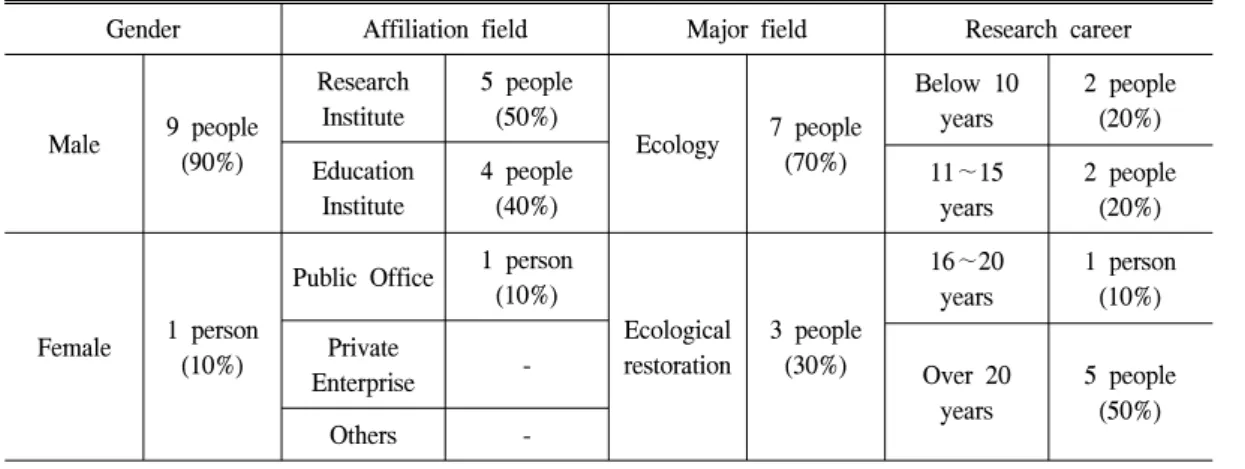
유효한 응답자 10명은 전원 관련 분야 박사
이상으로 연구 경력 5년 이상 2명, 11년 이상 3명, 20년 이상 5명으로 구성되었다(Table 1). 설문 지의 맹꽁이 서식처 복원 최적 위치 선정을 위한 평가항목 및 평가요소에 대한 내용은 Table 2와 같다.
2. 가중치 산정
맹꽁이 서식처 복원 최적 위치 선정을 위해 선정된 평가항목에 대한 설문 결과를 토대로 쌍 대비교 행렬을 작성하고 표준화 행렬 과정을 통 해 각 평가항목의 가중치(상대적 중요도)를 산 정하였다(Table 3).
공간, 먹이, 은신처, 물(번식), 위협요소 등 5개 의 평가영역 간 가중치 산정 결과, 은신처(0.283), 물(번식)(0.276), 먹이(0.230), 공간(0.147), 위협 요소(0.064) 순으로 나타났다. 맹꽁이의 생활사 는 산란 시기를 제외하고는 주로 은신처에 서식 을 하기에 은신처가 가장 중요한 의미를 갖는 것 으로 나타나며 그 다음으로 번식을 위한 물이 중 요한 것으로 해석할 수 있다. NIBR(2011)에 따 르면 맹꽁이 산란지 주변의 대표적인 환경 조사 결과 밭이 많이 나타났는데 이는 맹꽁이의 주요 은신처와 관계가 깊다고 판단된다.
공간 평가영역의 하위 평가항목 간 가중치
산정 결과, 습지, 초지, 밭, 하천, 논과의 거리
Table 2. The assessment items and factors for the optimal site selection of the narrow-mouth frog(Kaloula borealis)
habitat restoration.Optimal site selection of the
narrow-mouth frog (Kaloula
borealis)
habitat restorationAssessment area Assessment item Assessment factor
Space
Distance from wetland, grassland, farm, stream, rice fields
The spatial relationship (distance) between the habitat and its surroundings
Altitude of spawning pond Altitude of spawning area
Feed
Bed structure of forest Layer structure type of vegetation as upper, middle and lower classes
Low-rise grassland Insect habitat space being the food source of the narrow-mouth frog(Kaloula borealis)
Cover
Stones and between the stones Space that the narrow-mouth frog(Kaloula
borealis) can hide
Soil quality Space that the narrow-mouth frog(Kaloula
borealis) can burrow and hide underground
Water (breeding)
Area of permanent wetland Permanent wetland with water
Area of temporary wetland Temporary wetland during wet season and rainy days (for about 1 month)
Coverage of emerged plants on wetland (Ratio of open water)
Cover of the narrow-mouth frog(Kaloula
borealis) larvae and habitat of the food source
Water depthWater depth of spawning area where the narrow-mouth frog(Kaloula borealis) spawns and the larvae lives in
Water quality (DO)
Water quality of spawning area where the narrow-mouth frog(Kaloula borealis) spawns and the larvae lives in
pH
pH of spawning area where the narrow-mouth frog(Kaloula borealis) spawns and the larvae lives in
Threatening factor
Distance from street Threatening factor that causes road-kill of the narrow-mouth frog(Kaloula borealis)
Distance from pollutant
Factor that contaminates the spawning area and cover of the narrow-mouth frog(Kaloula
borealis)
(0.704), 산란지 고도(0.296) 순으로 나타나 서식 처 주변의 공간적인 관계가 더 중요한 것임을 확인할 수 있다. 먹이 평가영역의 하위 평가항 목 간 가중치 산정 결과, 저층 초지 공간(0.828), 수림대 층상 구조(0.172) 순으로 나타났다. Ko et al.(2012a)에 따르면 출현빈도로 본 맹꽁이의
먹이로는 파리류가 가장 많았으며, 먼지벌레,
개미류 순으로 나타나, 이러한 곤충류들이 서식
하는 공간이 초지이기에 수림대보다 초지 공간
이 더 중요하다고 판단된다. 은신처 평가영역의
하위 평가항목 간 가중치 산정 결과, 토질(0.629),
돌 및 돌 틈(0.371) 순으로 나타났다. 맹꽁이의
Table 3. The outcomes of calculated weighting values of the assessment items for the optimal site selection of
the narrow-mouth frog(Kaloula borealis) habitat restoration.Assessment area
High levels of
weighting values Assessment item Low levels of weighting values
Final weighting values (rank)
Space 0.147
Distance from wetland, grassland, farm,
stream, rice fields 0.704 0.104 (4) Altitude of spawning pond 0.296 0.044 (7)
Feed 0.230 Bed structure of forest 0.172 0.040 (10)
Low-rise grassland 0.828 0.190 (1)
Cover 0.283 Stones and between the stones 0.371 0.105 (3)
Soil quality 0.629 0.178 (2)
Water
(breeding) 0.276
Area of permanent wetland 0.156 0.043 (8) Area of temporary wetland 0.308 0.085 (5) Coverage of emerged plants on wetland
(Ratio of open water) 0.128 0.035 (12)
Water depth 0.181 0.050 (6)
Water quality (DO) 0.153 0.042 (9)
pH 0.074 0.020 (14)
Threatening
factor 0.064 Distance from street 0.559 0.036 (11)
Distance from pollutant 0.441 0.028 (13)
은신처 및 동면 장소가 주로 흙 속이며 주요 먹 이원 중에 하나인 개미류를 흙 속에서 섭취하므 로(Ko, 2012), 부드러운 토질이 더 중요한 것임을 알 수 있다. 물(번식) 평가영역의 하위 평가항목 간 가중치 산정 결과, 일시습지 면적(0.308), 수심 (0.181), 영구습지 면적(0.156), 수질(DO)(0.153), 습지 수생식물의 피도(개방수면 비율) (0.128), pH(0.074) 순으로 나타났다. NIBR(2011)에 따 르면 맹꽁이 산란지의 습지 형태로 일시습지가 가장 높은 비율(94.7%)로 나타나, 장마철 비가 오는 시기에 일시적으로 형성된 낮은 수심의 웅 덩이(습지)에 주로 산란하기에 일시습지 면적과 수심이 더 중요한 것으로 해석할 수 있다. 위협 요소 평가영역의 하위 평가항목 간 가중치 산정 결과, 도로와의 거리(0.559), 오염원과의 거리
(0.441) 순으로 나타났다. Ko(2012)에 따르면 제주지역에서 맹꽁이의 감소 요인으로 크게 세 가지를 제시하였는데, 첫 번째는 도시화의 확장 에 따른 주택지 개발과 도로건설이며, 두 번째 로는 농업으로 인한 농지의 확장과 농약 및 비 료로 인한 피해이며, 세 번째로는 산란지에 붕 어나 미꾸라지 등 포식자를 방류함으로써 맹꽁 이의 산란을 방해하는 것이다. 도로건설로 인한 피해는 서식처의 단편화 및 로드킬(road-kill)이 며, 농약은 양서류 사망률에 미치는 아주 중요 한 요인이 되는 환경오염의 하나이다(Davidson et al., 2002).
14개 평가항목의 최종가중치는 저층 초지 공
간(0.190), 토질(0.178), 돌 및 돌 틈(0.105) 등의
순으로 높게 나타났다.
Table 4. The scoring criteria diagram for the optimal site selection of the narrow-mouth frog(Kaloula borealis)
habitat restoration.Assessment
area Assessment item Assessment factor Scoring criteria Weighting values
Space
Distance from wetland, grassland,
farm, stream, rice fields
The spatial relationship (distance) between the habitat
and its surroundings
Under 150m 100
0.104
150m∼300m 70
300m∼500m 40
Over 500m 10
Altitude of
spawning pond Altitude of spawning area
Under 250m 100
0.044
250m∼400m 70
Over 400m 40
Feed
Bed structure of forest
Layer structure type of vegetation as upper, middle
and lower classes
Existing of
multi-layer structure 100
0.040 Existing of
mono-layer structure 70
None 40
Low-rise grassland
Insect habitat space being the food source of the
narrow-mouth frog (Kaloula borealis)
Over 1,500m2 100
0.190
50∼1,500m2 70
Under 50m2 40
None 10
Cover
Stones and between the stones
Space that the narrow-mouth frog(Kaloula borealis) can hide
Stone arrangement 100
0.105
None 50
Soil quality
Space that the narrow-mouth frog(Kaloula borealis) can burrow and hide underground
Over 20cm depth of soft soil 100
0.178 Under 20cm depth
of soft soil 70
None 40
3. 일관성 검증
분석 자료의 신뢰도와 산정된 가중치의 논리 적 일관성을 검증하기 위하여 일관성 비율(CR) 을 산출하였다. 산출 결과, 5개 평가영역들의 가 중치의 일관성 비율은 0.050이며, 물(번식) 평가 영역의 6개 평가항목들의 가중치의 일관성 비율 은 0.068으로 나타나 본 연구에서 사용한 평가 항목의 가중치는 모두 일관성을 확보하였다.
4. 적용(배점 기준 제시)
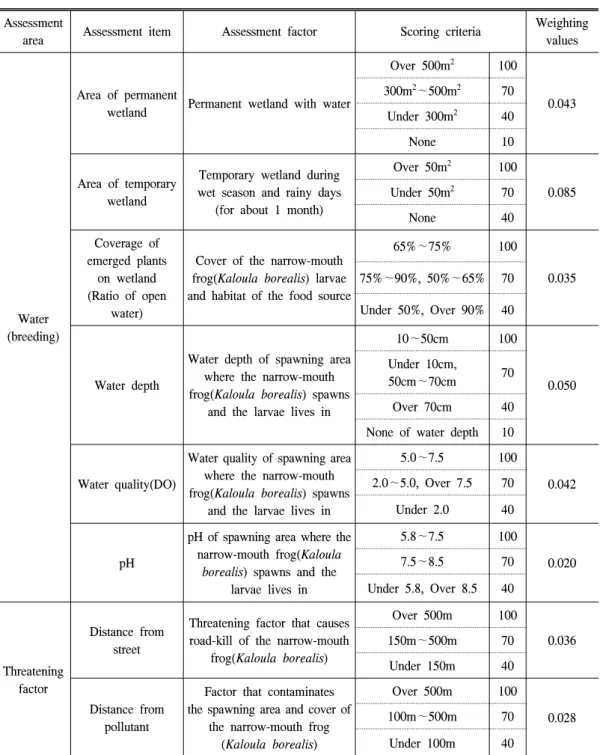
평가항목 및 평가요소에 따른 배점기준은 맹 꽁이 HSI의 항목별 기준을 고려하여 등간격으 로 점수화하여 적용하였다(Table 4).
평가요소는 객관성, 일관성, 명확성, 용이성
및 계획적 수단이나 실제 적용 가능성 등을 가
질 수 있도록 하였으며(Koo et al., 2011), 배점
기준은 자료 취득이 용이하고 정량화 및 수치화
Table 4. Continued.
Assessment
area Assessment item Assessment factor Scoring criteria Weighting values
Water (breeding)
Area of permanent
wetland Permanent wetland with water
Over 500m2 100
0.043 300m2∼500m2 70
Under 300m2 40
None 10
Area of temporary wetland
Temporary wetland during wet season and rainy days
(for about 1 month)
Over 50m2 100
0.085 Under 50m2 70
None 40
Coverage of emerged plants
on wetland (Ratio of open
water)
Cover of the narrow-mouth frog(Kaloula borealis) larvae and habitat of the food source
65%∼75% 100
0.035 75%∼90%, 50%∼65% 70
Under 50%, Over 90% 40
Water depth
Water depth of spawning area where the narrow-mouth frog(Kaloula borealis) spawns
and the larvae lives in
10∼50cm 100
0.050 Under 10cm,
50cm∼70cm 70
Over 70cm 40
None of water depth 10
Water quality(DO)
Water quality of spawning area where the narrow-mouth frog(Kaloula borealis) spawns
and the larvae lives in
5.0∼7.5 100
0.042 2.0∼5.0, Over 7.5 70
Under 2.0 40
pH
pH of spawning area where the narrow-mouth frog(Kaloula
borealis) spawns and the
larvae lives in5.8∼7.5 100
0.020
7.5∼8.5 70
Under 5.8, Over 8.5 40
Threatening factor
Distance from street
Threatening factor that causes road-kill of the narrow-mouth
frog(Kaloula borealis)
Over 500m 100
0.036
150m∼500m 70
Under 150m 40
Distance from pollutant
Factor that contaminates the spawning area and cover of
the narrow-mouth frog (Kaloula borealis)
Over 500m 100
0.028
100m∼500m 70
Under 100m 40
가 가능한 자료를 활용하였다. 따라서 맹꽁이 서식처 복원 최적 위치 선정 배점 기준표는 최 적 위치 선정에 대한 계량화가 편리하고 신속한
의사결정이 가능하며(Hong et al., 2014). 다수
의 맹꽁이 서식처 후보지들에 대하여 우선 순위
부여가 가능하다고 판단된다.
IV. 결 론