| Abstract |
Purpose: This study aimed to determine how inclined-treadmill walking training with rhythmic auditory stimulation affects balance and gait in stroke patients.
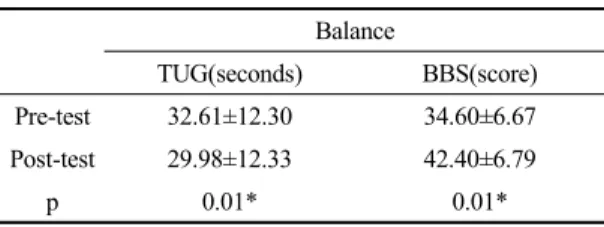
Methods: Ten chronic stroke patients, admitted to B hospital in Gangwon-do between August and October 2015, were trained 5 times per week for 4 weeks; each session lasted 30 minutes. To assess balance and gait before and after the training, the timed up and go (TUG) test, Berg balance scale (BBS), six minute walking test (6MWT), and three-dimensional spatiotemporal gait ability were used to measure the relevant variables. The data were analyzed using the paired t-test, and the statistical significance level was 0.05.
Results: There were significant differences in the TUG, BBS, 6MWT, gait speed, cadence, single limb support (SLS), and symmetric index (SI) before and after training (p < 0.05).
Conclusion: The results showed that the inclined-treadmill walking training with rhythmic auditory stimulation was effective at improving the balance and walking ability of stroke patients. Hearing training, using one of the basic procedures of proprioceptive neuromuscular stimulation, is considered to be an important aspect.
Key Words: Rhythmic auditory stimulation, Inclined treadmill, Balance, Gait, Stroke
†Corresponding Author : Young-Min Lee ([email protected])
Original Article Open Access
리듬청각자극을 동반한 경사 트레드밀 보행 훈련이 뇌졸중 환자의 균형 및 보행에 미치는 영향
윤성경⋅이영민
1†1)불노요양병원 물리치료실,
1한림대학교춘천성심병원 물리치료실
Effects of Inclined-treadmill Walking Training with Rhythmic Auditory Stimulation on Balance and Gait in Stroke Patients
Sung-Kyeung Yoon⋅Young-Min Lee
1†Department of Physical Therapy, Boolo Recuperation Hospital
1