216
한국산 광대버섯속 Lepidella 아속의 미기록종 보고
진용주1·유기범1·홍승범1·권순우1·김수진1·김성환2*·석순자1*
1농촌진흥청 국립농업과학원 농업미생물과, 2단국대학교 미생물학과
Notes on the Unrecorded Species of Subgenus Lepidella in Korean Genus Amanita
Yong Ju Jin1, Ki Bum Yoo1, Seung Beom Hong1, Soon Wu Kwon1, Soo Jin Kim1, Seong Hwan Kim2* and Soon-Ja Seok1*
1Agricultural Microbiology Division, National Institute of Agricultural Sciences, RDA Wanju 55365, Korea
2Department of Microbiology and Institute of Basic Sciences, Dankook University, Cheonan 31116, Korea
ABSTRACT: Amanita subgenus Lepidella is a well-known group that includes lethal amanitas. However, the taxonomic investigation of Korean Amanita species is still in progress. In this study, we collected Amanita specimens in Korea from 2009 to 2015 and classified 22 of them as subgenus Lepidella based on the morphology. Phylogenetic analysis of the 22 Amanita specimens based on the internal transcribed spacers sequences identified 16 phylogenetic species which included three undescribed Amanita species (A. sepiacea, A. modesta and A. kotohiraensis). Microscopic features of newly recorded Amanita species were photographed and line drawings were made. All collections cited here are deposited in the Herbarium Conservation Center of the National Institute of Agricultural Sciences.
KEYWORDS : Amanita kotohiraensis, Amanita modesta, Amanita sepiacea, Phylogenetic anaylsis, Subgenus Lepidella
서 론
광대버섯속(genus Amanita)은 담자균문(Basidiomycota) 주름버섯목(Agricales) 광대버섯과(Amanitaceae)에 속한다 [1]. 세계적으로 약 500여 종이 보고되어 있으며[2, 3], 국내 에는 58종이 기록되어 있는 분류군이다[4-6]. 이 속은 떨어 진 주름살을 가지고 있고, 백색 혹은 크림색의 포자문을 형 성하며, 다른 버섯종에 비하여 다양한 형태분화를 하고 있 다. 종의 특성에 따라 대주머니 혹은 대의 표면 그리고 갓
위에 외피막 흔적들이 남아있고, 갓 표면은 건조하다. 이 특 징은 갓의 표면이 점액질 형태인 광대버섯과 노을버섯속 (genus Limacella)과 구별된다[7]. 또한 미세구조의 특성에 서 포자는 주로 4포자이나 드물게 2포자도 관찰되며 대부 분의 포자가 비호청색성(acyanophilic)이고, 요오드용액 (e.g., Melzer's Reagent)에 대한 화학적 반응을 통해 비아 밀로이드(inamyloid)와 아밀로이드(amyloid) 두 가지 형태 로 나타내는데, 이를 기준으로, Amanita와 Lepidella 두 아 속(subgenus)으로 구분을 하고 있다[7, 8]. 이 중 Amanita 아속은 형태적인 기준으로 3개의 절(Amanita, Caesareae, Vaginatae)로 구분하였고, Lepidella 아속은 4개의 절(Ami- della, Lepidella, Phalloideae)로 각각 구분하였다[9, 10]. 광 대버섯 속은 침엽수 또는 활엽수 식물과 공생관계를 유지 하는 외생균근성(ectomycorrhizal) 균류로 산림 생태계에 중요한 역할을 하고 있으며 식용이 가능한 종과 인체에 치 명적인 독소를 가지고 있는 종을 포함하고 있어 잘 알려진 버섯이다. 특히, 강력한 독소인 amatoxin을 함유한 독광대 버섯군(lethal amanitas)은 Lepidella 아속 Phalloideae 절에 주로 속한다[11].
본 연구에서는 국내에 자생하는 광대버섯속 중 형태적으 로 Lepidella 아속에 속하는 22 표본을 대상으로 형태적 특
*Corresponding author
E-mail: [email protected]; [email protected] Received November 2, 2015
Revised November 9, 2015 Accepted November 16, 2015
This is an Open Access article distributed under the terms of the Creative Commons Attribution Non-Commercial License (http://
creativecommons.org/licenses/by-nc/3.0/) which permits unrestricted non-commercial use, distribution, and reproduction in any medium, provided the original work is properly cited.
Kor. J. Mycol. 2015 December, 43(4): 216-223 http://dx.doi.org/10.4489/KJM.2015.43.4.216 pISSN 0253-651X • eISSN 2383-5249
© The Korean Society of Mycology
성조사와 internal transcribed spacer (ITS) 염기서열을 이 용한 분자유전학적 분석을 통해 명확한 종 동정과 계통학 적 위치를 확인하고 미기록 3종에 대한 특징을 기술하고 한국명을 신칭하여 보고하고자 한다.
재료 및 방법
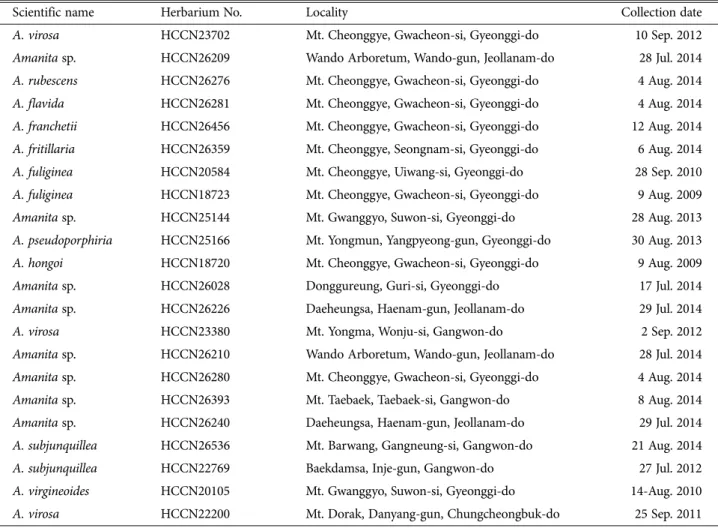
광대버섯속의 종 다양성 연구를 위해 2009년부터 2015년 까지 수집되어 국립농업과학원 표본실(Herbarium Conser- vation Center of NAAS, HCCN)에 보관중인 광대버섯 표 본 중 Lepidella 아속에 속하는 22 표본을 선정하였다 (Table 1). 본 연구를 위해 채집한 버섯은 발생한 장소에서 사진을 촬영하였다. 자실체의 발생양상과 동정을 위한 형 태적인 특성은 갓, 대, 대기부 및 주름살의 색깔, 크기, 표 면 상태 등의 육안적 특징을 조사, 기록하였다[12]. 미세구 조 관찰은 광학현미경(Axioplan 2; Carl Zeiss, Oberkochen, Germany)을 이용하여 1% Congo red와 1% Phloxine 용 액으로 세포를 염색한 후 포자, 담자기, 시스티디아 등 미 세구조를 관찰하고 상세하게 기록하였다[13]. 또한, 포자는 Melzer 용액으로 염색하여 요오드반응을 확인하였다. 담자
포자의 크기는 (a) b-c (d) 범위 표기법을 이용하여 기록하 였다. b-c의 범위는 측정값의 90%가 해당하는 중간값을 표 기하고 a와 d에 각각 최소값과 최대값을 표기하였다. Q는 담자포자의 길이/너비의 값, Q는 측정된 모든 담자포자 Q 의 표준편차를 ±와 함께 표기하였다[14]. 관찰된 미세구조 의 특성은 사진을 찍어 종 특성자료로 첨부하고, 삽화를 본 논문에 기재하였다. 모든 표본은 학술적 자료로 영구 보존 하기 위해 약 40oC, 6~12시간 열풍 건조하여 상대습도 40
± 2%, 18~20oC의 HCCN에 보존하였다.
분자생물학적 종 동정과 계통학적 위치를 확인하기 위 해 건조표본과 생버섯에서 DNA를 추출하였다. 건조표본 에서 DNA를 추출하기 위한 방법으로 조직을 일정량 떼어 내어 생버섯의 조직처럼 부풀린다. 증류수와 70% 에탄올 을 사용하여 불린 후, Cetyl trimethylammonium bromide (CTAB) 추출법을 기본으로 수행하였다[15]. ITS 염기서열 을 증폭하기 위해 ITS1 (5-TCCGTAGGTGAACCTGCG- 3)과 ITS4 (5-TCCTCCGCCTTATTGATATGC-3) primer 를 사용하였다[16]. Polymerase chain reaction (PCR) 반 응조건은 pre-denaturation 94oC 5 min 다음 denaturation 94oC 1 min, annealing 56oC 1 min, extension 72oC 1 min
Table 1. Information on the 22 Amanita specimens used in this study
Scientific name Herbarium No. Locality Collection date
A. virosa HCCN23702 Mt. Cheonggye, Gwacheon-si, Gyeonggi-do 10 Sep. 2012
Amanita sp. HCCN26209 Wando Arboretum, Wando-gun, Jeollanam-do 28 Jul. 2014
A. rubescens HCCN26276 Mt. Cheonggye, Gwacheon-si, Gyeonggi-do 4 Aug. 2014
A. flavida HCCN26281 Mt. Cheonggye, Gwacheon-si, Gyeonggi-do 4 Aug. 2014
A. franchetii HCCN26456 Mt. Cheonggye, Gwacheon-si, Gyeonggi-do 12 Aug. 2014
A. fritillaria HCCN26359 Mt. Cheonggye, Seongnam-si, Gyeonggi-do 6 Aug. 2014
A. fuliginea HCCN20584 Mt. Cheonggye, Uiwang-si, Gyeonggi-do 28 Sep. 2010
A. fuliginea HCCN18723 Mt. Cheonggye, Gwacheon-si, Gyeonggi-do 9 Aug. 2009
Amanita sp. HCCN25144 Mt. Gwanggyo, Suwon-si, Gyeonggi-do 28 Aug. 2013
A. pseudoporphiria HCCN25166 Mt. Yongmun, Yangpyeong-gun, Gyeonggi-do 30 Aug. 2013
A. hongoi HCCN18720 Mt. Cheonggye, Gwacheon-si, Gyeonggi-do 9 Aug. 2009
Amanita sp. HCCN26028 Donggureung, Guri-si, Gyeonggi-do 17 Jul. 2014
Amanita sp. HCCN26226 Daeheungsa, Haenam-gun, Jeollanam-do 29 Jul. 2014
A. virosa HCCN23380 Mt. Yongma, Wonju-si, Gangwon-do 2 Sep. 2012
Amanita sp. HCCN26210 Wando Arboretum, Wando-gun, Jeollanam-do 28 Jul. 2014
Amanita sp. HCCN26280 Mt. Cheonggye, Gwacheon-si, Gyeonggi-do 4 Aug. 2014
Amanita sp. HCCN26393 Mt. Taebaek, Taebaek-si, Gangwon-do 8 Aug. 2014
Amanita sp. HCCN26240 Daeheungsa, Haenam-gun, Jeollanam-do 29 Jul. 2014
A. subjunquillea HCCN26536 Mt. Barwang, Gangneung-si, Gangwon-do 21 Aug. 2014
A. subjunquillea HCCN22769 Baekdamsa, Inje-gun, Gangwon-do 27 Jul. 2012
A. virgineoides HCCN20105 Mt. Gwanggyo, Suwon-si, Gyeonggi-do 14-Aug. 2010
A. virosa HCCN22200 Mt. Dorak, Danyang-gun, Chungcheongbuk-do 25 Sep. 2011
HCCN, Herbarium Conservation Center of NAAS.
로 하여 총 35 cycles, final extension 72oC 10 min으로 진 행하였다. PCR 산물은 purification kit (AccuPrep PCR &
Gel Extraction Kit; Bioneer, Daejeon, Korea) 를 사용하여 정제한 후 Macrogen (Seoul, Korea)에 의뢰하여 분석하였 다. 분석된 염기서열은 National Center for Biotechno- logy Information의 BLAST program을 사용하여 GenBank 에 등록되어 있는 sequence data와 비교하였다.
염기서열의 다중염기서열정렬(alignment)은 ClustalX 1.83 program [17]을 사용하였고, BioEdit v7.0.5 program [18]
을 사용하여 수정하였다. 계통수 분석을 위해 MEGA 6.0 program [19]을 사용한 maximum likelihood (ML) analy- sis, MrBayes v3.1.2 program [20]을 사용한 Bayesian infe- rence (BI) 그리고 PAUP v4.0b10 program [21]을 사용한 maximum parsimony (MP) bootstrap analysis을 수행하 였다. ML tree는 1,000번의 bootstrap 분석을 수행하였고, bootstrap 값 70% 이상만 계통수에 사용하였다. BI는 met- ropolis-coupled Markov-chain Monte Carlo (MCMC) 방 법을 사용하여 하나의 cold chain 세 개의 heated chain이 26 generation 진행하는 동안 split frequency의 표준편차가 0.01 이하가 되었을 때 얻어진 계통수를 사용하였다. BI 값 은 0.9 이상의 값만을 선택하였다. MP tree는 1,000 repli- cates of random stepwise addition of sequence와 tree- bisection reconnection (TBR) branch-swapping 알고리즘 을 이용하여 만들어냈다. 모든 parsimony 분석의 branch support는 heuristic search 100 random-addition replicate 와 1,000번의 bootstrap replicate로 설정하여 측정하였다.
결과 및 고찰
ITS dataset는 67 taxa와 526 parsimony informative site 를 포함한 1,045 position으로 이루어져 있다. ITS sequence data의 MP 분석으로 3,446 tree length의 65 most-parsi- monious tree (consistency index = 0.389, retention index
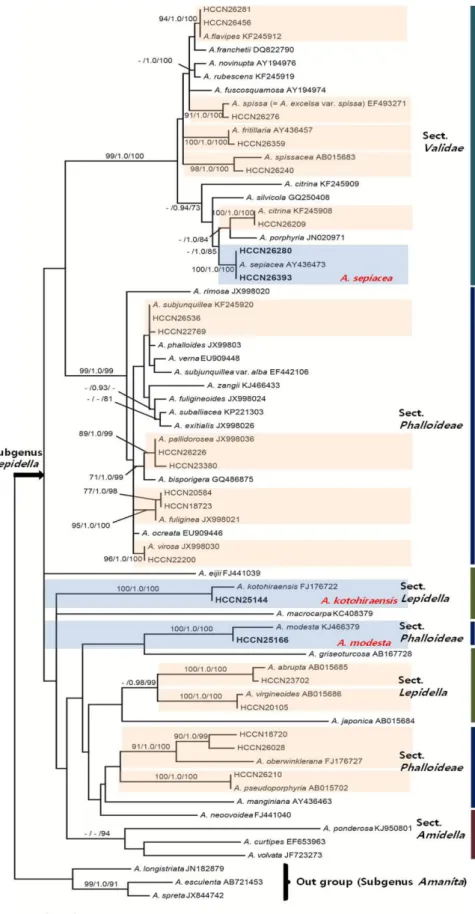
= 0.617 and homoplasy index = 0.611)를 얻었다. 또한, ML 분석을 통해 추론한 계통수는 maximum likelihood bootstraps (LB), Bayesian posterior probabilities (PP) 그 리고 maximum parsimony bootstraps (PB)값을 함께 나 타내었다(Fig. 1).
본 연구에 사용된 한국산 광대버섯 22 표본은 Lepidella 아속 16종의 분류군으로 동정되었다(Fig. 1, Table 2). 16종 의 분류군은 Validae절에 속한 A. flavipes S. lmai, A.
excelsa var. spissa (Fr.) Neville & Poumarat, A. fritillaria Sacc., A. spissacea S. lmai, A. citrina (Schaeff.) Pers., A.
sepiacea S. lmai와 Phalloideae절에 속한 A. fuliginea hongo, A. modesta Corner & Bas, A. oberwinklerana Zhu L. Yang
& Yoshim. Doi, A. pallidorosea P. Zhang & Zhu L. Yang, A. pseudoporphyria Hongo, A. subjunquillea S. lmai and A.
virosa (Fr.) Bertillon in Dechambre 그리고 Lepidella절에
속한 A. abrupta Peck, A. kotohiraensis Nagas. & Mitani, A. virgineoides Bas이며, 모두 높은 bootstrap support value (LB > 70, PP > 0.9 and PB > 90)로 그룹을 형성하였다. A.
citrina (Schaeff.) Pers의 경우 형태학적 특성에 따른 3개의 variety와 5개의 formae이 알려져 있으나[20], 국내에는 Kim 등[6]의 이전 연구에서 두 가지 타입이 보고되었다.
본 연구에 사용된 A. citrina HCCN26209는 앞선 두 가지 타입 중 국립수목원의 표본 KA12-1226의 염기서열과 높 은 bootstrap support value (LB = 100, PP = 1.0 and PB
= 100)로 그룹을 형성하였다. A. kotohiraensis는 Zhang 등 [13]의 MHHNU6998 표본의 염기서열과 99%, A. modesta 는 Cai 등[22]의 HKAS75405 표본의 염기서열과 98%, 마 지막으로 A. sepiacea는 Zhang 등[9]의 HKAS38716 표본 의 염기서열과 99% 상동성을 확인하였다. A. kotohiraensis Nagas. & Mitani, A. modesta Corner & Bas, A. sepiacea S.
lmai 3종이 국내 미기록종으로 확인되었다. 또한, 본 연구 에 사용된 염기서열은 National Center for Biotechnology Information GenBank에 등록하였다(Table 2).
국내 미기록종의 분류학적 연구
환문광대버섯 (신칭) A. kotohiraensis Nagas. & Mitani Mem. Natn Sci. Mus, Tokyo 32: 93 (2000)
Macroscopic features (Fig. 2A, 2B)
Pileus ca. 50~90 mm diam., convex, white, it is covered with white, felty to patchy volval remnants, appendiculate pileal margin. Stipe ca. 40~80 × 10~20 mm, attenuate upwards, with a surface and context that are white. The stipe’s basal bulb is subglobose, with its upper part cov- ered with white, granular to subconic voval remnants.
The annulus is white and fugacious.
Microscopic features (Fig. 3Aa, 3Ab)
Basidia 29.5~38.5 × 6~9 µm, clavate, 4-spored, Clamps were not observed at the bases of basidia; sterigma 2.5~4 µm long. Basidiospores 6.5~8.0 (~9.0) × 5.0~5.5 µm [Q
= 1.3~1.5 (~1.8), Q = 1.45 ± 0.13], broadly ellipsoid to oblong, amyloid, colorless, hyaline, thinwalled, smooth.
Edibility: unknown.
Habit & Habitats: Solitary sometimes few gregarious on ground in broadleaved forests or mixed forests, sum- mer to fall. Ectomycorrizal fungi.
Distribution: Japan, China, Korea. It is not uncommon in China[8, 9].
Specimen examined. Mt. Gwanggyo, Sanggwanggyo- dong, Jangan-gu, Suwon-si, Gyeonggi-do, Korea, 28 Aug 2013, collection by Y. J. Jin (specimen: HCCN25144).
Remark: The smell of the present species is reported as disagreeable or unpleasant[8, 14].
갓은 직경 50~90 mm로 반반구형이며 흰색이다. 흰 펠
Fig. 1. Phylogenetic tree inferred from maximum likelihood (ML) analysis based on internal transcribed spacer (ITS) sequences.
LB/PP/PB are shown above or below branches. Only LB and PB over 70%, and PP over 0.90 were reported. Subgenus Amanita (A. longistriata, A. esculenta and A. spreta) was used as the outgroup. HCCN, Herbarium Conservation Center of NAAS; LB, maximum likelihood bootstraps; PP, Bayesian posterior probabilities; PB, maximum parsimony bootstraps.
트느낌의 대주머니의 잔여물이 덮여있으며 갓 끝부분에도 피막이 있다. 대는 40~80 × 10~20 mm, 위로 갈수록 좁아 지며, 표면과 육질은 흰색이다. 대의 기부는 유구형이며, 기부 상단 주변에 대주머니의 흰색 잔여물이 남아있다. 턱 받이는 흰색으로 쉽게 사라진다. 담자기는 29.5~38.5 × 6~9 µm 크기로 곤봉형이며, 4개의 담자포자를 형성하고, 클램프는 관찰되지 않았다. 담자뿔의 길이는 2.5~4 µm이 다. 담자포자는 6.5~8.0 (~9.0) × 5.0~5.5 µm [Q = 1.3~
1.5 (~1.8), Q = 1.45 ± 0.13], 넓은 타원형에서 장방형으로 아밀로이드 성이며, 무색 투명한 얇은 격벽을 가지고 있으 며, 표면은 평활하다.
식용가능성: 불명
발생시기 및 서식지: 여름에서~가을 사이에 활엽수림 또 는 혼합림의 지상에 단생하는 균근성 균류이다.
분포: 일본, 중국, 한국[8, 9]
시험재료: 경기도 수원시 장안구 상광교동 광교산 2013.
8.28. (HCCN25114), 채집자 진용주
관찰: 이 종은 굉장히 불쾌한 냄새가 보고되어 있다[8, 14].
회색광대버섯(신칭) A. modesta Corner & Bas Persoonia 2(3): 279 (1962)
Macroscopic features (Fig. 2C, 2D)
Pileus ca. 50~60 mm diam., plano-convex, subumbonate, with a smooth, Its color ranges from livid umber to fuli- ginous umber and is paler and innately streaked toward the margin. Stipe is 50~60 × 7~8 mm subcylindric. con- text is white. Volva is limbate the lower third to half is attached to the stipe's bulb. Annulus is 8~12 mm broad, finely striate above and smooth below.
Microscopic features (Fig. 3Ba, 3Bb)
Basidia 25~39 × 7~9 µm, clavate, 4-spored, Clamps were not observed at the bases of basidia, sterigmata 2.4~3.5 µm long. Basidiospores 6.5~8.0 × (4.5~)5.0~5.5 µm [Q = (1.2~)1.27~1.5, Q = 1.43 ± 0.39], broadly ellipsoid to ellipsoid, amyloid, colorless, hyaline, thin walled, smooth.
Edibility: deadly poisonous
Habit & Habitats: Solitary sometimes few gregarious on ground in broadleaved forests or mixed forests, sum- Table 2. List of 22 Amanita specimens identified in this study
Herbarium No. Scientific name Similarity (%) GenBank accession No.
HCCN23702 A. abrupta 98 KT894839
HCCN26209 A. citrina 99 KT894840
HCCN26276 A. excelsa var. spissa (= A. spissa) 99 KT894842
HCCN26281 A. flavipes 99 KT849845
HCCN26456 A. flavipes 99 KT894854
HCCN26359 A. fritillaria 98 KT894843
HCCN20584 A. fuliginea 98 KT894847
HCCN18723 A. fuliginea 98 KP004944
HCCN25144 A. kotohiraensis 98 KT894850
HCCN25166 A. modesta 98 KT894851
HCCN18720 A. oberwinklerana 96 KT894853
HCCN26028 A. oberwinklerana 95 KT894852
HCCN26226 A. pallidorosea 99 KT894838
HCCN23380 A. pallidorosea 99 KT894837
HCCN26210 A. pseudoporphyria 99 KT894849
HCCN26280 A. sepiacea 99 KT894846
HCCN26393 A. sepiacea 99 KT894844
HCCN26240 A. spissacea 97 KT894841
HCCN26536 A. subjunquillea 99 KT894848
HCCN22769 A. subjunquillea 99 KM052527
HCCN20105 A. virgineoides 98 KP004958
HCCN22200 A. virosa 100 KT894836
HCCN, Herbarium Conservation Center of NAAS.
mer to fall. Ectomycorrizal fungi.
Distribution: Singapore, Malaya, Korea, East Asia[8, 9]
Specimen examined: Mt. Yongmun, Yongmun-myeon, Yangpyeong-gun, Gyeonggi-do, Korea, 30 Aug 2013, collec- tion by Jin et al. (specimen: HCCN25167).
Remark: This species should be treated as deadly poi- sonous until more is known of this species.
갓은 직경 50~60 mm로 편평반반구형이며 약간의 돌기 가 있고, 매끄럽다. 색상은 검푸른 암갈색에서 어두운 암갈 색이고 선천적으로 갓 끝부분에 밝은 색의 줄무늬가 있다.
대는 50~60 × 7~8 mm, 약간 원통형으로, 육질은 흰색이 다. 대의 기부는 limbate 형태의 질긴 막질로 둘러싸여 있 다. 턱받이는 8~12 mm로 넓고, 미세한 줄무늬가 있다. 대 주머니는 흰색으로 쉽게 사라진다. 담자기는 25~39 × 7~9 µm 크기로 곤봉형이며, 4개의 담자포자를 형성하고, 클램 프는 관찰되지 않았다. 담자뿔의 길이는 2.4~3.5 µm이다.
포자는 6.5~8.0 × (4.5~)5.0~5.5 µm [Q = (1.2~)1.27~1.5, Q = 1.43 ± 0.39], 넓은 타원형에서 타원형으로 아밀로이드 성이며, 무색 투명한 얇은 격벽으로 표면은 평활하다.
식용가능성: 독.
발생시기 및 서식지: 여름에서~가을 사이에 활엽수림 또 는 혼합림의 지상에 단생, 드물게 소수 군생하는 균근성균 류이다.
분포: 싱가포르, 한국 등 동아시아지역[8, 9]
시험재료: 경기도 양평군 용문면 용문산 2013. 8.4.
(HCCN25167), 채집자 진용주 등.
관찰: 이 종은 확실하게 알려지기 전까지 치명적인 독성 을 가진 것으로 간주해야 한다는 보고가 있다[23, 24].
노을광대버섯(신칭) A. sepiacea S. Imai, Bot. Mag., To- kyo 47: 426 (1933)
Synonymy. Amplariella sepiacea (S. Imai) E.-J. Gilbert, Fig. 2. Fruit bodies of unrecorded Amanita species in Korea. A, B, Amanita kotohiraensis (HCCN 25144); C, D, Amanita modesta (HCCN26380, HCCN26393); E, F, Amanita sepiacea (HCCN26280, HCCN26393). (scale bars: A, B = 5 cm). HCCN, Herbarium Conservation Center of NAAS.
in Bresadola, Iconogr. Mycol. 27(Suppl. 1): 78 (1941) Macroscopic features (Fig. 2E, 2F)
Pileus is 60~150 mm wide, convex to applanate, dark grey to brown to blackish, darker in the center, innately fibrillose, covered with dirty white to greyish conical to verrucose warts, 1~4 mm high and wide; margin is smooth and non-appendiculate. Stipe is 100~180 × 10~
25 mm, subcylindric or attenuate upwards, with its sur- face white to dirty white−its lower half covered with greyish to grey fibrillose squamules; the stipe's basal bulb is subglobose to spindle-shaped to turnip-shaped, with its upper part covered with white, rarely greyish, verru- cose to conical volval remnants in a few concentric in- complete rings. Annulus is apical to subapical, membra- nous, and white.
Microscopic features (Fig. 3Ca, 3Cb)
Basidia 30~38.5 × 7.5~10 µm, clavate, 4-spored, Clamps are absent from the bases of basidia; sterigmata 2.3~4 µm long. Basidiospores (6.5~)7.5~9.0 × 5.0~6.0(~6.5) µm [Q
= (1.3~)1.36~1.6, Q = 1.52 ± 0.1], broadly ellipsoid to oblong, amyloid, colorless, hyaline, thin walled, smooth.
Edibility: unknown.
Habit & Habitats: Solitary sometimes few gregarious on ground in broadleaved forests, coniferous forests or mixed forests, summer to fall. Ectomycorrizal fungi.
Distribution: Japan, China, Korea, East Asia[8, 9]
Specimen examined: Mt. Cheonggye, Makgye-dong, Gwacheon-si, Gyeonggi-do, Korea, 04 Aug 2014, collec- tion by Y. J. Jin (specimen: HCCN26280).
Remarks: This species is characterized by covered with dirty white to greyish conical to verrucose warts of pileus.
갓은 직경 60~150 mm로 반반구형에서 편평형이며 검회 색에서 검은갈색으로 중앙이 어둡고, 1~4mm의 어두운 흰 색 또는 회색 원뿔형 사마귀점이 있다. 끝부분은 매끄럽고 피막은 없다. 대는 100~180 × 10~25 mm, 원통형, 위로 갈 수록 좁아진다. 대의 색깔은 백색에서 흐린 백색이고 대의 기부는 구근상에서 순무모양의 방추형이며, 흰색 혹은 회 색 계열의 원뿔형 대주머니 잔여물이 불완전한 고리의 형 태로 존재한다. 턱받이는 선단에서 준선단에 위치하며, 막 질에 흰색이다. 담자기는 30~38.5 × 7.5~10 µm 크기로 곤 봉형이며, 4담자 포자를 형성하고, 클램프는 담자기에 존 재하지 않는다. 담자뿔의 길이는 2.3~4 µm이다. 포자는 (6.5~)7.5~9.0 × 5.0~6.0(~6.5) µm [Q = (1.3~)1.36~1.6, Q = 1.52 ± 0.1], 넓은 타원형에서 장방형으로 아밀로이드 성이며, 무색 투명한 얇은 격벽으로 표면은 평활하다.
식용가능성: 불명
발생시기 및 서식지: 여름에서~가을 사이에 활엽수림, 침엽수림 또는 혼합림의 지상에 단생, 드물게 소수 군생하
는 균근성 균류이다.
분포: 일본, 중국, 한국 등 동아시아지역[8, 9]
시험재료: 경기도 과천시 막계동 청계산, 2014. 8.4.
(HCCN26280), 채집자 진용주.
관찰: 이 종은 갓 표면에 어두운 흰색 또는 회색의 사마 귀점이 있는 것이 특징적이며, Amanita tristis Corner &
Bas와 종종 비교된다[8].
적 요
광대버섯 Lepidella 아속은 독광대버섯군 (Sect. Phalloi- deae)가 속해있는 것으로 잘 알려진 그룹이다. 그렇지만, 국내 광대버섯 종의 분류학적 연구는 여전히 진행 중이다.
이번 연구에서, 우리는 국내에서 2009년부터 2015년까지 Fig. 3. Microscopic structures of unrecorded Amanita species in Korea. A, Amanita kotohiraensis (HCCN25166); B, Amanita modesta (HCCN26380); C, Amanita sepiacea (HCCN26280);
a, Basidia (×1000); b, Basidiospores (×1000). (scale bars: A, B
= 5 cm). HCCN, Herbarium Conservation Center of NAAS.
수집된 광대버섯 표본 중 형태학적 기반으로 Lepidella 아 속에 속하는 22 표본을 분석하였다. Internal transcribed spacer (ITS) 영역의 염기서열을 기반으로 분자유전학적 계통분석을 진행한 결과, 16종의 분류군이 동정되었으며 이 중 국내 미기록인 Amanita sepiacea, Amanita modesta 와 Amanita kotohiraensis가 포함되어있었다. 처음 보고되 는 3종의 현미경적 특징은 기록과 함께 이미지를 저장하 고 삽화를 그렸다. 본 연구에 사용된 모든 표본은 국립농 업과학원 표본실에 보관되어 있다.
Acknowledgements
This work was supported by a grant National Academy of Agricultural Science, Rural Development Administra- tion (Project No. PJ011248032015) and National Institute of Biological Resources (NIBR No. 2013-02-001) in Korea.
REFERENCES
1. Bas C. Morphology and subdivision of Amanita and a mono- graph on its section Lepidella. Persoonia 1969;5:285-579.
2. Yang ZL. Bibliotheca Mycologica, 170: the Amanita species of Southwest China. Berlin: J. Cramer; 1997.
3. Yang ZL. Flora fungorum sinicorum v.27: Amanitaceae. Bei- jing: Science Press; 2005.
4. Seok SJ, Lim YW, Kim CM, Ka GH, Lee JS, Han SK, Kim SO, Hur JS, Hyun IH, Hong SG, et al. List of mushrooms in Korea. The Korean Society of Mycology; 2013.
5. Kim CS, Jo JW, Kwag YN, Oh JS, Shrestha B, Sung GH, Han SK. Four newly recorded Amanita species in Korea: Ama- nita sect. Amanita and sect. Vaginatae. Mycobiology 2013;41:
131-8.
6. Kim CS, Jo JW, Kwag YN, Oh JS, Shrestha B, Sung GH, Han SK. Taxonomic study of Amanita subgenus Lepidella and three unrecorded Amanita species in Korea. Mycobiology 2013;41:183-90.
7. Singer R. The agaricales in modern taxonomy. 4th ed. Koe- nigstein: Koeltz Scientific Books; 1986.
8. Tulloss, RE, Yang, ZL. Amanitaceae studies [internet]. Bronx (NY): New York Botanical Garden; 2003. [cited 2015 Oct 05].
Available from: http://www.amanitaceae.org.
9. Zhang L, Yang J, Yang Z. Molecular phylogeny of eastern Asian species of Amanita (Agaricales, Basidiomycota): taxono- mic and biogeographic implications. Fungal Divers 2004;17:
219-38.
10. Moreno G, Platas G, Pelaez F, Bernedo M, Vargas A, Daza A, Santamaria C, Camacho M, de la Osa LR, Manjon JL. Mole- cular phylogenetic analysis shows that Amanita ponderosa and A. curtipes are distinct species. Mycol Prog 2008;7:41-7.
11. Largent DL, Johnson D, Watling R, Simpson K. How to iden- tify mushrooms to genus III: microscopic features. Eureka:
Mad River Press; 1977.
12. Seok SJ, Jin YJ, Kwon SW, Kim YS, Kim WG, A taxonomic study of genus Melanophyllum in Korea. Kor J Mycol 2013;41:
205-11.
13. Zhang P, Chen ZH, Xiao B, Tolgor B, . Bao HY, Yang ZL.
Lethal amanitas of East Asia characterized by morphological and molecular data. Fungal Divers 2010;42:119-33.
14. Yang ZL. Species diversity of the genus Amanita (Basidiomy- cetes) in China. Acta Bot Yunnanica 2000;22:135-42.
15. Doyle JJ, Doyle JL. A rapid DNA isolation procedure for small quantities of fresh leaf material. Phytochem Bull 1987;19:11- 5.
16. White TJ, Bruns TD, Lee SB, Taylor JW. Amplification and direct sequencing of fungal ribosomal RNA genes for phylo- genetics. In: Innis MA, Gelfand DH, Sninsky JJ, editors. PCR protocols: a guide to methods and applications. San Diego:
Academic Press; 1990. p. 315-22.
17. Thompson JD, Gibson TJ, Plewniak F, Jeanmougin F, Hig- gins DG. The ClustalX windows interface: flexible strategies for multiple sequence alignment aided by quality analysis tools. Nucleic Acids Res 1997;25:4876-82.
18. Hall TA. BioEdit: a user-friendly biological sequence align- ment editor and analysis program for Windows 95/98/NT.
Nucleic Acids Symp Ser 1999;41:95-8.
19. Tamura K, Stecher G, Peterson D, Filipski A, Kumar S.
MEGA6: Molecular Evolutionary Genetics Analysis version 6.0. Mol Biol Evol 2003;30:2725-9.
20. Ronquist F, Huelsenbeck JP. MrBayes 3: Bayesian phylogene- tic inference under mixed models. Bioinformatics 2003;19:
1572-4.
21. Swofford DL. PAUP* 4.0: phylogenetic analysis using parsim- ony. Sunderland: Sinauer Associates; 2003.
22. Cai Q, Tulloss RE, Tang LP, Tolgor B, Zhang P, Chen ZH, Yang ZL. Multi-locus phylogeny of lethal amanitas: Implica- tions for species diversity and historical biogeography. BMC Evol Biol 2014;14:143.
23. Tulloss RE. Amanita-distribution in the Americas with com- parison to eastern and southern Asia and notes on spore cha- racter variation with latitude and ecology. Mycotaxon 2005;
93:189-231.
24. Yang ZL, Doi Y. A contribution to the knowledge of Amanita (Amanitaceae, Agaricales) in Japan. Bull Natl Sci Mus Ser B Bot 1999;25:107-30.