• 검색 결과가 없습니다.

10380, 인제대학교 일산백병원 재활의학과

N/A
N/A
Protected

Academic year: 2021

Share "10380, 인제대학교 일산백병원 재활의학과"

Copied!
10
0
0

로드 중.... (전체 텍스트 보기)

전체 글

(1)

접수일 : 2018 년 5 월 31 일 , 게재승인일 : 2018 년 8 월 13 일

책임저자 : 강중모 , 경기도 고양시 일산서구 주화로 170

10380, 인제대학교 일산백병원 재활의학과

Tel: 031-910-7440, Fax: 031-910-7446 E-mail: [email protected]

맞춤형 발 보조기가 유연성 평발 환아 발 통증과 균형에 미치는 장기적 효과

인제대학교 일산백병원 재활의학과

1

, 인제대학교 일산백병원 스포츠 건강의학센터

2

이홍재1ㆍ임길병1ㆍ유지현1ㆍ김지용1ㆍ강중모1ㆍ이호진1ㆍ정태호2

Long Term Effect of Custom-Molded Foot Orthoses on Foot Pain and Balance in Children with Symptomatic Flexible Flat Feet

Hong-Jae Lee, M.D.

1

, Kil-Byung Lim, M.D., Ph.D.

1

, Jeehyun Yoo, M.D.

1

, Jiyong Kim, M.D.

1

, Joongmo Kang, M.D.

1

, Hojin Lee, M.D.

1

and Tae-Ho Jeong, M.S.

2

1

Department of Physical Medicine and Rehabilitation, Inje University Ilsan Paik Hospital,

2

Institute of Sports Rehabilitation, Inje University Ilsan Paik Hospital, Goyang, Korea

Objective: To evaluate the long termeffect of custom-molded foot orthoses on foot pain and balance ability in children with symptomatic flexible flat feet after 1 year. Method: A total of 35 children over 6 year-old with flexible flat feet and foot pain for at least 6 months were recruited. Individual custom-molded rigid foot orthoses fabricated with the inverted orthotic technique was prescribed. Pain related parameters (pain sites, degree, and frequency) were obtained through questionnaires. Pain assess- ment was performed prior to application of the foot orthoses, and 1, 3, 6, 12 months after applying the orthoses. Balance ability was tested by computerized posturography. Such measures were evaluated prior to, 3 months, and 12 months after applying the foot orthoses. Additionally, the difference inbalance ability between barefoot and withfoot orthosesat 12 months was assessed to estimate carryover effect. Results: 17 out of 35 children completed the study. Significant improvements were noted upto 12 months in pain parameters and balance ability. The carry over effect of the orthoses was confirmed.

Conclusion: There were significant improvements offoot pain and balance ability in children with symptomatic flexible flat foot after wearing foot orthoses fabricated with the inverted orthotic technique over 1year period. (Clinical Pain 2018;17:81-90) Key Words: Flat feet, Foot orthoses, Pediatrics, Musculoskeletalpain, Postural balance

INTRODUCTION

Flat feet, also called pes planus or fallen arches, are commonly found in children with various symptoms, fre- quently gathering parents’ attention.

1,2

‘Flat feet’ is a term referring to deformation of feet occurring from hyper- pronation caused by the loss or immaturity of the medial longitudinal arch.

3

Flat feet can be divided into pathologic flat feet and physiologic flat feet. Pathologic flat feet occur from various primary causes, and physiologic flat feet oc- cur from lack of development of the medial longitudinal arch.

4

Flat feet in children are mostly physiologic flat feet and are found in approximately 90% of children under age

of two. This is because normal longitudinal arch develop- ment begins at the age between 3 to 5 years, which com- pletes its growth before the age of 10.

5,6

Flat foot can also be divided into flexible type and rigid type. In flexible type, the medial longitudinal arch dis- appears when the patient supports his own weight, whilethe medial longitudinal arch appears again when the patient stands on his toes or on his heels. In rigid flat foot, the arch- constantly remains low regardless of the weight bearing.

7-10

Most flexible flatfeet in children are physiologic, asymp- tomatic, and improve with age. It does not require treat- ment unless symptomatic.

11

If physiological dysfunctions accompany, various symptoms such as pain, reduction of exercise ability, and abnormality of gait may occur.

4,12-14

Symptomatic flexible flat feet (SFFF) treatment involves

nonsurgical and surgical methods. Nonsurgical options in-

cludeactivity modification, wearing proper shoes or foot

orthoses, stretching, strengthening exercises, and medi-

(2)

Fig. 1. Fabrication of custom molded rigid foot orthoses made with inverted orthotic technique. Inverting of the positive cast and plat- forming of the forefoot (A), remodeling of plantar arch from sustentaculum tali to 1st metatarsal head (B), and finalized orthosis (C).

cation.

15-17

Numerous studies have reported the effect of foot or- thosis on foot pain. However, there is none which inves- tigated the effect of foot orthoses examining the changes in the patient’ sbalance ability at the same time, in long term. In our previous study, we reported that foot pain and balance ability improved extremely significantly in 3 month follow-up for the children with SFFF.

15

The primary goal of this study was to evaluate the long term effect (over 1 year) of foot orthoses for children with SFFF with regards to pain and balance ability. In addition, by comparing the balance ability with and without foot orthoses at 12 months, we evaluated the presence of carry- over effects.

MATERIALS AND METHODS 1. Study subjects

Pediatric patients clinically diagnosed with flat foot at our foot clinic between June 2012 and December 2014 par- ticipated in the study.

Inclusion criteria were individuals aged over 6 years, with complaints of foot pain of at least four times a month or an average of at least once a week for the past 6 months, who were capable of independent walking and running on functional test, with eversion angle of resting calcaneal stance position (RCSP) on both feet over 4 degrees, and calcaneal pitch under the 20 degrees. In pediatric foot clin- ics, RCSP is a commonly used biomechanical parameter in diagnosing flatfoot. A study by Sobel et al. concluded that although variations existed, RCSP had a high degree of re- liability, independent of age, height and weight.

18

RCSP ev- ersion angle greater than 4 degrees with less than 20 de- grees of calcaneal pitch angle is a frequently used diag-

nostic method of flexible flat foot in children, as illustrated in several lituratures.

19,20

Exclusion criteria were individuals with bone fractures, deformities of spine or lower extremities on X-ray images, neurologic anomalies, infectious diseases, hemostaticdis- orders, malignant diseases. Patients who wereon medi- cationfor depression were excluded as well. The reason why we have limited the subjects to be overage 6 was be- cause subjects were required to be able to followbalancing posture according to the instruction of computerized posturography.

This was a prospective study for a 12 month period with a total of initial 35 participants enrollment. Due to poor compliance in filling out the questionnaires and performing balance tests during follow-up visits, finally 17 subjects re- mained in the study.

2. Methods

1) Biomechanical and radiological tests and the use of foot orthoses: Calcaneal pitch angle and resting calcaneal stance position (RCSP) were measured by foot X-rays and biomechanical tests, respectively.

21

All subjects were exam- ined by a single experienced professional physician. When a biomechanical abnormality like overpronation was found, we prescribed customized foot orthoses fabricated by the inverted orthotic technique.

22

For example, when the RCSP were −5º to −6º, and −7º to −8º, the inverted orthotic technique was prescribed 20º, and 25º angles, respectively.

For the RCSP of −9º to −10º but lower than −11º (more severe), 30º and 35º inverted orthotic technique with lateral long flanges was prescribed respectively. Then the foot or- thosis was fabricated in the laboratory (Fig. 1).

2) Evaluation of pain frequency, sites, and degrees in

the feet and ankles: Pain sites in the feet, frequency of pain

(3)

Table 1. General Characteristics of the Subjects

Characteristics Value

Male:Female 11:6

Age (year) 11.3 ± 1.49

Height (cm) 148.3 ± 9.57

Weight (kg) 41.4 ± 9.59

Table 2. Resting Calcaneal Stance Position (RCSP) and Calcaneal Pitch Angle

Right Left

RCSP − 6.4 ± 2.32 − 5.2 ± 2.77

Calcaneal pitch angle 17.3 ± 2.4º 18.5 ± 2.7º Values are presented as mean ± standard deviation.

complaints, and the degree of pain before treatment were compared to those at 1, 3, 6 months post-treatment, and 12 months post-treatment. The visual analog scale (VAS) was used to evaluate the pain degree. The pain sites were exam- ined on middle sole, heel base, posterior heel or Achilles tendon, and ankle (medial, lateral, anterior). Frequency of pain complaintsindicated the frequency of pain experience during a 1-week period.

3) Evaluation of balance ability: A computerized postur- ography, Balance Master

system (NeuroCom Inc., Clackamas, OR, USA) was used for evaluating balance ability. The device used a dynamic dual force plate to measure the vertical forces on the patient’s feet. Static, dy- namic, and functional tests were performed prior to, 3 months, and 12 months after application of orthoses treatment.

For evaluatingstatic balance ability, unilateral stance test was performed. Subjects stood on one leg and tried to maintain their posture with their eyes opened or closed for 10 seconds on a force plate to measure the center of gravity (COG) sway velocity. Each test was repeated three times and the mean values were calculated.

For dynamic balance ability, 5 subsections inlimits of stability were assessed. Subjects intentionally moved their COG to four directions from the center. The reaction time, movement velocity, endpoint excursion in the first move- ment, maximum excursion, and directional control were measured.

For evaluating functional balance test, the step/quick turn and tandem gait were measured. For the step/quick turn, subjects waited at the starting point, stepped onto the force plate at the examiner’s starting signal, turned around 180º after two steps, and returned to the starting point.

During this process, turn sway (º) of the COG and turn time (seconds) were measured. For the tandem walk test, subjects walked on the force plate with the toe and the heel

touching the plate to examine their walking characteristics involving step width, step speed, and end sway.

In order to check carryover effect of the orthosis in the first 1 year, we also compared balanceablity on barefoot and withfoot orthosis.

3. Statistical analyses

SPSS ver. 21.0 (IBM SPSS, Armonk, NY, USA) was used for statistical analyses. Repeated-measures analysis of variance was used to compare pain degree and frequency of pain complaints, balance ability changes. Listwise dele- tion method was applied on the missing 18 subjects values.

Statistical significance was considered when p was less than 0.05.

RESULTS 1. Subject general characteristics

Among the 35 enrollees, 28 participants completed the pain questionnaires, and only 17 subjects completed the full balance test. The data from 18 drop-outs were com- pletely excluded in the statsticial analysis. Only the data from the remaining 17 subjects were analyzed. The boy to girl ratio was 11 to 6. The average age, height, and weight were 11.3 ± 1.49 years, 148.3 ± 9.57 cm, and 41.4 ± 9.59 kg respectively (Table 1).

2. Biomechanical and radiological findings

The average RCSP of all participants was −6.4º on the right and −5.2º on the left in the biomechanical test (Table 2). The average calcaneal pitch angle of the participant were 17.3 ± 2.4º on the right, and 18.5 ± 2.7º on the left.

There were11patients who presented with severe case of

the pitch angle (under 15º).

(4)

Fig. 2. Frequency of pain complaints. p were derived using re- peated-measures analysis of variance. *p<0.05, **p<0.01,

***p<0.001.

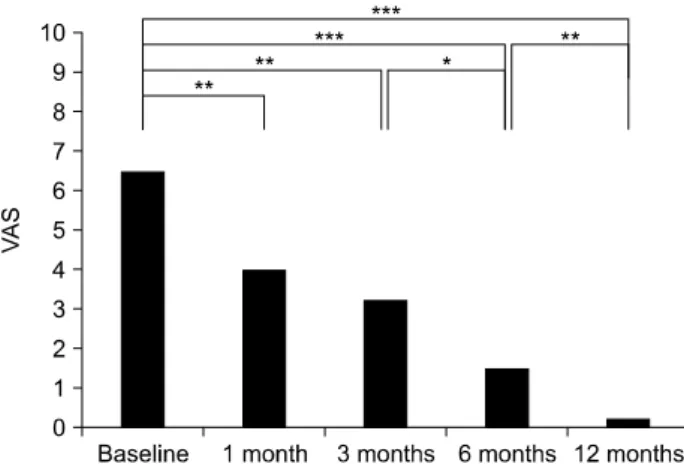
Fig. 3. Visual analog scale (VAS) in the main pain site. p were derived using repeated-measures analysis of variance. *p<0.05,

**p<0.01, ***p<0.001.

Table 3. Location of Pain in the Foot

Location of pain No.

Middle sole (arch) 12

Plantar heel 5

Posterior heel and Achilles tendon 3 Ankle (medial, lateral, anterior) 5 Note. The patients were allowed to answer more than onepain locations.

3. Pain sites and change in pain degrees and frequencies

Pain sites answered by the subjects included the middle sole area (n=12), plantar heel (n=5), posterior heel anda- chilles tendon (n=3), and ankle (anterior, medial, lateral) (n=5). 8 out of the 17 subjects complained of pain in more than two regions (Table 3).

Compared to the pain frequency of 14.75 ± 8.92 per monthinitially before treatment, there was a significant de- crease to 7.50 ± 4.71 per month at 1 month (p=0.007), 7.25

± 4.96 per month at 3 months (p=0.004), 4.25 ± 6.26 per month at 6 months (p<0.001), and 0.50 ± 0.86 per month at 12 months after foot orthoses (p<0.001) (Fig. 2). The pain frequency decreased significantly over time by linear pattern.

As for the degree of pain in the most frequent sites, compared to the degree of pain of 6.50 ± 2.18 before treat-

ment, there was a significant reduction to 4.00 ± 1.22 at 1 month (p=0.008), 3.25 ± 3.49 at 3 months (p=0.003), 1.50 ± 2.06 at 6 months (p<0.001) and 0.25 ± 0.43 at 12 months after foot orthoses application p<0.001) (Fig. 3).

The degree of pain showed statistically significant decline over timeby linear pattern.

4. Change in balance ability

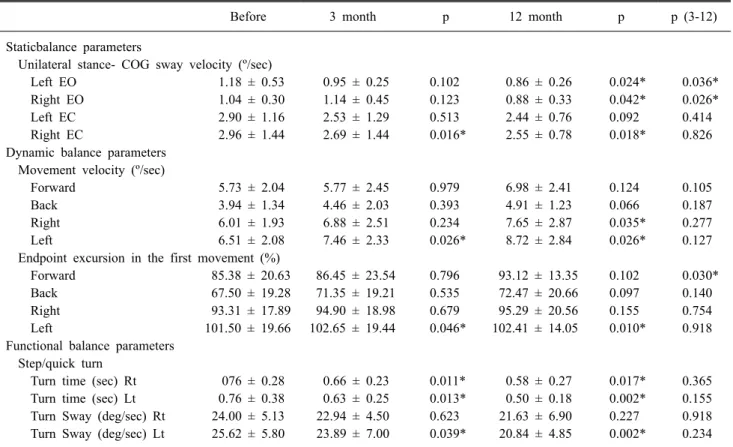
1) Static balance: In the unilateral stance test with eyes opened, there was no significant improvement between the COG sway velocity before treatment and that at 3 months after treatment. However, a statistically significant im- provement in both left and right one leg standing at 12 months after treatment was present, from 1.18 ± 0.53 (º/sec) to 0.86 ± 0.26 (º/sec)with the left unilateral stance (p=0.024), and from 1.04 ± 0.30 to 0.88 ± 0.33 with the right unilateral stance (p=0.042).

Comparing unilateral stance with eyes closed, statistical improvements of the sway velocity were found at 3 months as well as 12 months after treatment on the right single leg stance, from 2.96 ± 1.44 (º/sec) to 2.69 ± 1.44 after 3 months (p=0.016), and to 2.55 ± 0.78 after 12 months (p=0.018) (Table 4).

2) Dynamic balance: The limits of stability were meas-

ured with the child moving in four directions. In the move-

ment velocity domain, the movement speed to left side im-

proved significantly after 3 months treatment from 6.51 ±

2.08 (º/sec) to 7.46 ± 2.33 (p=0.026), and after 12 months

to 8.72 ± 2.84 (p=0.026). The speed to right side improved

(5)

Table 4. Comparison of Static, Dynamic and Functional Balance Ability after Applying Foot Orthoses

Before 3 month p 12 month p p (3-12)

Staticbalance parameters

Unilateral stance- COG sway velocity (º/sec)

Left EO 1.18 ± 0.53 0.95 ± 0.25 0.102 0.86 ± 0.26 0.024* 0.036*

Right EO 1.04 ± 0.30 1.14 ± 0.45 0.123 0.88 ± 0.33 0.042* 0.026*

Left EC 2.90 ± 1.16 2.53 ± 1.29 0.513 2.44 ± 0.76 0.092 0.414

Right EC 2.96 ± 1.44 2.69 ± 1.44 0.016* 2.55 ± 0.78 0.018* 0.826

Dynamic balance parameters Movement velocity (º/sec)

Forward 5.73 ± 2.04 5.77 ± 2.45 0.979 6.98 ± 2.41 0.124 0.105

Back 3.94 ± 1.34 4.46 ± 2.03 0.393 4.91 ± 1.23 0.066 0.187

Right 6.01 ± 1.93 6.88 ± 2.51 0.234 7.65 ± 2.87 0.035* 0.277

Left 6.51 ± 2.08 7.46 ± 2.33 0.026* 8.72 ± 2.84 0.026* 0.127

Endpoint excursion in the first movement (%)

Forward 85.38 ± 20.63 86.45 ± 23.54 0.796 93.12 ± 13.35 0.102 0.030*

Back 67.50 ± 19.28 71.35 ± 19.21 0.535 72.47 ± 20.66 0.097 0.140

Right 93.31 ± 17.89 94.90 ± 18.98 0.679 95.29 ± 20.56 0.155 0.754

Left 101.50 ± 19.66 102.65 ± 19.44 0.046* 102.41 ± 14.05 0.010* 0.918

Functional balance parameters Step/quick turn

Turn time (sec) Rt 076 ± 0.28 0.66 ± 0.23 0.011* 0.58 ± 0.27 0.017* 0.365 Turn time (sec) Lt 0.76 ± 0.38 0.63 ± 0.25 0.013* 0.50 ± 0.18 0.002* 0.155 Turn Sway (deg/sec) Rt 24.00 ± 5.13 22.94 ± 4.50 0.623 21.63 ± 6.90 0.227 0.918 Turn Sway (deg/sec) Lt 25.62 ± 5.80 23.89 ± 7.00 0.039* 20.84 ± 4.85 0.002* 0.234 Values are presented as mean ± standard deviation.

COG: center of gravity, EO: eyes open, EC: eyes closed, *p<0.05.

significantly after 12 months treatment, from 6.01 ± 1.93 to 7.65 ± 2.87 (p=0.035), despite no significance at 3 months. Forward, backward movements showed some im- provements but the values were not statistically significant (Table 4). On the other hand, the endpoint excursion in the first movement performed to the left showed significant improvements from 101.50 ± 19.66 (%) to 102.65 ± 19.44 (p=0.046) after 3 months, and to 102.41 ± 14.05 (p=0.010) after 12 months. In addition, the endpoint excursion in the first movement to the forward showed significant improve- ment when comparing between 3months and 12 months af- ter treatment, from 86.45 ± 23.54 (%) to 93.12 ± 13.35 (p=0.030) (Table 4).

3) Functional balance: The turn time to right in step/quick turn showed a statistically significant improve- ment from 0.76 ± 0.28 (sec) to 0.66 ± 0.23 (p=0.011) after 3 months, and to 0.58 ± 0.27 (p=0.017) after 12 months.

Similarly, the turn time to left also showed significant im- provement from 0.76 ± 0.38 (sec) to 0.63 ± 0.25 (p=0.013)

after 3 months, and to 0.50 ± 0.18 (p=0.002) after 12 months. In the sway during turning, statistically significant decrease was noted from 25.62 ± 5.80 (º/sec) to 23.89 ± 7.00 (p=0.039) after 3 months, and to 20.84 ± 4.85 (p=0.002) after 12 months in the left side (Table 4).

5. Evaulation of carryover effect of foot orthoses on balance ability after 1 year

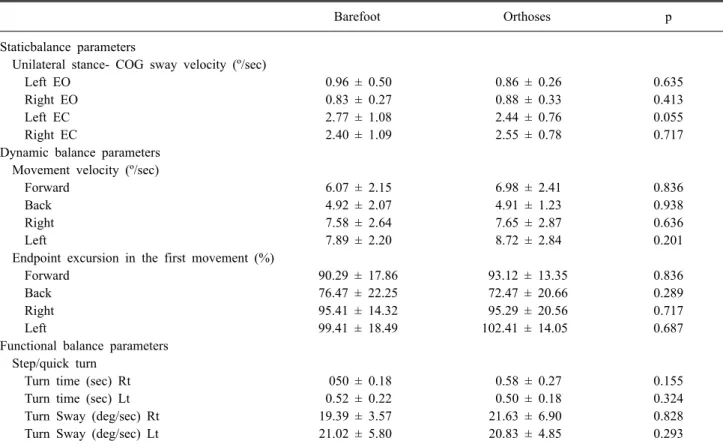
Static, dynamic, and functional balance abilities were

evaluated in a same way mentioned above with and without

wearing foot orthosis after 12 months to figure out the car-

ryover effect. Although there were some changesin the pa-

rameter of directional control during moving forward and

leftward respectively in static balance ability, all other sub-

sections of dynamic balance ability and functional balance

ability showed no differences between barefoot and wear-

ing foot orthoses (Table 5). This result showed that the

children had similar balance ability with or without foot or-

thosisafter 1 year of foot orthoses application.

(6)

Table 5. Carryover Effect on Static, Dynamic and Functional Balance Ability at 12 Months

Barefoot Orthoses p

Staticbalance parameters

Unilateral stance- COG sway velocity (º/sec)

Left EO 0.96 ± 0.50 0.86 ± 0.26 0.635

Right EO 0.83 ± 0.27 0.88 ± 0.33 0.413

Left EC 2.77 ± 1.08 2.44 ± 0.76 0.055

Right EC 2.40 ± 1.09 2.55 ± 0.78 0.717

Dynamic balance parameters Movement velocity (º/sec)

Forward 6.07 ± 2.15 6.98 ± 2.41 0.836

Back 4.92 ± 2.07 4.91 ± 1.23 0.938

Right 7.58 ± 2.64 7.65 ± 2.87 0.636

Left 7.89 ± 2.20 8.72 ± 2.84 0.201

Endpoint excursion in the first movement (%)

Forward 90.29 ± 17.86 93.12 ± 13.35 0.836

Back 76.47 ± 22.25 72.47 ± 20.66 0.289

Right 95.41 ± 14.32 95.29 ± 20.56 0.717

Left 99.41 ± 18.49 102.41 ± 14.05 0.687

Functional balance parameters Step/quick turn

Turn time (sec) Rt 050 ± 0.18 0.58 ± 0.27 0.155

Turn time (sec) Lt 0.52 ± 0.22 0.50 ± 0.18 0.324

Turn Sway (deg/sec) Rt 19.39 ± 3.57 21.63 ± 6.90 0.828

Turn Sway (deg/sec) Lt 21.02 ± 5.80 20.83 ± 4.85 0.293

Values are presented as mean±standard deviation.

COG: center of gravity, EO: eyes open, EC: eyes closed, *p<0.05.

DISCUSSION

1. Discussion on the decrease in foot pain

In this study, a large and statistically significant decrease in pain was found in both frequency and intensity.The im- provement was found to be the greatest during the first 3 months (Fig. 2, 3). In particular, the frequency of painde- creased to nearly zero point, and pain intensity also de- creased to nearlypain free level after 1 year of foot orthosis application.

There have been other previous studies using foot ortho- ses to treat flat foot with foot pain.

16,17

Recent Cochrane reviews have suggested that there is limited evidence for the use of foot orthoses in children with SFFF

23,24

. Whitford et al

17

compared a custom-made foot orthosis with a ready-made orthosis, and reported that there is some improvement in pain and motor function after 1 year of wearing the orthosis, but there was no statistically sig- nificant difference found between the two groups. Wenger

et al

25

compared a control group with 3 groups of different treatment methods (corrective orthopedic shoe, Helfet heel-cup, and custom-molded plastic insert) for 3 years, and reported a similar improvement in all 4 groups based on radiographic findings, in children under 6 years old with flat feet. The studies so far have showed controversial re- sults regarding the effects of foot orthosis on SFFF.

In this study, notably significant reduction (p<0.001) in pain frequency and intensity was foundat 1 month and 3 months, in particular. We can infer two significant points from this result.

First, the inverted orthotic technique in the custom made foot orthoses may have led to the dramatic reduction in pain. The inverted orthotic technique is supposed to pre- vent the foot from overpronation because it provides a high medial arch in contrast to other foot orthoses (Fig. 1). This aggressively high arch must have played a significant role in reduction of foot pain in SFFF.

Second, because the subjects were children with chronic

(7)

and recurring foot pains persisting over 6 months, it is not likely that the pain decreased by a natural process in 1 or 3 months. Rather, pain reduction may have been the result of application of foot orthosis.

In order to understand how foot orthosis reduces pain, it is necessary to understand the mechanism causing foot pain in SFFF. As for the pain in foot sole, overuse injury of the foot intrinsic muscles,

26

and referred pain due to my- ofascial pain syndrome in tibialis posterior or soleus mus- cles

27

are the primary origins. Since flexible flat feet in children bear high mechanical instability, the intrinsic and extrinsic muscles of the feet have to be highly activated to maintain the balance of the body. This eventually may be expressed as foot sole pain. Furthermore, tibialis poste- rior muscle, which is the primary muscle for maintaining the arch of the foot and restricting overpronation, must be activated in compensation. When the muscle is overused, because tibialis posterior is a deeplylocated muscle, it can cause referred painin the archarea (middle of sole) and the inferior aspect of the heel.

27

Therefore, foot orthoses, by preventing the overuse of foot intrinsic muscles and tibialis posterior or soleus muscles, appear to reduce foot sole pain.

Regarding plantar foot pain, foot orthoses may have alle- viated the stress on the plantar ligaments, resulting in pain relief. Leung et al

28

performed gait analysis before and af- ter wearing foot orthoses, and reported that orthoses could reduce the extent and duration of abnormal pronation dur- ing the stance phase, which could potentially reduce strain on the plantar ligaments.

Lastly, as for the pain in the posterior part of the heel (the posterior aspect of calcaneus and the Achilles tendon), foot orthoses may have prevented the overuse of triceps surae muscle. From a mechanical perspective, in flexible flat feet, the midtarsal joint does not undergo resupination during the push-off phase. Therefore, the midfoot is in an unlocked state, which makes push off inefficient. In order to compensate for the lacking push off, triceps surae mus- cle will contractwith more force. When there is repeated and excessive contraction of triceps surae muscle, in- creased stress will be added to Achilles tendon and the ten- don insertion site on calcaneus. This couldbe relieved by applying proper foot orthoses.

There are several foot orthosis studies which revealed improvement in radiological indicators including RCSP,

calcaneal pitch angle, and anteroposterior talocalcaneal an- gle in children with SFFF.

19,20,29

In addition, a few other studies showed changes in subtalar joint, ankle joint with alterations in gait pattern.

28,30

Based on such findings, we can infer that certain biomechanical changes have occurred in our subjects as well. We believe this led to stress reliefs in foot intrinsic muscles, plantar ligaments, and foot ex- trinsic muscles resulting in significant reduction of foot pain and improvement in balance.

In summary, it is presumed that the foot orthoses fab- ricated with the inverted orthotic technique for the children with SFFF have reduced the stress of foot intrinsic mus- cles, plantar ligaments, and foot extrinsic muscles, ulti- mately resulting in significant reduction of foot pain over 1 year. Because the decrease in foot pain occured most sig- nificantly during the first 3 months, it is likely that foot orthosis may have played a more significant role in re- ducing pain, than natural improvement.

2. Discussion on the improvements in posture maintenance and balance ability

The second aim of this study was to investigate the ef- fect of foot orthosis fabricated with the inverted orthotic technique on posture maintenance and balance ability. In the assessment of static balance ability, there was a statisti- cally significant reduction in COG sway velocity in a uni- lateral stance with eye opened after 12 months and eye closed after 3 and 12 months. In the assessment of dynamic balance ability, there was a statistically significant im- provementin movement velocity to the right and left side, endpoint distance of thefirst movementto the left sideafter 3 and 12 months compared with those before wearing the foot orthosis. In the assessment of functional balance abil- ity, there was a statistically significant improvement after 3 and 12 months in turn time in both directions, and turn sway in the left side during step/quick turn compared with those before wearing the foot orthosis (Table 4).

The static balance ability (posture maintenance ability)

showed a significant decrease in sway velocity with the

eyes closedin unilateral stance. Maintaining a unilateral

stance with the eyes closed requires the use of proprio-

ceptive information from the foot, ankle, and sole. The im-

provement in static balance abilityafter wearing the foot

orthoses may indicate that the foot orthoses provided more

proprioceptive stimulation from the foot and ankle joints,

(8)

and more tactile stimulation to the plantar aspect.

Feuerbach et al

31

have studied dermal touch stimulation and the ability to sense joint position by applying an ankle orthoses, and found that the ability to sense joint position is improved due to an increase in the afferent feedback from receptors in the skin of the foot and the ankle. In fact, the foot orthoses made by the inverted orthotic technique was intended to place the subtalar joint closer to a neutral position, and also to place the midtarsal joint closer to the normal position. This may have promoted the transmission of normal afferent signals from the proprioceptors in the ankle and the plantar aspect of the foot.Another reason for the improvement in static balance ability is mechanical sta- bilityprovided by the foot orthosis. Children with SFFF have a large amount of mechanical instability in ligaments amongfoot bones. The foot orthosesraisedand supported the whole arch of the foot, reducing mechanical instability.

The dynamic balance ability showed a significant im- provement after 3 and 12 months in movement speed to left and rightside andendpoint distance of the first move- ment to the left direction compared with those before wear- ing the foot orthosis, although foreward and backward movement velocity did not show a statistical improvement.

Improvement in this assessment simply indicates that the subjects are able to voluntarily control their bodies well.

In the same context where static balance ability improved, subjects may have acquired mechanical stability in their feet and profound proprioceptive information from the foot, ankle, and sole after wearing foot orthosis.

In the step/quick turn test to assess functional balance ability, the subject were asked to step forward, turn 180º after a total of two forward steps, and then return to the starting point. Here, the sway in COG during turning and the turn time (seconds) are measured. The subjects showed a statistically significant improvement in turn time in both directions, and in turn sway in the left direction 3 months and 12 months after wearing the foot orthosis. Provided that the feet were responsible for balance during turning, the significant improvement in this test indicates that pos- tural stability was increased as a result of wearing the foot orthoses, and this was made possible only when mechan- ical stability was provided to the feet, and precise afferent signals could be transmitted from the feet and ankles.

3. Discussion on carryover effect of the foot orthoses on balance ablity

The last aim of this study was to evaluate the carryover effect of the foot orthoses on balance ability after foot orthoses application for 1 year. Static, dynamic and func- tional balance abilities were evaluated in the same way without wearing foot orthosis. Although there were some changes in the parameter of directional control during mov- ing forward and leftward in static balance ability, all other subsections of dynamic balance ability and functional bal- ance ability showed no differences between barefoot and foot orthosis application (Table 5). This result showed that the children had similar balance ability with or without foot orthosis. Therfore, this seems that there is a carryover ef- fectafter applying the foot orthosis for 1 year.

4. Limitation

This study had several limitations. Most importantly, there was no control group. The presence of the control group without foot orthosis application was necessary to assess the exclusive effect of the foot orthosis. In addition, as the examiner was not blinded, the outcome might have been inflated.

Also, the sample size was extremely small with only 17 subjects. Another limitation was the fact that body habitus and body mass index was not taken into account.

In order to enhance the outcome, and to compare the ef- fects between the natural process and foot orthosis, future studies wouldneed to be double-blinded, includinga larger sample size and a control group.

CONCLUSION

The subjects with SFFF showed a meaningful reduction

in pain frequency and intensity after application of the foot

orthoses fabricated by the inverted orthotic technique. The

change was most significant during the first 3 months, and

the pain was nearly relieved after application of foot ortho-

ses after 1 year. The children showed a considerable im-

provement in static, dynamic, and functional balance ability

over 1 year. Carryover effect appeared to be present in bal-

ancing ability after 1 year of foot orthosis application. This

study did not have a control group to compare the ex-

clusive effect of foot orthosis. However, it showed a possi-

(9)

bility that custom molded foot orthoses by the in- vertedorthotictechniquemay be effectivein pediatric patients withSFFF in reducing pain and improving balance.

REFERENCES

1. Sullivan JA. Pediatric flatfoot: evaluation and management.

J Am Acad Orthop Surg 1999; 7: 44-53

2. Garcia-Rodriguez A, Martin-Jimenez F, Carnero-Varo M, Gómez-Gracia E, Gómez-Aracena J, Fernández-Crehuet J.Flexible flat feet in children: a real problem? Pediatrics 1999; 103: e84

3. Kim SB, Yoon KS, Park HS, Kwak H, Ha NJ, Park JS.

Radiologic measurement of flatfoot. J Korean Acad Rehab Med 2000; 24: 995-1001

4. Harris EJ, Vanore JV, Thomas JL, Kravit SR, Mendelson SA, Mendicino RW, et al. Diagnosis and treatment of pe- diatric flatfoot. J Foot Ankle Surg 2004; 43: 341-373 5. Staheli LT, Chew DE, Corbett M. The longitudinal arch.

A survey of eight hundred and eighty-two feet in normal children and adults. J Bone Joint Surg Am 1987; 69:

426-428

6. Mosca VS. Flexible flatfoot in children and adolescents. J Child Orthop 2010; 4: 107-121

7. Fabry G. Clinical practice. Static, axial, and rotational de- formities of the lower extremities in children. Eur J Pediatr2010; 169: 529-534

8. Yagerman SE, Cross MB, Positano R, Doyle SM.

Evaluation and treatment of symptomatic pes planus. Curr Opin Pediatr2011; 23: 60-67

9. Nemeth B. The diagnosis and management of common childhood orthopedic disorders. Curr Probl Pediatr Adolesc Health Care2011; 41: 2-28

10. Houghton KM. Review for the generalist: evaluation of pe- diatric foot and ankle pain. Pediatr Rheumatol Online J2008; 6: 6

11. Yan GS, Yang Z, Lu M, Zhang JL, Zhu ZH, Guo Y.

Relationship between symptoms and weight-bearing radio- graphic parameters of idiopathic flexible flatfoot in children. Chin Med J 2013; 126: 2029-2033

12. Lin CJ, Lai KA, Kuan TS, Chou YL. Correlating factors and clinical significance of flexible flatfoot in preschool children. J Pediatr Orthop 2001; 3: 378-382

13. Evans AM, Rome K, Peet L. The foot posture index, ankle lunge test, Beighton scale and the lower limb assessment score in healthy children: a reliability study. J Foot Ankle Res2012; 5: 1

14. Krul M, van der Wouden JC, Schellevis FG, van Suijlekom-Smit LW, Koes BW. Foot problems in children

presented to the family physician: a comparison between 1987 and 2001. Fam Pract 2009; 26: 174-179

15. Lee HJ, Lim KB, Yoo J, Yoon SW, Yun HJ, Jeong TH.

Effect of Custom-MoldedFoot Orthoses on Foot Pain and Balance in Children With Symptomatic Flexible Flat Feet.Ann Rehabil Med. 2015; 39: 905-913

16. Powell M, Seid M, Szer IS. Efficacy of custom foot ortho- ticsin improving pain and functional status in children withjuvenile idiopathic arthritis: a randomised trial.

JRheumatol 2005; 32: 943-950

17. Whitford D, Esterman AA. A randomized controlled trial of two types of in-shoe orthoses in children with flexible excess pronation of the feet. Foot Ankle Int 2007; 28:

715-723

18. Sobel E, Levitz SJ, Caselli MA, Tran M, Lepore F, LiljaE, et al. Reevaluation of the relaxed calcaneal stanceposition:

reliability and normal values in children and adults. J Am Podiatr Med Assoc 1999; 89: 258-264

19. Bok SK, Kim BO, Lim JH, Ahn SY. Effects of Custom-Made Rigid Foot Orthosis on Pes Planus in Children Over 6 Years Old. Ann Rehabil Med 2014; 38:

369-375

20. Ahn SY, Bok SK, Kim BO, Park IS. The Effects of Talus Control Foot Orthoses in Children with Flexible Flatfoot.

J Am Podiatr Med Assoc 2017; 107: 46-53

21. Valmassy RL, editor. Clinical bimomechanics of the low- erextremities, 1st ed, New York: Mosby, 1996, 243-277 22. Blake RL. Inverted functional orthosis. J Am Podiatr Med

Assoc 1986; 76: 275-276

23. Rome K, Ashford RL, Evans A. Non-surgical interventions for paediatric pes planus. Cochrane Database Syst Rev 2010; 7: CD006311

24. Evans AM, Rome KA. Cochrane review of the evidence for nonsurgical interventions for flexible pediatric flat feet.

Eur J Phys Rehabil Med2011; 47: 69-89

25. Wenger DR, Mauldin D, Speck G, Mogan D, Lieber RL.

Corrective shoes and inserts as treatment for flexible flat- foot in infants and children. J Bone Joint Surg Am 1989;

71: 800-810

26. Lorimer D, French G, O’Donnell M, Burrow JG. Neale’s Disorder of the foot, 6th ed, Edinburgh:Churchill Livingstone, 2002, 306-307

27. Travell JG, Simons DG. Travell and Simons’ Myofascial Pain and Dysfunction: The Trigger Point Manual, Volume 2 The lower extremity, Baltimore: Williams & Wilkins, 1992, 460-461

28. Leung AK, Mak AF, Evans JH. Biomechanical gait evalua-

tion of the immediate effect of orthotic treatment for flexi-

ble flat foot. Prosthet Orthot Int 1998; 22: 25-34

29. Lee EC, Kim MO, Kim HS, Hong SE. Changes in Resting

(10)

Calcaneal Stance Position Angle Following Insole Fitting in Children with Flexible Flatfoot. Ann Rehabil Med 2017;

41: 257-265

30. Prachgosin T, Leelasamran W, Smithmaitrie P, Chatpun S.Effect of total-contact orthosis on medial longitudinal

arch and lower extremities in flexible flatfoot subjects dur- ing walking. ProsthetOrthot Int 2017; 42: 579-586 31. Feuerbach MA, Brabiner MO, Koh TJ. Effect of an ankle

orthosis and ankle ligament anesthesia on ankle joint

proprioception. Am J Sports Med 1994; 22: 223

수치

Fig.  1.  Fabrication  of  custom  molded  rigid  foot  orthoses  made  with  inverted  orthotic  technique
Table  1.  General  Characteristics  of  the  Subjects Characteristics Value Male:Female 11:6 Age  (year) 11.3  ±  1.49 Height  (cm) 148.3  ±  9.57 Weight  (kg) 41.4  ±  9.59
Fig.  3.  Visual  analog  scale  (VAS)  in  the  main  pain  site.  p  were  derived  using  repeated-measures  analysis  of  variance
Table  4.  Comparison  of  Static,  Dynamic  and  Functional  Balance  Ability  after  Applying  Foot  Orthoses
+2

참조

관련 문서

When a child with severe brain damage is held like this, her legs may automatically stiffen and her feet point down-the so-called 'tiptoe reflex'.. Because the feet sometimes

Modification letters will be assigned to type designators for variable systems, subsystems, centers, centrals, sets, groups, and units, or for units designed to accept plug-ins,

Therefore depending on the size of the fracture in the veneering porcelain, intraoral repair methods using surface treatment and composite resins may

The purpose of this study was to provide primary material in discussing methods to activate the treatment effects of diabetes and reduce the rate of

“태양광과 풍력의 발전이 기후변화 대처에 큰 도움이 되지만 하루 24시간 태양이 떠 있지는 않다.”.. “The progress in solar and wind is very helpful, but the

For very simple flows (no swirl or separation) converge with second order upwind and k-ε model. „ If the flow involves jets, separation, or moderate swirl, converge solution

Schou S, Holmstrup P, Jørgensen T, Skovgaard LT, Stoltze K, Hjørting-Hansen E, Gundersen HJG: Implant surface preparation in the surgical treatment of

CT (Computed Tomography) – TDLAS (Tunable Diode Laser Absorption Spectroscopy) is a non-intrusive diagnostic technique that allows for spatially resolved measurements