Biomedical Science Letters 2018, 24(1): 23~29 https://doi.org/10.15616/BSL.2018.24.1.23 eISSN : 2288-7415
Chitinase 3-Like 1 (CHI3L1) Polymorphism Contributes to Visceral Obesity and Obesity-related Inflammation Induces Chi3l1 in Adipocytes
A Young Kim
1, Hyun Woo Jeong
1, Ji-Hae Lee
1, Jin Kyu Choi
2, Jeong Kee Kim
3, Jae Sung Hwang
3and Dae-Bang Seo
1,†1
Vital Beautie Research Division, Amorepacific R&D Center, Yongin 17074, Korea
2
QA team, Aestura Corporation, Ansung 17573, Korea
3
Department of Genetic Engineering & Graduate School of Biotechnology, College of Life Sciences, Kyung Hee University, Yongin 17104, Korea
Abdominal obesity is considered as one of the most risky factors governing the development of metabolic diseases.
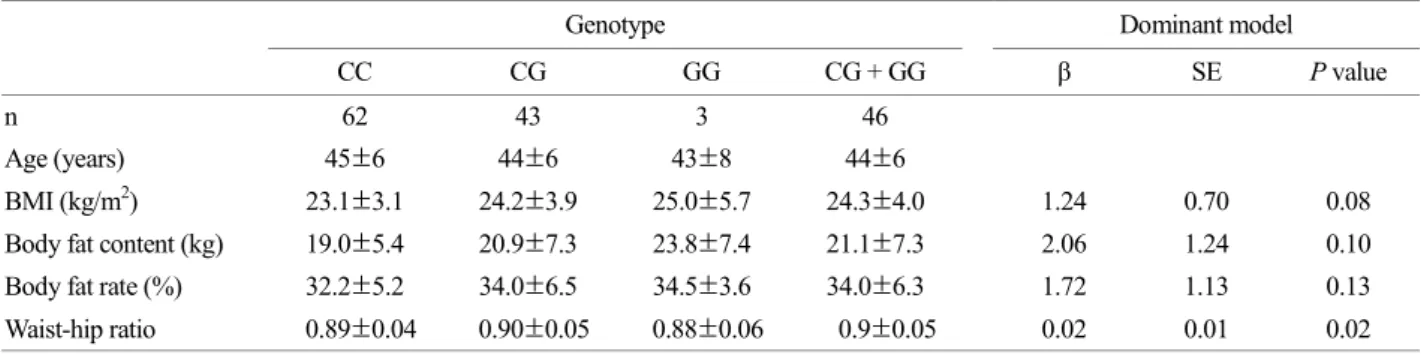
Here we identify that human chitinase 3-like 1 (CHI3L1, also called YKL-40 in human) single nucleotide polymorphism (SNP), rs883125, is associated with abdominal obesity in Korean women. Korean women subjects with the rs883125 G/G or C/G genotype present higher waist-hip ratio than subjects with C/C genotype suggesting that human subjects who G nucleotide substitution at the rs883125 tended to more accumulate intra-abdominal fat at the abdominal cavity. In addition, Chi3l1 gene expression is increased in adipose tissue from obese mice and pro-inflammatory cytokine enhances Chi3l1 expression in adipocytes, indicating that Chi3l1 is greatly related with obesity and obesity-induced pro-inflammatory responses. Taken together, the minor allele of rs883125 is associated with a higher prevalence of abdominal obesity in Korean women. These findings suggest that genotype of rs883125 can be a biomarker of incident abdominal obesity and abdominal obesity-related metabolic diseases.
Key Words: Chitinase 3-like 1, CHI3L1, YKL-40, SNP, Abdominal obesity, Korean women
INTRODUCTION
For the several decades, the prevalence and severity of obesity is dramatically and continuously has increased world- wide. Obesity has become a major public health problem since it is one of the key factors for development of meta- bolic diseases such as insulin resistance, type 2 diabetes, atherosclerosis, and several cancers. Although obesity is considered as a lifestyle disease, it is substantially recognized that genetic factors are also involved in the pathogenesis of obesity (Herrera and Lindgren, 2010; Choquet and Meyre,
2011). Single nucleotide polymorphisms (SNPs) is repre- sented these genetic factors that contribute to development of obesity. Many researchers have found SNPs, which are associated with obesity, and identified those SNPs are located in genes that involved in food intake, fat metabolism, adipo- cyte differentiation, and energy metabolism (Dina et al., 2007; Frayling et al., 2007; Loos et al., 2008; Lindgren et al., 2009; Meyre et al., 2009).
Abdominal fat, also known as visceral fat, is located in peritoneal cavity around the organs. Accumulation of excess energy as abdominal fat in adipocytes leads abdominal obesity and is a very high risk factor for cardiovascular diseases and
Original Article
*Received: November 29, 2017 / Revised: March 12, 2018 / Accepted: March 13, 2018
†Corresponding author: Dae-Bang Seo. Vital Beautie Research Division, Amorepacific R&D Center, Youngin 17074, Korea.
Tel: +82-31-280-5975, Fax: +82-31-284-8392, e-mail: [email protected]
○CThe Korean Society for Biomedical Laboratory Sciences. All rights reserved.
○CCThis is an Open Access article distributed under the terms of the Creative Commons Attribution Non-Commercial License (http://creativecommons.org/licenses/by-nc/3.0/) which permits unrestricted non-commercial use, distribution, and reproduction in any medium, provided the original work is properly cited.