ISSN 2288-0356(Online) Original Article
Antioxidant and Antimicrobial Activity of Rosa multiflora Thunberg Fruits Extracts
Young-Je Cho
*School of Food Science & Biotechnology, Food & Bio-Industry Research Institute, Kyungpook National University, Daegu 702-701, Korea
Abstract
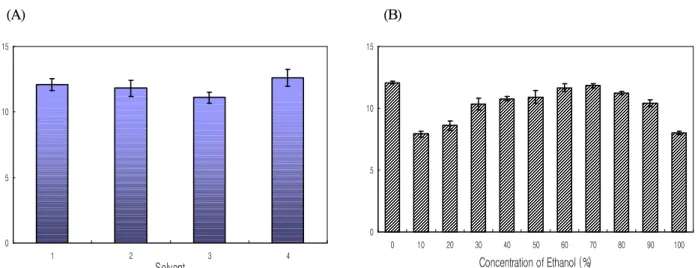
In this study, we selected some material to have potential bioactivity from natural plants, confirmed as basic data for industrializing and tried to develope the food materials using them. DPPH, ABTS, antioxidant protection factor, TBARs and antimicrobial activity of extracts from Rosa multiflora Thunberg fruits were determined. The total phenolics extracted from Rosa multiflora were 12.08, 11.82, 11.1 and 12.6 mg/g when using water, 70%
ethanol, 70% methanol and 70% acetone as the solvent, respectively. The optimum conditions for extracting the phenolic compounds were 70% ethanol over for 12 hrs(11.82 mg/g). The electron donating ability and inhibition rate on ABTS of the 70% ethanol extracts were 97% and 92.2%, respectively while the antioxidant protection factor(PF) of the water extracts and 70% ethanol extracts were 1.79 and 1.34 PF, respectively. The TBAR (thiobarbituric acid reactive substance) value were 1.3 μM for the control and 0.15 μM for the 70% ethanol extracts. The inhibitory activity against α-amylase was 26% for the 70% ethanol extracts. The 70% ethanol extracts from Rosa multiflora Thunberg fruits exhibited antimicrobial activity against H. pylori, S. epidermidis, S. aureusand and E. coli with clear zone diameters of 14, 25, 14 and 13 mm, respectively when using 200 μg/mL of the phenolic compounds. An HPLC analysis identified 6 major phenolic metabolites in the Rosa multiflora Thunberg fruits extracts: rosmarinic acid, caffeic acid, chlorogenic acid, courmaric acid, protocatechuic acid and quercetin. In particular, the content of rosmarinic acid was the highest in the 70% ethanol extracts. Therefore these results indicate that 70% ethanol extracts from Rosa multiflora Thunberg fruits can be useful as a natural antioxidant and in functional foods.
Keywords:Antimicrobial activity, Antioxidant activity, α-Amylase inhibitory activities, Rosa multiflora Thunberg fruits
Introcuction
1)Prooxidants and antioxidants are normally balanced in the human body yet this balance can break under certain conditions, resulting in oxidative stress that can lead to potent cell damage or bacterial disease (Videla and Fernandez 1998). The direct cause of such oxidative stress is reactive oxygen species (ROS) that are unstable and highly reactive, meaning they react easily with various biological substances and, attack cells and tissues, damaging them irreversibly or inducing mutation, cell poisoning and carcinogenic activity. Extensive studies have already been conducted to find antioxidants in food and nature, resulting in the development of many functional foods and cosmetics promoting human health(Cho et al. 2008; Choi et al. 2003).
The fruits of Rosa multiflora Thunberg is used in Oriental medicine to cure diuresis, edema, constipation and boils. In addition, it has been reported to help improve energy levels, unblock the coronary arteries, strengthen protein and lipid metabolism, and inhibit the occurrence the bamboo arteries (Park et al. 2008). The key components include a quercetin derivative
(multiside A, multinoside B, quercitrin), kaempferol derivative (multiflorin A, multiflorin B, afzelin, astragalin), methyl gallate from the tannin group, and lycopene that is the red pigment in the fruit (Higasi 2000; Kang et al. 1996).
With the recent growing interest in healthy life styles, there is also a growing interest in the development of functional foods and functional substances with natural bioactivity. Accordingly, this study, selected various natural plants with potential bioactivity and confirmed their basic data for future application in food materials.
Materials and Methods Chemicals
The ABTS[2,2-azinobis(3-ethylbenzothiazoline-6-sulfonic acid)], yeast extracts, BHT, beef extracts, pyruvic acid, β-carotene, α ,α-diphenyl-β-picrylhydrazyl (DPPH), pancreatin α-amylase, α -glucosidase, ρ-nitrophenol-α-D-glucopyranoside (PNPG) were all special grade and purchased from Sigma Co.
Received: August 20 2013 / Revised: September 23 2013 / Accept: September 27 2013
*
Corresponding Author: Young-Je Cho, Tel. 82-53-950-7755, Fax. 82-53-950-7762, Email. [email protected]
©2012 College of Agricultural and Life Science, Kyungpook National University
Sample Preparation
2)The Rosa multiflora fruits was purchased at an oriental herb market dried in a drying oven at 50℃ mashed using a 40 mesh screen, and stored at 4℃until use.
Extract preparation
Water extracts :1 g of the sample was added to 200 mL of distilled water in a flask boiled until the volume was reduced to 100 mL, and then cooled and shaken for 24 hrs. Ethanol extracts : 1 g of the Rosa multiflora Thunberg fruits powder was added to 100 mL of various concentrations of ethanol, shaken at room temperature for 24 hrs, and then filtered using Whatman No.1 filter paper. The ethanol extracts were also concentrated using rotary vacuum evaporator (Eyela NE, Japan).
Total phenolic assay
The total phenolic was measured according to the Folin-Denis' method (Joslyn 1970). Briefly, 1 mL sample of the water extracts and ethanol extracts were added to test tubes and mixed with 1 mL of 95% ethanol and 5 mL of distilled water. Thereafter 0.5 mL of a 1N Folin-ciocalteu reagent was added, then 5 min later, 1 mL of 5% Na
2CO
3was added and the absorbance read at 725 nm. The total phenolic content was calculated using gallic acid equivalents.
DPPH radical scavenging assay
The 1,1-diphenyl-2-picrylhydrazyl (DPPH) radical scavenging assay was measured using Blois method (Brand-Williams et al.1995). Briefly, 3 mL of 60 μM DPPH in ethanol was added to 1 mL of each sample and incubated at room temperature for 15 min. The absorbance was then read at 517 nm. The activity was calculated as follows:
×
Measurement of ABTS radical cation decolorization The measurement of the ABTS[2,2'-azinobis(3-ethylbenzothiazoline- 6- sulfonic acid)] radical cationdecolorization was determined using the Pellegrin et al. method (Pellegrinet al. 1998). Briefly, 5 mL of 7 mM ABTS and 88 μL of 140 mM K
2S
2O
8were mixed and left to stand in a dark place for 14~16 hrs before use. Prior to the assay, the ABTS stock solution was diluted with absolute ethanol (ratio 1:88) to give an absorbance at 734 nm of 0.7±0.002 and equilibrated to 30℃ Next 1 mL of ABTS was added to glass test tubes containing 50 μL of each extract.
The contents were then mixed using a vortex mixer for 30 sec and incubated for 2.5 min. The absorbance was read at
734 nm. The percentage inhibition was calculated as follows:
×
Antioxidant Protection Factor (PF)
The antioxidant protection factor (PF) was evaluated using the assay described by Andarwulan and Shetty (Andarwulan and Shetty 1999). Briefly, 10 mg of β-carotene was dissolved in 50 mL of spectroscopic grade chloroform. 1.0 mL of this solution was then evaporated to dryness in a round flask using a rotary evaporator at 40℃ Next, 20 μL of linoleic acid, 184 μL of Tween 40, and 50 mL of H
2O
2were added to the β-carotene flask and mixed to make an emulsion. 5 mL of the emulsion solution was then added to glass test tubes containing 100 μL of each extract and mixed using a vortex mixer. Finally, the tubes were incubated at 50 ℃ for 30 min and cooled. The absorbance was read at 470 nm using ethanol as the blank.
The antioxidant activity was expressed as the protection factor (PF) and calculated as follows:
×
Measurement of Thiobarbituric acid substances(TBARs) The thiobarbituric acid substances(TBARs) were measured using the Buege and Aust' method (Buege and Aust 1978).
Briefly, emulsions were prepared using 1% linoleic acid and 1% Tween 40 in 100 mL of distilled water. 0.8 mL of the emulsions was then added to glass tubes containing 0.2 mL of each extract, and the tubes incubated in a water bath at 50℃for 10 hrs. Thereafter, 1.0 mL of the reacted solution was added to a tube containing 2 mL of the TBA reagent, vortexed and heated in a boiling water bath for 15 min. After cooling for 10 min, the solution was centrifuged for 15 min at 1,000 rpm and, the absorbance measured at 532 nm. The TBAR value (absorbance×0.0154) was determined as the μM of 1,1,3,3- tetraethoxypropane (TEP) product from 1 mL of the reacted mixture.
Measurement of pancreatin α-amylase inhibition activity The inhibition activity of pancreatin α-amylase was measured using an agar diffusing method (Cavidson and Parish 1989).
Briefly, the plates was prepared using 1% agar and 1% soluble
starch that were, solved, boiled, and sterilized at 121℃ for 15
min in a flask and then 15 mL plated on petri dishes. After
cooling the petri dishes, 0.8 μL of the sample and 0.2 μL of
α -amylase were mixed and plated on the petri dishes using
a disc paper. The control was plated with a mixture of distilled water and α-amylase. The petri-dishes were then incubated at 37℃ or 3 days, followed by the addition of 5 mL of I
2/KI (inhibition rate calculated as 5 mM I
2in 3% KI) and standing for 15 min for coloring.
3)
×
Measurement of antimicrobial activity
This study used Staphylococcus aureus (standard colony KCTC 1039), Candida albicans (standard colony KCTC 7965), Escherichia coli (standard colony KCTC 1039) and Streptococcus mutans (standard colony KCTC 3065) that cause cavities. The microorganisms were incubated on agar plates using an nutrient medium, Brain Heart medium, YM medium and Tryptic soy medium in a 37℃ incubator and CO
2incubator while maintaining air and nonair conditions for 24~48 hrs. The antimicrobial activity measurements were used to confirm a clear zone around the disc of the plate medium prepared using 100 μL of the stock microorganism, then filter paper(Φ 8mm) discs containing 50~200 μg/mL phenolics were applied to the surface (Ju and Cho 2009).
HPLC analysis
The HPLC chromatographic analysis of the Rosa multiflora
(A) (B)
0 5 10 15
1 2 3 4
Solvent
Content of phenol (mg/g)
0 5 10 15
0 10 20 30 40 50 60 70 80 90 100
Concentration of Ethanol (%)
Content of phenol (mg/g)
Figure 1. Effect of different solvents(A) and ethanol concentrationons(B) on extraction of phenolics from Rosa multiflora Thunberg.
1: Water extracts 2: 70% Ethanol extracts 3: 70% Methanol extracts 4: 70% Acetone extracts
* Each value represents mean±SD(n=3)
extracts was conducted using a modified version of the Whitaker’
method (Vattem and Shetty 2002; Whitaker et al. 1984). Briefly, 2 mL of the Rosa multiflora extracts was filtered through a 0.2 mm filter. 5 mL of the sample was then injected using an by Agilent ALS 1100 autosampler into an Agilent 1100 series HPLC equipped with a VWD 1100 variable wavelength detector. The solvents used for the gradient were (A) 10 mM phosphoric acid (pH 2.5) and (B) methanol. The methanol concentration was increased to 60% during the first 8 min and to 100% during the next 7 min, then decreased to 0% during 3 min and maintained at 0% for the last 7 min (total run time, 25 min). The analytical column was an Agilent Zorbax SB-C18, 250 ×4.6 mm i.d., including packing material with a 5 mm particle size at a flow rate of 1 mL/min at an ambient temperature.
During each run the chromatogram was recorded at 306 nm and integrated using an Agilent Chemstation enhanced intergrator. Pure procatechuic acid, caffeic acid, coumaric acid, rosmarinic acid and quercetin in 100% methanol were used to calibrate the standard curve and retention times.
Results and Discussion Total content of phenolics
Phenolic compounds are known as secondary metabolic products
whit various structures and molecular weights, plus they exhibit
antioxidant activities based on compounding protein and huge molecules due to their phenolic hydroxyl group (Jung et al.
2004). To determine the optimal conditions for extracting samples, the total phenolics extracted using the water, 70%
ethanol, 70% methanol and 70% acetone solvent were 12.08 mg/g, 11.82 mg/g, 11.1 mg/g, and 12.6 mg/g, respectively (Figure. 1-A). To apply Rosa multiflora extracts to food products, the total phenolics were prepared using 10~100%
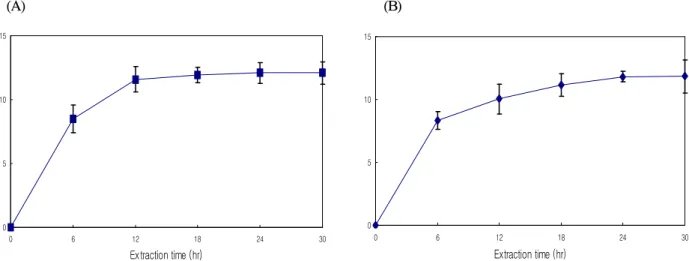
ethanol, which is harmless and highly solubile with phenolic substances. As a result, the highest total phenolics were extracted when using 70% ethanol (Figure. 1-B). In addition, the total phenolics were compared when using different extraction times (Figure. 2). In the case of 70% ethanol, the total phenolics increased during 6~24 hrs, yet remained unchanged after 24 hrs. Thus, the optimal extraction conditions for Rosa multiflora were 70% ethanol for 24 hrs. Clark et al. (Clark and Tl-Feraly 1981) previously reported that phenolic substances in plants exhibit antimicrobial activity, thus it was expected that the phenolics in the 60% and 70% ethanol extracts would be a natural antimicrobial substance and physiologically active substance.
4)(A) (B)
0 5 10 15
0 6 12 18 24 30
Extraction time (hr)
Content of phenol (mg/g)
0 5 10 15
0 6 12 18 24 30
Extraction time (hr)
Content of phenol (mg/g)
Figure 2. Effect of extraction time on water extraction(A) and 70% ethanol extraction(B) of phenolics from Rosa multiflora Thunberg.
Each value represents mean±SD(n=3) A antioxidant effects
A DPPH radical scavenging assay of antioxidant activities is an effective method for measuring antioxidant ability using decoloring anioic acids, like cysteine and glutathione that contain sulfur, aromatic amine, and ascorbic acid. These substances are also used to measure aging inhibition in the body against free radicals in terms of reducing or offsetting free radicals
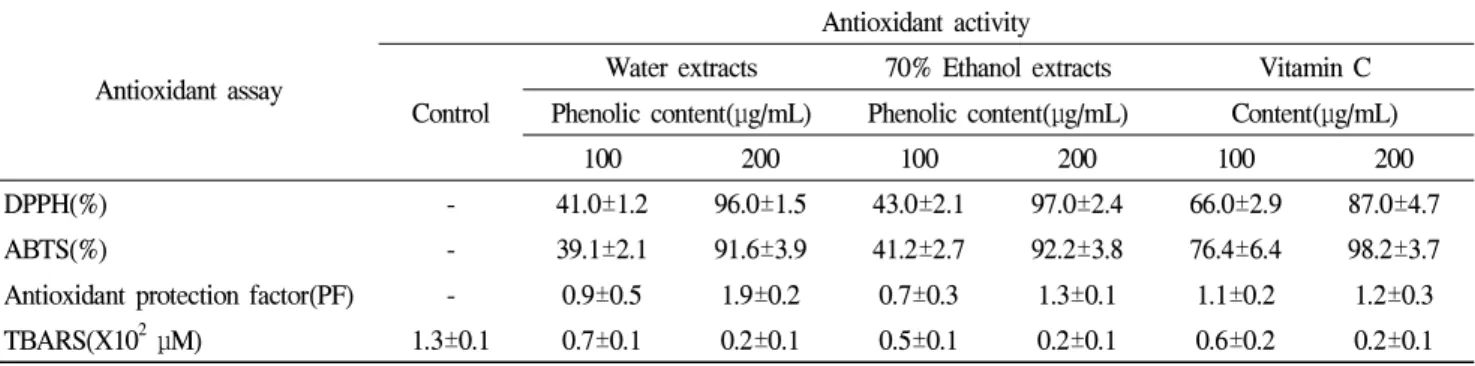
(superoxide) (Torelet al. 1986). The DPPH radical scavenging ability of the Rosa multiflora extracts (200 μg/mL) was remarkable at over 90% over, and the 70% ethanol extracts were the highest at 97% (Table 1). When compared with Park's report that 70% water extracts of Cornus officinalis, Glycyrrhiza uralensis and Astragali radix had a DPPH radical scavenging ability of more than 70% (Park et al. 2008), the antioxidant ability of the Rosa multiflora extracts is clearly excellent, plus the present study used less total phenolics. Kang et al.(1996) reported that thehigher the ability of electron donation, the higher the reducing ability of phenolic substances. To measure the hydrophilic antioxidant ability, the ABTS radical cation decolorization was assayed and no differences were found between the water extracts and the 70% ethanol extracts, as both exhibited high inhibition rates at 91.6% and 92.2%, respectively [Table 1]. Therefore it is anticipated that the water extracts and 70% ethanol extracts can both be developed as hydrophilic and lipophilic agents. To determine the lipophillic antioxidant activity, the antioxidant protection factor (PF) was measured and the results for the water extracts (200 μg/mL) and 70% ethanol extracts (200 μg/mL) were 1.79 PF and 1.34
PF, respectively, as shown in Table 1. These results indicate
very high antioxidant activities, as 1.2 PF is commonly
considered high antioxidant activity. Furthermore, the TBAR
values were measured to confirm the inhibitory effect of the
Rosa multiflora extracts against lipid oxidation, where the value
for the water extracts (200 μg/mL) was 0.21±0.06 μM and that
for the 70% ethanol extracts (200 μg/mL) was 0.15±0.04 μM.
Table 1. Antioxidant activities of water and 70% ethanol extracts from Rosa multiflora Thunberg
Antioxidant assay
Antioxidant activity
Control
Water extracts 70% Ethanol extracts Vitamin C Phenolic content(μg/mL) Phenolic content(μg/mL) Content(μg/mL)
100 200 100 200 100 200
DPPH(%) - 41.0±1.2 96.0±1.5 43.0±2.1 97.0±2.4 66.0±2.9 87.0±4.7
ABTS(%) - 39.1±2.1 91.6±3.9 41.2±2.7 92.2±3.8 76.4±6.4 98.2±3.7
Antioxidant protection factor(PF) - 0.9±0.5 1.9±0.2 0.7±0.3 1.3±0.1 1.1±0.2 1.2±0.3
TBARS(X10
2μ M) 1.3±0.1 0.7±0.1 0.2±0.1 0.5±0.1 0.2±0.1 0.6±0.2 0.2±0.1
*Phenolic content was 100 and 200(μg/mL)
*Each value represents mean±SD(n=3)
5)These values were lower than the control which was 1.3±0.02 μ M. Therefore, the results indicated that Rosa multiflora extracts had a high inhibitory ability against oxidation. Thus, the antioxidant activities of the phenolic compounds in the Rosa multiflora extracts match previous reports of phenoilc compounds and flavonoids in plants acting, as natural antioxidants (Bors and Saran 1987; Fitzpatrick et al.1993; Sato et al.1996). However, even though the water extracts included more total phenolic compounds than the 70% ethanol extracts, the antioxidant activity of the water extracts was lower than that of 70% ethanol extracts, meaning the 70% ethanol extracts included more antioxidant properties influencing antioxidant activity. Notwithstabding, the water extracts and 70% ethanol extracts can both still be used as antioxidant agents due to their remarkable activities against oxidation.
Measurement of pancreatin α-amylase inhibition activity Pancreatin α-amylase is a liquefactive enzyme that randomly hydrolyzes polysaccharides, and the Rosa multiflora extracts were examined to confirm their ability to inhibit the α-amylase enzyme. The enzyme inhibition effects of the water extracts and 70% ethanol extracts were both high at 40% and 61%, respectively (Figure. 3). Yet, the current results were remarkably low when compared with those previously reported for Rubifructus extracts (84%) and Schizandrae fructus extracts (100%). Iwuoha and Aina (Iwuoha and Aina 1997) reported that, phenolic matter reduces the ability to resolve starch, thereby inhibiting the activity of α-amylase. Thus, while the Rosa multiflora extracts exhibited excellent antioxidant activities, their ability to inhibit α-amylase activity was low.
Measurement of antimicrobial activity
The antimicrobial activities of the Rosa multiflora extracts were
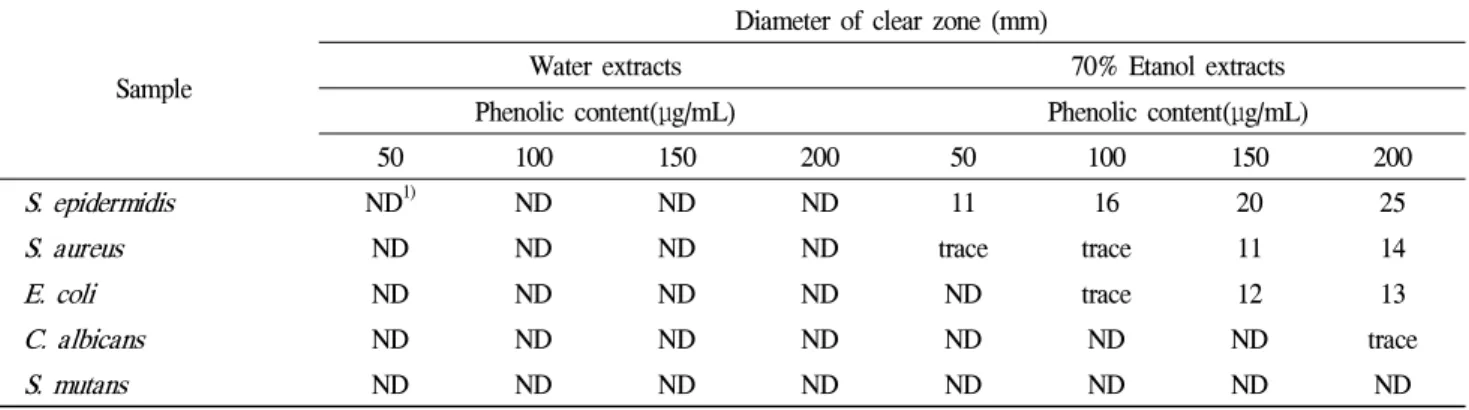
measured gainst S. aureus, E. coli, S. epidermidis, S. mutans and C. albicans based on Disc's method (Higasi 2000; Chun et al. 2005). Table 2 and Figure. 4 show that the water extracts did not show any inhibitory effect against skin microorganisms, yet the ethanol extracts showed a remarkable inhibitory effect against S. epidermidis with a clear zone of 11, 16, 20, and 25 mm in case of a phenolic content of 50, 100, 150, and 200 μg/mL, respectively. While the inhibitory effect against S. aureus and E. coli , was with a low phenolic content of 100 μ g/mL, both microorganisms were inhibited by phenolic contents of 150 and 200 μg/mL. In the case of C. albicans , weak antimicrobial activity was exhibited with a phenolic content over 150 μg/mL. No antimicrobial activity was exhibited against S. mutans.
Figure 3. Inhibition of α-amylase activity by water and 70%
ethanol extracts from Rosa multiflora Thunberg.
A: blank, B: control, C: water extracts, D: ethanol extracts
Table 2. Antimicrobial activity of water and 70% ethanol extracts from Rosa multiflora Thunberg with according to concentration of phenolic compounds
Sample
Diameter of clear zone (mm)
Water extracts 70% Etanol extracts
Phenolic content(μg/mL) Phenolic content(μg/mL)
50 100 150 200 50 100 150 200
S. epidermidis ND
1)ND ND ND 11 16 20 25
S. aureus ND ND ND ND trace trace 11 14
E. coli ND ND ND ND ND trace 12 13
C. albicans ND ND ND ND ND ND ND trace
S. mutans ND ND ND ND ND ND ND ND
*
1)ND : not detected
*Each value represent mean±SD(n=3)
6)Figure 4. Antimicrobial activity of 70% ethanol extracts from Rosa multiflora Thunberg.
① Staphylococcus epidermidis , ② taphylococcus aureus , ③ Escherichia coli HPLC analysis of extracts
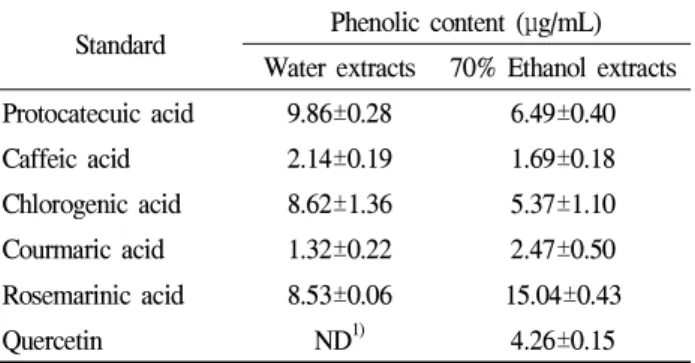
An HPLC analysis was carried out to identify the phenolic profiles of the Rosa multiflora extracts. The 6 major phenolic metabolites identified were rosmarinic acid, caffeic acid, chlorogenic acid, coumaric acid, protocatechuic acid and quercetin (Table 3). The contents of rosmarinic acid, courmaric acid and quercetin were higher in the ethanol extracts than in the water extracts. Conversely, the contents of protocatecuic
acid, caffeic acid and chlorogenic acid were higher in water extracts at 9.86, 2.14 and 8.62 mg/g dry weight, respectively, than in the ethanol extracts at 6.49, 1.69 and 5.37 mg/g dry weight, respectively. Among the 6 phenolics, the rosmarinic acid content was highest in the 70% ethanol extracts at 15.04 mg/g dry weight campare to 8.53 mg/gdry weight in the water extracts. The second highest content of a specific phenolic was related to protocatecuic acid, where the highest content was found in the ethanol extracts at 6.49 mg/g dry weight compared to 9.86 mg/g dry weight in the water extracts. Two other major phenolics of significance were chlorogenic acid and quercetin which were found at levels of 8.62 and 5.37 mg/g dry weight in the water and ethanol extracts, respectively. The other phenolics such as courmarinic acid and caffeicacid, are generally found in lower concentrations in oriental medicinal plant extracts.
In conclusion, the Rosa multiflora extracts were identified and characterized with a high phenolic profile and high antioxidant and antimicrobial activity. Furthermore, the high phenolic profile and high antioxidant activity were clearly correlated with a high antimicrobial and α-amylase inhibitory activity. The development of these phenolics many now faciliatte the development dietary phenolic ingredients with antioxidant potential that can enhance the protective host defence response in humans (Akyon 2002), while also inhibiting prokaryotic pathogenic bacteria, such as Helicobacter pylori linked to gastric infections, Staphylococcus epidermidis linked to skin infections, and Staphylococcus aureus and Escherichia coli linked to food poisoning infections.
Innovative strategies can also be used to develop functional
foods against chronic bacterial infections.
Table 3. Phenolic profiles of Rosa multiflora extracts Standard Phenolic content (μg/mL)
Water extracts 70% Ethanol extracts Protocatecuic acid 9.86±0.28 6.49±0.40
Caffeic acid 2.14±0.19 1.69±0.18
Chlorogenic acid 8.62±1.36 5.37±1.10 Courmaric acid 1.32±0.22 2.47±0.50 Rosemarinic acid 8.53±0.06 15.04±0.43
Quercetin ND
1)4.26±0.15
1)