online©ML Comm
-139-
J Rhinol 16(2), 2009 www.ksrhino.or.kr
Effect of Staphylococcal Enterotoxin on the Development of Allergic Rhinitis in Mice
Sang-Wook Kim, MD, Doo Hee Han, MD, Dong-Young Kim, MD, Hong-Ryul Jin, MD, Chae-Seo Rhee, MD and Yang-Gi Min, MD Department of Otorhinolaryngology, Seoul National University College of Medicine, Seoul, Korea
ABSTRACT
Background and Objectives:The aim of this study is to investigate the role of staphylococcal enterotoxin B (SEB) in the development of allergic rhinitis. Materials and Methods:Nasal mucosa and serum were obtained from sensitized mice and control groups, and the frequencies of allergic symptoms, such as sneezing and nasal rubbing, were counted. Eosinophil counts in the nasal mucosa were compared between the study groups. The serum levels of ovalbumin-specific IgE were measured by ELISA. Differences between the sensitized and control groups were statistically analyzed using the Kruskal-Wallis test and the Mann-Whitney U test. Results:The frequencies of sneezing and serum levels of ovalbumin-specific IgE were significantly higher in the groups locally sensitized with SEB than in the control group. On the other hand, they sneezed less frequently and showed lower serum levels of ovalbumin-specific IgE than those in the group locally sensitized with ovalbumin. Conclusion:
SEB may participate in the pathogenesis of allergic rhinitis although it is a less potent inducer than ovalbumin.
KEY WORDS:Staphylococcal enterotoxin B·Allergic rhinitis·Mice.
INTRODUCTION
Allergic rhinitis (AR) is an inflammatory disease of the nasal mucosa characterized by the infiltration of inflam- matory cells and the release of inflammatory mediators.
Many previous studies have shown that environmental factors such as temperature, dry air, air pollution, sex hor- mones, stress and alcohol can modify the pathogenesis of AR.1)2) After a series of papers has been published on the role of bacteria in the pathogenesis of atopic diseases, including atopic dermatitis and bronchial asthma, it is generally known that bacterial colonization is associated with AR.3-5) Some of the previous studies have focused on the role of Staphylococcus aureus enterotoxin in the de- velopment of AR. According to one of them, the frequency of Staphylococcus aureus nasal carriage in patients with AR is higher than that in the normal subjects, and half of the allergic patients were colonized by S. aureus producing
enterotoxins and toxic shock syndrome toxin 1 (TSST-1).
In addition, S. aureus-positive groups in allergic patients revealed significantly severe symptoms than S. aureus- negative groups.6) Another study has demonstrated that al- lergic patients sensitive to staphylococcal enterotoxin have higher serum levels of total IgE and allergen-specific IgE antibodies.7) This study also showed that among patients with persistent rhinitis, those with IgE antibodies against staphylococcal enterotoxins have higher ECP levels which are considered as a useful parameter of eosinophil activa- tion, than those without specific IgE against staphylococcal enterotoxins. In addition, it has been suggested that mic- robial superantigens may induce resistance to steroids.8) However, the role of staphylococcal enterotoxin in the pathogenesis of AR has not yet been completely elucidat- ed. In this study, we investigated the relationship between staphylococcal enterotoxin B (SEB) and the development of AR using a mouse model.
MATERIALS AND METHODS Animals and allergens
Twenty-six 5-week-old BALB/c female mice were di- vided into 3 groups: the control and 2 experimental groups.
Address correspondences and reprint requests to Yang-Gi Min, M.D., Department of Otorhinolaryngology, Seoul National Uni- versity College of Medicine, 101 Daehangno, Jongno-gu, Seoul 110-744, Korea
Tel:82-2-2072-2446, Fax:82-2-745-2387 E-mail:[email protected] Received for publication on July 2, 2009 Accepted for publication on September 8, 2009
140 / J Rhinol 16(2), 2009
The experimental groups consisted of the OVA group that was intranasally sensitized with ovalbumin (Sigma-Aldrich, St Louis, MO, USA) and the SEB group that was intranas- ally sensitized with SEB (Sigma-Aldrich). All mice were specific pathogen-free. The experimental protocol used in this study was approved by the Institutional Animal Care and Use Committee at Seoul National University.
Sensitization of mice
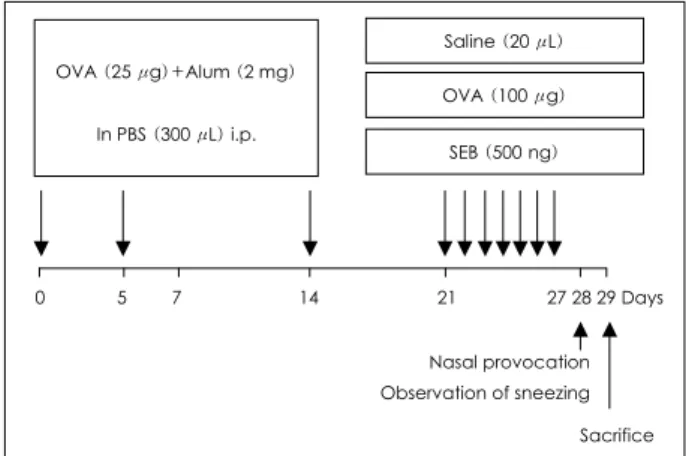
The mice were sensitized intraperitoneally and then in- tranasally according to the protocol depicted in Fig. 1.
They were systemically sensitized with 25 μg of oval- bumin dissolved in 300 μL phosphate-buffered saline in the presence of 2 mg alum (Pierce Biotechnology Inc., Rockford, IL, USA) as adjuvants by intraperitoneal in- jection on experimental days 0, 5 and 14. One week after the third intraperitoneal sensitization, the mice were in- tranasally challenged for 7 consecutive days. The control and OVA groups (n=10 for each) intranasally received 20 μL of saline and 100 μg of ovalbumin dissolved in 20 μL of saline, respectively. In order to investigate the ef- fect of exposure to SEB on nasal challenge, the SEB group (n=6) intranasally received 500 ng of SEB dis- solved in 20 μL of saline. Twenty-four hours after the final nasal challenge, 200 μg of ovalbumin was instilled into the nasal cavity in order to provoke allergic symp- toms, including sneezing and nasal rubbing, and symptom scores were counted immediately after provocation for 15 minutes. Twenty-four hours later, the mice were euthanized in the chamber filled with dry ice.
Histological examination
The decapitated specimens were immediately fixed in
10% formalin and embedded in paraffin after decalcifi- cation. The coronal sections (4 μm thick) of the whole head were mounted on silanized slides, deparaffinized in xylene and then rehydrated in graded ethanol solutions (100%, 90%, 80% and 70%). The sections were stained with hematoxylin and eosin according to the routine me- thod. The number of eosinophils that infiltrated into the nasal mucosa was counted, and the average of 5 different sites observed by 2 independent researchers in a high po- wer fields (×400) was calculated.
Measurement of ovalbumin-specific IgE
Serum levels of ovalbumin-specific IgE were measured by ELISA (BD Biosciences, San Jose, CA, USA) accord- ing to the manufacturer’s instructions.
Statistical analyses
The Kruskal-Wallis test and the Mann-Whitney U test generated by SPSS version 12.0 were applied to deter- mine the presence of statistical differences in the symptom scores, serum levels of ovalbumin-specific IgE and degrees of eosinophilic infiltration between the 3 groups.
RESULTS Development of allergic symptoms
The control group sneezed and rubbed the nose 0.6 and 2.9 times on the average, respectively. In contrast, the OVA group showed a sneezing frequency of 28.2 and a nasal rubbing frequency of 23.6, and the SEB group exhibited a sneezing frequency of 10.7 and a nasal rubbing frequency of 14.5 on the average. Both experimental groups showed significantly higher sneezing frequencies than the controls (p<.05, Kruskal-Wallis test) although the SEB group sne- ezed less frequently than the OVA group (p=.007, Mann- Whitney U test). Likewise, the 2 experimental groups showed more frequent nasal rubbing than the controls (p
<.05, Kruskal-Wallis test). However, the frequency of nasal rubbing was not statistically different between the OVA and SEB groups (p=.211, Mann-Whitney U test)(Fig. 2).
Ovalbumin-specific IgE
The mean value of ovalbumin-specific IgE in the SEB and OVA groups were 0.337 and 0.468, respectively. On the other hand, the mean value of ovalbumin-specific IgE
Fig. 1. Protocols used to sensitize mice. OVA:Ovalbumin, SEB:
Staphylococcal enterotoxin B.
OVA (25 μg)+Alum (2 mg)
In PBS (300 μL) i.p.
OVA (100 μg) Saline (20 μL)
SEB (500 ng)
0 5 7 14 21 27 28 29 Days
Nasal provocation Observation of sneezing
Sacrifice
Kim et al:Staphylococcal Enterotoxin B and Allergic Rhinitis / 141
in the control was 0.134, which was significantly lower than both experimental groups (p<.05, Kruskal-Wallis test). In addition, the difference in the level of ovalbumin- specific IgE between the SEB and OVA groups was statis-
tically significant (p=.02, Mann-Whitney U test)(Fig. 3).
Eosinophilic infiltration (H&E stain)
The number of eosinophils infiltrating the nasal mucosa was calculated by averaging 5 different sites at a mag- nification of ×400 as examined by 2 independent resear- chers. In the control group, eosinophilic infiltration was rarely found, but in the SEB group, 6.6 eosinophils per 5 sites were found on the average. Eosinophils were found in the epithelium and submucosal tissue. On the other hand, the OVA group showed 8.4 eosinophils on the average (Fig. 4). Although both experimental groups showed sig- nificantly more severe eosinophilic infiltration than the control group (p<.05, Kruskal-Wallis test), the difference between them was insignificant (Fig. 4).
DISCUSSION
It has been established that T cell activation elicited by allergens, such as staphylococcal enterotoxins or TSST-1, lead to the production of IL-4 and IL-5 in atopic diseases such as bronchial asthma and atopic dermatitis.6)9-11) IL-4, a cytokine, is known to be required for the production of IgE, which induces isotype switching in B cells. On the other hand, IL-5 is a cytokine that stimulates the growth, differentiation, and survival of eosinophils. Upregulation of these 2 cytokines by superantigen stimulation has been suggested to be an important factor in the pathogenesis of atopic diseases.6) Conventional allergens, such as oval- bumin, induce T cell activation via antigen processing and presentation by antigen-presenting cells. On the other hand, superantigens, such as SEB, stimulate T cells by binding directly to MHC class II β chain and the TCR-V β ele- ment. This process lead to the production of T helper 2
Sneezes/15 min
35 30 25 20 15 10 5 0
Control OVA SEB
*
*
†
Fig. 2. Frequencies of sneezing and nasal rubbing. Animals in the 2 experimental groups showed more frequent nasal rub- bing and sneezing than the control group (*significantly differ from control, p<.05, Kruskal-Wallis test). The OVA group sneez- ed more frequently than the SEB group (†significantly differ from each other, p<.05, Mann-Whitney U test). The data are expressed as the mean±SEM.
Nasal rubs/15 min
30
25
20
15
10
5
0
Control OVA SEB
*
*
OVA-specific lgE (OD490)
0.6
0.5
0.4
0.3
0.2
0.1
0
*
*
†
Fig. 3. Serum levels of ovalbumin-specific IgE. The OVA and SEB groups demonstrated higher serum levels of ovalbumin-spe- cific IgE than the control group (*significantly differ from control, p<.05, Kruskal-Wallis test). Between these 2 experimental groups, the OVA group showed significantly higher serum levels of ovalbumin-specific IgE than the SEB group (†significantly differ from each other, p=.02, Mann-Whitney U test). The data are expressed as the mean±SEM.
Control OVA SEB
Eosinophil count (×400)
14 12 10 8 6 4 2 0
*
*
Fig. 4. Eosinophil counts in the control and 2 experimental groups (at 5 different sites, ×400). Values represent mean±SD. *:Sig- nificantly different from control, p<.05, Kruskal-Wallis test.
Control OVA SEB
142 / J Rhinol 16(2), 2009
cell predominant cytokines which promote local inflam- mation contributing to the lesions of atopic diseases.3)12) Unlike AR, there have been numerous reports on the as- sociation of atopic diseases with bacteria, including the abovementioned studies. The relationship between AR and bacteria, however, has not been completely documented.
Recently several studies were performed to investigate the association between bacteria and AR.6)7)9) A previous human study has indicated that the mean carriage rate of Staphylococcus aureus in AR patients is higher than that in the normal population, and those sensitized to staphyl- ococcal enterotoxins seem to suffer from more severe al- lergic diseases.7) In another study, the serum levels of eo- sinophil cationic protein (ECP) and specific IgE towards a variety of staphylococcal enterotoxins (A, B, C, D) and TSST-1 were measured in patients suffering from rhinitis and/or asthma due to allergy. It was concluded that patients sensitive to staphylococcal enterotoxins have higher serum level of ECP, which can be a reliable marker for clinical severity of allergic disease. In another human study with AR patients has suggested that S. aureus-positive groups have significantly higher nasal symptom scores than S.
aureus-negative groups.6) In addition, peripheral blood lymphocytes in patients sensitized to SEB or TSST-1show significantly higher proliferative responses and production of Th2 cell-related cytokines such as IL-4, and IL-5.6) As shown in those prior clinical reports, clinical symptoms and a few markers which are representative of allergic responses, such as ECP, IL-4 and allergen specific IgE, are likely to be positively related to the presence of SEB.
Nevertheless, causal relationships between SEB and AR have not been well elucidated. In a recent animal study using a mouse model sensitized to Schistosoma mansoni egg antigen (SmEA), susceptibility to AR was found to be enhanced by nasal exposure to SEB, whereas mice treat-d with SEB alone did not produce SEB-specific IgE or dem- nstrate nasal eosinophilia, which suggests that SEB itself does not induce allergic reactions.13)
In this study, in contrast, the SEB group showed more severe allergic symptoms and higher serum levels of oval- bumin-specific IgE than the control group. Although the mice intranasally sensitized to SEB sneezed less frequently and revealed significantly lower levels of ovalbumin-spe- cific IgE than those intranasally sensitized to ovalbumin, these findings indicate that the presence of SEB may con- tribute to inducing AR, although it is a less potent inducer than ovalbumin. The pathogenesis of AR is possibly a
complicated process, thus, it can be assumed that SEB may play a partial role in developing AR.
In conclusion, the results of this study suggest that SEB may contribute to inducing AR. Although it is not a single etiologic factor for the development of AR, it may serve to induce AR.
Acknowledgments
This study was supported by a grant number 04-2005-039-0 from Seoul National University Hospital Fund.
REFERENCES
1) Sorri M, Hartikainen-Sorri AL, Karja J. Rhinitis during pregnancy.
Rhinology 1980;18:83-6.
2) Peterson B, Saxon A. Global increases in allergic respiratory dis- ease: the possible role of diesel exhaust particles. Ann Allergy As- thma Immunol 1996;77:263-8; quiz 9-70.
3) Herz U, Ruckert R, Wollenhaupt K, Tschernig T, Neuhaus-Steinmetz U, Pabst R, et al. Airway exposure to bacterial superantigen (SEB) induces lymphocyte-dependent airway inflammation associated with increased airway responsiveness--a model for non-allergic asthma.
Eur J Immunol 1999;29:1021-31.
4) Konig B, Neuber K, Konig W. Responsiveness of peripheral blood mononuclear cells from normal and atopic donors to microbial su- perantigens. Int Arch Allergy Immunol 1995;106:124-33.
5) Shinogi J, Majima Y, Takeuchi K, Harada T, Sakakura Y. Quantita- tive cytology of nasal secretions with perennial allergic rhinitis in children: comparison of noninfected and infected conditions. La- ryngoscope 1998;108:703-5.
6) Shiomori T, Yoshida S, Miyamoto H, Makishima K. Relationship of nasal carriage of Staphylococcus aureus to pathogenesis of pe- rennial allergic rhinitis. J Allergy Clin Immunol 2000;105:449-54.
7) Rossi RE, Monasterolo G. Prevalence of serum IgE antibodies to the Staphylococcus aureus enterotoxins (SAE, SEB, SEC, SED, TSST-1) in patients with persistent allergic rhinitis. Int Arch Al- lergy Immunol 2004;133:261-6.
8) Fakhri S, Tulic M, Christodoulopoulos P, Fukakusa M, Frenkiel S, Leung DY, et al. Microbial superantigens induce glucocorticoid receptor beta and steroid resistance in a nasal explant model. La- ryngoscope 2004;114:887-92.
9) Motala C, Potter PC, Weinberg EG, Malherbe D, Hughes J. Anti- Staphylococcus aureus-specific IgE in atopic dermatitis. J Allergy Clin Immunol 1986;78:583-9.
10) Nomura I, Tanaka K, Tomita H, Katsunuma T, Ohya Y, Ikeda N, et al. Evaluation of the staphylococcal exotoxins and their specific IgE in childhood atopic dermatitis. J Allergy Clin Immunol 1999;
104:441-6.
11) Hahn DL, Dodge RW, Golubjatnikov R. Association of Chlamydia pneumoniae (strain TWAR) infection with wheezing, asthmatic bronchitis, and adult-onset asthma. JAMA 1991;266:225-30.
12) Okano M, Takishita T, Yamamoto T, Hattori H, Yamashita Y, Nishioka S, et al. Presence and characterization of sensitization to staphylo- coccal enterotoxins in patients with allergic rhinitis. Am J Rhinol 2001;15:417-21.
13) Okano M, Hattori H, Yoshino T, Sugata Y, Yamamoto M, Fujiwara T, et al. Nasal exposure to Staphylococcal enterotoxin enhances the development of allergic rhinitis in mice. Clin Exp Allergy 2005;35:
506-14.