Preparation and Characterization of Coating Solution
Based on Waterborne Polyurethane Dispersion containing Fluorine for Primer on Electro Galvanized Steel Sheet
Chung Keun Jin and Sung Hyung Lim†
Buhmwoo Institute of Technology Research 366-8, Maebawi-ro, Jangan-myon, Hwaseong-si, Gyeonggi-do, Korea (Received January 08, 2015; Revised June 26, 2015; Accepted June 29, 2015)
The purpose of this research was to synthesize fluorine modified waterborne polyurethane dispersion (F-WPU) by soap-free (internal emulsifier) emulsion polymerization techniques, to prepare coating solution based on fluorine modified waterborne polyurethane dispersion (F-WPU) and to compare the chemical and thermo-mechanical properties on the electrogalvanized steel sheet. Environmentally friendly F-WPU was prepared with a fluorinated polyol containing 60 wt% of fluorine. There are various ways of combining a wide variety of fluorinated polyols and diisocyanate to exhibit novel properties of waterborne polyurethane dispersion. Components of coating solution were largely divided into 4 kinds i.e., F-WPU, acrylic emulsion, silane coupling agent, and colloidal silicate. F-WPU coating solution on the electro-galvanized steel sheet showed excellent properties of corrosion resistance, alkali resistance and heat resistance, as compared to other coating solutions using a general waterborne resin. The F-WPU coating solution’s reliable effects are possibly due to the fluorine atoms incorporated even in a small amount of F-WPU.
Keywords : waterborne polyurethane, fluorine, steel, corrosion resistance
†Corresponding author: [email protected]
1. Introduction
Recently, from the viewpoint of environmental pro- tection, the emission of organic compounds into the atmos- phere is strictly regulated. Hence, water-soluble or water- borne coatings are strongly demanded for development and application. Waterborne polyurethane dispersions are non- toxic and non-flammable materials. They also provides excellent chemical, solvent and abrasion resistance, as well as adhesion to the surface of substrates such as glass, rubber, leather, and metal so that polyurethane is suitable for many coating applications1-3).
Polyurethane is formed by the well known nucleophilic addition reaction between diisocyanate and polyol leading to polyurethane segments, which are hard and soft segment.
Urethane bond is expressed by NH-CO-O. Hard segment is crystalline or semi-crystalline region by hydrogen bond- ing, resulting in the strength and hardness and consists of short chain diol, diamine and diisocyanate. Soft seg- ment is amorphous and rubbery region, resulting in the low temperature property such as elongation and chemical resistance and consists of long chain diol4-6).
Fluorinated compounds have been widely used in paint industry because of its low surface energy, water and oil repellent. However, in most cases poor adhe- sion and relatively high production cost may circum- scribe their use. It is one of the important topics of the research on how to make the fluorinated compo- nents play a better role and how to increase the bond strength of the material on the promise of maintaining good surface properties of materials7-10). The defects could be improved through these methods: the copoly- merization of fluorinated monomer with other monomers and the mixing of fluorinated compound with other emulsions. Furthermore, the copolymerization method is widely used in the preparation of coating materials, but the method is mainly used by colloidal dispersion or emulsion polymerization. In this method, the applica- tion of fluorine results in a poor dispersion stability and properties due to hydrophobic property of fluorine.
So, the fluorine contents can be used on limited. The mixing of fluorinated compound and waterborne resin results in a poorer quality product similar to copoly- merizaton method because of the limited miscibility of phase separation between the two polymers11-17). Therefore, to overcome these problems, many studies have been carried out on polymer blends and composites.
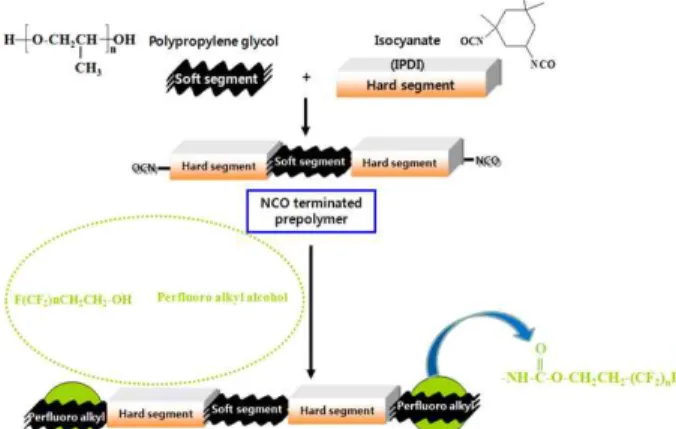
Fig. 1. Reaction scheme for fluorine modified PU oligomer (F-PU).
Fig. 2. Reaction scheme for fluorine modified PU dispersion (F-WPU).
Interpenetrating polymer networks (IPNs) are more or less in compatible polymer blends in which macroscopic phase separation is prevented by suitably core/shell morpholo- gies of the participating compounds.
In this study, polyurethane oligomer was prepared with fluorine groups as the seed material, then waterborne poly- urethane dispersion is synthesized with fluorine modified polyurethane oligomer by interpenetrating polymer net- works (IPNs) method, to prepare coating solution contain- ing fluorine modified waterborne polyurethane dispersion.
Degree of reaction, particle size, contact angle, corrosion resistance and heat & humidity resistance are charac- terized by FT-IR, ELS, contact angle analysis, salt spray test (SST), and spectrophotometer, respectively.
2. Experimental Procedure 2.1 Materials
Polycarbonate diol (PCDL, Mw.2,000, Ube chemical), polypropylene glycol (PP1000, Mw.1000, KPX chemical) were dried at 90 ℃ for 3 hrs before use. Hydroxylethyl
perfluorooctane (EA812IW, Clariant), Isophorone diisocyanate (IPDI, Degussa), dicyclohexylmethane 4,4’- diisocyanate (H12MDI, Degussa), triethylamine (TEA, Aldrich chemical) and 2,2’-dimethylol propionic acid (DMPA, Aldrich chemical) were dried at 90 ℃ for 12 hrs before use. N-methyl-2-pyrrolidone (NMP, Junsei Chemical), Dibutyltin dilaurate (DBTDL, Aldrich Chemical), Glyci- doxypropyltrimethoxysilane (GPTMS, Dow corning), col- loidal silica (amorphous silica, Nissan chem.), and acrylic emulsion (ethylene acrylic acid) were used.
2.2 Synthesis of Fluorine modified Polyurethane Oligomer Synthesis of fluorine modified polyurethane oligomer (F-PU) was carried out in a 500 mL four-neck, round-bot- tom flask equipped with mechanical stirrer, additional fun- nel, N2inlet, thermometer and heating mantle. Fig.1 shows the schematic diagram of preparations of fluorine modi- fied polyurethane Oligomer. Polypropylene glycol was added into the flask and mixed at 70 ℃for 30 min. Then, isophorone diisocyanate (IPDI) was charged and reaction proceeded for 2 hrs at the same temperature until the theo- retical NCO contents was reached. The change in the NCO value during the reaction was determined with the stand- ard dibutylamine back-titration method (ATSM D 1638).
Then, hydroxylethyl perfluorooctane (EA812IW) was sub- sequently charged and reaction proceeded for another 2 hrs at 80 ℃, upon which NCO/OH (its theoretical value
= 1.0) was determined by FT-IR. A typical scheme for the preparation of F-PU is given in Table 1.
2.3 Synthesis of Fluorine modified Waterborne Polyurethane Dispersion
Synthesis of fluorine modified waterborne polyurethane dispersion (F-WPU) was carried out in a 500 mL four- neck, round-bottom flask equipped with mechanical stirrer, additional funnel, N2inlet, thermometer and heating mantle. Fig. 2 shows the schematic diagram of preparations of fluorine modified waterborne polyurethane dispersion.
Polycarbonate diol, DMPA (dimeylol propionic acid) and NMP (N-metyl-2-pyrrolidone) were added into the flask and mixed at 80 ℃ for 30 min. Then isophorone diisocya- nate was added into the polycarbonate diol mixture. One drop of dibytyltin dilaurate (DBTDL) was added at this temperature. The prepolymerization of polyurethane was carried out at 80 ℃ under N2 atmosphere for 2 hrs until the NCO content reached the theoretical value. The change in the NCO value during the reaction was de- termined with the standard dibutylamine back-titration method (ATSM D 1638).
Fluorine modified polyurethane Oligomer (F-PU) was subsequently charged and reaction proceeded for another
Table 1. Recipe for the preparation for fluorine modified polyurethane Oligomer (F-PU) Sample
Composition (molar ratio)
NCO/OH NCO%
IPDI PPG EA812IW
F-PU 2.1 1 2.2 1 0
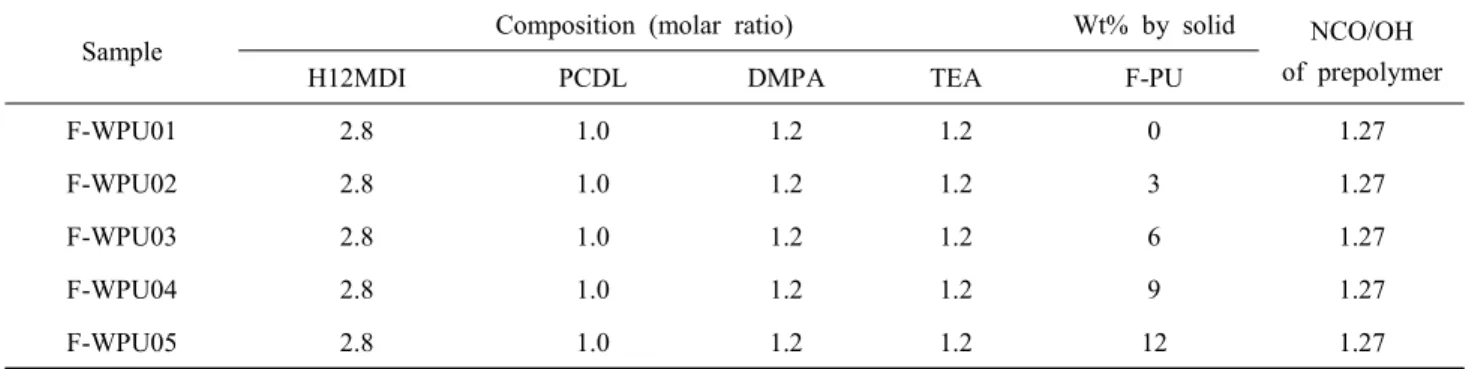
Table 2. Recipes for the preparation for fluorine modified polyurethane dispersion (F-WPU) Sample
Composition (molar ratio) Wt% by solid NCO/OH
of prepolymer
H12MDI PCDL DMPA TEA F-PU
F-WPU01 2.8 1.0 1.2 1.2 0 1.27
F-WPU02 2.8 1.0 1.2 1.2 3 1.27
F-WPU03 2.8 1.0 1.2 1.2 6 1.27
F-WPU04 2.8 1.0 1.2 1.2 9 1.27
F-WPU05 2.8 1.0 1.2 1.2 12 1.27
Table 3. Recipes for the preparation for fluorine modified coating solution (F-Coatings)
Sample
Composition (g)
N.V(%) F-WPU01 F-WPU02 F-WPU03 F-WPU04 F-WPU05 Acrylic
Emulsion
Colloidal
silica GPTMS
F-Coatings01 20 20 10 3 15
F-Coatings02 20 20 10 3 15
F-Coatings03 20 20 10 3 15
F-Coatings04 20 20 10 3 15
F-Coatings05 20 20 10 3 15
2 hrs at the same temperature, The change in the NCO value during the reaction was determined with dibuty- amine back-titration method. TEA was added to the pre- polymer to neutralize the carboxyl group of the NCO ter- minated prepolymer. After 0.5 hr of neutralization, dis- tilled water was added to the flask with vigorous stirring (600 rpm). The reaction was continued at 40 ℃ for 5 hrs, upon which NCO/OH was determined by the FT-IR.
A typical recipe for the preparation of F-WPU is given in Table 2.
2.4 Preparation of Coating Solution for Electro-galvanized Steel Sheet
Preparation of coating solution for electro galvanized steel sheet was carried out in a 500 mL four-neck, round-bottom flask equipped with mechanical stirrer.
F-WPU and Acrylic emulsion were first charged into the flask and stirring, and mixed at 25 ℃ for 10 min. Then, colloidal silica and epoxy silane were charged and mixing proceeded for another 1 hr at the same temperature. A
typical recipe for the preparation of coating solutions is given in Table 3.
2.5 Preparation of films
Films were prepared by casting the newly synthesized sample onto a electro-galvanized steel sheet and were dried at 300 ℃ for 20 sec. The final coating thickness was 800 ~ 1200 mg/m2.
2.6 Characterization
In order to characterize the synthesized F-PU and F-WPU, fourier transform infrared spectroscopy (FT-IR) analysis was performed using Nicolet 360E.S.P in the range between 4000 and 400 cm-1 at ambient temperature.
The sample was coated as a thin liquid film on KRS-5 pellets and dried for examination. Particle size is the im- portant parameter in deciding the end use industrial appli- cations of aqueous waterborne resin. The average particle size was measured using electrophoretic light scattering (ELS) spectrophotometer (Otsuka ELS-8000). The contact
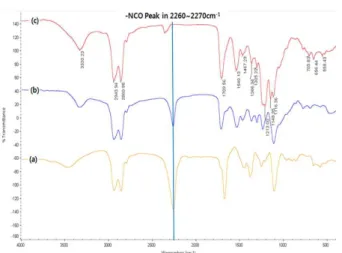
Fig. 3. FT-IR spectra for fluorine modified PU oligomer (F-PU) prepared from different materials: (a)IPDI charged, (b) IPDI+PP1000, and (c) IPDI +PP1000+EA812IW.
Fig. 4. FT-IR spectra for fluorine modified PU dispersion (F-WPU) on the following steps: (a) H12MDI charged, (b) prepolymer, (c) dispersion (initial), and (d) dispersion (final).
angles of water measured at 25 ℃ using angle shape ana- lyzer (Phoenix-300, Surface electro optics), and the re- ported results were the mean values of five times. The change of contact angle was determined with sessile drop method. After coating to the electro-galvanized steel with coating solution containing F-WPU and were tested the corrosion resistance of the coating layer while spraying the form of vapour 5 % NaCl at 35 ℃ for 72hrs(Q-Fog CCT-1000, Q. Panel lab). Corrosion resistance was meas- ured by ASTM B117 method. For evaluation of alkari resistance of coating, coated film on electro-galvanized steel sheet was dipped into 5 % NaOH solution and △E was measured by spectrophotometer (CM-3700d, Konica Minolta) after 5min. For hHigh temperature & humidity test, coated film on electro-galvanized steel sheet was left in a constant temperature & humidity chamber (60 oC.
and 90% of relative humidity, LH33-14M, Nagano Science) for 5 days and then △E was measured by spec- trophotometer (CM-3700d, Konica Minolta)
FT-IR. FT-IR spectra can help confirm the synthesis of the F-PU and F-WPU because of the presence of characteristic absorption bands. FT-IR measurement results of F-PU were shown Fig. 3. (a) and (b) the absence of change in NCO stretch peak that appears in the 2270 cm-1 around and in © depending on the progress of the reaction, NCO stretch peak of 2270 cm-1 around is possible to ensure that it completely disappeared approaching reduced more and more.
From this, it can be confirmed that the OH groups of the polyol and NCO groups of the polyurethane prepol- ymer was all reacted. In a ddition, N-H stretch peak was confirmed at 3320 cm-1 and the C=O stretch peak was confirmed at 1710 cm-1, so, it was confirmed that urethane bonds are generated from that.
Fig. 4. Shows FT-IR spectra for F-WPU. In Fig. 4 (a), (b), and (c), the absence of change in NCO stretch peak that appears in the 2270 cm-1 around and in (d) depending on the progress of the reaction, NCO stretch peak of 2270 cm-1 around is possible to ensure that it completely disappeared approaching reduced more and more. From this, it can be confirmed that the OH groups of the polyol and NCO groups of the polyur- ethane prepolymer was all reacted. In addition, N-H stretch peak was confirmed at 3320 cm-1 and the C=O stretch peak was confirmed at 1710 cm-1, so, it was confirmed that urethane bonds are generated from that.
Particle size. In general, the size of particle dispersed in water in no known that there is direct relationship to the physical properties of the water-dispersible poly- urethane resins, it is possible to adjust the size of the particles, dispersed urethane it is considered important
to the coating resin17). To confirm the change in the particle size of the F-WPU depending on the presence (different) or absence of fluorine , the average particle size was measured using ELS (electrophoretic light scattering spectrometer). Fig. 5(a)-(d) shows the par- ticle size distribution of the fluorine modified water- borne polyurethane dispersion (F-WPU). As the F-PU content increase from 0 to 9 % by weight, the average particle size of F-WPU was similar to pure WPU that does not contain fluorine (F-WPU01). And it was founded that phase separation was prevented by suitably core/shell morphology of F-WPU. Fig. 5 (e) shows that F-WPU containing 12 % F-PU is confirmed that it is dis- played larger than for pure WPU, which may be the result of hydrophobic tendency of fluorine into the polyurethane
Fig. 5. Particle size for fluorine modified waterborne Polyurethane dispersion (F-WPU) with various contents of F-PU: (a) 0 %, (b) 3 %, (c) 6 %, (d) 9 %, and (e) 12 %.
Fig. 6. Contact angle for fluorine modified waterborne polyurethane Dispersion (F-WPU) with various contents of F-PU: (a)0 %, (b) 3 %, (c) 6 %, (d) 9 %, and (e) 12 %.
Fig. 7. Corrosion resistance for F-coating films containing various F-WPUs on electro-galvanized steel sheet: (a) F- Coating01, (b) F-Coating02, (c) F-Coating03, (d) F-Coaging04, and (e) F-Coating05.
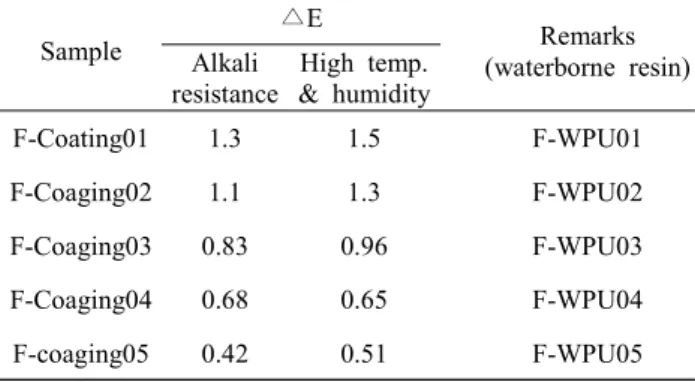
Table 4. Alkali resistance and high temperature & humidity property of F-Coating with different fluorine content
Sample
△E Remarks
(waterborne resin) Alkali
resistance
High temp.
& humidity
F-Coating01 1.3 1.5 F-WPU01
F-Coaging02 1.1 1.3 F-WPU02
F-Coaging03 0.83 0.96 F-WPU03
F-Coaging04 0.68 0.65 F-WPU04
F-coaging05 0.42 0.51 F-WPU05
particles. And it was founded that fluorine affects the par- ticle size of dispersion and critical content (Fig.5 (d)) of suitably core/shell morphology of F-WPU.
Contact angle. The contact angles of water measured at 25 ℃ using angle shape analyzer (Phoenix-300, Surface electro optics), and the reported results were the mean values of five times. The contact angle was de- termined with sessile drop method. The contact angle, a measure of the surface wettability, was used to determine the hydrophobicity and hydro-philicity. Fig. 6 shows the contact angle for F-WPU. As the F-PU content increase from 0 to 12 % by weight, the contact angle of F-WPU increased from 60º to 82º, which could be the low surface energy of fluorine into the F-WPU particles.
Corrosion resistance. After coating to the electro- galvanized steel with coating solution containing F-WPU and were tested the corrosion resistance of the coating layer while spraying the form of vapour 5 % NaCl at 35 ℃ for 72hrs. Corrosion resistance was measured by ASTM B117 method, Q-Fog CCT-1000 cabinet was used for salt spray exposure. It can be seen from Fig. 7 that the Coating layer absence of F-WPU was being advanced in the Fig. 7(a), coating layer con- taining F-WPU was performed slower in the Fig (b)-(d). Also, coating solution containing more F-WPU content is more excellent corrosion resistance with the electro-galvanized steel sheet. But, it can be seen from the result, which F-PU content was above 12 % (F-Coaing05), corrosion resistance of film on the elec- tro-galvanized steel sheet was decreased when com- pared to F-coating04. This was because particle size was increased.
And it was founded that particle size of dispersion affects corrosion resistance of coated film on the elec- tro-galvanized steel sheet. However, it can be seen from the results, to know that coating solution contain- ing an appropriate fluorine content is suitable for being applied as a coating resin of the electro-galvanized steel sheet.
Alkali resistance. Coated film on electro-galvanized steel sheet was dipped into 5 % NaOH solution for 5min. and the appearance of the film was evaluated with △E which was measured by spectrophotometer (CM-3700d, Konica Minolta). Table 4 shows alkali re- sistance of F-Coating with different fluorine content.
According to the results of F-coating, alkali resistance were increased with increasing fluorine content, which result is caused by relatively lower surface energy. It can be seen from the results, to know that coating sol- ution containing the fluorine content is suitable for be-
ing applied as a coating rein of the electro-galvanized steel sheet.
High temperature & humidity property. After coat- ing to the electro-galvanized steel sheet with coating solution containing F-WPU and were tested the high temperature & humidity property of the coating layer.
The prepared electro-galvanized steel sheet was left in a constant temperature & humidity chamber (23 ℃.
and 60 % of relative humidity (R.H)) for 5 days, and the appearance of the film was evaluated with △E which was measured by spectrophotometer (CM- 3700d, Konica Minolta). Table 4 shows high temper- ature & humidity property of F-Coating with different fluorine content. According to the result of F-coating, high temperature & humidity property was increased with increasing fluorine content, which result is caused by water repellent property.
4. Conclusions
In this study, fluorine modified polyurethane Oligomer (F-PU), fluorine modified waterborne poly- urethane dispersion (F-PUD) and coating solutions based on waterborne polyurethane dispersion contain- ing fluorine (F-WPU) were prepared. Coating Films were prepared by casting the newly prepared coating solution onto a electro-galvanized steel sheet at 300℃
for 20 sec. Polyurethane oligomer was prepared with fluorine groups as the seed material, then F-WPU is synthesized with F-PU by IPNs method. From the re- sults of FT-IR spectroscopy study, the OH groups of the polyol and NCO groups of the polyurethane prepol- ymer was all reacted.
From the result of particle size distribution of the F-WPU, the average particle size of waterborne dis- persion was similar to from 41 to 46 nm when the fluorine content increased from 0 to 9 % by weight, which could be the phase separation was prevented by suitably core/shell morphology (IPNs) of F-WPU. But, F-WPU containing 12 % F-PU is confirmed that it is displayed larger than for pure WPU, which may be the result of hydrophobic tendency of fluorine into the polyurethane particles. And it was founded that fluo- rine affects the particle size of dispersion and 9 % of F-PU was critical content of suitably core/shell mor- phology of F-WPU.
Compared with contact angle of F-WPU, the coated film containing greater content of fluorine showed the higher contact angle. This was because more fluorine could be the lower surface energy.
According to the results of F-coating, corrosion and alkali resistance were increased with increasing fluo- rine content, which result is caused by relatively lower surface energy. But, F-PU content was above 12 % (F-Coaing05), corrosion resistance of film on the elec- tro-galvanized steel sheet was decreased. This was be- cause particle size was increased. Also, it became ob- vious that coating solution with the higher fluorine contents had the higher high temperature & humidity property.
The syntheses of waterborne polyurethane dispersion containing fluorine unit were described. These dis- persion have water-repellent property as demonstrated contact angle, according to the result, it can be con- firmed that coating solution containing fluorinated res- in for primer on electro-galvanized steel sheet showed that corrosion resistance, alkali resistance and heat re- sistance (high temperature & humidity) were excellent.
References
1. Y. S. Kwak, E. Y. Kim, H. D. Kim, and J. B. Lee, Colloid Polym. Sci., 283, 880 (2005).
2. M. W. Urban, C. L. Allison, C. C. Finch, and B. A.
Tatro, J. coat. Technol. Res., 71, 75 (1999).
3. E. S. Jang, S. B. Khan, J. Seo, K. ,Akhtar, J. Choi, K.
I. Kim, and H. Han, Macromol. Res., 19, 1006 (2011).
4. C. Hepburn, Polyurethane Elastomers, 2nded., Elsevier, London (1991).
5. H. Zhang, Y. Chen, Y. Zhang, X. Sun, H. Ye, and W. Li, J. Elastomer Plast., 40, 161 (2008).
6. M. M. Rahman and H. D. Kim, Macromol. Res., 14, 634 (2006).
7. Y. Yuan and M. S. Shoichet, Macromolecules, 33, 4926 (2000).
8. W. Ming, J. Laven, and R. Minde, Macromolecules, 33, 6886 (2000).
9. H. J. Kim, Polymer (Korea), 25, 33 (2001).
10. C. C. Zhang and Y. J. Chen, Polym. Int., 54, 1027 (2005).
11. S. Chen, W. C. Yan, L. Chen, Y. J. Chen, and N. P.
Xu, Colloid Polym. Sci., 284, 413 (2006).
12. X. J. Cui, S. G. Zhong, and H. Y. Wang, Colloid Surf.
A, 303, 173 (2007).
13. L. He and J. Liang, J. Fluorine Chem., 129, 590 (2008).
14. H. L. Huang, S. H. Goh, D. M. Y. Lai, and C. H.
A. Huan, Appl. Surf. Sci., 227, 373 (2004).
15. R. Song, D. Yang, L. B. He, and G. T. Yao, J. Polym.
Sci. Part B: Polym. Phys., 45, 138 (2007).
16. K. Koh, S. Sugiyama, T. Morinaga, K. Ohno, Y. Tsujii, T. Fukada, M. Yamahiro, T. Iijinma, H. Oikawa, K.
Watanabe, and T. Miyashita, Macromolecules, 38, 1264 (2005).
17. M. V. Ebrahimi, M. Baricani, S. Mohammad and S.
Mohaghegh, Iran. polym. J, 15, 323 (2006).