서 론
고혈압은 1차 의료에서 가장 많이 볼 수 있는 질환 중 하나이다.
2013년 국민건강영양조사(Korea National Health and Nutrition Ex- amination Survey)에서는 검진 당시 수축기 혈압 140 mmHg 이상 또 는 이완기 혈압 90 mmHg 이상이거나 고혈압 약을 복용하고 있는 경
우를 고혈압으로 정의하였으며, 국민건강영양조사에 따르면 30세 이상 성인에서 고혈압의 유병률은 전체 30.4%, 남자 34.2%, 여자 26.9%로 나타났다.1)
혈압 수준에 따른 질병 위험도를 연구한 국내 자료인 Korea Medi- cal Insurance Corporation Study에 따르면 혈압 수준이 140/90 mmHg 이상인 고혈압 환자는 130/85 mmHg 미만의 혈압을 가진 사람들에
Utilization Pattern of Anti-Hypertensive Medications according to Comorbidities in a Hospital-Based Family Medicine Practice
Boram Lim, Eunkyo Kang, Seung-hyun Yoo, Sung Sunwoo*
Department of Family Medicine, Asan Medical Center, University of Ulsan College of Medicine, Seoul, Korea
Background: The prevalence of hypertension (HTN) in Korea has been estimated to be 30.4%, and HTN is the most common comorbidity in patients with diabetes mellitus (DM). The objective of this study was to examine recent trends in antihypertensive drug prescription in a hospital-based family medicine practice. In addition, we evaluated whether these drug utilization patterns follow the recommendations of the latest guidelines for the management of HTN.
Methods: We analyzed the utilization pattern of antihypertensive medications for patients with established HTN (n=964). We reviewed the medical records of patients who visited the outpatient clinic of the Department of Family Medicine of a Asan Medical Center between April 2013 and December 2013. A chi-square test was performed to evaluate the difference in the use of antihypertensive drugs according to comorbidities.
Results: The patients diagnosed as having both HTN and DM were more likely to be treated with combination therapies than those diagnosed as having HTN alone (P=0.003). The most common class of antihypertensive medication prescribed was angiotensin-receptor blockers (ARBs), followed by calcium channel blockers (CCBs), diuretics, and beta-blockers. As monotherapy, ARBs were the most common choice, followed by CCBs.
Furthermore, the prescription rate of ARBs was significantly higher in the DM patients. In the patients who received combination therapies, combinations that included ARBs were the most frequent.
Conclusion: The utilization pattern of antihypertensive medications in a hospital-based family medicine practice adheres to the latest guidelines for the management of HTN.
Keywords: Hypertension; Diabetes Mellitus; Drug Utilization Pattern; Primary Care
Received June 22, 2016 Revised October 4, 2016 Accepted October 21, 2016
Corresponding author Sung Sunwoo Tel: +82-2-3010-3810, Fax: +82-2-3010-3815 E-mail: [email protected]
Copyright © 2017 The Korean Academy of Family Medicine
This is an open-access article distributed under the terms of the Creative Commons At- tribution Non-Commercial License (http://creativecommons.org/licenses/by-nc/4.0) which permits unrestricted noncommercial use, distribution, and reproduction in any medium, provided the original work is properly cited.
3차 병원 가정의학과 외래에서 동반질환에 따른 고혈압 약물의 사용 양상
임보람, 강은교, 유승현, 선우성*
울산대학교 의과대학 서울아산병원 가정의학교실
Original Article
https://doi.org/10.21215/kjfp.2017.7.4.563 eISSN 2233-9116
Korean J Fam Pract. 2017;7(4):563-568
Korean Journal of Family Practice
KJFP
Boram Lim, et al. Utilization Pattern of Anti-Hypertensive Medications
Korean Journal of Family Practice
KJFP
비해 심뇌혈관질환의 위험도가 2.6배 높았다.2,3) 고혈압은 뇌졸중의 가장 큰 기여 위험인자이자 관상 동맥 심장질환의 주요 위험인자 중 하나로 알려져 있다. 또한, 고혈압이 당뇨병의 위험을 직접적으로 증 가시키는지는 명확하지 않으나 제 2형 당뇨병과 밀접한 연관성이 있 다고 보고되어 있다.4,5) 한 연구에서 당뇨병 환자군은 일반 인구 집단 에 비해 고혈압이 2배 많이 발견되고, 고혈압 환자군도 당뇨병의 발 생 위험이 약 2배 증가한다고 보고하였다.6-8) 2013년 국민건강영양조 사에 따르면 현재 우리나라 30세 이상 당뇨병 환자는 11.9%이며 이 중 거의 절반에 가까운 환자들이 고혈압을 동반하고 있는 것으로 알 려져 있다.1,9) 당뇨병 환자에서 고혈압 발생이 높은 이유는 체중 증가 와 함께 고인슐린혈증이 발생하여 교감신경을 항진시키고 콩팥에 서 나트륨을 저류시켜 체액을 증가시키는 것이 원인이 될 수 있으며, 고혈당으로 인해 혈관 경직도를 증가시키고 동맥경화를 진행시키는 것 또한 원인이 될 수 있다.6)
고혈압 환자의 고혈압 약물의 사용 양상, 혈압 조절 정도, 비용에 대해 분석한 기존의 연구들이 있었으며,10-12) 고혈압 약물의 사용 양 상을 JNC 보고서(Joint National Committee on Prevention, Detection, Evaluation, and Treatment of High Blood Pressure)의 권고사항과 비교 분석하는 연구도 있었다.13) 그러나 대학 병원 급 이상의 병원에서 동 반질환에 따른 단일 약물의 사용, 복합 약물의 사용 양상을 구분하 여 비교 분석한 연구는 많지 않은 상태이다.
본 연구는 대학병원 가정의학과 외래를 방문한 재진 환자에서 당 뇨병, 이상지질혈증 등의 동반질환에 따른 고혈압 약물 사용 양상을 알아보기 위하여 시행하였다. 또한 실제 임상에서의 고혈압 약물 처 방 시, 최근 발표된 고혈압 관련 가이드라인을 준수하고 있는지 살펴 보고자 한다.
방 법
1. 연구대상
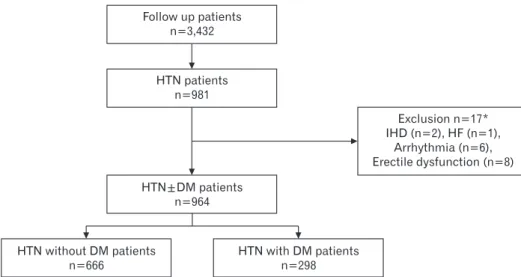
본 연구는 2013년 4월부터 2013년 12월까지 서울지역의 단일 3차 대학병원 가정의학과 외래를 방문한 재진 환자 중 봄, 여름, 가을, 겨 울 계절별로 1주일씩을 무작위 추출하여 후향적으로 의무기록을 검 토하여 연구를 시행하였다. 대상 환자의 선정기준은 가정의학과 외 래를 방문한 재진 환자로, International Classification of Diseases (ICD) 진단명 중 고혈압을 포함한 경우 또는 의무기록의 진단 및 추정으로 고혈압을 명시한 경우를 고혈압 환자로 정의하였다. 해당 기간 동안 단일 대학병원 가정의학과 외래를 방문한 재진 환자는 총 3,432명이 었으며, 그 중에서 고혈압을 가진 환자는 총 981명이었다. 대한고혈압 학회에서 발표한 2013 고혈압 진료지침을 참고하여 고혈압 치료방법 에 영향을 미칠 수 있는 질환 중 허혈성 심장질환 2명, 심부전 1명, 부 정맥 6명, 발기부전 8명 환자 총 17명을 연구 대상자에서 제외하였다 (Figure 1).6)
2. 방법
연구에 포함된 환자 964명을 대상으로 연령, 성별, 처방 의사, 당뇨 병 유무, 이상지질혈증 유무, 사용 약물을 조사하였다. 의무기록을 검토하여 처방 의사를 교수, 임상강사, 수련의로 분류하였으며, 당뇨 병 군은 고혈압이 있으면서 ICD 진단명 중 당뇨병을 포함하는 경우, 의무기록의 진단 및 추정으로 당뇨병을 명시한 경우 또는 경구 혈당 강하제 또는 인슐린 주사를 처방받은 경우로 분류하였고, 이상지질 혈증 군은 고혈압이 있으면서 ICD 진단명 중 이상지질혈증 을 포함 하는 경우, 의무기록의 진단 및 추정으로 이상지질혈증을 명시한 경 우 또는 이상지질혈증 약물을 복용하고 있는 경우로 분류하였다.
Figure 1. Flowchart of the study partici- pants (n=3,432).
HTN, hypertension; IHD, ischemic heart disease; HF, heart failure; DM, diabetes mellitus.
*Some comorbidities were not includ- ed which conforms to the regional and international guidelines.
Follow up patients n=3,432
HTN patients n=981
HTN without DM patients n=666
HTN with DM patients n=298 HTN+DM patients
n=964
Exclusion n=17*
IHD (n=2), HF (n=1), Arrhythmia (n=6), Erectile dysfunction (n=8)
임보람 외. 고혈압 약물의 사용 양상 Korean Journal of Family Practice
KJFP
대상자들에 대해 당뇨병 군과 비 당뇨병 군 간의 약물 사용 양상 을 비교 분석하였고 비 당뇨병 군과 당뇨병 군을 구분하지 않고 각 고혈압 약물의 종류별 사용 빈도에 대해 단일 약물 요법, 2가지 이상 복합 약물 요법 각각의 경우로 나누어 분석하였다. 또한 당뇨병, 이상 지질혈증 등의 동반 질환에 따른 고혈압 약물 사용 양상을 분석하 였다. 본 연구 대상자들 중 angiotensin converting enzyme inhibitors (ACEi)를 사용한 환자는 총 4명에 불과하여 따로 분류하지 않고 an- giotensin-receptor blocker (ARB) 또는 ACEi를 사용한 환자군으로 통 합하여 분류하였다.
3. 통계분석
본 연구의 자료는 IBM SPSS Statistics version 21.0 (IBM Co., Ar- monk, NY, USA)통계 분석 프로그램을 이용하여 항목별로 평균값과 표준편차를 구하였다. 동반질환에 따른 각 집단 간의 고혈압 약물 사용 양상의 차이를 분석하기 위해 chi-square test를 이용하였다. 모 든 통계적인 분석은 유의수준 5%, 양측검정으로 실시하였고, P<0.05 인 경우를 통계적으로 유의한 것으로 간주하였다.
결 과
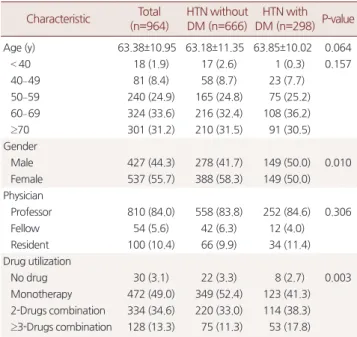
본 연구의 대상은 총 964명으로 평균 나이는 63.4±11.0세였으며, 비 당뇨병 군 63.2±11.4세, 당뇨병 군 63.9±10.0로 통계적으로 유의한 차
이는 없었다(P=0.064). 남녀 비율은 비 당뇨병 군에서 남자 41.7%, 여 자 58.3%, 당뇨병 군에서 남자 50.0%, 여자 50.0%로 당뇨병이 없는 군 에서 여성의 비율이 더 높았다(P=0.010). 두 군 모두에서 의사 별 처 방을 살펴보았을 때 교수가 80% 이상으로 나타났다.
약물 처방을 받지 않은 환자는 총 30명(3.1%)이었고 이 중에서 비 당뇨병 군이 22명(3.3%)으로 당뇨병 군 8명(2.7%)에 비해 높은 비율을 보였다. 단일 약물을 사용한 환자는 총 472명(49.0%), 2가지 복합 약 물 사용한 환자는 334명(34.6%), 3가지 이상의 복합 약물을 사용한 환자는 128명(13.3%)이었다. 당뇨병 유무에 따른 약물 사용 양상을 살펴보았을 때, 비 당뇨병 군에서는 단일 약물을 처방 받은 경우가 349명(52.9%), 2가지 이상 복합 약물을 처방 받은 경우가 295명(44.3%) 이었고, 당뇨병 군에서는 단일 약물 사용 비율이 123명(41.3%), 2가지 이상 복합 약물 사용 비율이 167명(56.1%)으로 당뇨병 군에서 2가지 이상 복합 약물 사용 비율이 유의하게 높게 나타났다(P=0.003) (Table 1).
당뇨병 유무에 따른 고혈압 약제의 성분 별 처방 양상을 살펴보면 비 당뇨병 군과 당뇨병 군 두 군 모두 단일약물 중에서는 ARBs 또는 ACEi 사용이 58.9%로 가장 많았고, calcium channel blockers (CCB) 34.3%, diuretics (D) 3.6%, beta-blockers (BB) 3.2% 순으로 나타났다. 당
Table 1. Baseline characteristics of the study participants Characteristic Total
(n=964)
HTN without DM (n=666)
HTN with DM (n=298) P-value
Age (y) 63.38±10.95 63.18±11.35 63.85±10.02 0.064
< 40 18 (1.9) 17 (2.6) 1 (0.3) 0.157
40–49 81 (8.4) 58 (8.7) 23 (7.7)
50–59 240 (24.9) 165 (24.8) 75 (25.2)
60–69 324 (33.6) 216 (32.4) 108 (36.2)
≥70 301 (31.2) 210 (31.5) 91 (30.5)
Gender
Male 427 (44.3) 278 (41.7) 149 (50.0) 0.010
Female 537 (55.7) 388 (58.3) 149 (50.0)
Physician
Professor 810 (84.0) 558 (83.8) 252 (84.6) 0.306
Fellow 54 (5.6) 42 (6.3) 12 (4.0)
Resident 100 (10.4) 66 (9.9) 34 (11.4)
Drug utilization
No drug 30 (3.1) 22 (3.3) 8 (2.7) 0.003
Monotherapy 472 (49.0) 349 (52.4) 123 (41.3) 2-Drugs combination 334 (34.6) 220 (33.0) 114 (38.3) ≥3-Drugs combination 128 (13.3) 75 (11.3) 53 (17.8) Values are presented as mean±standard deviation or number (%).
HTN, hypertension; DM, diabetes mellitus.
Table 2. Utilization pattern of anti-hypertensive drugs according to the presence of DM
Drug Total
(n=964)
HTN without DM (n=666)
HTN with DM (n=298) P-value
Monotherapy <0.001
ARB or ACEi 278 (58.9) 179 (51.3) 99 (80.5)
CCB 162 (34.3) 141 (40.4) 21 (17.1)
D 17 (3.6) 15 (4.3) 2 (1.6)
BB 15 (3.2) 14 (4.0) 1 (0.8)
2-Drugs combination 0.297
(ARB or ACEi)+CCB 150 (44.9) 100 (45.5) 50 (43.9) (ARB or ACEi)+D 147 (44.0) 95 (43.2) 52 (45.6)
BB+CCB 14 (4.2) 12 (5.5) 2 (1.8)
(ARB or ACEi)+BB 12 (3.6) 8 (3.6) 4 (3.5)
CCB+D 10 (3.0) 4 (1.8) 6 (5.3)
BB+D 1 (0.3) 1 (0.5) 0 (0.0)
≥3-Drugs combination 0.556
(ARB or ACEi)+CCB+D 97 (75.8) 57 (76.0) 40 (75.5) (ARB or ACEi)+BB+
CCB
18 (14.1) 11 (14.7) 7 (13.2)
(ARB or ACEi)+BB+
CCB+D
8 (6.3) 3 (4.0) 5 (9.4)
(ARB or ACEi)+BB+D 3 (2.3) 2 (2.7) 1 (1.9)
BB+CCB+D 2 (1.6) 2 (2.7) 0 (0.0)
Values are presented as number (%).
DM, diabetes mellitus; HTN, hypertension; ARB, angiotensin-receptor blocker;
ACEi, angiotensin converting enzyme inhibitor; CCB, calcium channel blockers;
D, diuretics; BB, beta-blocker.
Boram Lim, et al. Utilization Pattern of Anti-Hypertensive Medications
Korean Journal of Family Practice
KJFP
뇨병 군에서는 ARB 또는 ACEi 사용 비율이 80.5%로 비 당뇨병 군 51.3%에 비해 의미 있게 높은 것으로 나타났다(P<0.001). 두 가지의 약물을 복합 사용한 경우에는 ARB 또는 ACEi와 CCB의 사용 비율 이 44.9%로 가장 높았고, 당뇨병 군에서는 45.6%, 비 당뇨병 군에서는 43.2%로 각 조합 간 통계적으로 유의한 차이를 보이지는 않았다 (P=0.297). 3가지 이상의 약물을 사용한 환자들에서는 ARB 또는 ACEi, CCB와 D의 사용 비율이 75.8%로 가장 많은 비율을 보였으나, 각 조합 간 통계적으로 유의한 차이는 없었다(P=0.556) (Table 2).
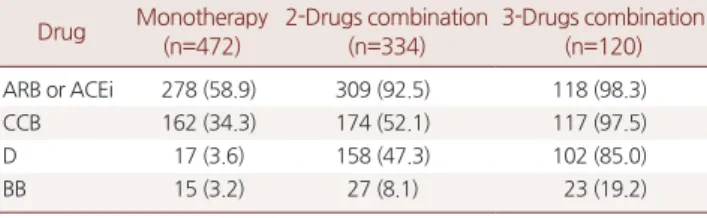
각 고혈압 약물 종류별 사용 빈도에 대해 비 당뇨병 군과 당뇨병 군을 구분하지 않고 각각 단일 약물을 사용한 환자 472명, 두 가지의 복합 약물을 사용한 환자 334명과 세 가지의 복합 약물을 사용한 환 자 120명의 3가지 군으로 나누어서 분석해보았다. ARB 또는 ACEi의 사용 빈도가 각각 278명(58.9%), 309명(92.5%)과 118명(98.3%)으로 3가 지 군 모두에서 가장 높게 나타났으며, 그 다음으로 CCB, D, BB 순서 를 보였다(Table 3).
동반 질환에 따른 고혈압 약물의 처방 빈도를 당뇨병과 이상지질 혈증의 유무로 나누어 살펴보았다(Figure 2). 동반 질환으로 당뇨병
이 없는 환자 666명과 당뇨병이 있는 환자 404명에 대해 단일 요법, 복합 요법을 구분하지 않은 고혈압 약물 종류별 사용 비율을 분석 하였고(Figure 2A), 동반 질환으로 당뇨병이 없는 666명의 환자를 이 상지질혈증 유무에 따라 나누어 고혈압 약물 종류별 사용 비율을 분석하였다(Figure 2B).
비 당뇨병 군의 고혈압 약물 종류별 사용은 ARB 또는 ACEi 사용 비율이 68.3%로 가장 높았고 뒤를 이어 CCB, D, BB 순서로 나타났다.
당뇨병 군에서는 ARB 또는 ACEi 사용 비율이 86.6%였고 그 다음으 로 CCB, D, BB 순으로 나타났다. 당뇨병 군에서 ARB 또는 ACEi 처방 빈도가 비 당뇨병 군에 비해 18.3% 더 높은 것으로 나타났다(P<0.001) (Figure 2A). 이상지질혈증이 있는 군과 없는 군 모두에서 ARB 또는 ACEi 사용 비율이 가장 높았고, 다음으로 CCB, D, BB 순서로 나타났 다. 이상지질혈증 여부에 따른 고혈압 약물 사용 양상은 CCB (P=0.032)를 제외하고는 통계적으로 유의한 차이를 보이지 않았다 (Figure 2B).
고 찰
본 연구에서는 대학병원 가정의학과 외래를 방문한 재진 환자를 대상으로 당뇨, 이상지질혈증 등의 동반 질환에 따른 고혈압 약물의 사용 양상을 비교, 분석하고 이를 최근의 고혈압 가이드라인과 비교 해보고자 하였다.
고혈압은 심뇌혈관질환, 신부전증, 만성 신질환, 말초동맥질환 및 망막증의 주요 위험요인이며,12,14,15) 수축기혈압이 10 mmHg 낮아질 때마다 당뇨병과 관련된 사망률은 15%, 심근경색증은 11%, 망막증 혹은 콩팥병과 같은 미세 혈관 합병증은 13%씩 감소한다.7) 일차 진 Table 3. Proportion of each class of drugs in mono- and combination
therapies
Drug Monotherapy (n=472)
2-Drugs combination (n=334)
3-Drugs combination (n=120)
ARB or ACEi 278 (58.9) 309 (92.5) 118 (98.3)
CCB 162 (34.3) 174 (52.1) 117 (97.5)
D 17 (3.6) 158 (47.3) 102 (85.0)
BB 15 (3.2) 27 (8.1) 23 (19.2)
Values are presented as number (%).
ARB, angiotensin-receptor blocker; ACEi, angiotensin converting enzyme inhibi- tor; CCB, calcium channel blockers; D, diuretics; BB, beta-blocker.
Figure 2. Difference in the use of anti-hypertensive drugs according to comorbidities (A: according to DM, B: according to DL).
DM, diabetes mellitus; DL, dyslipidemia; HTN, hypertension; ARB, angiotensin-receptor blocker; ACEi, angiotensin converting enzyme inhibitor; BB, beta-blocker; CCB, calcium channel blocker; D, diuretics.
ARB or ACEi 100
90 80 70 60 50 40 30 20 10
%
0
A B
HTN without DM (n=666) HTN with DM (n=298)
BB CCB D
P<0.001
P=0.598
P=0.109
P<0.001
ARB or ACEi 100
90 80 70 60 50 40 30 20 10
%
0
HTN without DM and DL (n=262) HTN without DM and with DL (n=404)
BB CCB D
P=0.670
P=0.661
P=0.032
P=0.655
임보람 외. 고혈압 약물의 사용 양상 Korean Journal of Family Practice
KJFP
료의는 여러 가이드라인에서 제시하는 권고사항대로 적절한 고혈 압 약제를 선택하고 이를 환자에게 처방함으로써 고혈압뿐만 아니 라 다른 동반 질환, 합병증의 발생을 예방할 수 있을 것이다. 2013년 국민건강영양조사에 따르면 고혈압 유병자 기준 조절률(만 30세 이 상)은 1998년 4.9%, 2001년 12.3%, 2005년 27.2%, 2007–2009년 42.1%로 증가한 이후 약 42% 수준을 유지하고 있는데 아직은 고혈압 및 동반 질환에 대한 관리가 미흡한 실정이다.1,12) 따라서, 고혈압과 그 동반 질환에 대해 파악하고 그에 맞는 적절한 처방을 하는 것이 중요하다.
2014년 발표된 JNC 8차 보고서(the recommendations of the Eighth Joint National Committee on Prevention, Detection, Evaluation, and Treatment of High Blood Pressure)에 따르면 당뇨병이 있는 비 흑인의 경우 Angiotensin converting enzyme inhibitors, Angiotensin-receptor blockers, Calcium channel blockers, D (Thiazide)의 처방을 권고하고 있다(Grade B). 그러나 BB의 경우 ARB에 비해 심혈관 사망, 심근경색, 뇌졸중이 더 높은 비율로 보고된 한 연구로 인해 고혈압의 초기 치 료제로 권고하지 않고 있다.16,17) 2013년 발표된 European Society of Hypertension/European Society of Cardiology 가이드라인에 따르면 당뇨병이 있는 고혈압 환자의 고혈압 약물로 ARB 또는 ACEi를 우선 적으로 권고한다.18) ARB 또는 ACEi를 권고하는 이유는 angiotensin 생성 억제, bradykinin의 분해를 지연, prostaglandin 생산 변화를 초 래하고, 교감신경계 활성도를 조절함으로써 혈압을 강하시키고, 미 세알부민뇨를 줄여 당뇨병성 신병증의 진행을 막기 때문이다.19) 또 한, 이전의 한 연구 결과를 보면 당뇨병과 신장 질환을 가진 고혈압 환자에서 초기 치료제로 ARB를 주로 처방하였다.12) 본 연구 결과는 여러 가이드라인에 부합하게 단일 약물의 처방 비율을 분석한 결과 두 군 모두에서 ARB 또는 ACEi 사용 비율이 유의하게 가장 높게 나 타났고, 두 군을 비교해보면 비 당뇨병 군보다 당뇨병 군에서 사용 비율이 더 높게 나타났다.
본 연구에서 이상지질혈증 유무에 따른 약물 처방 양상은 대체적 으로 통계적으로 유의한 차이를 보이지 않는 것을 알 수 있었다. 이 는 최근의 고혈압 관련 가이드라인에서 권고하듯이, 동반 질환 중 당뇨병은 고혈압 약물 처방에 있어서 중요한 고려사항 중 하나에 포 함되지만, 이상지질혈증의 경우에는 그렇지 않다는 것을 반영한다.
고령이나 비만, 당뇨병 등이 있는 고혈압 환자에서 amlodipine과 valsartan을 복합 투여한 경우가 amlodipine을 단일 투여한 경우에 비 해 혈압 강하 효과가 크다는 이전 연구 결과가 있듯이,19) 본 연구에서 도 당뇨병 군에서 비 당뇨병 군에 비해 단일 약물의 사용 비율은 낮 은 반면, 2가지 이상의 복합 약물의 사용은 더 높은 비율을 보였다.
본 연구는 다음과 같은 제한점을 가진다. 첫째, 본 연구에서는 ICD 진단명 중 고혈압을 포함한 경우 또는 의무기록의 진단 및 추정
으로 고혈압을 명시한 경우를 고혈압 환자로 분류하였는데, 2013년 국민건강영양조사에 따라 검진 당시 수축기 혈압이 140 mmHg 이상 또는 이완기 혈압이 90 mmHg 이상이거나 고혈압 약을 복용하고 있 는 경우를 고혈압으로 정의할 경우, 연구 결과가 달라질 수 있다. 둘 째, 본 연구에서는 연구에 참여한 대상자들의 연령 분포만을 살펴보 았는데, 이를 보완하기 위해서는 표준 인구를 이용한 연령별 유병률 을 산출하여 2013년 국민건강영양조사에서의 유병률 분포와 비교 해 볼 수 있을 것이다. 셋째, 본 연구는 동반 질환으로 당뇨병과 이상 지질혈증에 국한하여 분석하였으며 이에 대하여 추후 다른 동반 질 환을 포함하는 추가적인 연구가 필요할 것으로 생각한다. 넷째, 본 연구에서는 동반 질환에 따른 고혈압 약물 사용 양상에 대해서만 조사하였으나, 대상 환자에 대한 혈압 조절 정도 또는 혈당 조절 정 도에 대한 연구가 동반된다면 더 의미 있는 결과를 얻을 수 있을 것 이다.
본 연구를 통해 대학병원 규모의 실제 임상에서 환자 개개인의 동 반 질환을 평가하고 고혈압 약제의 적절한 처방 양상이 여러 가이드 라인에 부합하는지 알아보았다. 일차 의료에 종사하는 가정의학과 의사는 이를 바탕으로 고혈압 환자 개개인의 특성에 맞는 약제를 제 시할 수 있어야 할 것이며, 이를 위해서 추후 지속적인 조사 및 연구 가 뒷받침되어야 할 것이다.
요 약
연구배경:
한국의 고혈압의 유병률은 30.4%로, 고혈압은 당뇨병 환 자에서 흔히 동반되는 질환이다. 본 연구에서는 대학병원 가정의학 과 외래에서의 최근 고혈압 약물 처방 양상을 평가하고 이러한 고혈 압 약물 사용 양상이 최근 발표된 고혈압 관련 가이드라인의 권고 사항을 따르고 있는지를 살펴보고자 한다.방법:
본 연구는 고혈압으로 분류된 환자 964명의 고혈압 약물 사용 양상을 분석하였다. 2013년 4월부터 2013년 12월까지 서울아산병원 가정의학과 외래를 방문한 재진 환자 중 고혈압을 가진 환자들을 대 상으로 후향적으로 의무기록을 검토하여 연구를 시행하였다. 동반 질환에 따른 고혈압 약물 사용의 차이점을 평가하기 위해 chi-square test를 이용하여 분석하였다.결과:
고혈압과 당뇨병을 진단받은 환자는 단순 고혈압 환자보다 2 개 이상의 약물을 처방 받은 비율이 더 높게 나타났다(56.1% vs.44.3%, P=0.003). 고혈압 약물의 처방 빈도는 angiotensin-receptor blocker (ARB), calcium channel blocker (CCB), D, beta-blocker 순으로 나타났고, 한가지 약물을 처방 받은 경우에는 ARB, CCB 순으로 나 타났다. 또한 ARB의 사용 비율은 당뇨병 군에서 비 당뇨병 군에 비
Boram Lim, et al. Utilization Pattern of Anti-Hypertensive Medications
Korean Journal of Family Practice
KJFP
해 유의하게 높게 나타났다. 복합 약물을 처방 받은 환자 중에서는 ARB를 포함한 조합의 약물 사용이 가장 높은 비율로 나타났다.
결론:
본 연구에서는 대학병원 규모의 가정의학과 외래에서 동반 질환에 따른 고혈압 약물의 사용 양상에 대해 검토해보았고, 고혈압 약물의 사용 양상이 최근 발표된 고혈압 관련 가이드라인에 부합하 는 것으로 나타났다.중심단어:
고혈압; 당뇨병; 약물 사용 양상; 일차 의료REFERENCES
1. Korea Health Statistics 2013 : Korea National Health and Nutrition Exami- nation Survey (KNHANES VI-1) [Internet]. Korea Centers for Disease Control, Ministry of Health and Welfare; 2014 Dec 16 [cited 2016 Feb 18].
Available from: http://www.cdc.go.kr/CDC/contents/CdcKrContentView.
jsp?cid=60949&menuIds=HOME001-MNU1130-MNU1639- MNU1749-MNU1761.
2. Jee SH, Appel LJ, Suh I, Whelton PK, Kim IS. Prevalence of cardiovascular risk factors in South Korean adults: results from the Korea Medical Insur- ance Corporation (KMIC) Study. Ann Epidemiol 1998; 8: 14-21.
3. Park JK, Kim CB, Kim KS, Kang MG, Jee SH. Meta-analysis of hypertension as a risk factor of cerebrovascular disorders in Koreans. J Korean Med Sci 2001; 16: 2-8.
4. O'Donnell MJ, Xavier D, Liu L, Zhang H, Chin SL, Rao-Melacini P, et al. Risk factors for ischaemic and intracerebral haemorrhagic stroke in 22 countries (the INTERSTROKE study): a case-control study. Lancet 2010; 376: 112-23.
5. Epstein M, Sowers JR. Diabetes mellitus and hypertension. Hypertension 1992; 19: 403-18.
6. Shin J. 2013 Korean Society of Hypertension guidelines for the manage- ment of hypertension. Clin Hypertens 2015; 21: 2.
7. Sowers JR, Haffner S. Treatment of cardiovascular and renal risk factors in the diabetic hypertensive. Hypertension 2002; 40: 781-8.
8. Grundy SM, Benjamin IJ, Burke GL, Chait A, Eckel RH, Howard BV, et al.
Diabetes and cardiovascular disease: a statement for healthcare profession- als from the American Heart Association. Circulation 1999; 100: 1134-46.
9. Association KD. Korea Centers for Disease Control and Prevention. Diabe- tes fact sheet in Korea, 2012 [Internet]. Seoul: Korean Diabetes Association;
2012 [cited 2013 Aug 23]. Available from: http://www.diabetes.or.kr/temp/
Diabetes_Fact_sheet2012.pdf.
10. Gu Q, Burt VL, Dillon CF, Yoon S. Trends in antihypertensive medication use and blood pressure control among United States adults with hyperten- sion: the National Health And Nutrition Examination Survey, 2001 to 2010.
Circulation 2012; 126: 2105-14.
11. Yoo KB, Lee SG, Park S, Kim TH, Ahn J, Cho MH, et al. Effects of drug price reduction and prescribing restrictions on expenditures and utilisation of antihypertensive drugs in Korea. BMJ Open 2015; 5: e006940.
12. Kim KI, Kim Y, Kim HJ, Kang DH, Park JB, Choi DJ, et al. Current status and characteristics of hypertension treatment by primary physicians in Korea:
data from Korean epidemiology study on hypertension (KEY study). Am J Hypertens 2008; 21: 884-9.
13. Gu Q, Paulose-Ram R, Dillon C, Burt V. Antihypertensive medication use among US adults with hypertension. Circulation 2006; 113: 213-21.
14. Kim CH, Kim YS, Park YK. Management of hypertension in primary care.
Korean J Fam Pract 2012; 2: 8-14.
15. ALLHAT Officers and Coordinators for the ALLHAT Collaborative Re- search Group. The Antihypertensive and Lipid-Lowering Treatment to Pre- vent Heart Attack Trial. Major outcomes in moderately hypercholesterol- emic, hypertensive patients randomized to pravastatin vs usual care: The Antihypertensive and Lipid-Lowering Treatment to Prevent Heart Attack Trial (ALLHAT-LLT). JAMA 2002; 288: 2998-3007.
16. James PA, Oparil S, Carter BL, Cushman WC, Dennison-Himmelfarb C, Handler J, et al. 2014 evidence-based guideline for the management of high blood pressure in adults: report from the panel members appointed to the Eighth Joint National Committee (JNC 8). JAMA 2014; 311: 507-20.
17. Task Force for the management of arterial hypertension of the European Society of Hypertension; Task Force for the management of arterial hyper- tension of the European Society of Cardiology. 2013 ESH/ESC Guidelines for the Management of Arterial Hypertension. Blood Press 2013; 22: 193- 278.
18. Casas JP, Chua W, Loukogeorgakis S, Vallance P, Smeeth L, Hingorani AD, et al. Effect of inhibitors of the renin-angiotensin system and other antihyper- tensive drugs on renal outcomes: systematic review and meta-analysis. Lan- cet 2005; 366: 2026-33.
19. Destro M, Luckow A, Samson M, Kandra A, Brunel P. Efficacy and safety of amlodipine/valsartan compared with amlodipine monotherapy in patients with stage 2 hypertension: a randomized, double-blind, multicenter study:
the EX-EFFeCTS Study. J Am Soc Hypertens 2008; 2: 294-302.