https://doi.org/10.4174/astr.2021.100.5.282 Annals of Surgical Treatment and Research
Clinical characteristics of rectal cancer patients with neoadjuvant chemoradiotherapy: a nationwide population-based cohort study in South Korea
Jun Woo Bong1, Yeonuk Ju1, Jihyun Seo1, Jung Ae Lee2, Sang Hee Kang1, Sun Il Lee1, Byung Wook Min1
1Division of Colon and Rectal Surgery, Department of Surgery, Korea University Guro Hospital, Korea University College of Medicine, Seoul, Korea
2Department of Radiation Oncology, Korea University Guro Hospital, Korea University College of Medicine, Seoul, Korea
INTRODUCTION
Rectal cancer accounts for approximately 33.6% of all colorectal cancer cases in South Korea [1]. The treatment of rectal cancer differs from that of colon cancer as local control is important. Neoadjuvant chemoradiation therapy (NCRT)
has been accepted as an effective treatment to prevent local recurrence of advanced rectal cancer [2]. In addition, it has been demonstrated that the tumor response to NCRT is associated with improved survival [3]. The National Comprehensive Cancer Network guidelines recommend NCRT as a priority treatment for stage II–III rectal cancer. NCRT followed by total mesorectal
Received January 11, 2021, Revised February 12, 2021, Accepted February 26, 2021
Corresponding Author: Byung Wook Min
Department of Surgery, Korea University Guro Hospital, Korea University College of Medicine, 148 Gurodong-ro, Guro-gu, Seoul 08308, Korea Tel: +82-2-2626-3079, Fax: +82-2-2626-1148
E-mail: [email protected]
ORCID: https://orcid.org/0000-0002-3621-5113
Copyright ⓒ 2021, the Korean Surgical Society
cc Annals of Surgical Treatment and Research is an Open Access Journal. All articles are distributed under the terms of the Creative Commons Attribution Non- Commercial License (http://creativecommons.org/licenses/by-nc/4.0/) which permits unrestricted non-commercial use, distribution, and reproduction in any medium, provided the original work is properly cited.
Purpose: Neoadjuvant chemoradiotherapy has been accepted as a standard treatment for stage II–III rectal cancer. This study aimed to evaluate the clinical characteristics of patients who underwent neoadjuvant chemoradiotherapy for rectal cancer and effects on overall survival (OS) of neoadjuvant chemoradiotherapy in South Korea.
Methods: Patients who underwent curative resection for rectal cancer from 2014 to 2016 were retrospectively reviewed from the database of the National Quality Assessment program in South Korea. Patients were categorized into the upfront surgery group and neoadjuvant chemoradiotherapy group. We evaluated factors associated with the administration of neoadjuvant chemoradiotherapy and its effects on OS. Inverse probability of treatment weighting was performed to account for baseline differences between subgroups.
Results: A total of 6,141 patients were categorized into the upfront surgery group (n = 4,237) and neoadjuvant chemoradiotherapy group (n = 1,904). The neoadjuvant chemoradiotherapy was more frequently administered to male, midrectal cancer, and younger patients. In the neoadjuvant chemoradiotherapy group, old age, underweight, and pathologic stage were significant risk factors of OS, and male sex, the level of tumor and clinical stages were not associated with OS.
After adjustment, the OS of the neoadjuvant chemoradiotherapy group followed the OS of the upfront surgery group of the same pathologic stage.
Conclusion: Male sex and the level of tumor were not related to the OS of rectal cancer patients with neoadjuvant chemoradiotherapy. The OS of patients who underwent neoadjuvant chemoradiotherapy was decided by their pathologic stages regardless of clinical stages.
[Ann Surg Treat Res 2021;100(5):282-290]
Key Words: Neoadjuvant therapy, Rectal neoplasms, Survival
excision (TME) is also the current standard of care for stage II–
III rectal cancer patients in South Korea.
However, there are some disadvantages of NCRT. For example, it can increase surgical difficulty as tissue inflammation after radiation leads to congestion or edema [4]. Similarly, anastomosis leakage or perineal wound dehiscence can occur.
In addition, NCRT may lead to distant metastasis, especially in tumors that respond poorly to radiation therapy [5]. Therefore, establishing specific indications is important to maximize the advantages and minimize unnecessary administration of NCRT. There is a lack of study about the treatment outcomes of NCRT for rectal cancer based on the national registry of the Asian countries. In this study, we aimed to investigate factors related to the administration of NCRT and its association with overall survival (OS) of rectal cancer patients using the national registry of South Korea.
METHODS
Data
Data from the National Quality Assessment program in South Korea was retrospectively reviewed. The Health Insurance Review and Assessment Service (HIRA) runs this program to evaluate the appropriateness of treatment for major diseases in medical institutions and ensure appropriate expenditure on health care. The HIRA collects information on patients with major diseases from institutions every year. This assessment program for colorectal cancer has been performed since 2011.Information on patients who were diagnosed with colorectal cancer and charged for surgery was collected. The data consisted of clinical characteristics including age, sex, height, weight, date and type of surgery, the American Society of Anesthesiologists (ASA) physical status (PS) classification, mortality, cell type, pathologic stages, and margin status. Positive resection margin is defined as the presence of malignant cells at the resection margin. The tumor height was recorded based on the location from the anal verge to the tumor and was categorized into high (above the peritoneal reflection), low (below the peritoneal reflection), and mid (at the peritoneal reflection). Clinical stage (cStage) was recorded if the patient had received neoadjuvant therapy and categorized into 3 groups (stage I: T1–T2, N0; stage II: T3–T4, N0; and stage III: T1–T4, N1–N2). Pathologic stage (pStage) was categorized into 5 groups (stage 0: no residual tumor; stage I: T1–T2, N0; stage IIA: T3, N0; stage IIB–C: T4, N0;
stage III: any T, N+). TNM staging was performed according to the American Joint Committee on Cancer guidelines 7th edition.
Patient selection
Patients who underwent curative resection for rectal cancer between January 2014 and December 2016 were included.
Patients who had distant metastasis, other malignancies within 5 years, or palliative resections were excluded. Patients with incomplete records were also excluded. Patients were classified into 3 age groups (>75 years, ≥65 and ≤75 years, and <65 years). We additionally calculated body mass index (BMI) of the patients and categorized it into 3 groups (underweight, <18.5 kg/m2; normal, 18.5–25 kg/m2; obese, >25 kg/m2) according to the Asia-Pacific standards [6]. The Institutional Review Board of Korea University Guro Hospital approved this study (No. 2019GR0416), which waived the requirement of informed consent. The datasets are generated from the Korean National Health Insurance database. The datasets are not allowed publicly without official permission.
Measured outcomes
Statistical comparison of the clinical characteristics of patients who underwent NCRT or upfront surgery was performed. The OS was defined as the period from the date of surgery to the date of death. Survival analysis was performed after excluding all cases of mortality, the follow-up period of
<30 days, positive resection margin, or adjuvant radiotherapy.
We analyzed the OS in patients who underwent upfront surgery according to the pStage and compared them with OS in patients treated with NCRT according to the corresponding pStage after neoadjuvant chemoradiotherapy (ypStage).
Statistical analysis
Discrete values, such as sex, TN categories, and primary tumor locations, were compared using the chi-square test.
The odds ratios (ORs) for the association between NCRT administration and other clinical characteristics were investigated using logistic regression models. Cox proportional hazards regression analysis was used to evaluate the hazard ratios (HRs) for OS. The OS was analyzed using the Kaplan- Meier method and log-rank test. Before the analysis of Kaplan- Meier method, adjustments for differences in baseline characteristics between subgroups are performed using the inverse probability of treatment weighting (IPTW) method to reduce the selection bias and their confounding effects. The propensity score (PS) was estimated using a multivariable logistic regression model based on ages, sex, tumor height, BMI, ASA PS classification, cell type, and the number of harvested lymph nodes. IPTW for patients with NCRT were the inverse of PS, and IPTW for patients with upfront surgery were the inverse of 1 – PS. A standardized difference of <0.1 was considered to indicate a well-balanced result. A 2-sided P-value of <0.05 was considered statistically significant. All data were analyzed using SAS Enterprise Guide ver. 6.1 (SAS Institute, Cary, NC, USA) and R software ver. 3.0.2 (R Foundation for Statistical Computing, Vienna).
RESULTS
A total of 53,217 colorectal cancer patients were included, of whom 19,295 patients (36.3%) were diagnosed with rectal cancer (Fig. 1). Finally, 6,141 patients were included in the analysis, of which 4,237 (69.0%) and 1,904 (31.0%) patients underwent upfront surgery and NCRT, respectively.
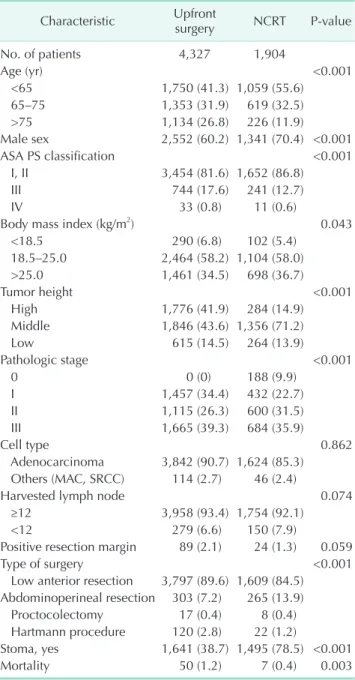
The baseline characteristics of the patients are presented in Table 1. The proportion of patients with young ages, obesity, ASA PS classification of I or II, male sex, midrectal cancer, and abdominoperineal resection was higher in the NCRT group than in the upfront surgery group. The rate of positive resection margin in NCRT group was marginally lower than the upfront surgery group. The most common chemotherapeutic regimens during NCRT were intravenous fluorouracil based chemotherapy (n = 921, 48.3%) and capecitabine (n = 847, 44.5%), and other regimens including oxaliplatin or irinotecan were used in 136 patients (7.1%).
The ORs for the association between NCRT administration and several factors (Table 2) revealed a tendency for less frequent administration of NCRT to older or ASA PS classification of III patients. In addition, NCRT was more frequently administered to patients with male sex and midrectal cancer.
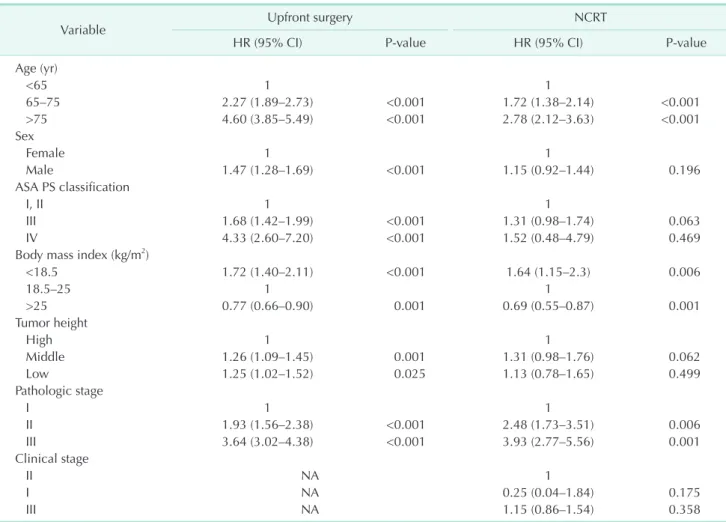
The HRs for OS of each group were analyzed (Table 3). Older age, male sex, underweight, tumor height, ASA PS classification of III or IV, and pStage were significant risk factors for OS in patients who underwent upfront surgery. In patients who underwent NCRT, older age, underweight, and pStage were risk factors for poor OS and male sex; tumor height and cStage were not significantly associated with OS. Table 4 shows the changes
of stages of patient in NCRT group. The proportions of patients whose ypStage were lower than cStage were 59.8%, 41.0%, and 40.0% in patients with cStage III, II, and I, respectively.
Table 5 shows the baseline characteristics of patients in the NCRT and upfront surgery groups after the adjustment. Fig. 2 shows the comparison of OS of patients in 2 groups according to the same pStage. Regardless of cStage, the OS rate of the NCRT group was not statistically different from the OS rate of patients in the upfront surgery group with the same pStage (Fig.
2A: 5-year OS, pStage III = 64.6%, ypStage III [cStage II] = 57.4%, Table 1. Baseline characteristics of patients
Characteristic Upfront
surgery NCRT P-value
No. of patients 4,327 1,904
Age (yr) <0.001
<65 1,750 (41.3) 1,059 (55.6)
65–75 1,353 (31.9) 619 (32.5)
>75 1,134 (26.8) 226 (11.9)
Male sex 2,552 (60.2) 1,341 (70.4) <0.001
ASA PS classification <0.001
I, II 3,454 (81.6) 1,652 (86.8)
III 744 (17.6) 241 (12.7)
IV 33 (0.8) 11 (0.6)
Body mass index (kg/m2) 0.043
<18.5 290 (6.8) 102 (5.4)
18.5–25.0 2,464 (58.2) 1,104 (58.0)
>25.0 1,461 (34.5) 698 (36.7)
Tumor height <0.001
High 1,776 (41.9) 284 (14.9)
Middle 1,846 (43.6) 1,356 (71.2)
Low 615 (14.5) 264 (13.9)
Pathologic stage <0.001
0 0 (0) 188 (9.9)
I 1,457 (34.4) 432 (22.7)
II 1,115 (26.3) 600 (31.5)
III 1,665 (39.3) 684 (35.9)
Cell type 0.862
Adenocarcinoma 3,842 (90.7) 1,624 (85.3) Others (MAC, SRCC) 114 (2.7) 46 (2.4)
Harvested lymph node 0.074
≥12 3,958 (93.4) 1,754 (92.1)
<12 279 (6.6) 150 (7.9)
Positive resection margin 89 (2.1) 24 (1.3) 0.059
Type of surgery <0.001
Low anterior resection 3,797 (89.6) 1,609 (84.5) Abdominoperineal resection 303 (7.2) 265 (13.9)
Proctocolectomy 17 (0.4) 8 (0.4)
Hartmann procedure 120 (2.8) 22 (1.2)
Stoma, yes 1,641 (38.7) 1,495 (78.5) <0.001
Mortality 50 (1.2) 7 (0.4) 0.003
Values are presented as number only or number (%).
NCRT, neoadjuvant chemoradiation therapy; ASA, American Society of Anesthesiologists; PS, physical status; MAC, mucinous adenocarcinoma; SRCC, signet ring cell carcinoma.
All patients with colorectal cancer,
2014 2016 (n = 53,217)
Patients with rectal cancer (n = 19,295)
6,277 patients
6,141 patients
No NCRT (n = 4,237)
NCRT (n = 1,904)
Colon cancer or
rectosigmoid colon cancer
No data of NCRT (n = 13,018)
Palliative resection (n = 136)
Fig. 1. Flowchart of patient selection from the database of the National Quality Assessment program. NCRT, neoadjuvant chemoradiation therapy.
ypStage III [cStage III] = 63.2%; Fig. 2B: 5-year OS, pStage II = 78.6%, ypStage II [cStage II] = 78.7%, ypStage II [cStage III] = 77.5%; Fig. 2C: 5-year OS, pStage I = 90.1%, ypStage I [cStage II]
= 87.7%, ypStage I [cStage III] = 90.1%).
DISCUSSION
The benefits of NCRT have been demonstrated in other randomized controlled studies, NCRT has been accepted as a standard treatment for stage II and III rectal cancer [7]. Previous studies have reported on the maximization of NCRT effect, such as modulation of the waiting periods after radiation therapy prior to surgical resection or introduction of consolidation/induction chemotherapy with chemoradiation therapy [8,9]. These studies will eventually make it possible to selectively perform TME after NCRT with strict indications to avoid overtreatment or undertreatment of disease through the evaluation of multiple factors related to treatment outcomes. In this large retrospective cohort study, we evaluated the current status of NCRT in South Korea using the national registry data and identified multiple factors related with the treatment strategies and survivals. Our results showed that NCRT was more frequently administered to younger, male, and midrectal cancer patients. Additionally, NCRT reduced the negative effects of male sex and the tumor height on OS. The OS in patients who underwent NCRT was not different from that of patients
who underwent upfront surgery with corresponding pStage.
In NCRT group, there were 30 patients with cStage I and 284 patients with high tumors. In addition, among the patients with midrectal or low-rectal cancer, there were 563 and 872 patients with pStage II and III, respectively, who underwent upfront surgeries. We could not evaluate how statistically cStage was consistent with pStage because there was no information related to cStage of the upfront surgery group in this database.
Nevertheless, considering these patients, it could be estimated that about 32.9% (n = 2,019) of all rectal cancer patients (n = 6,141) did not follow the standard guideline of treatment for rectal cancer. Thus, even with the same cStage or tumor height, it was found that the treatment policy for rectal cancer could be determined differently in consideration of various factors including age, sex, or side effects of radiation therapy.
Male sex was an independent risk factor for poor OS in patients who underwent upfront surgery in our study, which is consistent with results of a previous cohort study, reporting that men had poorer long-term outcomes than women [10].
There have been several explanations for better survival in female patients than in male patients. The protective effect of female sex hormones has already been reported in previous studies [11]. It has been hypothesized that female hormones have stimulatory effects on immunologic response, in contrast to the detrimental effects of testosterone [12]. In addition, colorectal surgeons recognized that women typically have wider Table 2. Association of administration of neoadjuvant chemoradiation therapy with patient characteristics
Variable Univariate analysis Multivariate analysis
OR (95% CI) P-value OR (95% CI) P-value
Age (yr)
<65 1 1
65–75 0.76 (0.67–0.85) <0.001 0.79 (0.69–0.89) <0.001
>75 0.33 (0.28–0.39) <0.001 0.36 (0.31–0.43) <0.001
Sex
Female 1 1
Male 1.57 (1.40–1.76) <0.001 1.44 (1.28–1.63) <0.001
Body mass index (kg/m2)
<18.5 0.79 (0.62–0.99) 0.045 0.89 (0.70–1.15) 0.385
18.5–25 1 1
>25 1.07 (0.95–1.20) 0.270 1.06 (0.94–1.20) 0.326
ASA PS classification
I, II 1 1
III 0.65 (0.55–0.77) <0.001 0.82 (0.69–0.98) 0.032
IV 0.53 (0.23–1.22) 0.134 0.91 (0.38–2.18) 0.824
Tumor height
High 1 1
Middle 4.61 (3.99–5.32) <0.001 4.64 (4.01–5.37) <0.001
Low 2.69 (2.22–3.25) <0.001 2.77 (2.28–3.36) <0.001
OR, odds ratio; CI, confidence interval; ASA, American Society of Anesthesiologists; PS, physical status.
ORs were obtained from logistic regression model.
pelvic dimensions, and the female pelvis is generally more accessible than the male pelvis, especially for mid and low- rectal cancer [13]. These anatomical differences may contribute to the difference in prognosis between male and female rectal cancer patients.
There are several structures below the peritoneal reflection,
such as the seminal vesicles, prostate, vagina, and neurovascular bundles that are important for maintaining genitourinary functions. Since the OR for the association between NCRT administration and the tumor height was higher in midrectal cancer than in low-rectal cancer, we concluded that, with sphincter preservation, preservation of these structures was also an important factor affecting the decision of NCRT administration. However, preservation of these structures can make it difficult to perform R0 resection, especially in advanced rectal cancer. It is challenging for surgeons to acquire a safe resection margin without injuring these structures. Those structures in narrow pelvis can affect a negative effect on the treatment outcomes of patients with low-lying tumors.
Low-lying tumor and male sex are both related to the narrow pelvis and are important factors of rectal cancer to secure a circumferential resection margin (CRM) of safe width [14].
Although many studies regarded CRM > 1 mm of patients who received NCRT and TME as positive, it is also true that the optimal width after NCRT still has been unclear. Previous Table 3. Multivariate analysis of hazard ratio for overall survival in patients according to administration of the NCRT
Variable Upfront surgery NCRT
HR (95% CI) P-value HR (95% CI) P-value
Age (yr)
<65 1 1
65–75 2.27 (1.89–2.73) <0.001 1.72 (1.38–2.14) <0.001
>75 4.60 (3.85–5.49) <0.001 2.78 (2.12–3.63) <0.001
Sex
Female 1 1
Male 1.47 (1.28–1.69) <0.001 1.15 (0.92–1.44) 0.196
ASA PS classification
I, II 1 1
III 1.68 (1.42–1.99) <0.001 1.31 (0.98–1.74) 0.063
IV 4.33 (2.60–7.20) <0.001 1.52 (0.48–4.79) 0.469
Body mass index (kg/m2)
<18.5 1.72 (1.40–2.11) <0.001 1.64 (1.15–2.3) 0.006
18.5–25 1 1
>25 0.77 (0.66–0.90) 0.001 0.69 (0.55–0.87) 0.001
Tumor height
High 1 1
Middle 1.26 (1.09–1.45) 0.001 1.31 (0.98–1.76) 0.062
Low 1.25 (1.02–1.52) 0.025 1.13 (0.78–1.65) 0.499
Pathologic stage
I 1 1
II 1.93 (1.56–2.38) <0.001 2.48 (1.73–3.51) 0.006
III 3.64 (3.02–4.38) <0.001 3.93 (2.77–5.56) 0.001
Clinical stage
II NA 1
I NA 0.25 (0.04–1.84) 0.175
III NA 1.15 (0.86–1.54) 0.358
NCRT, neoadjuvant chemoradiation therapy; HR, hazard ratio; CI, confidence interval; ASA, American Society of Anesthesiologists;
PS, physical status; NA, not available.
HRs were obtained from Cox regression model adjusted for age, sex, BMI, level of tumor, pathologic and clinical stage.
Table 4. Changes of stages of patients after neoadjuvant chemoradiotherapy
ypStage cStage
III (n = 1,562) II (n = 312) I (n = 30)
III 627 (40.1) 55 (17.6) 2 (6.7)
II 469 (30.0) 129 (41.3) 2 (6.7)
I 324 (20.7) 94 (30.1) 14 (46.7)
0 142 (9.1) 34 (10.9) 12 (40.0)
Values are presented as number (%).
cStage, clinical stage; ypStage, pathologic stage after neoadjuvant chemoradiotherapy.
studies demonstrated that a wider width of CRM in rectal cancer of 2 mm might be essential to achieve less-distant metastasis and patients with 1.1–5 mm showed the prognosis in a gray zone comparing those of ≤1 mm and ≥5 mm [15,16].
In this study, the rates of positive resection margin were 2.3%
and 1.4% (upfront surgery group and NCRT groups, respectively;
P = 0.059). Additional analysis was performed with patients of midrectal and low-rectal cancer with the same method.
Midrectal and low-rectal cancer patients who underwent NCRT showed a lower rates of positive resection margin than patients who underwent upfront surgery (midrectal cancer: 58 patients [3.4%] with upfront surgery vs. 21 patients [1.8%] with NCRT, P = 0.015; low-rectal cancer: 13 patients [2.3%] with upfront
surgery vs. 0 patients [0%] with NCRT, P = 0.041). According to the results of the proportion of positive resection margin and risk factors for worse OS of patients in NCRT group, we could estimate that NCRT could be helpful in enhancing the surgical completeness of patients with male sex and low-lying rectal cancer by helping to secure safe resection margin length.
The reduced use of NCRT in patients of old age has been reported in other national registry-based studies and this tendency might be due to the higher rates of toxicity after NCRT in elderly patients than in younger patients [17,18]. However, according to a study based on the Swedish national database, old age (>75 years) affected treatment decisions, but it had no effect on the survival in patients [19]. The ACCORD12 phase Table 5. Baseline characteristics of patients after adjustment using the inverse probability of treatment weighting method
Variable Upfront surgery NCRT P-value SMD
No. of patients 4,691 4,743
Age (yr) 0.819 0.024
<65 2,024 (43.1) 2,002 (42.2)
65–75 1,516 (32.3) 1,532 (32.3)
>75 1,151 (24.5) 1,766 (37.2)
Male sex 2,965 (63.2) 2,978 (62.8) 0.824 0.009
ASA PS classification 0.965 0.011
I, II 3,895 (83.0) 3,934 (82.9)
III 768 (16.4) 777 (16.4)
IV 28 (0.6) 33 (0.7)
Body mass index (kg/m2) 0.681 0.033
<18.5 293 (6.2) 288 (6.1)
18.5–25 2,752 (58.7) 2,715 (57.2)
>25 1,646 (35.1) 1,740 (36.7)
Tumor height 0.905 0.015
High 1,710 (36.5) 1,764 (37.2)
Middle 2,338 (49.8) 2,314 (49.4)
Low 643 (13.7) 638 (13.5)
Pathologic stage <0.001 0.423
0 0 (0) 67.5 (1.4)
I 1,970 (42.0) 1,128 (23.8)
II 1,286 (27.4) 1,673 (35.3)
III 1,435 (30.6) 1,874 (39.5)
Cell type 0.862 0.002
Adenocarcinoma 4,591 (97.9) 4,644 (97.9)
Others (MAC, SRCC) 100 (2.1) 99 (2.1)
Harvested lymph node 0.220 0.040
≥12 4,357 (92.9) 4,452 (93.9)
<12 334 (7.1) 291 (6.1)
Type of surgery 0.002 0.148
Low anterior resection 4,227 (90.1) 4,117 (86.8)
Abdominoperineal resection 339 (7.2) 547 (11.3)
Proctocolectomy 24 (0.5) 17 (0.4)
Hartmann procedure 101 (2.2) 73 (1.5)
Values are presented as number only or number (%).
NCRT, neoadjuvant chemoradiation therapy; SMD, standardized mean difference; ASA, American Society of Anesthesiologists; PS, physical status; MAC, mucinous adenocarcinoma; SRCC, signet ring cell carcinoma.
The propensity score was estimated based on the age, sex, tumor height, BMI, ASA PS classification, cell type, and harvested lymph nodes.
III trial demonstrated that the surgical outcomes, including R0 resection rate and pathologic complete response, did not differ between old (≥70 years) and young (<70 years) patients [20]. We need to consider the utilization of NCRT for elderly patients positively with careful assessment and management of morbidity.
The cStage was not a risk factor for OS in patients who underwent NCRT; however, pStage was a significant risk factor for OS in both NCRT and patients who underwent upfront surgery. This was consistent with the results of previous studies and supports the idea of selecting patients who may acquire survival benefits from NCRT through downstaging [21].
In this study, the OS in ypStage I/II patients was similar to
that of the corresponding pStage I/II patients who underwent upfront surgery. Actually, before the adjustment, the OS in ypStage III patients was statistically better than that of pStage III patients who underwent upfront surgery. We speculated that this difference in OS was due to the tendency of the less administration of NCRT of old aged patients. In particular, the proportion of elderly patients was significantly higher in the upfront surgery group than in the NCRT group. This discrepancy in age might have resulted in poor survival in the upfront surgery group with pStage III. This difference became insignificant after adjustment for differences in clinical characteristics between the 2 subgroups.
This study has several limitations. First, there was no
80
Overallsurvival
Follow-up (mo) 1.0
0.8
0.6
0.4
0.2
0 20 40 60
Stage
pStage III ypStage III (cStage II) ypStage III (cStage III)
Number at risk
Month 0 Month 20 Month 40 Month 60
1,435
164
1,708
1,262
135
1,551
1,045
117
1,346
466
25
479
pStage III
ypStage III (cStage II) ypStage III (cStage III)
80
Overallsurvival
Follow-up (mo) 1.0
0.8
0.6
0.4
0.2
0 20 40 60
Stage
pStage II ypStage II (cStage II) ypStage II (cStage III)
Number at risk
Month 0 Month 20 Month 40 Month 60
1,286
319
1,349
1,194
301
1,291
1,115
277
1,184
537
188
445
pStage II
ypStage II (cStage II) ypStage II (cStage III)
80
Overallsurvival
Follow-up (mo) 1.0
0.8
0.6
0.4
0.2
0 20 40 60
Stage
pStage I ypStage I (cStage II) ypStage I (cStage III)
Number at risk
Month 0 Month 20 Month 40 Month 60
1,970
243
856
1,917
241
804
1,852
234
783
987
148
388
pStage I
ypStage I (cStage II) ypStage I (cStage III)
A B
C
Fig. 2. Kaplan-Meier curve of overall survival of patients who underwent NCRT compared with patients who underwent upfront surgery after the adjustment using inverse probability of treatment weighting method. (A) The patients of pStage III (pStage III vs. ypStage III [cStage II], P = 0.579; pStage III vs. ypStage III [cStage III], P = 0.521). (B) The patients of pStage II (pStage II vs. ypStage II [cStage II], P = 0.853; pStage II vs. ypStage II [cStage III], P = 0.653). (C) The patients of pStage I (pStage I vs. ypStage I [cStage II], P = 0.693; pStage I vs. ypStage I [cStage III], P = 0.356). NCRT, neoadjuvant chemoradiotherapy; pStage, pathologic stage; ypStage, pathologic stage after neoadjuvant chemoradiotherapy;
cStage, clinical stage.
information about the cStages of upfront surgery groups.
Hence, it was not possible to evaluate the concordance of cStage with pStage; thus, the association (OR) of cStage with NCRT administration could not be evaluated. Second, a large proportion of patients (n = 13,018, 67.5%) were excluded from the analysis because there was no record of NCRT. Although the database was managed by HIRA, there were missing data of patients from many institutions, and the majority of data related to NCRT could not be analyzed. In addition, detailed information on clinical characteristics, including molecular profiling, local/systemic recurrence, and tumor regression grade was unavailable in the database. Moreover, the status of resection margins did not differentiate CRM and distal resection margin (DRM); thus, we could not evaluate the effect of resection margin according to the types of resection margin.
HIRA revised the database to record the length of resection margins of CRM/DRM in 2018, and, for this reason, the database we utilized did not have information on the length of the resection margin of patients according to the types of resection margin. In spite of these shortcomings of this study, this study is the first study using the database from the National Quality Assessment program which is the only national registry of patients with colorectal cancer in South Korea. We hope that this study will not only provide information on neoadjuvant chemoradiotherapy in South Korea but also be a springboard for the national registry to be more informative.
In conclusion, NCRT was more frequently administered to young, midrectal cancer, and male patients, and old age, underweight, and pStage were independent risk factors for OS in patients who underwent NCRT. NCRT was helpful in controlling the negative effects of male sex and the tumor
height on OS. The final pStage was a more reliable predictive factor of OS after NCRT than the cStage.
ACKNOWLEDGEMENTS
The authors thank Eunjin Noh (Smart Healthcare Cancer, Korea University Guro Hospital) for data management and statistical analysis.
Conflict of Interest
No potential conflict of interest relevant to this article was reported.
ORCID iD
Jun Woo Bong: https://orcid.org/0000-0002-9530-7069 Yeonuk Ju: https://orcid.org/0000-0001-7174-1218 Jihyun Seo: https://orcid.org/0000-0003-3171-4885 Jung Ae Lee: https://orcid.org/0000-0003-0186-8672 Sang Hee Kang: https://orcid.org/0000-0002-6097-8831 Sun Il Lee: https://orcid.org/0000-0002-5286-8042 Byung Wook Min: https://orcid.org/0000-0002-3621-5113
Author Contribution
Conceptualization: JWB, BWM Formal Analysis: JWB, SHK Investigation: YJ, JS Methodology: SHK, JAL
Project Administration: SIL, BWM
Writing – Original Draft: JWB, YJ, JS, JAL, SHK Writing – Review & Editing: JWB, SIL, BWM
REFERENCES
1. Hur H, Oh CM, Won YJ, Oh JH, Kim NK. Characteristics and survival of Korean patients with colorectal cancer based on data from the Korea Central Cancer Registry data. Ann Coloproctol 2018;34:212-21.
2. Sauer R, Liersch T, Merkel S, Fietkau R, Hohenberger W, Hess C, et al. Preoperative versus postoperative chemoradiotherapy for locally advanced rectal cancer:
results of the German CAO/ARO/AIO- 94 randomized phase III trial after a median follow-up of 11 years. J Clin Oncol 2012;30:1926-33.
3. Park IJ, You YN, Agarwal A, Skibber JM, Rodriguez-Bigas MA, Eng C, et al.
Neoadjuvant treatment response as an early response indicator for patients with rectal cancer. J Clin Oncol 2012;30:1770-6.
4. Li Y, Wang J, Ma X, Tan L, Yan Y, Xue C, et al. A review of neoadjuvant chemoradiotherapy for locally advanced rectal cancer. Int J Biol Sci 2016;12:1022- 31.
5. Kim CH, Lee SY, Kim HR, Kim YJ.
Pathologic stage following preoperative chemoradiotherapy underestimates the risk of developing distant metastasis in
rectal cancer: a comparison to staging without preoperative chemoradiotherapy.
J Surg Oncol 2016;113:692-9.
6. Regional Office for the Western Pacific, World Health Organization. The Asia- Pacific perspective: redefining obesity and its treatment. Sydney: Health Communications Australia; 2000.
7. Rahbari NN, Elbers H, Askoxylakis V, Motschall E, Bork U, Büchler MW, et al. Neoadjuvant radiotherapy for rectal cancer: meta-analysis of randomized controlled trials. Ann Surg Oncol 2013;20:4169-82.
8. Cercek A, Roxburgh CS, Strombom P, Smith JJ, Temple LK, Nash GM, et al.
Adoption of total neoadjuvant therapy for locally advanced rectal cancer. JAMA Oncol 2018;4:e180071.
9. Garcia-Aguilar J, Smith DD, Avila K, Bergsland EK, Chu P, Krieg RM, et al. Optimal timing of surgery after chemoradiation for advanced rectal c a ncer: prel i mi n a r y result s of a multicenter, nonrandomized phase II prospective trial. Ann Surg 2011;254:97- 102.
10. Rutter CM, Johnson EA, Feuer EJ, Knudsen AB, Kuntz KM, Schrag D. Secular trends in colon and rectal cancer relative survival. J Natl Cancer Inst 2013;105:1806- 13.
11. Majek O, Gondos A, Jansen L, Emrich K, Holleczek B, Katalinic A, et al. Sex differences in colorectal cancer survival:
population-based analysis of 164,996 colorectal cancer patients in Germany.
PLoS One 2013;8:e68077.
12. Wichmann MW, Müller C, Hornung HM, Lau-Werner U, Schildberg FW; Colorectal Cancer Study Group. Gender differences in long-term survival of patients with colorectal cancer. Br J Surg 2001;88:1092-8.
13. Zhou XC, Su M, Hu KQ, Su YF, Ye YH,
Huang CQ, et al. CT pelvimetry and clinicopathological parameters in evaluation of the technical difficulties in performing open rectal surgery for mid- low rectal cancer. Oncol Lett 2016;11:31-8.
14. Rullier A, Gourgou-Bourgade S, Jarlier M, Bibeau F, Chassagne-Clément C, Hennequin C, et al. Predictive factors of positive circumferential resection margin after radiochemotherapy for rectal cancer: the French randomised trial ACCORD12/0405 PRODIGE 2. Eur J Cancer 2013;49:82-9.
15. Trakarnsanga A, Gonen M, Shia J, Goodman KA, Nash GM, Temple LK, et al. What is the significance of the circumferential margin in locally advanced rectal cancer after neoadjuvant chemoradiotherapy? Ann Surg Oncol 2013;20:1179-84.
16. Sung S, Kim SH, Lee JH, Nam TK, Jeong S, Jang HS, et al. Continuous effect of radial resection margin on recurrence and survival in rectal cancer patients who receive preoperative chemoradiation and curative surgery: a multicenter retrospective analysis. Int J Radiat Oncol Biol Phys 2017;98:647-53.
17. Delitto D, George TJ Jr, Loftus TJ, Qiu P, Chang GJ, Allegra CJ, et al. Prognostic
value of clinical vs pathologic stage in rectal cancer patients receiving neoadjuvant therapy. J Natl Cancer Inst 2018;110:460-6.
18. Claassen YH, Vermeer NC, Iversen LH, van Eycken E, Guren MG, Mroczkowski P, et al. Treatment and survival of rectal cancer patients over the age of 80 years: a EURECCA international comparison. Br J Cancer 2018;119:517-22.
19. Jung B, Påhlman L, Johansson R, Nilsson E. Rectal cancer treatment and outcome in the elderly: an audit based on the Swedish Rectal Cancer Registry 1995- 2004. BMC Cancer 2009;9:68.
20. François E, Azria D, Gourgou-Bourgade S, Jarlier M, Martel-Laffay I, Hennequin C, et al. Results in the elderly with locally advanced rectal cancer from the ACCOR12/PRODIGE 2 phase III trial:
tolerance and efficacy. Radiother Oncol 2014;110:144-9.
21. Babaei M, Jansen L, Balavarca Y, Sjövall A, Bos A, van de Velde T, et al. Neoadjuvant therapy in rectal cancer patients with clinical stage II to III across European countries: variations and outcomes. Clin Colorectal Cancer 2018;17:e129-42.