www.e-roj.org
This is an Open Access article distributed under the terms of the Creative Commons Attribution Non-Commercial License (http://creativecommons.org/
licenses/by-nc/4.0/) which permits unrestricted non-commercial use, distribution, and reproduction in any medium, provided the original work is properly cited.
Received 10 December 2015, Revised 29 March 2016, Accepted 10 May 2016.
Correspondence: Jin Hee Kim, MD, PhD, Department of Radiation Oncology, Dongsan Medical Center, Keimyung University School of Medicine, 56 Dalseong-ro, Jung-gu, Daegu 41931, Korea. Tel: +82-53-250-7665, Fax: +82-53-250-7984, E-mail:
[email protected]
Purpose: To identify possible predictors of pathologic complete response (pCR) of rectal cancer after preoperative concurrent chemoradiotherapy (CCRT).
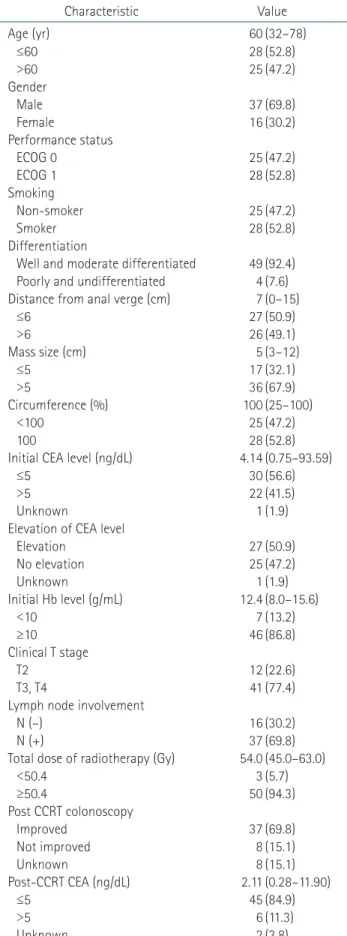
Materials and Methods: We conducted a retrospective review of 53 patients with rectal cancer who underwent preoperative CCRT followed by radical surgery at a single center between January 2007 and December 2012. The median radiotherapy dose to the pelvis was 54.0 Gy (range, 45.0 to 63.0 Gy). Five-fluorouracil-based chemotherapy was administered via continuous infusion with leucovorin.
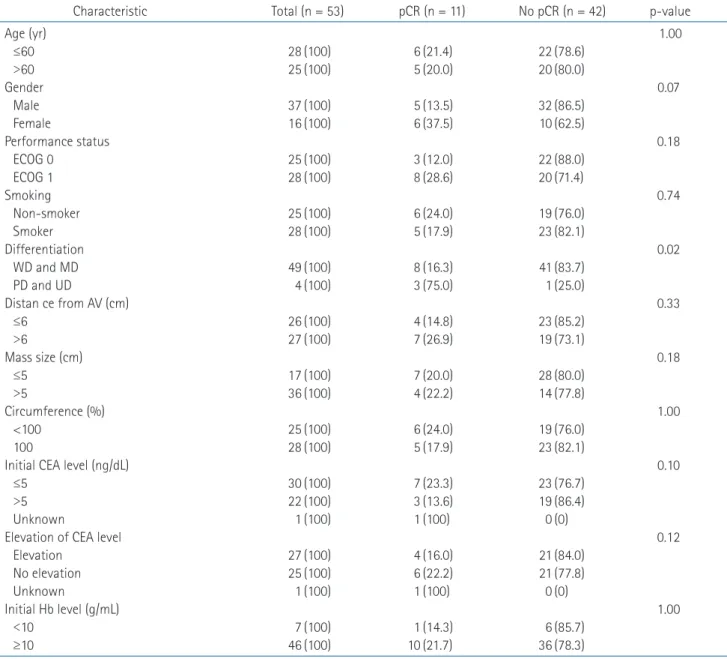
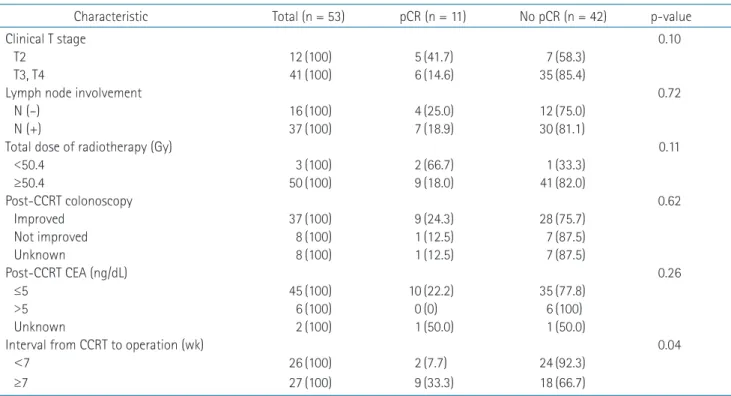
Results: The pCR rate was 20.8%. The downstaging rate was 66%. In univariate analyses, poor and undifferentiated tumors (p = 0.020) and an interval of ≥7 weeks from finishing CCRT to surgery (p = 0.040) were significantly associated with pCR, while female gender (p = 0.070), initial carcinoembryonic antigen concentration of <5.0 ng/dL (p = 0.100), and clinical stage T2 (p = 0.100) were marginally significant factors. In multivariate analysis, an interval of ≥7 weeks from finishing CCRT to surgery (odds ratio, 0.139;
95% confidence interval, 0.022 to 0.877; p = 0.036) was significantly associated with pCR, while stage T2 (odds ratio, 5.363; 95%
confidence interval, 0.963 to 29.877; p = 0.055) was a marginally significant risk factor.
Conclusion: We suggest that the interval from finishing CCRT to surgery is a predictor of pCR after preoperative CCRT in patients with rectal cancer. Stage T2 cancer may also be an important predictive factor. We hope to perform a robust study by collecting data during treatment to obtain more advanced results.
Keywords: Rectum, Rectal neoplasms, Chemoradiotherapy, Stage, Interval
Predictors of pathologic complete response after preoperative concurrent chemoradiotherapy of rectal
cancer: a single center experience
Euncheol Choi, MD
1, Jin Hee Kim, MD, PhD
2, Ok Bae Kim, MD, PhD
2, Mi Young Kim, MD
2, Young Ki Oh, PhD
2, Sung Gyu Baek, MD, PhD
31