The Application of Convergence lesson about Private Finance with Life Science subject in Mongolian University
Bayarmaa Natsagdorj, Kuensoo Lee
*Dept. of Computer Science and Engineering (& Computer System Institute), Hankyong National University
몽골대학에서 개인 금융과 올바른 삶 교과간 융합수업 적용
바야르마, 이근수*
한경대학교 컴퓨터공학과 컴퓨터시스템 연구소
Abstract STEAM is an acronym for Science, Technology, Engineering, Arts, and Mathematics. It is considered important to equip students with a creative thinking ability and the core competences required in future society, helping them devise new ideas emerging from branches of study. This study is about the convergence of instructional design in private finance for the life sciences, which aims to foster talent through problem-based learning (PBL).
Skills like collaboration, creativity, critical thinking, and problem solving are part of any STEAM PBL, and are needed for students to be effective. STEAM projects give students a chance to problem-solve in unique ways, because they are forced to use a variety of methods to solve problems that pop up during these types of activities. The results of this study are as follows. First is the structured process of convergence lessons. Second is the convergence lesson process. Third is the development of problems in the introduction of private finance and the life sciences for a convergence lesson at Dornod University. Learning motivation shows the following results: understanding of learning content (66.6%), effectiveness (63.3%), self-directed learning (59.9%), motivation (63.2%), and confidence (63.3%).
To make an effective model, studies applying this instructional design are to be implemented.
Keywords : convergence lesson, creative thinking ability, designing the lesson, Problem-Based Learning, STEAM
요 약 STEAM은 과학, 기술, 공학, 예술 및 수학의 약자입니다. 미래 사회에서 요구되는 창의적 사고력과 핵심 역량을 갖추게 하고 연구 분야에서 빠져나오는 새로운 아이디어를 고안하도록 돕는 것이 중요하다고 여겨진다. 이 연구는 PBL(문제 중심 학습)을 통해 인재를 육성하는 라이프사이언스 과목과 민간금융의 교육적 디자인을 융합시키는 것이다. 협업, 창의력, 비판적 사고, 문제 해결과 같은 기술은 STEAM PBL의 일부이며, 학생들이 효과적이 되도록 해야 한다. STEAM 프로젝트는 학생들에게 독특한 방식으로 문제를 해결할 수 있는 기회를 제공합니다. 왜냐하면 학생들은 이러한 유형의 활동 중에 발생하 는 문제를 해결하기 위해 다양한 방법을 사용해야 하기 때문입니다. 본 연구의 결과는 다음과 같습니다. 첫째, 융합과정의 체계적 과정 둘째, 수렴 과정. 셋째, 도로노드 대학교의 구글 강의실 기반 수업을 위한 라이프사이언스 과목과 민간금융의 문제해결와 이 모델을 효과적으로 활용하기 위한 교육적 설계를 적용하는 연구가 시행된다. 학습 동기 부여는 학습 내용의 이해(66.6%) 효과(63.3%) 자기 주도 학습(59.9%) 동기(63.2%) 신뢰(63.3%)를 보여 줍니다.
*Corresponding Author : Keunsoo Lee(Hankyong National Univ. & Computer System Institute) Tel: +82-31-670-5161 email: [email protected]
Received August 14, 2018 Revised September 10, 2018 Accepted December 7, 2018 Published December 31, 2018
1. Introduction
STEAM is an acronym of Science, Technology,
Engineering, Arts, and Mathematics. This is an educational curriculum that combined Art to the existing American STEM (Science, Technology, Engineering,
Mathematics) curriculum[1].
STEAM aims to strengthen the foundation of STEM by helping students enhance their critical thinking skills and recognize the intersection of art, science, technology, engineering, and math. STEAM education does not entail a part of education but refers to an overall paradigm from the professional learning to lifelong learning, which is organized with the addition of art to the existing education, especially in the integrated education of Science, Technology, Engineering, Mathematics and Art. STEAM students can even partner with real-world companies and initiatives to develop solutions to problems[2].
Both PBL and STEAM education are growing rapidly in many educational institutions. Both PBL and STEAM help schools target rigorous learning and problem solving. As many teachers know, STEAM education isn't just the course content—it's the process of being scientists, mathematicians, engineers, artists, and technological entrepreneurs[3]. This study advocate convergence curriculum to Mongolian students' creativity, problem-solving skills and ultimately support them to become a creative talent built on convergence.
The purpose of this study design convergence lesson model based on Google Classroom and traditional learning technology. Including problem solving procedures and figure out the problems for PBL in Private Finance and Life Science subjects. This paper contains Research introduction in Chapter 1, Review of the Literature, the methodology in Chapter 2, and the Summary in Chapter 3.
2. Review of the Literature
2.1 What is STEAM education?
STEAM is an educational approach to learning that uses Science, Technology, Engineering, the Arts and Mathematics as access points for guiding student inquiry, dialogue, and critical thinking. The end results are students who take thoughtful risks, engage in
experiential learning, persist in problem-solving, embrace collaboration, and work through the creative process. These are the innovators, educators, leaders, and learners of the 21st century[2].
How to make your classroom a STEAM classroom[4]:
• Add hands-on projects to your students‘ day to let them be more involved
• Include real-world problem-solving activities
• Encourage question-asking
• Let students make decisions about the projects they‘re assigned
When students engage in activities that combine different elements of STEAM, they experience guided inquiry in which they must ask thoughtful questions, discover answers, apply what they learn, and problem-solve creatively. STEAM projects involve teamwork and thoughtful dialogue in which students exchange ideas and discuss ways to problem-solve.
Through these activities, students learn how to divide up responsibilities, compromise, listen to and encourage each other. And require students to systematically think through problems, applying the information they learn along the way about technology and engineering to figure out the best solutions. [5].
2.2 Characteristics of STEAM Education Characteristics of STEAM education and elements of contents development is as follows[1].
1) It should be converged with socio-economy and the environment based on science․engineering to organize activities capable of predicting the future in a systematic manner.
2) The five elements should not be separated and instead be set up in ways to ensure a natural organization from the basic principles to the expanded domain.
3) Diversity of hi-tech science․ technology․
engineering related to application of a certain basic principle should be proposed in a suitable
level to fit with each grade's educational attainment standard.
4) Definition of creativity should not be over-interpreted and a variety of learning methods, learning tools and experience activities should be developed.
Real problems provide rich learning opportunities since students must conduct research, hypothesize, create, test, analyze, revise, and synthesize. STEAM project brings the outside world into the classroom and challenges students to think critically, benefiting them as learners and as future professionals. A long-lasting, successful It asks learners for honest, constructive feedback. By asking students to participate in anonymous surveys and/or polls, teachers are able to know what‘s really working and what isn't[6]. Giving students affective skill training, which helps them tap into their motivation for education, combined with the freedom to explore that comes with PBL learning or genius-hour style projects will work well to help them approach their education as active, entrepreneurial learners, rather than passive recipients of teaching[7].
2.3 Methodology
Used Google Classroom in Private Finance and Life Science subject for convergence lesson in Dornod University. This study conducted with 30 first year Linguistic and Business students in small groups of 6, undertake 8 hours in a week. The size of small group is between 4 to 5 students. This lesson involves the real world problem is introduced to students in the classroom. The process of this lesson proceeded on Google Classroom actively. The students search the information from various resources through self-directed learning and present their information to the group members. During these activity, they help each others and learn how to tolerate peer behaviour and attitude. They give and accept constructive feedback from peers and instructor through Google Classroom and face-to-face learning.
2.4 Online Environment
An instructor can keep all the files save in the Google Drive and grade, attach you tube or any link for instructional purposes. From Google Classroom, an instructor can send mail to all students at the same time. Janzen, M. (2014), points out the following benefits of using Google Classroom[8].
Easy to use - It is very easy to use. "Google Classroom’s design purposefully simplifies the instructional interface and options used for delivering and tracking assignments; communication with the entire course or individuals is also simplified through announcements, email, and push notifications."(Janzen, M. 2014)
Saves time - Google classroom is designed to save time. It integrates and automates the use of other Google apps, including docs, slides, and spreadsheets, the process of administering document distribution, grading, formative assessment, and feedback is simplified and streamlined. Chehayeb, A. (2015), Google Classroom Software Engineer mentions that they built classroom "to save time". He claims that Google is launching some features like export grades to Google Sheets, easier to update grade point scale, keyboard navigation for entering grades, sort by name on grading page etc to save instructors' time.
Cloud-based Google Classroom presents more professional and authentic technology to use in learning environment as Google apps represent "a significant portion of cloud-based enterprise communications tools used throughout the professional workforce." (Mary, 2014)
Flexible This app is easy to use and accessible to instructors and students in both face-to-face learning environment and full online environment. This enables educators to explore and influence "flipped instructional methods more easily as well as automate and organize the distribution and collection of assignments and communications in multiple instructional milieus." (Mary, 2014)
Free Google Classroom in itself is not necessarily
available to students without access to an educational institution. But anyone can access to all the other apps, such as Drive, Docs, Spreadsheets, Slides, etc. simply by signing up for a Google account.
Mobile-friendly Google Classroom is designed to be responsive. It is easy to use on any mobile device.
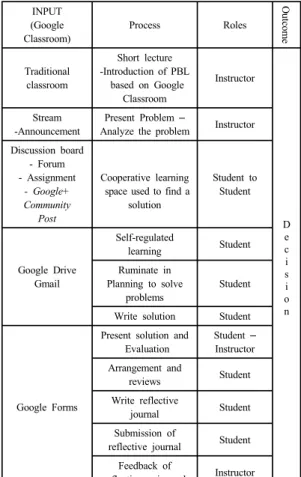
"Mobile access to learning materials that are attractive and easy to interact with is critical in today’s web connected learning environment."(Janzen, M 2014) Keeler, A. (2014) also mentions several other benefits of using Google Classroom. She mentions how Google Classroom ensures streamline counseling only by posting an announcement. Crawford, A. R. (2015) states that Google Classroom facilitates collaborative learning. Here, the instructor can upload materials and give feedback to students. Students can also upload materials and make personal comments. Moreover, students can collaborate with each other. They can share their documents and assignment thus, they can come up with their best assignment or work. The Google Classroom model focuses on the components in ensuring the effectiveness of the PBL Table 1.
Description of each of the elements found in PBL components are as follows: Firstly, instructor gives instruction about learning objectives, class teaching methods, assessments, evaluation, criteria and features of PBL in an off-line environment.
Stream and Announcement Use them to give notices to students. Announcements are shown at the top of the class stream. In this part, prepare the problem for PBL.
Identify the learning objectives and pose questions on it. Instructor presents a problem on Announcement in PBL.
(2) Discussion board Students can have online discussions with Google Classroom using Google+
Community, Forum and Assignment.
Google Drive and Gmail Access store files anywhere, from any device even if you don’t have an internet connection. Keep all documents in one place with a shared team folder. Scan documents and images as PDFs with phone. Keep all drafts in a single file;
Table 1. Google Classroom mode INPUT
(Google Classroom)
Process Roles
Outcome
Traditional classroom
Short lecture -Introduction of PBL
based on Google Classroom
Instructor
D e c i s i o n Stream
-Announcement
Present Problem –
Analyze the problem Instructor Discussion board
- Forum - Assignment
- Google+
Community Post
Cooperative learning space used to find a
solution
Student to Student
Google Drive Gmail
Self-regulated
learning Student
Ruminate in Planning to solve
problems
Student
Write solution Student
Google Forms
Present solution and Evaluation
Student – Instructor Arrangement and
reviews Student
Write reflective
journal Student
Submission of
reflective journal Student Feedback of
reflective journal Instructor
can revert to an earlier version any time. In Gmail instructor and students can send professional email to each others.
(4) Google Forms With Google forms, it manages event registrations, create a quick opinion poll, and much more. Create and analyze surveys right in mobile or web browser, no special software is required. Get instant results as they come in. And, can summarize survey results at a glance with charts and graphs.
Presenting solution and Evaluation, Arrangement and reviews, Writing reflective journal, Submission of reflective journal and Feedback of reflective journal take place in Google forms.
(5) Decision It gives the result of PBL process using Google Classroom. And shows the advantages and gaps of using Google Classroom application in
PBL. Students can share and discuss the report using Drive Presentation easily. The emphasis of Lifelong Learning has challenged the traditional ideas of schools being the final learning places. The broad applications of the Internet have Distance Education become another wave of learning mainstream (Tsou, 2009)[9].
Google Classroom takes into consideration the achievement of specific functions such as simplifying the students-teacher communication, and the ease of distributing and grading assign-ments. It provides the students with an opportunity to submit their work to be graded by their teacher online within the deadlines.
2.5 Hypothesis
30 students participated Survey and they was positive attitude about the understanding of learning content. Table 2 presents 66.6%(20) of students, self-directed learning positiveness is 59.9%(19)
Table 2. Learning motivation Very
positive Positive Normal Negative Very Negative Understanding
of learning content
13.3%
4
53.3%
16
33.3%
10 0% 0%
Effectiveness 13.3%
4
50%
15
36.6%
11 0% 0%
Self-directed learning
13.3%
4
46.6%
14
59.9%
12 0% 0%
Motivation 16.6%
5
46.6%
14
36.6%
11 0% 0%
Confidence 13.3%
4
50%
15
36.6%
11 0% 0%
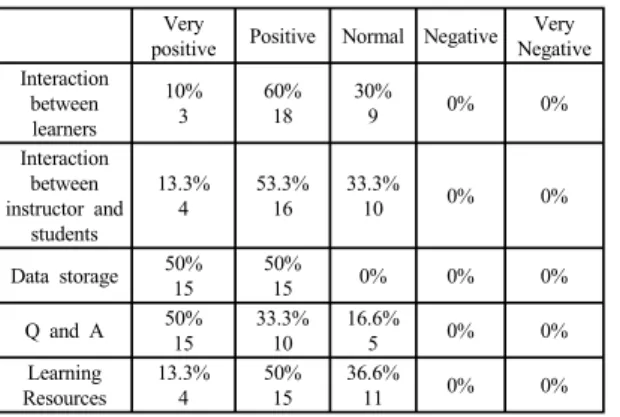
Table 3. The Effectiveness of Google Classroom Very
positive Positive Normal Negative Very Negative Interaction
between learners
10%
3
60%
18 30%
9 0% 0%
Interaction between instructor and
students
13.3%
4
53.3%
16
33.3%
10 0% 0%
Data storage 50%
15
50%
15 0% 0% 0%
Q and A 50%
15 33.3%
10 16.6%
5 0% 0%
Learning Resources
13.3%
4
50%
15
36.6%
11 0% 0%
Table 3 presented attitude about Google Classroom.
60% of students were positive working on it. Google Classroom is easy to use and suitable collaboration platform.
3. Conclusion
This study concluded the structured process of convergence lesson based on Google Classroom for Private Finance and Life Science subject in Dornod University in Mongolia. It was first time to using Google Classroom and second time to implementing PBL instruction. Developed and presented problems about the introduction of Private Finance and Life Science subject for convergence lesson firstly there.
Private Finance and Life Science lesson which is conducted on Google Classroom was effective. All of participants have got a Sertification. 30 students participated Survey and they was positive attitude about the understanding of learning content is 66.6% of students, self-directed learning positiveness is 59.9%.
This study was designed to help students to acquire critical thinking skill, problem solving skill, apply they idea and knowledge in the learning process and being confident during class. Indeed, the effective feedback system required through Google Classroom for this study.
References
[1] Development of Computer, Math, Art Convergence Education Lesson Plans Based on Smart Grid Technology https://link.springer.com/chapter/10.1007%
2F978-3-642-35264-5_15
[2] What is STEAM? By Education Closet https://educationcloset.com/steam/what-is-steam/
[3] Andrew Miller PBL and STEAM Education: A Natural Fit. May 20, 2014. Updated May 25, 2017 https://www.edutopia.org/blog/pbl-and-steam-natural-fit-a ndrew-miller
[4] Resources for Current and Future STEAM Educators https://www.alleducationschools.com/resources/steam-edu cation/
[5] The Benefits of Teaching STEAM Lessons By The Room 241 Team. July 21, 2017 https://education.cu-portland.edu/blog/classroom-resource s/benefits-of-teaching-steam
[6] Nicole Mace. Characteristics of a Great STEAM Program MEd Oct 30, 2018 https://education.cu-portland.edu/blog/classroom-resource s/characteristics-great-steam-program/
[7] Monica Fuglei, STEMpathy: Thomas Friedman&s Case for Humanity in STEM Education. Nov 25, 2015 https://education.cu-portland.edu/blog/classroom-resource s/stempathy-stem-education/
[8] Shampa Iftakhar "Google Classroom: What works and how?" Journal of Education and Social Sciences, Vol. 3, (Feb.) 2016
[9] Effects of Distance Learning on Learning Effectiveness Hong-Cheng Liu I-Shou University, TAIWAN Jih-Rong Yen National Pingtung University of Education, TAIWAN Received 16 March 2014; accepted 15 October 2014
Natsagdorj Bayarmaa [Regular member]
•Feb. 2015 : Mongolian Educational Univ,. Dept. of Economy, M.A
•Sep. 2012- Jun. 2015 : Dornod Univer., Professor
•2015 ~ current: Hankyong National Univer., Department of Computer Science & Engineering (Computer system Institute) Studying at Doctor's course
<Research interests>
PBL, Educational Engineering, Engineering Design, Convergence Class, Accounting, Economy, and Marketing
Keunsoo Lee [Regular member]
•Feb. 1988 : Soongsil Univ., Dept.
of Computer Science, M.S
•Aug. 1993 : Soongsil Univ.,Dept.
of Computer Science, Ph.D
•1989 ~ current: Hankyong National University., Dept. of Computer Science & Engineering (Computer system Institute), Professor
<Research interests>
Computer Vision, Image Processing, Fuzzy Theory, Motion Understanding, Video Retrieval. Ubiquitous computing, PBL, Educational Engineering, Engineering Design, and Convergence Lesson