VOLUME 15, NUMBER 2, June 2010
A carpometacarpal joint (CMCJ) dislocation of the thumb accounts for less than 1% of all hand injuries1. Fractures of the trapezium are quite rare, accounting for less than 5% of carpal fractures2. Accordingly, the CMCJ dis- location of the thumb associated with a frac- ture of the trapezium is quite rare3. We report a dislocation of the thumb CMCJ asso-
ciated with an oblique fracture of the trapez- ium. This case was treated with open reduc- tion and internal fixation using two Kirsc- hner wires for the trapezial fracture and repair of the ruptured dorsal capsular liga- ment and additional Kirschner wire fixation for the CMCJ stability. We believe this is the first case described of the thumb CMCJ dislo-
대
대다 다각 각골 골 골 골절 절과 과 동 동반 반된 된 무 무지 지 수 수근 근중 중수 수관 관절 절 탈 탈구 구 -- 11예 예 보 보고 고 --
정창훈∙김형민∙이상욱∙배재호∙박일중
가톨릭대학교 의과대학 부천성모병원 정형외과학교실Carpometacarpal Joint Dislocation of the Thumb Associated with Fracture of the Trapezium
- A Case Report -
Changhoon Jeong, M.D., Hyoung-Min Kim, M.D., Sang-Uk Lee, M.D., Jae-Ho Bae, M.D., Il-Jung Park, M.D.
Department of Orthopedic Surgery, Bucheon St. Mary's Hospital, The Catholic University of Korea
We report a dislocation of the thumb carpometacarpal joint associated with an oblique fracture of the trapezium. This case was treated with open reduction and internal fixation using two Kirschner wires for the trapezial fracture and repair of the ruptured dorsal capsular ligament and additional Kirschner wire fixation for the carpometacarpal joint stability.
At the 12 months follow-up examination, there was no pain or chronic instability. There was no evidence of post-trau- matic arthritic changes. (J Korean Soc Surg Hand. 2010;15:88-92)
Key Words: Dislocation, Thumb, Carpometacarpal joint, Fracture, Trapezium
C
Coorrrreessppoonnddiinngg aauutthhoorr:: IIll--JJuunngg PPaarrkk,, MMDD
2 Sosa-dong, Wonmi-gu, Bucheon, Kyounggi-Do, Korea.
Department of Orthopedic Surgery, Bucheon St. Mary's Hospital, The Catholic University of Korea
TEL: +82-32-340-7034, FAX: +82-32-340-2671 E-mail: [email protected]
통
통신신저저자자:: 박박 일일 중중
경기도 부천시 원미구 소사2동
가톨릭대학교 의과대학 부천성모병원 정형외과 TEL: 032-340-7034, FAX: 032-340-2671 E-mail: [email protected]
접수일: 2010년 4월 13일, 게재확정일: 2010년 5월 13일
cation and the trapezial fracture in the coun- try.
Case Report
A 28-year-old man fell off his motorbike and landed on his outstretched right hand,
injuring his thumb. A physical examination revealed severe tenderness, swelling and obvi- ous instability at the CMCJ of the thumb.
There were no neurovascular injuries or skin lesions. The radiographs confirmed an oblique fracture of the trapezium with a dislocation of the CMCJ of the thumb (Fig. 1). His
Fig. 1. Radiographs of the right hand showed a dislocation of the thumb CMCJ associated with an oblique fracture of the trapezium.
Fig. 2. After the reduction, the computed tomography clearly showed complete splitting of the trapezium and con- comitant dislocation of the CMCJ.
accompanying injury was a right clavicle shaft fracture. Under lidocaine block, a closed reduction was performed by gentle traction. After the reduction, the computed tomography clearly showed complete splitting of the trapezium and concomitant dislocation of the CMCJ (Fig. 2).
The patient was taken to the operating room and examined under regional anesthesia with fluoroscopic guidance. The CMCJ was significantly unstable and the reduction of trapezia1 fracture was not easy. An open reduction and internal fixation was performed using two Kirschner wires for the trapezial fracture. At operation, we found the dorsal capsular ligament ruptured but the volar cap- sule and anterior oblique ligament intact.
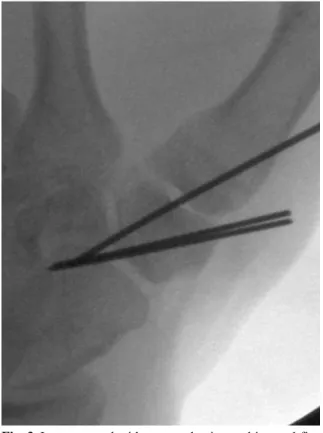
The CMCJ stability was obtained by repair of the ruptured dorsal capsular ligament and additional Kirschner wire fixation (Fig. 3).
The thumb was immobilized in a thumb spica cast for 6 weeks. Routine activities were rec- ommended immediately after removing the cast. The Kirschner wires were removed 8 weeks after surgery. At the 12 months fol- Fig. 3. It was treated with open reduction and internal fix-
ation using two Kirschner wires for the trapezial fracture and repair of the ruptured dorsal capsular ligament and additional Kirschner wire fixation for the CMCJ stability.
Fig. 4. Twelve months postoperative radiographs showed no evidence of post-traumatic arthritic changes at CMCJ of the thumb.
low-up examination, there was no pain or chronic instability. There was no evidence of post-traumatic arthritic changes (Fig. 4).
Discussion
Jones and Ghorbal2 reported fractures of the trapezium account for less than 5% of carpal fractures. The usual classification proposed by Walker et al4. distinguishes between trapezial ridge and body fractures. Most are described as vertical fractures, and only a few cases of oblique fractures have been reported4. Because the CMCJ of the thumb is important structure in the performance of strong pinch and grasp, it is believed that anatomical reduction and rigid fixation for the fractures of trapezium is indicated to pro- vide the earliest restoration of motion with the least possibility of subsequent traumatic arthritis5. Of course, conservative treatment may be successful in non-displaced fractures.
However many authors advocated open reduc- tion and internal fixation was the treatment of choice that provided a satisfactory outcome for these fractures4,6-8.
The injury mechanism of the thumb CMCJ dislocation associated with the trapezial frac- ture is believed to originate from an axial load on a flexed thumb metacarpal that dri- ves the metacarpal base dorsally over the trapezium3,8. It was suggested if the thumb metacarpal is fully flexed, the impact results in a dorsal dislocation or dorsal CMCJ liga- ment disruption. However, if the flexion is minimal, a thumb metacarpal base strikes the trapezium producing a trapezial fracture.
At this point, the fracture line is a vertical one and the lateral fragment which is con- nected to the first metacarpal is often sub- luxated proximally and radially in most cases4. In our case, a dislocation of the thumb CMCJ and an oblique fracture of the trapezium which were unique combination of injuries occurred simultaneously.
The CMCJ dislocation of the thumb associ-
ated with a fracture of the trapezium was first described by Brunelli et al9. in 1989.
They treated by open reduction and internal fixation using a Kirschner wire and recon- struction of the ligament using a slip of abductor pollicis longus tendon. They reported excellent stability and function at 24 weeks follow-up. Tolat and Jones3 reported this in a 14-year-old boy who was treated with closed reduction and cast for 6 weeks. They report- ed a good result but only at the 3 weeks fol- low-up. Mody and Dias8 reported this injury in a 21-year-old man who was treated with open reduction and internal fixation using a Kirschner wire for a trapezial fracture, and a ligament reconstruction using the extensor carpi radialis longus. They reported joint sta- bility at the 24 weeks follow-up. Recently, Parker et al10. reported this injury in a 12- year-old boy who was treated with closed reduction and external fixation. At the 3 years follow-up, the patient demonstrated an excellent range of motion, strength, and no joint instability.
The stability of the thumb CMCJ depends primarily on the anterior oblique ligament.
Stability also relies upon the dorsal capsular ligament. In this case, we performed open reduction and internal fixation using two Kirschner wires for the trapezial fracture.
And repair of the ruptured dorsal capsular ligament and additional Kirschner wire fixa- tion for the CMCJ stability was then per- formed because the anterior oblique ligament was intact. Reconstruction of the ligament should be performed if any instability is noticed after the osteosynthesis7. In our case, the patient demonstrated a normal range of motion, good strength and no joint instability at the 12 months follow-up and no further treatment was necessary. Although the fol- low-up period is too short to allow a comment on the development of post-traumatic arthrit- ic changes, this good result would encourage us to adopt this technique in future cases.
REFERENCES
1) Mueller JJ. Carpometacarpal dislocations: report of five cases and review of the literature. J Hand Surg Am.
1986;11:184-8.
2) Jones WA, Ghorbal MS. Fractures of the trapezium. A report on three cases. J Hand Surg Br. 1985;10:227-30.
3) Tolat AR, Jones MW. Carpometacarpal dislocation of the thumb associated with fracture of the trapezium. Injury.
1990;21:411-2.
4) Walker JL, Greene TL, Lunseth PA. Fractures of the body of the trapezium. J Orthop Trauma. 1988;2:22-8.
5) Cordrey LJ, Ferrer-Torells M. Management of fractures of the greater multangular. Report of five cases. J Bone Joint Surg Am. 1960;42:1111-8.
6) Foster RJ, Hastings H 2nd. Treatment of Bennett, Rolando, and vertical intraarticular trapezial fractures. Clin Orthop Relat Res. 1987;214:121-9.
7) Garavaglia G, Bianchi S, Santa DD, Fusetti C. Trans- trapezium carpo-metacarpal dislocation of the thumb.
Arch Orthop Trauma Surg. 2004;124:67-8.
8) Mody BS, Dias JJ. Carpometacarpal dislocation of the thumb associated with fracture of the trapezium. J Hand Surg Br. 1993;18:197-9.
9) Brunelli G, Monini L, Brunelli F. Stabilisation of the trapezio-metacarpal joint. J Hand Surg Br. 1989;14:209- 12.
10) Parker WL, Czerwinski M, Lee C. First carpal-metacarpal joint dislocation and trapezial fracture treated with exter- nal fixation in an adolescent. Ann Plast Surg. 2008;
61:506-10.
저자들은 대다각골의 사선형 골절을 동반한 무지의 수근중수관절 탈구를 치험하였다. 대다각골의 골절에 대해서는 관혈적 정복 및 두 개의 K-강선을 이용한 내고정을 시행하였고, 수근중수관절의 탈구에 대해서는 파열된 배측피막 인대의 봉합 및 추가적인 K-강선 고정을 시행하였다. 12개월 추시상 통증이나 만성 불안정성은 없었으며, 외상 후 관절염의 소견은 보이지 않았다.
색인 단어: 대다각골, 골절, 무지, 수근중수관절, 탈구 국문초록