https://doi.org/10.21022/IJHRB.2021.10.1.45 High-Rise Buildings
www.ctbuh-korea.org/ijhrb/index.php
The 20
thCentury High-Rise as Heritage:
Notes on a Teaching Experience of the Adaptive Reuse of the Metropolo Hotel in Shanghai
Plácido González Martínez
†College of Architecture and Urban Planning, Tongji University, Shanghai, China
Abstract
The adaptive reuse of 20th-century high-rise architecture poses important questions about the prevalence of authorized discourses in the heritage conservation field. Based on a two-year teaching experience at Tongji University about the adaptive reuse of the Metropolo Hotel (Palmer and Turner, 1934), an iconic historic high-rise building in the Shanghai Bund area, this paper will show the extent to which disciplinary and urban authorized heritage discourses are present in the development of design and representation strategies in adaptive reuse. Using discourse analysis as a method, this paper will make the argument that disciplinary discourses have a limited effect in the practice of adaptive reuse, which is perceived as a fundamentally creative activity. At the same time, the paper reveals how urban discourses have a much more lasting effect, confirming the intimate links between adaptive reuse and the wider phenomena of beautification and gentrification of high-rise listed areas.
Keywords: 20th-Century Heritage, Adaptive reuse, Authenticity, Authorized heritage discourse, Shanghai high-rise
1. Introduction
This paper explores the cultural dimension of the adaptive reuse of high-rise buildings in a historical context, using an architectural education experience at Tongji University as an example. Adaptive reuse belongs to a lively discussion in the heritage conservation field, as it has a variety of implications. Even if it would be normally met with object-centered, functional and aesthetic criteria, when applied to heritage buildings, it necessarily incorporates strong contextual associations (Pendlebury et al., 2018).
This situation is even more exacerbated in the case of high-rise heritage buildings. An outcome of real estate entrepreneurialism, the pragmatic nature of the high-rise was accompanied, from the very beginning, with an iconic impact. This impact not only characterized the buildings, but also whole urban areas and cities where they were located, due to the production of a distinctive skyline.
The development of heritage conservation in the last quarter of the 20th century and the first two decades of the 21st century has seen how high-rise urban areas have become objects of protection. Considered as beholders of urban identity, we argue that their impact has been re- signified according to authorized heritage discourses (Smith, 2006). According to Smith, “this discourse takes its cue from the grand narratives of nation and class on the one hand, and technical expertise and aesthetic
judgement on the other” (Smith, 2006: 11), determining design strategies and re-significations in the adaptive reuse of high-rise buildings in two ways:
- Firstly, through the production of conservation doctrines, according to which distinct approaches should be applied to recent heritage, due to its unique material and ideological condition. This has been a position held the framework of international organizations fostering the conservation of modern architecture, such as DOCOMOMO or ICOMOS (2017).
- Secondly, that adaptive reuse should respond to
“useful functions” and “useful aesthetics” (Veldpaus and Fava, 2020) with a positive impact on economic profit and city marketing. These are the common approaches that, from the perspective of city branding, have been greatly conditioning the afterlife of buildings, according to idealized visions of their past, which in turn greatly condition the future (Ashworth & Karavatzis, 2011).
As we will argue, both authorized discourses are embedded in daily architectural practice and education, and require an evaluation from a critical perspective in order to acknowledge the complexity of heritage as a process. The Bund area in the historic downtown of Shanghai constitutes a unique example of this. Political shifts throughout the 20th century motivated dramatic changes in the Bund’s valorization: before the Japanese invasion in 1937, it hosted the highest concentration of high-rise structures in Asia, only to became neglected after 1949, due to its symbolic associations with its capitalistic past. The political, economic and social changes of the 1980s motivated a re-appreciation
†Corresponding author: Plácido González Martínez E-mail: [email protected]
of the Bund, which became paradigmatic of Shanghai’s modern past acting as a reference for the future.
In light of these significant functional, social and material changes, this paper will use the case of the Metropolo Hotel as a means to analyze the influence of authorized heritage discourses about the building and the area, which inform heritage design proposals in an academic context.
This paper will pose the following questions: How do authorized heritage discourses influence the adoption of criteria in the adaptive reuse of historic high-rise buildings? What are the means through which these discourses are reflected in design and representation strategies? To what extent does an academic experience inform new approaches to the adaptive reuse of high-rise buildings in the heritage conservation debate?
This paper develops a discourse analysis of the design proposals developed in the framework of the Arch Design Studio II “Highrise Heritage: The Adaptive Reuse of a 1930s Skyscraper in Shanghai”, developed at Tongji University’s College of Architecture and Urban Planning (CAUP) in 2018 and 2019. The qualitative approach of the analysis does not aim for an academic re-evaluation of the proposals, which were already externally reviewed and graded. It instead focuses on the narratives such proposals developed, either through explicit design orientations (mainly referring to the re-use functionality and aesthetic concerns) and architectural means (materiality and technological issues); or through means of representation (typography, graphic techniques), with the aim of exploring how these narratives aligned or challenged authorized discourses in the adaptive reuse of high-rise structures in a heritage- listed area.
The paper will elaborate on the notion of adaptive reuse from a critical heritage perspective, applied to historic high-rise structures. Such purpose will be contextualized in recent debates on the conservation of 20th-century heritage and the incorporation of contemporary architecture in historic environments. The analysis of adaptive reuse proposals for the Metropolo Building will offer the opportunity to envision different heritage futures for the building and the area. The final outcome will be a critical vision on the current transformations in the Bund area, as part of the broader purpose of image construction for Shanghai in the 21st century. With this, the paper aims to serve educators and designers, helping to raise awareness about the role of authorized discourses, and inform about the possibilities of endorsing or challenging such discourses through design and representation means.
2. Literature Review
2.1. The authorized heritage discourses around 20th century heritage and the conservation of high-rise architecture
Debates on the conservation of 20th century architecture since the 1980s have been stirred by international organizations’
doctrine, producing authorized heritage discourses, which are subject to strong political, economic and social interests.
Even if the approach to 20th-century heritage conservation given by international organizations like ICOMOS, DOCO- MOMO or the Getty Conservation Institute (MacDonald and Ostergreen, 2011) has aimed for the objective charac- terization of a scientific notion of progress, this objectivity derives mainly from particular historical constructions belonging to a Western perspective.
This discussion has been complicated, as from an architectural perspective, 20th century and modern architecture is defined as distinct from other ages, requiring specific heritage approaches. Material and ideological considerations supporting this idea have been taken regarding, mainly, the short life span of modern buildings, and their rapid material and functional obsolescence (Prudon, 2017).
Greater complexity comes from the special consideration towards the individual architect’s “genius” and the prevalence of the “intention of the author” in heritage interventions (Hammer, 2020), which has proven controversial, even when the same authors have intervened in their previous work (Dias Comas, 2018). Even if these positions have been contested from the field of restoration as lacking solid fundamentals (Salvo, 2015), they have endured, informing the formulation of international conservation doctrines (ICOMOS, 2017).
Discussions about the specific realm of modern high- rise buildings intensified at the end of the 1990s (Prudon, 1998), revealing specific matters like the prevalence of
“coreism” over “façadism,” as a reverse of traditional conservation discussions. The restorations of the Lever House in New York and the Pirelli Building in Milan showed the complexities of this debate (Stephens, 2003;
Pergoli Campanelli, 2014), especially when addressing the notion of authenticity from visual or material perspectives.
Moreover, recent contributions on adaptive reuse (Pendlebury et al., 2018) have highlighted how this practice is intertwined with a re-signification of the heritage assets.
This re-signification is both informed by, and characterizes, the areas where the assets are located, beyond a mere object- centered consideration, and requires specific attention for the case of high-rise buildings, due to their iconic significance.
2.2. Authorized discourses in the conservation of high- rise historic environments
These debates add to the production of authorized heritage discourses about the conservation of historic environments. The long heritage discussions between the
“old” and the “new” have intensified in the context of rapid urban development since the end of the century, giving way to the 2005 Vienna Memorandum (UNESCO, 2005) and the Recommendation on Historic Urban Landscape (UNESCO, 2011). Both doctrinal documents refer to the many dimensions – social, economic, and cultural – that inform
the practice of architecture in historic environments, aiming with great ambition for an encompassing inclusiveness.
But by doing so, they set aside the fundamental question of urban authenticity, which becomes subject to mainly touristic interpretations (Zukin, 2010; González Martínez, 2016).
These questions are particularly controversial in the recent interest on the listing of high-rise areas. For instance, the report supporting the inclusion of the early Chicago skyscrapers in the UNESCO World Heritage Tentative List reveals a linear understanding of history, highlighted by mentions of inventiveness, innovation and newness1. The attempt to apply such narratives of linear progress in other non-Western contexts like the Shanghai Bund area risk overlooking the immense shifts in the appreciation of historical events and their manifestation in the built environment (Denison and Ren, 2006).
Even if in recent years the adaptive re-use of buildings like the East China Electric Power Building have stirred a debate about the new identity of the Bund (Liu and Hua, 2018), the debate still needs to be extended to the re-use of buildings from Shanghai’s “Golden Era.”
Particularly when considering the possibility of applying the methodologies developed by UNESCO in recent years in the Recommendation on Historic Urban Landscape, which aim to look beyond the immediate touristic or branding interests, and fundamentally, the management of change in historic areas, with consideration to other pressing issues like poverty reduction, housing and gentrification (UNESCO, 2011).
3. Method
Our thesis is that architectural education offers opportunities to test adaptive reuse possibilities beyond authorized heritage discourses, enabling students to evaluate the heritage asset and elaborate consequent intervention criteria. This paper aims to confirm such hypotheses, developing a discourse analysis of the design proposals developed by the students for the case study, a high-rise building in the Shanghai Bund area dating from the 1930s. This discourse analysis points towards evidence of re-signification based on:
- Architectural and urban factors (materiality, volume, façade, position, height, use);
-The graphic and textual presentation and communication of adaptive reuse ideas (means of architectural represen- tation; explanatory texts; typography).
The design courses, developed in two consecutive years, lasted for 17 teaching weeks. Contents included a kick- off guided site visit, plus a series of lectures on heritage conservation, high-rise architecture in Shanghai, and the history of the Bund area. Course assignments aimed to give the students free rein to define the continuity or the introduction of alternative uses; propose demolitions, additions or extractions. Interventions needed to respond to the values identified by the students, both in the building and in the setting, with the final goal to intensify the building’s character and contribute to what could be identified as the new identity of the area.
In total, 13 proposals were developed in two consecutive
Figure 1. Satellite image showing the Waitan (Bund) Cultural and Historical Listed area (1) and the location of the Metropolo Hotel (2). Source: Google Earth / Plácido González Martínez.
years, 2018 and 2019. This study initially aimed to incorporate the design proposals from the 2020 academic year, but the course was finally cancelled, due to the COVID epidemic situation. Our analysis does not aim to focus on the teaching evaluation of the proposals, but on the design and representation tools put in practice to develop a new narrative for the heritage asset, and to what extent the developed narratives adhere to or contest authorized heritage discourses for the conservation of 20th century architecture and the Shanghai Bund area.
4. Case Study and Proposals
The case study incorporates a double heritage consi- deration: The Metropolo Building has been a heritage- listed element by the Shanghai Municipality since 2005, located at the core of Waitan, one of Shanghai’s 12 Cultural and Historical Listed Areas passed in 2003 (see Figure 1). Considered the greatest concentration of high- rise buildings in Asia during the first third of the 20th Century, the Waitan (also called “Bund”) experienced a controversial history of re-significations later in the century.
After 1949, memory ties with capitalism motivated the functional change of the area, from business to adminis- trative district, together with the incorporation of residential use in former office buildings. From the 1980s onwards, the new economic policies and the rise of Shanghai as a global city motivated a partial recovery of the original commercial and representative functions of Waitan, yet still facing the difficulties of a high degree of dereliction in the area.
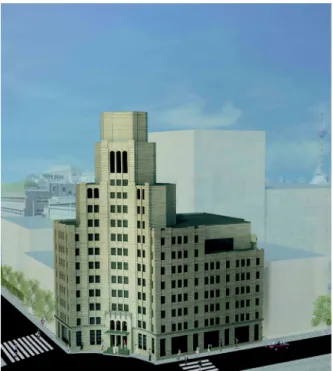
Located at the intersection of Fuzhou Road and Jiangxi Middle Road, the Metropolo Hotel was designed by Palmer and Turner in 1931 (see Figure 2). Due to its iconic character, it is considered as representative of the heyday of high-rise construction in Shanghai during the 1920s and 1930s (Denison and Ren, 2006: 135). Benefitting from a significant urban position, it became an icon in the downtown. Its Art Deco architectural style and composition is representative of the cultural connections between Shanghai and other international metropolises (Wakeman, 2019). Subject to a recent refurbishment in 2012, its function complements the business character of the area, and has remained unchanged since the construction of the building (see Figure 3).
The design proposals approached the building without being subject to budgetary or heritage regulation restrictions.
The students had previous education experience in architectural heritage conservation. They were free to determine the continuity or the incorporation of new uses, starting from an analysis of the intrinsic capacities of the building itself, and of the area. Decisions on the design:
use, materiality, volume, and position of the proposals were subject to review with the course instructor, plus the comments from external reviewers in the mid-term and final reviews. Students had free rein to decide the means of representation: models, renderings, plans, typography and supporting texts. Even if design and representation are completely intertwined, our analysis distinguishes between those aspects related to the disciplinary discourse, which would mainly rest on the design, and those related to heritage narratives in the area, which would rest on
Figure 2. Sketch of Hamilton House (center) and Metropolo Hotel (left), with the Commercial Bank of China under construction (right). Source: Denison and Ren, 2005.
both the design and the means of representation.
The 13 proposals are classified according to Tables 1 and 2. Table 1 reflects on the main design decisions taken by the students, referring mainly to the use, materiality, and changes in the building that enable the introduction of new functions (see Table 1). Table 2 brings together different dimensions of representation that build and contribute to the overall narrative (see Table 2).
The overall analysis of the design and representation proposals reveals common patterns of design and attitudes towards the pre-existing structure, as follows:
4.1. Design Determinations
- Use: Most of the designs propose a continuation of the use as hotel, incorporating new functions. These new functions are mainly cultural and offices, which correspond to a turn towards the service economy in the area. Only two incorporate “social” functions which could be considered besides the quest for entrepreneurial profit, which theoretically, would demand governmental participation. Only four proposals considered a complete change of use as cultural, community and co-working spaces.
- Materiality: In general, design proposals respected the materiality of the original building, and most of them established a principle of contrast with the pre-existing Figure 3. The Metropolo Hotel today. Source: Plácido
González Martínez.
Table 1. Design principles applied by the authors. Source: Plácido González Martínez
Table 2. Means of representation used by the authors. Source: Plácido González Martínez
conditions in their new interventions (see Figure 4).
This contrast relied on the use of light materials, following established heritage conventions about the relationship between old and new elements (see Figure 5). Only one proposal used the same stone cladding of the original building.
- Height: All design proposals respected the height of the original building, with small increases in two of the proposals that incorporated additions (see Figures 6 and 7). The only proposal with a remarkable height for the new extension (21 floors) justified the increase by means of visual cone analysis, which was checked from the street level.
- Intervention strategies (extension, addition, extraction):
Light additions were the preferred strategy for more than 50% of the proposals (see Figure 8); extraction was the second preferred option (see Figure 9), due to its ‘less visible’ character. Only three proposals in- corporated extensions, but always expressing respect for the balance of visual relations in the area.
Figure 4. Material continuity proposed by students for the addition atop the building (Authors: Youngran Seo and Florian Hirschel). Source: Plácido González Martínez.
Figure 5. Light construction principles proposed by students for the addition atop the building (Author: Yipeng Feng). Source: Plácido González Martínez.
Figure 6. New high-rise extension, with setbacks for visual impact control (Author: Fabian Kitzberger). Source:
Plácido González Martínez.
Figure 7. Rooftop addition and extraction strategies (Author: Donglin Liu). Source: Plácido González Martínez.
4.2. Representation
- Texts were incorporated on a regular basis. Out of the 13 proposals, three did not incorporate explanatory texts, and relied exclusively on the graphic description.
Those who did, elaborated on different perspectives:
three followed the authorized heritage discourses on Shanghai’s heyday in the 1930s, whereas the rest elaborated on the proposals from a strict design strategy perspective.
- Models were predominantly digital, with no specific references to the historic character of the area (see Figure 10). They aimed for the objectivity of represen- tation, without the introduction of new narratives.
Only one proposal incorporated a real physical model developed in clay (see Figure 11), which, according to the author, was considered as a reference to the massive nature of the original building.
- Renderings were mostly developed in a digital format, and were neutral in their representation. Surprisingly, renderings did not incorporate special historical features.
Figure 8. Light addition strategy (Author: Giovanni Bertocchi). Source: Plácido González Martínez. Figure 9. Extraction strategy, including the demolition of intermediate floor slabs (Authors: Louisa Wenkemann and Sebastian Seibert). Source:
Plácido González Martínez.
Figure 10. Virtual model representation (Author: Isabella Contu). Source: Plácido González Martínez.
Figure 11. Clay model (Author: Louise Huba). Source:
Plácido González Martínez.
Only two of the representations were deemed to elaborate on historic discourses: the only non-digital representation, which was elaborated in watercolor, referred to the heyday of Art Deco (see Figure 12);
whereas one of the digital representations elaborated on the “Gotham” iconography that symbolically linked Shanghai with New York City in the 1930s (see Figure 13).
- Plans were developed digitally in all proposals. The representation was completely pragmatic, incorporating no distinctive features.
- Typography was neutral for most of the cases.
Significantly, four proposals incorporated Art Deco
“streamlined” font types, which linked the representation to established references of visual identity from the 1930s.
5. Discussion
The study of the proposals shows that in general, all express an idea of “respect” towards the building. This respect implies that neither design or representations challenge the conventional principles of heritage conservation referring to use, materiality and transformations (ICOMOS, 1964). Nevertheless, we could detect significant examples of a deviation from established authorized heritage discourses, both in the architectural heritage field and in the characteri- zation of the area, that indicate possible avenues for research and design.
In general, design proposals ignored the prevalent disciplinary discourses on the singularity of 20th century architecture. Specific material, or technical responses to the built substance of the building avoided to characterize it differently from any other historic heritage asset. The weight of hypothetical “intentions of the author,” which apply for the conservation of the work of great masters of Modern architecture, was not considered determinant by any of the proposals. Certainly, this could be due to the relative lack of information about the firm of Palmer and Turner, far from the widespread acknowledgement of Figure 12. Watercolor representation (Author: Louise Huba).
Source: Plácido González Martínez.
Figure 13. “Dark” Gotham iconography (Author: Donglin Liu). Source: Plácido González Martínez.
architects like Laszlo Hudec in the city. Furthermore, the students argued that the pragmatic nature of 1920s architecture in Shanghai did not require intensive study of the determining role of authorship in this case.
The notion of authenticity relied on the attention to conservative discourses, which have a predominantly visual inspiration. In this sense, the concern of the proposals to maintain the visual and material relationships with the pre-existing building were manifest. Even the most impacting decisions, like additions, were limited in height, and for cases where high extensions were planned, the total height was limited by visual considerations. The second preferred strategy of extraction and interior demolitions, being intrinsically aggressive, remained concealed behind the apparent protective symbolic shield of the building façade.
We consider that the material and functional treatment of the building, together with the representation, aligned with authorized heritage discourses produced for the area in a significant proportion of the proposals. Consistently disseminated through the narratives of official cultural institutions like the Waitan History Exhibition Hall, these authorized discourses privilege the attention towards the 1920s and 1930s as representative of the city’s entrepreneurial and cosmopolitan spirit (González Martínez, 2020).
Accordingly, only five out of the 13 proposals were lacking any references to the stereotypes of Art Deco, or the 1930s. The other eight, which elaborated on authorized heritage discourses for the area, did so with different intensities. Still, it should be highlighted that none of the proposals could be described as a complete nostalgic re- enactment of the building as it stood in bygone eras;
therefore, “adaptive reuse” acts as conscious assemblage, catering to the future of the city (Lagerqvist, 2010).
The proposals show the clear impact of recent calls of adaptive reuse to go “beyond the object” and highlight the effects in area regeneration. Even though, the reach of these effects failed to be acknowledged with the extent and complexity that the UNESCO HUL Recommendation has claimed for, especially in the social dimension (UNESCO, 2011). Only two of the 13 proposals focused on social issues that challenged the current status quo: the problem of homelessness for example, even being less widespread in Shanghai than in American cities, was raised by one of the students; whereas the possibility of incorporating the topic of the highly mobile, migrant population of Shanghai that live in the area was proposed by another one.
In this sense, we may also argue that the choices for new functions continue adding to the new developmental narratives that characterize the Waitan protection area (Zhu, 2020). Office space, touristic and leisure facilities, all high-end representational spaces, are part of the new program of the Bund, implying the end of the popular residential reuse of former office and administrative buildings which has continued since the 1950s. The shift is illustrative of a deep clash in the two different definitions of authenticity that apply in the heritage conservation
field in China. According to Zhu (2015), the calls for a return to an “original” state implicit in the notion of yuanzhenxing would imply the recovery of the original functions, therefore favoring the gentrification of the area.
On the other hand, the acknowledgement of the different historic stages in the Bund, including the collectivization of its high-rise architecture, would constitute the different
“objective” interpretation of authenticity called zhenshixing.
But this seems to be the less-favored option in official discourses, as reflected in the design decisions taken in our case studies.
6. Conclusions
The analysis of the design proposals shows that authorized heritage discourses are embedded in the context in which students develop their creative responses. Nevertheless, the two main discourse types, both disciplinary and urban, have diverging effects. The influence of authorized heritage discourses at an urban level clearly determined a significant number of the proposals, leading to the confirmation of the established dynamics of change towards fundamentally office and commercial uses. Furthermore, design decisions aimed, in general, to contribute to a harmonious, balanced conception of the urban heritage space.
On the contrary, the authorized heritage discourses that inform the discipline had a very limited effect. Despite the characterization of the diversity of approaches in the course content, most of the proposals ignored the calls for a distinct approach to 20th-century heritage that most international organizations have called for since the 1980s. The students’ choices aligned with those defended from the Italian school of restoration (Carbonara, 2015;
Salvo, 2015), which aim to synthesize the adaptive reuse of high-rise architecture with the approaches to any kind of historic building.
The authorized heritage discourses were manifest in the proposals at the level of design strategies and representation.
As the impact of disciplinary discourses is considered limited, the focus on the urban ones reveals a richer variety of attributes. In this sense, the means of representation reflected the students’ awareness and contribution to authorized heritage discourses to a great extent. Only one proposal contested these narratives, significantly, through the design strategy, rather than by means of representation.
This academic experience on the adaptive reuse of high-rise buildings reveals the important relationship between intervention in heritage assets and the process of re-signification of historic areas. There are some limitations to be highlighted in this study, such as the decision to set aside heritage regulations that apply in area listings. Even so, we consider that the possibility of negotiation on listing determinations in a development-led context like Shanghai enables a greater diversity of design orientations.
The performed analysis reveals a fundamentally visual
approach to the definition of intervention criteria, which results from a limited interpretation of heritage and urban authenticity. Taken to the debate on authenticity in China, this position aligns with a declared intention of return to an “original” state embedded in nostalgic narratives. This nostalgia determines not only aesthetic decisions, but more influential ones such as the choice of new uses, triggering commercial and residential gentrification. It is a nostalgia that is, nevertheless, oriented towards the future:
a sanitized, cosmopolitan, sophisticated image of Shanghai as a global city of the 21st century.
References
Ashworth, G. J., and Kavaratzis, M. (2011). “Why brand the future with the past? The role of heritage in the construction and promotion of place brand reputations”.
In International Place Branding Yearbook, edited by F.
Go and R. Govers, pp.25-46. Palgrave MacMillan, London, UK.
Carbonara, G. (2015). “An Italian view on architectural and archaeological conservation”. Frontiers of Architectural Research, 4 (2), pp.79-80. https://doi.org/10.1016/j.foar.
2015.03.006
Denison, E., and Ren, G.Y. (2006). Building Shanghai. The Story of China’s Gateway. Wiley, Chichester, UK.
Dias Comas, C.E. (2018). “Heritage agencies and the conservation of Brazilian modern masterpieces: A partial report”. Built Heritage, 2, pp.35-49. https://doi.org/10.
1186/BF03545692
González Martínez, P. (2016). “Authenticity as a challenge in the transformation of Beijing's urban heritage: The commercial gentrification of the Guozijian historic area”.
Cities, 59, pp.48-56. https://doi.org/10.1016/j.cities.2016.
05.026
González Martínez, P. (2020). “Curating the selective memory of gentrification: The Wulixiang Shikumen Museum in Xintiandi, Shanghai”. International Journal of Heritage Studies (in press). https://doi.org/10.1080/13527258.2020.
1821237
Hammer, I. (2020). “White, everything white? Josef Frank’s Villa Beer (1930) in Vienna, and its materiality in the context of the discourse on ‘white cubes’”. Built Heritage, 4, pp.35-49. https://doi.org/10.1186/s43238-020-00011-9 ICOMOS (1964). International Charter for the Conservation
and Restoration of Monuments and Sites. [Online] <http:/
/www.icomos.org/charters/venice_e.pdf> [Accessed 2.9.2020]
ICOMOS (2017). Approaches to the conservation of Twentieth-Century cultural Heritage Madrid – New Delhi Document 2017. [Online] <http://www.icomos-isc20c.
org/pdf/madrid-new-delhi-document-2017.pdf>
[Accessed 2.9.2020]
Lagerqvist, A (2010). “The future is here: Media, memory and futurity in Shanghai”. Space and Culture, 13 (3), pp.220-238. https://doi.org/10.1177/1206331210365247 Liu, J., Hua, X. (2018). “The transition of Chinese
conception of architectural form. Thirty-year controversy of East China Electric Power Building”. Time and
Architecture, 2018/6, pp.54-57. DOI:10.13717/j.cnki.ta.2018.
06.010 (in Chinese)
MacDonald, S. and Ostergren G. (2011). Developing an Historic Thematic Framework to Assess the Significance of Twentieth-Century Cultural Heritage. The Getty Conservation Institute, Los Angeles, USA. http://www.
getty.edu/conservation/publications_resources/pdf_publications/
developing_historic.html [Accessed 2.9.2020]
Pendlebury, J.; Wang Y.-W. and Law, A. (2017). “Re-using
‘uncomfortable heritage’: the case of the 1933 building, Shanghai”. International Journal of Heritage Studies, 24:3, pp.211-229. DOI: 10.1080/13527258.2017.1362580 Pergoli Campanelli, A. (2014). “Restoration of the façade of
the Pirelli skyscraper in Milan and the repair of damage to reinforced concrete structures caused by a plane crash:
An example of critic conservation”. Frontiers of Architectural Research, 3 (2), pp.213-223. https://doi.org/10.1016/j.
foar.2014.03.005
Prudon, T. (1998). “Restoring 20th Century Skyscrapers in New York: Woolworth Building, Chrysler Building, Lever House”. ICOMOS - Hefte des Deutschen Nationalkomitees, 24. https://doi.org/10.11588/ih.1998.0.21708
Prudon, T. (2017). “Preservation, design and modern architecture: the challenges ahead”. Journal of Architectural Conservation, 23:1-2, pp.27-35, DOI: 10.1080/13556207.
2017.1327193
Salvo, S. (2015). “Conservation and modern architecture.
Fortune and misfortune of the School of Mathematics at Rome University (G. Ponti, 1932-1935)”. Frontiers of Architectural Research, 4 (3), pp.186-201. https://doi.org/
10.1016/j.foar.2015.03.004
Smith, L. (2006). Uses of Heritage. Routledge, London, UK.
Stephens, S. (2003). “Analysis: The restoration of New York City's Lever House is not so same-old-same-old, as architects SOM and William T. Georgis demonstrate”
Architectural Record, 191(3), pp.122-128.
UNESCO. 2005. Vienna Memorandum on “World Heritage and Contemporary Architecture - Managing the Historic Urban Landscape” and Decision 29 COM 5D. [Online]
<https://whc.unesco.org/archive/2005/whc05-15ga-inf7e.pdf>
[Accessed 2.9.2020]
UNESCO. 2011. Recommendation on the Historic Urban Landscape. [Online] <http://whc.unesco.org/en/activities/
638> [Accessed 2.9.2020]
Veldpaus, L. and Fava, F. (2020). “The ethics and aesthetics of adaptive reuse”. Presented at the Association of Critical Heritage Studies 5th Biennial Conference 2020, London.
Wakeman, R. (2019). “Shanghai and New York: Mid- century urban avant-gardes”. Built Heritage, 3, 49-61.
https://doi.org/10.1186/BF03545743
Zhu, Y. (2015). “Cultural effects of authenticity: contested heritage practices in China”. International Journal of Heritage Studies, 21:6, pp.594-608, DOI:10.1080/13527258.
2014.991935
Zhu, Y. (2020). “Is colonial heritage still different? Heritage making of the Bund in Shanghai”. Presented at the Association of Critical Heritage Studies 5th Biennial Conference 2020, London.