JCN
Open Access236 Copyright © 2016 Korean Neurological Association
Malignant Posterior Reversible Encephalopathy Syndrome:
A Case of Posterior Irreversible Encephalopathy Syndrome
Dear Editor,
Posterior reversible encephalopathy syndrome (PRES) is a clinicoradiologic syndrome characterized by predominant parietal and occipital lobe edema that is mainly reversible within a few days.1,2 However, many atypical patterns have been identified.3 Reversibility is not always achieved,3 which exposes a contradiction in this supposedly benign entity. We report the case of a 14-year-old patient who presented with classical signs of PRES, but whose condition evolved into a malignant phenotype.
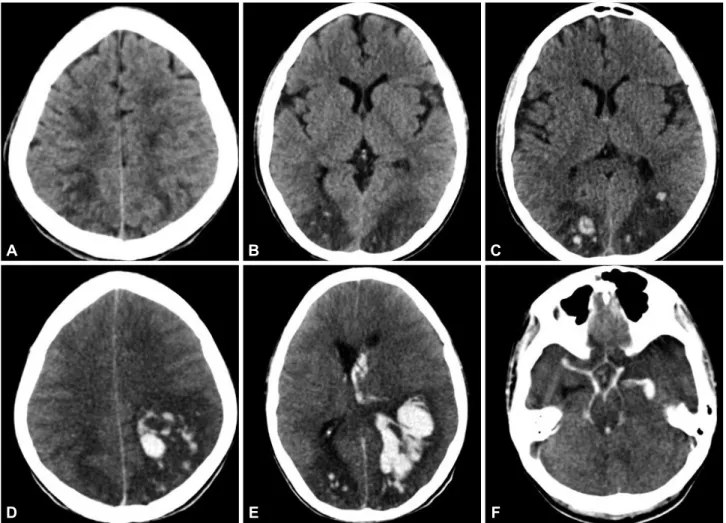
A 14-year-old patient received a renal transplant from a cadaveric donor and took tacroli- mus, corticosteroids, and antithymocyte immunoglobulin. On the third day, his renal func- tion had not improved and hemodialysis was started. He then immediately developed head- ache, vomiting, and experienced a tonic-clonic seizure. His blood pressure (BP) peaked at 240/150 mm Hg. Brain CT revealed bilateral edema in the parieto-occipital regions associ- ated with a small hemorrhagic transformation, representing PRES (Fig. 1A, B, and C). Lab- oratory tests revealed thrombocytopenia (66,000/μL) and elevated serum creatinine (2.52 mg/dL). Tacrolimus was suspended and sodium nitroprusside was administered, which fully controlled his hypertension.
On the following day his BP was 147/90 mm Hg but his neurological function had deteri- orated. Follow-up brain CT revealed extensive cortical and white-matter edema associated with parenchymatous, subarachnoid, and intraventricular hemorrhage (Fig. 1D, E, and F).
Brain death was later confirmed, leading to the suspension of life support.
PRES pathophysiology remains a mystery even after almost 20 years since its initial de- scription.1 There are two prevailing hypotheses: cytotoxic and vasogenic.4,5 Eclampsia, renal failure, autoimmune diseases, and chemotherapy treatment and other factors may trigger PRES.1,5 Despite its classically favorable outcome, PRES is associated with direct mortality in 5–15% of cases.6,7 Important prognostic factors within PRES have been suggested, such as the anatomical distribution of edema, hemorrhage, and cytotoxic edema in diffusion-weight- ed imaging sequences, but they have yet to be proven.7,8 Alhilali et al.7 further analyzed the prognostic factors in PRES and found that hemorrhage, even if minor, is the most relevant factor associated with a poor outcome, which may indicate more extensive endothelial dys- function.
Hefzy et al.6 found that hemorrhagic transformation occurred in 17% of PRES cases, mainly small or petechial hemorrhages (<5 mm) and hematomas, but also subarachnoid and intra- ventricular bleeding. The rates found in other studies have varied from 6.4% to 19.4%, with mortality reaching 26–29% in this group.6,7 The precipitating illness is usually severe, and PRES may be only a marker of such severity, but novel reports unveil the malignant evolution of this condition.7,8 Although many terms have been used to describe this event,7 malignant PRES seems to best encompass the permanent neurological damage or even death that sometimes accompanies this endothelial breakdown in the brain.
William Alves Martins Luiz Carlos Porcello Marrone
Department of Neurology, Hospital São Lucas,
Pontifícia Universidade Católica do Rio Grande do Sul (PUCRS), Porto Alegre, Brazil
pISSN 1738-6586 / eISSN 2005-5013 / J Clin Neurol 2016;12(2):236-237 / http://dx.doi.org/10.3988/jcn.2016.12.2.236
Received July 6, 2015 Revised July 13, 2015 Accepted July 16, 2015 Correspondence William Alves Martins, MD Department of Neurology, Hospital São Lucas da PUCRS, Avenida Ipiranga 6690, Sala 220, Porto Alegre, RS 90610-000, Brazil Tel +5551 3320 2760 Fax +5551 3320 2760 E-mail [email protected]
cc This is an Open Access article distributed under the terms of the Creative Commons Attribution Non-Com- mercial License (http://creativecommons.org/licenses/by-nc/3.0) which permits unrestricted non-commercial use, distribution, and reproduction in any medium, provided the original work is properly cited.
LETTER TO THE EDITOR
www.thejcn.com 237
Martins WA and Marrone LCP
JCN
The optimal management of PRES has yet to be elucidat- ed.8 Better outcomes in malignant PRES have been attributed to aggressive neurointensive care, decompressive craniecto- my, and intracranial pressure management.8 These results are promising, but larger studies are needed to confirm the effi- cacy of this approach.
PRES is usually a benign entity; however, it represents a small outlier in the clinical spectrum of this syndrome. A wid- er range of neurological disabilities encompasses this syn- drome and leads to a malignant evolution, suggesting that a good prognosis cannot be assumed with PRES, but rather its occurrence should prompt immediate action to avoid dis- ability.
Conflicts of Interest
The authors have no financial conflicts of interest.
REFERENCES
1. Hinchey J, Chaves C, Appignani B, Breen J, Pao L, Wang A, et al. A reversible posterior leukoencephalopathy syndrome. N Engl J Med 1996;334:494-500.
2. Casey SO, Sampaio RC, Michel E, Truwit CL. Posterior reversible encephalopathy syndrome: utility of fluid-attenuated inversion recov- ery MR imaging in the detection of cortical and subcortical lesions.
AJNR Am J Neuroradiol 2000;21:1199-1206.
3. McKinney AM, Short J, Truwit CL, McKinney ZJ, Kozak OS, Santa- Cruz KS, et al. Posterior reversible encephalopathy syndrome: inci- dence of atypical regions of involvement and imaging findings. AJR Am J Roentgenol 2007;189:904-912.
4. Porcello Marrone LC, Gadonski G, de Oliveira Laguna G, Poli-de- Figueiredo CE, Pinheiro da Costa BE, Lopes MF, et al. Blood-brain barrier breakdown in reduced uterine perfusion pressure: a possible model of posterior reversible encephalopathy syndrome. J Stroke Cere- brovasc Dis 2014;23:2075-2079.
5. Marrone LC, Gadonski G, Diogo LP, Brunelli JP, Martins WA, Lagu- na Gde O, et al. Posterior reversible encephalopathy syndrome: dif- ferences between pregnant and non-pregnant patients. Neurol Int 2014;6:5376.
6. Hefzy HM, Bartynski WS, Boardman JF, Lacomis D. Hemorrhage in posterior reversible encephalopathy syndrome: imaging and clinical features. AJNR Am J Neuroradiol 2009;30:1371-1379.
7. Alhilali LM, Reynolds AR, Fakhran S. A multi-disciplinary model of risk factors for fatal outcome in posterior reversible encephalopathy syndrome. J Neurol Sci 2014;347:59-65.
8. Akins PT, Axelrod Y, Silverthorn JW, Guppy K, Banerjee A, Hawk MW. Management and outcomes of malignant posterior reversible encephalopathy syndrome. Clin Neurol Neurosurg 2014;125:52-57.
Fig. 1. Brain CT in the first presentation. A: Subcortical edema extends to the parietal and frontal region. B and C: Bilateral occipital edema is dem- onstrated, with minor hemorrhagic transformation, suggesting posterior reversible encephalopathy syndrome. D, E, and F: Control brain CT 24 hours later shows extensive intraparenquimatous bleeding (D), associated to intraventricular (E) and subarachnoid hemorrhage (F).
A
D
B
E
C
F