Original Article
The effect of adjuvant hormonal therapy on the endometrium and ovary of breast cancer patients
Ho Sung Kim, Yong Tark Jeon, Yong Beom Kim
Department of Obstetrics and Gynecology, Seoul National University Bundang Hospital, Seongnam, Korea
Objective: To investigate the effect of adjuvant hormonal therapy on the endometrium and ovary of breast cancer patients.
Methods: A retrospective review was performed on the 207 patients who had taken tamoxifen or anastrozole, as adjuvant hormonal therapy after breast cancer surgery between January 2003 and December 2006. Gynecologic surveillance constituted of ultrasonographic exam of the endometrial thickness and ovarian cyst formation. The patients were classified into three groups and analyzed; premenopausal/postmenopausal women receiving tamoxifen and women receiving anastrozole.
Results: Mean duration of follow up?was 20.6±6.6 months. There was no difference of mean endometrial thickness before hormonal therapy among the three groups (p=0.327). In women receiving tamoxifen, the endometrium was continuously thickened in proportion to the duration of the therapy irrespective of menopausal status while it remained unchanged in women receiving anastrozole (p<0.05). Endometrial biopsies were performed in 28 patients receiving tamoxifen. The most common histologic finding was proliferative endometrium in premenopausal women (7/21) and atrophic endometrium in postmenopausal women (6/7). There was no case of endometrial cancer in both groups. Ovarian cyst was found in 32 women and the most were developed in premenopausal women receiving tamoxifen (30/32). All of them showed benign nature on transvaginal ultrasonographic findings.
Conclusion: Women undergoing adjuvant hormonal therapy after breast cancer surgery exhibited changes in the endometrium and ovary. However most changes were not a serious problem in this study and frequent gynecologic surveillance in these patients needs further investigation.
Key Words: Breast cancer, Tamoxifen, Anastrozole, Endometrium
Received October 27, 2008, Revised November 17, 2008, Accepted November 18, 2008
Address reprint requests to Yong Beom Kim
Depatrment of Obstertics and Gynecology, Seoul National University Bundang Hospital, 300, Gumi-dong, Bundang-gu, Seongnam 463-707, Korea
Tel: 82-31-787-7253, Fax: 82-31-787-4054 E-mail: [email protected]
INTRODUCTION
Breast cancer is the most common cancer in women that is a major cause of morbidity and mortality, with more than 1 mil- lion new cases and 410,000 deaths reported worldwide each year.1,2 The primary aim of treatment for early or advanced breast cancer is to maximize therapeutic effect and prevent re- currence through primary surgery followed by adjuvant ther- apy including chemotherapy, irradiation, or hormonal therapy.
In recent decades, tamoxifen, the selective estrogen receptor modulator, has been the standard regimen of adjuvant hormo- nal therapy for estrogen receptor (ER) positive breast cancer in both pre- and post-menopausal women. Although tamox-
ifen is an ER antagonist in breast cancer, which reduces the breast cancer recurrence rate and mortality rate,3 it also acts as an ER agonist in other tissue such as the endometrium and ovary. This agonist effect can stimulate proliferation, which increases the risk of polyps, hyperplasia, endometrial cancer, and ovarian cyst formation.4-7
Aromatase inhibitors (AIs) such as anastrozole have been found to be at least as effective as tamoxifen in the treatment of postmenopausal women suffering from ER-positive breast cancer.8,9 Estrogen ablative therapy with anastrozole may not only be effective in the treatment of breast cancer, but may al- so be beneficial in reducing the risk of other estrogen-depend- ent diseases.
The aim of this study was to investigate the effect of tamox- ifen and anastrozole on the endometrium and ovary in women undergoing adjuvant hormonal therapy after breast cancer surgery.
MATERIALS AND METHODS
Between January 2003 and December 2006, 207 women
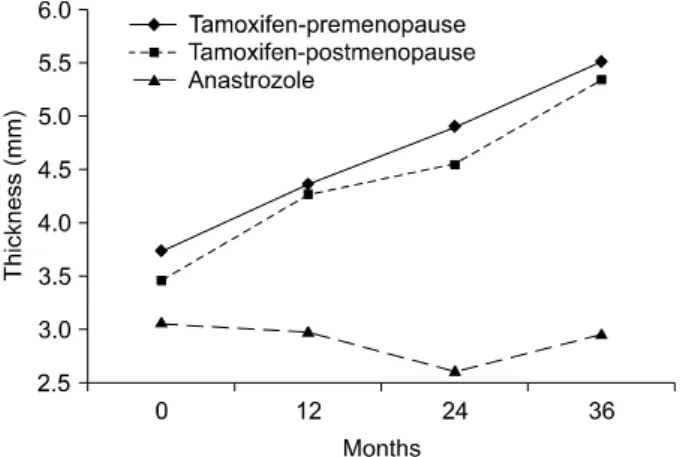
Fig. 1. Changes of endometrial thickness during adjuvant hormonal therapy after breast cancer surgery (p<0.05).
Characteristics
Tamoxifen user
Arimidex user
(group 3) p value
Premenopause (group 1)
Postmenopause (group 2) Number of patients
Age (year)
Duration of follow up (month) Endometrial thickness (mm)
155 41.7±5.6 20.9±7.8 3.72±1.92
32 56.1±7.8 19.9±6.7 3.45±1.09
20 53.0±7.4 20.1±5.6 3.06±0.24
- - NS NS NS: not significant
Table 1. Patient’s characteristics
with ER-positive, primary breast cancer, who were receiving adjuvant tamoxifen or anastrozole treatment more than one year after surgery were included in this study. These women were identified by retrospective review of their medical re- cords and classified into three groups; 155 premenopausal women receiving tamoxifen (group 1), 32 postmenopausal women receiving tamoxifen (group 2), and 20 post- menopausal women receiving anastrozole (group 3). All pre- menopausal women received adjuvant chemotherapy before tamoxifen therapy. Tamoxifen was administered 20 mg/day and anastrozole was administered 1.0 mg/day. The post- menopausal status was defined as an amenorrhea duration of more than 1 year or serum FSH (follicular stimulating hor- mone) levels of >40 mIU/ml before primary surgery.
Endometrial and ovarian evaluation was performed by Transvaginal Ultrasonography (TU) before the start of hor- monal therapy and the changes were periodically measured by TU at an interval of 6 or 12 months. All patients underwent TU assessment of the endometrial lining by measuring the maximum thickness from the outermost limits of endo- metrial-myometrial juncture. A double-layered endometrial stripe subsequently measuring more than 5 mm at a periodic checkup was considered abnormal and an endometrial biopsy was performed. Ovarian cysts were identified as sonolucen- cies in the ovary with a diameter of >30 mm in all women.
All statistical analyses were performed using SPSS 15.0 for Windows. Comparative analyses were performed with Kruskal Wallis test, Mann-Whitney U-test, Chi-square test and Fisher's exact test. Continuous variables were presented as mean and standard deviation. Only p-values <0.05 were considered significant.
RESULTS
The mean age of the three groups was 41.7±5.6, 56.1±7.8, and 53.3±7.4 years, respectively. The mean duration of fol- low-up was 20.6±6.6 months (range, 12 to 36). There was no difference of mean endometrial thickness before hormonal therapy among the three groups (3.72±1.92 vs. 3.45±1.09 vs.
3.06±0.24 mm, Table 1).
The endometrial thickness was continuously increased in proportion to the duration of receiving tamoxifen from 3.72±
1.92 and 3.45±1.09 at baseline to 4.35±2.50 and 4.26±2.15 after 1 year, to 4.89±2.73 and 4.54±1.77 after 2 years, and to 5.50±3.07 and 5.33±2.94 after 3 years in group 1 and group 2, respectively, while it remained <5 mm in group 3 treated with anastrozole for 3 years (p<0.05) (Fig. 1).
Endometrial biopsies were performed for 28 women receiv- ing tamoxifen in whom endometrial pathology suspected; in group 1 (21 women, 13.5%) and group 2 (7 women, 21.9%).
Of the 21 women in group 1 undergoing endometrial biopsy, endometrial polyps were found in 6 cases, proliferative endo- metrium in 7 cases, submucosal myoma in 1 case, simple hy- perplasia in 1 case, and atrophic endometrium in 6 cases. Of the 7 women in the group 2, endometrial polyp was found in 1 case and atrophic endometrium in 6 cases. The most com- mon histologic finding was proliferative endometrium in group 1 (7/21 cases, 33.3%) and atrophic endometrium in group 2 (6/7 cases, 85.7%). There was no cases of endo- metrial cancer in both groups (Table 2).
Ovarian cyst was found by transvaginal ultrasonography during follow up in 30 women (19.4%) of group 1, 2 women (6.3%) of group 2, and 1 woman (5.0%) of group 3. All the cysts were 30-60 mm in size and unilocular or bilocular in shape without any solid portions. Further evaluation such as laparoscopic biopsy was not performed because the ovarian cysts had a benign nature on ultrasonography in all cases.
Histology Premenopause (group1, n=155)
Postmenopause (group 2, n=32) Endometrial polyp
Proliferative endometrium Submucosal myoma Simple hyperplasia Atrophic endometrium Total
6 7 1 1 6 21 (13.5%)
1 0 0 0 6 7 (21.9%) Table 2. Histopathologic outcomes of endometrial biopsies in ta- moxifen users
DISCUSSION
Treatment for women with early and advanced breast cancer are strongly related to the presence of ER-positive and/or PR-positive tumors, which indicates that the estrogen stim- ulates tumor growth, and that hormonal therapy may be effec- tive in preventing disease progression. Until recently, tamox- ifen, which acts by blocking estrogen stimulation, has been known to be an effective adjuvant therapy for breast cancer in pre- and post-menopausal patients with ER-positive breast cancer. However, it is now widely accepted that an AIs should be the treatment of choice for postmenopausal women in the advanced breast cancer setting.10
A trial of AIs as first-line therapy for postmenopausal wom- en with hormone receptor positive advanced breast cancer have shown anastrozole to be at least equivalent to tamoxifen in efficacy and tolerability.9 Multiple phase III trials of AIs for the treatment of advanced breast cancer have demonstrated that letrozole, anastrozole, and exemestane are superior to megestrol as second-line endocrine therapy after failure with tamoxifen.11-15
Unlike tamoxifen, which prevents estrogen binding to its cognate receptor at the DNA level, AIs prevent the formation of estrogen.16 Therefore, they do not have the mixed agonistic /antagonistic properties inherent in tamoxifen, and it is thought that the inhibitors may overcome tamoxifen resistance.
Tamoxifen has an effect on the endometrium that varies with the serum estradiol (E2) concentration in that it will function as an estrogen agonist only in postmenopausal women.17-20 An increased risk of endometrial carcinoma has been de- scribed, specifically in postmenopausal women, and the risk increases with cumulative dose and duration of tamoxifen treatment.6,21-25
Cheng et al. compared the endometrial findings of pre- and post-menopausal women receiving tamoxifen therapy with abnormal bleeding.26 No differences were detected in mean endometrial thickness, uterine size, and histopathologic find- ings in premenopausal patients, regardless of tamoxifen ingestion. In addition, in premenopausal women using ta- moxifen in a chemoprevention trial, who had elevated serum levels of E2 because of ovarian stimulation, the endometrial thickness was not increased, suggesting an antiestrogenic ef-
fect of tamoxifen on the endometrium in an estrogen-rich environment.27 Although data in the literature are scarce and longer follow-up is needed, initial studies show no adverse ef- fect of tamoxifen on the endometrium in premenopausal women.
In a chemoprevention trial by Chang et al, endometrial carci- noma has been reported in women who were premenopausal at the start of tamoxifen and who became amenorrheic during long-term tamoxifen treatment with proved low serum estro- gen levels. Ultrasonography of the endometrium in those women on tamoxifen showed an increased endometrial thickness.27 Only in women with a low serum level of E2, ta- moxifen is associated with increased endometrial thickness and increased uterine size on ultrasound, and increased fre- quency of endometrial pathology.4,27
Tamoxifen can stimulate proliferation of the endometrium, which increases the risk of polyps, hyperplasia, and endo- metrial cancer by 2- to 4-fold, compared with patients not re- ceiving tamoxifen.6,21-24,28-31 It has been reported that 10% of tamoxifen-treated patients will develop tamoxifen-induced endometrial pathology within 5 years, leading to operative intention.32 Although endometrial cancer was not detected in our data, the change of endometrium in the pre- and post-menopausal women receiving tamoxifen was in accord- ance with these reports.
In a randomized study (ATAC study) which compared ad- juvant anastrozole with tamoxifen in the treatment of meno- pausal patients with ER positive breast cancer, a lower preva- lence of endometrial cancer was found.33 The results of the ATAC endometrial sub-protocol, initiated in order to estab- lish the background prevalence of endometrial pathology and finalized to prospectively assess the incidence of endometrial changes following the start of anastrozole therapy, have been recently published.34,35 Sixty nine patients were assessable af- ter 24 months of therapy with anastrozole and there was no change in the median endometrial thickness compared with the baseline. However, the emerging rate of endometrial path- ology did not differ significantly between the patients treated with anastrozole (8.7%) and tamoxifen (17.9%). Similarly, we showed changes from the baseline endometrial thickness after 3 years in women treated with tamoxifen, whereas endo- metrial thickening did not change in postmenopausal women treated with anastrozole.
The mechanism of action of tamoxifen in stimulating the de- velopment of ovarian cysts is not yet fully known. It is believed that tamoxifen competes with estrogen receptors, leading to a decline in circulating estrogen levels and thus increasing the level of gonadotropin releasing hormone, which stimulates the pituitary gonadotropins.36 Chronic treatment with tamox- ifen in pre-menopausal women with primary breast cancer has been reported to cause an increase in ovarian estrogen synthesis.37,38 Powles et al.39 demonstrated in a placebo-con- trolled tamoxifen chemoprevention trial in 1,054 healthy pre- and post-menopausal women, a significantly increased risk of
ovarian cysts in pre-menopausal women who had received ta- moxifen for >3 months. We found ovarian cyst in 19.4% of pre-menopausal women using tamoxifen in this study.
Christensen et al. reported that among the overall population of 428 gynecologically healthy women, 29 (7%, ages 16-43) were found to have ovarian cysts.40
In this study, there were significant changes of endometrial thickness and ovarian cyst formation in women undergoing adjuvant hormonal therapy after breast cancer surgery. When compared with anastrozole, tamoxifen led to much thicker endometrium after 3 years of medication. Additionally, pre- menopausal tamoxifen users had a higher proportion of ovar- ian cyst formation than others. Therefore we conclude that all breast cancer patients being treated with hormones should be under close gynecological and ultrasonographic surveillance.
Gynecologists must be familiar with this side effect of hormo- nal therapy to avoid unnecessary invasive studies.
REFERENCES
1. Parkin DM, Bray F, Ferlay J, Pisani P. Global cancer statistics, 2002. CA Cancer J Clin 2005; 55: 74-108.
2. Ries LAG, Melbert D, Krapcho M. SEER cancer statistics review, 1975-2004. Bethesda, MD: National Cancer Institute; 2007.
3. EBCTCG. Effects of chemotherapy and hormonal therapy for early breast cancer on recurrence and 15-year survival: An overview of the randomised trials. Lancet 2005; 365: 1687-717.
4. Hulka CA, Hall DA. Endometrial abnormalities associated with tamoxifen therapy for breast cancer: Sonographic and patho- logic correlation. Am J Roentgenol 1993; 160: 809-12.
5. Mourits MJ, Van der Zee AG, Willemse PH, Ten Hoor KA, Hollema H, De vries EG. Discrepancy between ultrasono- graphic and hysteroscopic and pathologic endometrial findings in postmenopausal breast cancer patients using tamoxifen.
Gynecol Oncol 1999; 73: 21-6.
6. Van Leeuwen FE, Benraadt J, Coebergh JW, Kiemeney LA, Gimbrere CH, Otter R, et al. Risk of endometrial cancer follow- ing breast cancer treatment with tamoxifen. Lancet 1994; 343:
448-52.
7. Shusan A, Peretz T, Uziely B, Lewin A, Mor-Yosef S. Ovarian cysts in premenopausal and postmenopausal tamoxifen treated women with breast cancer. Am J Obstet Gynecol 1996; 174:
141-4.
8. Nabholtz JM, Buzdar A, Pollak M, Harwin W, Burton G, Mangalik A, et al. Anastrozole is superior to tamoxifen as first-line therapy for advanced breast cancer in postmenopausal women: Results of a North American multicenter randomized trial. Arimidex Study Group. J Clin Oncol 2000; 18: 3758-67.
9. Bonneterre J, Thurrimann B, Robertson JF, Krzakowski M, Mauriac L, Koralewski P, et al. Anastrozole versus tamoxifen as first-line therapy for advanced breast cancer in 668 post- menopausal women: Results of the Tamoxifen or Arimidex Randomized Group Efficacy and Tolerability study. J Clin Oncol 2000; 18: 3748-57.
10. Baum M. Current status of aromatase inhibitors in the manage- ment of breast cancer and critique of the NCIC MA-17 trial.
Cancer Control 2004; 11: 217-21.
11. Gershanovich M, Chaudri HA, Campos D, Lurie H, Bonaventura A, Jeffrey M, et al. Letrozole, a new aromatase inhibitor:
Randomised trial comparing 2.5 mg daily, 0.5 mg daily and ami- noglutethamide in postmenopausal women with advanced
breast cancer. Ann Oncol 1998; 9: 639-45.
12. Buzdar A, Douma J, Davidson N, Elledge R, Morgan M, Smith R, et al. Phase III, multicenter, double-blind, randomized study of letrozole, an aromatase inhibitor, for advanced breast cancer versus megestrol acetate. J Clin Oncol 2001; 19: 3357-66.
13. Buzdar AU, Jones SE, Vogel CL, Wolter J, Plourde P, Webster A.
A phase III trial comparing anastrozole (1 and 10 milligrams), a potent and selective aromatase inhibitor, with MA in post- menopausal women with advanced breast carcinoma. Cancer 1997; 79: 730-9.
14. Kaufmann M, Bajetta E, Dirix LY, Fein LE, Jones SE, Zilembo N, et al. Exemestane is superior to megesterol acetate after ta- moxifen failure in postmenopausal women with advanced breast cancer: Results of a phase III randomized double-blind trial. J Clin Oncol 2000; 18:1399-411.
15. Mouridsen H, Gershanovich M, Sun Y, Perez-Carrion R, Boni C, Monnier A, et al. Superior efficacy of letrozole versus tamox- ifen as first-line therapy for postmenopausal women with ad- vanced breast cancer: Results of a phase III study of the International Letrozole Breast Cancer Group. J Clin Oncol 2001; 19: 2596-606.
16. Brodie AM, Schwarzel WC, Shaikh AA, Bordie HJ. The effect of an aromatase inhibitor, 4-hydroxy-4-androstene-3,17-dione, on estrogen-dependent processes in reproduction and breast cancer. Endocrinology 1977; 100: 1684-95.
17. Gal D, Kopel S, Bashevkin M, Lebowicz J, Lev R, Tancer ML.
Oncogenic potential of tamoxifen on endometria of post- menopausal women with breast cancer. Gynecol Oncol 1991;
42: 120-3.
18. Lahti E, Blanco G, Kaupilla A, Apala-Sarkinen M, Taskinen PJ, Laatikain T. Endometrial changes in postmenopausal breast cancer patients receiving tamoxifen. Obstet Gynecol 1993; 81:
660-4.
19. Cohen I, Rosen DJ, Shapira J, Cordoba M, Gilboa S, Altaras MM, et al. Endometrial changes with tamoxifen: Comparison between tamoxifen-treated and nontreated asymptomatic post-menopausal breast cancer patients. Gynecol Oncol 1994;
52: 185-90.
20. Kedar RP, Bourne TH, Powles TJ, Collins WP, Ashley SE, Cosgrove DO, et al. Effects of tamoxifen on uterus and ovaries of postmenopausal women in a randomised breast cancer pre- vention trial. Lancet 1994; 343: 1318-21.
21. Fisher B, Constantino JP, Wickerham DL, Redmond CK, Kavanah M, Cronin WM, et al. Tamoxifen for the prevention of breast cancer: Report of the National Surgical Adjuvant Breast and Bowel Project P-1 Study. J Natl Cancer Inst 1998; 90:
1371-88.
22. Fisher B, Constantino JP, Redmond CK, Fisher ER, Wickerham DL, Cronin WM. Endometrial cancer in tamoxifen treated breast cancer patients: Findings from the National Surgical Adjuvant Breast and Bowel Project (NSABP) B-14. J Natl Cancer Inst 1994; 86: 527-37.
23. Rutqvist LE, Johansson H, Signomklao T, Johansson U, Fornander T, Wilking N. Adjuvant tamoxifen therapy for early stage breast cancer and second primary malignancies. J Natl Cancer Inst 1995; 87: 645-51.
24. Curtis RE, Boice JD, Shriner DA, Hankey BF, Fraumeni JF.
Second cancers after adjuvant therapy for breast cancer [brief communication]. J Natl Cancer Inst 1996; 88: 332-4.
25. Ismail SM. Pathology of endometrium treated with tamoxifen. J Clin Pathol 1994; 47: 827-33.
26. Cheng WF, Lin HH, Thorng PL, Huang SC. Comparison of en- dometrial changes among symptomatic tamoxifen-treated and nontreated premenopausal and postmenopausal breast cancer patients. Gynecol Oncol 1997; 66: 233-7.
27. Chang J, Powles TJ, Ashley SE, Iveson T, Gregory RK, Dowsett M. Variation in endometrial thickening in women with amenor- rhea on tamoxifen. Breast Cancer Res Treat 1998; 48: 81-5.
28. Fornander T, Rutqvist LE, Cedermark B, Glas U, Mattsson A, Silfversward C, et al. Adjuvant tamoxifen in early breast cancer:
Occurrence of new primary cancers. Lancet 1989; 1: 117-20.
29. Magriples U, Naftolin F, Schwartz PE, Carcangiu ML. High- grade endometrial carcinoma in tamoxifen treated breast can- cer patients. J Clin Oncol 1993; 11: 485-90.
30. Seoud MA, Johnson J, Weed JC Jr. Gynecologic tumors in ta- moxifen-treated women with breast cancer. Obstet Gynecol 1993; 82: 165-9.
31. Stearns V, Gelmann EP. Does tamoxifen cause cancer in hu- mans? J Clin Oncol 1998; 16: 779-92.
32. Gerber B, Krause A, Muller H, Reimer T, Kulz T, Makovitzky J, et al. Effects of adjuvant tamoxifen on the endometrium in postmenopausal women with breast cancer: A prospective long-term study using transvaginal ultrasound. J Clin Oncol 2000; 18: 3464-70.
33. ATAC Trialists Group. Results of the ATAC (arimidex, tamox- ifen, alone or in combination) trial after completion of 5 years' adjuvant treatment for breast cancer. Lancet 2005; 365: 60-2.
34. Duffy S, Jackson TL, Lansdown M, Philips K, Wells M, Pollard S, et al. The ATAC (arimidex, tamoxifen, alone or in combination) adjuvant breast cancer trial: Baseline endometrial sub-protocol
data on the effectiveness of transvaginal ultrasonography and di- agnostic hysteroscopy. Hum Reprod 2005; 20: 294-301.
35. Duffy S, Jackson TL, Lansdown M, Philips K, Wells M, Pollard S, et al. The ATAC (‘Arimidex’, Tamoxifen, Alone or in Combination) adjuvant breast cancer trial: first results of the endometrial sub-protocol following 2 years of treatment. Hum Reprod 2005; 21: 545-53.
36. Jolles CJ, Smotkin D, Ford KL, Jones KP. Cystic ovarian ne- crosis complicating tamoxifen therapy for the breast cancer in a premenopausal woman: Case report. J Reprod Med 1990; 35:
299-300.
37. Mourits MJ, de Vries EG, Willemse PH, ten Hoor KA, Hollema H, Sluiter WJ, et al. Ovarian cysts in women receiving tamox- ifen for breast cancer. Br J Cancer 1999; 79: 1761-4.
38. Radvin PM, Fritz NF, Tormey DC, Jordan VC. Endocrine status of premenopausal node positive breast cancer patients follow- ing adjuvant chemotherapy and long-term tamoxifen. Cancer Res 1998; 46: 1026-9.
39. Powles TJ, Jones AL, Ashley SE, O’rien MER, Tidy VA, Treleaven J, et al. The Royal Marsden Hospital pilot tamoxifen chemo- prevention trial. Breast Cancer Res Treat 1994; 31: 73-82.
40. Christensen JT, Boldsen JL, Westergaard JG. Functional ovarian cysts in premenopausal and gynecologically healthy women.
Contraception 2002; 66: 153-7.