서 론
녹농균(Pseudomonas aeruginosa)은 호기성 포도당 비발 효 그람음성 간균으로 병원감염의 주요 원인균이다. 녹농균 에 의한 감염은 대부분 기회감염이며, 외이도염, 골수염, 뇌 수막염, 심내막염, 폐렴, 요로감염, 균혈증 등 다양한 유형 의 감염증을 유발한다(Bergogne-Berezin, 2004).
녹농균에 의한 감염증 치료에는 carbapenem계 항균제 가 많이 사용되어 왔는데 이는 작용 범위가 넓고, extended
Corresponding Author : Sung, Ji Youn. Department of Biomedi- cal Laboratory Science, Far East University, Eumseong 369-700, Korea
TEL: 010-3454-8296. E-mail: [email protected]
Received : 3 May 2011
Return for modification : 23 June 2011 Accepted : 24 June 2011
Korean J Clin Lab Sci. 2011, 43(2) : 68 - 74 ISSN 1738-3544
spectrum ß-lactamase (ESBL)을 포함한 대부분의 ß- lactamase에 안정성을 보여 그람음성균의 치료에 매우 효 과적이기 때문이다(Jacoby와 Medeiros, 1991). 그러나, 최 근 carbapenem에도 내성을 보이는 녹농균의 감염이 증가 하고 있어 심각한 문제가 되고 있다. 2003년 전국 항균제 내성률 조사에서도 imipenem 내성인 녹농균의 비율이 20%
로 높게 나타났는데, 이중 대부분은 다제내성 균이었다(이 등, 2006).
녹농균의 carbapenem 내성은 주로 세포막의 투과성 감 소, 항균제의 유출, 그리고 carbapenemase 생성 등에 의 해 나타나는데 획득성 carbapenemase에 의한 내성은 다 른 균에 그 내성유전자를 전달 할 수 있다는 점에서 내성 확산의 우려를 낳고 있다. 특히 녹농균이 생성하는 대표적 인 carbapenemase 중 metallo-ß-lactamase (MBL) (이 등, 2002; 이 등, 2005)는 가수분해 범위가 넓으며 blaIMP 및 blaVIM과 같은 내성유전자의 경우 대개 integron 내에 위치
Analysis of Class 1 Integrons in Imipenem-resistant Pseudomonas aeruginosa
Ji Youn Sung
Departments of Biomedical Laboratory Science, Far East University, Eumseong 369-700, Korea
Pseudomonas aeruginosa is an aerobic, Gram-negative, glucose-nonfermenting bacterium, which has emerged as a serious opportunistic pathogen. Recently, outbreaks of carbapenem resistant P. aeruginosa give rise to significant therapeutic challenges for treating nosocomial infections. The genes of metallo- ß-lactamase (MBL), a powerful carbapenemase, are carried as a part of the mobile gene cassettes inserted into integrons playing an important role in rapid dissemination of antibiotic resistance genes among bacterial isolates. In this study, we investigated the prevalence of integron in imipenem resistant P. aeruginosa isolates. A total of 61 consecutive, non-duplicate, and imipenem resistant P. aeruginosa strains were isolated from a university hospital in the Chungcheong province of Korea. We employed repetitive extragenic palindromic sequence-based PCR (rep-PCR) method for the selection of clonally different P. aerusinosa strains. PCR and DNA sequencing were conducted for the detection of integrons.
Twenty-one clonally different P. aeruginosa strains were isolated. Only one (P28) of the strains har- bored blaVIM-2 that was found as gene cassettes in class 1 integrons. Four of 21 carbapenem resistant P.
aeruginosa strains harbored class 1 integron containing aminoglycoside resistance determinant. All of the integrons detected in the study contained more than one resistance gene cassette, which can mediate resistance to multiple antibiotics. To prevent further spreading of the multi-drug resistant P. aeruginosa, conseguent monitoring and clinical polices are required.
Key Words : Pseudomonas aeruginosa, Imipenem, Class 1 integron, blaVIM-2
하는 특징이 있다(Poirel 등, 2000; 김 등, 2004).
Integron은 장소-특이적인 재조합 기전에 의해 유전자 카세트를 인지하고 포획하여 이동시킬 수 있는 구성요소 를 가진 효율적인 유전적 기구로, integrase 단백질의 상동 성에 근거를 두어 최소한 6 종류의 class로 분류된다. 그 중 class 1은 가장 흔한 구조로 2개의 보존적 분절인 5’-보존 영역(5’-CS)과 3’-보존 영역(3’-CS)을 가지고 있고(Ploy 등, 2000), 그 안에 많은 항균제 내성 유전자 카세트들을 종 합적으로 축적할 수 있다. 또한 integron에 위치한 내성 유 전자들은 발현되거나 전파되기가 쉬우므로 integron을 가지 고 있는 감염균들은 항균제에 더욱 강한 내성을 보이게 된 다(Recchia와 Hall, 1995; Richet 등, 2001).
이러한 integron을 포함하고 있는 carbapenem 내성 녹 농균은 많은 경우 다제내성을 보이게 되고 이러한 다제내 성 녹농균의 출현 및 확산은 이 세균에 의한 감염증 치료 에 많은 어려움을 가중시킬 수 있으므로 임상적으로 중요 한 문제가 된다.
본 연구에서는 충청지역의 한 대학병원에서 분리된 imi- penem 내성 녹농균을 대상으로 integron의 존재여부를 조 사하였고 class 1 integron내에 carbapenemase가 존재하는 지를 확인하여 내성세균의 확산 방지책을 마련하는데 필요 한 기초자료를 제공하고자 하였다.
재료 및 방법
1. 균주의 수집
2006년 7월부터 2008년 3월까지 충남대학교 병원 진단검 사의학과에 의뢰된 임상검체에서 분리된 녹농균 중 imipe- nem에 내성을 보인 61주를 대상으로 하였다. 항균제 내성 에 상관없이 분리된 순서대로 균주를 수집하였으며, 동일 환자에서 반복 분리된 균주는 수집대상에서 제외하였다. 분 리된 균주의 동정은 Vitek GNI card (bioMerieux Vitek Inc., Hazelwood, Mo., USA)를 이용하여 시행하였다.
2. 항균제 감수성 시험
미국의 Clinical and Laboratory Standards Institute (CLSI)
지침에 따라 amikacin, gentamicin, netilmicin, tobramycin, aztreonam, ceftazidime, cefepime, imipenem, meropenem, piperacillin, piperacillin-tazobactam, ticarcillin, ticarcillin- clavulanic acid 및 ciprofloxacin (BBL, Cockeysville, MI., USA)에 대한 감수성을 Mueller-Hinton 한천(Difco, Cock- eysville, MD, USA)을 사용하여 디스크 확산법으로 확인 하였다(CLSI, 2010). 정도관리를 위해서 Escherichia coli ATCC 25922와 P. aeruginosa ATCC 27853을 동시에 시험 하여 허용범위내에 있는지를 확인하였다.
3. Repetitive extragenic palindromic sequence-based PCR (rep-PCR)을 이용한 clone 선택
대상 균주를 brain heart infusion broth (Difco)에 접종하 여 37℃에서 하룻밤 진탕배양 한 후 배양액으로부터 DNA purification kit (SolGent, Daejeon, Korea)를 사용하여 대상 균주의 염색체 DNA를 추출하였다. 추출된 염색체 DNA를 주형 DNA로 사용하였고 시발체로는 ERIC2 (5’-AAGTA- AGTGACTGGGGTGAGCG-3’)와 REP2-Dt (5’-NCGNCT- TATCNGGCCTAC-3’)로 명명된 장내세균의 반복 서열을 이용하였다(Shannon과 French, 2004). 증폭반응은 DNA 추 출액 (5.0 µL), 10× Taq buffer (5.0 µL), 10 mM dNTP mix (1.0 µL), primer 각 20 pmol, 1.4 U Taq DNA polymerase (SolGent) 및 증류수를 혼합하여 50 µL의 혼합액으로 시행 하였다. GeneAmp PCR System 9600 (Perkin-Elmer Centus Corp., Norwalk, CT., USA)으로 95℃에서 5분간 반응시킨 후, 90℃에서 40초, 42℃에서 1분, 68℃에서 7분씩 35회 증 폭 반응시키고, 68℃에서 15분간 연장 반응시켰다. 증폭산 물(10 µL)은 ethidium bromide가 포함된 1.5% agarose gel 에 전기영동 한 후 BioDoc-14 Imagingsystem (UVP, Cam- bridge, UK)을 이용하여 분석하였다. Band의 강도와 상관 없이 band의 분자량과 개수로 각 균주를 비교하며, 두 개 이상의 밴드 차이가 있으면 역학적 상관관계가 없는 것으로 판단하였다(정 등, 2003).
4. Integron의 유전자 카세트 분석 1) Integron의 검출
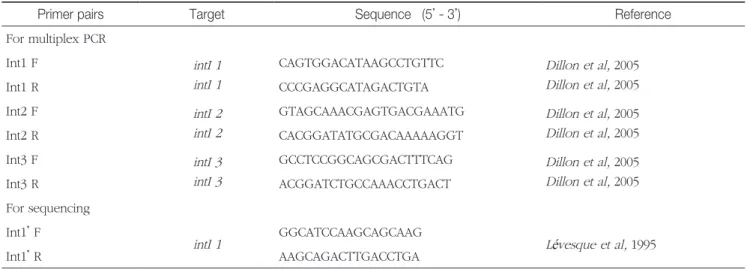
Class 1, 2, 및 3에 속하는 integron을 검출하기 위해 기
존의 시발체(Table 1)를 사용하여 다중 중합효소연쇄반응 (multiplex polymerase chain reaction)을 수행하였다. 대상 균주를 brain heart infusion broth (Difco)에 접종하여 37℃
에서 하룻밤 진탕배양 한 후 배양액으로부터 DNA purifi- cation kit (SolGent)을 사용하여 염색체 DNA를 추출하였 다. DNA 추출액 (5 µL), 10× Taq buffer (2.5 µL), 10 mM dNTP mix (0.5 µL), primer 각 10 pmol, 0.7U Taq DNA polymerase (SolGent) 및 증류수를 혼합하여 총 부피 25 µL의 반응용액을 만들었다. GeneAmp PCR System 9600 (Perkin-Elmer Centus Corp.)으로 95℃에서 5분간 반응시 킨 후, 94℃에서 1분, 59℃에서 1분, 72℃에서 1분씩 30회 증폭 반응시키고, 72℃에서 5분간 연장 반응시켰다. 각각 의 PCR 생산물을 ethidium bromide가 포함된 1.5% agarose gel에서 40 분간 전기영동 하였다. PCR 증폭산물의 위치가 약 160 bp, 788 bp, 및 979 bp인 것을 각각 class 1, 2, 및 3 integron으로 간주하였다.
2) Class 1 integron의 유전자 카세트 유전형 확인 Class 1 integron내에 존재하는 유전자 카세트의 유전형 을 확인하기 위해 5’ 보존영역(GGCATCCAAGCAGCAAG) 과 3’ 보존영역의 분절(AAGCAGACTTGACCTGA)을 시발체 로 하여 PCR을 수행하였다(Lévesque 등, 1995). 다중 중합 효소연쇄반응 때와 같은 조성의 반응용액 25 µL를 95℃에
서 5분간 반응시킨 후, 94℃에서 1분, 55℃에서 1분, 72℃에 서 4분씩 30회 증폭 반응시키고, 72℃에서 10분간 연장 반 응시켰다. 각각의 PCR 생산물을 ethidium bromide가 포함 된 1.5% agarose gel에서 40 분간 전기영동 하여 증폭산물 의 band를 확인한 후 염기서열 분석을 수행하였다. 5’ 보존 영역과 3’ 보존영역의 분절을 시발체로 하여 얻어진 각각의 PCR 생산물을 염기서열 분석한 뒤, 말단 부분에서 다시 새 로운 시발체를 디자인하여 PCR을 수행하고 염기서열 분석 을 하는 일련의 과정을 되풀이 하는 primer walking 방법으 로 전체 염기서열을 분석하였다.
결 과
1. 항균제 감수성 양상
시험기간 중 총 61주의 imipenem 내성 녹농균이 환자 의 임상검체에서 분리되었다. 이들이 같은 클론에서 유래 되었는지를 확인하기 위하여 rep-PCR을 수행한 결과 61주 중 총 21주가 서로 다른 밴드 양상을 보여 서로 다른 클론 에서 유래되었음이 확인되었다(Fig. 1). 이들 21주를 대상으 로 항균제 감수성 시험을 한 결과 amikacin 38.1%, genta- micin 57.1%, netilmicin 61.9%, tobramycin 42.9%, aztreo- nam 61.9%, ceftazidime 38.1%, cefepime 42.9%, imipenem
Table 1. Oligonucleotide primers for the detection of integrons
Primer pairs Target Sequence (5’ - 3’) Reference
For multiplex PCR
Int1 F intI 1
intI 1
CAGTGGACATAAGCCTGTTC Dillon et al, 2005
Dillon et al, 2005
Int1 R CCCGAGGCATAGACTGTA
Int2 F intI 2
intI 2
GTAGCAAACGAGTGACGAAATG Dillon et al, 2005 Dillon et al, 2005
Int2 R CACGGATATGCGACAAAAAGGT
Int3 F intI 3
intI 3
GCCTCCGGCAGCGACTTTCAG Dillon et al, 2005
Dillon et al, 2005
Int3 R ACGGATCTGCCAAACCTGACT
For sequencing Int1’ F
intI 1 GGCATCCAAGCAGCAAG
Lévesque et al, 1995
Int1’ R AAGCAGACTTGACCTGA
Abbreviations: F, forward; R, reverse.
100.0%, meropenem 61.9%, piperacillin 47.6%, piperacil- lin-tazobactam 38.1%, ticarcillin 76.2%, ticarcillin-clavu- lanic acid 57.1%, 및 ciprofloxacin 47.6%의 내성율을 보였 다(Table 2).
2. Class 1 integron 검출과 유전자 카세트의 유전형 확인
Imipenem 내성 녹농균 21주를 대상으로 다중 중합효소 연쇄반응을 수행한 결과 총 4주(P2, P4, P5, P28)에서 class 1 integron에 해당하는 약 160 bp크기의 PCR 산물이 검출 Fig. 1. Repetitive element sequence-based (rep)-PCR patterns of genomic DNA from sixty-one imipenem-resistant Pseudomo- nas aeruginosa. Lane M is 1kb DNA size marker.
Table 2. Antibiotic susceptibility patterns of 21 isolates of imipenem-resistant Pseudomonas aeruginosa
Antimicrobial agent No. of isolates (%)
Susceptible Intermediate Resistant
Amikacin 11 (52.4) 2 (9.5) 8 (38.1)
Gentamicin 5 (23.8) 4 (19.0) 12 (57.1)
Netilmicin 6 (28.6) 2 (9.5) 13 (61.9)
Tobramycin 12 (57.1) 0 9 (42.9)
Aztreonam 5 (23.8) 3 (14.3) 13 (61.9)
Ceftazidime 8 (38.1) 5 (23.8) 8 (38.1)
Cefepime 7 (33.3) 5 (23.8) 9 (42.9)
Imipenem 0 0 21 (100.0)
Meropenem 5 (23.8) 3 (14.3) 13 (61.9)
Piperacillin 11 (52.4) 0 10 (47.6)
Piperacillin/tazobactam 13 (61.9) 0 8 (38.1)
Ticarcillin 5 (23.8) 0 16 (76.2)
Ticarcillin/clavulanic acid 9 (42.9) 0 12 (57.1)
Ciprofloxacin 10 (47.6) 1 (4.8) 10 (47.6)
되었다. 반면 class 2 와 class 3 integron에 해당하는 약 788 bp 와 979 bp 크기의 PCR 산물은 한 주에서도 검출되지 않 았다.
다중 중합효소연쇄반응에서 160 bp크기의 PCR 생산물 이 검출되었던 4개의 균주를 대상으로 유전자 카세트 유전 형을 확인하기 위한 PCR과 염기서열 분석을 수행 한 결과 4주가 각각 서로 다른 class 1 integron을 가지고 있는 것이 확인되었다(Fig. 2). 검출된 class 1 integron의 크기는 2.5 kb, 3.0 kb, 및 4.0 kb 이었으며, 2.5 kb 크기의 integron 내 에는 MBL인 VIM-2 유전자 카세트가 위치해 있었다. P2와 P5에서 확인된 3.0 kb의 integron은 각각 tnpA와 blaOXA-2를 유전자카세트로 포함하고 있었고, 4.0 kb크기의 integron은 blaOXA-10과 cmlA2를 유전자카세트를 포함하고 있었다. 또 한, 검출된 모든 integron에는 aminoglycoside 내성에 관련 된 유전자카세트가 존재하고 있었다.
고 찰
Carbapenem 항균제는 녹농균이 생성하는 여러가지 ß- lactamase에 안정하며 분자량이 작고 양성(zwitterionic)하 전 및 친수성 구조여서 세균 세포내로 잘 투과되는 장점 이 있다. 따라서 carbapenem은 여러 ß-lactam제에 내성 인 녹농균의 감염치료에 쓸 수 있는 귀중한 항균제이다. 그 러나 carbapenem 사용이 늘어감에 따라, 이들 항균제에도 내성을 보이는 다제내성 녹농균의 감염이 증가하고 있어 임 상적으로 많은 문제가 되고 있다. 따라서 carbapenem 내성 기전을 밝히는 것은 녹농균 감염을 치료하는데 매우 중요하 다(Timurkaynak 등, 2006).
본 연구에서 녹농균의 carbapenem 내성기전을 조사하기 위해 imipenem 내성이면서 유전적으로는 서로 다른 균주 를 수집한 결과 총 21주의 녹농균이 임상검체로부터 얻어졌 다. 항균제 감수성 시험결과 이들 중 8주에 해당하는 38.1%
가 다제내성균인 것으로 확인되었다.
수집된 총 21주의 imipenem 내성 녹농균을 대상으 로 carbapenem 내성획득에 중요한 역할을 하는 integron Fig. 2. Schematic representation of gene cassette structure located in the class 1 integrons isolated from imipenem-resistant Pseudomonas aeruginosa. The horizontal arrows indicate the translation orientation of the genes. attI and attC (integron-associ- ated recombination site) were shown as white and black circle, respectively.
의 유전형을 조사한 결과 대상 균주 21주 중 한 주(P28)가 blaVIM-2를 유전자 카세트로 포함하는 class 1 integron을 가 지고 있음이 확인되었다. VIM-2 생성 녹농균은 1998년 이 등에 의해 국내에 처음으로 소개되었으며, 2003년 국내에서 분리된 carbapenem 비감수성 녹농균 중 11.4%를 차지하였다 (이 등, 2003). 2005년 김 등에 의한 보고에서도 18.1%에 해 당하는 carbapenem 비감수성 녹농균이 VIM-2를 생성하는 것으로 나타나 국내에는 VIM-2가 흔한 것임이 밝혀 진 바 있다. VIM-2 등의 MBL 유전자는 대부분은 class 1 integron 에 유전자 카세트로 존재하는데 이런 특징은 이들 내성유전 자가 다른 균종으로 쉽게 전달 될 수 있음을 뜻한다. 특히 MBL 유전자 카세트를 가지고 있는 integron은 다양한 내성 유전자 카세트들도 함께 포함하고 있는 경우가 많으며 이러 한 integron의 보유는 다제내성의 원인이 된다(Jang, 2005).
본 연구에서도 VIM-2 유전자 외에 aminoglycoside 내성유 전자인 aadA1을 가지고 있었다. 이러한 integron의 구조는 2006년 러시아에서 분리된 녹농균에서 처음 보고되었으며 국내에서도 유사한 구조가 Enterobacter cloacae에서 보고 된 바 있다(정 등, 2003; Shevchenko 등, 2006).
VIM-2 생성균주 외에도 P2, P4, 및 P5 균주가 class 1 integron을 가지고 있는 것으로 확인되었다. 이들 3주에서 검출된 integron에는 aadA2, aadB, aacA4, 또는 aacA5 등 의 aminoglycoside 내성 유전자가 포함되어 있었는데, 이 는 항균제 감수성시험에서 이들 3주가 aminoglycoside 항 균제에 내성을 보인 것이 integron의 존재 때문일 수도 있음 을 시사한다. 2005년 중국에서 분리된 녹농균에서도 유사한 결과가 보고되었는데, aminoglycoside, quinolones, 및 ß- lactam 항균제에 대해 내성을 보이는 것과 integron의 존재 가 밀접한 관련이 있다고 했다(Gu 등, 2007). 3.0 kb 과 4.0 kb 크기의 integron에는 ß-lactamase 유전자인 blaOXA-2과 blaOXA-10이 각각 위치해 있었으며 4.0 kb integron은 그 외 에도 chloramphenicol 내성에 관련된 유전자인 cmlA1을 가 지고 있었다. 특히 검출된 4개의 integron 모두에는 두 종류 이상의 항균제 내성유전자가 위치해 있었으며 P28을 제외 한 나머지 3주는 모두 다제내성균인 것으로 확인되었다. 이 는 녹농균이 다제내성을 갖게 하는데 integron이 중요한 역 할을 하고 있음을 시사한다.
한편 대상균주 21주 중 class 2와 class 3 integron을 가지 고 있는 균주는 한 주도 없었다. 장내세균과에 속하는 세 균의 경우 class 2 integron을 보유하는 경우가 빈번하며 (White 등, 2001) class 3 integron 또한 덜 빈번하지만 보고 가 되고 있는 반면 녹농균에서는 보고가 드물다(Senda 등, 1996). 2004년에 그리스에서 분리된 녹농균에서도 class 1 integron의 검출률이 96.6%로 높았던 반면 class 2 integron 은 검출되지 않았다(Perimeni 등, 2006; Yan 등, 2007). 국 내에서도 녹농균을 대상으로 한 연구에서 class 2 혹은 class 3 integron에 대한 보고가 현재까지 없는 것으로 보아 그람 음성 세균에서 가장 빈번하게 검출되는 class 1 integron이 녹농균에서도 내성확산에 주도적인 역할을 하고 있는 것으 로 보인다.
이상의 결과에서 충청지역의 한 대학병원에서 분리된 imipenem 내성 녹농균에 확산되어 있는 class 1 integron 에 는 VIM-2 등의 MBL 유전자 뿐 만 아니라 ß-lactamase 유 전자 및 aminoglycoside 내성 유전자가 포함되어 있는 것으 로 나타났다. 또한 녹농균은 다양한 항균제 내성유전자 카 세트가 포함된 integron의 보유를 통해 많은 항균제에 대해 내성을 나타낼 수 있음이 확인되었다. 따라서 다제내성균의 출현 및 증가에 중요한 역할을 하는 integron의 확산에 대한 지속적인 감시가 필요할 것으로 사료된다.
참고문헌
1. Bergogne-Berezin E. Pseudomonas and miscellaneous gram-negative bacilli. In: Cohen J, Powerly WG et al. In- fectious Diseases. 2th eds, 2004, p2203-2226. Mosby, New York.
2. CLSI. Performance Standards for Antimicrobial Susceptibility Testing; Sixteenth Informational Supplement. CLSI document M100-S20. Wayne, 2010. Clinical and Laboratory Standards Institute, Wayne, Pennsylvania.
3. Dillon B, Thomas L, Mohmand G, Zelynski A, Iredell J. Mul- tiplex PCR for screening of integrons in bacterial lysates. J Microbiol Methods. 2005, 62:221-232.
4. Gu B, Tong M, Zhao W, Liu G, Ning M, Pan S, et al. Preva- lence and characterization of class I integrons among Pseudo- monas aeruginosa and Acinetobacter baumannii isolates from
patients in Nanjing, China. J Clin Microbiol. 2007, 45:241- 243.
5. Jacoby GA and Medeiros AA. More extended-spectrum ß- lactamases. Antimicrob Agents Chemother. 1991, 35:1697- 1704.
6. Jang SJ. The role of integrons in the spread of multi-drug resistance. Korean J Clin Microbiol. 2005, 8:1-9.
7. Jeong SH, Lee K, Chong Y, Yum JH, Lee SH, Choi HJ, et al. Characterization of a new integron containing VIM-2, a metallo-ß-lactamase gene cassette, in a clinical isolate of Enterobacter cloacae. J Antimicrob Chemother. 2003, 51:397-400.
8. Kim IS, Lee NY, Ki CS, Oh WS, Peck KR, Song JH. Increasing prevalence of imipenem-resistant Pseudomonas aeruginosa and molecular typing of metallo-ß-lactamase producers in a Korean hospital. Microb Drug Resist. 2005, 11:355-359.
9. Kim IS, Oh WI, Song JH, Lee NY. Screening and identifi- cation of metallo-ß-lactamase gene in clinical isolates of imipenem-resistant Pseudomonas aeruginosa. Korean J Lab Med. 2004, 24:177-182.
10. Lee K, Chong Y, Shin HB, Yong D. Rapid increase of imi- penem-hydrolyzing Pseudomonas aeruginosa in a Korean hospital. 38th ICAAC, 1998, Abstr E-85.
11. Lee K, Lee WG, Uh Y, Ha GY, Cho J, Chong Y. Korean Nationwide Surveillance of Antimicrobial Resistance Group.
VIM- and IMP-type metallo-ß-lactamase-producing Pseudomonas spp. and Acinetobacter spp. in Korean hospi- tals. Emerg Infect Dis. 2003, 9:868-871.
12. Lee K, Lim JB, Yum JH, Yong D, Chong Y, Kim JM, et al.
blaVIM-2 cassette-containing novel integrons in metallo-ß- lactamase-producing Pseudomonas aeruginosa and Pseu- domonas putida isolates disseminated in a Korean hospital.
Antimicrob Agents Chemother. 2002, 46:1053-1058.
13. Lee K, Park KH, Jeong SH, Lim HS, Shin JH, Yong D, et al.
Further increase of vancomycin-resistant Enterococcus fae- cium, amikacin- and fluoroquinolone-resistant Klebsiella pneumoniae, and imipenem-resistant Acinetobacter spp.
in Korea: 2003 KONSAR surveillance. Yonsei Med J. 2006, 47:43-54.
14. Lee K, Yum JH, Yong D, Lee HM, Kim HD, Docquier JD, et al. Novel acquired metallo-ß-lactamase gene, bla(SIM-1), in a class 1 integron from Acinetobacter baumannii clinical isolates from Korea. Antimicrob Agents Chemother. 2005, 49:4485-4491.
15. Lévesque C, Piché L, Larose C, Roy PH. PCR mapping of inte- grons reveals several novel combinations of resistance genes.
Antimicrob Agents Chemother. 1995, 39:185-191.
16. Perimeni D, Tryfinopoulou K, Giakouppi P, Vourli S, Tsimettas I, Gianneli D, et al. Screening for the presence of class 1 and 2 integrons in non-fermenting isolates from a tertiary hospital: association with antibiotic resistance pheno- types. 16th ECCMID, 2006, Abstr R-1962.
17. Ploy MC, Lambert T, Couty JP, Denis F. Integrons: an anti- biotic resistance gene capture and expression system. Clin Chem Lab Med. 2000, 38:483-487.
18. Poirel L, Naas T, Nicolas D, Collet L, Bellais S, Cavallo JD, et al. Characterization of VIM-2, a carbapenem-hydrolyzing metallo-ß- lactamase and its plasmid- and integron- borne gene from a Pseudomonas aeruginosa clinical isolate in France. Antimicrob Agents Chemother. 2000, 44:891-897.
19. Recchia GD and Hall RM. Gene cassettes: a new class of mo- bile element. Microbiology. 1995, 141:3015-3027.
20. Richet HM, Mohammed J, McDonald LC, Jarvis WR. Building communication networks: international network for the study and prevention of emerging antimicrobial resistance. Emerg Infect Dis. 2001, 7:319-322.
21. Senda K, Arakawa Y, Ichiyama S, Nakashima K, Ito H, Ohsu- ka S, et al. PCR detection of metallo-ß-lactamase gene (blaIMP) in gram-negative rods resistant to broad-spectrum ß-lactams. J Clin Microbiol. 1996, 34:2909-2913.
22. Shannon KP and French GL. Increasing resistance to antimi- crobial agents of Gram-negative organisms isolated at a Lon- don teaching hospital, 1995-2000. J Antimicrob Chemother.
2004, 53:818-825.
23. Shevchenko O, Edelstein M, Kretchikov V, Stratchounski L.
Characterization of class 1 integrons carrying the genes for VIM- and IMP-type metallo-ß-lactamases in Pseudomo- nas aeruginosa strains from Russia. 16th ECCMID, 2006, Abstr P-1407.
24. Timurkaynak F, Can F, Azap OK, Demirbilek M, Arslan H, Karaman SO. In vitro activities of non-traditional antimi- crobials alone or incombination against multidrug-resistant strains of Pseudomonas aeruginosa and Acinetobacter bau- mannii isolated from intensive care units. Int J Antimicrob Agents. 2006, 27:224-228.
25. White PA, McIver CJ, Rawlinson WD. Integrons and gene cassettes in the enterobacteriaceae. Antimicrob Agents Che- mother. 2001, 45:2658-2661.
26. Yan H, Shi L, Yamasaki S, Li X, Cao Y, Li L, et al. A plasmidic class 1 integron from five Pseudomonas aeruginosa clinical strains harbored aacA4 and nonsense-mutated cmlA1 gene cassettes. J Health Science. 2007, 53:750-755.