한방안이비인후피부과학회지 제31권 제4호(2018년 11월)
J Korean Med Ophthalmol Otolaryngol Dermatol 2018;31(4):42-64 pISSN 1738-6640 eISSN 2234-4020
http://www.ood.or.kr http://dx.doi.org/10.6114/jkood.2018.31.4.042
Original Article / 원저
말초성 안면마비 후유증의 비수술적 치료에 관한 국내외 연구 동향
이성은1․ 윤화정2․ 고우신2
동의대학교 부속한방병원 한방안이비인후피부과 (1수련의, 2교수)
Research Trends on Non-surgical Treatment of Peripheral Facial Paralysis Sequelae
Sung-Eun Lee ․ Hwa-Jung Yoon ․ Woo-Shin Ko
Dept. of Korean Medicine Ophthalmology & Otolaryngology & Dermatology, Clinical Korean Medicine, Dong-eui University
Abstract
Objectives : The purpose of this study was to investigate the non-surgical treatment of peripheral facial paralysis sequelae such as bell’s palsy and Ramsay-hunt syndrome during last 10 years.
Methods : We searched articles in the RISS, MEDLINE, CAJ from January, 2008 to June, 2018. Articles on the non-surgical treatment of bell’s palsy and Ramsay-hunt syndrome sequelae were included. We extracted data about treatments, characteristics of intervention, outcomes from the included studies and classified in to 4 categories such as case studies, RCTs, nRCTs, literature reviews.
Results : 132 potentially relevant studies were identified, of which 60 studies met our inclusion criteria. Of 60 included studies, 30 were case reports, 22 were RCTs, 4 were nRCTs, and 4 were reviews. China (81.8%) were the most common by country, bell’s palsy(81.7%) by disease, and case reports(50%) by study type were the most common. Symptoms were lagophthalmos, asymmetry, contracture, spasm, dacryorrhea, synkinesis, paresthesia, crocodile tears mostly in the order of frequency, and these symptoms occurred at least one month after the onset of symptoms. The most common method of treatment was acupuncture, which was used in 49 studies. As the evaluation variables, the effective rate was the highest in 25, House-Brakmann grading system in 17, and Sunnybrook facial grading system in 7. In 95% of the studies, after-treatment was reported to be cured, but objectivity is low.
Conclusions : This study suggests that Korean medicine such as acupuncture can play a valid role in the non-surgical treatment of peripheral facial paralysis sequelae. In the future, a systematic and well-designed clinical study is needed for treatment of peripheral facial paralysis sequelae.
Key words : Bell’s palsy; Ramsay-Hunt syndrome; facial palsy; sequelae; acupuncture
ⓒ 2018 the Society of Korean Medicine Ophthalmology & Otolaryngology & Dermatology
This is an Open Access journal distributed under the terms of the Creative Commons Attribution Non-Commercial License (http://creativecommons.org/license/by-nc/3.0/) which permits unrestricted non-commercial use, distribution, and reproduction in any medium, provided the original work is properly cited.
이성은 외 2인 : 말초성 안면마비 후유증의 비수술적 치료에 관한 국내외 연구 동향
Ⅰ. 서 론
말초성 안면신경마비는 크게 원발성과 속발성으로 분류되는데, 원발성을 흔히 Bell마비(Bell’s palsy)라 고 한다1). Bell마비는 10만 명당 20~30명이 매년 또 는 일생 동안 60~70명 중 1명꼴로 발생하며, 안면신 경마비 중 가장 많은 형태이다. 대부분 일측성으로 갑 작스럽게 발생하는데, 일반적으로 48시간 내에 가장 심하게 나타나고 이후통이 1~2일 있은 뒤 안면마비가 오며, 수주~수개월 내에 80% 이상 회복된다. 원인은 아직 밝혀지지 않았지만, 안면신경이 herpes simplex virus에 감염되어 분절 탈수초형성이 일어나 이에 속 발한 부종이 안면 신경관 내의 신경을 압박하여 안면 신경마비가 발생된다고 보는 학설이 유력하다2). 속발성의 원인은 크게 외상, 감염, 종양, 기타 질환 으로 분류된다. 이 중, herpes zoster virus에 의한 Ramsay-Hunt증후군이 Bell마비 다음으로 흔한 질환 이다1). Ramsay-Hunt증후군은 이통, 소수포성 발진, 감각신경성 난청, 이명, 현훈과 함께 안면신경마비가 동반되는 질환으로, 예후가 불량하여 완전 회복률은 20% 정도이다2).
말초성 안면신경마비에 이환된 환자 중 15~31%에 서는 평균 발병 후 약 3~6개월 후부터 후유증이 생기 며, 대표적인 증상으로는 연합운동(synkinesis), 구축 (contracture), 경련(spasm), 악어눈물 증후군(crocodile impairment), 청각장애(hearing impairment) 등이 있다3). 장기간 지속되는 후유증은 심리적 위축 등의 정신적인 위해를 가할 수 있어 삶의 질을 저하시키는 원인이 된다. 따라서 급성기 못지않게 후유증기의 안 면신경마비를 효과적으로 치료하는 것이 중요하게 대 두되고 있다.
국내외의 안면신경마비 진료지침을 살펴보면 급성
기 치료에 대해서는 많은 지면을 할애하였으나1,4-14), 후유증 치료에 대해서는 간략하게 수술요법15-18) 또는 보톡스 주사만 언급하고, 한방치료를 소개하였으나 추 천하는 치료법은 아니라고 하였다1,8,9). 이에 저자는 말초성 안면신경마비 중 가장 흔한 질환인 Bell마비와 Ramsay-Hunt증후군 후유증의 비수술적 치료에 관 한 지난 10년간의 논문을 고찰하여 약간의 지견을 얻 었기에 이를 보고하고자 한다.
Ⅱ. 방 법
1. 데이터베이스 선택 및 검색
검색은 2008년 1월부터 2018년 7월까지 국내외에 발표된 논문을 대상으로, RISS(www.riss.kr), MEDLINE (www.medline.com), Chinese Academic Journals (이하 CAJ, www.cnki.net)의 온라인 데이터베이스를 활용하여 말초성 안면신경마비의 치료에 관한 연구를 검색하였다.
검색어는 민감도를 높이기 위하여 RISS에서 “안면 마비 후유증”을 사용하였고, 논문 전체를 확인하여 말 초성으로 인한 안면신경마비 후유증을 선택하였다.
MEDLINE에서 [(bell’s palsy) AND (sequelae)], [(ramsay-hunt) AND (sequelae)]를, CAJ에서는 [AB=’面瘫后遗症’ or SU=’面瘫后遗症’]을 사용하였다.
2. 선정 기준
말초성 안면신경마비의 급성기 치료에 관한 문헌은 많으나 후유증 치료 관련 논문의 수는 적을 것이라 예 상하여, 검색어 조합으로 인해 발생할 수 있는 누락을 줄이기 위해 말초성 안면신경마비와 치료만으로 구성 된 기본적인 검색식을 사용하였다.
검색된 문헌에서 중복된 자료를 제외시킨 뒤, 초록 을 검토하여 말초성 질환이 아닌 것, 후유증이 아닌 것, 치료에 관한 내용이 아닌 것, 원문을 찾을 수 없는 경우를 제외하기로 하였다. 그리고 신경 이식술, 감압
Corresponding author: Hwajung Yoon, The society of Korean Medicine Ophthalmology & Otolaryngology & Dermatology, Dong eui University, San 45-1, Yangjeong-2dong, Busanjin-gu, Busan, 614-710, Korea.
(Tel: +82-21-850-8658, E-mail: [email protected])
• Received 2018/10/11 • Revised 2018/11/1 • Accepted 2018/11/8
한방안이비인후피부과학회지 제31권 제4호(2018년 11월)
술 등 한방치료에 적용시키기 어려운 침습적인 치료 도 함께 제외기준으로 삼았다. 그 후 원문을 읽어 학 위 논문이거나 논문 양식에 맞지 않는 문헌도 제외하 기로 하였다.
3. 포함논문의 내용분석
최종 선정된 각 연구의 원문을 검토하여 정보를 추 출하였다. 선정된 논문들을 연구 형태에 따라 증례 보 고, 무작위배정 비교임상시험(Randomized controlled clinical trials, 이하 RCT), 비무작위배정 비교임상시 험(Non-randomized controlled clinical trial, 이 하 nRCT), 문헌 고찰의 4가지로 분류하였다. 그 후에 발표 연도 및 국가, 대상 환자의 진단, 이환기간, 증 상, 치료방법 및 기간, 평가 지표와 결과 등에 따라 분 석하였다.
Ⅲ. 결 과
1. 자료 선별
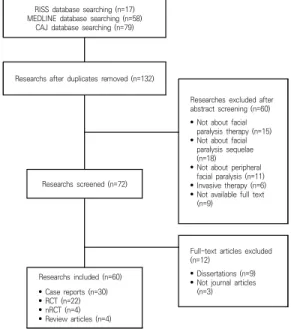
연구방법에 따라 논문을 검색한 결과 RISS에서 17 편, MEDLINE에서 58편, CAJ에서 79편의 문헌이 검 색되었다. 이 중 중복된 논문 22편을 제외하고 남은 132편을 대상으로 초록을 검토하여 선별을 시행하였 다. 선정 기준에 따라 치료와 관련이 없는 15편, 안면 마비에 대한 연구이지만 후유증과 관련이 없는 18편 과 말초성이 아닌 11편, 수술과 같이 침습적인 치료에 관한 6편, 원문을 구할 수 없었던 9편을 제외하였다.
남은 문헌 72편의 전문을 검토하여 학위논문 9편과 신문 기사처럼 논문 형식이 아닌 3편을 제외하였고, 총 60편의 논문이 최종 선정되었다(Fig. 1).
2. 선정 논문의 분석
최종 선정된 문헌을 연구 형태에 따라 4가지로 분 류하였다. 증례 보고 30편, RCT 22편, nRCT 4편,
문헌고찰 4편을 각각 검토하여 분석하였다.
RISS database searching (n=17) MEDLINE database searching (n=58)
CAJ database searching (n=79)
Researchs after duplicates removed (n=132)
Researches excluded after abstract screening (n=60)
• Not about facial paralysis therapy (n=15)
• Not about facial paralysis sequelae (n=18)
• Not about peripheral facial paralysis (n=11)
• Invasive therapy (n=6)
• Not available full text (n=9)
Researchs screened (n=72)
Full-text articles excluded (n=12)
• Dissertations (n=9)
• Not journal articles (n=3) Researchs included (n=60)
• Case reports (n=30)
• RCT (n=22)
• nRCT (n=4)
• Review articles (n=4)
Fig. 1. Flow Chart of the Selection Results
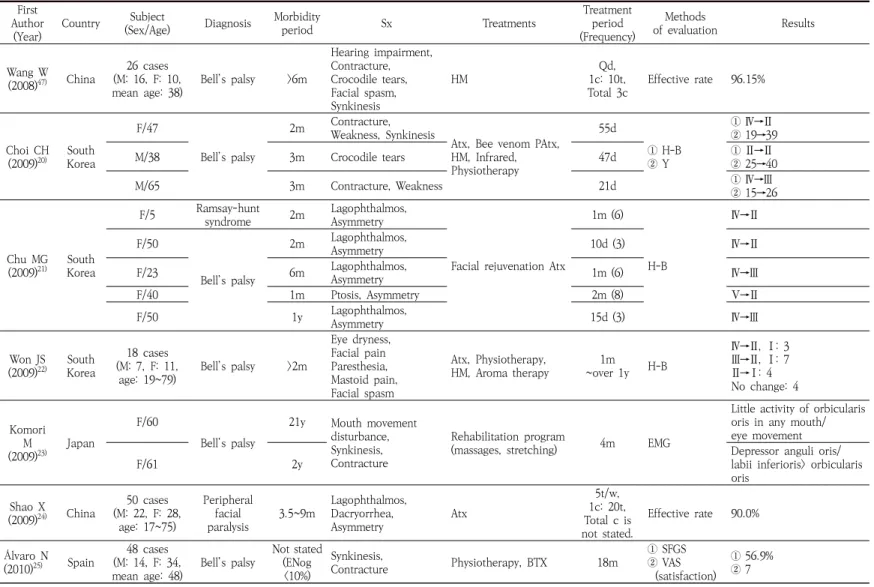
1) 증례 보고(Table 1)
2008 년에 1 편19), 2009 년에 5 편20-24), 2010 년 에 3 편25-27), 2011 년에 3 편28-30), 2012 년에 9 편
31-38), 2013 년에 3 편39-41), 2014 년에 1 편42), 2015 년에 3 편43-45), 2016 년에 1 편3), 2018 년에 1 편46) 발표되었고, 국가별로는 한국에서 8 편, 중국에서 19 편, 일본과 미국, 스페인에서 각각 1 편이 발표되었다.
Bell 마비라고 명시한 연구가 21 례, 그 중 1 례에서 Ramsay-hunt 증후군을 포함하였고, 나머지 9 편은 말초성 안면신경마비로 진단되었다. 말초성 안면신경 마비라고 언급한 논문을 읽어보면 중추성 질환으로 인한 안면마비 또는 기타 외상, 수술, 감염 등으로 인 한 안면마비를 배제한다는 내용이 있어 Bell 마비를 지칭한다고 생각되었다. 그러나 고찰에 객관성을 두기 위해 저자가 원문에 명시된 대로 ‘말초성 안면신경마 비’라고 하였다.
후유증이라 진단할 때에 대부분 증상과 함께 이환 기간을 명시하였고, 최소 1 개월 이상에서 최대 21 년
이성은 외 2인 : 말초성 안면마비 후유증의 비수술적 치료에 관한 국내외 연구 동향
이상이었다. 1 편에서는 기간이 아닌 ENog 검사를 제 시하였는데, 10% 미만인 경우를 후유증으로 보았다25). 환자가 호소하는 후유증 증상으로 토안(Lagoph- thalmos), 비대칭(Asymmetry)가 가장 많았고, 그 다 음으로 구축(Contracture), 경련(Spasm), 유루증 (Dacryorrhea), 연합운동(Synkinesis), 감각저하 (Paresthesia), 악어눈물(Crocodile tears) 빈도 순으 로 있었다. 그 외 이후통(Post ear pain), 청각장애 (Hearing impairment), 뻣뻣함(Stiffness), 안검하수 (Ptosis), 눈의 건조감(Dry eye), 유양돌기 통증 (Mastoid pain), 목 통증(Neck pain), 얼굴 통증 (Facial pain), 근력저하(Weakness) 등이 있었다. 증 상에 대한 언급이 없었던 논문은 1 편이었다28). 치료 방법으로 전통적인 방법으로 침을 사용한 연 구가 15 편으로 가장 많았는데 한국에서 3 편, 중국에 서 12 편이었다. 한약을 사용한 연구는 8 편이었고 한 국 4 편, 중국 4 편이었다. 물리치료를 사용한 연구 또 한 8 편이었는데, 한국 4 편, 중국 2 편이었고 일본 1 편, 스페인 1 편이었다. 정안침 및 안면성형침은 전통 적인 침법과는 다른 술기여서 따로 분류하였고, 4 편 전부 한국에서 발표되었다. 매화침 및 사혈 요법, 뜸 을 사용한 연구는 중국에서 4 편 발표되었다. 적외선 을 사용한 연구는 3 편으로 한국 2 편, 중국 1 편이었 다. 보톡스와 필러를 사용한 연구 2 편은 스페인과 미 국에서 각각 발표되었다. 한국에서 약침을 사용한 연 구 3 편, 매선 1 편, 아로마 요법 1 편이 있었고, 중국 에서는 화침 1 편, 전침 1 편, 할치요법 2 편, 혈위주 사 2 편, 불을 이용한 치료 1 편을 논문으로 발표하였다.
평가 지표로 유효율을 사용한 연구가 11 회로 가장 많았고, 모두 중국 논문이었다. 痊愈, 显效, 好转, 无 效의 4 가지 단계로 결과를 나눈 후에 치료 효과를 계 산하는 방법이었고, 중국의 많은 연구에서 이 방법을 사용해 치료 효능을 평가하였다. 痊愈란 안면마비가 깨끗이 소실된 것을 말하고, 显效는 대부분의 운동기 능이 회복된 것을 말하고, 好转는 일부가 회복된 것, 无效는 증상이 개선되지 않은 것을 말한다. House-
brackmann grading system(이하 H-B)은 7 회로 한국에서 6 회, 중국에서 1 회 사용되었다.
Yanagihara scale(이하 Y)은 한국에서 3 회 사용되 었고, Sunnybrook facial grading scale(이하 SFGS)은 중국과 스페인에서 각각 1 회로 총 2 회, Portmann scale 은 중국에서 2 회 사용되었다. 그 외 사진촬영 3 회(한국 2 회, 미국 1 회), Visual analogue scale 1 회(스페인), EMG 1 회(일본), Peitersen 1 회(한국)가 있었다. 평가 지표에 대한 언 급이 없었던 연구는 중국에서 발표된 연구 4 편이었다
30,34-36).
연구 결과 중 대부분은 호전되었다고 발표하였다. 변 화가 없었던 증례가 포함된 연구는 2 편22,31)이었고, 그 중 결과를 언급하지 않은 논문31)은 치료 전 H-B 는 있었으나 치료 후 H-B 가 없었다. 앞서 평가 지표 가 없었던 연구30,34-36)에서 결과는 명시하였는데, 해 당 환자가 완치 또는 호전되었다고 하였다. 한편 p-value 로 유의수준을 나타낸 연구는 한국28)과 중국
38) 각각 1 편이었다.
2) RCTs(Table 2)
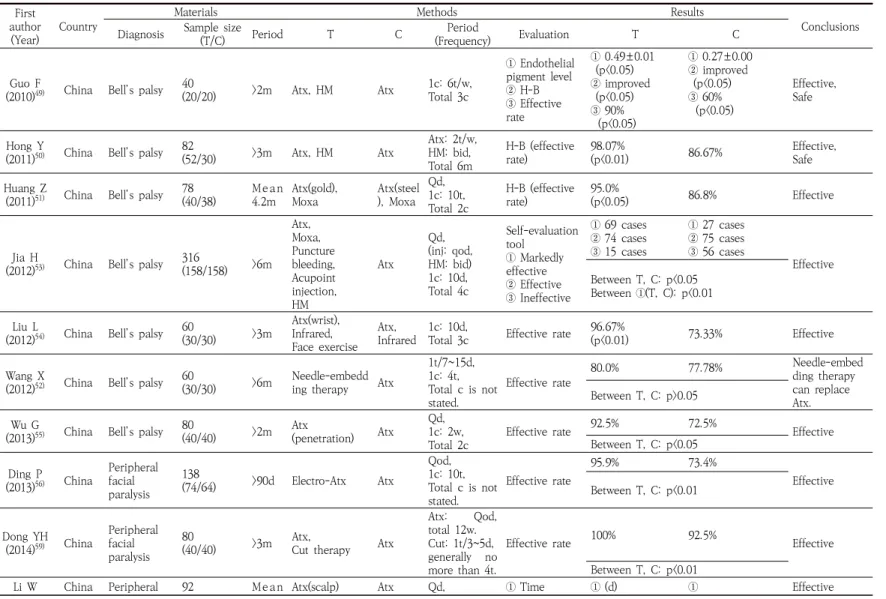
연도별로 발표된 연구는 2008, 2009년에는 없었 고, 2010년에 1편49), 2011년에 2편50,51), 2012년에 3편52-54), 2013년에 2편55,56), 2014년에 3편57-59), 2015년에 5편60-64), 2016년65,66)과 2017년67,68), 2018년69,70)에 각각 2편이었고, 국가별로는 이란에서 1편, 한국에서 1편, 중국에서 2편이었다.
Bell마비를 대상으로 한 연구는 12편, Ramsay- hunt증후군은 1편, 나머지 9편은 말초성 안면신경마 비를 대상으로 연구하였다. 안면마비에 이환된 기간을 대개 2개월 이상으로 정하였고, 이에 대한 언급이 없 었던 연구는 1편69)이었다. 연구 중재에 관한 기간과 빈도에 대하여 대다수 연구는 명확히 밝혔으나, 총 기 간을 명시하지 않은 논문이 2편52,56), 매개변수 하나에 대한 기간을 명시하지 않은 논문이 1편69) 있었다.
평가 지표로는 H-B이 한국에서 1회, 중국에서 9회,
한방안이비인후피부과학회지 제31권 제4호(2018년 11월)
총 10회로 가장 많이 사용되었다. 또한 유효율 검사도 10회였고, 전부 중국에서 사용하였다. SFGS는 이란 1회, 한국 1회, 중국 3회로 총 5회 사용되었다. “10 项记分法”이 중국에서만 2회 사용되었다. 이것은 Bell 마비의 증상을 10개로 분류하여 정상, 경도, 중도, 고 도의 4단계로 나누어 점수를 매기고, 치료 전 Bell마 비 점수에 대한 치료 전후 Bell마비 점수 차이를 백분 율로 계산하여 효능지수를 나타내는 방법이다. 이 외 에 FDI(physical & social)가 한국에서 1회, 혈관내 피세포 수치가 중국에서 1회 사용되었다.
치료 결과는 모든 연구에서 효과적이라고 하였다.
가장 많이 등장한 치료법은 침이었고, 크게 재료와 방 법을 달리한 연구로 분류할 수 있다. 먼저 침의 재료 를 중재로 한 연구에서는 금과 스테인리스로 만든 침 으로 연구하였고, 그 결과 금이 더 효과적이었다. 다 양한 자침법을 중재로 한 연구에는 투자법(透刺法)과 제삽법(提揷法), 신침 요법인 두침(頭針), 완과침(腕踝 針)이 있었고, 침병에 뜸과 같이 열기를 가하는 온침 (溫鍼), 그 밖에 혈위 구성을 달리하는 방법이 있었다.
침과 함께 사용한 치료법으로는 한약, 뜸, 자락, 매화 침, 혈위주사, 전침, 할치요법, 부항, 물리치료 등이 있었다. 침을 포함하지 않은 연구는 3편으로 매선에 관한 연구 2편52,62), 보톡스에 관한 연구 1편61)이었다.
P-value가 없었던 연구는 4편으로 중국 3편58,62,69
), 한국 1편61)이었고, 중재에 대한 안전도를 검증한 연 구는 단 2편이었다.
3) nRCTs(Table 3)
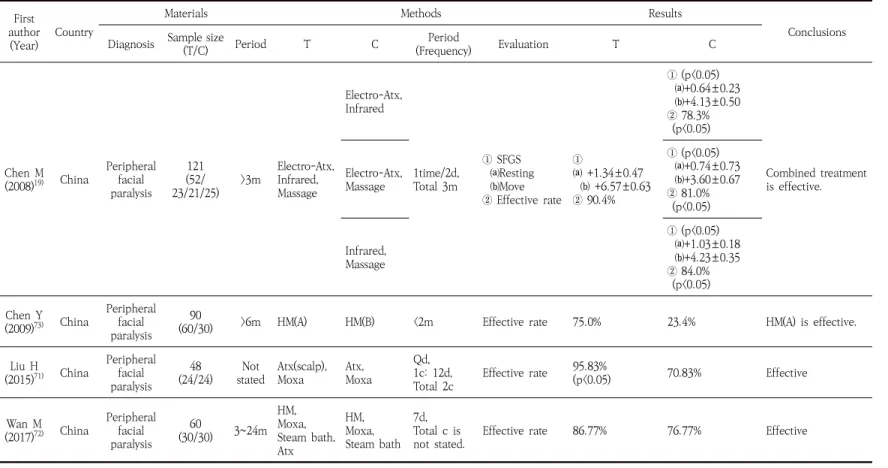
모두 중국에서 2008년, 2009년, 2015년, 2017년 에 1편씩 발표되었고, 말초성 안면신경마비로 진단하 였다. 후유증 이환기간은 공통적으로 3개월 이상이었 고, 기간을 명시하지 않은 논문은 1편71)이었다.
연구 중재로는 3편에서 모두 침이 사용되었고, 전 침, 뜸, 훈증, 적외선, 물리치료를 함께 사용하였다.
오로지 한약으로만 중재한 연구는 补气养血荣肌汤과 牵正散의 효능을 비교하였다. 중재 기간을 명시하지
않은 논문은 1편72)이었다. 모든 연구에서 평가지표로 유효율을 사용했고, 1편에서는 SFGS도 추가로 사용 하였다.
연구 결과는 모두 효과적이라 하였으나 p-value가 없던 논문은 2편72,73)이었다.
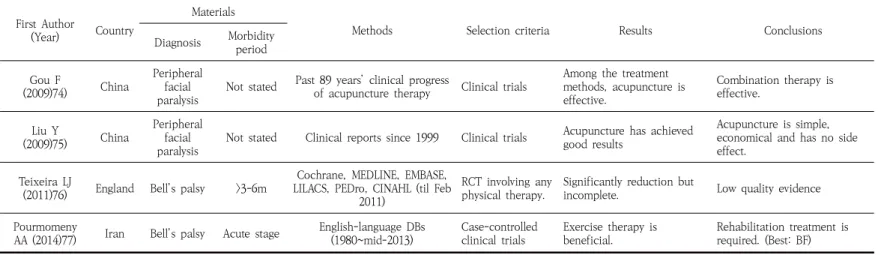
4) 문헌 고찰(Table 4)
2009년에 2편, 2011년에 1편, 2014년에 1편씩 발표되었다. 중국에서 발표된 2편은 말초성 안면신경 마비로 진단하였고, 영국 1편과 이란 1편은 Bell마비 로 진단하였으며 이 중 영국 논문은 체계적 문헌고찰 (Systemic review, 이하 SR)이었다.
연구 대상에서 중국 2편은 안면마비 이환기간을 언 급하지 않았고, 영국 1편은 3~6개월 이상이라 명시하 였다. 반면 이란에서 진행한 연구는 급성기라고 밝혔 는데, 후유증 증상인 연합운동과 안면비대칭을 언급한 논문을 고찰하였다. 중국에서는 침으로 치료한 임상 연구 및 모든 임상 연구를 포함하였고, 영국에서는 물 리치료를 사용한 RCT를 대상으로 하였으며, 이란에 서는 Bell마비에 관한 영어 기반 자료 중 nRCT를 대 상으로 하였다.
중국에서는 중의학 치료가 효과적이고, 그 중 가장 효과적인 방법은 침이며 부작용이 없다고 결론을 내 렸다. 영국에서 시행한 SR은 물리치료로 인해 안면마 비가 유의하게 치료되지만 불완전하고, 치료에 관한 근거수준은 낮다고 하였다. 이란에서는 물리치료가 효 과적이며 그 중 biofeedback이 가장 좋은 치료법이 라 하였다.
Ⅳ. 고 찰
본 연구는 지난 10여년간 행해진 말초성 안면신경 마비 후유증의 비수술적인 치료법을 조사하기 위하여 증례보고, RCT, nRCT, 문헌고찰 문헌에서 동향을 파 악하였다.
Table 1. Analysis of the Case Reports
First Author
(Year)
Country Subject
(Sex/Age) Diagnosis Morbidity
period Sx Treatments
Treatment period (Frequency)
Methods
of evaluation Results
Wang W (2008)47) China
26 cases (M: 16, F: 10, mean age: 38)
Bell’s palsy >6m
Hearing impairment, Contracture, Crocodile tears, Facial spasm, Synkinesis
HM
Qd, 1c: 10t, Total 3c
Effective rate 96.15%
Choi CH (2009)20)
South Korea
F/47
Bell’s palsy
2m Contracture, Weakness, Synkinesis
Atx, Bee venom PAtx, HM, Infrared, Physiotherapy
55d
① H-B
② Y
① Ⅳ→Ⅱ
② 19→39
M/38 3m Crocodile tears 47d ① Ⅱ→Ⅱ
② 25→40
M/65 3m Contracture, Weakness 21d ① Ⅳ→Ⅲ
② 15→26
Chu MG (2009)21)
South Korea
F/5 Ramsay-hunt
syndrome 2m Lagophthalmos,
Asymmetry
Facial rejuvenation Atx
1m (6)
H-B
Ⅳ→Ⅱ
F/50
Bell’s palsy
2m Lagophthalmos,
Asymmetry 10d (3) Ⅳ→Ⅱ
F/23 6m Lagophthalmos,
Asymmetry 1m (6) Ⅳ→Ⅲ
F/40 1m Ptosis, Asymmetry 2m (8) Ⅴ→Ⅱ
F/50 1y Lagophthalmos,
Asymmetry 15d (3) Ⅳ→Ⅲ
Won JS (2009)22)
South Korea
18 cases (M: 7, F: 11,
age: 19~79)
Bell’s palsy >2m
Eye dryness, Facial pain Paresthesia, Mastoid pain, Facial spasm
Atx, Physiotherapy, HM, Aroma therapy
1m
~over 1y H-B
Ⅳ→Ⅱ, Ⅰ: 3
Ⅲ→Ⅱ, Ⅰ: 7
Ⅱ→Ⅰ: 4 No change: 4
Komori M (2009)23)
Japan
F/60
Bell’s palsy
21y Mouth movement disturbance, Synkinesis, Contracture
Rehabilitation program
(massages, stretching) 4m EMG
Little activity of orbicularis oris in any mouth/
eye movement
F/61 2y
Depressor anguli oris/
labii inferioris> orbicularis oris
Shao X (2009)24) China
50 cases (M: 22, F: 28,
age: 17~75)
Peripheral facial paralysis
3.5~9m
Lagophthalmos, Dacryorrhea, Asymmetry
Atx
5t/w, 1c: 20t, Total c is not stated.
Effective rate 90.0%
Álvaro N (2010)25) Spain
48 cases (M: 14, F: 34, mean age: 48)
Bell’s palsy
Not stated (ENog
<10%)
Synkinesis,
Contracture Physiotherapy, BTX 18m
① SFGS
② VAS (satisfaction)
① 56.9%
② 7
Fu X
(2010)26) China
100 cases (M: 36, F: 64,
age: 1~75)
Peripheral facial paralysis
3m~1y Facial spasm,
Paresthesia Puncture bleeding
2t/w, Until recovery
Effective rate 90.0%
Cui Y
(2010)27) China M/58 Bell’s palsy 3m Lagophthalmos,
Asymmetry Atx Qd,
Total 10w
P o r t m a n n
score 8→17
Lee CW (2011)28)
South Korea
27 cases (M: 13, F: 14, mean age: 47)
Bell’s palsy >3m Not stated Needle-embedding therapy
Qw (mean: 2.59)
① Y
② Number of Sx (Q)
③ Sx score (Q) (mean)
① 29.48→33.11
② 7.35→6.35
③ 5.93→4.71 (p<0.05) Wiener A
(2011)29) USA F/50 Bell’s palsy 3m
Synkinesis, Facial spasm, Neck pain
Neurotoxins, Fillers 6y Picture -
Ai B
(2011)30) China M/74
Peripheral facial paralysis
50d
Asymmetry, Lagophthalmos, Post ear pain
Atx,
Puncture bleeding
Qd~Qod, 1c: 10t, Total 4m
Not stated Improved
Rhee DH (2012)31)
South Korea
F/46
Bell’s palsy
4y Contracture, Synkinesis
Atx, PAtx, HM,
Physiotherapy 1m
① H-B
② P
⒜Contracture
⒝Synkinesis
① Ⅱ→?
② ⒜ Ⅱ→0
⒝ Ⅲ→Ⅱ
F/55 1y Contracture,
Synkinesis
① Ⅰ→?
② ⒜ Ⅱ→Ⅰ
⒝ Ⅲ→Ⅱ
M/59 15y
Contracture, Synkinesis Crocodile tears
① Ⅲ→?
② ⒜ Ⅲ→Ⅲ
⒝ Ⅲ→Ⅲ Crocodile tears:
exist→exist Lu Q
(2012)34) China M/53
Peripheral facial paralysis
2m
Lagophthalmos, Stiffness, Post ear pain
Atx, Moxa
Qd, 1c: 10t, Over 2m
Not stated Improved
Li H
(2012)35) China M/42 Bell’s palsy 7m Stiffness,
Asymmetry Atx, Acupoint injection
Qd~Qod, 1c: 10t, Total 3m
Not stated Cured
Fang D (2012)48) China
23 cases (M: 14, F: 9,
age: 18~69)
Peripheral facial paralysis
6w~20y
Facial spasm, Asymmetry, Lagophthalmos
Atx, Moxa, HM, Massage,
External application therapy
Qd, 1c: 10t, Total 5w
Effective rate 95.65%
Sun F
(2012)36) China F/34
Peripheral facial paralysis
>6m
Lagophthalmos, Asymmetry, Dacryorrhea
Fire therapy Qod,
Total 20d Not stated Improved
Ni w
(2012)38) China
23 cases (M: 10, F: 13, mean age: 49)
Bell’s palsy Mean 5.8m
Dacryorrhea, Lagophthalmos, Paresthesia,
Atx, Moxa, Massages 3t/w, Total 8w
P o r t m a n n score
12.76±2.07→ 16.10±1.97 (p<0.01)
Facial spasm
Wang W (2012)32) China
120 cases (M: 89, F: 31, mean age: 40)
Bell’s palsy Mean 3.3m
Lagophthalmos, Dacryorrhea, Asymmetry
Atx, HM, Cut therapy
HM: tid, Atx: 6~12w,
Cut:
1t/3~5d, generally no
more than 4t).
Total c is not stated.
Effective rate 98.33%
Wang W (2012)33) China
120 cases (M: 74, F: 46, mean age: 37)
Bell’s palsy Mean 2.2m
Asymmetry, Paresthesia, Contracture
Cut therapy
1t/3~5d, generally no
more than 4t.
Total c is not stated.
Effective rate 95.83%
Zhao J
(2012)37) China
48 cases (M: 20, F: 28,
age: 15~78)
Peripheral facial paralysis
2m~3y
Paresthesia, Lagophthalmos, Contracture, Facial spasm
Atx(fire)
Qd~Qod, 1c: 5t, Total 4c
Effective rate 91.67%
Cho E (2013)39)
South Korea
F/36
Bell’s palsy
3y Synkinesis, Contracture
Jung-An Atx
3m (20)
① Y
② P
③ SAQ
① 36→39
② ⒜ Ⅱ→Ⅰ
⒝ Ⅲ→Ⅱ
③ 31.1→26.7
F/43 3m
Asymmetry, Lagophthalmos, Contracture
1m (10)
① Y
② P
③ Picture
① 29→33
② ⒜ Ⅰ→0
⒝ 0→0
F/42 8m
Asymmetry, Lagophthalmos, Contracture, Synkinesis
2m (15)
① 34→37
② ⒜ Ⅱ→Ⅰ
⒝ Ⅲ→Ⅱ
F/40 18y Asymmetry,
Synkinesis 2m (15)
① 39→40
② ⒜ Ⅰ→0
⒝ Ⅱ→Ⅰ
Zhao J
(2013)41) China
176 cases (M: 73, F: 103,
age: 10~75)
Bell’s palsy >6m
Facial spasm, Contracture, Hearing impairment, Synkinesis
Atx, Moxa, Puncture bleeding, Acupoint injection, HM
Qd~Qod, 1c: 10t, Total 4c
Effective rate 82.3%
Han L
(2013)40) China
45 cases (M: 28, F: 17,
age: 15~64)
Peripheral facial paralysis
14w~1y Asymmetry Electro-Atx
Qd, 1c: 10t, Total c is not stated.
Effective rate 95.6%
Su M China 47 cases Bell’s palsy 2m~1y Asymmetry, Atx Qd, SFGS 93.6%
Sx: Symptom, d: day, m: month, y: year, t: time, c: course, Atx: Acupuncture treatment, PAtx: Pharmacopuncture, HM: Herbal medicine, BTX: Botulinum toxin, H-B:
House-Brackmann scale, Y: Yanagihara system, SFGS: Sunnybrook facial grading system, P: The Scale of Peitersen, (Q): Questionnaire, SAQ: Synkinesis Assessment Questionnaire, Facial nerve: Facial Nerve Grade Systems by Brackmann.
(2014)42) (M: 32, F: 15, age: 30~70)
Paresthesia, Dacryorrhea
1c: 7t, Total c is not stated
(Effective rate)
Lee EJ (2015)45)
South
Korea F/61 Bell’s palsy Not stated
Contracture, Crocodile tears, Facial spasm
Jung-An Atx 8d (8)
H-B
⒜Gross
⒝Facial nerve
⒜ Ⅴ→Ⅲ
⒝ Ⅴ→Ⅲ:
2/8→5/8 Pang Y
(2015)43) China 80 cases
(M: 48, F: 32, Bell’s palsy 3m~12y
Contracture, Facial spasm, Dacryorrhea
Atx
Qd, 1c: 5d, Total 4c
H-B
(Effective rate) 96.3%
Wang H (2015)44) China
43 cases (M: 28, F: 15, mean age: 55)
Peripheral facial paralysis
>3m Dacryorrhea Plum blossom needle
Qd, 1c: 10t, Total 2c
Effective rate 86.0%
Heo ES (2016)3)
South Korea
M/49
Bell’s palsy 1y
Asymmetry, Lagophthalmos, Contracture, Synkinesis
Jung-An Atx, Infrared, BR mask pack, PAtx, HM, Physiotherapy
8m (17)
① H-B
② P
③ Picture
④ Satisfaction score (Q)
① Ⅲ→Ⅱ
② ⒜ Ⅱ→Ⅰ
⒝ Ⅲ→Ⅱ
④ 5
M/12 1y
Asymmetry, Lagophthalmos, Contracture, Synkinesis
5m (18)
① Ⅲ→Ⅱ
② ⒜ Ⅱ→Ⅰ
⒝ 0→0
④ 4
F/63 10m Asymmetry,
Synkinesis 1m (12)
① Ⅱ→Ⅰ
② ⒜ Ⅱ→Ⅰ
⒝ Ⅱ→Ⅰ
④ 3
F/57 10m Asymmetry,
Contracture 2m (20)
① Ⅲ→Ⅱ
② ⒜ Ⅱ→Ⅰ
⒝ 0→0
④ 4
F/50 8m Asymmetry,
Contracture 20d (10)
① Ⅱ→Ⅰ
② ⒜ Ⅱ→Ⅰ
⒝ 0→0
④ 5
Wang J (2018)46) China
42 cases (M: 24, F: 18,
age: 26~75)
Bell’s palsy 1~3m
Asymmetry, Dacryorrhea, Lagophthalmos, Facial spasm
Atx, TDP
Qd, 1c: 12t, Total 2c
Effective rate 95.2%
Table 2. Analysis of the Randomized Controlled Trials
First author
(Year)
Country
Materials Methods Results
Conclusions Diagnosis Sample size
(T/C) Period T C Period
(Frequency) Evaluation T C
Guo F
(2010)49) China Bell’s palsy 40
(20/20) >2m Atx, HM Atx 1c: 6t/w,
Total 3c
① Endothelial pigment level
② H-B
③ Effective rate
① 0.49±0.01 (p<0.05)
② improved (p<0.05)
③ 90%
(p<0.05)
① 0.27±0.00
② improved (p<0.05)
③ 60%
(p<0.05)
Effective, Safe
Hong Y
(2011)50) China Bell’s palsy 82
(52/30) >3m Atx, HM Atx
Atx: 2t/w, HM: bid, Total 6m
H-B (effective rate)
98.07%
(p<0.01) 86.67% Effective,
Safe
Huang Z
(2011)51) China Bell’s palsy 78 (40/38)
Me a n 4.2m
Atx(gold), Moxa
Atx(steel ), Moxa
Qd, 1c: 10t, Total 2c
H-B (effective rate)
95.0%
(p<0.05) 86.8% Effective
Jia H
(2012)53) China Bell’s palsy 316
(158/158) >6m Atx, Moxa, Puncture bleeding, Acupoint injection, HM
Atx
Qd, (inj: qod, HM: bid) 1c: 10d, Total 4c
Self-evaluation tool
① Markedly effective
② Effective
③ Ineffective
① 69 cases
② 74 cases
③ 15 cases
① 27 cases
② 75 cases
③ 56 cases
Effective Between T, C: p<0.05
Between ①(T, C): p<0.01
Liu L
(2012)54) China Bell’s palsy 60
(30/30) >3m
Atx(wrist), Infrared, Face exercise
Atx, Infrared
1c: 10d,
Total 3c Effective rate 96.67%
(p<0.01) 73.33% Effective
Wang X
(2012)52) China Bell’s palsy 60
(30/30) >6m Needle-embedd ing therapy Atx
1t/7~15d, 1c: 4t, Total c is not stated.
Effective rate
80.0% 77.78% Needle-embed
ding therapy can replace Between T, C: p>0.05 Atx.
Wu G
(2013)55) China Bell’s palsy 80
(40/40) >2m Atx
(penetration) Atx
Qd, 1c: 2w, Total 2c
Effective rate 92.5% 72.5%
Effective Between T, C: p<0.05
Ding P
(2013)56) China
Peripheral facial paralysis
138
(74/64) >90d Electro-Atx Atx
Qod, 1c: 10t, Total c is not stated.
Effective rate
95.9% 73.4%
Effective Between T, C: p<0.01
Dong YH (2014)59) China
Peripheral facial paralysis
80
(40/40) >3m Atx,
Cut therapy Atx
Atx: Qod, total 12w.
Cut: 1t/3~5d, generally no more than 4t.
Effective rate 100% 92.5%
Effective Between T, C: p<0.01
Li W China Peripheral 92 Me a n Atx(scalp) Atx Qd, ① Time ① (d) ① Effective
(2014)57) facial
paralysis (46/46) 8.6y 1c: 12d,
Total 2c
⒜ Facial recovery time
⒝ Total treatment time
② Effective rate
③ Relapse rate
⒜ 11.74±1.81
⒝ 13.85±2.02
② 91.3%
③ 4.3%
⒜ 8.94±1.36
⒝ 11.22±1.75
② 71.7%
③ 28.3%
Between T, C: p<0.05
Li H
(2014)58) China
Peripheral facial paralysis
60
(30/30) >3m Atx (Suihui
Xuezu) Atx
Qd, 1c: 6d, Total 3c
H-B
⒜Curative rate
⒝Total efficacy
⒜ 42.3%
⒝ 100%
⒜ 34.8%
⒝ 91.6%
Guo C
(2015)62) China Bell’s palsy 60 (30/30)
3m
~1y
Needle embedding therapy, Moxa
Atx 2m H-B
(effective rate) 86.7% 76.7%
Pourmo meny AA
(2015)61)
Iran Bell’s palsy 34
(17/17) >6m BTX-A, EMG bf
NS, EMG bf 4m
① SFGS
② Picture
③ Video
① 55.17→74.17 (p<0.01)
① 66.31→
81.37 (p<0.01) Between T, C: p>0.05
Kwon HG (2015)60)
South
Korea Bell’s palsy 39
(26/13) >6m Atx None 8w
① FDI ⒜Social ⒝Physical
② H-B
③ SFGS
④ Lip mobility ⒜Length ⒝Snout
⑤ Stiffness
①
⒜ +21.69
⒝ +26.16
② -0.62
③ +24.54
④
⒜ +1.00
⒝ +2.36
⑤ -1.58
①
⒜ -1.85
⒝+4.62
② -0.38
③ +9.77
④
⒜ -0.25
⒝ -0.80
⑤ 0
Li C
(2015)64) China
Peripheral facial paralysis
80
(40/40) >2m
Warm needling combined with flash cupping treatment
Atx 3t/w,
Total 4w
① SFGS
② H-B (effective rate)
①52.825±2.413→
81.200±1.438
② 90%
①50.575±3.044→7 0.475±2.055
② 70%
Between T, C: p<0.05
Sun L
(2015)63) China
Peripheral facial paralysis
100
(50/50) >3m Electro-Atx IF pulse 2t/w, Total 20t
① SFGS
⒜ Resting
⒝ Movement
② Effective rate
①
⒜2.56±0.48→1.
28±0.66 (p<0.05)
⒝2.60±0.64→1.
79±0.62 (p<0.05)
② 58.13%
(p<0.05)
①
⒜18.42±2.30→12 .30±3.17 (p<0.05)
⒝19.22±3.20→14 .46±3.85 (p<0.05)
② 39.29%
Song Z China Bell’s palsy 60 >3m Atx (push and Atx Qd, ① H-B ① p<0.017 ① p<0.048
T: Treatment group, C: Control group, Sx: Symptom, NS: Normal saline, BF: Biofeedback
(2016)66) (30/30) pull) 1c: 5t,
Total 4c
② Ten scoring method
③ Effective rate
②
15.86±2.82→9.6 0±2.19 (p<0.01)
③ 96.6%
②
17.00±3.35→11.8 6±2.96
③ 90.0%
Between T, C③: p<0.033
Cao J
(2016)65) China
Peripheral facial paralysis
70
(35/35) 3m Atx, HM Atx 1c: 6t,
Total 3c
H-B
⒜ Curative rate
⒝ Efficiency rate
⒜ 40.0%
⒝ 97.7%
⒜ 15.6%
⒝ 78.1% Effective
Between T, C: p<0.05
Li X
(2017)68) China Ramsay-hunt syndrome
60
(20/20/20) >3m Plum blossom needle, Atx
P l u m blossom needle
1c: 20t (Atx: 10t) Total 2c
① H-B
② SFGS
③ Clinical efficacy
①
4.72±0.30→2.28
±0.65 (p<0.05)
②
53.56±2.12→97.
12±2.58 (p<0.05)
③ 95.0%
(p<0.05)
①
4.61±0.36→3.26
±0.45 (p<0.05)
②
53.87±5.26→74.5 2±3.23 (p<0.05)
③ 70.0%
Effective
Atx
①
4.53±0.44→2.96
±0.75 (p<0.05)
②
53.56±2.13→82.3 6±3.43 (p<0.05)
③ 85.0%
Chen Y (2017)67) China
Peripheral facial paralysis
43 (22/21)
N o t stated
Electro-Atx, HM, Moxa
Electro- Atx, HM
Qd, 1c: 15t, Total 2~12c
Cure rate 72.73% 42.86%
Effective p<0.05
Zhang J
(2018)70) China Bell’s palsy 70
(35/35) >3m Atx, Acupoint injection
Atx
Qd, 1c: 12t, Total 2c
① Ten scoring method
② Clinical efficacy
①
14.60±3.46→6.20
±3.46
② 82.86%
①
14.63±3.54→8.6 0±4.44
② 68.57%
Effective P<0.05
Zeng W (2018)69) China
Peripheral facial paralysis
87 (43/44)
N o t
stated Atx, HM Atx
Atx: not stated, HM: tid, 1c: 6d, Total 3c
Effective rate 88.64% 69.77% Effective
Table 3. Analysis of the Non-randomized Controlled Trials
First author
(Year)
Country
Materials Methods Results
Conclusions Diagnosis Sample size
(T/C) Period T C Period
(Frequency) Evaluation T C
Chen M (2008)19) China
Peripheral facial paralysis
121 (52/
23/21/25)
>3m
Electro-Atx, Infrared, Massage
Electro-Atx, Infrared
1time/2d, Total 3m
① SFGS
⒜Resting
⒝Move
② Effective rate
①
⒜ +1.34±0.47
⒝ +6.57±0.63
② 90.4%
① (p<0.05)
⒜+0.64±0.23
⒝+4.13±0.50
② 78.3%
(p<0.05)
Combined treatment is effective.
Electro-Atx, Massage
① (p<0.05)
⒜+0.74±0.73
⒝+3.60±0.67
② 81.0%
(p<0.05)
Infrared, Massage
① (p<0.05)
⒜+1.03±0.18
⒝+4.23±0.35
② 84.0%
(p<0.05)
Chen Y (2009)73) China
Peripheral facial paralysis
90
(60/30) >6m HM(A) HM(B) <2m Effective rate 75.0% 23.4% HM(A) is effective.
Liu H
(2015)71) China
Peripheral facial paralysis
48 (24/24)
Not stated
Atx(scalp), Moxa
Atx, Moxa
Qd, 1c: 12d, Total 2c
Effective rate 95.83%
(p<0.05) 70.83% Effective
Wan M (2017)72) China
Peripheral facial paralysis
60
(30/30) 3~24m HM, Moxa, Steam bath, Atx
HM, Moxa, Steam bath
7d, Total c is not stated.
Effective rate 86.77% 76.77% Effective
Table 4. Analysis of the Review Articles
First Author
(Year) Country
Materials
Methods Selection criteria Results Conclusions
Diagnosis Morbidity period
Gou F
(2009)74) China
Peripheral facial paralysis
Not stated Past 89 years’ clinical progress
of acupuncture therapy Clinical trials
Among the treatment methods, acupuncture is effective.
Combination therapy is effective.
Liu Y
(2009)75) China
Peripheral facial paralysis
Not stated Clinical reports since 1999 Clinical trials Acupuncture has achieved good results
Acupuncture is simple, economical and has no side effect.
Teixeira LJ
(2011)76) England Bell’s palsy >3-6m
Cochrane, MEDLINE, EMBASE, LILACS, PEDro, CINAHL (til Feb
2011)
RCT involving any physical therapy.
Significantly reduction but
incomplete. Low quality evidence
Pourmomeny
AA (2014)77) Iran Bell’s palsy Acute stage English-language DBs (1980~mid-2013)
Case-controlled clinical trials
Exercise therapy is beneficial.
Rehabilitation treatment is required. (Best: BF)
BF: Biofeedback