H.-Y. Cui ・ K.-J. Lee ・ H.-J. Lee ・ S.-Y. Park ( ) Department of Horticultural Science, Chungbuk National University, Cheongju 361-763, Republic of Korea e-mail: [email protected]
H. S. Lee ・ C.-Y. Oh, S.-H. Han
Division of Forest Tree Improvement, Korea Forest Research Institute, Suwon 441-847, Republic of Korea
K.-S. Kang
Department of Forest Sciences, College of Agriculture and Life Science, Seoul National University, Seoul 151-921, Republic of Korea
High-frequency regeneration by stem disc culture in selected clones of Populus euramericana
Hae-Yeon Cui ・ Hyo-Shin Lee ・ Chang-Young Oh ・ Shim-Hee Han ・ Kyung-Ju Lee ・ Hyun-Jeong Lee ・ Kyu-Seok Kang ・ So-Young Park
Received: 24 November 2014 / Revised: 20 December 2014 / Accepted: 20 December 2014
ⓒKorean Society for Plant Biotechnology
Abstract An efficient regeneration protocol for stem disc culture of Populus euramericana, which is important species for bioenergy resource in agroforestry, was established. The number of explants that were obtained and the number of explants that regenerated varied with the genotypes. However, in all the genotypes, stem disc culture produced more rege- nerated shoots than did in axillary bud culture. A comparison of the effects of cytokinin type and concentration on shoot regeneration in different explants (i.e., petiole, leaf, and root segments of P. euramericana) revealed that a concentration of 0.002 mg l-1 thidiazuron (TDZ) used on petiole segments resulted in the greatest shoot regeneration (95.83%). The hormonal requirements for the greatest shoot regeneration in the three explant types varied. Different concentrations of AgNO3 and CoCl2 were added separately to the medium to stop the yellowing and subsequent necrosis of the regenerated shoots. Lower concentrations (3 and 5 mg l-1) of these compounds improved shoot regeneration and elongation, compared with the control. The in vitro-regenerated shoots were transferred to rooting medium and subsequently acclimatized. The highly efficient regeneration system of P. euramericana reported here can be used for mass propagation of this recalcitrant for regeneration, economically important tree species.
Keywords AgNO3, CoCl2, Cytokinin, Genotype, Populu- seuramericana, Stemdiscculture
Abbreviations
TDZ Thidiazuron (N-phenyl-N’-1,2,3-thiadiazol-5-ylurea) BA 6-Benzylaminopurine
IBA Indole-3-butyric acid
PPFD Photosynthetic photon flux density pH Hydrogenion concentration
Introduction
Populus euramericana is a hybrid of P. deltoides and P.
nigra. Recently it was selected as a candidate for planting in high salinity areas, as it tolerates these conditions well. It is also a fast-growing species, so it is regarded as an economically important source of bioenergy (Wullscheleger et al. 2002).
Due to these qualities, Populus is now the leading choice of the U.S. Department of Energy for woody bioenergy crops (Kang et al. 2009). Populus trees have been the subject of several biotechnology studies because they grow quickly, may be propagated sexually or asexually, and show potential for interspecific crosses (Tsvetkov et al. 2007). Poplar is also a model subject for biotechnology studies because it is easy species to regenerate in vitro and because the full genome of P. trichocarpa has been released (Tuskan et al. 2006). However some of the species belonging to this family are recalcitrant in regeneration, and P. euramericana is one of them (Sellmer et al. 1989; Colman & Ernst 1990; Noel et al. 2002).
The purpose of the present study was to establish a highly efficient regeneration system for clonal mass propagation of P. euramericana that can also be used during genetic trans- formation of selected clones of this species. Stem disc culture DOI:http://dx.doi.org/10.5010/JPB.2014.41.4.236
Research Article
ISSN 1598-6365
has been studied as an alternative to axillary bud culture to regenerate shoots. A secondary aim of this study was to examine the effect of exposure of thin layers of lateral meristem in the stem sections to the regeneration medium. Elo et al. (2009) reported that although many regulatory mechanisms controlling the development and function of root and shoot apical meristems are known, our knowledge of similar processes in lateral meristems, including the vascular cambium, is still limited.
Materials and Methods Plant materials
Stems approximately 1 meter in length (diameter 5 ~ 10 mm) were taken from 5 clones of P. euramericana Guinier (P.
deltoides × P. nigra): ‘Dorskamp,’ ‘ECO-28,’ ‘I-476,’
‘Venziano,’ and ‘Ay48’ growing at the Korea Forest Research Institute. The stems were then cut into segments 5 ~ 7 cm in length and washed with running tap water for 30 min. Next, they were treated with 70% ethanol for 30 sec and then with 0.2% HgCl2 for 25 min. After receiving a final treatment with NaOCl for 15 min, they were thoroughly rinsed with sterilized water 3 ~ 5 times.
Stem disc culture and shoot regeneration
To prepare stem discs for culture, 1 ~ 2 mm thick cross sections of the sterilized stem were cut. An approximately 3~5-cm length of stem node with a single axillary bud was selected as a control. The stem discs were transferred onto the regeneration medium with 10 stem-disc sections per petri dish (87 x 10 mm). For nodal culture, a single node (3 ~ 5 cm) was trans- ferred into a test tube (15 x 20 mm) containing the regeneration medium. The regeneration medium consisted of ½ MS (Murashige and Skoog, 1962) supplemented with zeatin (Duchefa, The Netherlands) 0.5 mg l-1 and 2% (w/v) sucrose.
Effects of cytokinin type and concentration and explant type
To study the effect of cytokinin type and concentration on regeneration, basal medium consisting of ½ MS and sucrose at 20 g l-1 was supplemented with 6-benzylaminopurine (BA;
Duchefa, The Netherlands) (0.1 ~ 1.0 mg l-1), zeatin (0.1 ~ 1.0 mg l-1), or thidiazuron (N-phenyl-N’-1,2,3-thiadiazol-5- ylurea; TDZ) (Duchefa, The Netherlands) 0.002 ~ 0.1 mg l-1. To study the effect of the type of explant on regeneration, petiole, leaf, and root segments of plantlets of clone ‘I-476’
that were grown in vitro were used. The plantlets were
cultured for 4 weeks.
Effect of AgNO3 and CoCl2 on shoot development
To study the effect of AgNO3 and CoCl2 on shoot development, petioles of plantlets of clone‘I-476’ that were grown in vitro were used as explants. AgNO3 and CoCl2 were added at concentrations of 0, 3, 5, 10, and 15 mg l-1 separately to the basal medium, which consisted of ½ MS and sucrose at 20 g l-1 concentration. The plantlets were cultured for 4 weeks.
Acclimatization
In vitro-regenerated shoots were transferred into ½ MS medium containing Indole-3-butyric acid (IBA) 0.05 mg l-1 and 2% (w/v) sucrose for rooting. After the plantlets had been cultured for 4 weeks, a number of plantlets about 5 cm tall with at least 5 leaves were selected. These plantlets were then transferred into plastic pots (diameter 10 cm) containing artificial soil mixture [perlite:peatmoss:vermiculite = 1:1:1 (v:v:v)], and grown for 8 weeks under 80% relative humidity at 100 ~ 150 µmol m-2 s-1 Photosynthetic photon flux density (PPFD) for acclimatization in a greenhouse.
Statistical analysis
Statistical analysis was performed according to the SAS system (Version 6.21, SAS Institute Inc., Cary, NC 27513, USA).
Means and standard errors were used throughout and the statistical significance between mean values was assessed using ANOVA or Duncan’s multiple range tests at P < 0.05.
All the experiments were repeated 3 times.
Results
Stem-disc culture
The 5 clones of P. euramericana (‘Dorskamp,’ ‘ECO-28,’
‘I-476,’ ‘Venziano,’ and ‘Ay48’) produced different numbers of explants from the 30-cm stem. ‘Venziano’ showed the greatest number of explants per 30-cm stem, nearly 70, compared with the average 50 explants from all the clone types (Fig. 1A). The number of explants showing regeneration also varied, with ‘Venziano’ showing the greatest response.
The average response of all the clone types was 40 per 30 cm.
stem (Fig. 1B). Irrespective of the clone type, the stem disc culture produced more explants than did nodal culture, and more shoots were obtained from the stem disc section than
Fig. 1 Effects of genotypes and explant types for efficient shoot regeneration in Populus euramericana. A. Number of explants can be obtained from 30 cm length stem in conventional nodal culture and stem-disc culture. B. Number of shoots regenerated from two types of explants, nodes and stem-discs. C. Shoot regeneration process from nodes and stem-discs cultures
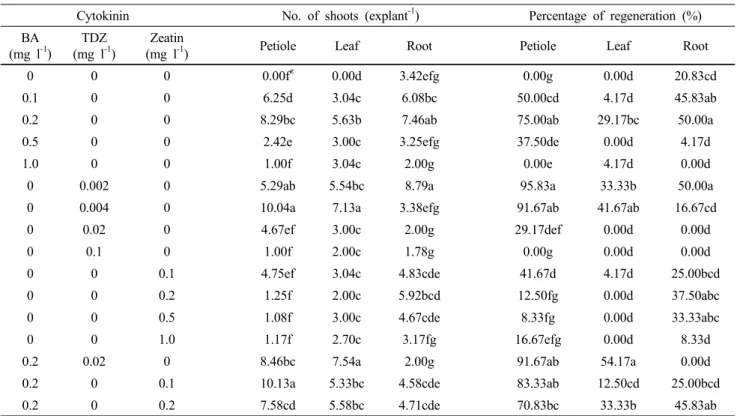
Table 1 Effects of different types and concentrations of cytokinins on shoot regeneration from various tissues of stem-disc culture derived plantlets in P. euramericana ‘I-476’after 4 weeks of culture
Cytokinin No. of shoots (explant-1) Percentage of regeneration (%)
BA (mg l-1)
TDZ (mg l-1)
Zeatin
(mg l-1) Petiole Leaf Root Petiole Leaf Root
0 0 0 0.00fz 0.00d 3.42efg 0.00g 0.00d 20.83cd
0.1 0 0 6.25d 3.04c 6.08bc 50.00cd 4.17d 45.83ab
0.2 0 0 8.29bc 5.63b 7.46ab 75.00ab 29.17bc 50.00a
0.5 0 0 2.42e 3.00c 3.25efg 37.50de 0.00d 4.17d
1.0 0 0 1.00f 3.04c 2.00g 0.00e 4.17d 0.00d
0 0.002 0 5.29ab 5.54bc 8.79a 95.83a 33.33b 50.00a
0 0.004 0 10.04a 7.13a 3.38efg 91.67ab 41.67ab 16.67cd
0 0.02 0 4.67ef 3.00c 2.00g 29.17def 0.00d 0.00d
0 0.1 0 1.00f 2.00c 1.78g 0.00g 0.00d 0.00d
0 0 0.1 4.75ef 3.04c 4.83cde 41.67d 4.17d 25.00bcd
0 0 0.2 1.25f 2.00c 5.92bcd 12.50fg 0.00d 37.50abc
0 0 0.5 1.08f 3.00c 4.67cde 8.33fg 0.00d 33.33abc
0 0 1.0 1.17f 2.70c 3.17fg 16.67efg 0.00d 8.33d
0.2 0.02 0 8.46bc 7.54a 2.00g 91.67ab 54.17a 0.00d
0.2 0 0.1 10.13a 5.33bc 4.58cde 83.33ab 12.50cd 25.00bcd
0.2 0 0.2 7.58cd 5.58bc 4.71cde 70.83bc 33.33b 45.83ab
zMean separation within columns by Duncan’s multiple range test at 5% level.
Fig. 2 Adventitious shoot formation from various explants of P. euramericana on ½ MS medium with 0.2 mg l-1 BA and 0.1 mg l-1 zeatin from (A) leaf segment, (B) petiole, and (C) root segment
Table 2 Effect of AgNO3 and CoCl2 concentrations on shoot regeneration of P. euramericana ‘I-476’ after 4 weeks of culture
Treatment (mg l-1) Shoot regeneration Shoot elongation
No. of shoots (explant-1) Shoot regeneration (%) No. of shoots (explant-1) Shoot elongation (%)
Control 0.0 15.88abz 86.67ab 5.19ab 80.17b
AgNO3 3.0 15.50ab 71.11ab 7.95ab 95.24ab
5.0 17.47ab 80.00ab 7.63ab 90.45ab
10.0 16.58ab 73.33ab 6.39ab 91.67ab
15.0 9.96b 66.67bc 5.79ab 91.67ab
CoCl2 3.0 17.14ab 91.11a 6.53ab 100.00a
5.0 26.13a 82.22ab 8.54a 97.62ab
10.0 9.00b 55.56c 5.92ab 87.22b
15.0 8.00b 13.33d 5.56ab 84.62b
zMean separation within columns by Duncan’s multiple range test at 5% level.
from the axillary bud culture (Fig. 1C).
Effect of cytokinin and explant type
The effect of cytokinin type and concentration were examined using the clone ‘I-476,’ as it was a good material for bioenergy source with relatively low lignin content among the 5 clones (data not shown). Shoot regeneration was observed after 7 days of culture on the regeneration medium. A concentration of 0.2 mg l-1 BA produced the greatest number of shoots per explant, irrespective of the explant type. A concentration of 0.004 mg l-1 TDZ induced the greatest number of shoots (10.04) with petiole as the explant. A concentration of 0.1 mg l-1 zeatin induced the greatest regeneration when petiole was used (41.67%). When a combination of cytokinins was used, a combination of 0.2 mg/l BA and 0.02 mg l-1 TDZ resulted in the greatest shoot regeneration (91.67%) from the petiole (Table 1).
Effect of AgNO3 and CoCl2
Shoots that had regenerated from explants started to turn
yellow after about 6 weeks on the regeneration medium containing cytokinins, and subsequently they showed necrosis (data not shown). Thus, regenerated shoots with explants were transferred on the ½ MS medium containing AgNO3 and CoCl2 separately. Lower concentrations (3 and 5 mg l-1) of these compounds promoted shoot regeneration and elongation, compared with the control (Table 2). Of these two, CoCl2 at a concentration of 3 mg/l resulted in better shoot regeneration (91.11%) and shoot elongation (100%).
Discussion
In the present study, the five different clone types of P.
euramericana showed different shoot regeneration potential.
Similar findings were reported for strawberry by Passey et al.
(2003), who found that different cultivars respond differently during adventitious shoot regeneration. Interestingly, irrespective of the clone type used, the stem disc culture yielded more regenerated shoots than did nodal culture. Similarly, Nayak et al. (2002) reported an efficient micropropagation system for
Fig. 3 Efficient shoot regeneration from stem-disc culture of P. euramericana ‘I-476.’ Shoot regeneration from cambium region of stem-disc cultured on ½ MS medium containing 0.5 mg l-1 zeatin after (A) 2 weeks and (B) 4 weeks. (C) Shoot elongation after 4 weeks on CoCl2-containing medium. (D) Rooting of regenerated shoots. (E) Acclimatized plants (scale bar = 3 mm)
Cymbidium aloifolium and Dendrobium nobile using thin cross sections of protocorm-like bodies.
Stem disc culture exposes more layers of cambium to the hormones. In the present study, shoot regeneration from the cambium region could be seen in the stem disc culture (Fig.
3A, 3B). Although several studies have explored the behavior of the two primary meristems at the root and shoot apexes, little attention has been paid to the lateral meristem (cambium), which forms the bulk of the biomass of woody plants. The cambium refers to one or several layers of initials that are analogous to the stem cells proposed for other meristems (Larson 1994). Several researchers have focused on the molecular nature of these positional cues (Doerner 2003). During active cell division in the cambium of P. tremula, microarray studies have indicated differential expression of more than 100 genes in a thin cambial zone (Schrader et al. 2004). Further, Laux (2003) proposed that that the fate of stem cells and their derivatives depends on their positional cues rather than their cell lineage.
Among the three types of explants examined in the present study, (petiole, leaf, and roots of in vitro-grown plantlets of clones of P. euramericana), petiole was the best explant, as it resulted in the greatest shoot regeneration and elongation. The hormonal requirements for the three explant types for maximum shoot regeneration also varied. Similarly, Kulkarni et al. (2001)
found that different explant types have different hormonal requirements for shoot regeneration in Withania somnifera.
In the present study, 0.2 mg l-1 BA resulted in good shoot regeneration in all the explant types (Table 1). Khattab (2011) observed a beneficial effect of 0.2 mg l-1 BA on shoot regeneration in Populus hybrids. A concentration of 0.002 mg l-1 TDZ resulted in the greatest shoot regeneration (95.83%) from petiole. Similarly, Sherif and Khattab (2011) reported maximum shoot regeneration from stem internode explants of Populus hybrids at a low TDZ concentration.
The regenerated shoots showed yellowing and necrosis after a few weeks of culture on the cytokinin medium. Nadel et al.
(1992) also observed yellowing of leaves in P. trichocarpa.
Thus, the compounds AgNO3 and CoCl2 were added to the basal medium. Both of these compounds promoted shoot regeneration at low concentrations as they not only stopped the yellowing of leaves but also increased shoot regeneration and elongation. The yellowing of leaves is known to occur due to ethylene production during in vitro culture (Ferrante and Francini 2006). AgNO3 and CoCl2 are known to absorb ethylene and have proved to be beneficial during in vitro culture of several species.
Thus, the present study shows that for highly efficient shoot regeneration of P. euramericana, stem disc culture is a better option than nodal culture. Furthermore, among the different
explant types, petiole produced the best response during shoot regeneration. Also, during shoot regeneration, a combination of the cytokinins BA and TDZ gave better results than the individual cytokinins. The problem of yellowing and necrosis of the in vitro-regenerated shoots was eliminated by using AgNO3 and CoCl2. Therefore, proper manipulation of the medium can result in highly efficient in vitro shoot regeneration in P. euramericana. The high percentage of regenerated shoots obtained from stem disc culture through proper medium manipulation resulted in healthy plantlets (Fig. 3A ~ E). The highly efficient regeneration system of P. euramericana reported here can be used for mass propagation of this recalcitrant, economically important tree species.
Acknowledgments
This study was carried out with the support of ´Forest Science
& Technology Projects (Project No. S121212L030110) provided by Korea Forest Service.
Literature cited
Coleman GD, Ernst SG (1990) Shoot induction competence and callus determination in Populus deltoides. Plant Sci 71:83-92 Doerner P (2003) Plant meristems: A merry-go-round of signals
review. Curr Biol 13:368-374
Elo A, Immanen J, Nieminen K, Helariutta Y. (2009) Stem cell function during plant vascular development. Semin Cell Dev Biol 20:1097-1106
Ferrante A, Francini A (2006) Ethylene and Leaf Senescence. In:
Khan NA (ed) Ethylene action in plants. Springer, Heidelberg, pp 51-67
Kang BG, Osburn L, Kopsell D, Cheng ZM (2009) Micro- propagatiom of Populus trichocarpa ‘Nisqually-1’: the genotype deriving the Populus reference genome. Plant Cell Tiss Org Cult 99:251-257
Khattab S (2011) Effect of different media and growth regulators on the in vitro shoot proliferation of Aspen, hybrid aspen and white poplar male tree and molecular analysis of variants in micropropagated plants. Life Sci J 8:177-184
Kulkarni AA, Thengane SR, Krishnamurthy KV (2001) Direct
shoot regeneration from node, internode, hypocotyls and embryo explants of Withania somnifera. Plant Cell Tiss Org Cult 62:203-209
Larson PR (1994) The vascular cambium: Development and Structure. Springer, Berlin
Laux T (2003) The stem cell concept in plants: A matter of debate.
Cell 113:281-283
Murashige T, Skoog F (1962) A revised medium for rapid growth and bioassay with tabacco cultures. Physiol Plant 15:473-497 Nadel BL, Hazan G, David R, Huttermann A, Altman A (1992) In
vitro propagation of Populus species: response to growth regulators and media composition. Acta Hortic 314:61-68 Nayak NR, Sahoo S, Patnaik S, Rath SP (2002) Establishment of thin
cross section (TCS) culture method for rapid micropropagation of Cymbidium aloifolium (L.) Sw. and Dendrobium nobile Lindl. (Orchidaceae). Sci Hortic 94:107-116
Noel N, Leple JC, Pilate G (2002) Optimization of in vitro micro- propagation and regeneration for Populus × interamerikana and Populus × euramericana hybrids (P. deltoides, P.
trichocarpa and P. nigra). Plant Cell Rep 20:1150-1155 Passey A, Barrett K, James D (2003) Adventitious shoot regeneration
from seven commercial strawberry cultivars (Fragaria × ananassa Duch.) using a range of explants types. Plant Cell Rep 21:397-401
Schrader J, Nilsson J, Mellerowicz E, Berglund A, Nilsson P, Hertzberg M, Sandberg G (2004) A high resolution transcript profile across the wood forming meristem of poplar identifies potential regulators of cambial stem cell identity. Plant Cell 16:2278-2292
Sellmer JC, McCown BH, Haissig BE (1989) Shoot culture dynamics of six Populus clones. Tree Physiol 5:219-227 Sherif FE, Khattab S (2011) Direct shoot regeneration from leaf,
root and stem internode segments of male poplar trees and the molecular analysis of variant regenerated plants. J Amer Sci 7:200-206
Tsvetkov I, Hausman JF, Jouve L (2007) Thidiazuron induced regeneration in root segments of white poplar (P. alba L.).
Bulgarian J Agri Sci 13:623-626
Tuskan GA, DiFazio S, Jansson S (2006) The Genome of Black Cottonwood, Populus trichocarpa (Torr. & Gray). Science 313:1596-1604
Wullscheleger SD, Jansson S, Taylor G (2002) Genomics and Forest Biology: Populus emerges as the perennial favourite.
Plant Cell 14:2651-2655