Original Article
J
Comparison of Both Legs EMG Symmetry during Over-Ground Walking and Stair Walking in Stroke Patients
Mu-Geun Jeong1, Joong-Hwi Kim2
1Department of Physical Therapy, General Graduate School, Catholic University of Daegu; 2Department of Physical Therapy, College of Medical Science, Catholic University of Daegu, Gyeongsan, Korea
Purpose: Gait is the most basic element when evaluating the quality of life with activities of daily living under ordinary life circumstanc- es. Symmetrical use of the lower extremities requires complicated coordination of all limbs. Thus, this study examined asymmetry of muscle activity quadriceps femoris and tibialis anterior as a baseline for training during over-ground walking and stair walking of stroke patients.
Methods: Subjects were 14 stroke patients included as one experimental group. Gait speed used in this study was determined by the subject. Low extremity paretic and non-paretic EMG was compared using the surface EMG system.
Results: The low extremity EMG difference was statistically significant during over-ground walking and stair walking (p< 0.05). The re- sult of low extremity EMG substituted symmetry ratio formula was compared to EMG symmetry ratio in both legs during over-ground walking and stair walking. The average symmetry ratio of quadriceps femoris during over-ground walking was 0.65, and average symme- try ratio of quadriceps femoris during stair walking was 0.47, with significant difference (p< 0.05).
Conclusion: EMG data was higher in stair walking than over-ground walking. However, in the comparison of symmetry ratio, asymmetric EMG of quadriceps femoris was significantly increased during stair walking. These findings suggested that application of stair walking for strengthening of both legs can be positive, but the key factor is maintaining asymmetrical posture of both legs. Therefore, physical thera- pists should make an effort to reduce asymmetry of quadriceps femoris power during stair walking by stroke patients.
Keywords: Stroke, Stair walking, Electromyography, Symmetry
INTRODUCTION
Gait is the most basic element when evaluating the quality of life with activities of daily living (ADL) under ordinary life circum- stances.1 As a basic and efficient method of locomotion, gait is the most important aspect when considering ability to live better life. It comprises most functional activities in daily life. The recovery of gait ability is essential to functional recovery during rehabilitation of stroke patients.2
Because of muscle weakness and abnormal gait cycle, the stroke patients have a short stance phase and long swing phase of paretic.
Slow gait pace and decreased balance are also observed.3 The factors of decreased balance in stroke patients include decreased proprio-
ception, delayed reflexes, failed postural control due to muscle weakness and control decreased, decreased coordination in ankle as well as knee and decreased flexibility.4 The hemiplegic patients affected by stroke show very high instability in the one leg stand as paretic during gait because of decreased mechanical torque of low extremity.5 The physiological problems that appear in the low ex- tremity of stroke patients are insufficient voluntary muscle contrac- tion ability, lack of control of muscle activity intensity, and decreased motor unit during muscle contraction. These factors reduce the gait quality and gait pace. Muscle weakness of low extremity after stroke is the most common aftereffect. Functional disability is a problem despite prolonged concentrated rehabilitation of patients after a se- vere stroke.6
Vol. 27, No. 4, August 2015 pISSN 1229-0475 eISSN 2287-156X
JKPT
Received Jul 23, 2015 Revised Aug 18, 2015 Accepted Aug 20, 2015
Corresponding author Joong-Hwi Kim E-mail [email protected]
Copylight © 2015 The Korea Society of Physical Therapy
This is an Open Access article distribute under the terms of the Creative Commons Attribution Non-commercial License (Http:// creativecommons.org/license/by-nc/3.0.) which permits unrestricted non-commercial use, distribution,and reproduction in any medium, provided the original work is properly cited.
J Kor Phys Ther 2015:27(4):228-233
http://dx.doi.org/10.18857/jkpt.2015.27.4.228
Recently, study suggests that chronic stroke patients appearance of atrophy and weakness in the affected leg.7 The resistance training for muscle strengthening improves muscle strength as well as per- formance of functional activity. Hence, strength training of variable way are recognized as important to stroke patients’ function and gait recovery.7,8 Therefore, increase in low extremity EMG of stroke patients has a positive effect on stride length, swing time, relief of asymmetric weight support and is one of the most important ele- ments to determine patients’ independent daily life and gait ability.9
Stair walking training in performing ADL is an essential element that lead to patient independence. Performing stair walking train- ing improves the quality of life and is important to recovery of low extremity ability in stroke patients during the treatment process.10 Healthy adults was reported in the stair walking at much more ex- tensor moment, as compared to flexor moment in low extremity and more extensor moment in knee joint and hip joint, as com- pared to the ankle.11 Walking ramps and stair walking pressure ex- erted on the knee joint during is about 4.25 times bigger appeared in body weight was reported in the stair walking.12
Symmetrical use of the low extremity requires complicated coor- dination of all limbs. Hence, the damage in coordination of stroke patients changes the gait pattern asymmetrically.13 When stroke pa- tients stand up unassisted, they show asymmetric weight support, and try hard to perform their task despite muscle weakness.14 Stair walking strengthens the quadriceps femoris muscle performance and weight support training through upper movement in stroke pa- tients. Thus, in this study examined asymmetry of muscle activity quadriceps femoris and tibialis anterior as a baseline of training during over-ground walking and stair walking of stroke patients.
METHODS
1. Subjects
This study was conducted on 14 stroke patients who received reha- bilitation by computed tomography (CT) or magnetic resonance imaging (MRI) from February to March 2015. Subjects who fit the following criteria were included in the study, first time stroke, more than three months after onset, no use of a stick, ability to walk over 6m, more than 24 points in MMSE-K (mini-mental state examina- tion-Korea version), and ability to understand the researchers’ re- quirements and perform. Subjects who had arthroplasty and bro-
ken bones or nerve disease were excluded from the trial.
2. Experimental methods
All participants were informed about the trial and filled out the agreement form. If they were unable to provide a signature, a repre- sentative signed for them. After investigating basic information such as patient age, cause of disease, and paresis, subjects participat- ed in the experiment as one group. Subjects practiced walking for 5 minutes to accustom at the laboratory. Gait speed used in this study was to determine by themselves. The stairs were used as the test de- sign for the rehabilitation of stroke patients. The dimensions of the stairs were 100 cm in width, 30 cm tread length, and 12 cm in height. electromyography (EMG) data during stair walking was used to average value of three times measurements by manufac- tured stairs. Guide rail is not used in consideration of the stabiliza- tion reaction force by the hand. Results of the test were not shared between subjects and the order of measurement was also random (Figure 1).
1) Measurement (1) Surface EMG system
FREE EMG (BTS Co. Italy) was used for measuring low extremity
Figure 1. Stair walking on manufactured stairs.
Mu-Geun Jeong, et al.
JKPT The Journal of Korean Physical Therapy
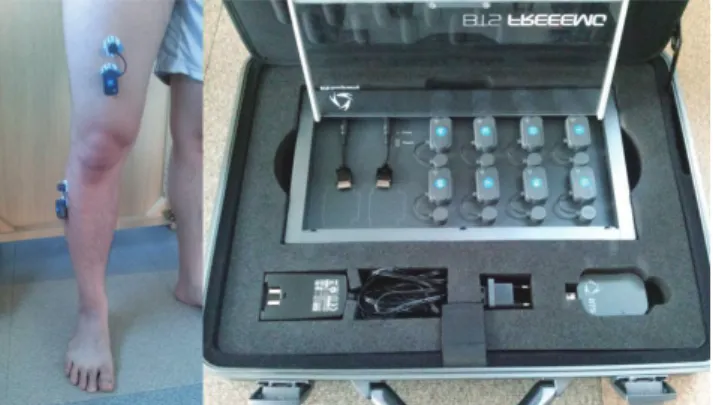
EMG. The converted digital signal was processed using MYOLAB (software, BTS Co, Italy) on a personal computer. Signal sampling rate was set as 1,024 Hz, and BPF (band pass filter) of 20-500 Hz was used to minimize the noise. The collected signal was processed to root mean square (RMS). Surface electrodes on muscles were fixed for measuring EMG. At this time, all hair near the part to be mea- sured was removed and then wiped with medical alcohol to reduce error. Electrodes were attached to the quadriceps femoris and tibia- lis anterior. The electrodes were attached to the muscle belly for measurement of EMG during over-ground walking and stair walk- ing. The maximum of RMS in quadriceps femoris and tibialis ante- rior during stance phase was measured and recorded. To reduce the measurement error, subjects rested every 5 minutes and the average value of 3 measurements was used (Figure 2).
(2) Symmetry ratio
The EMG results of quadriceps femoris and tibialis anterior were substituted with symmetry ratio’s formula for easy determination of the symmetry ratio of paretic and non-paretic. The symmetry ratio formula was as follows.15 Symmetry ratio=paretic side (parameter value)/non-paretic side (parameter value).
Thus, when symmetry ratio was 1, paretic and non-paretic was completely symmetrical and if the result were different from 1, sym- metry ratio would be large. If symmetry ratio was >1, paretic value was higher than non-paretic’s, and if it was <1, non-paretic value was higher than paretic’s.
2) Statistical analysis
SPSS version19.0 was used for all statistical analyses. Paired t-test was conducted to compare quadriceps femoris with tibialis anterior
EMG, by subject. Paired t-test was conducted on quadriceps femoris with tibialis anterior symmetry ratio, by subject. Statistical signifi- cant level of the study was < 0.05.
RESULTS
1. General characteristics of subjects
The 14 subjects who were diagnosed with stroke were 64.3% male and 35.7% female. The cause of disease was 50% of brain hemor- rhage, 50% of cerebral infarction, and paralysis was 50% of right for hemiplegia and 50% of left for hemiplegia (Table 1). Average age of subject was 50.4 years. Average disease period of subjects was 8.7 months.
2. The comparison of EMG for each trial on over-ground walking and stair walking
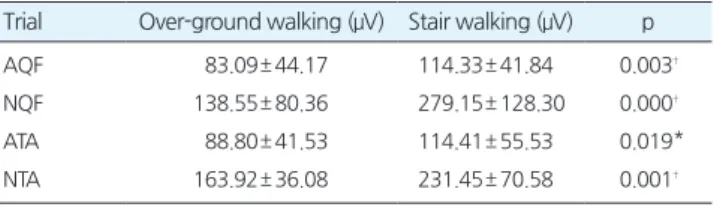
The extent of low extremity EMG of paretic and non-paretic was compared using the surface EMG system during over-ground walking and stair walking. The EMG average of paretic’s quadriceps femoris during over-ground walking was 83.09 μV, and the EMG average of paretic’s quadriceps femoris during stair walking was 114.33 μV, with significant difference (p< 0.05). The EMG average of non-paretic’s quadriceps femoris during over-ground walking was 138.55 μV, and the EMG average of non-paretic’s quadriceps femoris during stair walking was 279.15 μV, with significant difference (p< 0.05). The EMG average of paretic’s tibialis anterior during over- ground walking was 88.8 μV, and the EMG average of paretic’s tibi- alis anterior during stair walking was 114.41 μV, with significant difference (p< 0.05). The EMG average of non-paretic’s tibialis ante- rior during over-ground walking was 163.92 μV, and the EMG aver- age of paretic’s tibialis anterior during stair walking was 231.45 μV, with significant difference (p< 0.05) (Table 2).
Table 1. General characteristics of subjects (N= 14)
Characteristic N Percent (%)
Gender Male 9 64.3
Female 5 35.7
Factor Hemorrhage 7 50.0
Infarction 7 50.0
Affected side Right 7 50.0
Left 7 50.0
Figure 2. Attached surface electrodes & FREE EMG (BTS Co. Italy).
3. The comparison of symmetry ratio for each trial on over- ground walking and stair walking
The result of low extremity EMG substituted symmetry ratio for- mula was compared to EMG symmetry ratio in both legs during over-ground walking and stair walking. The symmetry ratio aver- age of quadriceps femoris during over-ground walking was 0.65, and symmetry ratio average of quadriceps femoris during stair walking was 0.47, with significant difference (p< 0.05). The symme- try ratio average of tibialis anterior during over-ground walking was 0.54, and symmetry ratio average of tibialis anterior during stair walking was 0.51, without significant difference (Table 3).
DISCUSSION
The gait ability of hemiplegic stroke patients is most highly regarded by the patients’ family and the patients themselves. Recovery of gait ability is thus the most important target in rehabilitation of stroke patients.16 But stroke patients assume an asymmetric position by supporting below 25-43% of weight in the low extremity of the af- fected side in standing position.17 Lack of exercise intensity has a bad influence on patient balance and gait ability; and walking pattern asymmetry such as severe difference of left and right’s stride is in- creased during gait.18 So temporal gait variable that is symmetry ra- tio of the time in one leg stand, step on the ground and, spatial gait variable that is symmetry ratio of step length in the gait of stroke patients is affected by functional balance and gait.19
The effect of muscle strengthening exercise of stroke has been studied. Furthermore, studies on quadriceps femoris in over- ground walking, standing, and balance of patients, are ongoing.20 Stair walking is one way of muscle strengthening that shows lots of movement in non-paretic and paretic in stroke patients; and gait
training was required to increase paretic’s muscle strength and movement in stairs and ramps as part of the exercise program.21 Stair walking was very stable at gait ability test in research on stair walking performance tests and was suitable for estimating diverse aspects of stroke patients’ gait performance.22
In this study, a comparison was made between paretic’s low ex- tremity muscle activity and non-paretic’s low extremity muscle ac- tivity using surface EMG system during over-ground walking and stair walking. As a result, statistically EMG of over-ground walking and stair walking in quadriceps femoris and tibialis anterior paretic and non-paretic was significantly different (p< 0.05); and it was higher than over-ground walking for stair walking. Because extent of muscle activity was higher in stair walking than over-ground walking, we can expect more muscle activity during stair walking training. The result of low extremity EMG substituted symmetry ratio formula was compared to EMG symmetry ratio in both legs during over-ground walking and stair walking. As a result, the symmetry ratio average of quadriceps femoris during over-ground walking was 0.653, and symmetry ratio average of quadriceps femo- ris during stair walking was 0.465, with significant difference (p< 0.05). The result showed that muscle activity asymmetry during stair walking was increased. Thus, when symmetry ratio was 1, pa- retic and non-paretic was completely symmetrical and if the result was far from 1, symmetry ratio would be large.
Stair walking is very often used by means of movement with over-ground walking and requires more power of low extremity and muscle strengthening than over-ground walking because of horizontal migration and perpendicular ascent during maintaining body balance.23 Over-ground walking appears as repeating inter- sectional feet movement and placing both feet together on the ground. However, each step starts from toe and sole, rather than the heel, and all power is required by antigravity of weight. Stair walk- ing is required a lot body balance and legs power. So kinematic ef- fort is more required in stair walking than over-ground walking.24,25
Table 2. The comparison of EMG for each trial at Over-ground walking
and stair walking (N= 14)
Trial Over-ground walking (μV) Stair walking (μV) p
AQF 83.09± 44.17 114.33± 41.84 0.003†
NQF 138.55± 80.36 279.15± 128.30 0.000†
ATA 88.80± 41.53 114.41± 55.53 0.019*
NTA 163.92± 36.08 231.45± 70.58 0.001†
*p<0.05, †p< 0.01.
AQF, Affected side of Quadriceps Femoris; NQF, Non-affected side of Quadri- ceps Femoris; ATA, Affected side of Tibialis Anterior; NTA, Non-affected side of Tibialis Anterior.
Table 3. The comparison of symmetry ratio for each trial at Over-
ground walking and stair walking (N= 14)
Trial Over-ground walking Stair walking p
QF 0.65± 0.21 0.47± 0.21 0.004†
TA 0.54± 0.22 0.51± 0.28 0.662
*p<0.05, †p< 0.01.
QF, Quadriceps Femoris; TA, Tibialis Anterior.
Mu-Geun Jeong, et al.
JKPT The Journal of Korean Physical Therapy
Use of low extremity is asymmetrically increased in stroke patient , and they try hard to perform their task despite muscle weakness.
Another research indicates that the stroke patients who have walk- ing difficulty make more rapid recovery on over-ground walking than stair walking and it is uncertain whether it is better to climbing stairs.26 As the similar study, there was research of locomotor limita- tion in stroke patients about muscle weakness and decrease aerobic ability.27 The recent studying of clinical assessment for stair walking qualitative research is performed.28
Stroke patients have asymmetric gait cycle by decline in optional muscle control and joint exercise patterns. To correct the gait pat- tern, increase of muscle activity and recovery of gait symmetry ratio have to be set, and effective exercise method is to be considered. To stimulate functional recovery, activity of daily living, using paretic limbs spontaneously and balance and physical intelligence are all improved through weight movement and load exercise. Walking speed and treatment that puts emphasis on paretic and non-paretic’
s symmetry ratio can improve functional independence.29,30 In this study, using surface EMG system for over-ground walking and stair walking in stroke patients, the extent of paretic and non- paretic’s low extremity EMG is compared and the EMG’s result is substituted for symmetry ratio’s formula; hence, EMG’s symmetry ratio is compared in both legs. As a result, EMG data was higher in stair walking than over-ground walking. EMG data in stair walking is increased significantly, and application makes low extremity EMG higher. But asymmetric EMG data of quadriceps femoris is increased significantly during stair walking in the comparison of symmetry ratio. In conclusion, stair walking application for strengthening of both legs can be positive, but the key factor is maintaining symmetrical posture in both legs and gait training is used when the stroke patients need according to asymmetric in- creased EMG of quadriceps femoris. Therefore, physical therapists need to effort to reduce asymmetry of quadriceps femoris power during stair walking to stroke patients. Future research is also nec- essary comparing additional kinematic values of over-ground walk- ing and stair walking, clinical trials will be needed on efficient and effective ways of stair walking in stroke patients.
REFERENCES
1. Roerdink M, Lamoth CJ, Kwakkel G et al. Gait coordination after stroke, benefits of acoustically paced treadmill walking. Physical Therapy.
2007;87(8):1009-22.
2. Katz-Leurer M, Shochina M. Early cycling test as a predictor of walking performance in stroke patients. Physiotherapy Research International.
2005;10(1):1-9.
3. Hong SI, Bang DH, Shin WS. Effects of Side Walking Training with Elastic-Band on Gait and Balance of Stroke Patients. J Kor Phys Ther.
2014;26(5):372-8.
4. Nitz JC, Choy NL. The efficacy of a specific balance-strategy training programme for preventing falls among older people, a pilot randomised controlled trial. Age and ageing. 2004;33(1):52-8.
5. Nott CR, Neptune RR, Kautz SA. Relationships between frontal-plane angular momentum and clinical balance measures during post-stroke hemiparetic walking. Gait & posture. 2014;39(1):129-34.
6. Newham DJ, Hsiao S-F. Knee muscle isometric strength, voluntary acti- vation and antagonist co-contraction in the first six months after stroke.
Disability & Rehabilitation. 2001;23(9):379-86.
7. Kim CY, Lee JS, Kim HD et al. The effect of progressive task-oriented training on a supplementary tilt table on lower extremity muscle strength and gait recovery in patients with hemiplegic stroke. Gait &
posture. 2015;41(2):425-30.
8. Chung YJ, Kim JH, Cha YR et al. Therapeutic effect of functional electri- cal stimulation-triggered gait training corresponding gait cycle for stroke. Gait & posture. 2014;40(3):471-5.
9. Dunsky A, Dickstein R, Marcovitz E et al. Home-based motor imagery training for Gait rehabilitation of people with chronic poststroke hemi- paresis. Archives of physical medicine and rehabilitation. 2008;89(8), 1580-8.
10. Kim YS. Muscle Activation Pattern of Stair Gait in Hemiparetic Patients Using Surface Electromyography. Journal of Adapted Physical Activity.
2006;14(1):1-15.
11. Eun SD, Lee KK, Seo JS. The study on the Gait pattern in stair-ascent ac- tivity of elderly persons. J Sport Leis Stud. 2004;22:511-22.
12. Kim YS, Kim EJ, Seo CJ. The comparative analysis of EMG and Gait pat- terns of lower extremities during going up stairs and down. Korean J Phys Educ. 2006;45:535-45.
13. Jansen K, De Groote F, Duysens J et al. Muscle contributions to center of mass acceleration adapt to asymmetric walking in healthy subjects. Gait
& posture. 2013;38(4):739-44.
14. Brière A, Nadeau S, Lauzière S et al. Knee efforts and weight-bearing asymmetry during sit-to-stand tasks in individuals with hemiparesis and healthy controls. Journal of Electromyography and Kinesiology. 2013;
23(2):508-15.
15. Patterson KK, Gage WH, Brooks D et al. Evaluation of Gait symmetry after stroke, a comparison of current methods and recommendations for standardization. Gait & posture. 2010;31(2):241-6.
16. Eich HJ, Mach H, Werner C et al. Aerobic treadmill plus Bobath walking training improves walking in subacute stroke, a randomized controlled trial. Clinical rehabilitation. 2004;18(6):640-51.
17. Yang YR, Chen YC, Lee CS et al. Dual-task-related Gait changes in indi- viduals with stroke. Gait & posture. 2007;25(2):185-90.
18. Brown LA, Sleik RJ, Winder TR. Attentional demands for static postural control after stroke. Archives of physical medicine and rehabilitation.
2002;83(12):1732-5.
19. Kim JH. Relationship Between Gait Symmetry and Functional Balance, Walking Performance in Subjects with Stroke. J Kor Phys Ther. 2014;
26(1):1-8.
20. Clark DJ, Condliffe EG, Patten C. Reliability of concentric and eccentric torque during isokinetic knee extension in post-stroke hemiparesis.
Clinical Biomechanics. 2006;21(4):395-404.
21. Cheon DW. Kinematic Analysis of Lower Extremities during Staris and Ramp Walking with Hemiplegic Patients. J Kor Phys Ther. 2013;25(5), 297-302.
22. Flansbjer UB, Holmbäck AM, Downham D et al. Reliability of Gait per- formance tests in men and women with hemiparesis after stroke. Journal of rehabilitation medicine, official journal of the UEMS European Board of Physical and Rehabilitation Medicine. 2005;37(2):75-82.
23. Park JW, Kim YJ. A Study on Changes in Knee Joint Loading during Stair Gait with Unstable Shoes. J Kor Phys Ther. 2014;26(2):74-81.
24. Han JT, Hwang BG. Kinematic Analysis of Lower Extremities during Stairs and Ramp Climbing with Older Adults. Korean Journal of Sport Biomechanics. 2009;19(3):435-48.
25. Christina KA, Cavanagh PR. Ground reaction forces and frictional de- mands during stair descent, effects of age and illumination. Gait & pos-
ture. 2002;15(2):153-8.
26. Kankanala V, Gunen EA, Ikenna IE. Comparative effect of interval and continuous training on walking Gait of stroke patients. British Journal of Sports Medicine. 2010;44(Suppl 1):i15-i.
27. Novak AC, Brouwer B. Strength and aerobic requirements during stair ambulation in persons with chronic stroke and healthy adults. Archives of physical medicine and rehabilitation. 2012;93(4):683-9.
28. Natalio MA, Faria CD, Teixeira-Salmela LF et al. Content validation of a clinical assessment instrument for stair ascent and descent in individuals with hemiparesis. Brazilian journal of physical therapy. 2014;18(4):353- 63.
29. Page SJ, Sisto S, Johnston MV et al. Modified constraint-induced therapy in subacute stroke, a case report. Archives of physical medicine and re- habilitation. 2002;83(2):286-90.
30. Eng JJ, Chu KS, Kim CM et al. A community-based group exercise pro- gram for persons with chronic stroke. Medicine and science in sports and exercise. 2003;35(8):1271.