Clinical Characteristics of Patients with Taste Disorders
Eun-Jin Lee, D.D.S., Won-Kyu Park, D.D.S.,M.S.D.,Ph.D., Jin-Woo Nam, D.D.S.,M.S.D.,Ph.D., Jong-Il Yun, D.D.S.,M.S.D.,Ph.D.,
Hong-Seop Kho, D.D.S.,M.S.D.,Ph.D.
Dept. of Oral Medicine & Oral Diagnosis,
School of Dentistry & Dental Research Institute, Seoul National University,
There is tremendous variability in the ways patients present with taste problems. Because of complex and multifactorial etiological background, it is not simple to evaluate patients with taste disorders. Accurate assessment of patients' status by prudent, thorough history taking and symptom analysis is the most essential for exact diagnosis of taste disorders. The aim of this study was to investigate the clinical characteristics of patients with taste problems as a primary complaint. Consecutive series of 50 patients (12 males and 38 females, mean age 53.6 ± 14.7 years) were included for the present study. All subjects were requested to complete a comprehensive questionnaire. Clinical evaluation procedures included oral examination, interview, questionnaire analysis, panoramic radiography, blood test and measurement of salivary flow rate.
The obtained results were as follows:
1. Among the patients, 36 patients (72%) complained of oral mucosal pain or burning sensation. Of these patients, 18 patients (36%) were diagnosed as burning mouth syndrome.
2. Nineteen patients (38%) complained of subjective oral dryness. The flow rate of unstimulated whole saliva was less than 0.1 mL/min in 14 patients (28%) and 17 (34%) had a stimulated whole salivary flow rate of less than 0.5 mL/min.
3. Among the types of taste disorders, hypogeusia, the most frequently reported, was found in 25 patients (50%), dysgeusia in 18 patients (36%), phantogeusia in 15 patients (30%), hypergeusia in 10 patients (20%), and ageusia in 5 patients (10%). Nineteen patients (38%) reported more than one type of taste disorder and the most frequent combination was dysgeusia + hypogeusia (n=6, 12%).
4. Based on data from the medical and dental histories and examinations, the patients were assigned to 12 probable causal categories. Taste disorders due to oral mucosal diseases and idiopathic taste disorder were the most frequent (n=9; 18%, each), followed by psychogenic taste disorder (n=8; 16%), drug-induced taste disorder (n=7; 14%), and taste disorder due to dry mouth (n=6; 12%). These 5 categories of taste disorder accounted for 78% of all cases in this study.
Key words: Taste disorder, Clinical characteristics, Burning mouth syndrome
Corresponding author: Hong-Seop Kho
Dept. of Oral Medicine and Oral Diagnosis, School of Dentistry & Dental Research Institute, Seoul National University, Yunkeun-Dong 28, Chongro-Ku, Seoul 110-749, Korea (ROK) Tel: +82-2-2072-3989
Fax: +82-2-744-9135 E-mail: [email protected] Received: 2009-08-28 Accepted: 2009-09-29
* This study was supported by a grant of the Korea Healthcare technology R&D Project, Ministry for Health, Welfare
& Family Affairs, Republic of Korea. (A080035)
Ⅰ. INTRODUCTION
Taste sensation plays a crucial role in selecting and ingesting foods with different qualities which convey information about their nutrient content and/or safety. Patients who experience changed or distorted taste sensations can either avoid food, resulting in weight loss and possible malnutrition, or, on the contrary, ingest an excessive quantity of food in order to compensate for lack of flavor causing health impairment from excessive sugar or salt intake. This is potentially hazardous especially in the older age groups, where diabetes mellitus, hypertension, and cardiac disease are more prevalent.
1,2)Water-soluble chemicals contained in meal get dissolved by saliva or water and stimulate receptor cells of taste buds. Then peripheral gustatory information is transmitted from the taste buds to the central nervous system primarily by cranial nerve VII (facial), IX (glossopharyngeal), and X (vagus). However, recognition of taste can be operated not only by stimulation of taste buds.
Primary tastes (i.e. sweet, sour, bitter, and salty) combine with texture, temperature, and odor to produce a flavor that allows us to identify what we are eating. In addition, it can be also affected by psychological status. Therefore, it is considered that taste is an extremely complex polymodal sensation.
3,4)Taste function can be affected by numerous factors. Many researchers have reported about the influence of aging and gender on taste function.
Oral conditions related to taste problems include dry mouth, poor oral hygiene, ill fitting prosthetic appliances, chemical exposure (e.g. dentifrice, gargling solution, smoking, solvents, metals, toxicants), and oral mucosal diseases (e.g. localized inflammation, candidiasis, lichen planus). Taste dysfunction could be caused by damage to the peripheral (e.g. surgical procedures such as tonsillectomy, middle ear surgery, and surgical tooth extraction) or central nervous system (e.g.
head trauma, brain tumor, and stroke). Various systemic conditions such as liver failure, uremia,
diabetes, thyroid disease, endocrinological status (e.g. menopause, pregnancy), nutritional status, autoimmune diseases, and certain medications are known to affect taste perception.
5-9)Because of complex and multifactorial etiological background, it is not simple to evaluate patients with taste disorders. Even though a number of methods are being used to measure it such as whole-mouth test using chemical solution, regional test using filter paper disc and electrogustometry, taste testing is less practical in chair-side situation, largely due to time considerations and general lack of commercial availability and well-validated taste tests. Accurate assessment of patients' status by prudent, thorough history taking and symptom analysis is the most essential for exact diagnosis of taste disorders.
There is tremendous variability in the ways patients present with taste problems. The range of disturbances include: (1) perceived loss or diminution of function, (2) the distortion of everyday flavors, (3) persistent abnormal taste sensations in the absence of taste stimuli, and (4) syndromes of pain with or without taste triggers.
10)These various types of taste disturbances can be symptoms of neurological derangement and there are various causes ranging from oral diseases to general disorders. A lack of trace elements, such as zinc, is considered to be one of the major causes of the disease.
Taste disorders, compared to other sensory organ disorders (e.g. auditory or visual dysfunction), have not been paid attention for a long time. Recently, as the number of people considering the quality of life as a crucial element increase, more patients suffering from taste disorders tend to visit clinics seeking help. However, there has been insufficient research about clinical symptoms and characteristics of the patients with taste problems, with only a limited number of clinical case studies published.
The aim of this study was to investigate the clinical
characteristics of patients complaining of taste
problems as a primary complaint.
Ⅱ. MATERIALS AND METHODS 1. Participants
The study population consisted of patients who consecutively visited the Department of Oral Medicine, Seoul National University Dental Hospital with the complaining of taste problems as a chief complaint during the past three years (from November 2005 to August 2008). Finally 50 patients were included for the present study. The research protocol was approved by the Institutional Review Board of the University Hospital (#CRI08018) 2. Clinical evaluation
Clinical evaluation procedures included oral examination, interview, questionnaire analysis, panoramic radiography, blood test, and measurement of salivary flow rate.
Patient interview was performed to get information about not only clinical history (e.g.
onset, timing, severity, suspecting cause, prior treatments, and their efficacy) of subjective taste problem, but also each patient's oral and systemic conditions like his or her current health, medical history, medications, recent dental procedures or surgeries, and other oral symptoms like oral pain, or burning, and dryness of the mouth.
3. Measurement of stimulated and unstimulated whole salivary flow rates
Saliva was collected by a standard, reproducible method. Briefly, samples from the subjects were collected between 9:00 a.m. - 11:00 a.m. to minimize diurnal variability in salivary composition. All subjects abstained from smoking, eating, and drinking for 2 h prior to the measurement of salivary flow rate. Unstimulated whole saliva (UWS) was collected for 10 min by the spitting method. Stimulated whole saliva (SWS) was collected for 5 min by habitual chewing 1 g of gum base. The flow rate of whole saliva was expressed as mL/min.
4. Laboratory tests
Laboratory tests were done to evaluate any possible systemic conditions affecting taste sensation such as liver failure, uremia, diabetes, decreased serum zinc level. The tests included complete blood counts with leukocyte differential counts, erythrocyte sedimentation rate, blood glucose, liver function tests (total protein, albumin, total bilirubin, alkaline phosphatase, aspartate aminotransferase (AST), alanine aminotransferase (ALT), cholesterol), kidney function tests (blood urea nitrogen, creatinine), calcium, phosphorus, zinc and magnesium levels.
5. Questionnaire
On the initial visit to the clinic, each patient was asked to fill out a questionnaire. The questionnaire, modified version of the Smell and Taste Center Questionnaire used at the University of Pennsylvania, comprised four sections: 1, General information (questions regarding demographics, referral source, and drinking and eating habits); 2, Medical history (listing of major illnesses and injuries, hospital admissions, medications taken in the year prior to and since symptom onset); 3, Smell symptoms (questions concerning problems with the sense of smell, general nasal health and abnormal nasal sensations, including nasal obstruction and rhinorrhea); 4, Taste symptoms (questions related to problems with the sense of taste, general oral health, and abnormal oral sensation).
6. Types of taste disorders
The system used to classify taste disorders in
this study was based on the types of gustatory
complaints according to the questionnaire and
interview. The term ageusia is used for complete
loss of taste, hypogeusia for diminished sense of
taste, hypergeusia for enhanced gustatory
sensitivity, dysgeusia for distorted taste perception,
and phantogeusia for persistent abnormal taste
sensation in the absence of taste stimulation.
Ⅲ. RESULTS 1. Characteristics of patients
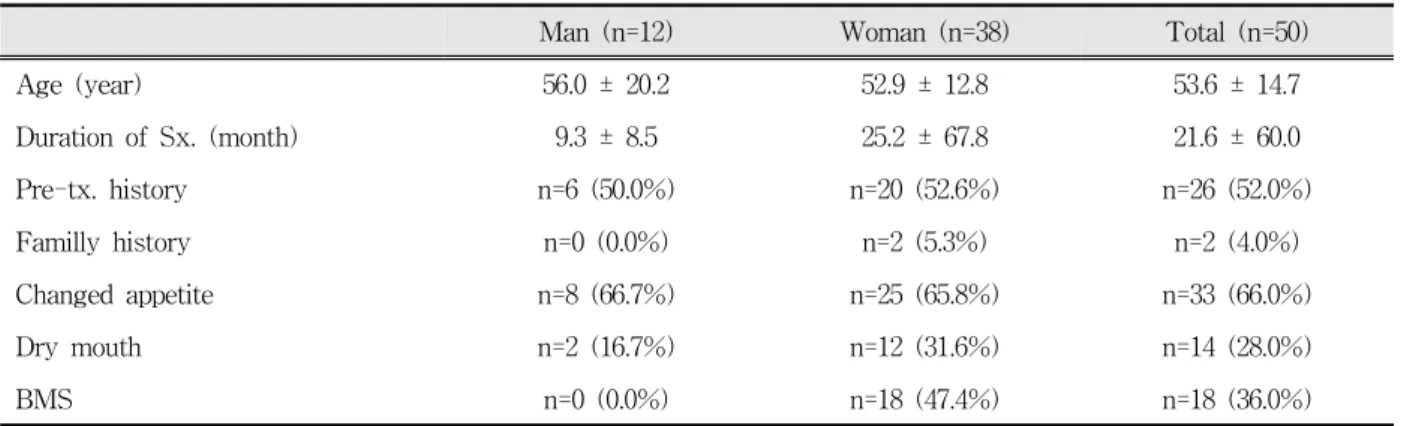
Consecutive series of 50 patients (12 males and 38 females, a male:female ratio of 1:3.2, mean age 53.6 ± 14.7 years) were included for the present study (Table 1). As shown in Figure 1, the majority (32%) of the patients were aged 51-60 years at their first examination for taste disorders.
Thirty patients (60%) were referred from other clinics (dentistry, otolaryngology, neurology, internal medicine, and neuropsychiatry). Among the rests who decided to receive a treatment for themselves, there were eight patients (16%) informed by the media (e.g. internet, TV, newspaper) and 7 patients (14%) by the people around them (e.g. family member, friend).
Twenty-six patients (52%) had received treatments for the taste problem from other doctors before. Among them, sixteen patients (32%) were treated by otolaryngologists, fourteen (28%) by dentists, and seven (14%) by physicians. Other medical specialists such as psychiatrists, family physicians were also reported.
Table 2 shows the patient's medical conditions and various medications taken by the patients. With regard to related conditions, twenty patients (40%) reported a history of nasal, sinus or respiratory
Man (n=12) Woman (n=38) Total (n=50)
Age (year) 56.0 ± 20.2 52.9 ± 12.8 53.6 ± 14.7
Duration of Sx. (month) 9.3 ± 8.5 25.2 ± 67.8 21.6 ± 60.0
Pre-tx. history n=6 (50.0%) n=20 (52.6%) n=26 (52.0%)
Familly history n=0 (0.0%) n=2 (5.3%) n=2 (4.0%)
Changed appetite n=8 (66.7%) n=25 (65.8%) n=33 (66.0%)
Dry mouth n=2 (16.7%) n=12 (31.6%) n=14 (28.0%)
BMS n=0 (0.0%) n=18 (47.4%) n=18 (36.0%)
Dry mouth: flow rate of unstimulated whole saliva ≤ 0.1 mL/min BMS: burning mouth syndrome
Table 1. Characteristics of the patients
problems, six patients (12%) of otolaryngologic surgery, twenty-two patients (44%) of oral surgery including tooth extraction, and sixteen patients (32%) reported to have allergic reactions to certain food or drugs. Forty-five patients (90%) had taken at least one medication within the past five years;
antibiotics (36%), analgesics (24%), antihyper- tensive (24%), antidepressant (18%), and other medications. Mean number of different medication categories by the patients was 2.4 ± 1.7. Five of the 50 patients were smokers and the rest of the patients had never smoked. There were two patients who had a person with chemosensory problem in their family.
2. Laboratory tests
As the result of blood test, of 50 patients, therewere 3 patients estimated to have anemia with lower hemoglobin and hematocrit level than the normal scope, and 5 patients with an increase in glucose level. Two patients got the increase of AST and ALT level and 1 patient with a higher value of blood urea nitrogen than normal. One patient with abnormal numeric values in almost all of the test items was diagnosed with salivary gland cancer later.
We could not find any cases in which serum Zn
and Mg level had decreased under the normal
Past medical history No. %
General anesthesia 30 60
Oral surgery (include tooth extraction) 22 44
Oral mucosal disease 12 24
Nasal/sinus problem 12 24
Psychiatric problems (e.g. depression) 11 22 Gastroesophageal reflux disorder 9 18
Respiratory problem 8 16
Cancer or tumor 8 16
Reproductive organ operation 8 16
Diabetes mellitus 7 14
Ear/nose/throat surgery 6 12
Head and neck area injury 5 10
Smoking 4 8
Renal diseases 3 6
Hepatic disease 2 4
Thyroid problem 2 4
Salivary gland disease 2 4
Lupus with Sjogren's syndrome 1 2
Toxic chemical exposure 1 2
Medications No. %
Antibiotics 18 36
Analgesics (e.g. NSAIDs) 12 24
Antihypertensive medications 12 24
Antidepressants 9 18
Stomach medications 9 18
Hormones 6 12
Oral cleansing agents 5 10
Anti-diabetics 4 8
Bronchial dilators 3 6
Anti-psychotic medication 3 6
Nasal spray or drops 2 4
Anticonvulsants 1 2
Antihistamines 1 2
Table 2. Related conditions of the patients
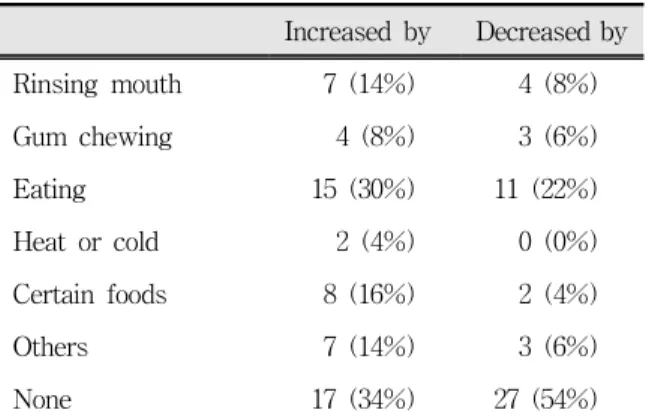
Increased by Decreased by
Rinsing mouth 7 (14%) 4 (8%)
Gum chewing 4 (8%) 3 (6%)
Eating 15 (30%) 11 (22%)
Heat or cold 2 (4%) 0 (0%)
Certain foods 8 (16%) 2 (4%)
Others 7 (14%) 3 (6%)
None 17 (34%) 27 (54%)
Table 3. Aggravating and relieving factors
values as the result of patients' blood tests and 5 patients had got their values increased.
3. Characteristics related to chemosensory complaint
Duration of symptom, which is the period from onset of symptoms of taste disorder to the first visit to our clinic, ranged from 10 days to 30 years (mean duration: 21.6 ± 60.0 months). The duration was less than one year in 37 patients (74%) and their mean duration of symptom was 5.4 ± 4.0 months.
A large proportion of the patients (72%, n=36) complained of oral mucosal pain or burning sensation, with 18 patients (36%) having these sensations as their another complaint with no visible mucosal abnormalities on clinical examination (i.e. burning mouth syndrome). There was no male patient among these BMS patients.
Nineteen patients reported that the amount of their saliva decreased. The flow rate of unstimulated whole saliva was less than 0.1 mL/min in 14 patients and 17 patients had a stimulated whole salivary flow rate of less than 0.5 mL/min. Decrease in salivary flow rate were more frequent in women than in men. Among the patients with subjective oral dryness or objective decreased salivary flow rate, 16 patients (32%) were diagnosed as BMS.
Thirty-three patients (66%) reported that the
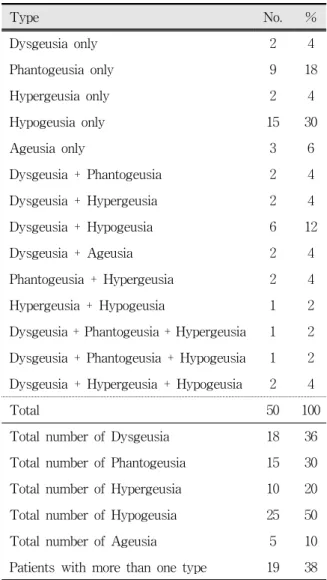
Type No. %
Dysgeusia only 2 4
Phantogeusia only 9 18
Hypergeusia only 2 4
Hypogeusia only 15 30
Ageusia only 3 6
Dysgeusia + Phantogeusia 2 4
Dysgeusia + Hypergeusia 2 4
Dysgeusia + Hypogeusia 6 12
Dysgeusia + Ageusia 2 4
Phantogeusia + Hypergeusia 2 4
Hypergeusia + Hypogeusia 1 2
Dysgeusia + Phantogeusia + Hypergeusia 1 2 Dysgeusia + Phantogeusia + Hypogeusia 1 2 Dysgeusia + Hypergeusia + Hypogeusia 2 4
Total 50 100
Total number of Dysgeusia 18 36 Total number of Phantogeusia 15 30 Total number of Hypergeusia 10 20 Total number of Hypogeusia 25 50
Total number of Ageusia 5 10
Patients with more than one type 19 38 Table 4. Types of taste disorders
taste dysfunction changed (decreased in the majority of cases) their appetite (Table 1). Table 3 shows various factors that aggravate or relieve the gustatory symptoms. The most common aggravating factor was eating (30%). On the other hand relief with eating was reported by eight (22%) but the majority (52%) reported no particular relieving factors.
Fig. 2 shows the changes perceived by the patients of the 5 dimensions of taste after the onset of symptoms. More patients complained of a weaker taste perception on general and this tendency was apparent with sweet, salty, and sour
Fig. 1. Age and gender distribution of the patients
Fig. 2. Self-reported changes of taste dimensions
tastes. In case of bitter and metallic tastes, the percentage of patients that did not claim any change held the largest proportion. A total of 11 patients (22%) claimed a stronger bitter taste than usual which accounted for the largest proportion of all increased case of taste perception.
4. Types of taste disorders
Table 4 shows the frequency of each type of
taste disorders that were reported by the patients in
this study. Hypogeusia, the most frequently
reported, was found in 25 patients (50%), dysgeusia
in 18 patients (36%), phantogeusia in 15 patients
(30%), hypergeusia in 10 patients (20%), and
ageusia in 5 patients (10%). Nineteen patients
(38%) reported more than one type of taste disorder
and the most frequent combination was dysgeusia
+ hypogeusia (n=6, 12%).
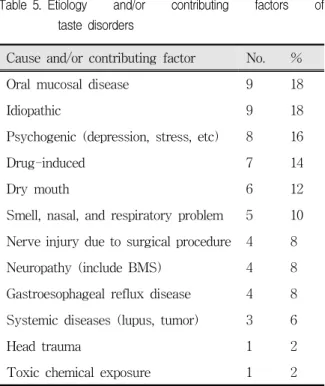
Cause and/or contributing factor No. %
Oral mucosal disease 9 18
Idiopathic 9 18
Psychogenic (depression, stress, etc) 8 16
Drug-induced 7 14
Dry mouth 6 12
Smell, nasal, and respiratory problem 5 10 Nerve injury due to surgical procedure 4 8
Neuropathy (include BMS) 4 8
Gastroesophageal reflux disease 4 8 Systemic diseases (lupus, tumor) 3 6
Head trauma 1 2
Toxic chemical exposure 1 2
Table 5. Etiology and/or contributing factors of taste disorders
5. Etiology and/or contributing factors of taste disorders
Based on data from the medical and dental histories and examinations, the patients were assigned to 12 probable causal categories. Table 5 shows the distribution of cause and/or contributing factor of taste disorders diagnosed in patients in this study.
Taste disorders due to oral mucosal diseases and idiopathic taste disorder were the most frequent (n=9; 18%, each), followed by psychogenic taste disorder (n=8; 16%), drug-induced taste disorder (n=7; 14%), and taste disorder due to dry mouth (n=6; 12%). These 5 categories of taste disorder accounted for 78% of all cases of taste disorders in this study.
Ⅳ. DISCUSSION
The present study was performed to investigate the clinical characteristics of patients complaining of taste problems as a primary complaint.
The 50 patients enrolled in this study had a male to female ratio of 1:3.2. Such female predominance among the patients with taste problem was consistent with other previous reports.
11-13)The higher frequency with which taste disorders are diagnosed in females indicate that not only the incidence of taste disorders is higher in women, but also more women seek treatment for a complaint of taste disorders. Women have more hormonal changes in their life and higher incidence of various systemic diseases that influence taste function such as autoimmune diseases. Moreover, it is considered that women having more opportunity to pay attention to taste because they do most of the cooking and women being less likely to have jobs and therefore having more time to visit a clinic.
11)The age distribution was almost even in male patients but peaked in the 51-60 year-group for female patients. Among the 38 female patients, 28 patients (73.7%) were in the 41-70 year group (i.e.
middle/old age group) which corresponded to peri- or post-menopausal period.
More than half of the patients reported to have
received treatment of taste dysfunction from other
various clinics before and dissatisfied with the
outcome, then they had visit our clinic. The
management of taste dysfunction must be focused
on the search and therapy for possible underlying
diseases. But taste function can be affected by
numerous factors include broad spectrum of
disorders and it is very difficult to get an objective
measure in gustatory function. Such complexity
helps to explain the difficulty that patients with
taste disturbance have in finding appropriate care,
and why many clinicians are uncertain how to
manage such patients and where to refer them.
10)Quite a large proportion of patients, 36.0% of all
patients in this study and 47.4% of the female
patients, were diagnosed as burning mouth
syndrome (BMS). The association between BMS
and taste aberration complaints has been reported
previously.
14-17)In addition to the primary oral
burning symptom, BMS patients may report
distorted taste perceptions or persisting dysgeusia,
or it is regarded that BMS could also be the clinical manifestation of taste damage. Furthermore, it has also been suggested that interactions between taste and oral pain were not limited to BMS but involved other orofacial pain complaints as well.
The close relations between saliva and taste were previously reported as well.
13,15,18)Saliva is the principal fluid component of the external environment of the taste receptor cells and as such, could play a role in taste sensitivity. Among the patients enrolled in this study, 19 patients (38%) complained of subjective oral dryness and 14 patients (28%) had an unstimulated whole salivary flow rate of less than 0.1 mL/min. Among these patients, in fact, 6 patients reported alleviation of symptoms after the use of artificial saliva;
therefore, we could estimate that decreased salivary flow was the most prominent causative factor of taste problem of them.
Sixty-eight percent of the patients reported that gustatory problem changed their appetite. The most common aggravating factor was eating, in addition, relief with eating also reported by some patients.
These results support the idea that taste function exert great influence on eating pattern, consequently, could affect patient's general health and quality of life.
19,20)In this study, it turned out that hypogeusia, half the cases of the patients, was the most general type among the 5 taste disorders. This result was also reflected in the fact that in each taste dimension there had been more patients with weaker change.
Also, the stronger changes, especially in bitter taste, seemed to correlate with dygeusic symptoms.
A fair number of the patients reported more than one type of taste disorder and there were four patients who complained of more than three types.
In particular, the combination between dysgeusia and hypogeusia was the major cases among them.
Our study indicates that perceived taste disturbance is complex and may be due to various factors, many of which remain idiopathic. The most frequent etiology was oral mucosal diseases including oral candidiasis (n=8) and lichen planus
(n=1). Local infections or inflammations are common causes of distorted taste and oral pain.
The mechanisms of taste disturbance can be direct inflammation and injury to a taste-related neural structure or the associated release of mucopurulent material that typically generates a poor flavor. In the case of oral candidiasis, obstruction of the taste buds by colonies of Candida cells and production of taste inhibitory substances are considered as possibilities.
21)It is reported that a very wide range of disorders and medications have the potential to adversely influence the taste sensation. A large number of patients in this study also had such conditions and the majority of the patients (90%) had taken such medications within the past five years. However, taste disturbance is a rare complication of such conditions; in other words, those conditions do not always induce taste dysfunction. For this reason, it is more difficult to assess the causes of taste disorders.
It was notable that the patients (n=4) diagnosed with taste disorders due to nerve injury complained of distorted and/or phantom taste sensation rather than decreased taste sensitivity. Even if there were focal regions of taste impairment due to nerve damage, the patients could be unaware of such deficits because of the redundancy of the multiple taste nerves. It has been found that anesthetizing the chorda tympani nerve (cranial nerve VII) unilaterally does not decrease whole-mouth perceived taste intensity and, in fact, enhances taste perception on the rear of the tongue (cranial nerve IX).
22)Such enhancement, which would be expected if significant regional nerve damage occurs, seemed to be accentuated for unpleasant tastants (dysgeusia) and, moreover, seemed to be associated with phantom tastes induced without stimuli being applied to the tongue (phantogeusia).
In many different literatures, zinc or magnesium
deficiency has been reported as a causative factor
of taste disorder especially of hypogeusia.
23-25)However, it is possible that serum zinc level
couldn't reflect actual zinc deficiencies at the tissue
level. In fact, in our study, we could not find any cases in which serum Zn and Mg level had decreased under the normal values as the result of patients' blood tests and, on the contrary, some patients had got their values increased.
V. CONCLUSIONS
The purpose of this study was to investigate the clinical characteristics of patients with perceived taste disorders.
The obtained results were as follows:
1. Among the patients, 36 patients (72%) complained of oral mucosal pain or burning sensation. Of these patients, 18 patients (36%) were diagnosed as burning mouth syndrome.
2. Nineteen patients (38%) complained of subjective oral dryness. The flow rate of unstimulated whole saliva was less than 0.1 mL/min in 14 patients (28%) and 17 (34%) had a stimulated whole salivary flow rate of less than 0.5 mL/min.
3. Among the types of taste disorders, hypogeusia, the most frequently reported, was found in 25 patients (50%), dysgeusia in 18 patients (36%), phantogeusia in 15 patients (30%), hypergeusia in 10 patients (20%), and ageusia in 5 patients (10%). Nineteen patients (38%) reported more than one type of taste disorder and the most frequent combination was dysgeusia + hypogeusia (n=6, 12%).
4. Based on data from the medical and dental histories and examinations, the patients were assigned to 12 probable causal categories. Taste disorders due to oral mucosal diseases and idiopathic taste disorder were the most frequent (n=9; 18%, each), followed by psychogenic taste disorder (n=8; 16%), drug-induced taste disorder (n=7; 14%), and taste disorder due to dry mouth (n=6; 12%). These 5 categories of taste disorder accounted for 78% of all cases in this study.
REFERENCES
1. Mattes RD. Nutritional implications of taste and smell.
In Doty RL (Ed). Handbook of olfaction and gustation. New York, 2003, Dekker, pp. 881-903.
2. Scott AE. Clinical characteristics of taste and smell disorders. Ear Nose Throat J 1989;68:297-315.
3. Breslin PA, Huang L. Human taste: peripheral anatomy, taste transduction, and coding. Adv Otorhinolaryngol 2006;63:152-190.
4. Woods MP. Taste and flavour perception. Proc Nutr Soc. 1998;57:603-607.
5. Bromley SM. Smell and taste disorders: a primary care approach. Am Fam Physician 2000;61:427-438.
6. Reiter ER, DiNardo LJ, Costanzo RM. Toxic effects on gustatory function. Adv Otorhinolaryngol 2006;
63:265-277.
7. Heckmann JG, Heckmann SM, Lang CJ, Hummel T.
Neurological aspects of taste disorders. Arch Neurol 2003;60:667-671.
8. Landis BN, Lacroix JS. Postoperative/posttraumatic gustatory dysfunction. Adv Otorhinolaryngol 2006;63:
242-254.
9. Doty RL, Shah M, Bromley SM. Drug-induced taste disorders. Drug Saf 2008;31:199-215.
10. Bromley S, Doty RL. Clinical disorders affecting taste:
evaluation and management. In Doty RL (Ed).
Handbook of olfaction and gustation. New York, 2003, Dekker, pp. 935-957.
11. Hamada N, Endo S, Tomita H. Characteristics of 2278 patients visiting the Nihon University Hospital Taste Clinic over a 10-year period with special reference to age and sex distributions. Acta Otolaryngol 2002;
Suppl 546:7-15.
12. Deems DA, Doty RL, Settle RG, Moore-Gillon V, Shaman P, Mester AF, Kimmelman CP, Brightman VJ, Snow JB Jr. Smell and taste disorders, a study of 750 patients from the University of Pennsylvania Smell and Taste Center. Arch Otolaryngol Head Neck Surg 1991;117:519-528.
13. Bergdahl M, Bergdahl J. Perceived taste disturbance in adults: prevalence and association with oral and psychological factors and medication. Clin Oral Investig 2002;6:145-149.
14. Grushka M, Ching V, Epstein J. Burning mouth syndrome. Adv Otorhinolaryngol 2006;63:278-287.
15. Hershkovich O, Nagler RM. Biochemical analysis of saliva and taste acuity evaluation in patients with burning mouth syndrome, xerostomia and/or
gustatory disturbances. Arch Oral Biol 2004;49:
515-522.
16. Formaker BK, Frank ME. Taste function in patients with oral burning. Chem Senses 2000;25:575-581.
17. Eliav E, Kamran B, Schaham R, Czerninski R, Gracely RH, Benoliel R. Evidence of chorda tympani dysfunction in patients with burning mouth syndrome. J Am Dent Assoc 2007;138:628-633.
18. Mese H, Matsuo R. Salivary secretion, taste and hyposalivation. J Oral Rehabil 2007;34:711-723.
19. Hutton JL, Baracos VE, Wismer WV. Chemosensory dysfunction is a primary factor in the evolution of declining nutritional status and quality of life in patients with advanced cancer. J Pain Symptom Manage 2007;33:156-165.
20. Scinska A, Jodkowska A, Korkosz A, Kukwa W, Sienkiewicz-Jarosz H. Post-tonsillectomy dysgeusia with weight loss: possible involvement of soft palate.
J Laryngol Otol 2008;122:e5.
국문요약
미각 장애 환자의 임상적 특성에 관한 연구
서울대학교 치의학대학원 구강내과․진단학 교실, 치학연구소
이은진․박원규․남진우․윤종일․고홍섭
사람들은 미각을 통해 음식물의 영양분과 안전성 여부를 파악하고, 이를 통해 식욕이 자극되고 만족되므로 미각은 음식물 을 섭취하는데 필수적인 역할을 한다고 할 수 있다. 미각이 상실되거나 왜곡된 환자들의 경우 섭식 양상에 변화를 일으켜 건강에 나쁜 영향을 미치게 될 수 있다. 미각 기능에 영향을 줄 수 있는 요소는 매우 다양하며 미각의 장애 양상 또한 매우 다양하게 나타날 수 있다. 하지만 미각은 주관적인 감각으로 다른 감각들과는 달리 객관적으로 평가하기가 까다로우며, 맛을 느끼는데 있어서 미각뿐 아니라 후각, 촉각, 온도감각, 심리 상태 등 여러 다른 요소들의 영향을 받으므로 미각 이상을 나타내 는 환자들을 진단하고 치료하는 것은 매우 어려운 일이다. 그러므로 실제 임상적 상황에서 미각장애의 평가를 위해서는 무엇 보다도 신중하고 철저한 병력청취와 임상적 증상의 분석을 통하여 환자의 상태를 정확히 평가하는 것이 가장 중요하다. 미각 은 시각이나 청각과 같은 다른 감각에 비해 그 동안 주목을 받아오지 못한 분야였으나, 사회가 발달함에 따라 삶의 질을 중시 하게 됨으로써 최근 미각 장애로 내원하는 환자가 증가하는 추세이다. 본 연구의 목적은 미각 장애를 주소로 내원한 환자들의 임상적 특성을 분석하는 것이다.
미각 장애를 주소로 2005년 11월부터 2008년 8월까지 서울대학교 치과병원 구강내과에 내원한 환자 50명(남 12명, 여 38명, 평균 연령 53.6 ± 14.7 세)을 대상으로 하였다. 상담을 통하여 현재 미각 장애의 증상과 관련된 사항들과 그 밖의 의과적․치 과적 병력, 투약, 미각 장애 외의 구강 증상들에 대하여 조사하였으며, 구강 검진, 설문지 작성, 방사선 사진 촬영, 혈액검사, 타액분비율 측정 검사 등의 임상적 검사를 시행하여 다음과 같은 결과를 얻었다.
1. 미각 장애 환자들 중 구강 점막의 통증 혹은 작열감을 호소한 환자가 36명(72%)이었다. 이들 중 구강점막에 특별한 병소를 보이지 않는 구강작열감증후군으로 진단된 환자는 18명(36%)이었다.
2. 전체 환자들 중 19명(38%)의 환자가 주관적 구강건조감을 호소하였으며, 타액분비율 측정 결과 비자극시 타액분비율이 0.1 mL/min 이하인 환자는 14명(28%)이었고, 자극시 타액분비율이 0.5 mL/min 이하인 환자는 17명(34%)이었다.
21. Osaki T, Ohshima M, Tomita Y, Matsugi N, Nomura Y. Clinical and physiological investigations in patients with taste abnormality. J Oral Pathol Med 1996;25:38-43.
22. Lehman CD, Bartoshuk LM, Catalanotto FC, Kveton JF, Lowlicht RA. Effect of anesthesia of the chorda tympani nerve on taste perception in humans. Physiol Behav 1995;57:943-951.
23. Davidson HI, Pattison RM, Richardson RA. Clinical undernutrition states and their influence on taste.
Proc Nutr Soc 1998;57:633-638.
24. Madden AM, Bradbury W, Morgan MY. Taste perception in cirrhosis: its relationship to circulating micronutrients and food preferences. Hepatology 1997;26:40-48.
25. Ikeda M, Ikui A, Komiyama A, Kobayashi D, Tanaka M. Causative factors of taste disorders in the elderly, and therapeutic effects of zinc. J Laryngol Otol 2008;122:155-160.
3. 미각 장애의 종류로는 미각감소(hypogeusia)가 25명(50%)으로 가장 많았으며, 미각왜곡(dysgeusia)이 18명(36%), 환상미 각 (phantogeusia)이 15명(30%), 미각과민(hypergeusia)이 10명(20%), 미각상실(ageusia)이 5명(10%) 이었다. 전체 50명 중 19명(38%)의 환자가 두 가지 이상의 미각 장애의 종류를 나타내었으며, 가장 많은 조합은 미각왜곡과 미각감소를 같이 보이는 경우였다.
4. 미각 장애의 원인이나 관련요인은 병력조사와 임상검사를 토대로 평가하였으며, 구강점막질환이나 원인불명인 경우가 각 각 9명(18%)으로 가장 많았다. 그 밖에 심인성이 8명(16%), 약물이 7명(14%), 구강건조증이 6명(12%)으로 나타났으며, 이 5가지의 항목이 전체의 78%를 차지하였다.
주제어: 미각 장애, 임상적 특성, 구강작열감증후군