pISSN 2288-9272 eISSN 2383-8493 J Oral Med Pain 2018;43(3):61-69 https://doi.org/10.14476/jomp.2018.43.3.61
Cardiometabolic Effects of Obstructive Sleep Apnea and Treatment Effects of Oral Appliance: An Updated Review for Dentists
Hye-Kyoung Kim, Mee-Eun Kim
Department of Oral Medicine, College of Dentistry, Dankook University, Cheonan, Korea
Received June 14, 2018 Revised August 24, 2018 Accepted August 29, 2018
Obstructive sleep apnea (OSA) is a relatively common, but greatly underdiagnosed sleep-related breathing disorder, characterized by recurrent collapse of the upper airway during sleep. OSA has been associated with a variety of cardiometabolic disease, such as hypertension, coronary artery disease, cardiac arrhythmia, cerebrovascular disease and metabolic dysfunction. Neuro- cognitive impairment, including excessive daytime sleepiness, increased risk of motor vehicle accidents, is also related to OSA. Sleep fragmentation and related arousals during sleep lead to intermittent hypoxia, sympathetic activation, oxidative stress, systemic inflammation and metabolic dysregulation which provide biological plausibility to this pathologic mechanism.
Extensive studies demonstrated that OSA is a modifiable risk factor for the above mentioned diseases and oral appliances (OAs), although continuous positive air pressure (CPAP) is a first- line therapy of OSA, are not inferior to CPAP at least in mild OSA, and may be an alternative to CPAP in CPAP-intolerant subjects with OSA. The goal of this article is to provide a current knowledge of pathologic link between OSA and cardiovascular disease, focusing on intermit- tent hypoxia, sympathetic activation, oxidative stress and metabolic dysregulation. Then, previous epidemiologic studies will be reviewed to understand the causal relationship between OSA and cardiovascular disease. Finally, the effects of OAs will be updated via recent meta- analyses compared to CPAP.
Key Words: Cardiovascular; Mandibular advancement device; Obstructive sleep apnea; Oral appliance
Correspondence to:
Mee-Eum Kim
Department of Oral Medicine, College of Dentistry, Dankook University, 119 Dandae-ro, Dongnam-gu, Cheonan 31116, Korea
Tel: +82-41-550-1915 Fax: +82-505-434-7951 E-mail: [email protected]
JOMP
Journal of Oral Medicine and PainCopyright Ⓒ 2018 Korean Academy of Orofacial Pain and Oral Medicine. All rights reserved.
CC This is an open-access article distributed under the terms of the Creative Commons Attribution Non-Commercial License (http://creativecommons.org/licenses/by-nc/4.0/),
INTRODUCTION
The third edition of the International Classification of Sleep Disorders-3 identified seven major categories consist- ing of insomnia disorders, sleep-related breathing disorders, central disorders of hypersomnolence, cardiac rhythm sleep- wake disorders, sleep-related movement disorders, para- somnias, and other sleep disorders (Table 1).
1)Among them, obstructive sleep apnea (OSA) is one of the major pheno- types of sleep-related breathing disorders (Table 2). In terms of mechanical view, OSA is a disease associated with mani- festation of ever-increasing resistance to airflow in upper airway cause by intermittent collapse of the upper airway
during sleep.
As consequences of repetitive obstruction of airflow, the diagnosis of OSA requires either signs/symptoms (associated sleepiness, fatigue, insomnia, snoring, subjective nocturnal respiratory disturbance, or observed apnea) or associated medical (hypertension [HTN], coronary artery disease [CAD], arterial fibrillation, congestive heart failure, stroke, diabetes) or psychiatric disorder (cognitive dysfunction, or mood dis- order) coupled with five or more predominantly obstructive respiratory events per hour of sleep during polysomnogra- phy (PSG).
2)Alternatively, a frequency of obstructive respi- ratory events ≥15/h satisfies the criteria.
OSA is a common health problem that affects 3% to 7%
of the adult population aged 30 to 70 years in western countries.
3)In Korea, Kim’s epidemiologic study
4)that used PSG found that the prevalence of sleep-disordered breath- ing (SDB, apnea-hypopnea index, AHI ≥5) was 27% and 16% in men and women aged 40 to 69 years.
4)When OSA was defined by an AHI ≥5 and excessive daytime sleepi- ness, its prevalence was 4.5% in men and 3.2% in women.
4)However, OSA still remains greatly underdiagnosed.
5)This prevalence is likely to increase because of increasing obe- sity and the aging population.
6)Undiagnosed and untreated OSA may lead to a variety of cardiometabolic disorders.
Long-term observation study confirmed a clear association between OSA and cardiovascular disease.
7)The dentist should have a sound understanding of sys- temic effect of untreated OSA in order to effectively diag- nose and treat OSA.
In this review, intermediate mechanisms underlying the systemic effects of OSA on cardiovascular disease (CVD) will be described and epidemiological evidence supports such a relation also be discussed. Finally, the treatment ef- fects of oral appliance (OA) on CVD will be updated.
UNDERLYING MECHANISM OF OSA FOR CARDIOVASCULAR DISEASE
1. Intermittent Hypoxia
Unique characteristic pattern of OSA is a repetitive epi- sodic hypoxia followed by reoxygenation. Animal studies of Fletcher’s group
8,9)have shown that intermittent hypoxia associated with recurrent upper-airway obstruction leads to a significant increase in blood pressure (BP) that that is dependent on peripheral carotid chemoreceptors. This was independent of hypercapnia. Exposure to intermittent
hypoxia for 2 weeks also elevated daytime BP and sympa- thetic activity of healthy subjects.
10)The renin-angiotensin system might be a possible explanation for secondary surge in BP on exposure to intermittent hypoxia. Fletcher’s ani- mal
11)experiment demonstrated that sustained alteration in the renin-angiotensin system following acute alteration in BP with intermittent hypoxia and suggested that upregula- tion of the tissue angiotensin II system appears to be nec- essary for the chronic BP changes that occur from episodic hypoxia.
11)All of these evidence support the importance of intermittent hypoxia, as the critical abnormality in OSA, leading to the immediate-term and long-term cardiovascu- lar consequences of OSA including systemic HTN, left ven- tricular hypertrophy, and endothelial dysfunction.
6)2. Sympathetic Activation
During hypoxia, activation of carotid chemoreceptors results in hyperventilation to enhance oxygen delivery to blood, which is followed by sympathetically mediated vaso- constriction to redistribute oxygenated blood flow to vital organs and simultaneously, parasympathetically activat- ed bradycardia to reduce myocardial oxygen demand.
12-14)Unfortunately, this oxygen-conserving reflex becomes dys- functional and pathological with the imbalance between sympathetic and parasympathetic activity when the increase in sympathetic activity is sustained in OSA. Somers et al.
13)has demonstrated that patients with OSA have high sym- pathetic activity even when awake, with further increases in BP and sympathetic activity during sleep. Kumar and Prabhakar
15)have suggested the concept of the carotid body plasticity as a result of intermittent hypoxia. It is thought that the sympathetic hyperactivity persists through the day- time owing to the memory effect of plasticity in the sympa- thetic activation
6)and this sensitization appears to be asso- ciated with reactive oxygen species (ROS) and hypoxia-in- ducible factor-1.
16)Ultimately, sustained sympathoexcitation
Table 2. Sleep-related breathing disorders Disorder Obstructive sleep apnea disorders Central sleep apnea syndromes Sleep-related hypoventilation disorders Sleep-related hypoxemia disorder Table 1. Seven major sleep disorders categorized by ICSD-3
Diagnostic section Insomnia
Sleep-related breathing disorders Central disorders of hypersomnolence Circadian rhythm sleep-wake disorders Parasomnias
Sleep-related movement disorders Other sleep disorders
ICSD, International Classification of Sleep Disorders.
can be seen as a critical mediator between OSA and HTN and has a catastrophizing effect on cardiovascular system.
Particularly, in patients with HTN, impaired baroreceptor- chemoreceptor reflex may predispose to excessive auto- nomic responses to chemoreflex and drug-resistant HTN.
12)3. Oxidative Stress
Repetitive intermittent hypoxia followed by reoxygen- ation, as mentioned above, promotes the carotid chemore- ceptors via an ROS-dependent pathway
17)and may cause adenosine triphosphate depletion, xanthine oxidase acti- vation, activation of polymorphoneuclear neutrophils and increases the generation of oxygen-derived free radicals.
18)This pathological phenomenon is analogous to a cardiac ischemia-reperfusion injury.
19)An imbalance between pro- and antioxidant system with overproduction of ROS leads to oxidative stress which imparts an tremendous burden the cardiovascular disease. Excessive accumulation of ROS in various organs and systems promotes vascular diseases through direct and irreversible oxidative damage to mac- romolecules, as well as disruption of redox-dependent vas- cular wall signaling processes.
20)Vascular damage via in- creased oxidative stress is involved in the pathogenesis of endothelial dysfunction with likely contribution to cogni- tive impairment as well as vascular lesion, atherosclerosis, HTN, myocardial injury and stroke.
6)Recurrent intermittent hypoxia contributes vascular dysfunction via systemic in- flammation as well as oxidative stress. OSA patients present increased circulating leukocyte,
21)C-reactive protein (CRP),
22)serum amyloid A
23)and cytokines,
24)such as tumor necrosis factor- α and interleukin-6.
4. Metabolic Dysregulation
Many studies have shown that OSA is associated with the development of metabolic syndrome, independent of obesity.
25-30)Coughlin et al.
31)reported that metabolic syn- drome was 9.1 times more likely to be present in subjects with OSA. Metabolic syndrome, as a major risk factor for cardiovascular morbidity and mortality,
32)is defined by the presence of at least three of the following signs: abdominal obesity, hypertriglyceridemia, low plasma high-density li- poprotein, hyperglycemia, and elevated BP.
27)Among them, insulin resistance is a primary manifestation of metabolic
syndrome and typical feature of OSA.
31,33)Human experi- ments have demonstrated that acute exposure to hypoxia worsened insulin sensitivity and glucose tolerance.
34,35)It is thought that sympathetic hyperactivity caused by hypoxia in OSA stimulates glycogenolysis, gluconeogenesis and li- polysis and as a result, promotes hyperinsulinemia and in- sulin resistance.
28,33)Sleep restriction or sleep loss could also affect the process, such as dysfunctional glucose me- tabolism and upregulation of appetite which can increase the risk of developing type II diabetes by 2 to 3 times.
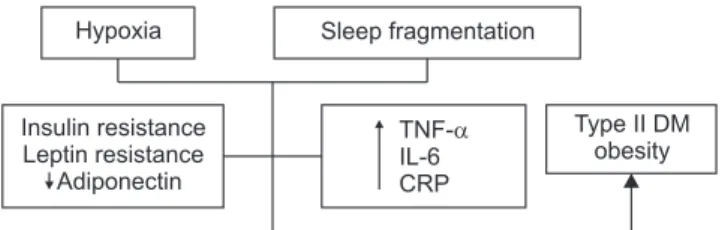
36-38)Adipose-derived hormones or cytokines should be consid- ered in the understanding of the mechanisms underlying this relation. Previous studies reported the dysfunctional role of leptin and ghrelin, an adipocyte-derived hormone that controls appetite, and increased leptin resistance in
OSA.
28,29,39)Adiponectin is an adipocyte-derived cytokine
with regulatory function in glucose and lipid metabolism and this anti-inflammatory cytokine is decreased in OSA as well as obesity and metabolic syndrome.
28,40,41)Inflammatory responses with elevated pro-inflammatory cytokines and CRP are also implicated.
28)Fig. 1 illustrates the impact of sleep disturbance and restriction of OSA on metabolic regulation.
EPIDEMIOLOGIC STUDIES ON THE ASSOCIATION BETWEEN OSA AND
CARDIOVASCULAR DISEASE
1. Systemic HTN and OSA
Systemic HTN is the most common CVD leading to a sig- nificant portion of CVD-related mortality in developed soci- eties and is the best-established cardiovascular consequenc- es of OSA.
6)Insulin resistance Leptin resistance Adiponectin
Type II DM obesity Hypoxia Sleep fragmentation
TNF- IL-6 CRP