
Introduction
Since positive airway pressure (PAP) for obstructive sleep apnea (OSA) was first described by Sullivan and colleagues in 1981 [1], determining “if, and how much, adults with OSA use the treatment” has been an im- portant consideration − for research, practice, and policy. Positive airway pressure (PAP), which for the purposes of this paper includes all modalities (i.e., con- tinuous, bi-level, automatic), is considered first-line medical treatment for OSA in adults [2] and focus on pa- tients’ use of PAP treatment is commonly termed adher-
ence in the extant literature. Emphasis on treatment ad- herence is not unique to the field of sleep. The World Health Organization’s Adherence Project set forth a def- inition of adherence in the context of long-term therapy:
“the extent to which a person’s behavior − taking medi- cation, following a diet, and/or executing lifestyle changes, corresponds with agreed recommendations from a health care provider.”[3] This adherence defi- nition is importantly differentiated from compliance.
Compliance confers an absence of acknowledging a per- son’s autonomy and is understood to be the outcome of a unidirectional treatment decision: “the extent to which
Received Aug 7, 2019 Accepted Aug 16, 2019
Corresponding author: Sawyer, Amy M., Sleep & Health Behavior, University of Pennsylvania, School of Nursing, 418 Curie Blvd., Claire Fagin Hall, Rm 349, Philadelphia, PA 19104, U.S.A. Tel: +1-215-573-2381, Fax: +1-215-207-9698, E-mail: [email protected]
CC This is an open access article distributed under the terms of the Creative Commons Attribution Non-Commercial License (http://creativecommons.org/
licenses/by-nc/4.0) which permits unrestricted non-commercial use, distribution, and reproduction in any medium, provided the original work is properly cited.
Copyrights ⓒ Chonnam National University Research Institute of Nursing Science http://crins530.jnuac.kr
Invited Paper
Positive Airway Pressure Treatment Adherence in Adults with Obstructive Sleep Apnea: A Perspective on
the Ever-evolving State of Science
Sawyer, Amy M.
1,2,31Associate Professor, University of Pennsylvania School of Nursing, Biobehavioral Health Sciences Department,
2University of Pennsylvania Perelman School of Medicine Center for Sleep & Circadian Neurobiology,
3Corporal Michael J. Crescenz Veterans Affairs Medical Center, Philadelphia, Pennsylvania, U.S.A.
Objective: The over-arching purpose of this paper is to describe the phenomenon of adherence to positive airway pressure
(PAP) in adults with obstructive sleep apnea (OSA) from an evolutionary perspective based on seminal influences. Specific objectives are: 1) Describe the evolution of knowledge about PAP adherence focused on PAP use, measurement of PAP adherence and intervention studies; 2) Discuss the definition of PAP adherence as it evolved in the field; and 3) Identify high impact opportunities for future work in the area of PAP adherence. Methods: The expert perspective review includes the seminal (1) primary research publications and (2) reviews that addressed PAP adherence since 1981 to address the objectives.
For the purposes of the review, seminal was defined as publications that bore theoretical, scientific and/or practical/policy significance, were of substantive and/or methodological interest and/or contributed value for future research. Results:
Seminal publications provided knowledge about PAP use and interventions to promote PAP use. These same publications brought attention to gaps in knowledge and burgeoning assumptions that were restrictive to the field while simultaneously stimulating lines of inquiry, practice initiatives and policies that continue to impact the field. Conclusions: Reflections on the past provide a foundation from which to springboard. The future work that addresses PAP adherence in adults with OSA will necessarily apply innovative approaches to a decades-old problem and thereby advance the field by revolutionizing the management of this chronic sleep disorder.
Key Words:
Continuous positive airway pressure, Obstructive sleep apnea, Patient compliance, Patient adherence
Vol. 24, No. 2, 75-88, August 2019 https://doi.org/10.33527/nhi2019.24.2.75
the patient’s behavior matches the prescriber’s recom- mendation”[4] whereas adherence to any regimen is a behavioral outcome that is firmly rooted in a partner- ship, or relationship, between healthcare provider and patient and necessitates agreement to the recom- mendation by the patient [3]. These conceptual differ- ences are insightful as the state of science addressing PAP adherence in the treatment of adult OSA is consid- ered and insights for research and practice are set forth.
The over-arching purpose of this paper is to describe the phenomenon of adherence to PAP from an evolu- tionary perspective based on seminal influences.
Specific objectives are: 1) Describe the evolution of knowledge about PAP adherence focused on PAP use, measurement of PAP adherence and intervention stud- ies; 2) Discuss the definition of PAP adherence as it evolved in the field; and 3) Identify high impact oppor- tunities for future work in the area of PAP adherence.
Methods
The expert perspective review includes the seminal (1) primary research publications and (2) reviews that ad- dressed PAP adherence since 1981, the year of Sullivan and colleagues first report of PAP for treatment of OSA [1]. Seminal sources of evidence are considered “classic”
publications. Such publications bear theoretical, scien- tific and/or practical/policy significance, are of sub- stantive and/or methodological interest and/or contrib- ute value for future research [5]. Taking into context the advantage of a historical perspective, seminal sources were also identified based on observed trends or re-di- rections in the field, or what might be colloquially termed “game changers,” or “pivotal papers;” for the purposes of this perspectives paper, these publications were considered significantly influential on the field of research, practice or policy and termed, “field changers.”
Thus, these criteria suggest impact in the field relative to the phenomenon of focus, PAP adherence. A chronology
of PAP adherence resulted from these methods from which high impact opportunities are generated to set forth directions for the continued evolution of knowl- edge and applied science for the phenomenon of PAP adherence.
Results
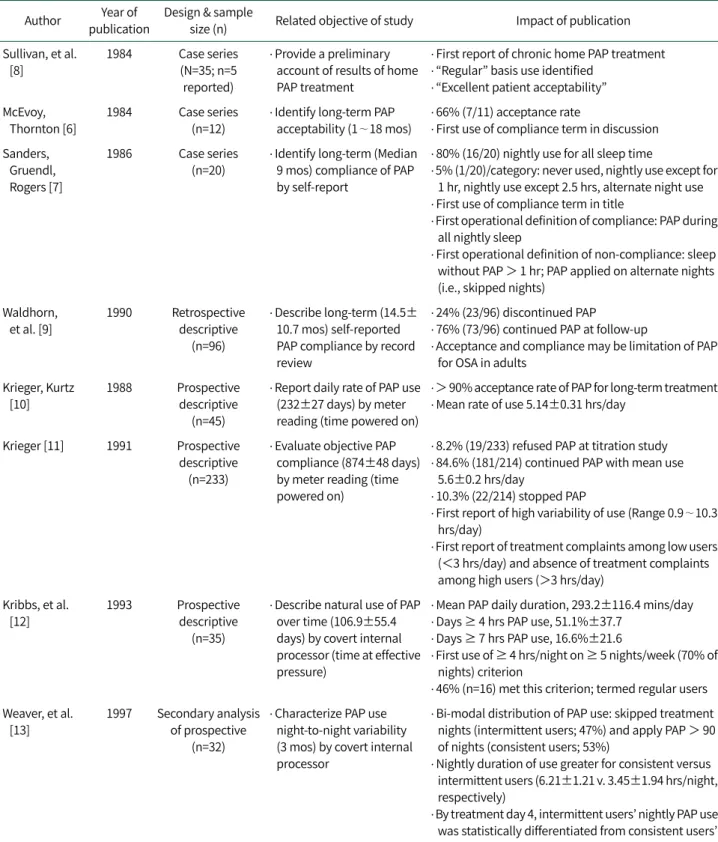
1. Evolution of Knowledge about PAP Adherence 1) Description of PAP Use Among Adults with OSA After PAP was first described as a treatment for OSA [1], a rapid emergence of case series reports [6-8] and small descriptive studies [9] of PAP use, initially termed com- pliance by McEvoy and Thornton [6], emerged in the lit- erature (Table 1). Long-term compliance was a priori- tized outcome along with the rate of initial PAP accept- ance in the earliest studies. PAP compliance was self-re- ported in these seminal studies. Early seminal reports in- dicated PAP treatment was accepted by adults with OSA and long-term compliance to treatment was high with reported use on most nights for the duration of sleep time. Within eight years of PAP being first described, the measurement of PAP compliance advanced from self-re- port to objective monitoring by device run-time meter [10] which permitted reports of PAP compliance equated to time that the device was powered-on across the total treatment duration. The extrapolated PAP compliance metric of hours/day was calculated as total run-time divided by total number of treatment days.
With objective PAP compliance data available, Krieger first identified high variability in PAP use in the largest prospective descriptive study published at the time [11].
Thereafter, patterns of PAP compliance, or use, were
recognized as potentially important for differentiating
compliers and non-compliers. Two seminal, albeit small,
studies in the field [12,13] employed a covert internal
processor that measured time on treatment at effective
pressure. These studies identified regularity of PAP use
was a differentiating factor between compliers and
non-compliers [12] and such differentiation could be identified in the first two weeks of treatment, possibly as
early as by day four of treatment [13]. Results of the Kribbs and colleagues’ study also indicated a higher
Table 1. Seminal Research Publications: Description of PAP Use in Adults with OSA Author Year of
publication
Design & sample
size (n) Related objective of study Impact of publication Sullivan, et al.
[8]
1984 Case series (N=35; n=5 reported)
․ Provide a preliminary account of results of home PAP treatment
․ First report of chronic home PAP treatment
․ “Regular” basis use identified
․ “Excellent patient acceptability”
McEvoy, Thornton [6]
1984 Case series
(n=12)
․ Identify long-term PAP acceptability (1∼18 mos)
․ 66% (7/11) acceptance rate
․ First use of compliance term in discussion Sanders,
Gruendl, Rogers [7]
1986 Case series
(n=20)
․ Identify long-term (Median 9 mos) compliance of PAP by self-report
․ 80% (16/20) nightly use for all sleep time
․ 5% (1/20)/category: never used, nightly use except for 1 hr, nightly use except 2.5 hrs, alternate night use
․ First use of compliance term in title
․ First operational definition of compliance: PAP during all nightly sleep
․ First operational definition of non-compliance: sleep without PAP > 1 hr; PAP applied on alternate nights (i.e., skipped nights)
Waldhorn, et al. [9]
1990 Retrospective descriptive
(n=96)
․ Describe long-term (14.5±
10.7 mos) self-reported PAP compliance by record review
․ 24% (23/96) discontinued PAP
․ 76% (73/96) continued PAP at follow-up
․ Acceptance and compliance may be limitation of PAP for OSA in adults
Krieger, Kurtz [10]
1988 Prospective descriptive
(n=45)
․ Report daily rate of PAP use (232±27 days) by meter reading (time powered on)
․ > 90% acceptance rate of PAP for long-term treatment
․ Mean rate of use 5.14±0.31 hrs/day
Krieger [11] 1991 Prospective descriptive (n=233)
․ Evaluate objective PAP compliance (874±48 days) by meter reading (time powered on)
․ 8.2% (19/233) refused PAP at titration study
․ 84.6% (181/214) continued PAP with mean use 5.6±0.2 hrs/day
․ 10.3% (22/214) stopped PAP
․ First report of high variability of use (Range 0.9∼10.3 hrs/day)
․ First report of treatment complaints among low users (<3 hrs/day) and absence of treatment complaints among high users (>3 hrs/day)
Kribbs, et al.
[12]
1993 Prospective descriptive
(n=35)
․ Describe natural use of PAP over time (106.9±55.4 days) by covert internal processor (time at effective pressure)
․ Mean PAP daily duration, 293.2±116.4 mins/day
․ Days ≥ 4 hrs PAP use, 51.1%±37.7
․ Days ≥ 7 hrs PAP use, 16.6%±21.6
․ First use of ≥ 4 hrs/night on ≥ 5 nights/week (70% of nights) criterion
․ 46% (n=16) met this criterion; termed regular users Weaver, et al.
[13]
1997 Secondary analysis of prospective
(n=32)
․ Characterize PAP use night-to-night variability (3 mos) by covert internal processor
․ Bi-modal distribution of PAP use: skipped treatment nights (intermittent users; 47%) and apply PAP > 90 of nights (consistent users; 53%)
․ Nightly duration of use greater for consistent versus intermittent users (6.21±1.21 v. 3.45±1.94 hrs/night, respectively)
․ By treatment day 4, intermittent users’ nightly PAP use was statistically differentiated from consistent users’
nightly PAP use (p=.001) PAP=positive airway pressure; OSA=obstructive sleep apnea; mos=months; hr or hrs=hour(s); mins=minutes.
prevalence of non-compliance than had been previously reported with an estimated 50% of PAP-treated adults using the treatment for less than four hours per night and fewer than 17% of PAP-treated adults using the treat- ment for more than seven hours per night. Two sim- ilarly-designed studies were published within the same time period and also identified low PAP compliance among adults with OSA [14,15]. Across these studies, average objectively-measured PAP use was 4.7 hours/
night [16]. Within a span of approximately 10 years of seminal work, OSA adults’ use of PAP was recognized to be problematic for effectively treating OSA [17].
2) Measurement of PAP Use in Adults with OSA The methods for measuring PAP use advanced in a rapid fashion after Sanders’ et al. seminal publication [7]
(Table 2). The early small case series reports measured PAP use by self-report questionnaire or survey and re- ported PAP use as compliance. In the initial decade of PAP device development, devices incorporated meters that permitted the first objective measurement of PAP use [10]; this was a proxy measure of PAP use that re- corded (i.e., measured) time that the device was pow- ered-on and permitted a calculated outcome of daily hours of PAP use. With subjective and objective meas- ures of a common construct established (i.e., PAP use),
Table 2. Seminal Research Publications: Measurement of PAP Use in Adults with OSA Author Year of
publication
Design & sample
size (n) Related objective of study Impact of publication Sanders,
Gruendl, Rogers [7]
1986 Case series (n=20)
․ Identify long-term (Median 9 mos) compliance of PAP by self-report
․ Survey questionnaire for self-reported PAP use established self-report as a measure of PAP compliance
Kriger, Kurtz [10]
1988 Prospective descriptive (n=45)
․ Report daily rate of PAP use (232±27 days) by meter reading (time powered on)
․ Run-time meter measure of PAP use
․ Calculate daily use by run-time total time/treatment days
․ Established objective measure of PAP compliance Rauscher,
et al. [18]
1993 Prospective descriptive (n=63)
․ Determine discrepancies between self-reported (by questionnaire) and objective PAP use (time powered on)
․ 5-compliance questionnaire items reported in paper
․ First report of convergent validity evaluation:
subjective by self-report and objective measures of PAP compliance
․ Self-reported PAP use overestimates PAP compliance (r=.55; estimated use time/night and mean measured use time/night; r=.39, reported mean use time/night and mean measured use time/night)
Kribbs, et al.
[12]
1993 Prospective descriptive (n=35)
․ Describe natural use of PAP over time (106.9±55.4 days) by covert internal processor (time at effective pressure)
․ Secondarily determine over-estimate of
self-reported PAP use versus objective PAP use
․ First report of covert measurement of PAP compliance
․ First report of objective PAP use as time at effective pressure which discerns device-on time from mask-on time
․ Over-estimate, on average, of self-reported PAP use compared to objective PAP use was 69±110 mins (p <.002) and with low convergent validity (r=.41)
Stepnowsky, et al. [21]
2007 Randomized
controlled pilot trial (n=45)
․ Secondarily reported wireless PAP data transmission accuracy and data loss
․ First report of applied, independent testing of wireless tele-monitoring of PAP data inclusive of PAP use data and PAP efficacy data (e.g., residual AHI, mask leak)
․ Provided technical insights for data flow and data security
PAP=positive airway pressure; OSA=obstructive sleep apnea; mos=months; mins=minutes; AHI=apnea-hypopnea index.
comparative evaluations of the two measures of PAP use identified self-reported measures over-estimated PAP use [18]. Though correlation analysis indicated a statisti- cally significant relationship between self-reported and objectively measured PAP use, the correlations were only medium-sized. These results were confirmed in several subsequent publications [12,19]. Kribbs and colleagues’
seminal publication reporting an objective measure of PAP use that provided an actual measure of PAP use, termed mask-on time, as opposed to a proxy measure of PAP use, or device powered-on time, identified ob- jective measurement of PAP use was significantly less than subjective measurement of PAP use by self-report [12].
Web-based, industry-developed programs supporting remote access to objective PAP use data from device in- ternal processors, first by providers and later by patients, emerged in the 2000’s. These information technology advancements largely supported the advent of PAP tele- monitoring: access to device-collected data from a re- mote location or through a different and separate device (e.g., smartphone) [20]. Stepnowsky and colleagues first reported the feasibility, acceptability and applicability of PAP tele-monitoring as a measure of PAP compliance [21]. PAP compliance data accuracy by tele-monitoring compared to device-downloaded data was reported as 100% and the authors reported “negligible” loss of mo- dem-transmitted PAP data [21]. Though this pilot trial sought to examine the effect of tele-monitoring on PAP compliance, this independent, seminal study brought forth the accuracy and technological reliability of re- mote monitoring of PAP use.
3) Interventions to Promote PAP Use
The seminal studies of PAP compliance not only re- ported the descriptive outcome of PAP compliance but also explored disease characteristics associated with
“compliance” and “non-compliance” [9-11]. This line of inquiry led to a substantial body of evidence addressing
a multitude of factors associated with and influential on PAP compliance, or use [16,22], from which contributed variation to PAP use was clearly discerned. Of import- ance were two findings: (1) early PAP use is predictive of long-term PAP use [13,23,24]; and (2) psychological and social-cognitive factors influence PAP use [25-29]. This body of research set the stage for designing and testing interventions to promote PAP use in adults with new- ly-diagnosed and newly-initiated PAP treatment. Early PAP use, as opposed to the prior focus on “long-term PAP compliance,” was thereafter prioritized.
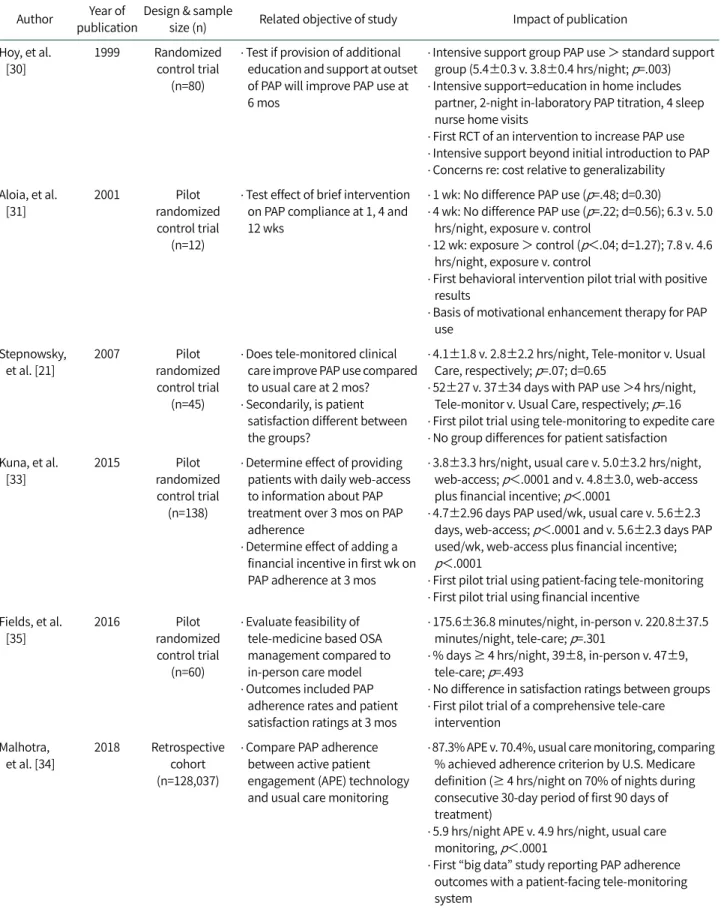
Seminal studies of PAP use interventions emerged in
the extant literature in 1999 with the first randomized
controlled trial reported by Hoy and colleagues [30] and
continue to be reported to present day (Table 3). Hoy et
al. tested a labor-intensive approach for providing edu-
cation and support over the initial four months of treat-
ment; the results of this trial were markedly positive for
increased PAP use among exposed participants com-
pared to usual support [30]. Essentially, the intervention
was designed as an amplified clinical management ap-
proach for initiating PAP treatment, incorporating the
basic principles of education of patient and family,
adaptation to a new medical treatment and the provision
of both social and technological support for incorporat-
ing a new medical treatment into daily life. Though the
trial’s positive results excited the field and suggested PAP
adherence was amenable to intervention, there was also
skepticism about the overall applicability and general-
izability of the intensive intervention in practice. With
accruing evidence of the influence of psychological and
social-cognitive factors on PAP use, Aloia and col-
leagues [31] first reported a pilot trial of a behavior-
ally-based intervention approach that was essentially a
precursor to motivational enhancement therapy for PAP
use [32]. Aloia et al.’s early positive results with medium
to large effect sizes were the basis for continued devel-
opment and testing of behavior science-based inter-
ventions for PAP adherence. With an increasingly in-
Table 3. Seminal Research Papers: Interventions to Promote PAP Use in Adults with OSA Author Year of
publication
Design & sample
size (n) Related objective of study Impact of publication Hoy, et al.
[30]
1999 Randomized control trial
(n=80)
․ Test if provision of additional education and support at outset of PAP will improve PAP use at 6 mos
․ Intensive support group PAP use > standard support group (5.4±0.3 v. 3.8±0.4 hrs/night; p=.003)
․ Intensive support=education in home includes partner, 2-night in-laboratory PAP titration, 4 sleep nurse home visits
․ First RCT of an intervention to increase PAP use
․ Intensive support beyond initial introduction to PAP
․ Concerns re: cost relative to generalizability Aloia, et al.
[31]
2001 Pilot
randomized control trial
(n=12)
․ Test effect of brief intervention on PAP compliance at 1, 4 and 12 wks
․ 1 wk: No difference PAP use (p=.48; d=0.30)
․ 4 wk: No difference PAP use (p=.22; d=0.56); 6.3 v. 5.0 hrs/night, exposure v. control
․ 12 wk: exposure > control (p<.04; d=1.27); 7.8 v. 4.6 hrs/night, exposure v. control
․ First behavioral intervention pilot trial with positive results
․ Basis of motivational enhancement therapy for PAP use
Stepnowsky, et al. [21]
2007 Pilot
randomized control trial
(n=45)
․ Does tele-monitored clinical care improve PAP use compared to usual care at 2 mos?
․ Secondarily, is patient satisfaction different between the groups?
․ 4.1±1.8 v. 2.8±2.2 hrs/night, Tele-monitor v. Usual Care, respectively; p=.07; d=0.65
․ 52±27 v. 37±34 days with PAP use >4 hrs/night, Tele-monitor v. Usual Care, respectively; p=.16
․ First pilot trial using tele-monitoring to expedite care
․ No group differences for patient satisfaction Kuna, et al.
[33]
2015 Pilot
randomized control trial
(n=138)
․ Determine effect of providing patients with daily web-access to information about PAP treatment over 3 mos on PAP adherence
․ Determine effect of adding a financial incentive in first wk on PAP adherence at 3 mos
․ 3.8±3.3 hrs/night, usual care v. 5.0±3.2 hrs/night, web-access; p<.0001 and v. 4.8±3.0, web-access plus financial incentive; p<.0001
․ 4.7±2.96 days PAP used/wk, usual care v. 5.6±2.3 days, web-access; p<.0001 and v. 5.6±2.3 days PAP used/wk, web-access plus financial incentive;
p<.0001
․ First pilot trial using patient-facing tele-monitoring
․ First pilot trial using financial incentive Fields, et al.
[35]
2016 Pilot
randomized control trial
(n=60)
․ Evaluate feasibility of tele-medicine based OSA management compared to in-person care model
․ Outcomes included PAP adherence rates and patient satisfaction ratings at 3 mos
․ 175.6±36.8 minutes/night, in-person v. 220.8±37.5 minutes/night, tele-care; p=.301
․ % days ≥ 4 hrs/night, 39±8, in-person v. 47±9, tele-care; p=.493
․ No difference in satisfaction ratings between groups
․ First pilot trial of a comprehensive tele-care intervention
Malhotra, et al. [34]
2018 Retrospective cohort (n=128,037)
․ Compare PAP adherence between active patient engagement (APE) technology and usual care monitoring
․ 87.3% APE v. 70.4%, usual care monitoring, comparing
% achieved adherence criterion by U.S. Medicare definition (≥ 4 hrs/night on 70% of nights during consecutive 30-day period of first 90 days of treatment)
․ 5.9 hrs/night APE v. 4.9 hrs/night, usual care monitoring, p<.0001
․ First “big data” study reporting PAP adherence outcomes with a patient-facing tele-monitoring system
PAP=positive airway pressure; OSA=obstructive sleep apnea; v.=versus; mos=month(s); hr=hour(s); wk=week(s); d=effect size;
U.S.=United States.
ter-disciplinary sleep field, both in research and prac- tice settings, the potential to generalize such interven- tions was apparent.
The information technology and computer science ad- vances did not only impart advantages for measuring PAP use, but also for how/when/where OSA and PAP care could be delivered and monitored. Stepnowsky et al.
reported a seminal pilot trial wherein tele-monitoring of PAP use by study providers was compared to usual care [21]. With a robust description of the tele-monitoring approach reported in the seminal publication, this pilot trial was the advent of applying remote monitoring of PAP use as not a measure of adherence, but rather a lev- erage for expediting care in a unidirectional manner (i.e., provider to patient) for PAP-treated adults. There- after, Kuna and colleagues reported their seminal study of a patient-facing, PAP use technology trial [33]. This seminal pilot trial addressed bidirectional web-based access to PAP use data by patients and providers, lever- aging the idea of engaging patients in a shared PAP man- agement approach. With overwhelmingly positive re- sults, Kuna et al. brought patient-facing information technologies to the forefront of sleep healthcare. The in- vestigators also examined financial incentives for PAP adherence, incorporating the principles of behavioral economics. Though this added exposure condition did not further improve PAP use beyond the web-based data access exposure condition alone, this seminal work did stimulate subsequent investigations that employed and tested other interventions based on behavioral econo- mics. The importance of patient engagement through close monitoring was further confirmed by Malhotra and colleagues wherein the investigators employed a “big data” approach to extend earlier findings and more de- finitively determine the effect of patient-facing tele- monitoring of PAP use on usage outcomes, or adherence [34].
As the field has increasingly recognized the limited sleep resources available to the general population for
not only diagnosing OSA but also managing what is now recognized as a chronic sleep disorder that necessitates ongoing management, these seminal studies were abso- lutely foundational for a movement to tele-health, or more specifically, tele-sleep. Fields and colleagues’ first report of a pilot trial testing a tele-medicine based OSA evaluation and management model quashed two major concerns: (1) patients would reject a model of care that was not delivered in-person and face-to-face; and of equal importance, (2) such a model would be inferior in terms of relevant outcomes to an in-person and face-to- face care model [35]. This seminal study provided critical insights for a new frontier in sleep healthcare that in- tegrates tele-sleep.
2. Definition of PAP Adherence
1) Early Studies of PAP Use Beget Compliance From the outset of seminal studies reporting PAP use, the terminology of “compliance” was employed (see Table 1). Yet, across these early studies there was no def- inition of compliance that accompanied the use of this term. Anecdotally, as in published discussions, several seminal publications acknowledged that the optimal dose of PAP, or optimal PAP compliance, was unknown.
Though PAP acceptance, or the willingness of a patient to accept home PAP therapy, was clearly differentiated from PAP compliance, the actual use of PAP treatment at home, whether by self-report or objective measure- ment, was simply synonymous with compliance and not associated with any optimal use criterion based on, for example, disorder responsiveness to treatment or symp- tom resolution.
The Kribbs’ et al study [12] acknowledged a non-evi-
dence based minimal acceptable use criterion of PAP
compliance that was employed in the study: ≥ 4 hours
use per 24-hour period. This criterion, combined with
the investigators’ use of a days per week criterion of 70%,
or 5 days, was highly influential on the criterion for PAP
compliance in the field. Subsequent studies of PAP use
employed this criterion and the collective evidence ad- dressing PAP use was largely reported in terms of the cri- terion with a dichotomized outcome of compliance, rates of achieving compliance, etc. As a result, in the U.S.A. and some other countries, third party payment for PAP is contingent on patients achieving this compliance threshold for a period of time at the outset of treatment [36]. Yet, as Kribbs et al. [12] and others [16] have ac- knowledged, this PAP compliance criterion was arbitra- rily established and does not equate to a definition of PAP compliance.
In studies published over time, operational definitions of PAP compliance (or adherence) were rarely ex- plicated, and often inferred from, or derived from, ana- lytic approaches. With increasing attention to the phe- nomenon of compliance, and the emergence in the liter- ature of the seemingly interchangeable term, adherence, defining the concept and construct was noticeably absent. A seminal set of reviews, however, brought crit- ical attention to the absence of definitions of the terms commonly used to address PAP use; these reviews were both conceptually and operationally useful for advanc- ing knowledge (Table 4).
In an early, poignant expert review, Grunstein elo- quently established the parallel nature of PAP use with use of other health/disease treatments; and, established that there was an absence of “true efficacy” PAP studies to bear influence on defining a threshold of PAP use that equated to “true effective compliance” [37]. Equally im- portant, in an effort to establish clarity amid the use of conflicting terminology across published studies and es- tablish a “syntax” for PAP use terminology based on prior reports, Grunstein differentiated the commonly used terms with operational definitions and aligned such with the indicated measurement approach(s) [37]. Shortly thereafter, Collard and colleagues similarly differ- entiated compliance and adherence, aligning com- pliance with actual use and adherence with intention of use after being provided with the treatment at home (i.e.,
intended use) [38]. The limitation of these seminal re- views was that the suggested definitions were simplisti- cally based on the evidence to date amid a relatively un- der-developed field of focused study.
2) From “compliance” to “adherence” and
“treatment use”
Since the mid-2000’s, two seminal reviews have been published that were guided both by the evolving science focused on PAP use and importantly incorporated prac- tice and theoretical perspectives. With an increasingly nuanced lens, Engleman and Wild [39] and Crawford and colleagues [22] set forth new paradigms for how scien- tists and practitioners think about PAP use (i.e., com- pliance) by explicitly aligning the outcome of treatment use with that of a health behavior. In essence, this neces- sarily supported the shift away from concept of com- pliance and the respective use of the terminology.
Though the term adherence was intermittently used in the extant literature addressing PAP use prior to these reviews, there was not a parsimonious movement away from the term of compliance, or a conceptualization of differences between compliance and adherence, until these two seminal integrative reviews [22,39].
Notably, the practice and science of sleep and sleep disorders was increasingly inter-disciplinary by the 2000s which led to a breadth of knowledge about pa- tients’ use of treatment that was behaviorally-oriented and understood to be contextualized by a multiplicity of internal and external factors. Engleman and Wild em- phasized the differences between compliance, a histor- ically patriarchic concept with biomedical roots, and adherence, a concept that emphasizes autonomy, shared decision-making and individually-variability consistent with a bio-psychosocial-cognitive model [39]. Thereafter, the absence of the term compliance in the extant literature addressing PAP use was noteworthy.
Crawford and colleagues’ seminal integrative review fur-
ther shifted the field by incorporating the World Health
Table 4. Seminal Review Publications: Defining PAP Adherence in Adults with OSA AuthorYear of publicationDesignRelated objective of studyAuthor-provided definitionImpact of publication Grunstein [37]1995Expert review․ Summarize data on the use of PAP in OSA, including compliance
․ Acceptance: Proportion of patients who meet selection criteria for PAP treatment and actually proceed to have PAP pressure level determined ․ Adherence: Proportion of patients prescribed PAP who report that they are continuing to use PAP ․ Usage: Proportion of patients with PAP machines “switched on” more than an arbitrary period of time ․ Compliance: Proportion of patients using PAP machines and delivering a pre-set level, suggesting mask is likely to be in-place
․ First publication to provide distinct definitions of acceptance, adherence, usage (use) and compliance ․ Also defined prescription and tolerance ․ Acknowledged definition criteria vary suggesting no benchmark existed ․ First acknowledgement of “true effective compliance” as an operational construct defined as the combination of PAP actual use and total sleep time Collard, et al. [38]1997Expert review․ Review the issue of acceptance and compliance of PAP
․ Primary Acceptance: Proportion of patients accepting PAP trial and willing to embark on home PAP treatment ․ Adherence, or Secondary Acceptance: Proportion of patients who pursue PAP long-term after device being provided for home treatment ․ Compliance: Rate at which patients who adhere to their treatment actually use the treatment
․ Contrasted primary acceptance from secondary acceptance, which was equated with the term, adherence ․ Differentiated compliance (use) from adherence (intention to use) Engleman, Wild [39]2003Integrative review․ Aim to enhance explanatory and interventional power of PAP adherence models with cognitive constructs
․ Compliance: Receipt and use of treatment from a powerful and knowledgeable “carer” ․ Adherence: Behavioral outcome of the individual/patient who is autonomous and increasingly interested/aware/knowledgeable and influenced by psychological, social and cognitive factors; suggest synonymous with “patient use”
․ Conceptually contrasted compliance, a biomedical construct, from adherence, a bio-psychosocial-cognitive construct ․ Acknowledged patient autonomy and patient/provider partnership Crawford, et al. [22]2014Integrative review․ Outline new concepts for the field based on current knowledge of PAP adherence
․ Compliance: From World Health Organization definition as the extent to which a person’s behavior coincides with medical or health advice ․ Adherence: From World Health Organization definition as the extent to which a person’s behavior corresponds with agreed recommendations from a health care provider ․ Adherence as a Behavior: Derived from World Health Organization description of adherence and incorporates principles of Biopsychosocial Model as a behavior that may or may not correspond with agreed recommendations but is individually-determined relative to the person, illness and treatment and influenced by psychological, social and biomedical factors
․ Based on accrued knowledge about PAP adherence, suggests compliance as a research construct is knowledge-limiting ․ Contrasts compliance and adherence at conceptual, research and clinical/practice level ․ Advocates for an integrative model (biopsychosocial) to address PAP adherence across these levels PAP=positive airway pressure; OSA=obstructive sleep apnea.

![Table 4. Seminal Review Publications: Defining PAP Adherence in Adults with OSA AuthorYear of publicationDesignRelated objective of studyAuthor-provided definitionImpact of publication Grunstein [37]1995Expertreview․ Summarize data on the useof PAP in OSA](https://thumb-ap.123doks.com/thumbv2/123dokinfo/5439770.234379/9.892.114.779.117.1115/publications-adherence-authoryear-publicationdesignrelated-studyauthor-definitionimpact-publication-expertreview.webp)
