• 검색 결과가 없습니다.

Heart Transplantation in the Elderly Patients: Midterm ResultsSang Yoon Yeom, M.D.

N/A
N/A
Protected

Academic year: 2021

Share "Heart Transplantation in the Elderly Patients: Midterm ResultsSang Yoon Yeom, M.D."

Copied!
6
0
0

로드 중.... (전체 텍스트 보기)

전체 글

(1)

http://dx.doi.org/10.5090/kjtcs.2013.46.2.111 ISSN: 2233-601X (Print) ISSN: 2093-6516 (Online)

1

Department of Thoracic and Cardiovascular Surgery,

2

Cardiovascular Center and Cardiovascular Research Institute, Department of Internal Medicine, Seoul National University Hospital, Seoul National University College of Medicine

†This article was presented at the 43th Annual Meeting of The Korean Society for Thoracic and Cardiovascular Surgery, Gwangju, Korea, November 6–8, 2011.

Received: September 11, 2012, Revised: October 11, 2012, Accepted: October 19, 2012

Corresponding author: Ki-Bong Kim, Department of Thoracic and Cardiovascular Surgery, Seoul National University Hospital, Seoul National University College of Medicine, 101 Daehak-ro, Jongno-gu, Seoul 110-744, Korea

(Tel) 82-2-2072-3482 (Fax) 82-2-747-5245 (E-mail) [email protected]

C

The Korean Society for Thoracic and Cardiovascular Surgery. 2013. All right reserved.

CC
This is an open access article distributed under the terms of the Creative Commons Attribution Non-Commercial License (http://creative- commons.org/licenses/by-nc/3.0) which permits unrestricted non-commercial use, distribution, and reproduction in any medium, provided the original work is properly cited.

Heart Transplantation in the Elderly Patients: Midterm Results

Sang Yoon Yeom, M.D.

1

, Ho Young Hwang, M.D., Ph.D.

1

, Se-Jin Oh, M.D.

1

, Hyun-Jai Cho, M.D., Ph.D.

2

, Hae-Young Lee, M.D., Ph.D.

2

, Ki-Bong Kim, M.D., Ph.D.

1

Background: Heart transplantation in elderly patients has raised concerns because of co-morbidities and limited life expectancy in the era of donor shortage. We examined the outcomes after heart transplantation in elderly patients.

Materials and Methods: From March 1994 to December 2011, 81 patients (male:female=64:17, 49.1±14.0 years) underwent heart transplantation. The outcomes after heart transplantation in the younger patients (<60 years;

group Y, n=60) were compared with those in the elderly patients (≥60 years; group O, n=21). The follow-up du- ration was 51.8±62.7 months. Results: Early mortality (≤30 days) occurred in 5.0% (3/60) and 4.8% (1/21) of groups Y and O, respectively (p>0.999). There were no differences in overall survival between the two groups (p=0.201). Freedom from rejection was higher in group O than in group Y (p=0.026). Multivariable analysis re- vealed that age ≥60 years was not a significant risk factor for long-term survival; postoperative renal failure was the only significant risk factor for long-term survival (p=0.011). Conclusion: Early and mid-term results of heart transplantation in elderly patients were similar to those in younger patients.

Key words: 1. Heart transplantation 2. Outcome assessment 3. Elderly

INTRODUCTION

Heart transplantation has evolved into the gold standard treat- ment for patients with end-stage congestive heart failure [1]. As outcomes of heart transplantation have improved, the number of patients waiting for heart transplantation has markedly increased, and the upper limit of the recipient’s age has been raised in some centers [2-4]. However, it has been suggested that ad- vanced age is considered a relative contraindication for heart transplantation due to the high incidence of co-morbidities such as malignancies, hypertension, diabetes mellitus, and reduced

life expectancy after heart transplantation [5,6]. In addition, heart transplantation in elderly patients is still under debate be- cause the shortage of donor hearts has been aggravated. The aim of this study was to evaluate early- and mid-term results of heart transplantation in patients ≥60 years old when compared with those of heart transplantation in patients <60 years old.

MATERIALS AND METHODS 1) Patient characteristics

Between March 1994 and December 2011, 81 patients un-

(2)

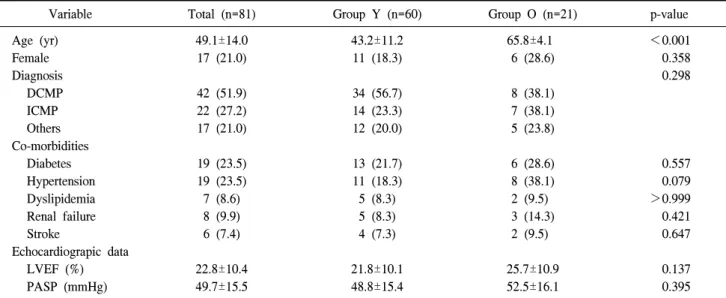
Table 1. Preoperative characteristics of the study patients

Variable Total (n=81) Group Y (n=60) Group O (n=21) p-value

Age (yr) Female Diagnosis

DCMP ICMP Others Co-morbidities

Diabetes Hypertension Dyslipidemia Renal failure Stroke

Echocardiograpic data LVEF (%) PASP (mmHg)

49.1±14.0 17 (21.0)

42 (51.9) 22 (27.2) 17 (21.0)

19 (23.5) 19 (23.5) 7 (8.6) 8 (9.9) 6 (7.4)

22.8±10.4 49.7±15.5

43.2±11.2 11 (18.3)

34 (56.7) 14 (23.3) 12 (20.0)

13 (21.7) 11 (18.3) 5 (8.3) 5 (8.3) 4 (7.3)

21.8±10.1 48.8±15.4

65.8±4.1 6 (28.6)

8 (38.1) 7 (38.1) 5 (23.8)

6 (28.6) 8 (38.1) 2 (9.5) 3 (14.3) 2 (9.5)

25.7±10.9 52.5±16.1

<0.001 0.358 0.298

0.557 0.079

>0.999 0.421 0.647

0.137 0.395 Values are presented as mean±standard deviation or number (%). Group Y, patients <60 years old at transplantation; group O, pa- tients ≥60 years at transplantation.

DCMP, dilated cardiomyopathy; ICMP, ischemic cardiomyopathy; LVEF, left ventricle ejection fraction; PASP, pulmonary artery systolic pressure.

Table 2. Operative data of the study patients

Variable Total (n=81) Group Y (n=60) Group O (n=21) p-value

Redo-operation Donor age (yr) Ischemic time (min)

Cardiopulmonary bypass time (min)

17 (21.0) 32.2±10.9 155±49 241±77

13 (21.7) 31.4±11.1 147±45 226±65

4 (19.0) 34.2±10.4

177±53 282±92

>0.999 0.312 0.015 0.004 Values are presented as number (%) or mean±standard deviation.

Group Y, patients <60 years old at transplantation; group O, patients ≥60 years at transplantation.

derwent heart transplantation in Seoul National University Hospital. Sixty-four of the patients were male, and 17 were female. The mean age was 49.1±14.0 years; 60 patients were younger than 60 years at the time of heart transplantation (group Y) and 21 patients were 60 years or older (group O).

Dilated cardiomyopathy was the most common indication for heart transplantation (n=42, 51.9%). Preoperative character- istics were similar in the two groups (Table 1).

2) Surgical techniques and data

Two techniques for heart transplantation were used. In most patients (96.3%), the bicaval Wythenshawe technique (bicaval and single left atrial anastomoses) [7] was used. The

conventional Lower and Shumway technique [8] was used in 3 patients (3.7%) who underwent transplantation in the early period. Seventeen patients (21%) had a history of previous cardiac surgery. The mean donor age was 32.2±10.9 years old. The mean cardiopulmonary bypass (CPB) and donor heart ischemic times were 241±77 and 155±49 minutes, respectively. The mean CPB time in group O was sig- nificantly longer than that in group Y (p=0.004) (Table 2).

3) Evaluation of mid-term clinical outcomes

The patients underwent regular postoperative follow-up through the outpatient clinic at 3-month or 4-month intervals.

The patients were also contacted by telephone for con-

(3)

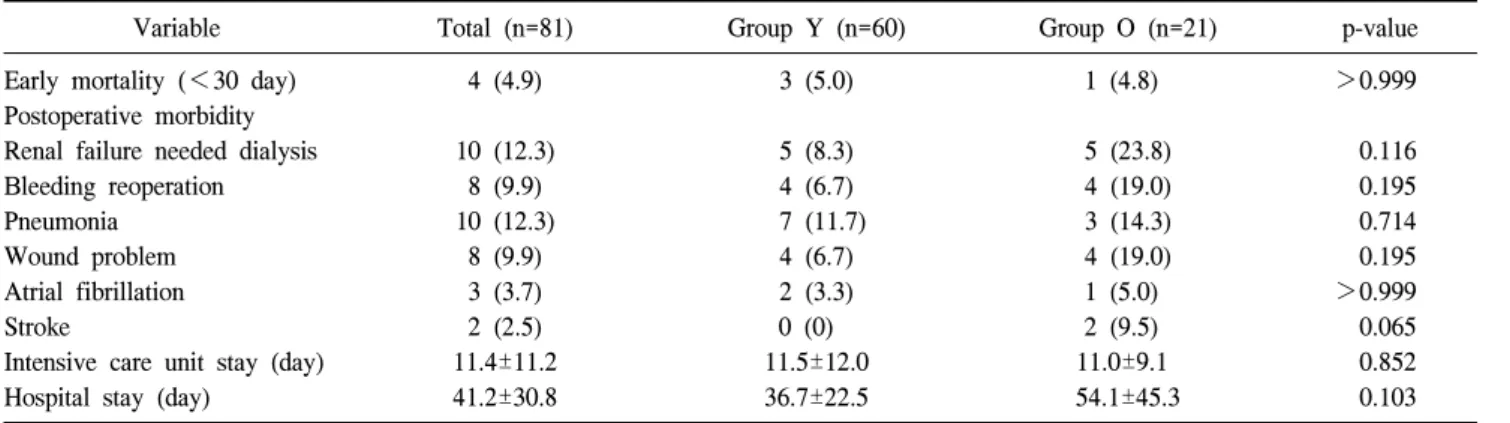
Table 3. Early clinical results

Variable Total (n=81) Group Y (n=60) Group O (n=21) p-value

Early mortality (<30 day) Postoperative morbidity Renal failure needed dialysis Bleeding reoperation Pneumonia

Wound problem Atrial fibrillation Stroke

Intensive care unit stay (day) Hospital stay (day)

4 (4.9)

10 (12.3) 8 (9.9) 10 (12.3)

8 (9.9) 3 (3.7) 2 (2.5) 11.4±11.2 41.2±30.8

3 (5.0)

5 (8.3) 4 (6.7) 7 (11.7)

4 (6.7) 2 (3.3) 0 (0) 11.5±12.0 36.7±22.5

1 (4.8)

5 (23.8) 4 (19.0) 3 (14.3) 4 (19.0) 1 (5.0) 2 (9.5) 11.0±9.1 54.1±45.3

>0.999

0.116 0.195 0.714 0.195

>0.999 0.065 0.852 0.103 Values are presented as number (%) or mean±standard deviation.

Group Y, patients <60 years old at transplantation; group O, patients ≥60 years at transplantation.

firmation of their condition if the last clinic visit was not conducted at the scheduled time. Clinical follow-up was com- pleted on May 31, 2012. Follow-up was completed in all pa- tients with a mean follow-up duration of 51.8±62.7 months.

4) Immune suppression protocol

The standard maintenance immune suppression protocol for heart transplantation (so-called “triple therapy”) was used: (1) a calcineurin inhibitor such as cyclosporine or tacrolimus, (2) an antiproliferative agent such as azathioprine (AZA, Imuran) or mycophenolate mofetil (MMF), and (3) corticosteroids such as prednisone or prednisolone [9]. Cyclosporine, AZA, and prednisolone were used in the early period until June 1999. At that point, the antiproliferative agent was changed from AZA to MMF. In July 2009, the calcineurin inhibitor was changed from cyclosporine to tacrolimus with an addi- tion of interleukin-2. Intravenous methylprednisolone (500 mg) was administered intraoperatively and followed by 3 doses (150 mg every 8 hours) postoperatively. Prednisone was then given at a daily dose of 1 mg/kg (per oral steroid) and tapered over six months to 0.1 mg/kg per day.

The patients underwent endomyocardial biopsy weekly for 4 weeks after transplantation, every 4 weeks until the third month, and then every 3 months until the second year.

Rejection severity was graded from 0 to 4 based on the International Society for Heart and Lung Transplantation (ISHLT) grading system [10]. Grade 1B and 2 were managed by increasing the dose of oral steroids. Intravenous methyl-

prednisolone (1 g/day for 3 days) was given for ≥grade 3A.

5) Statistical analysis

Statistical analysis was performed using the SPSS ver. 18.0 (SPSS Inc., Chicago, IL, USA). Data were expressed as mean±standard deviation, median and ranges, or proportions.

A p-value of less than 0.05 was considered statistically significant. Comparisons between the two groups were per- formed using the chi-squared or Fisher’s exact test for cate- gorical variables and the Student’s t-test for continuous variables. Survival rates were estimated using the Kaplan- Meier method and comparisons between the 2 groups were performed using the log-rank test. The Cox proportional haz- ards model was adopted for analysis of risk factors for time related events. The institutional review board of the Seoul National University Hospital approved this study (SNUH IRB No. H-1209-056-425).

RESULTS 1) Early results

There were 4 early mortalities (≤30 days): 3 (5.0%) in

group Y and 1 (4.8%) in group O (p>0.999). Postoperative

morbidities included renal failure requiring dialysis (n=10,

12.3%), bleeding reoperation (n=8, 9.9%), pneumonia (n=10,

12.3%), wound problems (n=8, 9.9%), and atrial fibrillation

(n=3, 3.7%). Early mortalities or postoperative complications

in the two groups did not differ (Table 3). The intensive care

(4)

Fig. 2. Kaplan-Meier curve of freedom from infection. Group Y, patients <60 years old at transplantation; group O, patients ≥60 years at transplantation.

Table 4. Analysis of risk factors for overall survival using the Cox proportional hazard model

Variable

Univariate Multivariable

p-value Hazard ratio

95%

confidence interval

p-value

Age (≥60 yr) Sex

Body surface area (m

2

) Diagnosis

Diabetes Hypertension Redo-operation PASP (mmHg) Ischemic time (min) Bleeding reoperation ECMO support Postoperative RF

0.201 0.210 0.630 0.510 0.529 0.843 0.761 0.759 0.420 0.530 0.829 0.003

1.545 1.434

- - - - - - - - - 2.991

0.551–4.336 0.585–3.513

- - - - - - - - - 1.279–6.992

0.408 0.430

- - - - - - - - - 0.011 PASP, pulmonary artery systolic pressure; ECMO, extracor- poreal membrane oxygenation; RF, renal failure.

Fig. 1. Kaplan-Meier curve of overall survival. Group Y, patients

<60 years old at transplantation; group O, patients ≥60 years at transplantation.

Fig. 3. Kaplan-Meier curve of freedom from rejection. Group Y, patients <60 years old at transplantation; group O, patients ≥60 years at transplantation.

unit and hospital stays were also similar in the two groups.

2) Overall survival

Among 77 survivors, late mortality (>30 days) occurred in 25 patients (32.5%). One-year and 5-year survival rates were 84.6% and 67.9% in group Y and 75.9% and 60.7% in group O, respectively. There was no difference in overall survival between the 2 groups (p=0.201) (Fig. 1). Multivar-

iate analysis revealed that age ≥60 years was not a sig- nificant risk factor for overall survival; postoperative renal failure was the only significant risk factor for overall surviv- al (p=0.011) (Table 4).

3) Event-free survival

Freedom from infection at 1 and 3 years was 72.5% and

67.8% in group Y and 63.6% and 63.6% in group O, re-

spectively (p=0.586) (Fig. 2). Freedom from rejection (ISHLT

grade ≥1B) at 1 year was 73.9% in group O and 45.9% in

group Y, respectively (p=0.026) (Fig. 3).

(5)

DISCUSSION

The present study demonstrated two main findings. First, there were no significant differences in the early results and mid-term survival between the elderly patients (≥60 years) and young patients (<60 years) at the time of transplan- tation. Second, the elderly patients demonstrated a sig- nificantly higher freedom from rejection at 1 year.

Advanced age has traditionally been considered a relative contraindication for heart transplantation [5,6,11-13]. Accor- ding to the 2011 report from the registry of the ISHLT, in- creasing recipient age remains an independent risk factor that adversely affects survival after heart transplantation [11].

Because of the critical shortage of donor organs, selection of candidates for transplantation is based on the potential for maximal benefit in terms of functional recovery and length of survival. In addition, advanced age is associated with shorter life expectancy and higher incidence of comorbidities such as hypertension and diabetes. Because of the rapid increase in the number of elderly patients, the number of candidates for transplantation older than 60 years has steadily increased [11,14]. However, the recipient age limit for heart trans- plantation is still a matter of debate [2,15]. Several studies have shown that heart transplantation in elderly patients could be performed successfully with acceptable morbidity and mor- tality and enhanced long-term survival, when compared with those of younger patients [2-4,16]. Recent advancements in postoperative care after heart transplantation, including the in- fection control protocols and immune suppression regimen, may have enabled that improvement [9]. In the present study, the early mortality rate was low and there were no differ- ences in 1- or 5-year survival rates of groups Y and O.

Previous studies have demonstrated that the incidence of infection was higher in older patient groups [4,5,12,13]. In the present study, however, freedom from infection until post- operative 3 years was similar in the 2 groups. This seems to be due to improvements in the medications for infection con- trol and immune suppression. Previous studies have also dem- onstrated that the incidence of acute cellular rejection was lower in older patients [3,5,16], and the present study also showed a similar result. Our immune suppression strategies have changed over time; however, the same strategies were

used in the two groups. An age-related decrease in immune reactivity and T-cell function might be responsible for this ef- fect [17]. In multivariable analysis, recipient age at the time of transplantation was not a risk factor for overall survival, but instead postoperative renal failure was the only significant risk factor.

There are limitations to the present study that must be recognized. First, this study was a nonrandomized, retro- spective, observational study in a single institution. Second, the number of enrolled patients was relatively small for draw- ing definite conclusions. Third, the follow-up duration was different between the 2 groups because we began to perform heart transplantation in the elderly patients only recently.

CONCLUSION

The mortality and morbidity after heart transplantation did not increase significantly in the elderly patients (≥60 years), when compared with the younger patients (<60 years). Heart transplantation might also be considered to be a treatment op- tion for elderly heart failure patients, although careful patient selection criteria should be applied considering donor shortage in the current era.

CONFLICT OF INTEREST

No potential conflict of interest relevant to this article was reported.

REFERENCES

1. Goldstein DJ, Smego D, Michler RE. Surgical aspects of congestive heart failure. Heart Fail Rev 2006;11:171-92.

2. Blanche C, Blanche DA, Kearney B, et al. Heart trans- plantation in patients seventy years of age and older: a comparative analysis of outcome. J Thorac Cardiovasc Surg 2001;121:532-41.

3. Demers P, Moffatt S, Oyer PE, Hunt SA, Reitz BA, Robbins RC. Long-term results of heart transplantation in patients older than 60 years. J Thorac Cardiovasc Surg 2003;126:224-31.

4. Morgan JA, John R, Weinberg AD, et al. Long-term results

of cardiac transplantation in patients 65 years of age and

older: a comparative analysis. Ann Thorac Surg 2003;76:

(6)

1982-7.

5. Bull DA, Karwande SV, Hawkins JA, et al. Long-term re- sults of cardiac transplantation in patients older than sixty years: UTAH Cardiac Transplant Program. J Thorac Cardiovasc Surg 1996;111:423-7.

6. Tjang YS, van der Heijden GJ, Tenderich G, Korfer R, Grobbee DE. Impact of recipient’s age on heart trans- plantation outcome. Ann Thorac Surg 2008;85:2051-5.

7. Sarsam MA, Campbell CS, Yonan NA, Deiraniya AK, Rahman AN. An alternative surgical technique in orthotopic cardiac transplantation. J Card Surg 1993;8:344-9.

8. Lower RR, Shumway NE. Studies on orthotopic homo- transplantation of the canine heart. Surg Forum 1960;11:

18-9.

9. Taylor DO. Cardiac transplantation: drug regimens for the 21st century. Ann Thorac Surg 2003;75(6 Suppl):S72-8.

10. Billingham ME, Cary NR, Hammond ME, et al. A working formulation for the standardization of nomenclature in the diagnosis of heart and lung rejection: Heart Rejection Study Group. The International Society for Heart Transplantation.

J Heart Transplant 1990;9:587-93.

11. Stehlik J, Edwards LB, Kucheryavaya AY, et al. The regis- try of the International Society for Heart and Lung Trans- plantation: twenty-eighth adult heart transplant report 2011.

J Heart Lung Transplant 2011;30:1078-94.

12. Robin J, Ninet J, Tronc F, et al. Long-term results of heart transplantation deteriorate more rapidly in patients over 60 years of age. Eur J Cardiothorac Surg 1996;10:259-63.

13. Borkon AM, Muehlebach GF, Jones PG, et al. An analysis of the effect of age on survival after heart transplant. J Heart Lung Transplant 1999;18:668-74.

14. Fonarow GC. How old is too old for heart transplantation?

Curr Opin Cardiol 2000;15:97-103.

15. Robbins RC. Ethical implications of heart transplantation in elderly patients. J Thorac Cardiovasc Surg 2001;121:434-5.

16. Baron O, Trochu JN, Treilhaud M, et al. Cardiac trans- plantation in patients over 60 years of age. Transplant Proc 1999;31:75-8.

17. Renlund DG, Gilbert EM, O’Connell JB, et al. Age-asso-

ciated decline in cardiac allograft rejection. Am J Med

1987;83:391-8.

수치

Table 1. Preoperative characteristics of the study patients
Table 3. Early clinical results
Fig. 3. Kaplan-Meier curve of freedom from rejection. Group Y,  patients  <60 years old at transplantation; group O, patients ≥60  years at transplantation.

참조

관련 문서

Verification of the appropriateness when a shortened version of the mini nutritional assessment (MNA) is applied for determining the malnutrition state of

In this group of high-risk patients with severe COVID-19 pneumonia, treatment with lenzilumab was associated with a significantly shorter time to clinical improvement compared

The purpose of this descriptive correlational study was to identify the factors affecting sleeping patterns among hospitalized elderly patients.. The findings

The aim of this study was to provide a optimal drug therapy which secures effectiveness and safeness in elderly patients by analyzing polypharmacy and the

The Incomplete diffuse type PVD found primarily in patients with diabetic retinopathy and retinal detachment and complete diifuse type PVD found primarily in patients

Results: In this research, in the group with fibromyalgia patients group, systemic lupus erythematosus patients group and without systemic autoimmune

Through a review of electronic medical records, we analyzed the applied BCSs, perioperative hematologic changes, and morbidity and mortality in JW patients

After analyzing their behavior and attitude before and after the program, it can be claimed that the group art therapy not only provides the elderly with