• 검색 결과가 없습니다.

Biventricular Repair after Bilateral Pulmonary Artery Banding as a Rescue Procedure for a Neonate with Hypoplastic Left Heart Complex

N/A
N/A
Protected

Academic year: 2021

Share "Biventricular Repair after Bilateral Pulmonary Artery Banding as a Rescue Procedure for a Neonate with Hypoplastic Left Heart Complex"

Copied!
5
0
0

로드 중.... (전체 텍스트 보기)

전체 글

(1)

ISSN: 2233-601X (Print) ISSN: 2093-6516 (Online)

1

Division of Pediatric Cardiac Surgery, Department of Thoracic and Cardiovascular Surgery,

2

Division of Pediatric Cardiology, Department of Pediatrics, and

3

Department of Radiology, Asan Medical Center, University of Ulsan College of Medicine

Received: July 13, 2015, Revised: September 18, 2015, Accepted: September 30, 2015, Published online: April 5, 2016

Corresponding author: Jeong-Jun Park, Division of Pediatric Cardiac Surgery, Asan Medical Center, 88 Olympic-ro 43-gil, Songpa-gu, Seoul 05505, Korea

(Tel) 82-2-3010-3587 (Fax) 82-2-3010-6811 (E-mail) [email protected]

C

The Korean Society for Thoracic and Cardiovascular Surgery. 2016. All right reserved.

CC
This is an open access article distributed under the terms of the Creative Commons Attribution Non-Commercial License (http://creative- commons.org/licenses/by-nc/4.0) which permits unrestricted non-commercial use, distribution, and reproduction in any medium, provided the original work is properly cited.

Biventricular Repair after Bilateral Pulmonary Artery Banding as a Rescue Procedure for a Neonate with

Hypoplastic Left Heart Complex

Jae Kwang Yun, M.D.

1

, Ji Hyun Bang, M.D.

1

, Young Hwee Kim, M.D.

2

, Hyun Woo Goo, M.D.

3

, Jeong-Jun Park, M.D.

1

Hypoplastic left heart complex (HLHC) consists of less severe underdevelopment of the left ventricle without in- trinsic left valvular stenosis, i.e., a subset of hypoplastic left heart syndrome (HLHS). HLHC patients may be able to undergo biventricular repair, while HLHS requires single ventricle palliation (or transplant). However, there is no consensus regarding the likelihood of favorable outcomes in neonates with HLHC selected to undergo this surgical approach. This case report describes a neonate with HLHC, co-arctation of the aorta (CoA), and patent ductus ar- teriosus (PDA) who was initially palliated using bilateral pulmonary artery banding due to unstable ductus-dependent circulation. A postoperative echocardiogram showed newly appearing CoA and progressively narrowing PDA, which resulted in the need for biventricular repair 21 days following the palliation surgery. The patient was discharged on postoperative day 13 without complications and is doing clinically well seven months after surgery.

Key words: 1. Congenital heart disease 2. Hypoplastic Left Heart Syndrome 3. Pulmonary artery

4. Biventricular repair

CASE REPORT

A male neonate weighing 3.63 kg was delivered at Asan Medical Center after 39 weeks of uneventful gestation. He was prenatally diagnosed with hypoplastic left heart syndrome (HLHS) and/or coarctation of the aorta (CoA) by a fetal echocardiogram. Upon delivery, his vital signs were stable with oxygen saturation of 90% in the right arm and 88% in the right leg. Initial postnatal echocardiogram revealed mitral stenosis, aortic stenosis, bicuspid aortic valve (AV), patent ductus arteriosus (PDA) with a bidirectional shunt, intact at-

rial septum, and near normal left ventricle (LV) function with an ejection fraction (EF) of 68%. The mitral valve (MV) and the AV annulus diameters were 7.1 mm (Z-score=−3.47) and 4.2 mm (Z-score=−4.86), respectively. Prostaglandin E was infused immediately (0.008 mcg/kg/min). However, on day 3 of hospitalization, the patient’s vital signs became un- stable, including severe fluctuation of blood pressure, increas- ing blood lactate level, diminishing urine output, and differ- ential cyanosis up to 30% when blood pressure was elevated.

Echocardiographic and computed tomography (CT) findings at

that time showed right to left dominant PDA flow, retrograde

http://dx.doi.org/10.5090/kjtcs.2016.49.2.107

(2)

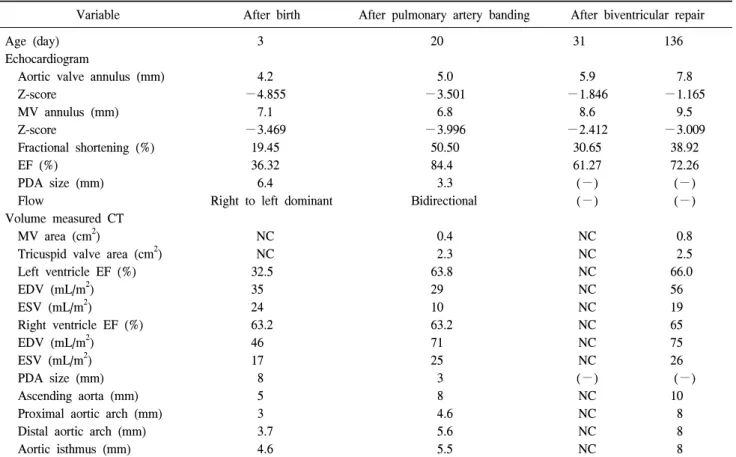
Table 1. Echocardiogram and volume measured CT findings

Variable After birth After pulmonary artery banding After biventricular repair

Age (day) 3 20 31 136

Echocardiogram

Aortic valve annulus (mm) 4.2 5.0 5.9 7.8

Z-score −4.855 −3.501 −1.846 −1.165

MV annulus (mm) 7.1 6.8 8.6 9.5

Z-score −3.469 −3.996 −2.412 −3.009

Fractional shortening (%) 19.45 50.50 30.65 38.92

EF (%) 36.32 84.4 61.27 72.26

PDA size (mm) 6.4 3.3 (−) (−)

Flow Right to left dominant Bidirectional (−) (−)

Volume measured CT

MV area (cm

2

) NC 0.4 NC 0.8

Tricuspid valve area (cm

2

) NC 2.3 NC 2.5

Left ventricle EF (%) 32.5 63.8 NC 66.0

EDV (mL/m

2

) 35 29 NC 56

ESV (mL/m

2

) 24 10 NC 19

Right ventricle EF (%) 63.2 63.2 NC 65

EDV (mL/m

2

) 46 71 NC 75

ESV (mL/m

2

) 17 25 NC 26

PDA size (mm) 8 3 (−) (−)

Ascending aorta (mm) 5 8 NC 10

Proximal aortic arch (mm) 3 4.6 NC 8

Distal aortic arch (mm) 3.7 5.6 NC 8

Aortic isthmus (mm) 4.6 5.5 NC 8

CT, computed tomography; MV, mitral valve; EF, ejection fraction; PDA, patent ductus arteriosus; NC, not checked; EDV, end dia- stolic volume; ESV, end systolic volume.

aortic arch flow, and severely decreased left ventricular func- tion with an EF of 36% (Table 1). Volume-measured heart CT produced the following measurements: subaortic area 4 mm;

ascending aorta 5 mm; proximal aortic arch 3 mm; distal aortic arch 3.7 mm; and aortic isthmus 4.6 mm. The LV EF was 32.5%, the LV end-diastolic volume (EDV) was 35 mL/m

2

, and the LV end-systolic volume (ESV) was 24 mL/m

2

(Table 1).

The patient also had a hypoplastic aortic arch and CoA was not definite (Fig. 1). The patient underwent emergent bilateral pulmonary artery banding using a 3.5-mm Gore-Tex graft as a rescue procedure. Immediately after the surgery, the mean left atrial pressure (LAP) decreased from 33 to 24 mmHg and the systolic blood pressure increased from 64 to 76 mmHg.

Six hours after the surgery, the LAP had decreased to 13 mmHg and became almost normal 12 hours later (Fig. 2) owing to reduction of pulmonary blood flow and LV volume unloading.

On postnatal day 15, follow-up echocardiogram due to

gradual development of differential cyanosis revealed dimin-

ished PDA size from 8 to 3 mm in addition to distinct CoA

(Table 1). The LV EF was 84.4%, and the MV annulus and

AV annulus diameters were 6.8 mm (Z-score=−4.00) and

5.0 mm (Z-score=−3.50), respectively. To determine the LV

volume and function, heart CT was performed on postnatal

day 20, which showed that the LV EDV changed from 35 to

29 mL/m

2

and the LV ESV from 24 to 10 mL/m

2

, with in-

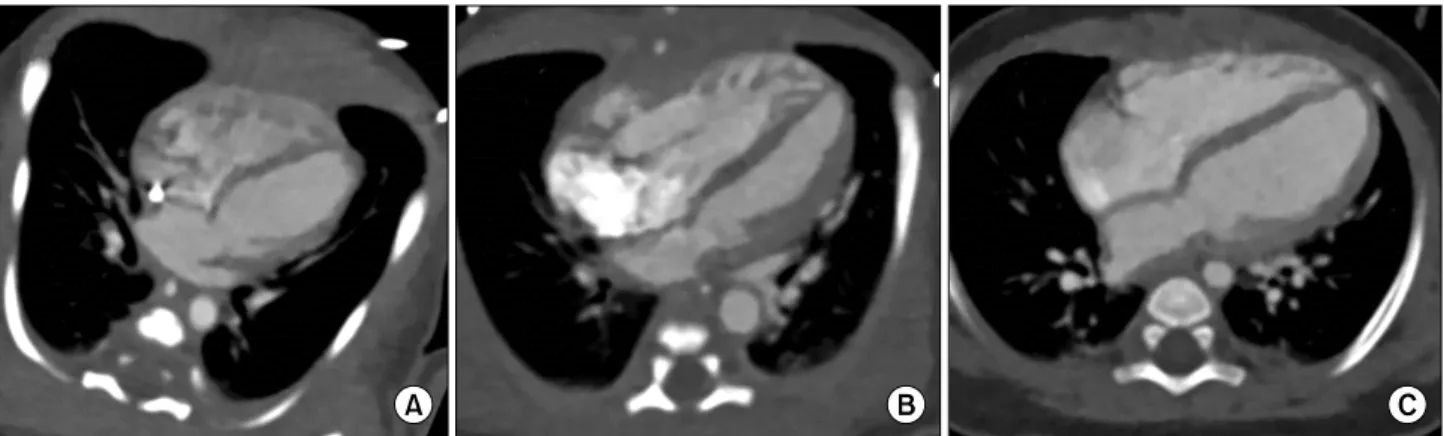
creased LV wall thickness and improved wall motion (Table

1, Fig. 3). On postnatal day 21, the patient underwent biven-

tricular (BV) repair including pulmonary artery debanding,

extensive aortic arch augmentation with main pulmonary ar-

tery (MPA) patch and end-to-end anastomosis, MPA and

right pulmonary artery angioplasty using glutaraldehyde-fixed

pericardium, and creation of an atrial septal defect (ASD, 3.5

mm). ASD creation was performed in order to better support

the systemic flow while preventing the left heart from ex-

(3)

Fig. 1. Serial follow-up of the sagittal view of the aorta. (A) On two days after the birth. (B) On day 20 of his life after pulmonary artery banding surgery. (C) On day 136 of his life after the biventricular repair surgery.

Fig. 2. Trend of LAP until 48 hours after PAB. LAP, left atrial pressure; PAB, pulmonary artery banding.

cessive overload and failure [1]. All procedures were per- formed under beating heart, and selective cerebral perfusion was instituted by prosthesis-aided cannulation of the right brachiocephalic trunk with moderate hypothermia at 28

o

C to 30

o

C. The cardiopulmonary bypass time and selective cere- bro-myocardial perfusion time were 141 and 36 minutes, respectively. To avoid compression by the sternum, the pa- tient was transferred to the intensive care unit with an open sternum and delayed sternal closure was performed the next

day. During this period, his vital signs and LAP were within a normal range. The patient was extubated on postoperative day 5 and was discharged on postoperative day 13 without complications. A postoperative follow-up echocardiogram dem- onstrated normal ventricular function, no mitral or aortic stenosis, no residual stenosis at the arch repair site, and iatro- genic ASD (3 mm). The diameters of the MV and AV annu- lus had increased to 8.6 mm (Z-score=−2.41) and 5.9 mm (Z-score=−1.85), respectively (Table 1). The patient was clinically well seven months following his surgery and with similar echocardiographic and CT findings (Table 1, Fig. 1).

DISCUSSION

HLHS comprises congenital structural cardiac malforma-

tions characterized by variable underdevelopment of the struc-

tures in the left heart-aorta complex [2]. Those at the favor-

able end of this group have been defined as having hypo-

plastic left-heart complex (HLHC), which presents with aortic

and mitral valve hypoplasia without intrinsic valve stenosis or

atresia, hypoplasia of the LV, hypoplasia of the left ven-

tricular outflow tract, and hypoplasia of the ascending aorta

and of the aortic arch and/or CoA [1]. Surgical decisions are

not difficult when patients present at the extreme end of the

spectrum, which implies univentricular (UV) or BV repair.

(4)

Fig. 3. Serial follow-up of the axial view of the heart. (A) On two days after the birth, diffuse thinning of LV wall is found. (B) On day 20 of his life after pulmonary artery banding surgery, increased LV wall thickness and enlarged right cardiac chambers are seen. (C) On day 136 of his life after the biventricular repair surgery, increased LV size and interval decrease in right cardiac chambers are found. LV, left ventricular.

However, it is sometimes difficult to decide which surgical correction to perform in patients with HLHC, due to the ab- sence of absolute criteria and because inadequate surgical management for these patients can lead to terrible con- sequences [3].

Since Rhodes et al. [4] first reported the parameters asso- ciated with predicted survival following BV repair in patients with critical aortic stenosis, such as a cut-off value for the in- dexed mitral valve area of 4.75 cm

2

/m

2

, a left ventricular length to heart long-axis ratio of 0.8, or an indexed aortic root size of 3.5 cm/m

2

, there has been limited success in de- termining the criteria for which patients have sufficient left heart structure and function to support the systemic circulation.

This is largely because most previous reports dealt with crit- ical aortic stenosis alone, and applying a cut-off value tar- geted to simple left-heart hypoplasia was not valid in patients with HLHC [5,6]. Indeed, the decision to pursue a UV or BV repair is generally made by experienced pediatric cardiol- ogists and cardiac surgeons based on echocardiographic im- ages, volume-measured heart CT, and/or information obtained from cardiac catheterization of the left heart.

In the clinical field, it is sometimes too difficult to decide which type of surgical correction to perform in neonates with HLHC, especially in those whose initial vital signs are un- stable, as in our patient. The consequences of an incorrect de- cision, such as conversion to UV circulation after a failed BV repair, are often deleterious, whereas the reverse sequence of

these procedures seems to have a favorable and successful outcome [4]. Therefore, in cases of HLHC, an initial pallia- tion surgery including bilateral pulmonary artery banding, augmentation of the right ventricular systemic flow, and maintaining the ductus patency by stenting or prostaglandins could be an alternative option without the need for an early decision and major surgery [6]. Although one-stage BV repair has the advantage of establishing normal physiology at an earlier point in time, Yerebakan et al. [7] reported that initial palliative surgery for neonates with HLHC allows time for the growth of the LV, thus avoiding major surgery and the associated prolonged myocardial ischemia and bypass during the neonatal period. The UV and BV options could be re- tained as alternatives to be performed at around four to eight months of age with satisfactory long-term outcomes [7].

Although the period from palliative surgery to BV repair was relatively short in our patient, the diminished PDA size and simultaneous development of CoA and improved LV con- tractility that occurred in the meantime enabled us to perform BV repair (Table 1).

In conclusion, we have successfully achieved BV repair af-

ter first-stage palliation for a neonate with HLHC, a subset of

HLHS. In selected patients with HLHC, bilateral pulmonary

artery banding is a suitable alternative surgical option that

could delay early decision-making on more invasive and risky

procedures. It serves as an initial rescue procedure in patients

who are clinically unstable. Although there is no absolute cri-

(5)

teria for which type of surgical repair to perform for neonates with HLHC, meticulous assessment of the left heart-aorta complex and timely surgical treatment that considers the pa- tient’s vital signs may be required for optimal treatment.

CONFLICT OF INTEREST

No potential conflict of interest relevant to this article was reported.

REFERENCES

1. Tchervenkov CI, Tahta SA, Jutras LC, Beland MJ.

Biventricular repair in neonates with hypoplastic left heart complex. Ann Thorac Surg 1998;66:1350-7.

2. Feinstein JA, Benson DW, Dubin AM, et al. Hypoplastic left heart syndrome: current considerations and expectations. J

Am Coll Cardiol 2012;59(1 Suppl):S1-42.

3. Grosse-Wortmann L, Yun TJ, Al-Radi O, et al. Borderline hypoplasia of the left ventricle in neonates: insights for deci- sion-making from functional assessment with magnetic reso- nance imaging. J Thorac Cardiovasc Surg 2008;136:1429-36.

4. Rhodes LA, Colan SD, Perry SB, Jonas RA, Sanders SP.

Predictors of survival in neonates with critical aortic stenosis. Circulation 1991;84:2325-35.

5. Alboliras ET, Mavroudis C, Pahl E, Gidding SS, Backer CL, Rocchini AP. Left ventricular growth in selected hypoplastic left ventricles: outcome after repair of coarctation of aorta.

Ann Thorac Surg 1999;68:549-55.

6. Akintuerk H, Michel-Behnke I, Valeske K, et al. Stenting of the arterial duct and banding of the pulmonary arteries: ba- sis for combined Norwood stage I and II repair in hypo- plastic left heart. Circulation 2002;105:1099-103.

7. Yerebakan C, Murray J, Valeske K, et al. Long-term results

of biventricular repair after initial Giessen hybrid approach

for hypoplastic left heart variants. J Thorac Cardiovasc Surg

2015;149:1112-20.

수치

Table 1. Echocardiogram and volume measured CT findings
Fig. 2. Trend of LAP until 48 hours after PAB. LAP, left atrial  pressure; PAB, pulmonary artery banding.
Fig. 3. Serial follow-up of the axial view of the heart. (A) On two days after the birth, diffuse thinning of LV wall is found

참조

관련 문서

Pilot Confirm runway 09 left for landing. ATC gives you further instructions to turn right heading 310. On the radar display, there was an area to avoid which requires a

Table 2. Schatzker and Lambert assessment --- 18.. A), B) Preoperative anteroposterior and lateral radiograph of the left knee of a sixty-two-year-old man who

activation(electroencephalolgram: left alpha wave, right alpha wave, left sensory motor rhythm, right sensory motor rhythm, right mid-beta wave, left attention concentration

In the lower extremity balance, the change in left unilateral clerk showed a statistically significant difference as the exercise group increased post-test

• Left temporal pole (BA 38) – Names of unique places. and person, but not

systemic circulation, in the right ventricle and oxygenated blood from the lungs, or pulmonary circulation, in the left ventricle, as in birds and mammals.. Two vessels,

**In matches where Round 3 requires a drill to be done on the Right side for half the round and Left side for the other half of the round, there will be a 10 second

core exercise program showed not only increasing peak torque of the right leg, left leg in Hip Extension of exercise group but also increasing peak torque of the right leg, left